
Category: General

Review: 2025 Mercedes-Benz G-Class works on its quads (motors, that is)
It has four motors, 579 hp, and an off-road heritage that goes back further than the Rivian R1S, GMC Hummer EV, and Tesla Cybertruck. With the electric version of its military-grade G-Class, Mercedes-Benz promises even more freedom from pavement than all those American-built flagwavers, and it does it all with batteries.
And it’s a sort of bellwether for a brand that had committed to going fully electric, but now says it will sell ICE vehicles into the next decade. The electric G-Class didn’t have to happen, based on the latest thinking—but it does, and it could nail Mercedes’ argument that electrification suits every kind of vehicle.
“If the G can go electric,” Mercedes marketing vice president Bettina Fetzer told Green Car Reports and other journalists in late April prior to our drive, “any car can go electric.”
Going electric doesn’t just bring the G-Class up to date. It makes the G-Wagen a better off-roader, as I experienced during our first test drive of the G 580 with EQ Technology in southwestern France, just a couple of weeks ago. The electric G’s not just capable, it’s in many ways the most capable G-Class of them all.
2025 Mercedes-Benz G 580 with EQ Technology
G-Class EQ: The floor is battery
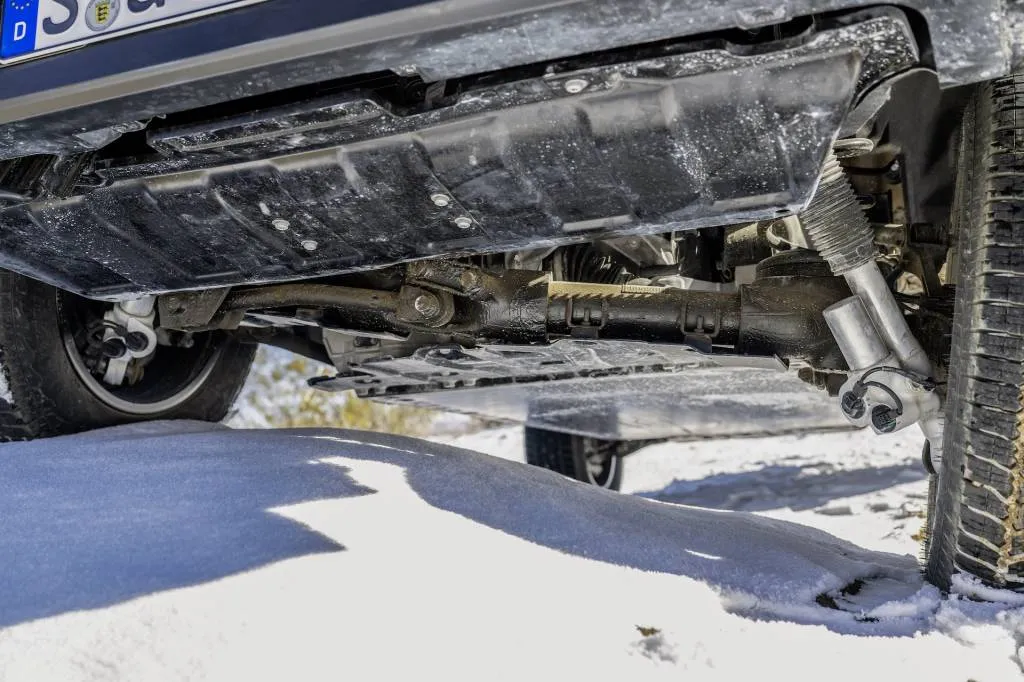
The electric G sports its usual ladder-frame construction, but instead of an ICE under the hood, it rides atop a 116-kwh lithium-ion battery mounted in its floor. Housed in a flex-resistant case, the battery pack integrates with the frame and wears thick metal protection as a skid plate. The pack combines 216 cells into 12 modules in two layers, cooled with three circuits. There’s no mention of the silicon-anode battery chemistry that Mercedes has been keen to introduce to speed charging times.
With a quad-motor setup, each generating a maximum of 108 kw, the G 580 EQ nets out at 579 hp and 859 lb-ft of torque. Each motor has its own transmission, which enables a low-range mode for off-roading and relieves it of the need for its gas cousin’s three locking differentials. Mercedes promises a 0-62 mph time of 4.7 seconds and a top speed of 112 mph, while it fills the cockpit with G-Roar, a programmed set of sounds associated with drive modes or events. It’s more noticeable to outsiders than to anyone inside the plush leather-lined cockpit.
2025 Mercedes-Benz G 580 with EQ Technology electric SUV
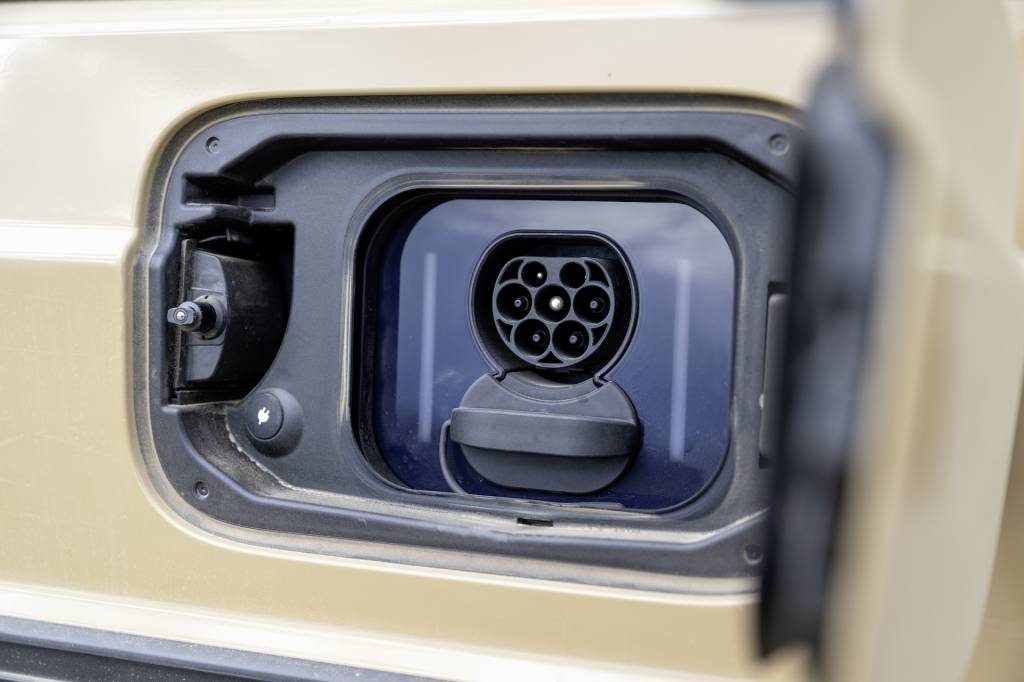
An aerodynamic brick wall weighing 6,800 pounds never was going to do great in range testing, and it’s little surprise that the EPA estimates for the G 580 should land around 240 miles. It’ll come with a CCS charging port and soon adopt the NACS standard. WIth 200-kw charging, Mercedes quotes 20-80% charging in just over a half-hour. The company has only said it will study future off-road charging stations with its current partners, and it points out that off-roading itself offers plenty of opportunity to recharge through regeneration (a point which, while technically correct, seems starkly unaware of the G-Class’ role as urban showpiece in the U.S., at least).
That recuperation is governed by the G 580’s paddle controls. Auto mode chooses regen levels based on cornering angle, speed, and other data; D+ lets the front motor uncouple and the vehicle sail often for the best efficiency. Normal, D-, and D– dial up the regen, but the G 580 can’t stop itself by releasing the accelerator; it’s just shy of one-pedal capability, as I found on a bucolic street drive before putting the electric G-Class’s hardware to the dirt and mud test.
2025 Mercedes-Benz G 580 with EQ Technology
Electric G-Class: Good on pavement too
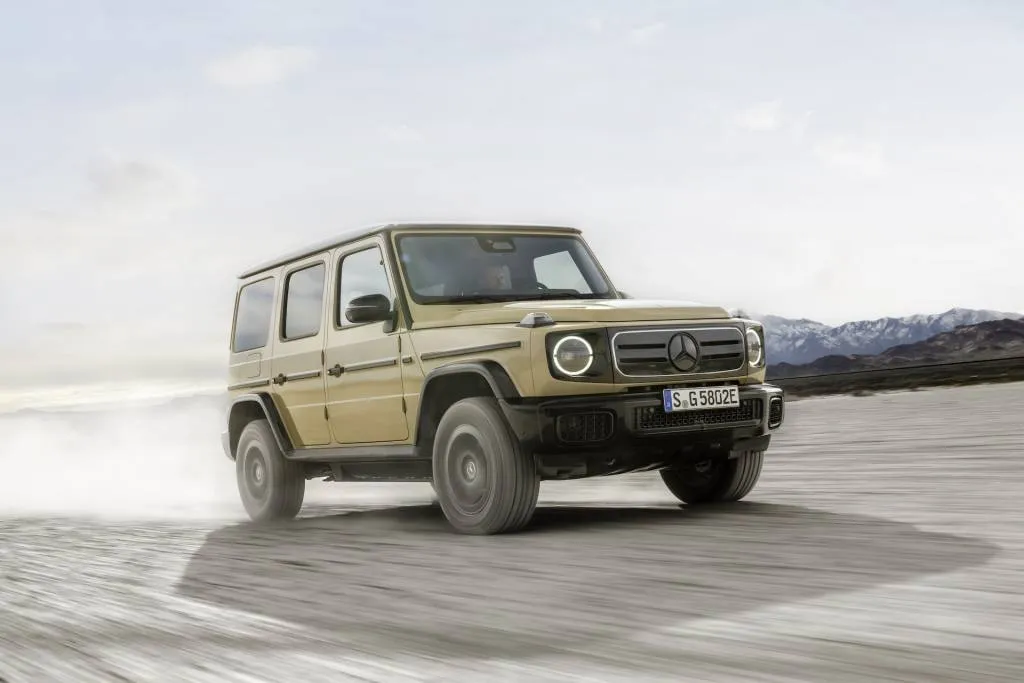
On a necklace of roads that circle prime off-road territory near Narbonne, France, I drove the reinvented G-Class and its barely revamped body. A bumper fairing here, a windshield header spoiler there, it hasn’t changed much outside in its transformation.
It has been modestly updated in its suspension, which combines front double-wishbone arms with a DeDion rear axle that’s needed to clear the rear motor. Its brakes remain hydraulic-assist, and the G-EV cruises on 265/60R18 tires. In its default drive modes it takes a very SUV-like 44.6 feet to make a U-turn.
The G 580 packs a hefty battery, which recenters its weight lower in the vehicle. It’s more stable as a result, and even without the electrohydraulic suspension now available on the gas-powered AMG model, its adaptive dampers perform backup while it mutes almost every road surface. The powertrain’s surge and its whuffling “G-Roar” synthetic sounds goaded me to go quicker constantly, but good damping aside, the G-Class doesn’t encourage that kind of driving.
It slows almost as well as it goes. It filters regen-braking settings through information about vehicle speed and cornering angle, then decides how much energy to redirect to the underfoot pack, in Auto mode at least. Through Normal, D-, and D– modes it adds more regen until it nears—but doesn’t provide—full one-pedal driving. Flipping its paddles for the opposite result, D+ eliminates almost all regen for a sailing mode.

2025 Mercedes-Benz G 580 with EQ Technology electric SUV
2025 Mercedes-Benz G 580 with EQ Technology electric SUV
2025 Mercedes-Benz G 580 with EQ Technology electric SUV
G 580 with EQ: Tough on dirt
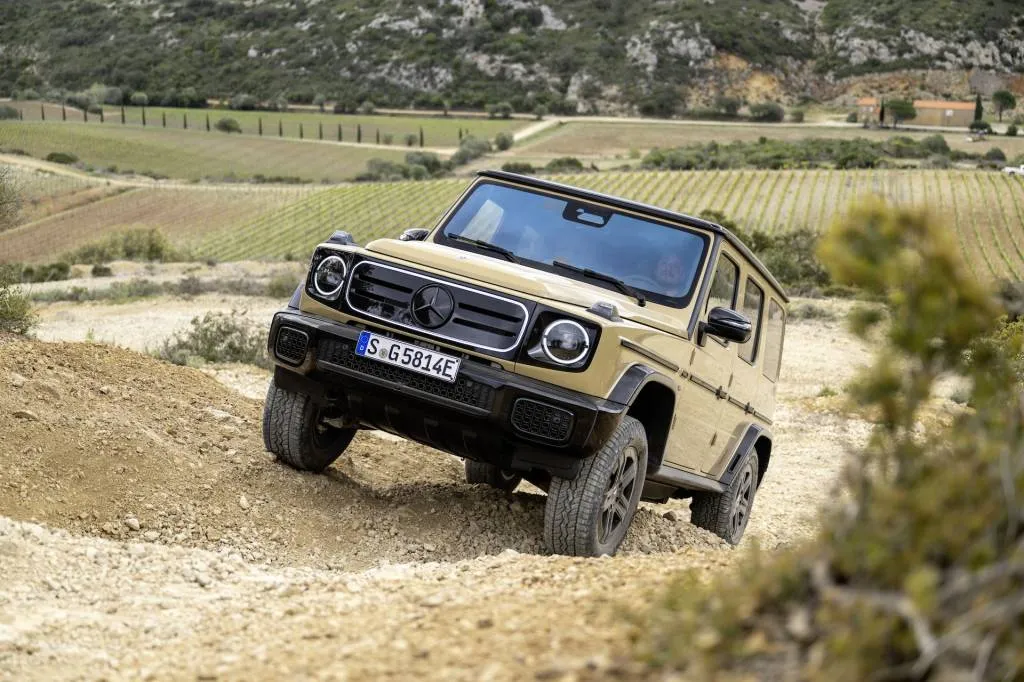
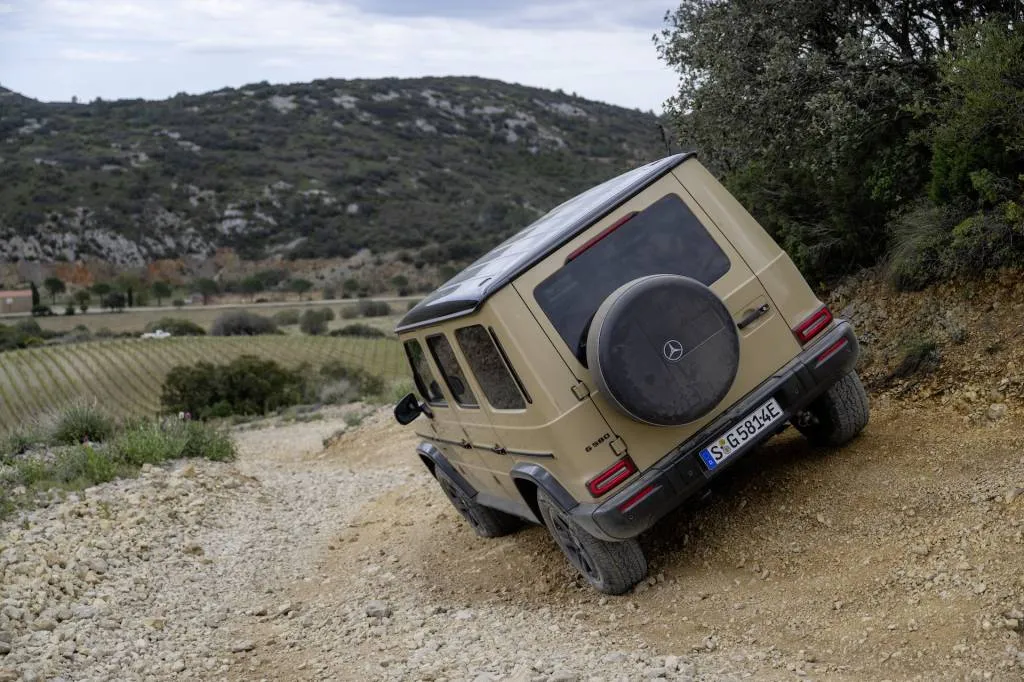
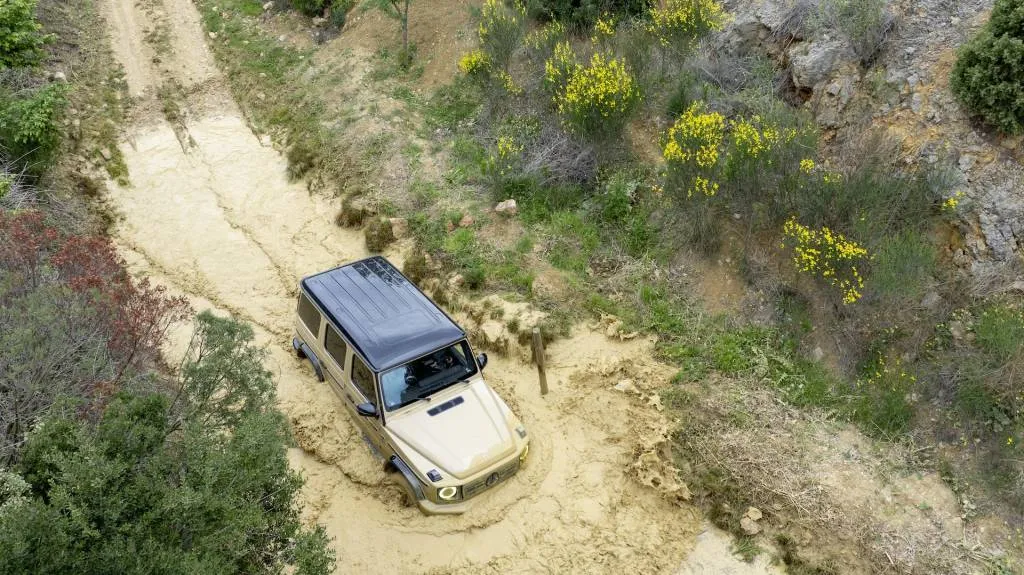
But trails are where the G 580 shines most brightly. With the windows rolled down as I approached a dozen kilometers of rocky pitches, muddy trenches, and pure slop, the G 580 glided through a 2-foot-deep riverbed filled by recent rains, with only the sound of sloshing water to accompany the slog. It’s better for fording than the standard G-Class, at 33 inches of depth versus about 26 inches.
It bounds out of ruts better, too. With at least 9.8 inches of ground clearance, it’s up a few tenths on the gas G—and offers a competitive breakover angle of 20.3 degrees, an approach angle of 32 degrees, and a departure angle of 30.7 degrees. WIth its carbon-reinforced breastplate underneath, the G 580 bounded over outcrops with the blessing of my co-pilot. After all, it’d already been tested on the same mountain trails at the Schöckl as the standard G-Class.

2025 Mercedes-Benz G 580 with EQ Technology
If off-roading has become a much simpler pursuit now that we have electronically controlled locking differentials and all-terrain traction programs, the electric G-Class brings down even more knowledge barriers to safe, preservation-minded off-roading. Its off-road cruise control system engages carefully measured speed through low, variable, and fast crawl modes that let it pick through terrain safely at up to 5 mph, all through precise motor control. The vehicle can essentially be driven with steering and paddle controls, no locking diffs required. I met so few ruts and obstacles that generated any wheelspin—a combination of sophisticated motor control and well-chosen off-road tires—that the trail behind seemed nearly the same as when I encountered it.
Cycling into its specific Trail mode permits higher speeds, but Rock mode is where I spent most of my trail time. It engages Low mode, which deploys the transmission paired with each motor to reduce the gear ratio 2:1, and limit speed to about 53 mph.
2025 Mercedes-Benz G 580 with EQ Technology electric SUV
That mode also slips the G 580 EQ into two stunt-drive modes. G-Steering enables all-wheel steering that reduces turning radii on low-friction surfaces, which reduces the chance of ruining the trail for others when hairpins present themselves. Rivian’s similar Tank Turn feature was canceled due to environmental concerns, though the GMC Hummer EV and the related Sierra EV have a CrabWalk setup for diagonal driving. This one allows far more steering angle, and spun the G 580 around a narrow dirt path between a literal rock and a hard place, with zero drama. No gas-powered SUV can do this, thanks to geometry.
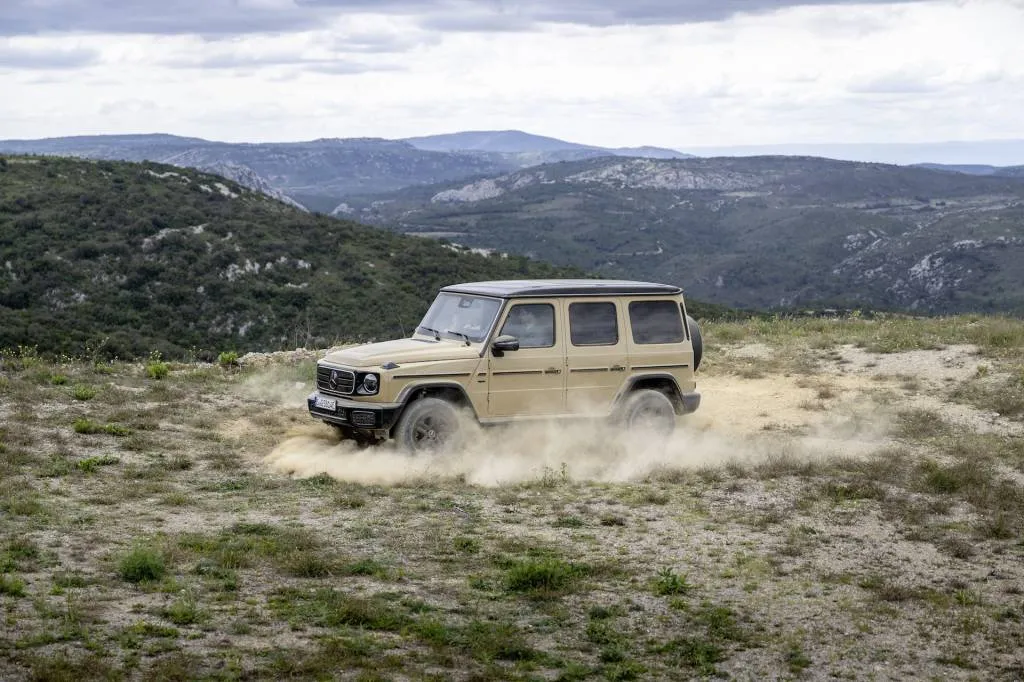
But it’s G-Turn that takes the electric platform’s potential to its ultimate party-trick zenith. In Rock and Low modes, steering wheel fully cranked and steering-column paddle pulled, all it takes is a full-on matted accelerator to spin the truck in two complete circles at a time, like a Bobcat with a brick on its gas pedal. Mercedes allows the function only on level low-friction surfaces, and guides drivers to do so only where it’s permitted and reasonable. Check all those boxes and you’ll never forget—as I haven’t—the feeling of being inside a leather-lined Speed Queen commercial dryer, minus the heat and noise. Sure, it’s a stunt. But it’s one that draws attention to the battery-electric version of the G while the ICE models get consigned to history.
2025 Mercedes-Benz G 580 with EQ Technology electric SUV
G-Class with EQ Technology: Looks about right
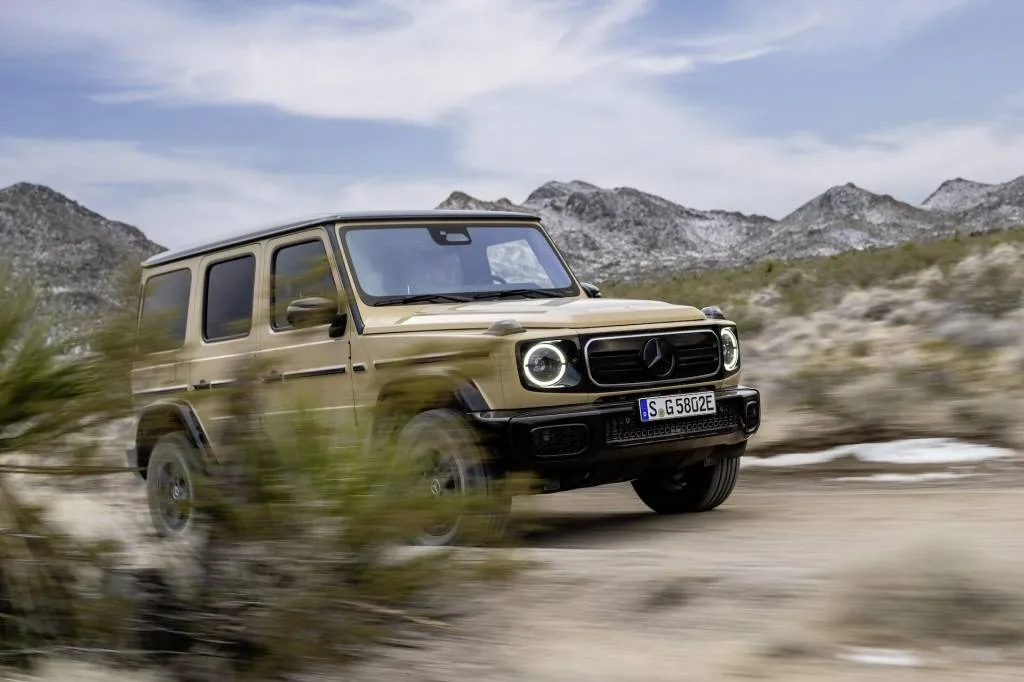
About seven inches shorter than the 2024 model-year ICE G-Class, the G-Class EQ is otherwise very close in style. It sports a black-panel “grille,” a higher hood line, flares on the rear fenders that act as air curtains, and a rear roof spoiler.
Riding on a 113.8-inch wheelbase, at 182.0 inches long, 76.0 inches wide, and 78.2 inches tall, the G EQ ladles on the electronica among its usual power features, open-pore wood and leather trim, and ambient lighting. It lights up a 12.3-inch digital gauge cluster and a 12.3-inch touchscreen for infotainment, with standard Apple CarPlay and Android Auto. Standard safety features include adaptive cruise control, active lane control, active steering with blind-spot monitors, and automatic parking. Its available surround-view camera system generates stitched-together views that show the area directly around the vehicle for picking around trails. Burmester sound, twin 11.6-inch rear-seat displays, a dashcam, and a wireless charging pad are available, as are 20-inch wheels, running boards, and a package that lights the star logo, the model name, and the EQ badge.
2025 Mercedes-Benz G 580 with EQ Technology
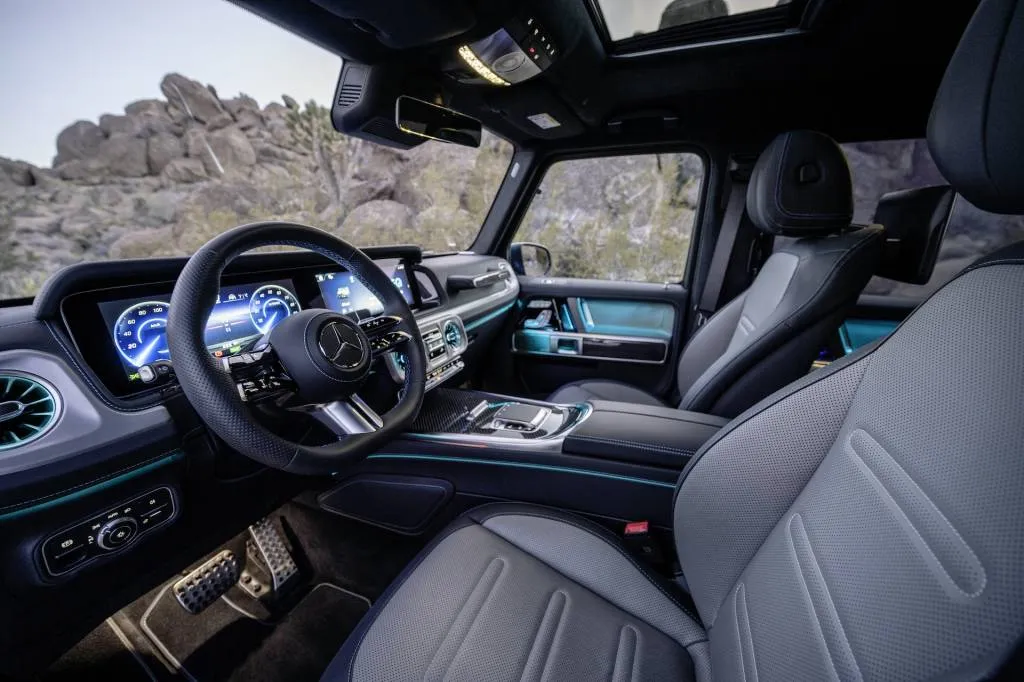
2025 Mercedes-Benz G 580 with EQ Technology
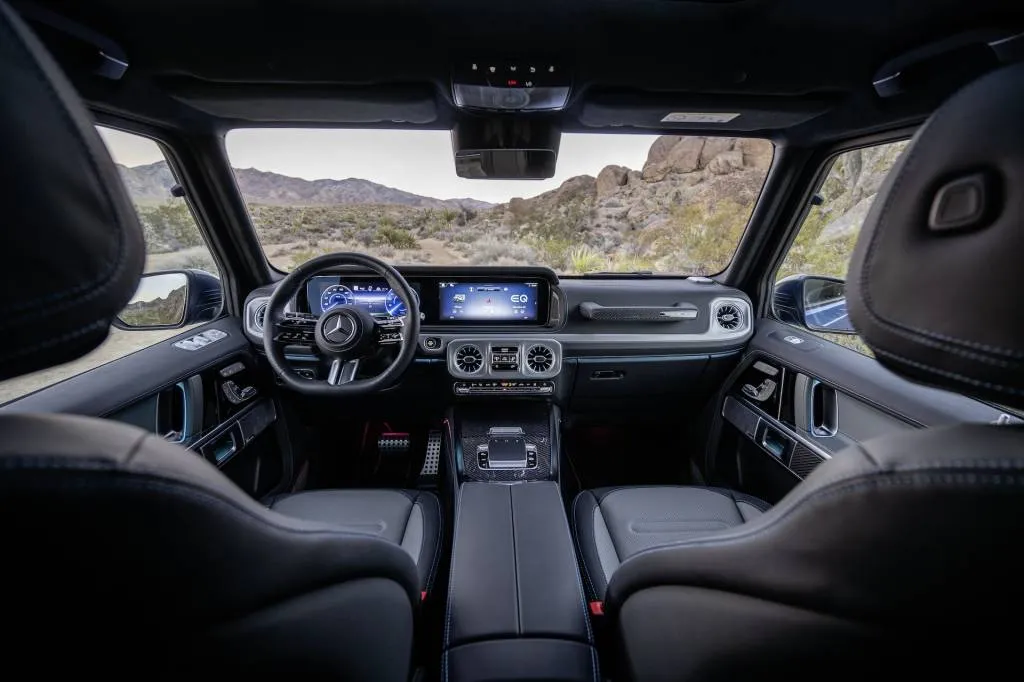
2025 Mercedes-Benz G 580 with EQ Technology
The electric G-Class arrives at dealers late this year. Prices have not been announced, but think big. In Euros, the standard G 580 with EQ Technology costs more than $150,000, and the Edition One costs more than $200,000. Even if you can’t buy one, find a good friend who can and take it for a spin. Two spins, when conditions permit.
—
NOTE: This story has been updated from a preview piece to one with dynamic on- and off-road driving impressions.
Mercedes-Benz paid for travel expenses so that we could spin ourselves silly in the G 580 and get our New Balances stuck in muck.

VW ID.Buzz features, Supercharger network growth, Vinfast and Sony: Today’s Car News
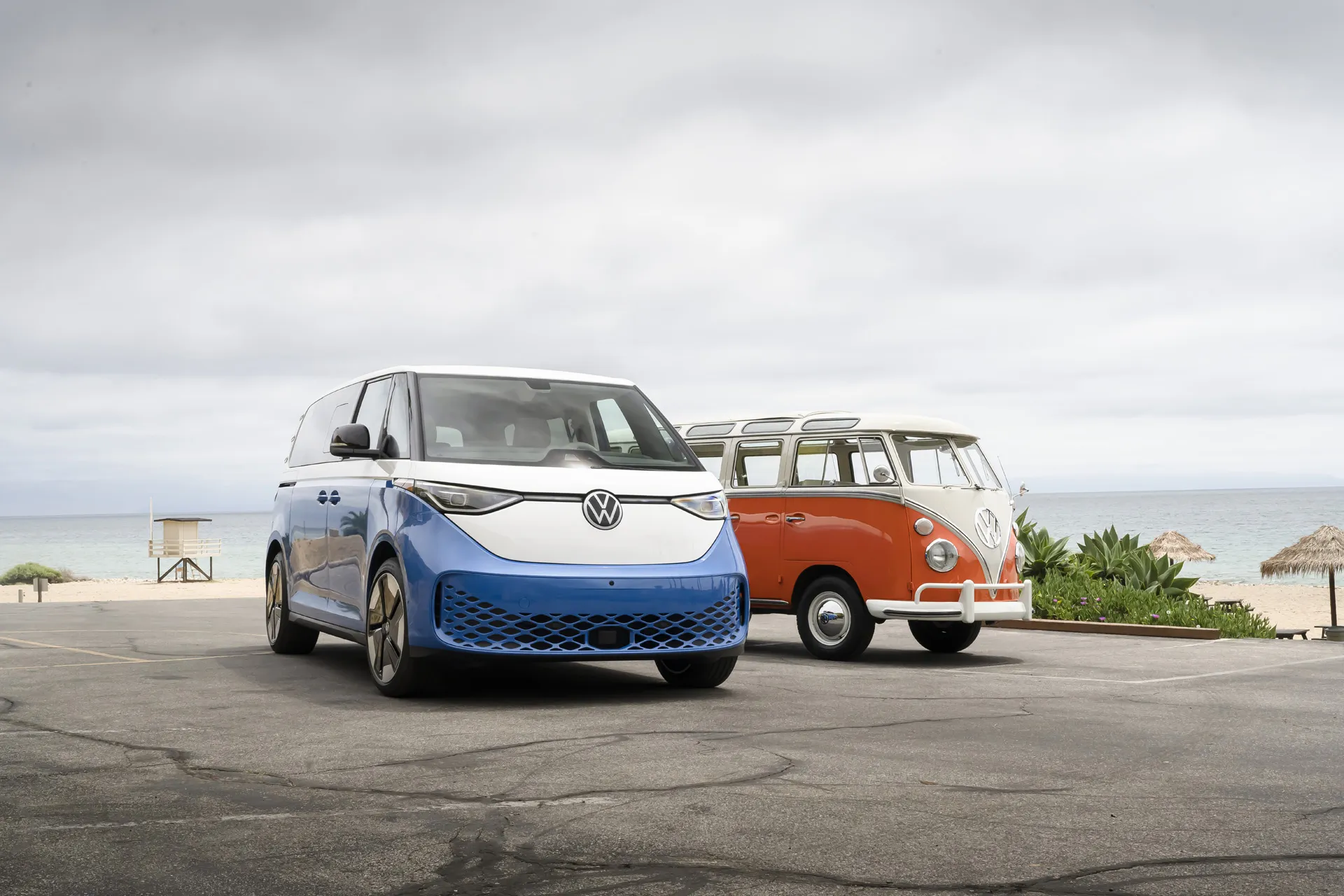
The Tesla Supercharger network is set to grow, even though the EV maker fired most of the people making its expansion possible. Vinfast debuts a new Sony entertainment interface. And VW gets a little more specific about how its ID.Buzz vans will be sold in the U.S.—but there’s still no price tag. This and more, here at Green Car Reports.
Volkswagen has confirmed standard features and trim levels for its U.S.-bound 2025 VW ID.Buzz electric vans, but pricing and EPA range might remain months away, closer to when these models are expected to arrive for first deliveries. Expect colors and interior trims for the longer three-row ID.Buzz versions that America gets.
Tesla’s Supercharger network is set to grow by “thousands” of chargers in 2024, attested CEO Elon Musk, despite a recent round of layoffs that essentially purged the entire division behind the highly successful charging network. It will spend “well over” $500 million on its Supercharger network this year, he said in a post on X, with that investment independent of operating costs.
And the world debut of Sony’s new in-vehicle entertainment app is in the Vinfast VF 8 electric SUV, the Vietnamese automaker announced Friday. Vinfast will initially offer the feature, called Ridevu, as complimentary, including a library of movies, and streaming to other passenger devices. The interface serves as an early preview of what’s in store in Sony’s upcoming Afeela EV conceived with Honda.
_________________________________


VW reveals more US ID.Buzz feature details—no pricing yet
Volkswagen has confirmed feature, trim, and color combinations for the upcoming 2025 ID.Buzz in its long-awaited U.S. specification.
The ID.Buzz will initially arrive for the U.S. in a launch-only 1st Edition version, VW confirmed, plus two other trims: Pro S and Pro S Plus.
Pricing of the U.S. version won’t be announced until close to its launch, according to VW. It had previously targeted the U.S. version for first deliveries in June or July 2024, although VW of America has more recently suggested it won’t arrive until later in the year. If it’s any indication, VW still doesn’t appear to have a live online U.S. build tool, allowing customers to visualize its different American proportions and build combinations.
As VW revealed with 2025 VW ID.Buzz specs nearly nearly a year ago, U.S. versions of the ID.Buzz will ride on a nearly 10-inch-longer wheelbase than the two-row model that won’t be sold in the U.S. Set to have a 91-kwh battery pack, the U.S. ID.Buzz will come with a single-motor electric powertrain for now, and it gets the 282-hp unit from the 2025 VW ID.4. A dual-motor version with 335 hp (also the same as the ID.4) is on the way. VW confirms the U.S. version will be able to tow with an available retractable tow hitch, but it hasn’t yet confirmed ratings.
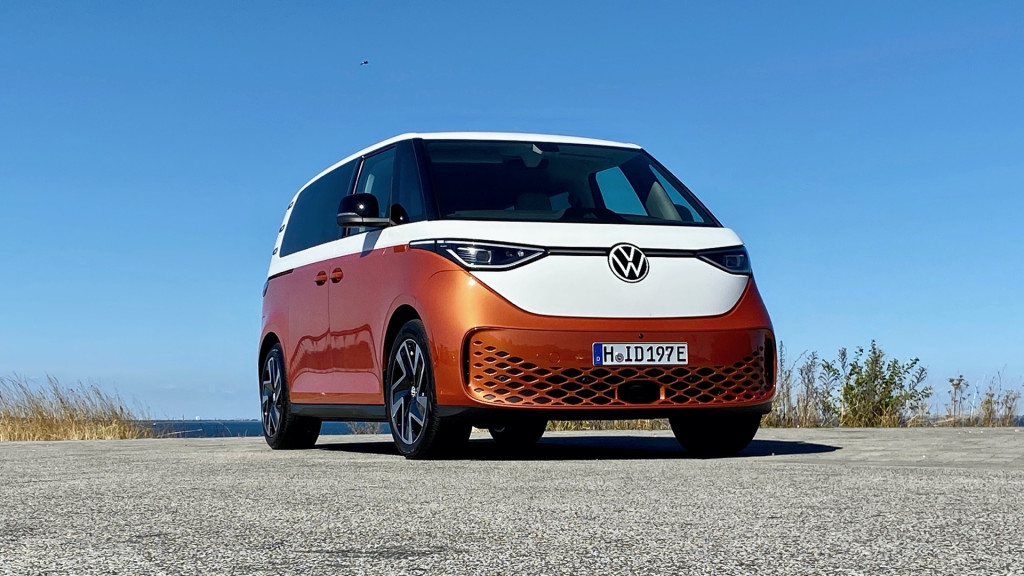
Volkswagen ID.Buzz (Euro spec)
In a review of the ID.Buzz EV in standard-wheelbase form two years ago (a version for Europe and other markets), Green Car Reports saw it as a great family vehicle in the tradition of a minivan, carrying over some of the excellent ride-and-handling traits of the VW ID.4 with which it shares MEB underpinnings.
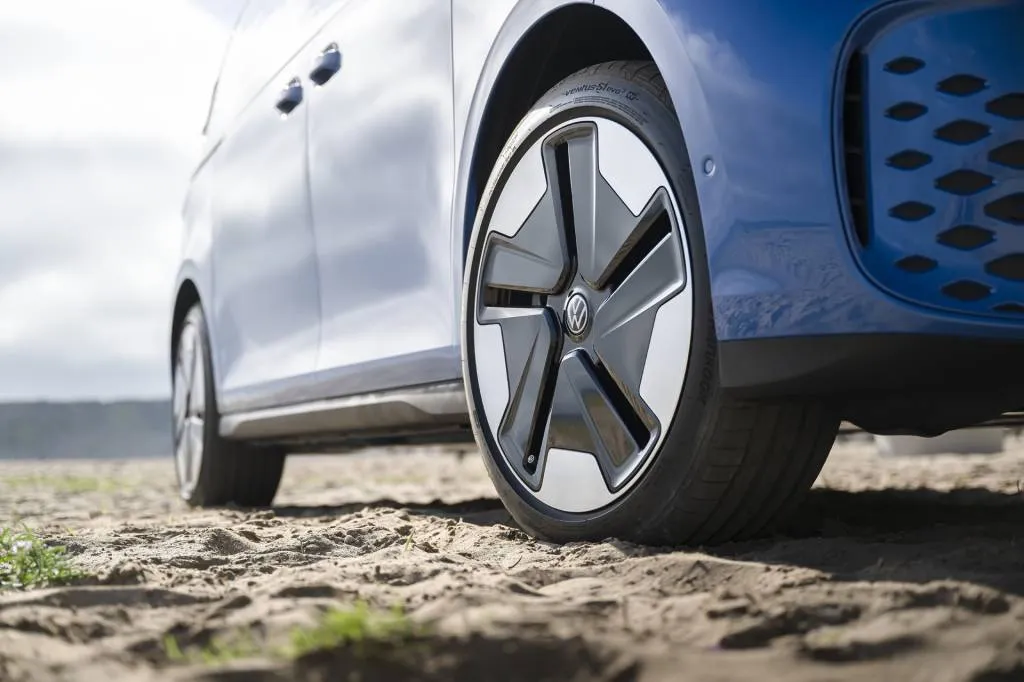
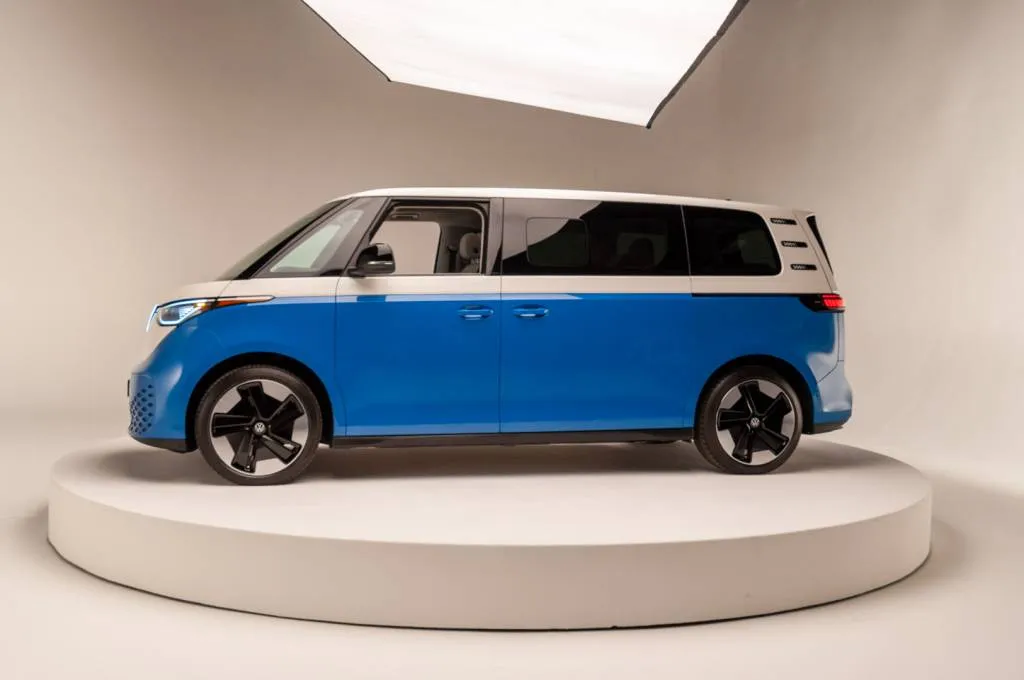
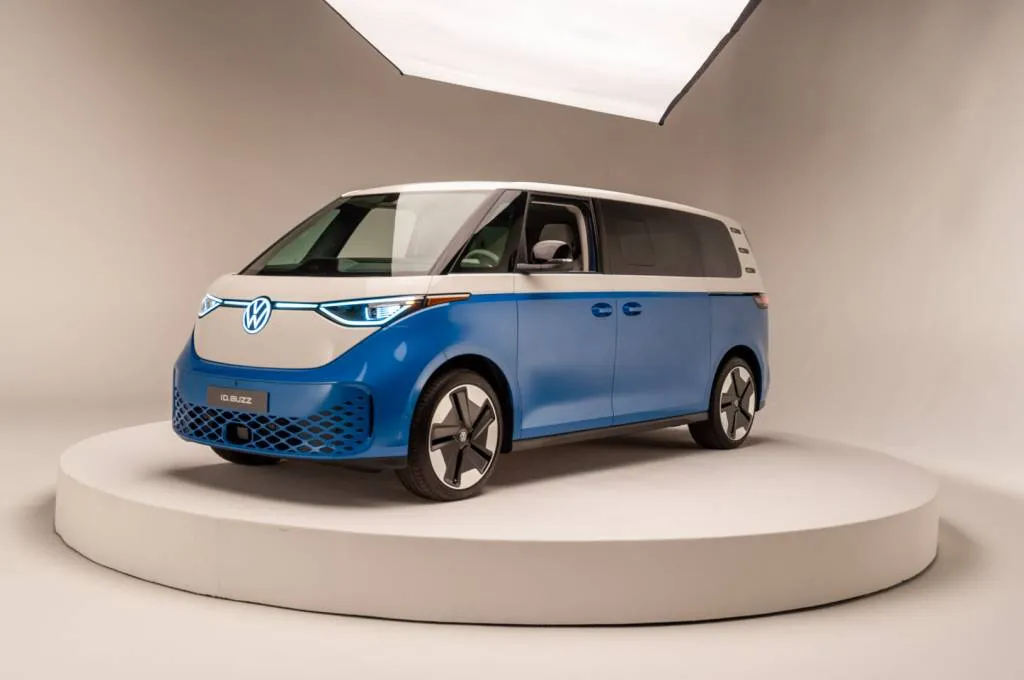
In its launch-only 1st Edition, which builds on the Pro S trim, the ID.4 gets a two-tone exterior with a unique 20-inch wheel design, roof rail cross bars, a “coastal-inspired interior” with a panoramic roof, a 700-watt premium sound system, power-sliding doors, and a power tailgate.
The base Pro S will get 20-inch wheels, a parking-assistance system, 30-color ambient lighting, and the bigger, much-improved 12.9-inch infotainment system now given to most of the ID.4 lineup.
2025 Volkswagen ID.Buzz
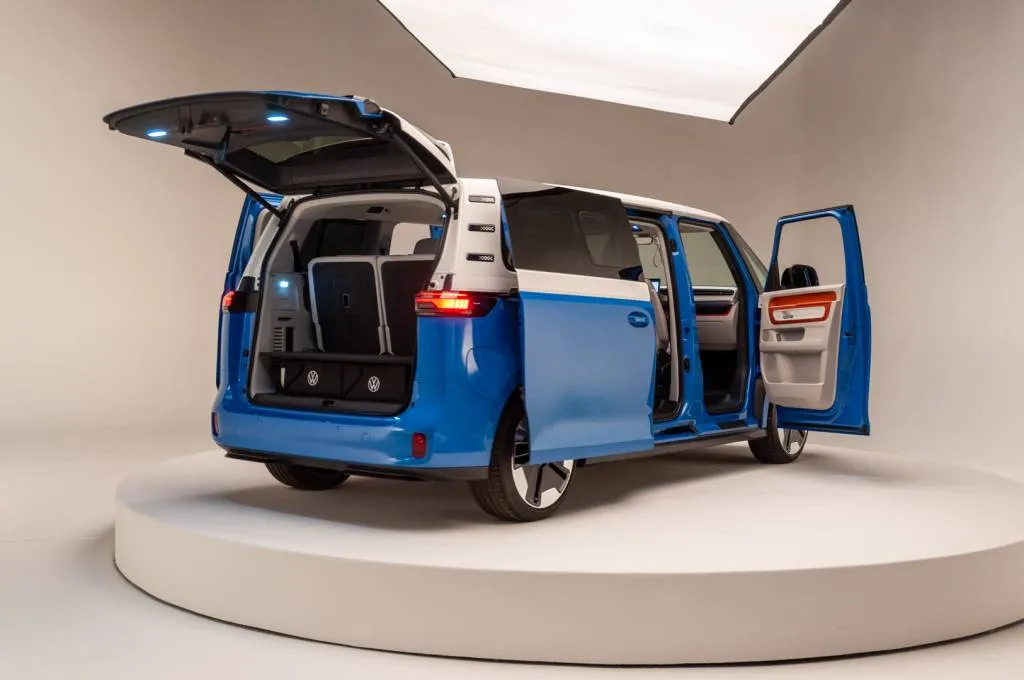
The key differentiator for the extended-length U.S. version is its second-row bench seat, allowing space for up to seven. Pro S Plus versions get bench seating as standard in single-motor form, but a captain’s chair package—dropping capacity to six—can be added. The captain’s chair layout is included on Pro S Plus and 1st Edition versions, and will come standard with all-wheel drive.
Despite the delay to repackage this vehicle for the American market and add three-row seating, none of the ID.Buzz versions offer completely flat-folding seats, underscoring an issue with skateboard-layout electric vans and their underfloor space that’s occupied by the battery pack. Included on the 1st Edition and optional on the Pro S Plus is a Flexboard system that adds two fabric storage bins and “creates a flat floor when the seats are folded”—by laying an elevated panel through to the hatch, at the level of the folded second row. The third row can be removed completely, though, and the second row slides fore and aft 7.9 inches.
2025 Volkswagen ID.Buzz
2025 Volkswagen ID.Buzz
2025 Volkswagen ID.Buzz
The Volkswagen ID.Buzz is a modern electric-van incarnation of the VW Microbus, and it’s been a long time coming. That’s especially the case for Americans, which perhaps had the strongest connection to the original Microbus via car culture.
VW decided that Americans didn’t want the version of the ID.Buzz that’s 185.5 inches long, or about the same overall parking footprint as the bestselling Tesla Model Y, riding on a wheelbase about four inches longer. In its U.S.-bound XL form, the ID.Buzz is 192.4 inches long, 77.9 inches wide, and 74.6 inches tall, and it has a 127.5-inch wheelbase. It will also get a huge panoramic glass sunroof, measuring 67.4 inches long by 40.8 inches wide, with electrochromic tinting.
VW is putting a big emphasis on color combinations inside and out for the ID.Buzz, and they’ll be different in U.S. versions. On the outside that includes bright white two-tone combos with orange, yellow, green, blue, and more, while single-color options are limited to silver, white, and pearl. Inside, the American version of the ID.Buzz will also get unique color combinations, including synthetic-leather seats in shades of brown and gray, a wood look for some of the trim, and various piping shades, with one of the combinations, Copper, said to channel “mid-century modern vibes.”
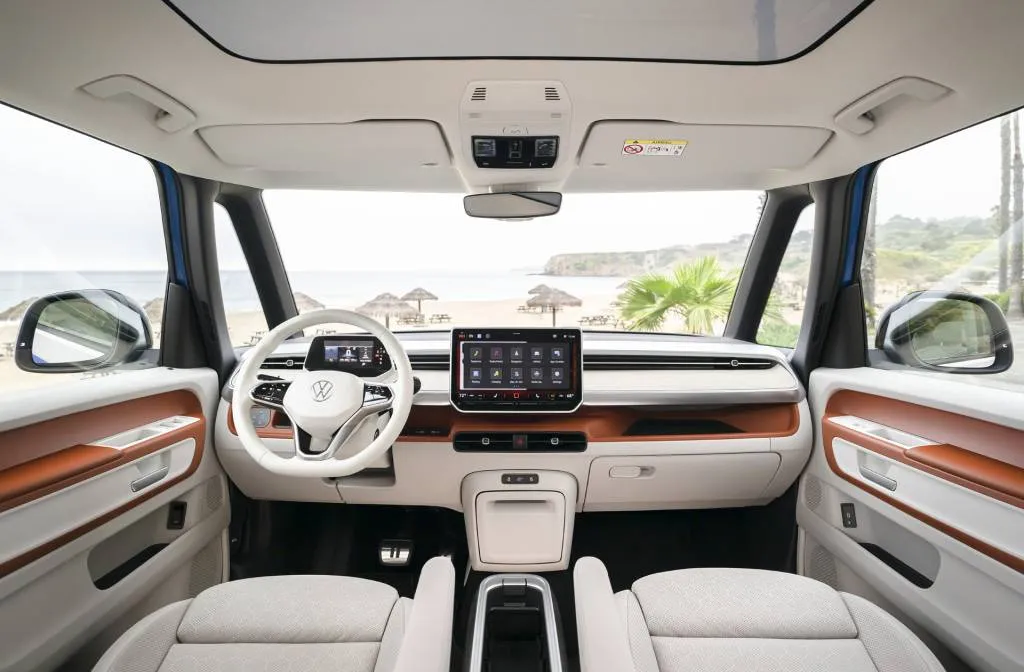
2025 Volkswagen ID.Buzz
Remarkable cabin trim and luxury features were never part of the original positioning of VW’s Microbus. Nor was a mid-century design aesthetic. So with VW mixing its messages on the Buzz, and building a product that’s a modern take on childhood nostalgia at this point, it remains to be seen whether this now much bigger product connects with Americans.

Vinfast updates troubled VF 8 EV—with Sony entertainment
Sony is in the process of launching its own Afeela EV brand in partnership with Honda, but in the meantime the company’s new in-car entertainment app is debuting in the Vinfast VF 8 electric SUV.
Dubbed Ridevu, this feature offers access to a regularly updated library of over 2,000 movies over a 12-month subscription period, according to Vinfast press release. That includes “unlimited replays of up to 100 movies” as well as “premium titles” accessible by redeeming credits or via in-app purchases or rentals.
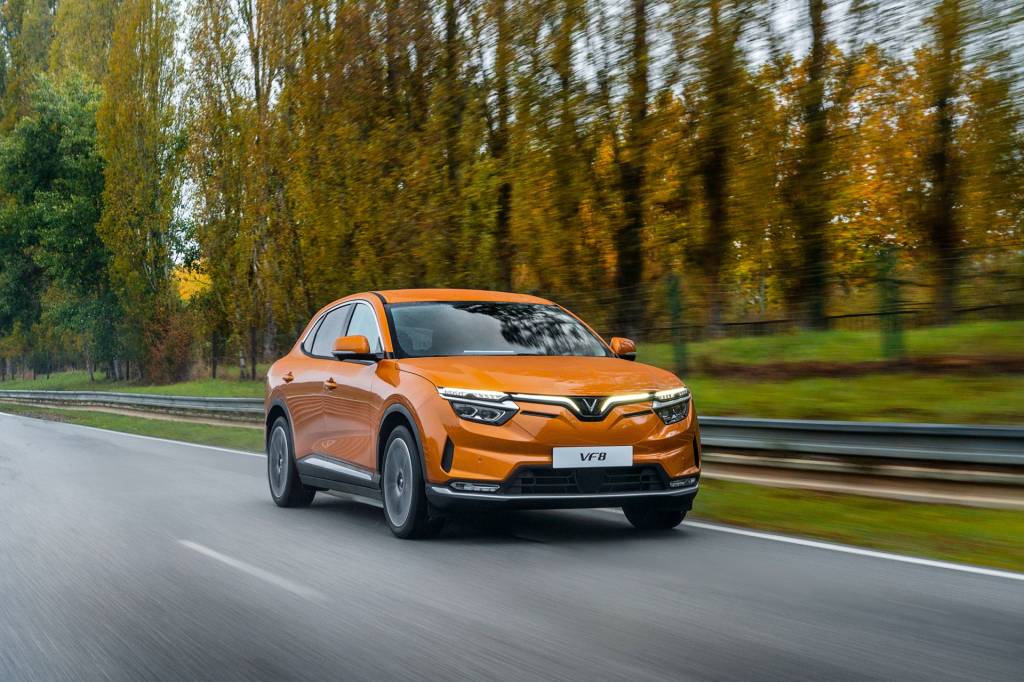
2023 Vinfast VF 8
This feature will offered initially as a complimentary part of the VF Connect Prime Package available on the VF 8 in the U.S. Owners who sign up for Ridevu will get access via an over-the-air update, allowing for streaming of videos through the car’s central screen while parked or via passenger devices while moving (the app is compatible with Android, iOS, Android TV, Apple TV, and Linux, according to Vinfast).
Sony has its own EV on the way, conceived as a device that essentially lives on the Sony gaming and entertainment platform. Created under the Sony Honda Mobility joint venture, it’s scheduled to launch in 2026.
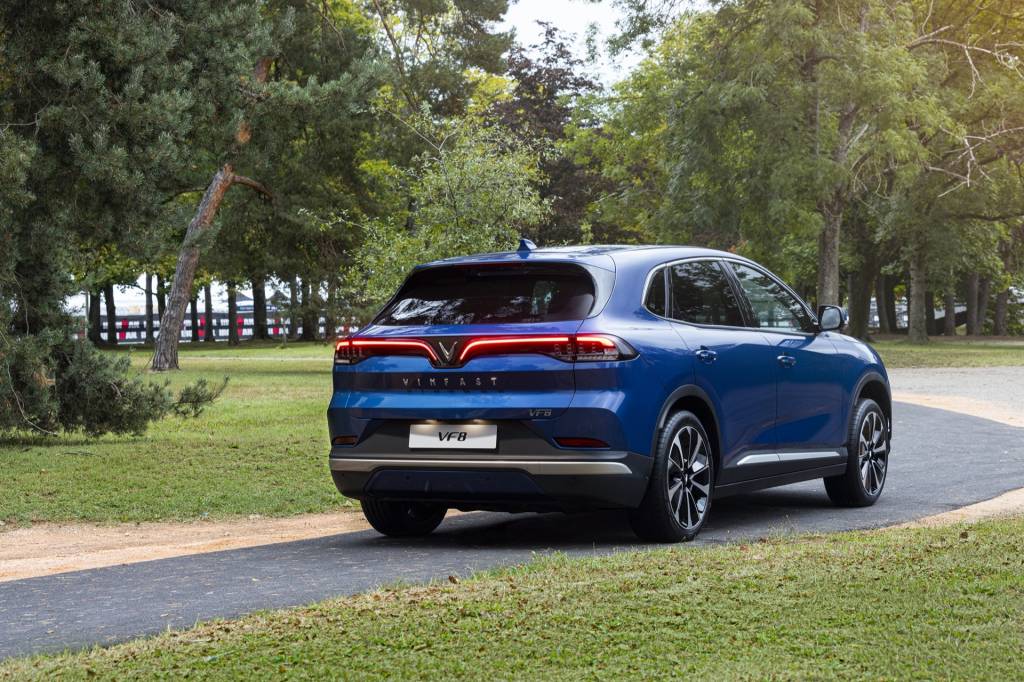
2023 Vinfast VF 8
For now, though, Vinfast appears questionable as a platform for showing off the entertainment giant’s latest tech. A first drive of the VF 8 last year led to a rare takeaway that you simply shouldn’t buy one. It appears Green Car Reports was not alone in this conclusion, as the VF 8 was similarly panned by other publications. Vinfast has reportedly made a number of changes to its VF 8 in recent months. While that takeaway might have changed by now, it hasn’t given media much access to these improvements.
Instead, Vinfast is moving ahead with other plans. Despite U.S. sales appearing to be lagging behind targets, the company is continuing the process of pivoting to a franchised dealer model. In January, it revealed a pickup truck concept and a tiny SUV called the VF 3. This week Vinfast opened deposits in its home country of Vietnam for the VF 3 at $9,200—battery not included.

Ioniq 6 review; Supercharger cuts; Toyota and Ram fuel-cell trucks: The Week in Reverse
Why did Tesla sell a base Model Y with a bigger battery than needed?
Why do rural communities see EV charging as less relevant?
This is our look back at the Week In Reverse—right here at Green Car Reports—for the week ending May 11, 2024.
In a follow-up Hyundai Ioniq 6 test drive, Green Car Reports found that this electric sedan goes the distance for a competitive price—with more range in the real world, or by ratings, versus the Tesla Model 3. But the Ioniq 6 doesn’t quite get it right on all its details.
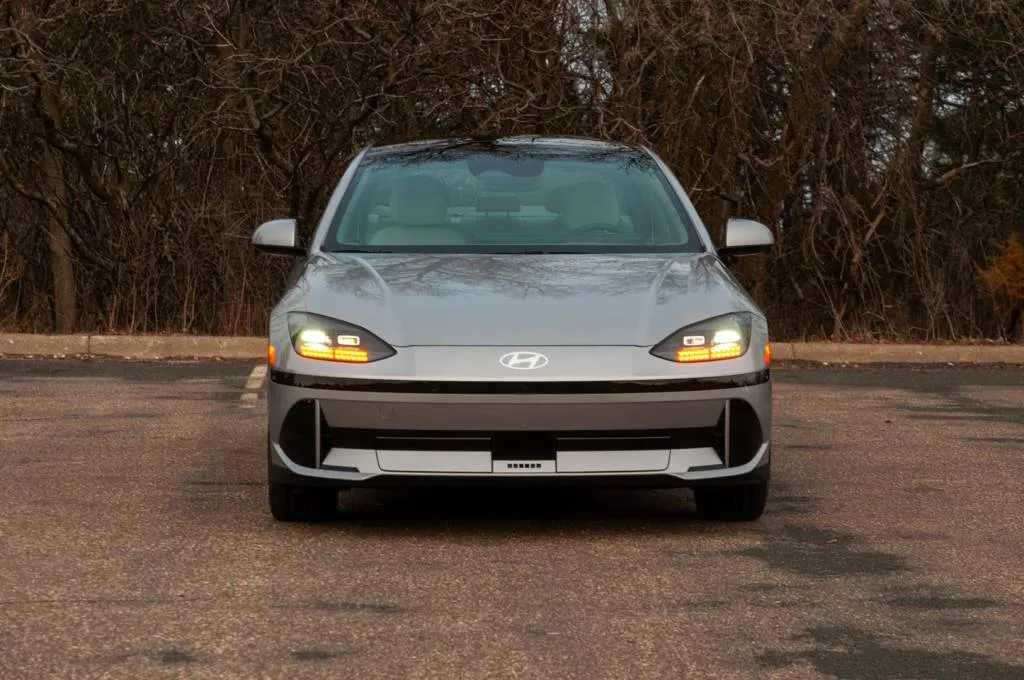
2024 Hyundai Ioniq 6
Kia has confirmed that its compact EV3 electric SUV is production-bound and will arrive next year. It hasn’t yet confirmed whether this model is coming to the U.S., although maybe that will be clarified after its May 23 debut. In a small set of close-cropped teaser photos, Kia showed that the production EV3 preserves many of the same bold design traits and so-called Star Map lighting theme as the concept.
Tesla has canceled its cheapest Model Y, while adding a rear-wheel-drive Model Y Long Range version with a range of 320 miles for just $2,000 more. Additionally, CEO Elon Musk suggests that recently delivered base Model Y versions can tap into all or nearly all that range as an upgrade, pending regulatory approvals.
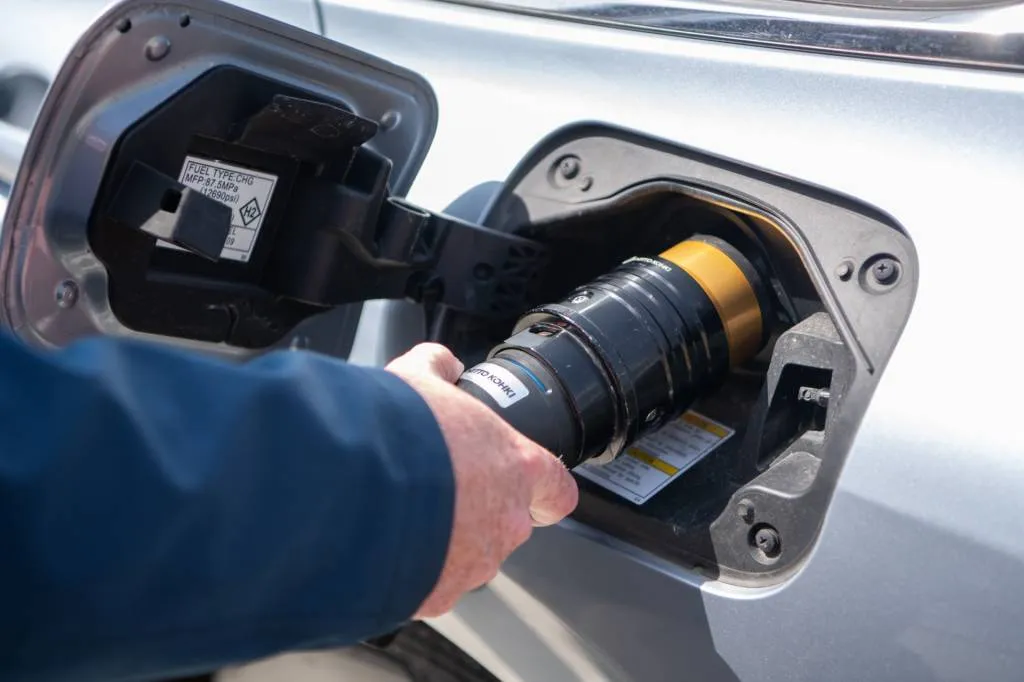
Hydrogen fueling at Toyota H2HQ
Although big batteries and hydrogen fuel cells are often seen as two opposing ways to electrify trucks with no tailpipe emissions, Toyota is reworking the formula in its hydrogen fuel-cell semi to include both. With a supersized battery pack but no plug-in capability, Toyota makes more of the fuel-cell tech. Look for the same formula, potentially, in future pickups.
As part of a commercial vehicle push, Stellantis plans a hydrogen fuel-cell Ram heavy-duty truck. Although details are yet to come, the decision to push well into the medium-duty sector with fuel cells coincides with other automakers’ decisions to shift away from fuel-cell passenger vehicles.
On the sixth anniversary of its first EV fast-charger installation, last week—the same week that Tesla laid off its Supercharger team—Electrify America confirmed big expansion plans. It aims to boost its total number of fast-chargers by 25% through the year, to 5,000 chargers. That’s about 20% more by the end of the year versus what it has today.
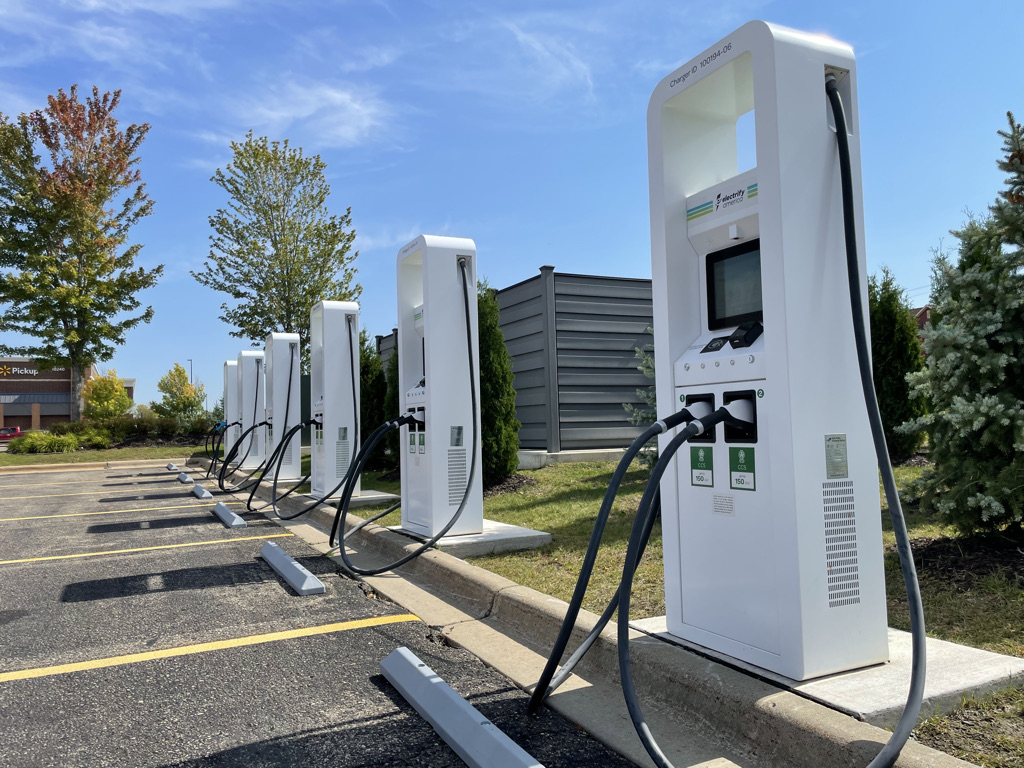
Electrify America chargers
In a strange turn of events, the oil giant BP may rescue Tesla Supercharger sites left in the lurch after Tesla’s still-puzzling decision to cut its Supercharger program. BP intends to spend $1 billion by 2030, with half of that investment to be made within the next two to three years. That will include 3,000 U.S. chargers, with some large-scale sites with 12 or more chargers, to be called Gigahubs.
Rivian is rejiggering the production capacity of its plant in Normal, Illinois, to accommodate up to 155,000 of its more affordable R2 SUVs annually. That’s more than the cumulative number of EVs the company has delivered since it started rolling its R1 family out to customers about 2.5 years ago.
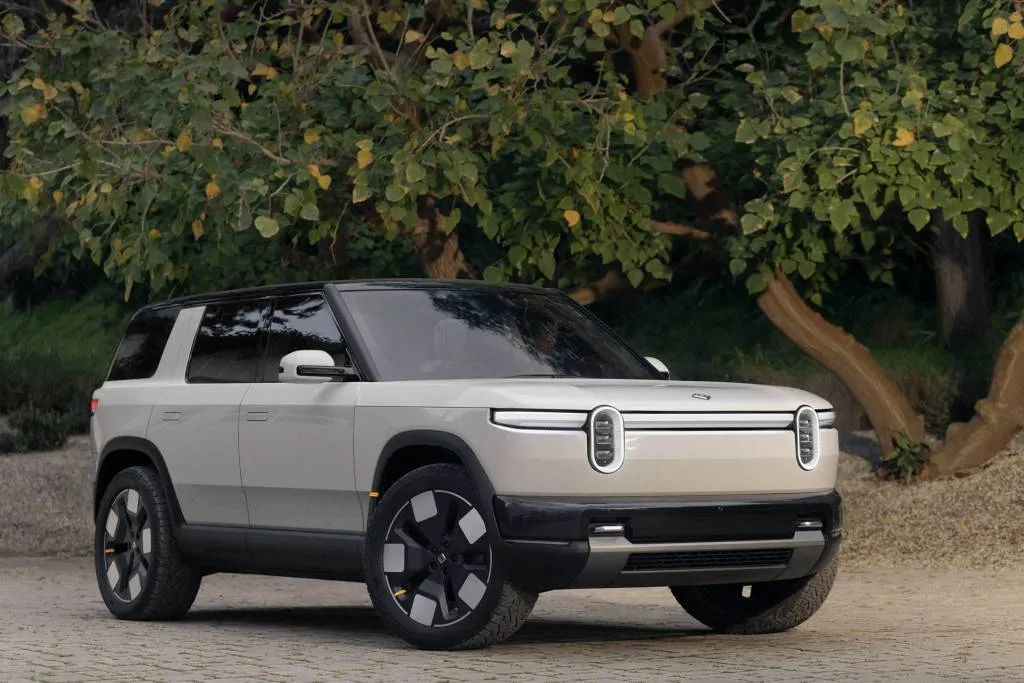
Rivian R2
According to the consultancy Wood Mackenzie, as quoted in a Reuters report this week, growing EV sales in both the U.S. and China could contribute to a significant cut in gasoline demand in 2024. That’s due not so much to an acceleration in EV growth but to the cumulative effect of all the EVs now in service.
Former President and current Presidential candidate Donald Trump reportedly tried to collect $1 billion in donations from top oil executives at Mar-a-Lago over the promise that Trump would scrap stricter EPA emissions rules anticipated to drive up the sales of EVs. Although with many of these companies recast as diversified, greener “energy companies,” the extra pollution might not be the image they’re looking for.
Residential electricity rates throughout the nation have soared over the past couple of years. Meanwhile, California is seeking to cut the cost of home EV charging through a fixed-charge plan—essentially a package of energy for a flat, reduced fee, with the cost even less for low-income households.
Are the flame retardants in vehicle cabins making us sick? Citing studies and investigations, Consumer Reports is calling on the federal government to reevaluate the standards, which were adopted in 1971 and haven’t changed much since. What’s more, the chemicals intended to curb a gasoline-fueled fire might not even be relevant in EVs.
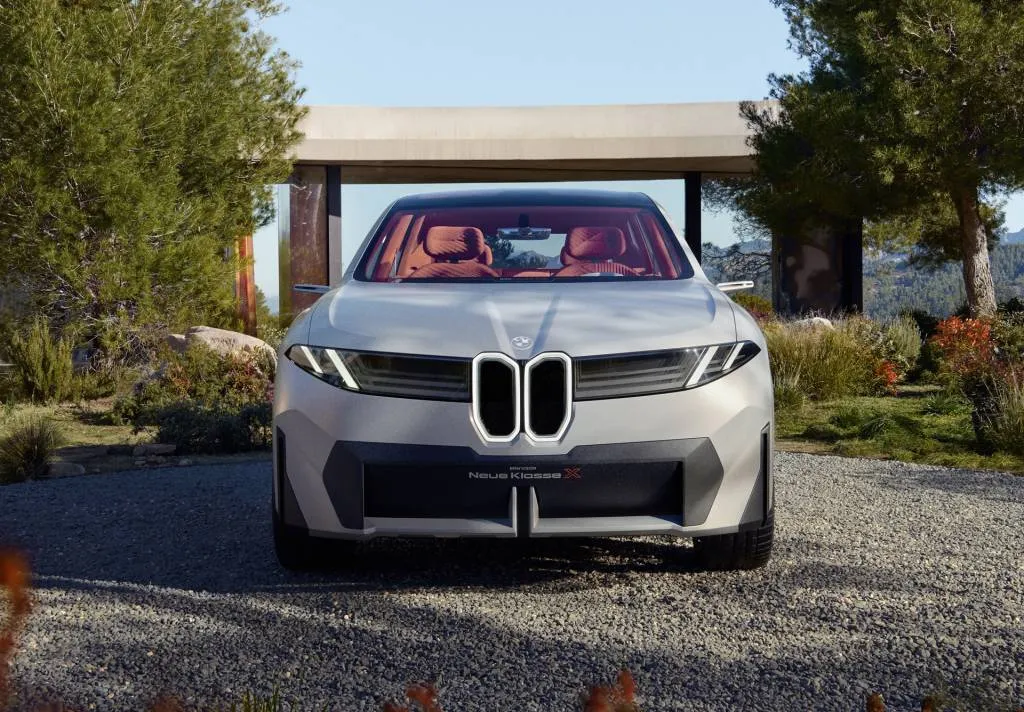
BMW Vision Neue Klasse X concept
BMW has started building a battery plant in Mexico that will provide more energy-dense cylindrical cells for longer range and faster charging in next-generation Neue Klasse EVs. If Inflation Reduction Act rules remain, the products might eventually qualify for the EV tax credit.
In what might be yet another example of an urban-rural divide, a recent University of Michigan survey suggested that EV charging is seen as less relevant to rural communities than to cities. While more local governments are interested versus a version of this survey in 2019, they’re still concerned about cost.
According to a recent annual report from the American Lung Association, 39% of the U.S. population lives with unhealthy air. While recent EPA emissions rules for passenger cars and commercial trucks will help clean up particle pollution, ozone pollution remains a challenge. EVs are part of the remedy, as progress is also made in curbing pollution from power plants.
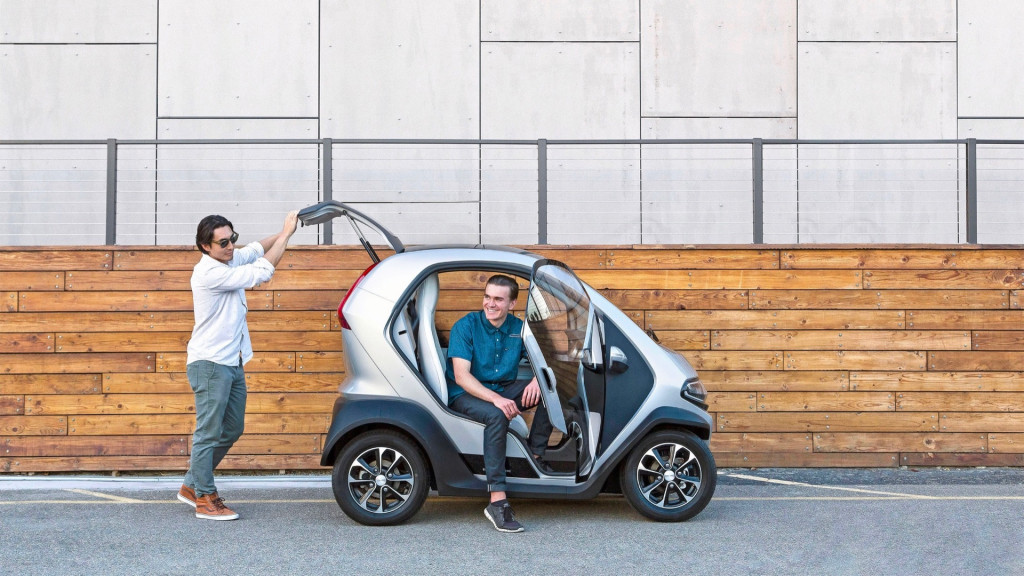
Eli Zero
If you’re fine moving no faster than 25 mph, the tiny $11,990 Eli Zero EV might be just right for urban deliveries. In U.S.-bound form, the two-seat hatchback minicar goes up to 90 miles, and constrained by those speeds it’s unlikely range anxiety is going to be a concern.
And Supercharger drama aside, will the Tesla NACS connector bring more reliable charging? As a report recently underscored, the answer to that is no, as the vast majority of charging issues relating to EVs isn’t due to a failure of the connector but to the maze of interoperability that manufacturers, hardware makers, and networks face
_______________________________________
Toyota Ventures’ Jim Adler finds fresh opportunity for mobility investments (Episode 250)
The founder and general partner of the venture-capital firm details a new $300 million infusion from its namesake automaker, separates hype from reality in the AI boom, and discussions automotive’s convergence toward the energy realm.

Musk: Tesla Supercharger network plans $500M expansion despite layoffs
Despite recent layoffs, the Tesla Supercharger network is due for an expansion, CEO Elon Musk claims.
Tesla will spend “well over” $500 million on the Supercharger network this year, Musk said Friday on X (formerly Twitter), the social media network he owns, adding that this investment will fund “thousands” of new chargers and is separate from any operating costs needed to simply keep the current network going. For perspective, there are currently 25,507 Tesla Supercharger ports in the U.S. and 2,264 station locations, according to the Energy Department’s Alternative Fuels Data Center.
Musk earlier this month fired nearly the entire Tesla Supercharger team, including Rebecca Tinucci, the executive who has accelerated growth of the network in recent years and helped convince nearly the entire U.S. EV market to switch to Tesla’s North American Charging Standard (NACS) connector.
Just to reiterate: Tesla will spend well over $500M expanding our Supercharger network to create thousands of NEW chargers this year.
That’s just on new sites and expansions, not counting operations costs, which are much higher.
— Elon Musk (@elonmusk) May 10, 2024
Ford led the way in adopting the Tesla charge port, in May 2023, at a time of great expansion for the Supercharger network—and nearly every other U.S. EV brand soon stepped up to confirm they’d also make the switch.
In the year since Ford’s announcement, NACS has also become an official standard—SAE J3400. That’s paving the way for more charging networks to add the NACS connector, including BP, which just this week said it is looking to purchase stranded Supercharger sites should Tesla contract the network.
EV advocates may be hoping for increased reliability from switching to NACS, given the Supercharger network’s solid reputation in that area. But reliability gains across the industry will take more than a Tesla connector. With about 100 charging station manufacturers and 500 combinations of cars and chargers, it’s a lot that needs to be cross-compatible.
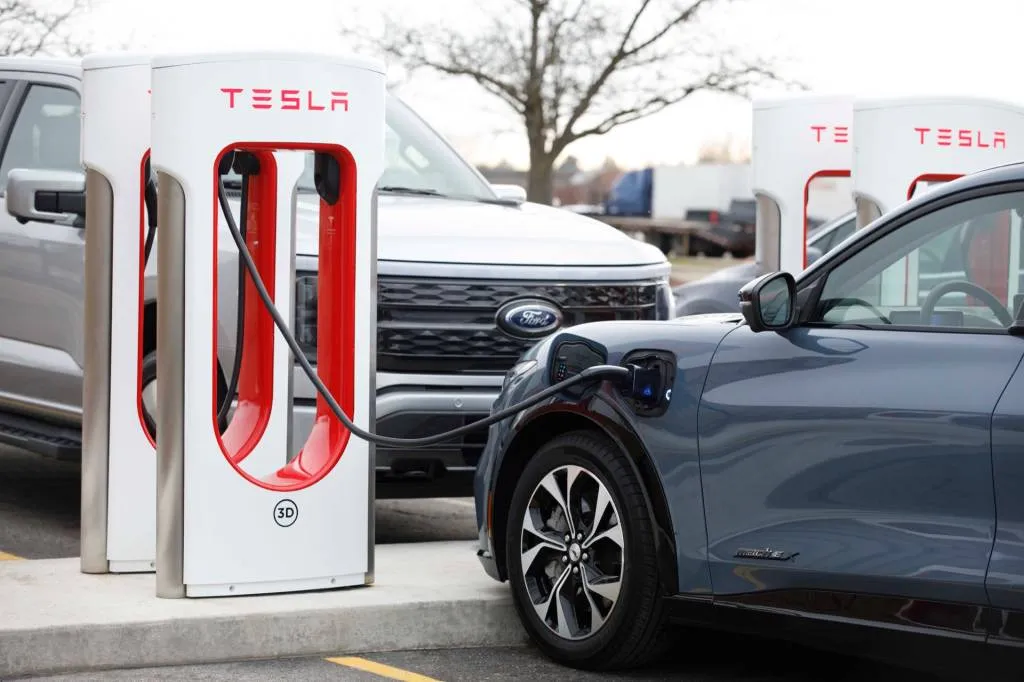
Ford EVs at Tesla Supercharger
Musk has also suggested in the past that the Supercharger network might charge extra for slow-charging non-Tesla EVs. We’ll see if that’s something the automaker introduces at some point soon.
There’s been little backstory about why the Supercharger division was nearly shuttered. Musk had recently actually praised the team as the key to its future. And he’s given no indication how the Supercharger network will continue to operate at its current level—let alone expand—after so many key personnel were dismissed.

BP’s Supercharger bailout, Trump’s Big Oil bet, big batteries in fuel-cell trucks: Today’s Car News

Trump reportedly offers to scrap EV-friendly EPA emissions rules. BP seeks to rescue stranded Supercharger stations as Tesla’s charging plans fizzle. And does going with a very large battery pack but no charge port make sense in fuel-cell semis and even pickups? Toyota thinks so. This and more, here at Green Car Reports.
Although big batteries and hydrogen fuel cells are often seen as two opposing ways to electrify trucks with no tailpipe emissions, Toyota is reworking the formula in its hydrogen fuel-cell semi to include both. With a supersized battery pack but no plug-in capability, Toyota makes more of the fuel-cell tech. Look for the same formula, potentially, in future pickups.
Former President and current Presidential candidate Donald Trump reportedly tried to collect $1 billion in donations from top oil executives at Mar-a-Lago over the promise that Trump would scrap stricter EPA emissions rules anticipated to drive up the sales of EVs. Although with many of these companies recast as diversified, greener “energy companies,” the extra pollution might not be the image they’re looking for.
And in a strange turn of events, the oil giant BP may rescue Tesla Supercharger sites left in the lurch after Tesla’s still puzzling decision to cut its Supercharger program. BP intends to spend $1 billion by 2030, with half of that investment to be made within the next two to three years. That will include 3,000 U.S. chargers, with some large-scale sites with 12 or more chargers, to be called Gigahubs.