
Category: General

Aptera finishes crowdfunding, seeks more capital for solar EV
Aptera late Wednesday announced the end date for its crowdfunding stage, as it seeks private capital on its way “towards high-volume production” of its high-efficiency, three-wheel solar EV.
The company’s Regulation A crowdfunding, which bypasses traditional investors and the stock market and emphasizes smaller amounts, will end on June 30, it says, and it’s engaging with the firm US Capital for additional funding.
Through all phases of crowdfunding so far, over three years, Aptera has raised more than $100 million from more than 17,000 investors. It was incentivized this past year with an Accelerator Program that gave investors—at a minimum of $10,000 each—priority for reservations of the first 2,000 initial build slots of the three-wheeled electric car.
Aptera notably doesn’t say that funding has been secured. It instead says that its crowdfunding efforts “have paved the way for the company to engage with US Capital to secure funding for the production of Launch Edition vehicles.”
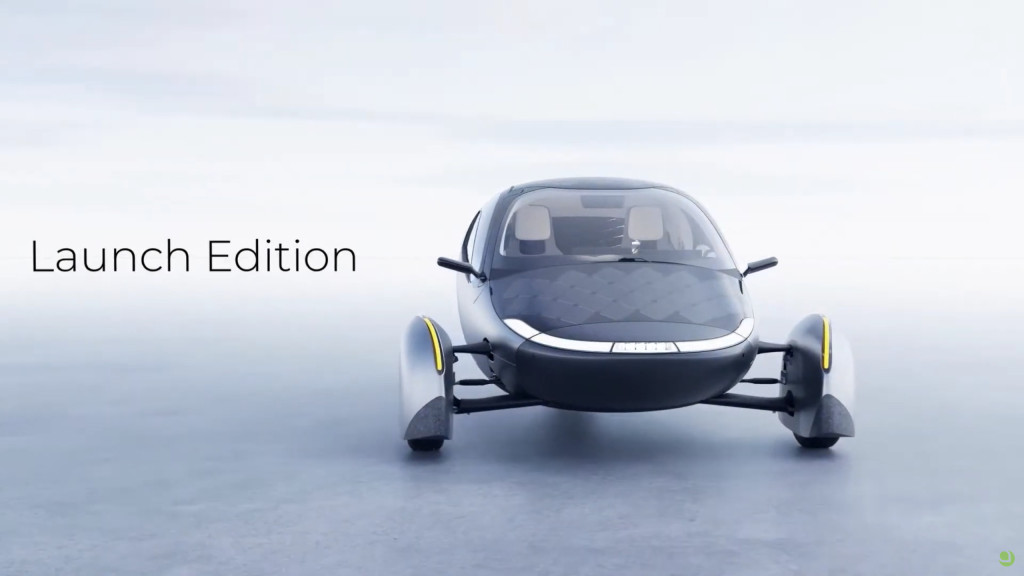
Aptera Launch Edition
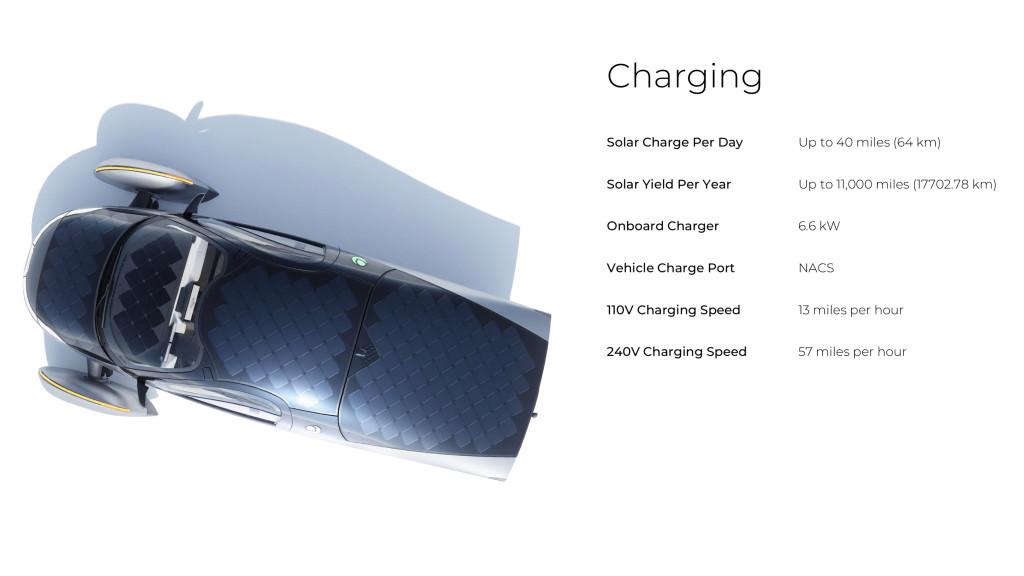
Aptera Launch Edition charging
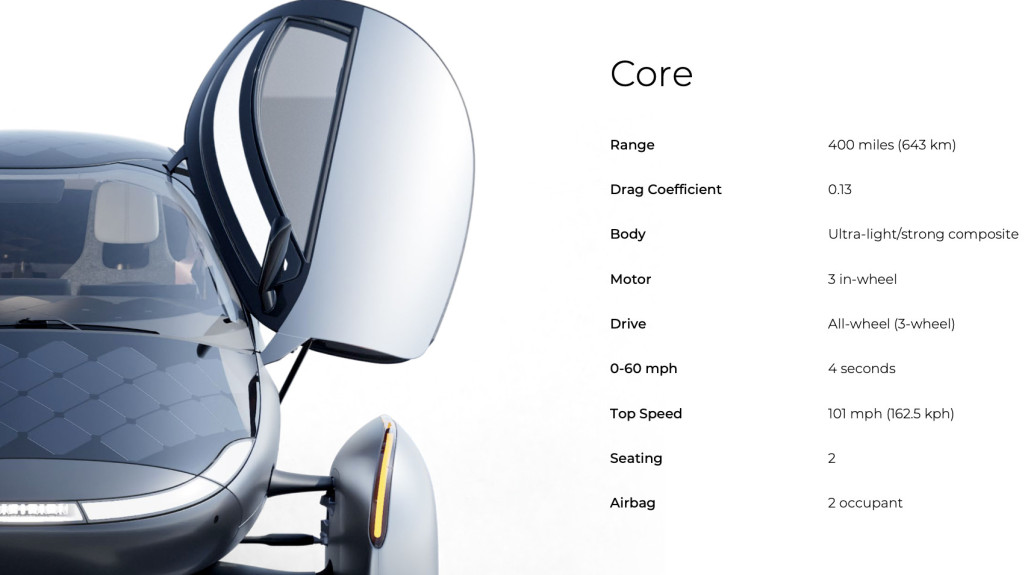
Aptera Launch Edition core specs
The Launch Edition was revealed in January 2023 with a 4.0-second 0-60 mph acceleration, a 42-kwh battery pack that would provide a range of up to 400 miles, and a solar system that can provide 700 watts of continuous power good for 40 miles of range per day, according to the company. Its price has been set at $33,200.
Aptera announced its use of the Tesla NACS port even before last year’s wave of American-market EV brands switching charging standards.
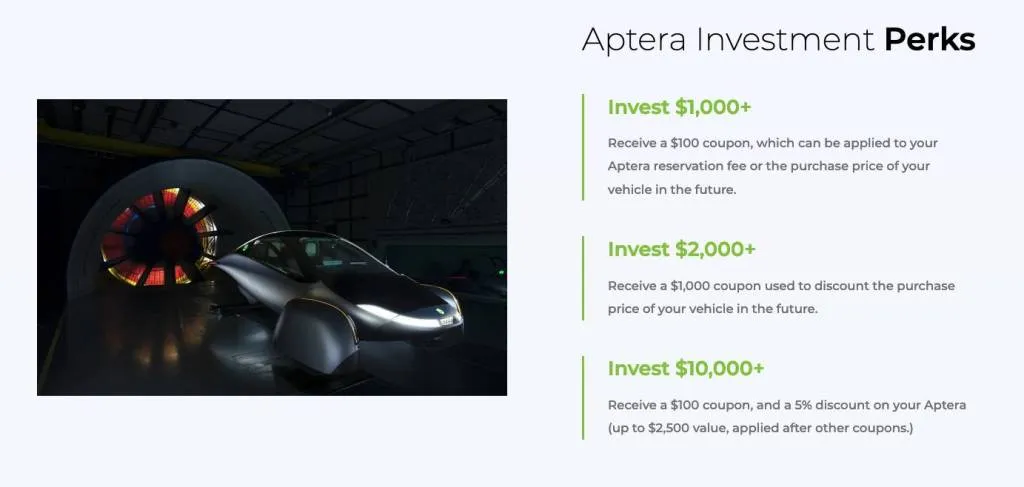
Aptera investment perks
The company announced the completion of the Accelerator Program in February and noted that it had raised enough money to “to fund the initial phases of production”—about $33 million, as of the end of January. Aptera appeared to walk that back a few weeks later, when it provided an update noting that “the start of production for Launch Edition requires additional capital.” Aptera clarified later to Green Car Reports that the previous claim of initial production phases referred to “production-intent vehicle builds.”
Aptera now also says that it plans to bring the vehicle to market “at scale” in 2025, and it hinted in recent months that some design changes are coming for efficiency and cost-effectiveness. Up to now, it’s looked to CPC in Italy for its carbon-fiber body plus chassis and suspension components, to battery supplier EVE Energy for 2170-format cylindrical NMC cells, and to CTNS in South Korea for battery modules.


BMW sticks to 50% EV target by 2030—not including hybrids, PHEVs
BMW still aims for about 50% global EV sales by the end of the decade, in line with a plan the automaker rolled out in 2021, but still isn’t ready to declare an end date for internal combustion.
“By 2030, all-electric vehicles should account for about half of our deliveries,” CEO Oliver Zipse said Wednesday in a speech to shareholders. But the exact cadence of the ramp-up will be determined by market trends, Zipse added.
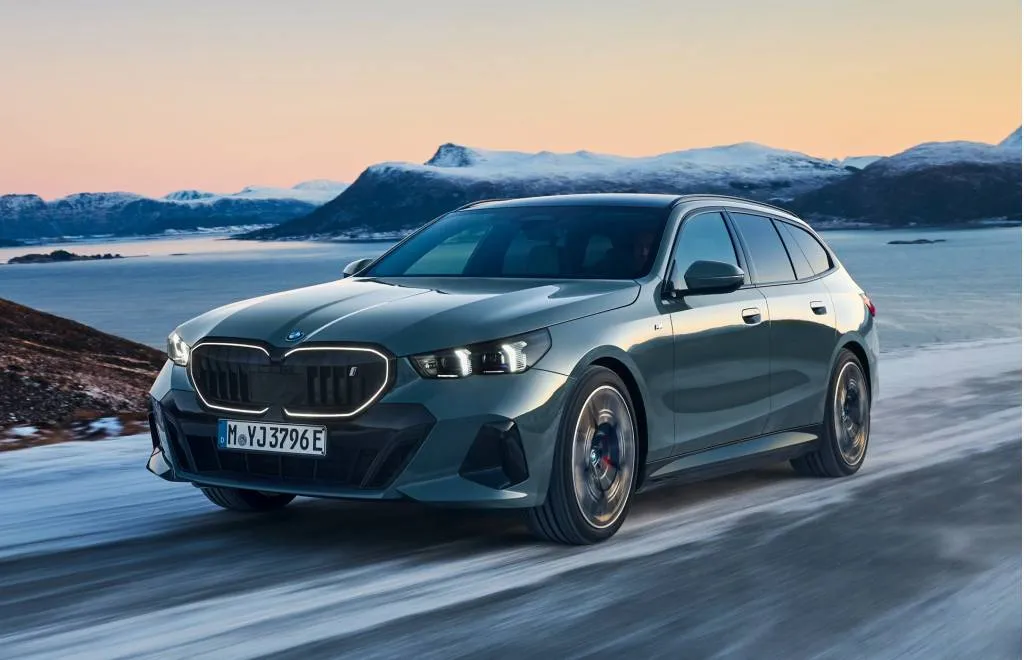
2024 BMW i5 Touring
“We remain committed to this goal and are steering the ramp-up in line with demand,” Zipse said. “We will stay flexible—even well into the 2030s.”
Zipse also emphasized that hybrids and plug-in hybrids remain a major part of BMW’s plans, noting that the automaker expects the plug-in hybrid version of its midsize 5-Series to account for about 20% of sales for that model in Europe. The 5-Series is also available with gasoline engines, and as the all-electric i5.
The electrification goal also applies to BMW-owned Mini and Rolls-Royce. The first Rolls-Royce EV—the Spectre coupe—arrived last year, and it accounted for 38% of Rolls deliveries in the first quarter of this year, Zipse said. BMW will have 15 all-electric models available globally across all of its brands, he added.
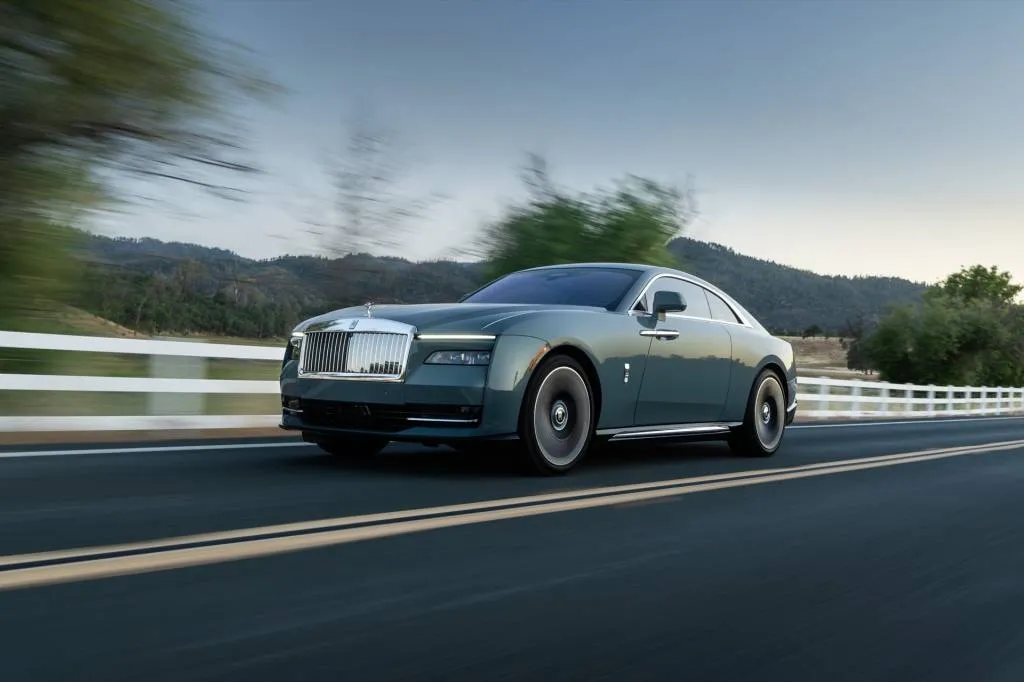
2024 Rolls-Royce Spectre
BMW will lead its next-generation EVs closer to the mass market with the Neue Klasse models, set to be made for the U.S. in Mexico. The first of these models—an SUV previewed by a recent concept—is scheduled to start production for the European market next year, in Hungary. Production will then be added in Germany, and finally in Mexico in 2027.
The Neue Klasse marks yet another swerve for BMW. After relatively slow sales of the i3 hatchback, BMW revised its electrification plans in 2019, with an emphasis first on fully electric variants or equivalents of its core internal-combustion models.

BYD Shark plug-in pickup, Kia EV6 update, US EV market share: Today’s Car News
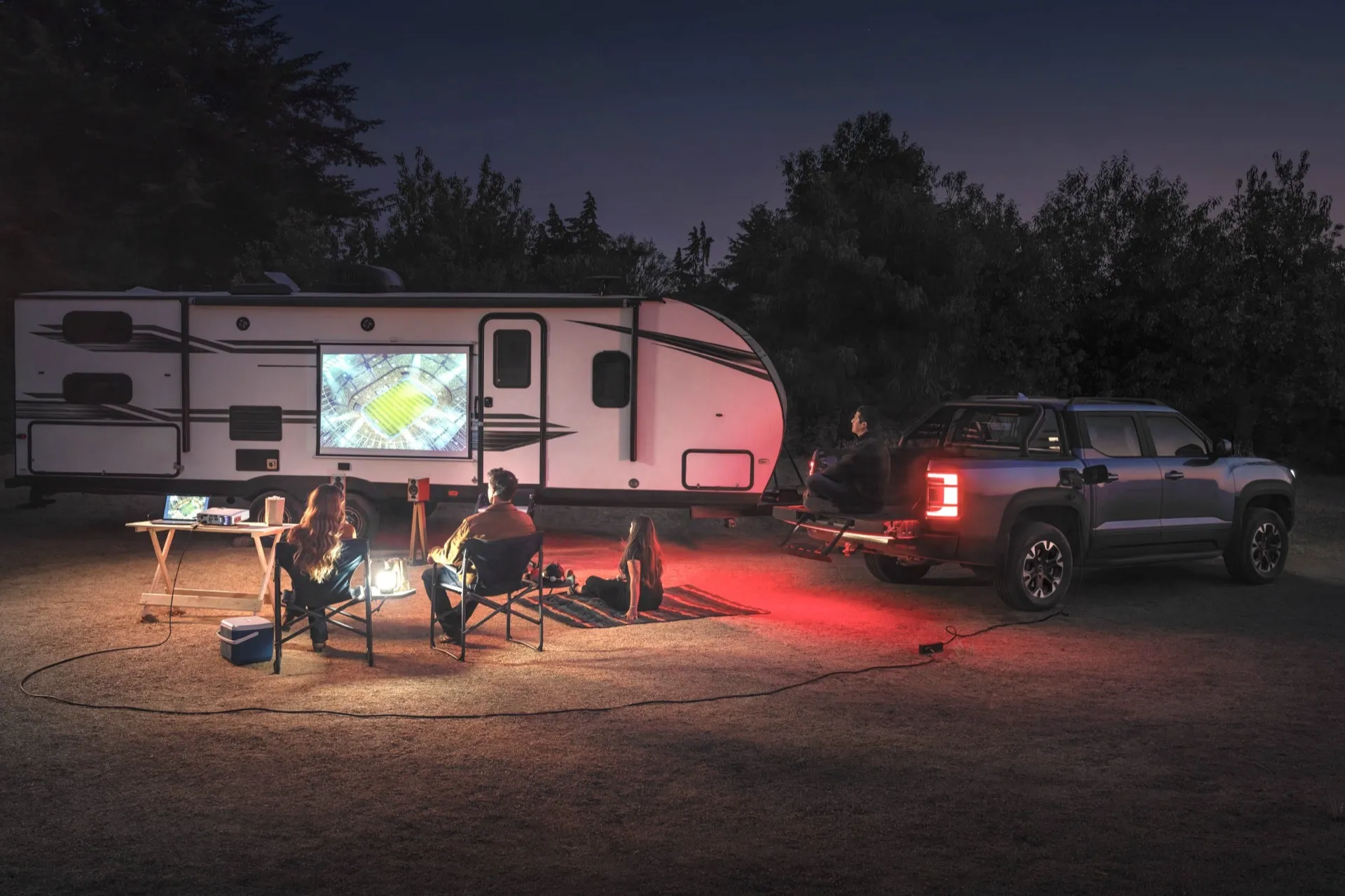
EV sales are up but market share is down. The Kia EV6 shows off a facelift and more range. And BYD drops a Shark of a plug-in hybrid pickup south of the border. This and more, here at Green Car Reports.
The same morning the Biden administration hiked tariffs vs. Chinese EVs in an effort to keep them out of the market, China’s BYD Shark plug-in hybrid pickup made its debut in Mexico. As the first completely new BYD to debut outside China, the sub-$55,000 pickup with 62 electric miles provided a political statement even if not intended.
The 2025 Kia EV6 has made a global debut with a larger battery pack and potentially a range boost of 10% or more—plus styling updates that appear to bring this trendsetting electric crossover in alignment with details from Kia’s latest EV9 and upcoming EV3.
And in Q1, U.S. EV market share fell, while EV sales levels remained significantly up on a year-over-year basis. With that as the top-level takeaway of an update from the DOE’s Energy Information Administration, the backstory suggested some complicated dynamics, as a glut of luxury EVs sits in a sagging luxury market, affordable EVs remain scarce as affordability challenges remain, and Tesla managed only slight U.S. sales gains.
_________________________________

EV market share fell in Q1, in a dearth of affordable models
U.S. EV and hybrid sales fell in the first quarter of the year, according to a Tuesday update from the Department of Energy’s Energy Information Administration (EIA).
Sales of battery electric vehicles (full EVs) dropped to 7.0% of overall light vehicle sales in the first quarter of 2024 from 8.1% in the previous quarter. Nationally, sales of hybrids, plug-in hybrids, and EVs combined dropped to 18.0% of the market, versus 18.8% in the previous quarter.
As the EIA reports—in a trend that parallels a California EV trend for the quarter—EV sales by actual volume were actually up 7% in the first quarter of 2024 versus the same quarter in 2023. But to add another splash of context, that was after 13 consecutive quarters of double-digit percentage gains.
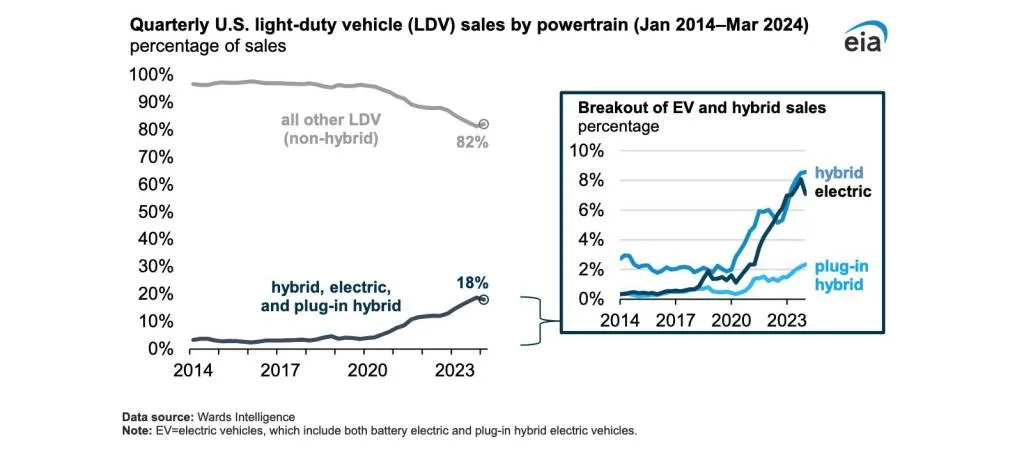
EIA update on EV and hybrid sales – May 2024
Multiple factors may be at play. Mass-market EV sales were way down, by 17.9%, and that appears to be related more to what’s available in the market than to demand. For instance, the Chevrolet Bolt EV was out of production in Q1 and disappearing from dealer lots, while GM’s next-most-affordable Chevy Equinox EV hasn’t yet arrived; and Nissan has slimmed down the Nissan Leaf lineup to just two trims.
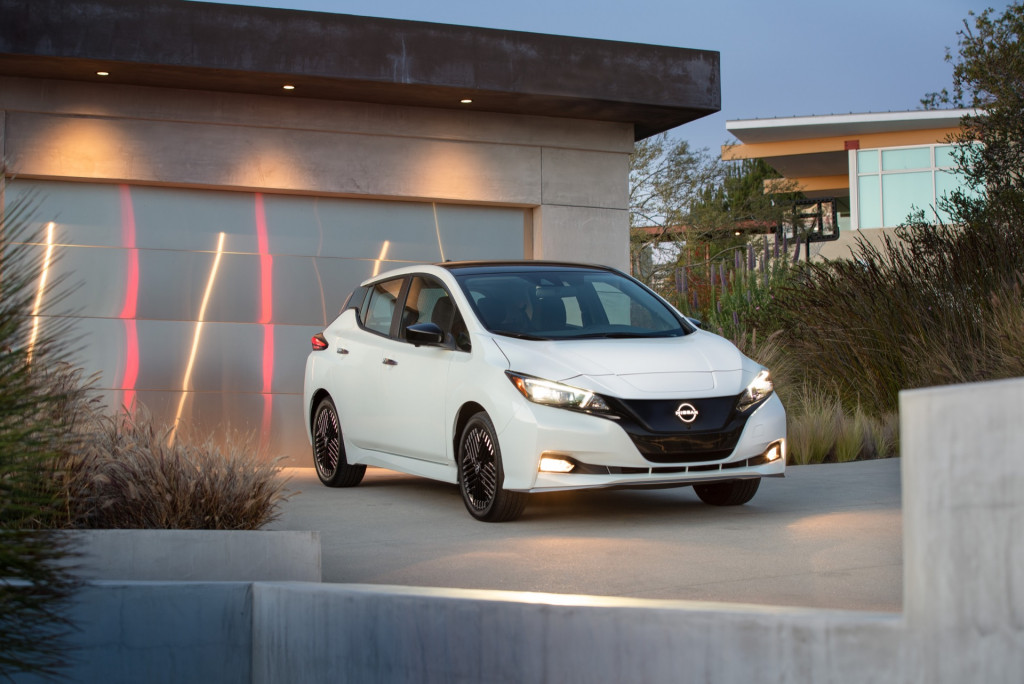
2023 Nissan Leaf
On a transaction basis, the EIA pointed to Cox Automotive data suggesting that EV transaction prices remain about $6,900 higher than the average vehicle price across the entire market. The number of vehicles eligible for the $7,500 EV tax credit that can make up for some or all of that difference is more limited than it was last year.
Meanwhile, there was a decline in the whole light-duty vehicle market, led by a sag in luxury-vehicle sales, at a time when eight out of 10 EV sales are luxury models. Luxury sales reached 18% of the new-vehicle market in 2023, but in Q1 they dropped to 16%. It’s a trend that’s difficult to extricate from the perfect storm of high interest rates and high sticker prices, after several years of nearly across-the-board price hikes. The agency notes that overall mass-market vehicle sales remain at about 10% below pre-pandemic levels, while the luxury sector bounced back two years ago.
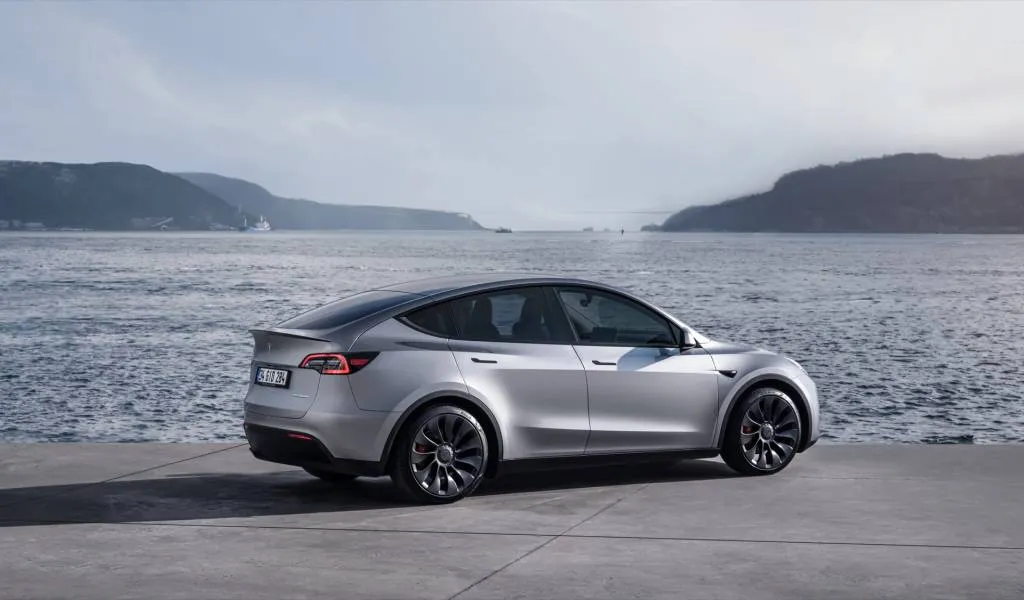
2024 Tesla Model Y. – Courtesy of Tesla, Inc.
Modest Tesla sales gains in the U.S. year-over-year for Q1—of about 4% according to Automotive News, based on registrations—weren’t enough to offset either of these factors. It should be noted that the EIA based these data trends on Ward’s Intelligence data, which also draws from registration data.
In the U.S., the vast majority of EVs have effectively been priced and positioned as premium offerings if not luxury vehicles. This isn’t the case in the rest of the world, and if automakers want to get serious about EV sales in the U.S.—and make EV sales gains—low-priced EVs are the way to go.

2025 Kia EV6 bows with bigger battery, styling updates
Kia this week revealed an updated version of its EV6 electric crossover for its home market of South Korea. The same changes are likely to be applied in the U.S. for the 2025 model year.
The biggest change is a new 84-kwh battery pack, replacing the 77.4-kwh pack that has been the largest available in the EV6 since its 2022-model-year launch. This may boost range by 10% or more—perhaps past the current peak of 303 EPA miles for the lineup to something potentially exceeding 330 miles.
The exterior gets a mild refresh. New headlights with a design Kia calls the Star Map are packaged with more subtle changes on other parts of the car, including a new graphic for the curved light bar of the taillights.
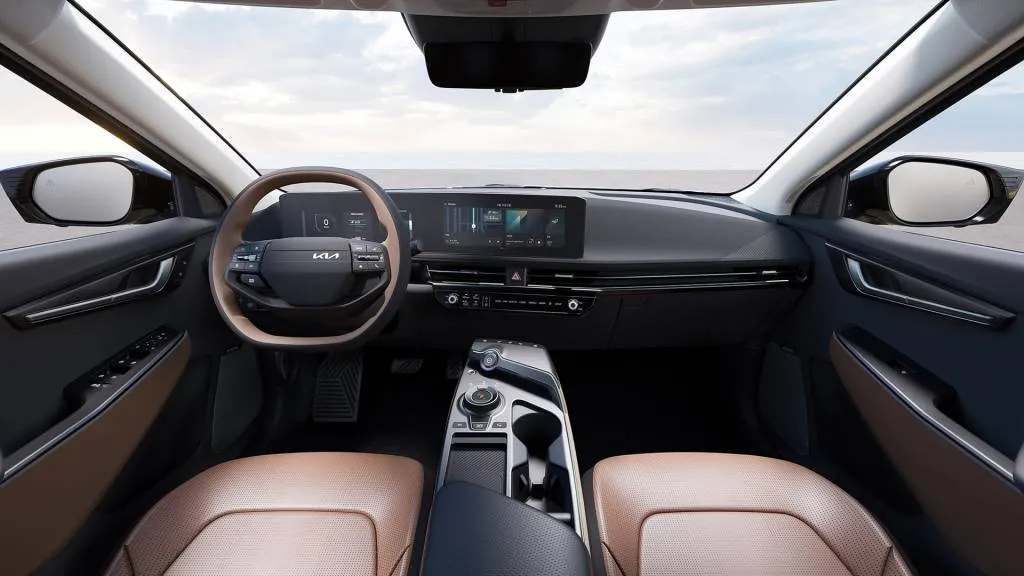
Updated Kia EV6 (Korean spec)
Inside, the EV6 features a new steering wheel and fingerprint authentication system. Kia added a digital rearview mirror and head-up display as well, and also made the B-pillars thicker to increase rigidity.
No powertrain changes are expected, meaning the lineup will include a single-motor rear-wheel drive powertrain rated at 225 hp and a dual-motor all-wheel drive option making 320 hp. Expect the sportier EV6 GT to return as well with 576 hp.
The EV6 is closely related to the Hyundai Ioniq 5, sharing that crossover’s E-GMP platform. It got off to a more solid start in the U.S. as Kia simply made it easier to buy the EV6—although now Hyundai has caught up on the dealership front.
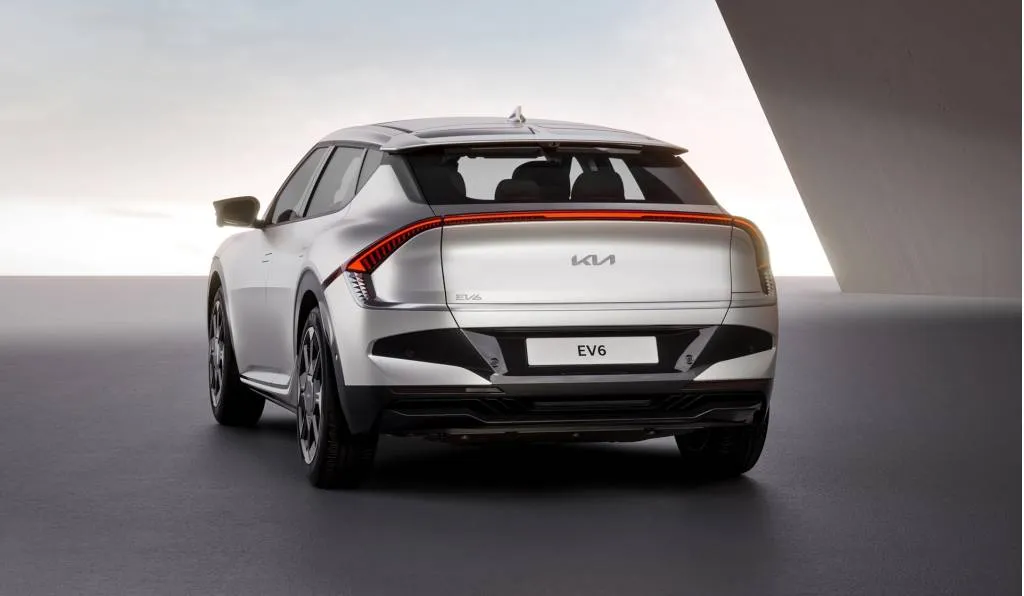
Updated Kia EV6 (Korean spec)
U.S. pricing will be announced closer to the updated EV6’s launch in this market, timing for which has not been announced. Kia did lower the price a bit for 2024, which saw the return of the lower-cost EV6 Light Long Range.
Kia recently confirmed a May 23 debut for its smaller EV3—which, it appears, borrows some design details from both the EV6 and the larger EV9.

2025 Kia Sorento Hybrid, Subaru Crosstrek Hybrid, Biden tariff hikes: Today’s Car News
The Biden administration hikes tariffs on various goods from China, and it goes beyond just EVs and batteries. Kia refreshes its three-row hybrid SUV. And Subaru is looking to Toyota for more of its EVs. This and more, here at Green Car Reports.
In a first drive of Mercedes’ electric G-wagen, we found it to be a better, more precise off-roader than the gasoline model—outshining the combustion versions even before the EV’s party-trick zenith called G-Turn.
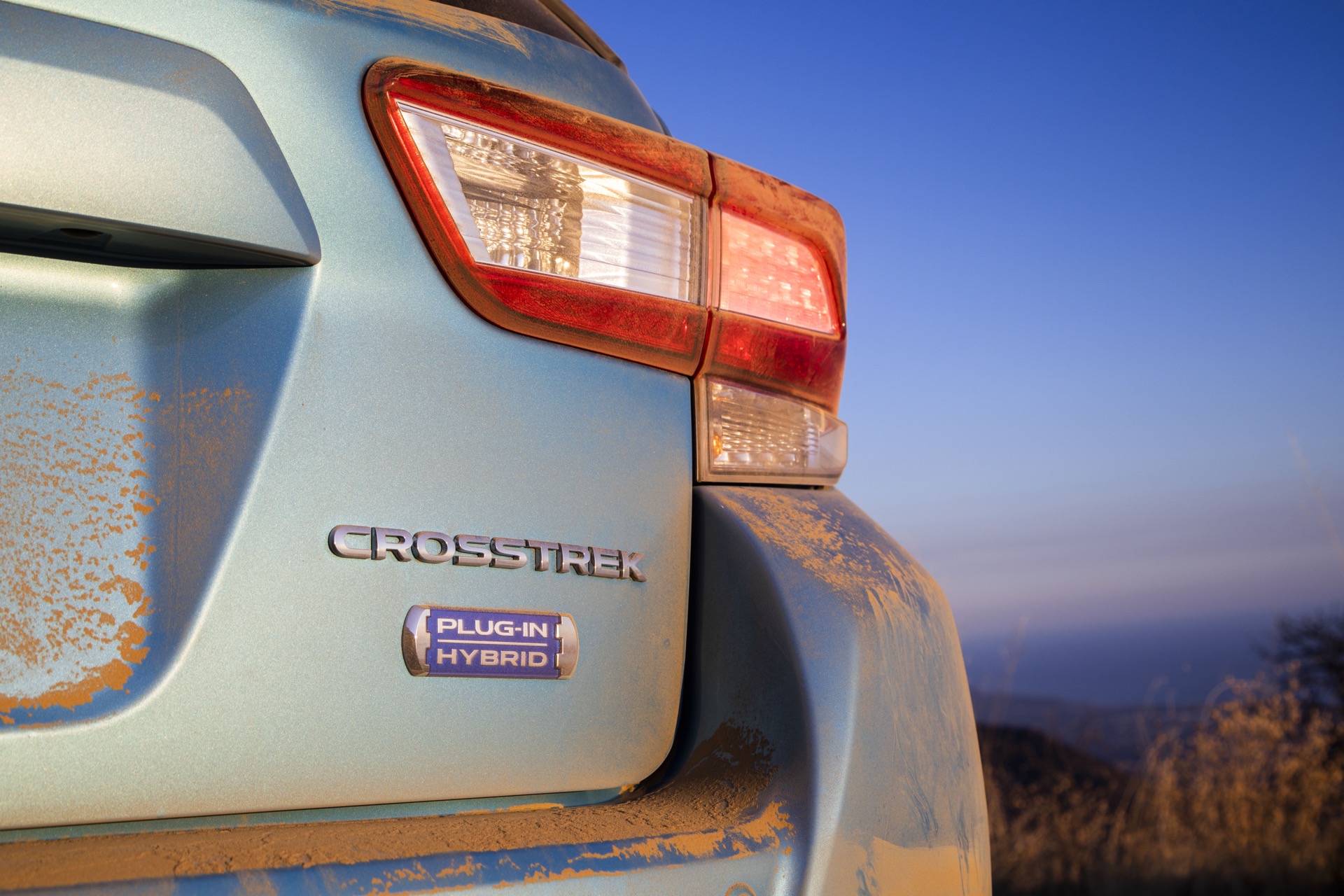
Subaru is bringing back the Crosstrek Hybrid, according to a report, and it will likely arrive soon after the upcoming 2026 Subaru Forester Hybrid. Meanwhile, it appears that three out of the four EVs that Subaru announced last year will be collaborations with Toyota.
The 2025 Kia Sorento Hybrid three-row SUV lineup earns up to 36 mpg, and it’s getting refreshed styling inside and out, without any price hike. Expect a similar update for the plug-in hybrid.
And the Biden administration effectively quadrupled the tariff on Chinese EVs, accompanying tariff hikes on EV batteries, solar cells, and critical minerals. It expands beyond just EVs, however, to steel and aluminum and semiconductors, but it omitted the language from challenger Donald Trump singling out imports from Mexico as an issue.
_________________________________

Biden hikes tariffs to keep Chinese EVs out
The Biden administration on Tuesday took a serious protectionist stance, revealing sweeping tariff hikes affecting $18 billion of Chinese imports, with electric vehicles and their supply chain at the core.
Specifically, tariffs on electric vehicles rise from 25% to 100% this year. The hikes aren’t just on finished EVs, but on critical elements of the supply chain. This year, the tariff rate on lithium-ion batteries and battery parts increases from 7.5% to 25% when applied to EVs, while an equivalent hike on lithium-ion batteries imported from China for other purposes will apply starting in 2026.
The move made clear that the idea of U.S. automakers, assembly plants, and auto workers competing on a “global marketplace” has been left to the history books—and that those holding out for a cheap $20,000 EV from China might want to look for a third-party Presidential candidate who’s on board with free trade.
The scope of the 100% tariff hike announced on EVs won’t at face value provide the same trade barrier as the 100% tariff on Mexico-built Chinese cars—EV or not—that former President and Presidential candidate Donald Trump proposed in March. But it goes after key aspects of the EV supply chain in ways that will affect new vehicles no matter what fuel they have.
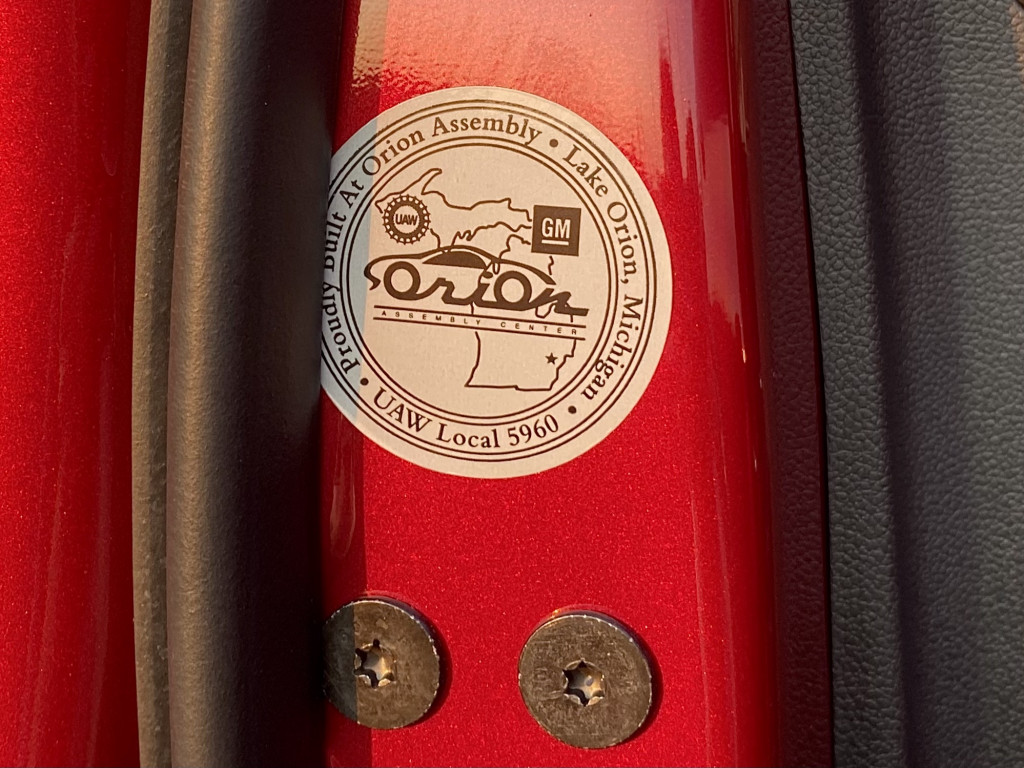
UAW-made sticker on 2022 Chevy Bolt EV
Officially, up to today, cars imported from China are only subject to a 25% tariff, while those made with Chinese parts in Mexico would only be subject to a 2.5% tariff—so it is effectively a loophole that Chinese companies like BYD might be able to exploit to get a foothold in the U.S. market.
Ironically, U.S. automakers have nothing like the affordable EVs that Chinese companies might try to bring to the U.S. The Chevrolet Bolt EV had a sticker price well under $30,000 and was U.S.-made, fully qualifying for the EV tax credit, but GM discontinued it last year and a replacement model won’t arrive for another year.
Preempting an EV invasion already happening in Europe
As an example of the threat from China, the well funded, global automaker BYD, for instance, now sells the Dolphin EV, a well-rated compact hatchback, in some markets in Europe for the equivalent of about $30,000. BYD’s even lower-priced EV, the Seagull, might be able to meet U.S. requirements for $20,000 or less—but the new 100% tariff is surely a deterrent.
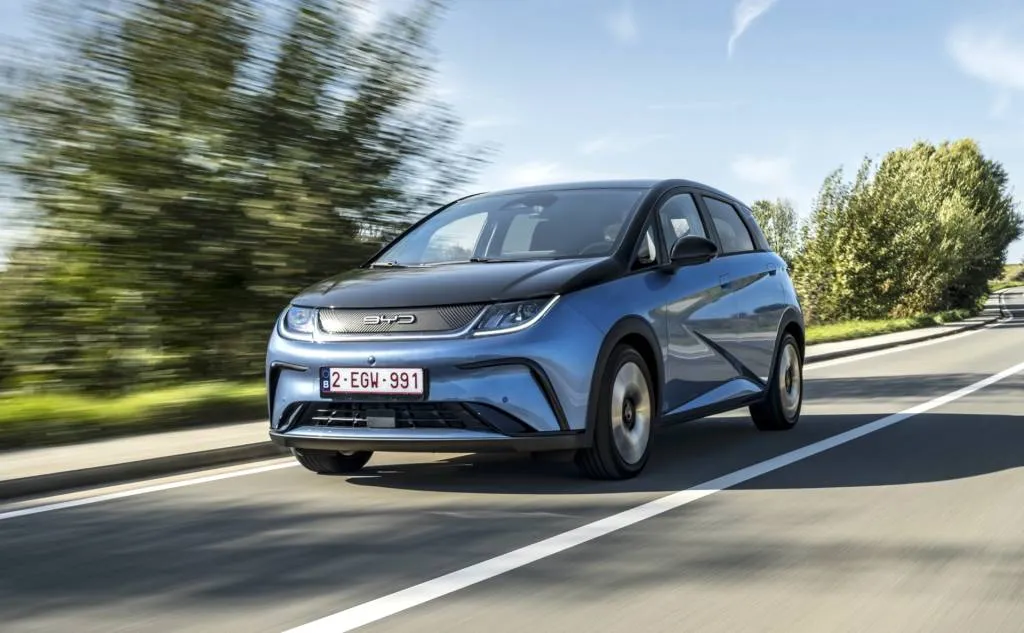
BYD Dolphin EV – Euro spec
The tariff hikes aren’t on everything, but they apply to “strategic sectors,” according to the Biden administration, that closely parallel the investments made by the administration. Beyond EVs and batteries, they include steel and aluminum, semiconductors, critical minerals, solar cells, cranes used at ports, and medical products.
China currently controls more than 80% of some aspects of the global EV battery supply chain, the administration says, which leaves national security at risk, among other concerns.
Electric or not, the Biden tariffs will prompt automakers to think twice about Chinese sourcing. Chinese steel and aluminum products will, for instance, get a 25% tariff this year, up from 7.5%, and semiconductors will get a 50% tariff in 2025, up from 25% today.
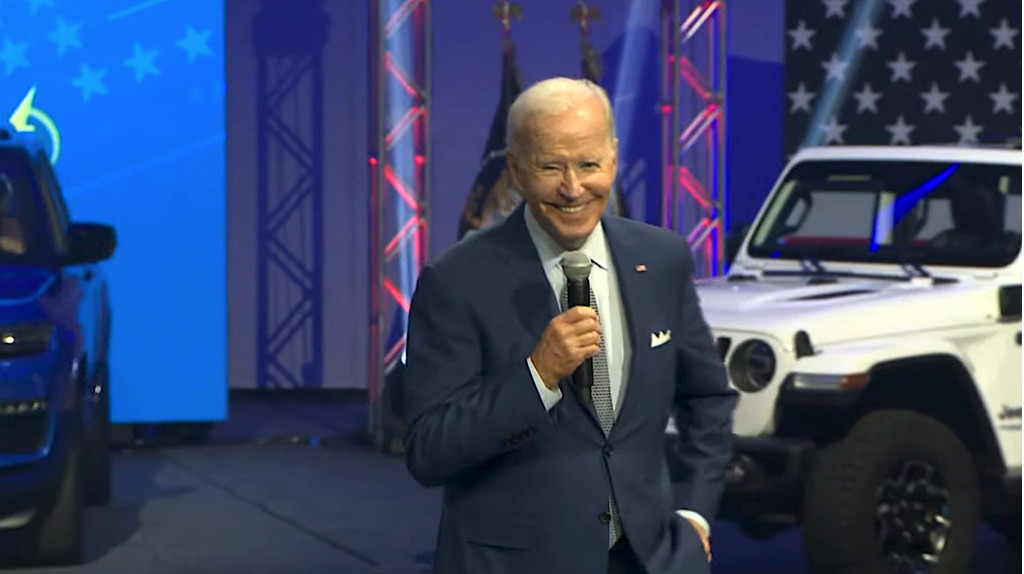
President Biden at 2022 Detroit Auto Show
“As President Biden says, American workers and businesses can outcompete anyone—as long as they have fair competition,” said the Biden administration, in an announcement of the sweeping tariff hikes. “But for too long, China’s government has used unfair, non-market practices.”
The administration then points to the technology transfers and intellectual property theft that have created “unacceptable risks to America’s supply chains and economic security,” noting that China’s current state of overcapacity could lead to export surges of low-priced vehicles that would harm American workers.
Earlier this month the Biden administration also released a revised set of regulations that would effectively allow automakers more time to cut China out of the EV supply chain without penalizing them on EV tax credit qualification in the meantime.

President Donald Trump (Photo courtesy Gage Skidmore/Wikimedia Commons)
The series of politically motivated squeezes of trade levers might not be over, though. Since this past weekend, seemingly in an effort to one-up Biden, Trump has promised a 200% tariff against China.
Mexico remains a potential loophole
What remains to be seen—and a key difference between potential administrations—might relate to what happens south of the border. According to the Wall Street Journal, in a query of U.S. Census Bureau data covering 2023 and 2024 through March, Mexico ranks third in electric vehicle imports to the U.S. after Germany and South Korea, while Japan and Belgium round out the top five. Imported EVs—including those from China—whether or not they comply with stricter EV tax credit sourcing requirements, still receive up to a $7,500 incentive when they’re leased.
Under the previous Trump administration, the U.S.-Mexico-Canada Agreement replaced NAFTA with stricter trade terms but effectively still allowed products to flow from Mexico tariff-free.
The Biden tariffs do little to assure that a Chinese internal combustion vehicle—even a hybrid, for instance—might not be assembled in Mexico and then shipped north. Beyond EVs, that may be a serious test of trade rules, and the industry, yet to come.