
Category: General

Karma reveals Ivara SUV concept, plans more PHEVs
Karma on Friday unveiled the Ivara concept at The Quail, A Motorsports Gathering, one of the premier events of 2024 Monterey Car Week that ran last week in California.
Joining it on Karma’s stand were the previously revealed Kaveya sports car and Gyesera sport sedan. The Kaveya was shown in Monterey with a revised interior that Karma said represents the design planned for production.
The Ivara is an SUV with a sleek, almost coupe-like design, and is slated to spawn a production version by the end of 2027. It seats four and features design elements that Karma said will feature on its future lineup.
Karma said the Ivara is being developed to offer the choice of battery-electric and plug-in hybrid powertrains. Karma didn’t say what PHEV technology it plans to use, though it’s likely to be a series plug-in hybrid setup similar to what the company already offers in its Revero sedan.

2020 Karma Revero GT with available Sport package
The Revero features a pair of electric motors at the rear axle delivering a combined 536 hp, and a BMW-sourced turbocharged 1.5-liter inline-3 sitting up front and serving purely as a generator for the battery. Karma estimates a range of 80 miles using the battery alone, and more than 360 miles with the gas engine employed.
The company previously planned to only launch electric vehicles beyond the Revero, though cooling demand for EVs means Karma is now likely to to add more PHEV powertrains.
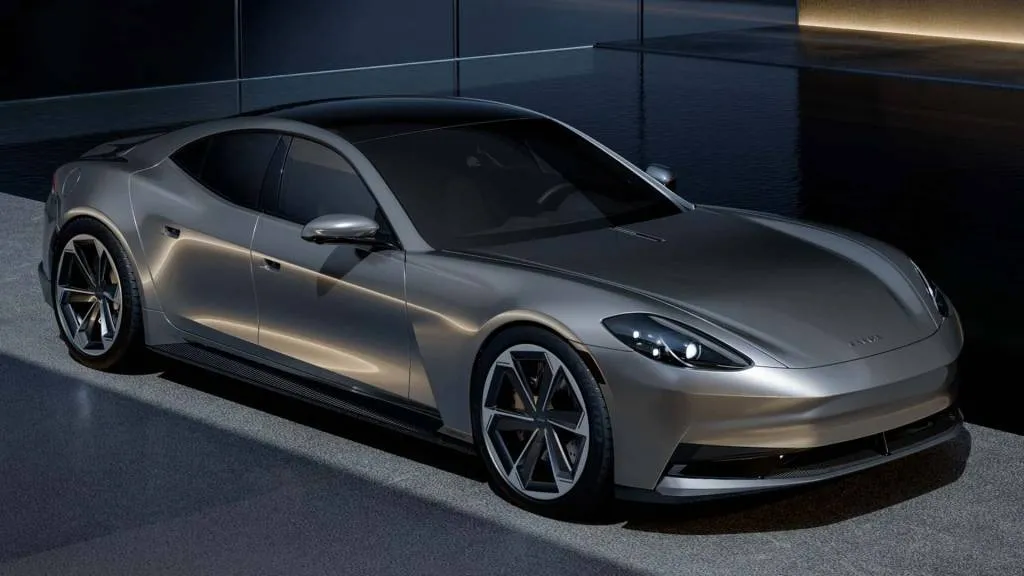
Karma Gyesera
The Gyesera is also likely to offer a PHEV powertrain. The sedan was originally planned to launch this year as an EV, though speaking with Automotive News (subscription required) at the reveal of the Ivara, Karma chief Marques McCammon hinted that the Gyesera may be modified to fit a PHEV powertrain.
“We’ve listened to the market and we’re leveraging our flexibility,” he said. “You’ll see some changes in the Gyesera platform that the market will respond well to.”
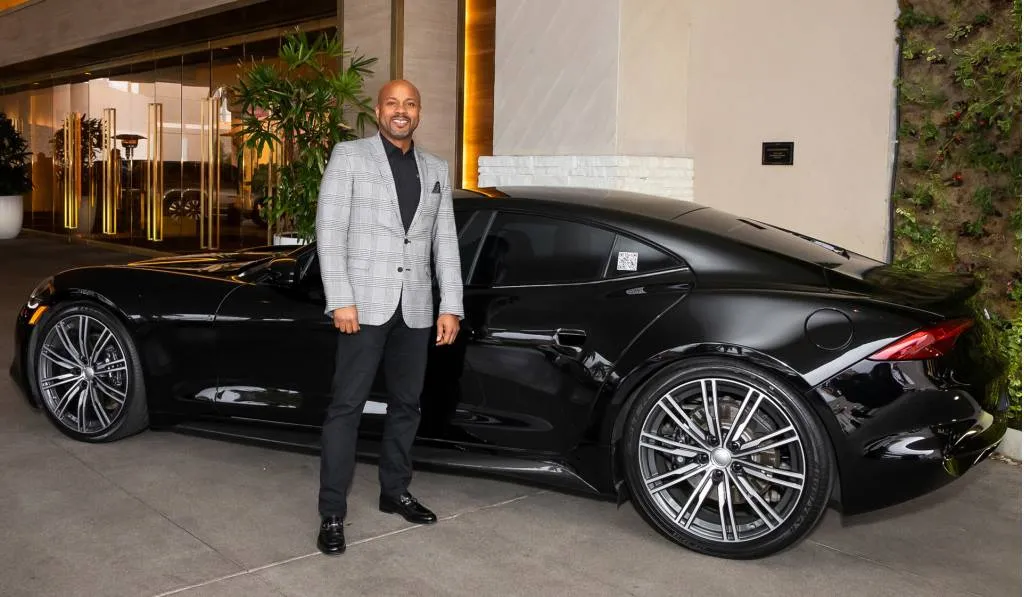
Marques McCammon
The Kaveya for now will be offered with a battery-electric powertrian only. The sports car is on track for launch in 2026 and is promised with up to 1,000 hp. The starting price will be around $300,000, Karma has previously said.
Karma at Monterey Car Week said the Kaveya will be a true software-defined vehicle (SDV) featuring technology developed with Intel. An SDV is essentially a vehicle equipped with software and hardware that allow it to receive over-the-air updates, potentially throughout its entire lifespan.
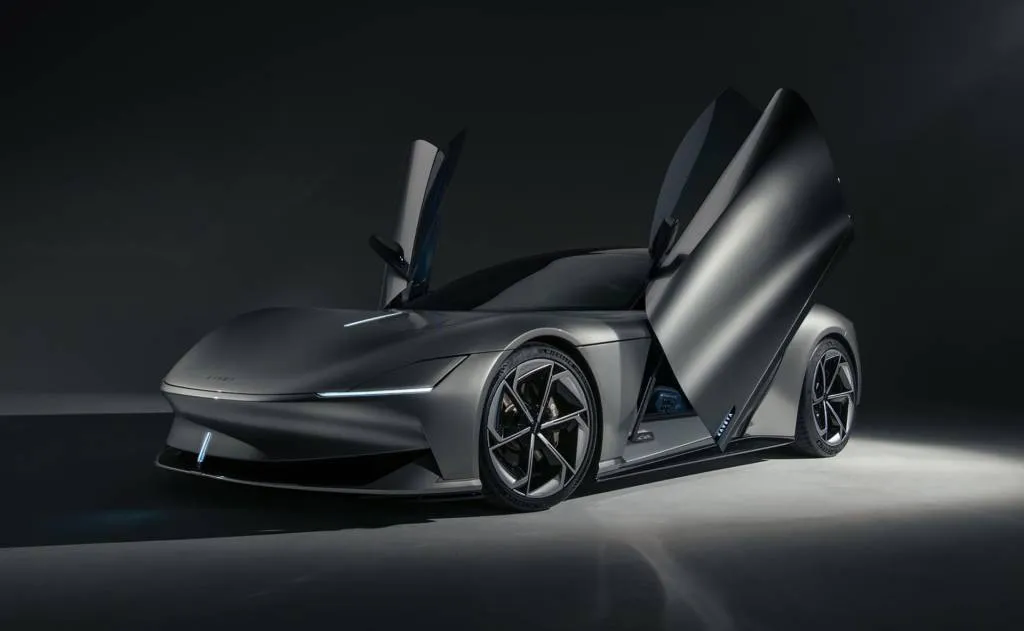
Karma Kaveya
Karma is the company born out of the remains of the original Fisker Automotive that went bankrupt in 2013, and its first and sole model currently available is the Revero, a heavily updated version of the former Fisker Karma. The company only a few years ago planned to offer luxury vehicles alongside commercial vehicles, though it now plans to focus exclusively on luxury vehicles with a high level of personalization.
It wants to position itself as an American ultra-luxury brand, not unlike Duesenberg more than a century ago. Production of the new Karmas will be handled at the company’s plant in Moreno Valley, California, where the Revero is built.

EV collision repair costs 20% more than for gas models
EV collision repairs continue cost more than those of internal combustion vehicles, according to a new report from Mitchell International, which provides tech for the auto insurance and collision repair industries.
The report, based on second-quarter 2024 data, shows similar rates of EVs and 2021-and-newer gasoline vehicles being declared total losses by insurance companies. EVs were declared not worth repairing in 9.16% of cases studied in the U.S., compared to 9.45% of newer gasoline cars.
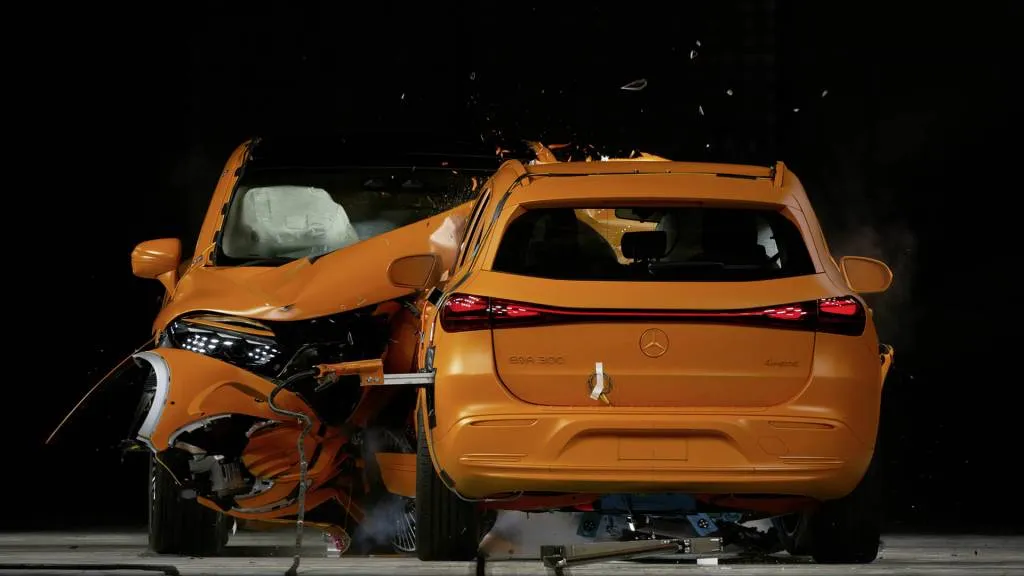
Mercedes-Benz EQS SUV and EQA crash test
When EVs aren’t totaled, though, they cost nearly 20% more to repair than comparable gasoline vehicles, according to the report. EV repair costs averaged $5,753 in the U.S. in Q2, compared to $4,806 for vehicles with a combustion engine. The average repair-cost rates for hybrids and plug-in hybrids were $4,726 and $5,059, respectively, which Mitchell puts down to plug-in hybrids’ use of larger battery packs.
The rate of claims for EVs also increased 45% in the second quarter, the report found, although that’s to be expected as more vehicles join the fleet and are inevitably crashed. The newness of many EV models is also reflected in a higher use of OEM parts for repairs, at 89% of parts dollars spent compared to 65% for combustion cars.
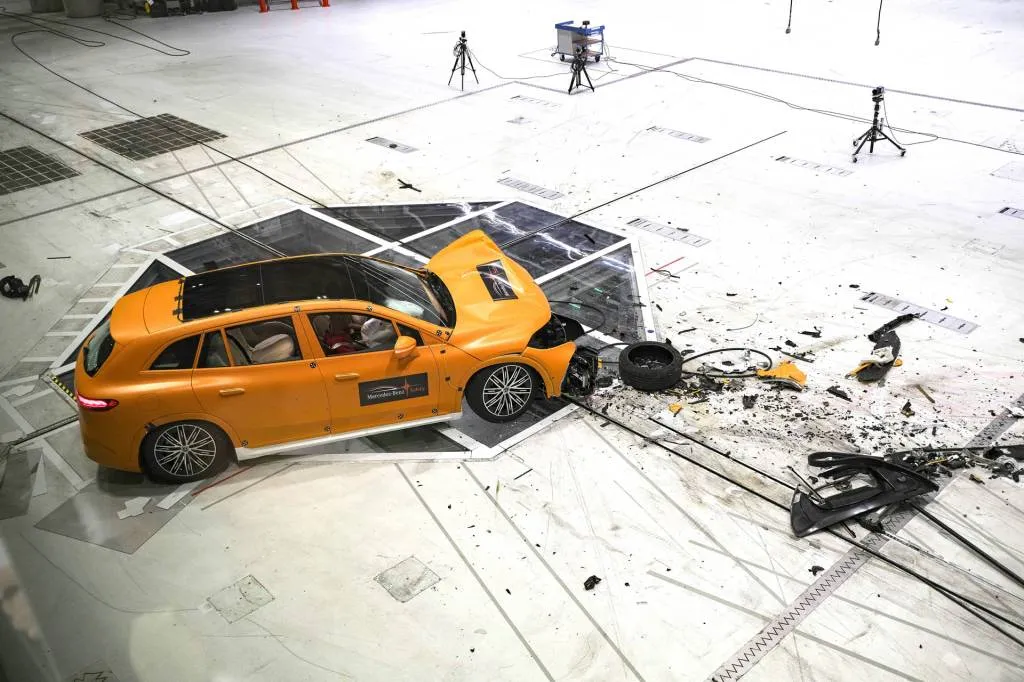
Mercedes-Benz EQS SUV and EQA crash test
EVs do at least require less frame repair work, according to the report, likely the result of higher curb weights and battery packs that can act as structural reinforcements. However, mechanics spent more time in Q2 appraising EV repairs than those of combustion vehicles, at 8.18% and 5.21%, respectively.
The new report has similar findings to one published by Mitchell in 2023, which found that average repair costs for EVs in the U.S. were $963 higher than comparable gasoline cars. Hertz also cited high collision repair costs as the main reason for slowing its EV plans, and they continue to be a factor in why EVs cost more to insure than hybrids right now.

EV wireless charging could catch on faster with this tech
- EV wireless charging has a standard to get positioned for an efficient charge
- Called DIPS, it enables cross-compatibility between hardware from different suppliers
- It also helps set the stage for wireless bidirectional charging
Charge ports, connectors, and cables may soon no longer be the only typical way to keep EVs and some types of hybrids charged up.
That’s because the inductive wireless charging industry is finally on its way toward a whole ecosystem of components that will be able to send a charge to vehicle batteries with no physical connection—via an oscillating magnetic field and the principle of electromagnetic induction.
The core of these new standards—on top of the unified standard for wireless charging announced in 2020 and original guidelines set in 2016—is the so-called Differential Inductive Positioning System (DIPS), which uses a low-intensity magnetic field with multiple smaller coils. The arrangement will recognize multiple ground assemblies and help the vehicle get aligned precisely with the charging pad despite various vehicle ride heights and weather conditions.
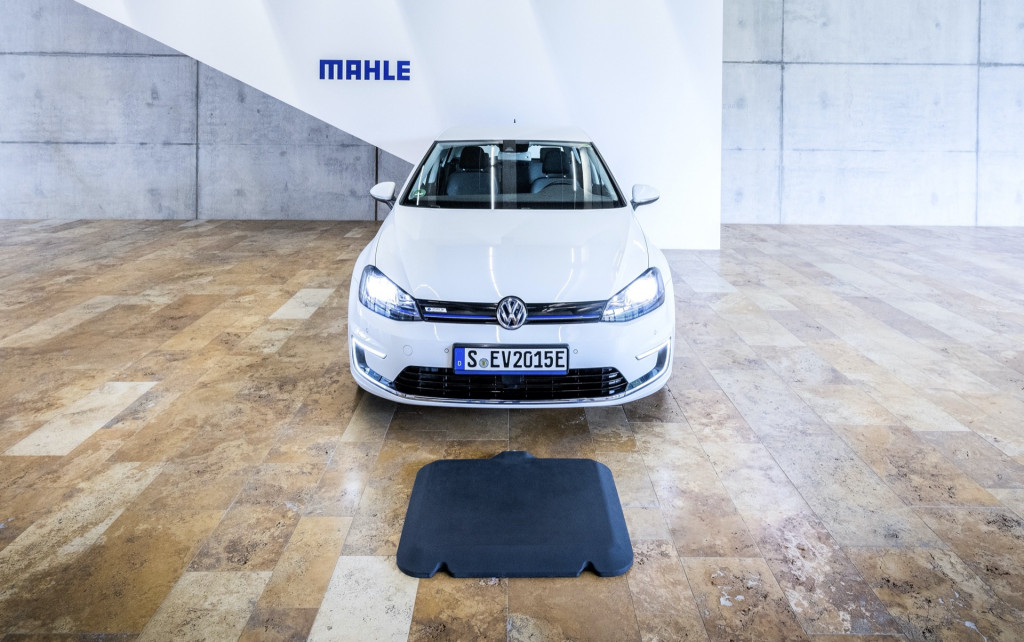
Mahle wireless charging
Publication of the standards was announced last week by the organization SAE International, the same organization that finalized the Tesla-based NACS charging interface. They address unidirectional wireless power transfer, so it might be used in both vehicle charging or in applications that send power banked in batteries back to the home or to the grid.
SAE finalized the methodology for DIPS last November. Now that it’s set as a standard, it opens the door for a range of suppliers to build a wide range of wireless charging components and accessories for EVs—including driveway or parking-lot charging pads, vehicle units, and fleet systems, all with a high level of confidence these systems will be cross-compatible.
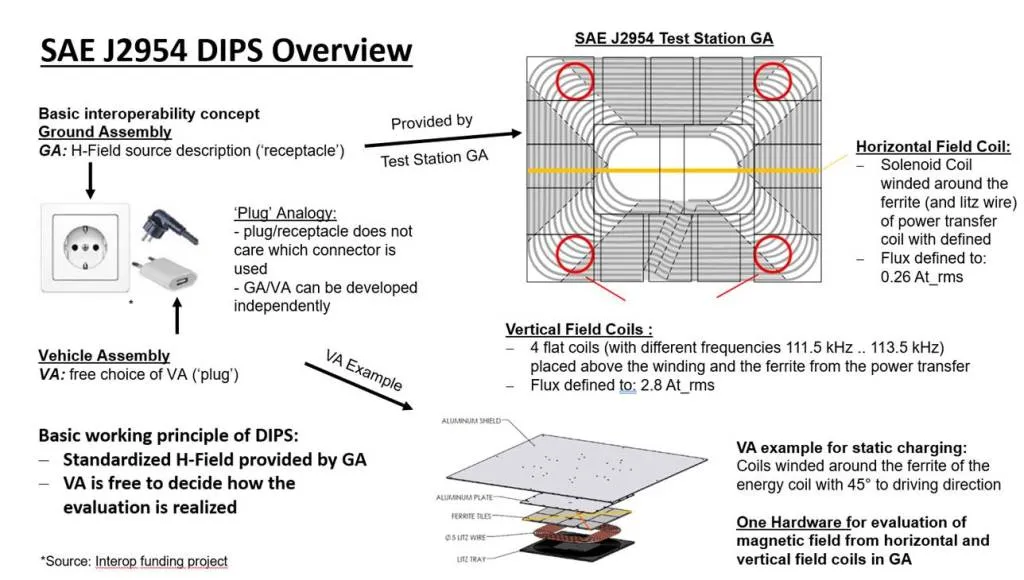
Differential Inductive Positioning System component of SAE J954 wireless-charging standard
According to the organization, these standards used “a lengthy consensus process” to finalize alignment for safe wireless power transfer of up to 11 kw at efficiencies of up to 93%. That’s far better than the efficiencies typically seen for smartphone charging pads, and nearly the same as for physical charging connectors when including long charge cables.
Wireless charging costs more than than physical charging, but over the long-term it’s an EV game-changer. Although it could help reduce the reliance on DC fast-charging by making public EV charging less complicated and deliberate.
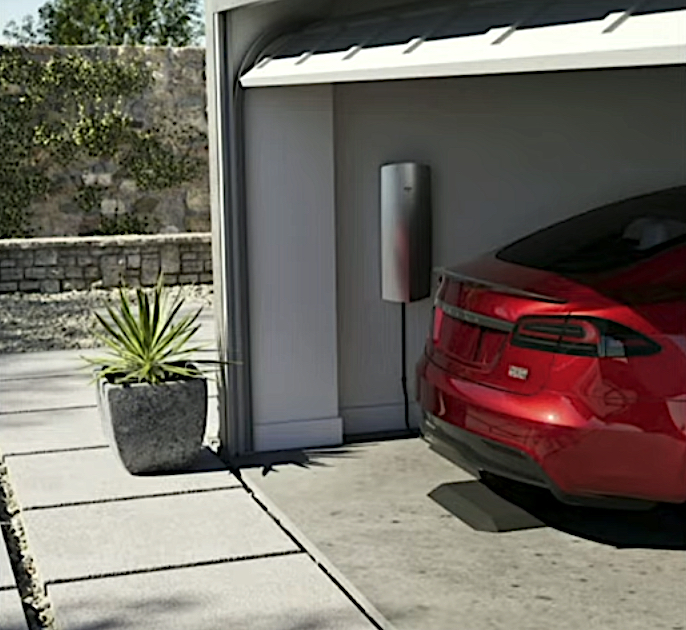
Model S wireless charging pad
So far, the expense of it—and the compatibility concerns—have kept wireless charging from going big. But with this boost from cross-compatibility plus plenty of hints Tesla is considering wireless charging, this tech might finally be on the verge of catching on.

2023 Ford Mustang Mach-E recalled due to bad windshield wiper motor

The 2023 Ford Mustang Mach-E is among three vehicles Ford is recalling for a bad windshield wiper motor. The others are the 2023-2024 Maverick and 2023 Ford Bronco Sport. A total of 37,371 vehicles are affected.
According to the NHTSA, the front windshield wiper motor of the affected vehicles may become inoperative, causing the wipers to fail. This could result in reduced visibility, increasing the risk of a crash.
The issue was brought to Ford’s attention on April 16. Ford investigated and discovered that water intrusion on the motor due to improper application of a sealer between the gear cover and gear housing was the cause for the failures.
The affected motors were assembled by a supplier on two dates: June 18, 2023, for the Mach-E and Maverick, and Sept. 1, 2023, for the Maverick and Bronco Sport. A total of 2,142 motors were built during this time. The affected Mach-Es were built at the Cuautitlan, Mexico, plant from July 3-17, 2023, and a total of 3,603 vehicles are affected.
The Mavericks were built at the Hermosillo, Mexico, plant June 20-Sept. 29, 2023, and the Bronco Sports were built at the same plant Sept. 3-Oct. 6, 2023. These more popular models make up the rest of the affected vehicles.
Ford is aware of 81 warranty reports across all three models, and says it is not aware of any reports of accidents or injuries due to the issue.
The cost of repairs will be covered by Ford. Owners can bring their vehicles to dealers, which will inspect and replace the windshield wiper motor if needed.
Ford is expected to notify owners on Aug. 26. Owners can also contact Ford customer service at 1-866-436-7332 and refer to recall number 24S51.

Toyota developing in-wheel electric motors
Toyota has filed a new patent application for in-wheel electric motors, indicating the automaker is still working on this tech.
The patent application was published by the United States Patent and Trademark Office (USPTO) Jul. 18, 2024, and originally filed by Toyota Oct. 30, 2023. It deals specifically with a gear-case design that uses two helical gears and thrust bearings, which Toyota claims in the application allows the gear case to withstand thrust loads on the gears with minimal weight increase.
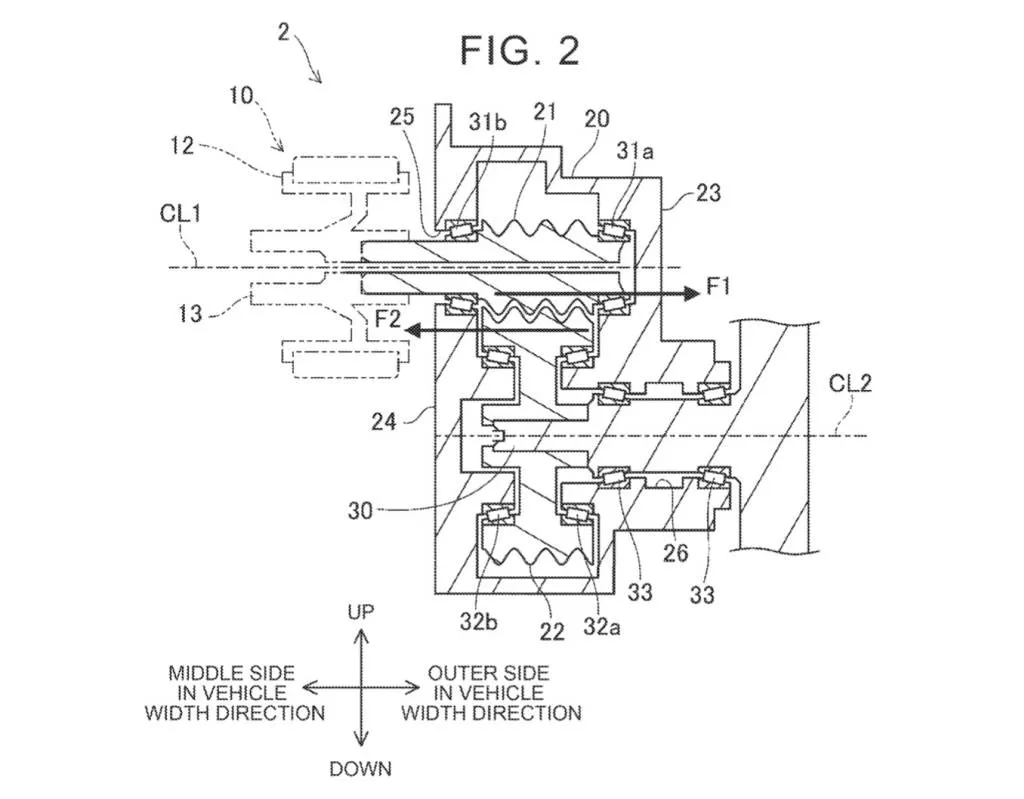
Toyota in-wheel motor patent image
While minimizing weight is an overall virtue in automotive engineering, keeping the weight of the gear case to a minimum can help reduce unsprung mass—one of the main drawbacks of in-wheel motors. Too much unsprung mass—meaning mass not supported by the suspension, such as motors attached the wheel hubs—can make tuning for ride and handling difficult.
Patent applications are not the same as product plans but, as Just-Auto has pointed out, Toyota has filed a lot of patents on in-wheel motors in recent years, so it’s clearly still at work on them. Toyota has had an in-house in-wheel motor program in the past (as did General Motors), and this might suggest that it either remains active or has been revived.
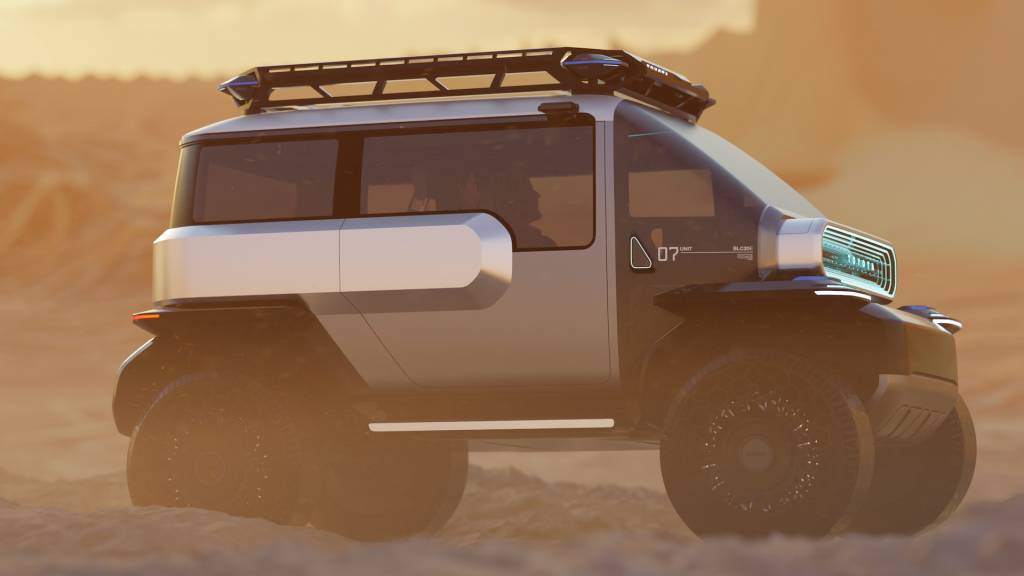
Toyota Baby Lunar Cruiser concept
Toyota highlighted in-wheel motors as an efficiency and packaging choice 15 years ago or more and had signaled that its iQ EV might have them in an internally developed form. It arrived with a standard inboard motor setup though. More recently, Toyota has teased in-wheel motors on its Lunar Cruiser concept.
The tech is finding its way into passenger vehicles, gradually, and Aptera is including them as part of what it claims will be a super-efficient electric 3-wheeler, but a lot of questions about durability and safety remain. Hyundai has also teased another approach that moves an in-wheel motor design close to the wheels but not in them—but with no clear production plans.

Ford tackling aero efficiency with deployable roof rack rails
Ford is looking to patent roof rails and roof racks that can stow away when not in use, helping to reduce aerodynamic drag and potentially improving fuel economy or EV range.
These potential aero-improving features were detailed in separate patent applications published by the United States Patent and Trademark Office (USPTO) July 11, 2024, and filed by Ford at earlier dates.
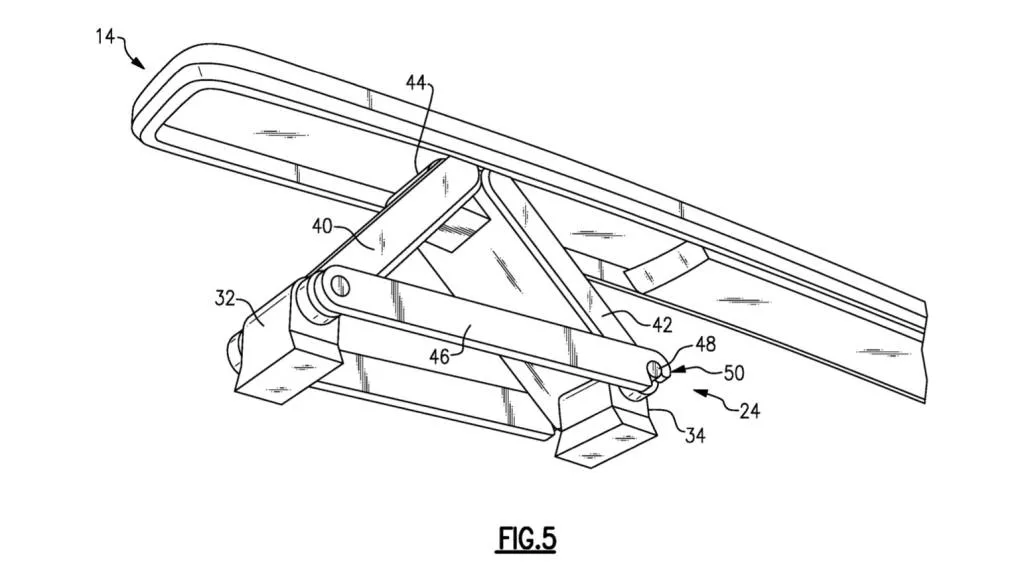
Ford deployable roof rail patent image
One patent application covers deployable roof rails that would pop up out of channels in a vehicle’s roof on hinges, and then serve as mounting points for cargo carriers and other accessories like the fixed roof rails already offered on many SUVs.
Another patent application covers a deployable roof rack, although in this case the hardware appears tailored specifically to pickup trucks. The roof rack would be stowed behind the back wall of a pickup’s cab, at the front of the cargo bed, and pivot upward onto the roof when needed.
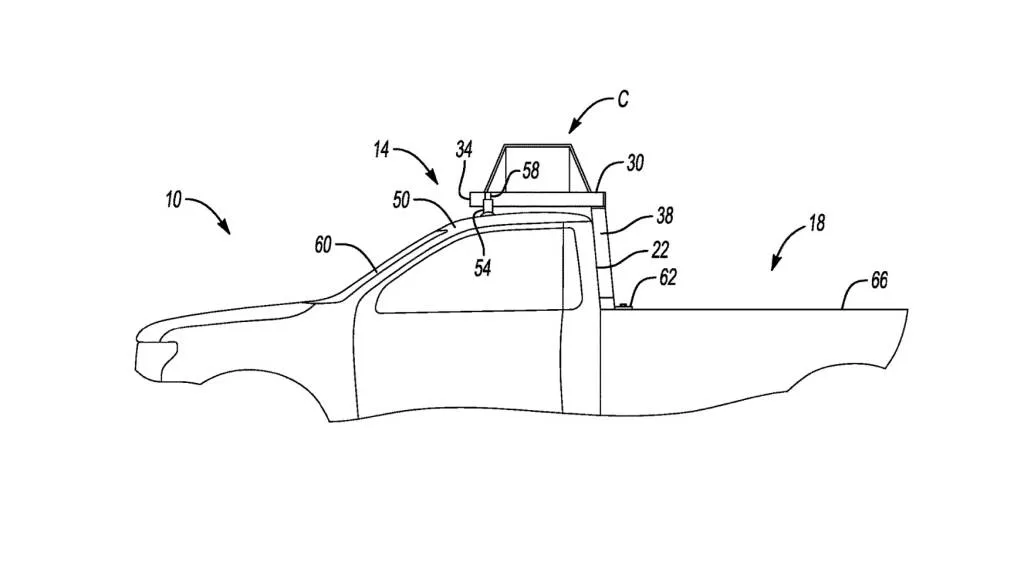
Ford deployable roof rack patent image
Automakers don’t always commercialize features that they patent, Ford wouldn’t be alone in looking for new ways to improve aero efficiency. Hyundai has designed an active air skirt for EVs that drops down ahead of the front wheels to reduce drag. The automaker claims this feature could help improve the aerodynamic performance of SUVs—something that could also be said of Ford’s deployable roof rails.
The need to maximize EV range has rekindled an obsession with aerodynamics first seen nearly a century ago, sparking the creation of streamlined shapes for the Hyundai Ioniq 6 and Volkswagen ID.7, among others. The Mercedes-Benz Vision EQXX concept has also shown that greater emphasis on aero—along with weight reduction—could help dramatically boost EV efficiency.

Shailen Bhatt delivers a new national V2X deployment plan (Episode 264)
The administrator of the Federal Highway Administration details a new U.S. DOT plan for rolling out a long-simmering technology capable of saving thousands of lives on American roads. He also talks about the ways artificial intelligence and infrastructure can accelerate safety improvements.

2024 Acura ZDX recalled for software that cuts braking power
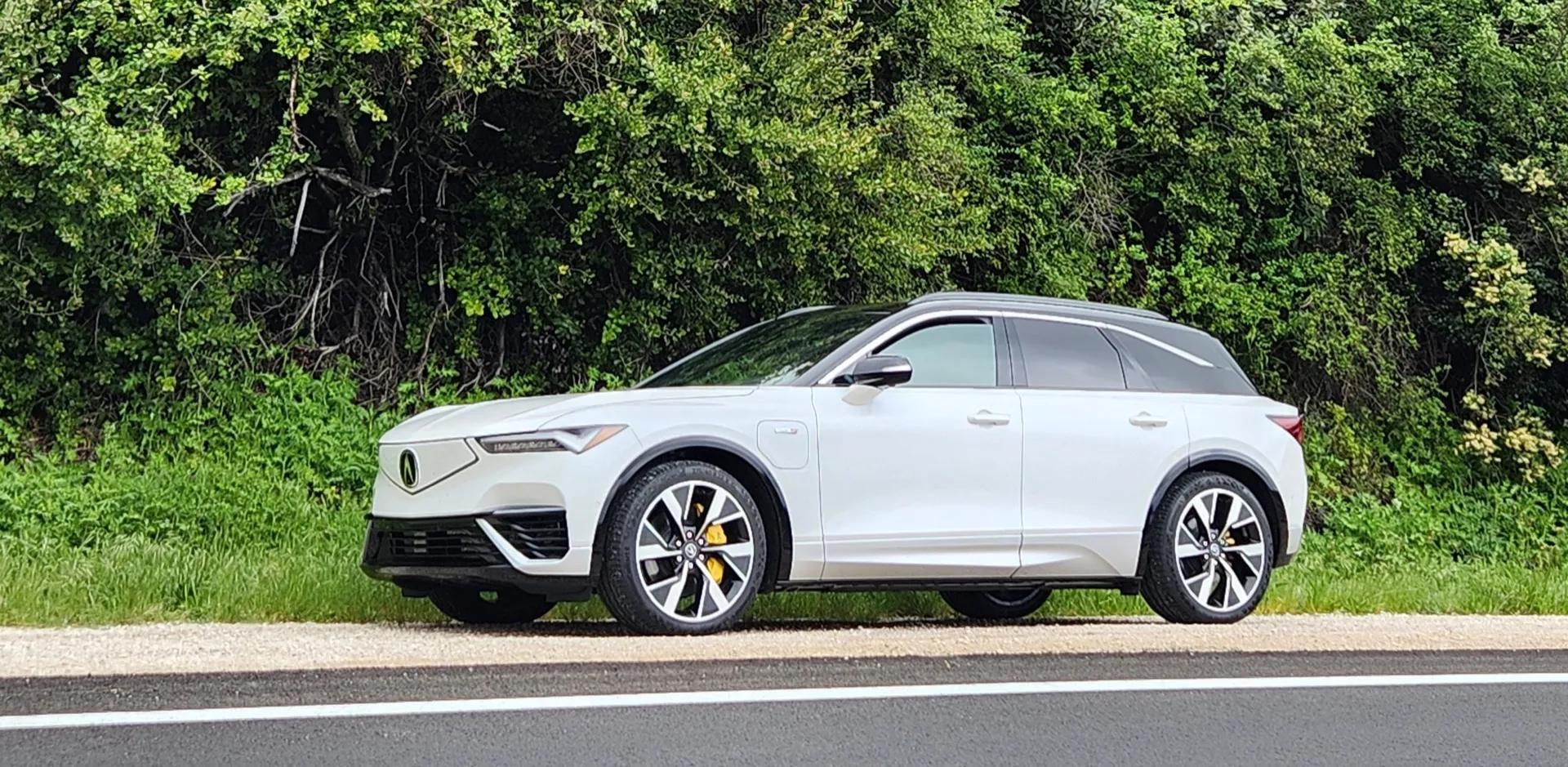
The 2024 Acura ZDX is being recalled for a software issue that can cause the anti-lock braking system to reduce stopping power at speeds under 25 mph, Acura announced Friday. The proposed remedy is easy enough: an over-the-air software update patched through at home that should take about five minutes. That means no trip to the dealer, unless you want help.
The software update to about 5,000 units of Acura’s first electric vehicle addresses a miscommunication between the electronic control module and the brakes. On flat, dry surfaces, and with the electric crossover traveling at less than 25 mph, the anti-lock braking system might continuously activate, and subsequently release braking pressure. Braking power can be reduced or fail altogether.
The remedy was patched through to owners today. After driving and shifting the EV to park, a prompt should appear on the 11.3-inch touchscreen to install an update. It can be done later by going to Settings>Updates>History. The caveat? The vehicle must be enrolled in OnStar, the GM telematics system that recently came under legal scrutiny for GM allegedly selling drivers’ data to insurers without drivers’ knowledge.
The 2024 Acura ZDX borrows many things from GM, including GM’s Ultium EV propulsion system used on the Cadillac Lyriq, Chevy Blazer EV, and Honda Prologue.
During the update, Acura says the ZDX won’t be operable and even the door locks and windows won’t work. If owners don’t want to do it themselves, they can visit an Acura dealer. For more info, visit contact Acura at 888-234-2138 or visit Acura’s recall hub.

Cadillac Opulent Velocity Concept previews possible performance EV
Cadillac is thinking about leaning into an ultra-luxury future, and if it comes it will be propelled by electric powertrains. The brand has already produced the $340,000 Celestiq EV and previewed a possible EV convertible called the Sollei concept. On Friday at Monterey Car Week, the American luxury brand showed the Cadillac Opulent Velocity Concept, which, as the name suggests, would deliver over-the-top luxury and exhilarating performance.
Cadillac touts the concept as the “ultimate expression of a zero emissions hypercar luxury performance” and “the future of all-electric luxury performance.” A 2+2 coupe, Cadillac says the Opulent Velocity Concept’s design is inspired by motorsports and combines a hypercar personality with luxury execution. We see the sleek style of the 1930s Delahayes.
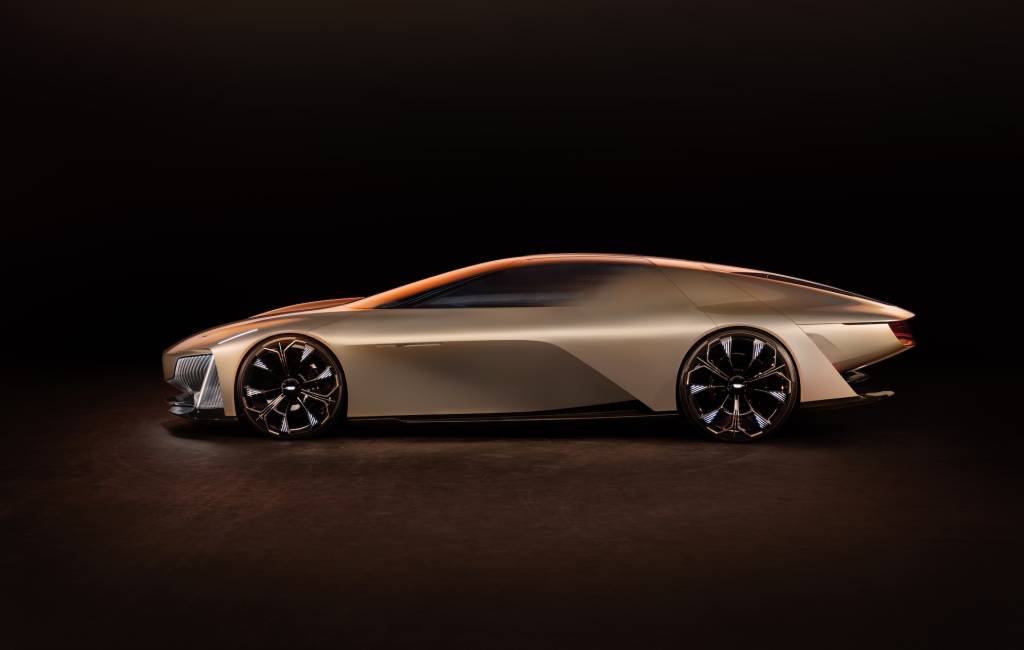
Cadillac Opulent Velocity Concept
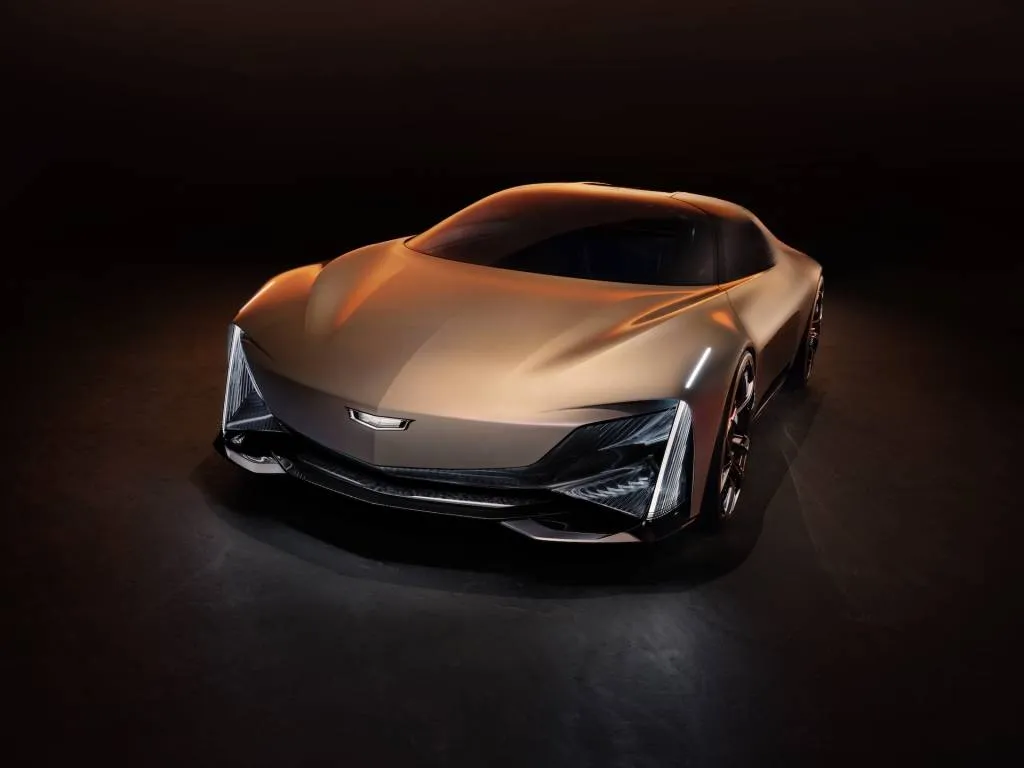
Cadillac Opulent Velocity Concept
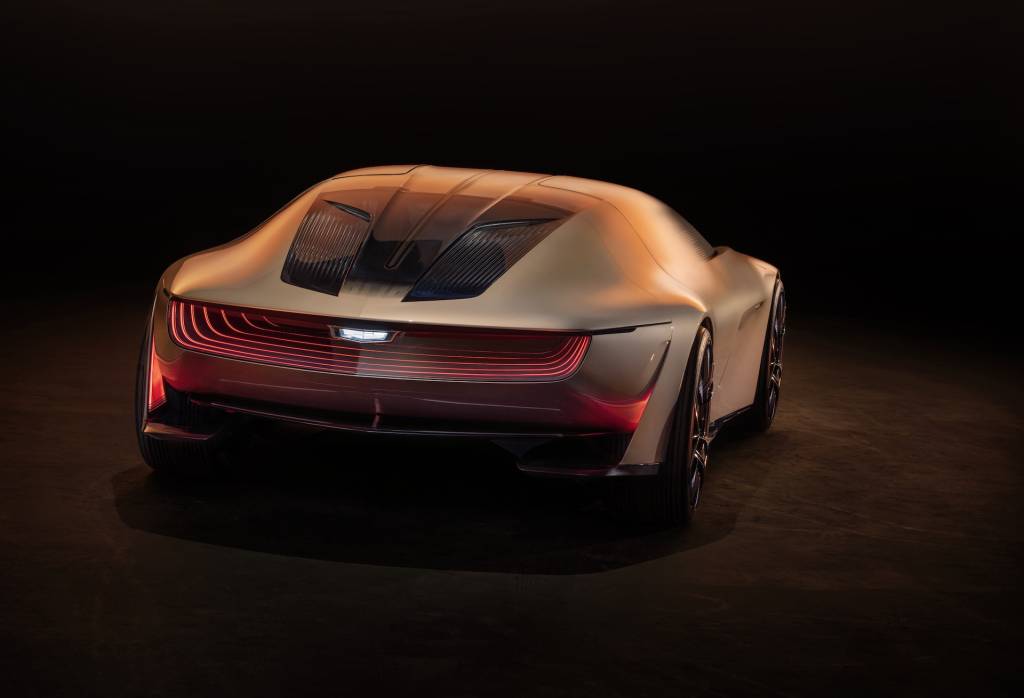
Cadillac Opulent Velocity Concept
Design director Brian Nesbitt said the car represents “future electrification design expressions.” The car has a long, flowing profile, a low stance, self-opening butterfly doors that cover both seating rows, and sheet metal that looks like it’s draped over the body. The nose sports a pointed beak that sits above a slim grille and is flanked by Cadillac’s signature vertical light elements. The roof resolves into a straked rear window with something of a split-window design, and the rear end has a full-width pinstripe taillight design that kicks up at each end. Crystal fluting adorns the headlights, grille, and taillights. The body is painted a gold Gilded Pearl.
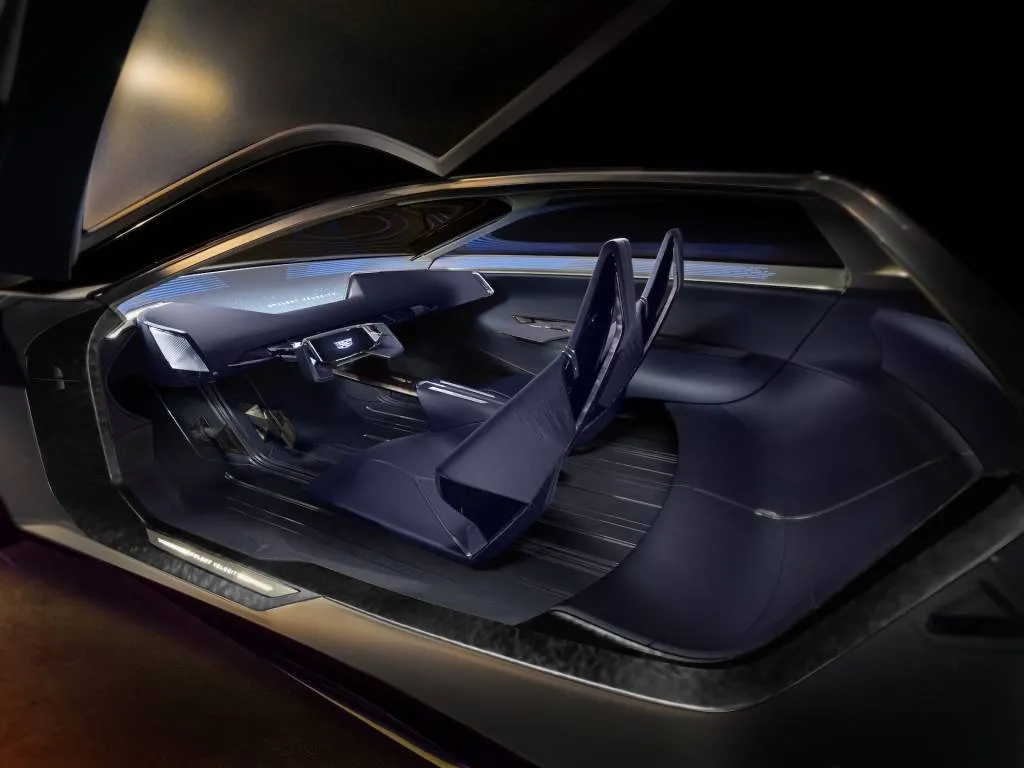
Cadillac Opulent Velocity Concept
Inside, it’s all concept car, with slim bucket seats, a yoke-style steering wheel with an integrated screen, an augmented reality head-up display, and a widescreen display that Cadillac says is “3D information-enabled.” The cabin is upholstered in a color called Selene, a dark blue that is offset by metal brushed finishes. The cockpit also uses 3D printing technology and flax fibers under silver pearl flakes.
The concept would provide two types of driving experiences. The Opulent experience would be enabled by a Level 4 hands-free driving system that would work in certain areas and allow drivers to look away from the road and only take back control when prompted. The experience would also use art, entertainment, and lighting during hands-free driving to relax occupants. The steering wheel and pedals would retract in this mode.
The Velocity experience promises track-ready thrills inspired by the brand’s Blackwing models. It would use a “ghost car” function on the head-up display to show the racing line and help drivers improve their lap times like in various driving games. Cadillac says the mode would also provide road overlay and road condition information, and let drivers control the active aerodynamics and suspension damping.
Cadillac provided no information on those active aero features or what the powertrain or suspension would be. The brand only said the Opulent Velocity Concept would use an electric powertrain, likely with big power numbers.
The high-minded and expensive Celestiq indicates Cadillac could build a car like the Opulent Velocity Concept, possibly with its Ultium battery set. More likely, however, elements of the design will appear on a future Cadillac performance model.