
Category: General


Lucid CEO: EV market softening “a temporary blip”
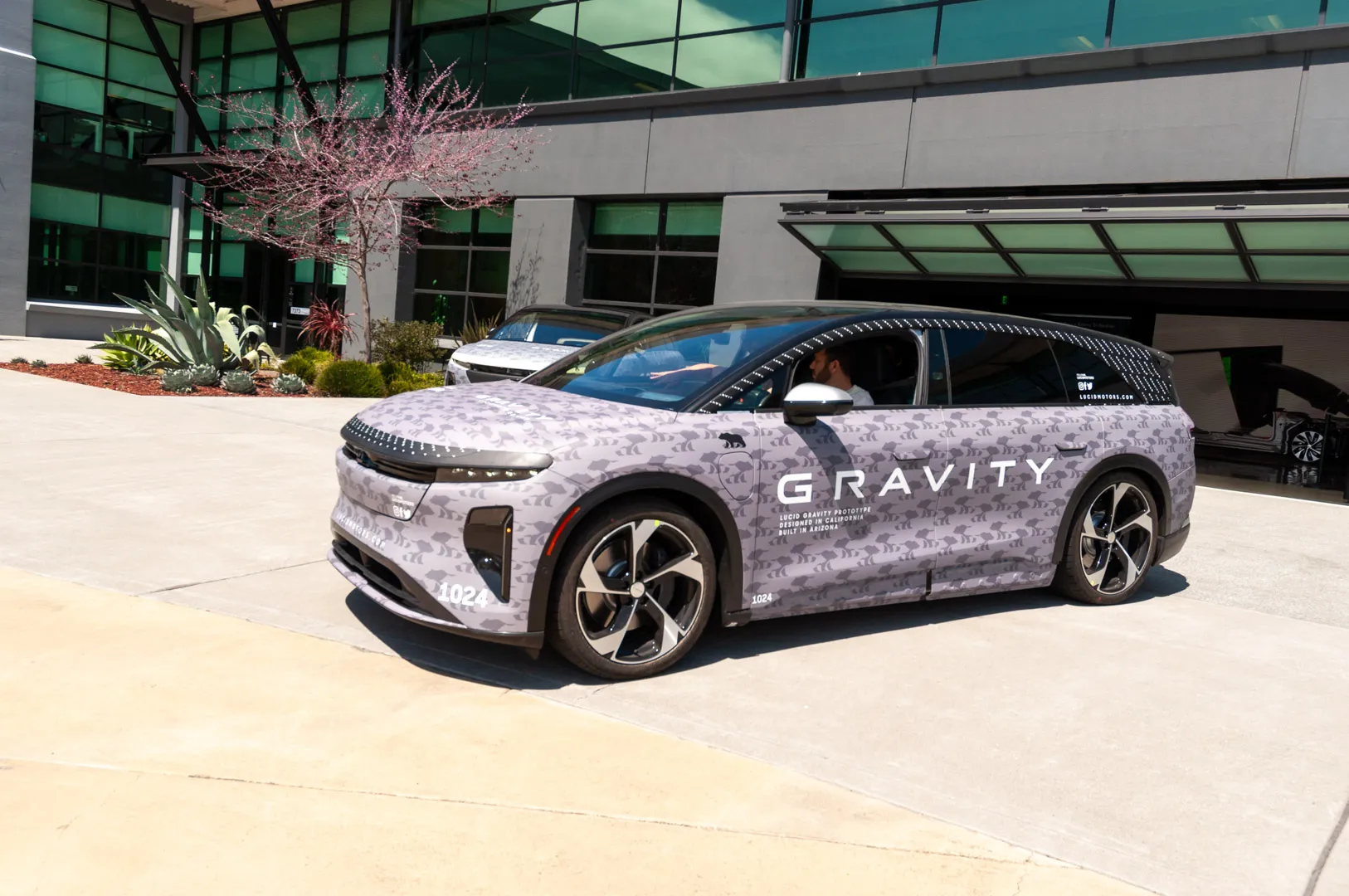
Lucid’s CEO Peter Rawlinson believes the future is electric.
Rawlinson told The Verge at 2024 Monterey Car Week in California that “I think we’re seeing a temporary blip. I think any talk of retrenchment into hybrids is a blind alley. I think hybrids offer the worst of all.”
The comment by Rawlinson came days before Ford killed its electric three-row SUV and said it would shift its electrification strategy to include more hybrids.
In May, the California New Car Dealers Association released Q1 2024 sales figures. While overall the EV market share sagged in California, EV sales were up. The reason was new-car registrations grew overall with even more non-electric vehicles sold. EV sales are rising by volume.
Dealerships today have more EV options for consumers than ever, but Rawlinson noted the options are underwhelming. The sentiment was echoed by Lucid’s president of design and brand, Derek Jenkins.
Lucid’s built a substantial advantage over the competition in terms of EV efficiency. The 2025 Lucid Air Pure is the most efficient vehicle sold in the U.S. with a 146 MPGe rating equating to 5.0 miles per kwh. Earlier in August Rawlinson noted in a LinkedIn Post that it will take years for the competition to catch up. The competition is slowing and shifting its electrification plans.
The second model from the startup automaker, the Gravity SUV, debuted in 2023 and pre-production units started rolling off the assembly line in July. Green Car Reports drove a prototype Gravity in May and noted when it launches later this year it might outpoint some key rivals in terms of packaging, design, and driving dynamics.
A midsize crossover SUV is under development and has been teased by Lucid. The potential Tesla Model Y rival has been dubbed “Project Midsize,” and is said to be planned for a launch after the Gravity SUV.

Tesla Model X recalled because roof trim may fall off
Tesla is recalling 9,136 Model X electric SUVs from early in the vehicle’s production run to fix trim prices that may not have been properly applied to the roof and could come off.
The recall includes 2016 Tesla Model X vehicles manufactured from the start of production until Jul. 31, 2016, when a change in the assembly process was made at a supplier, according to the NHTSA. In the earlier vehicles now being recalled, two trim pieces—one just behind the windshield and another between the upper glass sections of the Model X’s signature roof-hinged “Falcon doors”—may not have been applied properly.
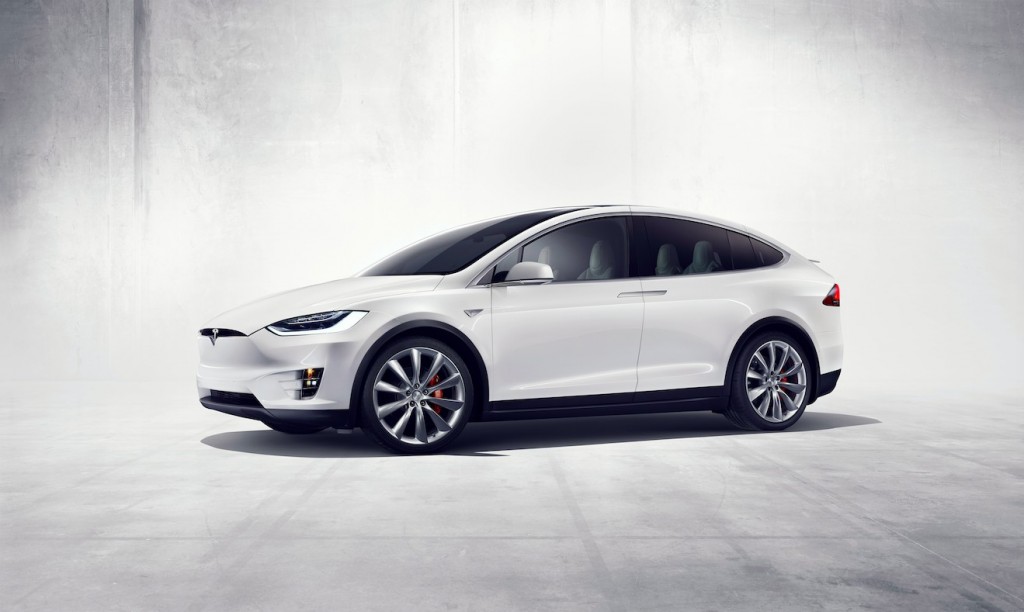
2016 Tesla Model X
If the trim pieces were attached without primer between the pieces and the urethane coating used to adhere them the adhesion could weaken over time, potentially leading to the trim pieces separating from the vehicle, according to the NHTSA. Trim pieces separating from a car while driving present a potential hazard to other road users, although Tesla is not aware of any accidents or injuries related to this problem.
Tesla previously conducted a recall for this issue on Nov. 17, 2020, but found that the inspection process used was inadequate. The automaker will now again ask customers to bring their cars to service centers where the trim pieces will be inspected and, if necessary, replaced free of charge.
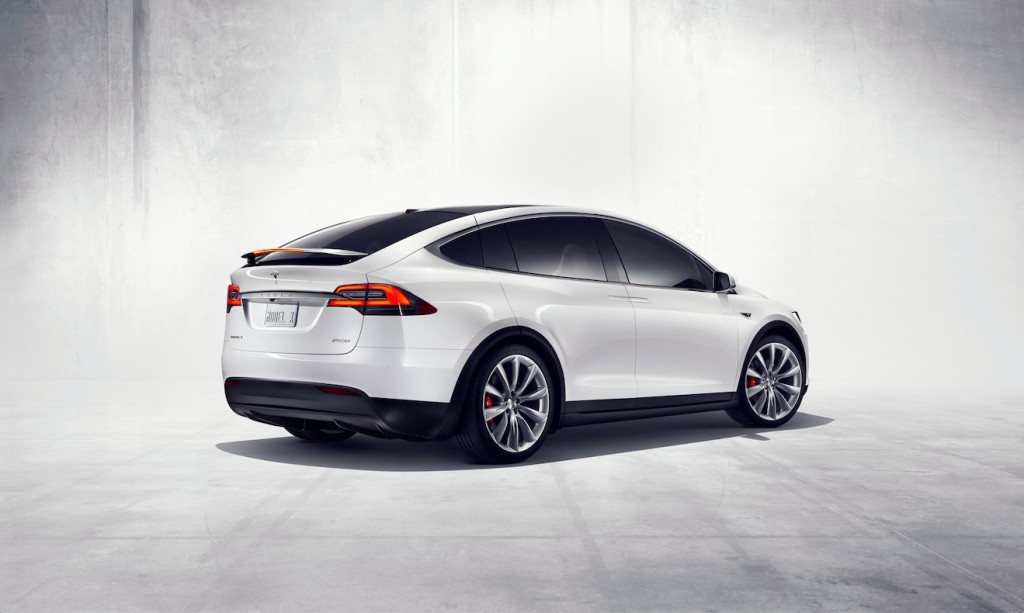
2016 Tesla Model X
While Tesla has managed to conduct several recalls with over-the-air software updates, hardware-related issues like this one, or a pair of recent recalls of the Tesla Cybertruck, still require an in-person visit to a service center.
Tesla plans to begin mailing notification letters to owners Oct. 14, 2024. In the meantime, owners can contact Tesla customer service at 1-877-798-3752 for more information. Tesla’s reference number for this recall is SB-24-12-008.

Love’s plots fast-charging for future road trips
- Love’s added charging stations to two of its gas stations
- All future Love’s Travel Stops will have EV chargers
- Love’s started adding chargers to its gas stations in 2017
Love’s Travel Stops is continuing to add EV charging at its locations, in part with federal funding from the Biden administration’s infrastructure law.
On Tuesday, Love’s announced the groundbreaking of two new “next-generation” charging sites in Ripley and Waterloo, New York. Each will feature two dual-port DC fast chargers (for a total of four charging connectors) albeit with a minimum power rate of 160 kw. All new Love’s Travel Stops will also have space set aside for EV charging.
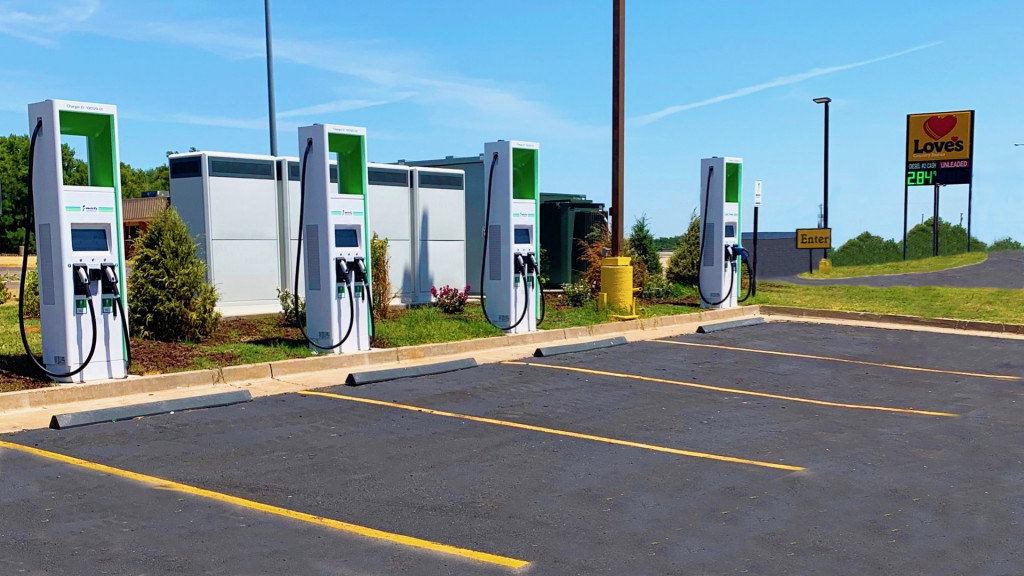
Electrify America charging stations at Love’s Travel Stop
Love’s has been installing EV chargers since 2017, and in 2020 partnered with Electrify America to add road-trip charging waypoints at its locations. The company now claims to have more than 100 chargers at 28 stores in 11 states. That includes a mix of Level 2 AC chargers and DC fast chargers, but future construction will be exclusively fast chargers under protective canopies.
Love’s also confirmed that it had secured National Electric Vehicle Infrastructure (NEVI) funding to pay for some of its new charging stations. Created under the 2021 infrastructure law, the NEVI program provides $7.5 billion for a national network of 500,000 charging stations along 75,000 miles of highways, with said funding allocated state-by-state. Love’s claims to be among the top three firms in terms of funding received.
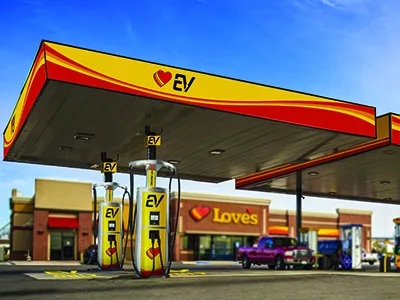
Love’s Travel Stop EV charging
Groundbreaking for four NEVI-funded stations in Pennsylvania, and four more in Kentucky, will start this year, according to Love’s. Construction on additional NEVI-funded stations in Alabama, Arkansas, Colorado, Georgia, Indiana, Kansas, Michigan, Ohio, Oklahoma, Tennessee, Texas, Virginia, and Washington is expected start in 2025. It’s an encouraging sign after the relatively slow roll out of the federal charging network thus far.
Love’s points to factors like proximity to highways, onsite amenities, and 24/7 staffing as plusses for co-locating EV charging with its travel centers. That’s also the case with an EV fast-charging network at Pilot Travel Centers being developed jointly with General Motors. The first 17 locations opened in 2023, with about 200 planned by the end of 2024.

Ford: Two new electric trucks, more hybrids, no three-row electric SUV
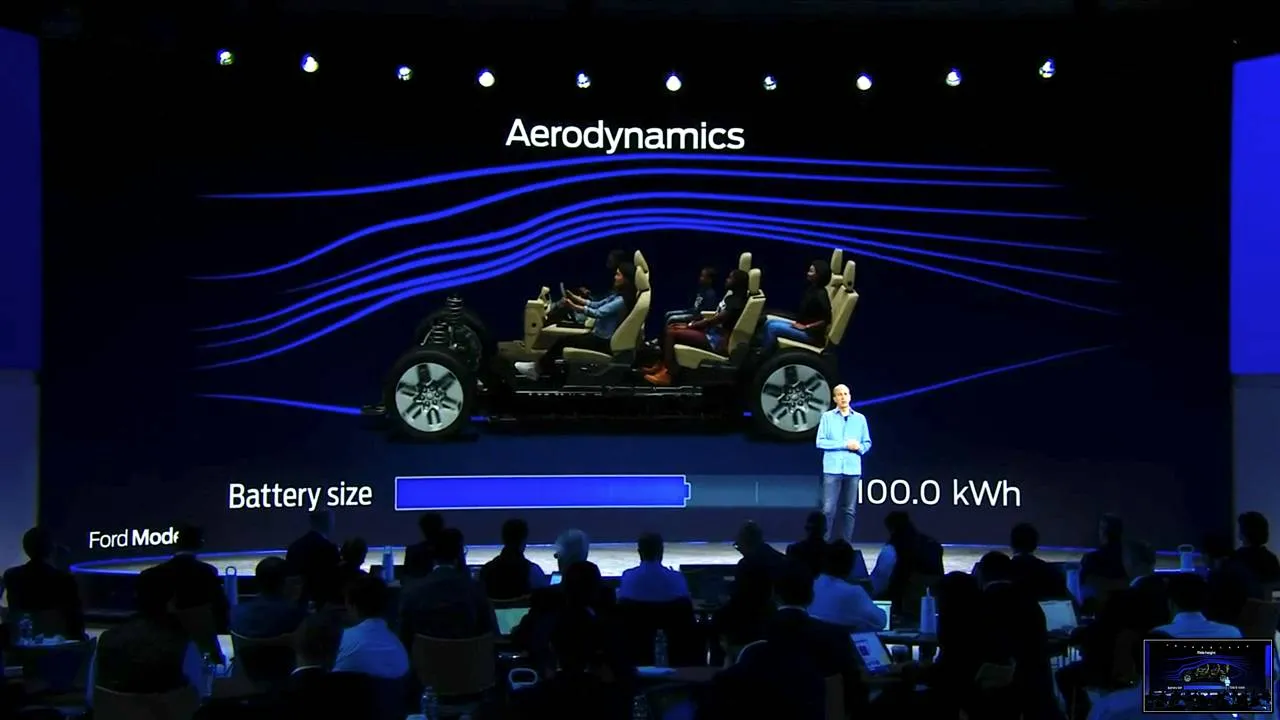
Ford on Wednesday said it plans to launch more hybrids and cut back on a previously announced battery-electric vehicle as it adjusts to the changing landscape for electrified vehicles.
The automaker said its changed roadmap is aimed at lowering prices, particularly for EVs whose buyers today are more cost conscious compared to the early adopters of previous years.
The new roadmap is also aimed at capitalizing on increasing demand for hybrids. A direct consequence of this will be a reduction in investment in EVs from about 40% of Ford’s annual capital expenditures at present to 30%.
3-row electric SUV out, midsize electric truck in
New EVs in the pipeline are confirmed by Ford to include a commercial van to be built in Ohio starting in 2026, followed by mid- and full-size pickup trucks in 2027. A previously announced three-row SUV originally planned for launch in 2025 has been canceled. Ford said it invested $400 million thus far in the three-row SUV, and that the final cost of its shifted product plan could reach up to $1.5 billion.
The midsize truck will be based on a new low-cost EV platform that Ford said was developed by a “skunkworks” team in California, and is set to feature the automaker’s BlueCruise automated driver-assist feature. The platform will be used for multiple vehicles, including passenger and commercial vehicles, starting with the midsize truck.
The full-size truck, code-named Project T3, will serve as the replacement for the F-150 Lightning. It will be built in Tennessee and has previously been referred to by Ford CEO Jim Farley as the “Millennium Falcon of pickup trucks.” The full-size truck was originally planned for launch in 2025, but Ford on Wednesday said delaying it will enable the automaker to benefit from lower-cost battery measures and other cost advantages while also giving the market more time to adjust to EVs.
Cheaper batteries are key
A specific lower-cost battery measure Ford will adopt is building cheaper lithium iron phosphate type batteries in the U.S., meaning they’ll qualify for for Inflation Reduction Act benefits. Ford also said on Wednesday it will move production of batteries for the Mustang Mach-E from Poland to the U.S. That suggests the vehicle will stick around and should also remain eligible for Inflation Reduction Act tax credits.
Ford also plans new hybrids, especially in bigger segments where the automaker said battery costs remain challenging. Ford specifically mentioned three-row SUVs that would offer hybrid powertrains, potentially covering the segments of the Explorer and Expedition.
Ford also hinted at a hybrid option for its next-generation F-Series Super Duty, which the automaker said would offer a range of propulsion options.
Ford plans to given an update on its electrification plans in the first half of 2025.

Battery maker Northvolt shutting down R&D in California
Swedish battery firm Northvolt is shutting down a research and development facility working on lithium-metal batteries in California and moving all development work to its R&D hub in Vasteras, Sweden, the company said Tuesday.
Northvolt had been conducting some development work on lithium-metal battery technology—an alternative to the currently prevalent lithium-ion chemistry—through wholly Cuberg, a wholly-owned subsidiary in the San Francisco Bay Area the company acquired in 2021.

Rendering of Northvolt Six battery factory in Quebec, Canada
In what the company calls a “strategic move,” Northvolt plans to move the lithium-metal development work to Sweden, where it will continue alongside research projects into other battery chemistries, including lithium-ion and sodium-ion.
“By centralizing our efforts, we are better equipped to deliver the next generation of energy solutions to meet the growing demands of the global market,” Northvolt chief development officer Sami Haikala said in a statement.
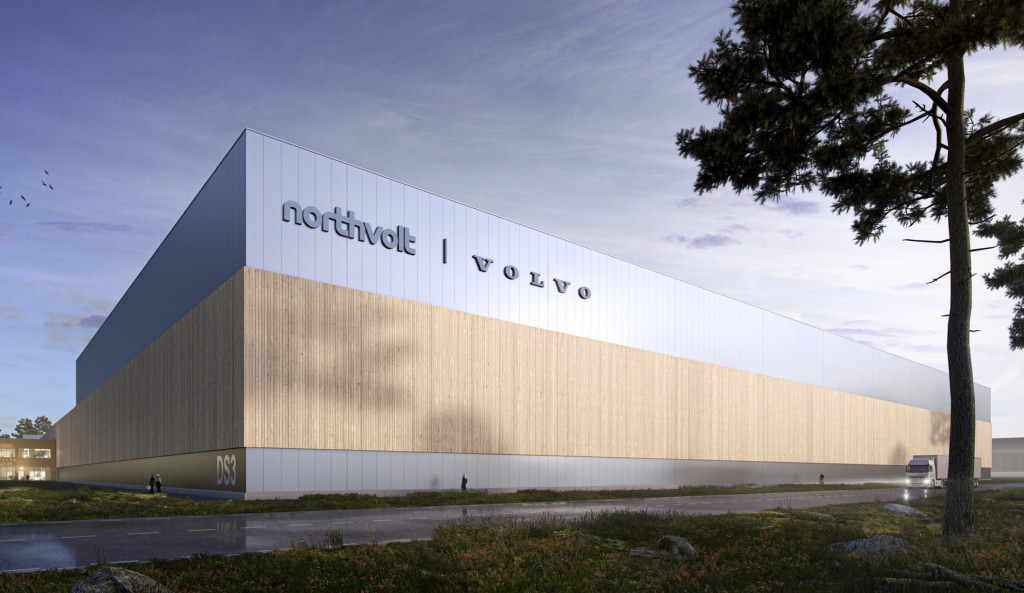
Artist’s impression of Volvo and Northvolt battery plant planned for Gothenburg, Sweden
Northvolt in June lost a BMW battery contract valued at roughly $2 billion, after reportedly failing to deliver batteries on time. The contract specified that Northvolt would start making batteries for BMW this year. The company also announced a joint-venture battery plant with Volvo in 2022 that’s expected to make batteries for an upcoming all-electric version of the Volvo XC60 SUV. That plant is scheduled to open in 2025 and aims to make enough batteries to supply 500,000 EVs annually.
Northvolt currently makes batteries in Europe exclusively, but in 2023 announced a $5.2 billion Canadian EV battery plant, to open by 2026. The plant’s Canadian location checks one of the boxes for qualification for the revamped federal EV tax credit under new rules enacted by the Biden administration.

2025 VW ID.Buzz costs $61,545, up to 234 miles of range
- The 2025 Volkswagen ID.Buzz will cost $61,545
- Single-motor models will have 234 miles of range, dual-motor models have 231 miles of range
- The ID.Buzz will arrive in U.S. dealers later this year
The two most pressing pieces of the VW Bus’s return have finally been revealed.
On Wednesday, Volkswagen said the 2025 ID.Buzz will cost $61,545 including a $1,550 destination charge and have up to 234 miles of range when it arrives later this year. Those numbers aren’t for the same vehicle.
Initially the ID.Buzz will be offered in three trim levels including Pro S, Pro S Plus, and launch-only 1st Edition. Rear-wheel drive will be standard while a dual-motor model with all-wheel drive will be available, but only on Pro S Plus and launch-only 1st Edition. Every U.S. ID.Buzz will feature three rows of seats with seating for six or seven passengers and a 91-kwh battery pack.
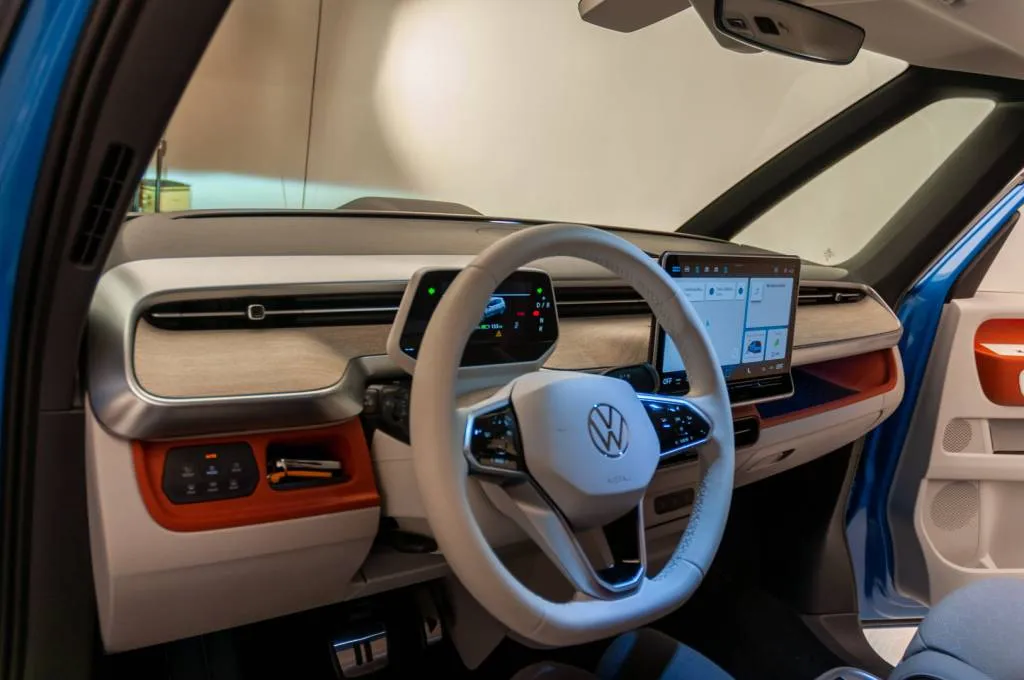
2025 Volkswagen ID.Buzz
Base Pro S models cost $61,545, have a single-rear motor with 282 hp and 234 miles of EPA-rated range. The rear-wheel-drive only model comes standard with a second-row bench seat with seating for up to seven passengers. Only three monotone colors, including Candy White, Deep Black Pearl, and Metro Silver, will be offered with the choice of Copper or Moonlight interior colors. Standard 20-inch aluminum wheels fill the wheels with LED lighting defining the front and rear ends.
Every ID.Buzz will have a 12.9-inch touchscreen infotainment system and 5.3-inch digital gauge cluster. The front center console is removable. Eight 45-watt USB-C ports and a 12-volt trunk outlet keep things charged along with a 150-watt 110-volt passenger seat outlet.
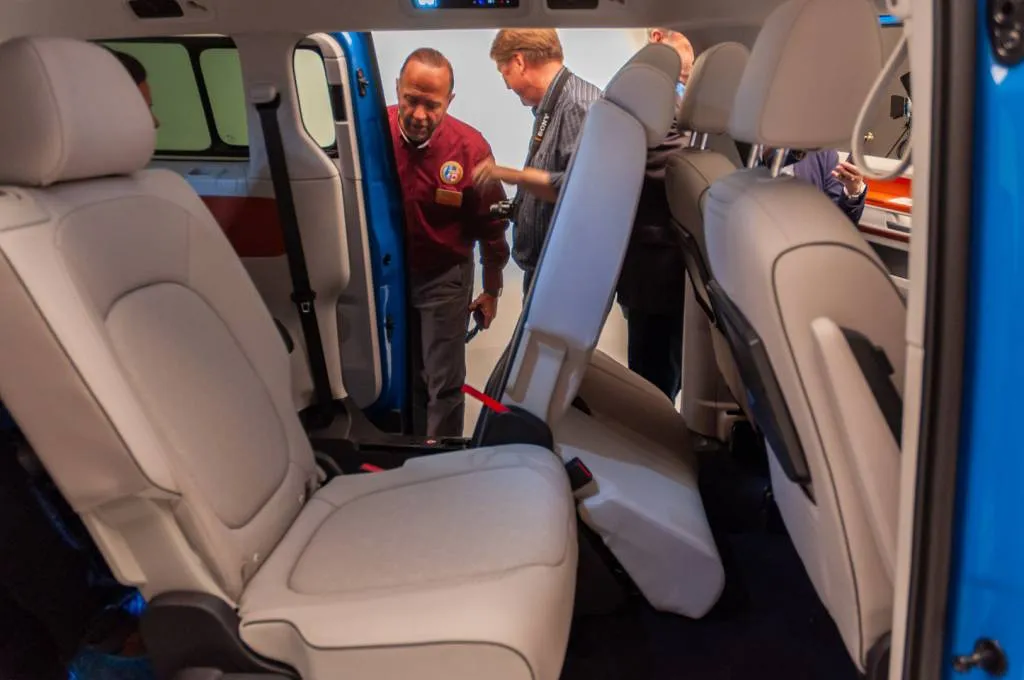
2025 Volkswagen ID.Buzz
Pro S Plus models cost $65,045 with the single 282-hp rear motor. Opting for the dual-motor model for all-wheel drive increases output to 335 hp and increases the price to $69,545 and drops EPA-rated range to 231 miles. The three monotone color options from the base model carry over, but for $995 the color palette opens to a variety of two-tone options. The interior can be optioned in Cooper, Moonlight, or Dune colors. The extra coin adds a head-up display and surround-view camera system along with a 700-watt Harmon Kardon sound system with 14 speakers. Single-motor Pro S Plus models a second-row bench seat is standard for hauling seven passengers while captain’s chairs are optional. Opting for the dual-motor powertrain makes the second-row captain’s chairs standard.
The launch-only 1st Edition model costs $67,045 in single-motor form and $71,545 for the dual-motor powertrain. Every 1st Edition features a Dune interior and five two-tone exterior color options. The 1st Edition models sport a specific 20-inch wheel design, roof rail cross bars, and badging throughout along with heritage-inspired floor mats. Single-motor models will have a second-row bench seat while dual-motor models will have captain’s chairs.

First 100% electric US school bus fleet arrives in Oakland
- The first school district in the U.S. to use all electric buses will be Oakland, California
- The buses, bidirectional chargers, and software management platform will be supplied by Zum
- The buses will feed up to 2.1 GW of power back into the grid when not being used
Zum, a transportation-services company that provides electric buses and charging stations to school districts, claims to have launched the first 100% electric school bus fleet in the U.S.
The company said that it is providing 74 electric school buses, bidirectional chargers, and a software management platform to the Oakland Unified School District of Oakland, California. The EVs will replace all internal-combustion buses in the district’s fleet, and will be able to feed up to 2.1 GW of power back into the grid when not transporting students, according to Zum.
While electric school buses are not a new idea, more than 90% of the nation’s nearly 500,000 school buses are still powered by fossil fuels, releasing 8.4 million tons of greenhouse gases annually, according to Zum. Most of those buses have diesel engines, creating an additional health hazard to students regularly exposed to exhaust fumes.
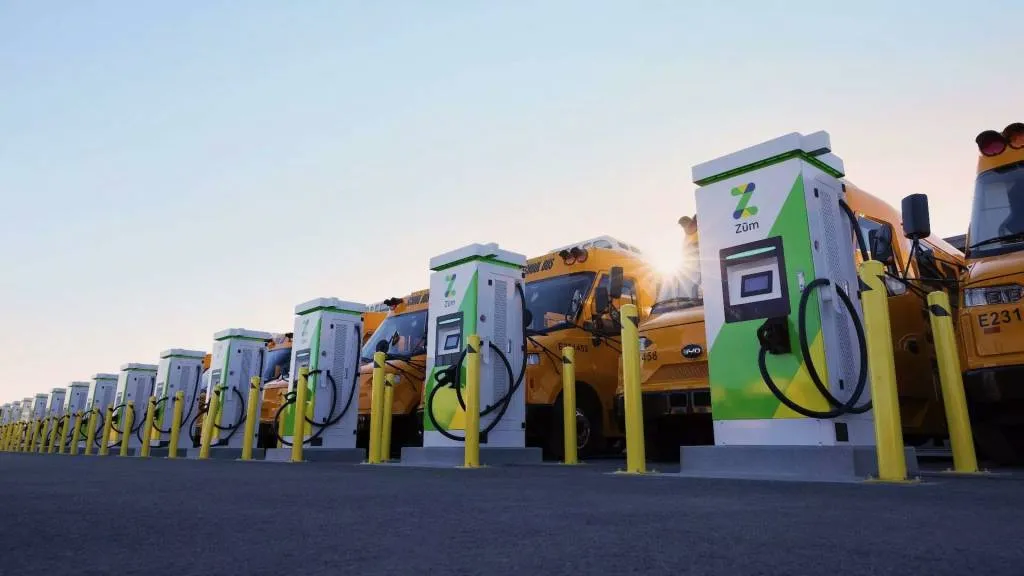
Electric school buses with Zum bidirectional charging stations
Use of electric school buses to support the grid, known as “vehicle-to-grid” (V2G) applications, requires extensive support from regulators and utilities, Zum noted. Pacific Gas & Electric (PG&E), whose service area the Oakland Unified School District is located in, also provided 2.7 MW of load to charge electric buses, the release added.
Zum aims to put 10,000 school buses capable of bidirectional charging into service, a fleet that could supply 300 GWH of power to electricity grids annually, the company claims. It’s currently working with the San Francisco Unified and Los Angeles Unified School Districts—which have bus fleets three and six times larger Oakland’s new electric fleet, respectively—to electrify their school buses.
Zum provides the vehicles but does not manufacture them. A handful of companies make electric school buses, including Lion Electric, which in 2021 announced plans for an Illinois plant to build them and other commercial vehicles. And in 2022 the EPA announced nearly $1 billion in grants for school districts looking to purchase these buses.