
Category: General

2025 GMC Sierra EV goes up to 460 miles, adds lower-price version
- 2025 GMC Sierra EV Denali steps up to an EPA-equivalent range of 460 miles
- Sierra EV Denali compares to Chevy Silverado EV RST
- Elevation and AT4 versions of Sierra EV are on the way
With the GMC Sierra EV pickup as well as the GMC Hummer EV family of SUVs and pickups, GM’s upmarket truck brand is fully on board with the idea of electric trucks—albeit without work-truck versions such as those offered through the Chevy brand.
To that, the GMC Sierra EV is mechanically identical to the Chevrolet Silverado EV, but it offers different design details and equipment to go along with the gas and diesel Sierra lineup. Both the Silverado EV and Sierra EV are entirely different vehicles underneath versus their combustion counterparts, built around GM’s large-format pouch cells jointly developed with LG.
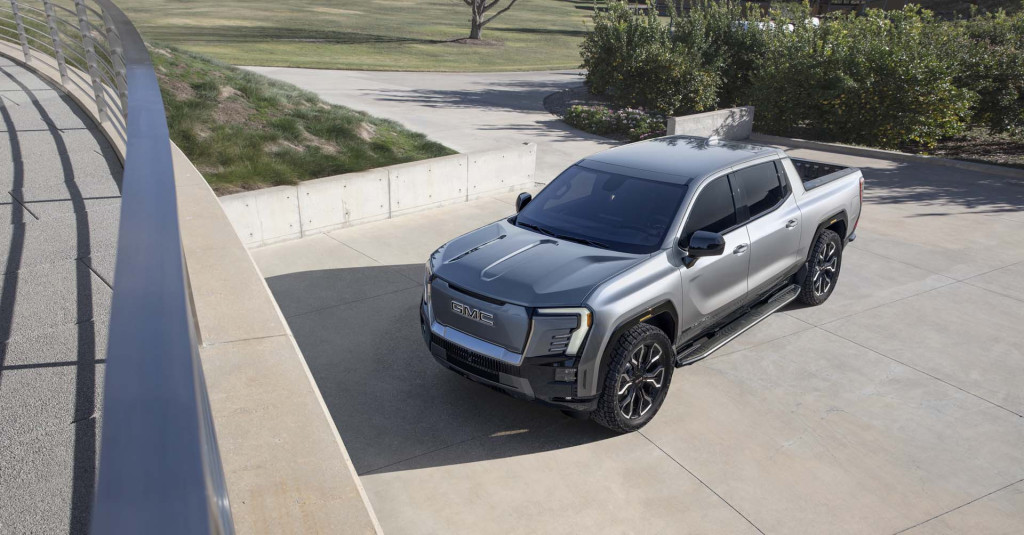
2024 GMC Sierra EV Denali Edition 1
The 2024 GMC Sierra EV has only up until now been delivered in Denali Edition 1 form, with the larger pack and a “GM-estimated” EPA range of 440 miles. GMC is re-upping the Sierra EV Denali for 2025 with more range and higher max tow ratings, and while work-truck versions remain out of the mix, it’s confirmed that Elevation and AT4 versions of the Sierra EV will arrive later in the 2025 model year.
Two battery-pack sizes give you a choice of how much range you need—and how much battery weight you want to be hauling around to enable that. In EPA range ratings, the GMC Sierra EV Extended Range versions deliver 390 miles of EPA range from about 170 kwh, and the Max Range versions previously at 440 miles are now “GM-estimated” up to 460 miles from about 205 kwh.
That parallels what Chevrolet recently announced for the 2025 Chevy Silverado RST—a range boost from 440 miles to 460 miles through what Chevy explained to be efficiency-related tweaks to motors, inverters, and aerodynamics. Work-truck (WT) versions of the 2025 Silverado EV rate up to 492 miles of range from that largest battery pack.
Both are dual-layer packs—meaning that the Sierra EV can charge at 800 volts and up to 350 kw—recovering up to 100 miles of range in about 10 minutes.

2024 GMC Sierra EV Denali Edition 1
The 2024 Sierra EV Denali was priced at $99,495, including the larger pack and $1,995 destination fee. For 2025, the Sierra EV Denali with that Max Range pack goes up about a thousand bucks, to $100,495 including 2025’s $2,095 destination fee. But with the smaller Extended Range pack, the Sierra EV costs $91,995.
The Sierra EV provides a combined 760 hp and 785 lb-ft of torque with either battery pack, via two motors and drive units—one front, one rear. Four-wheel steering enables an impressive turning circle of less than 42.2 feet, despite an overall length of 233.2 inches.
The front trunk—often called a frunk, but termed an “eTrunk” by GMC—holds 11.0 cubic feet of cargo and is an ideal space for a carry-on bag or backpack.
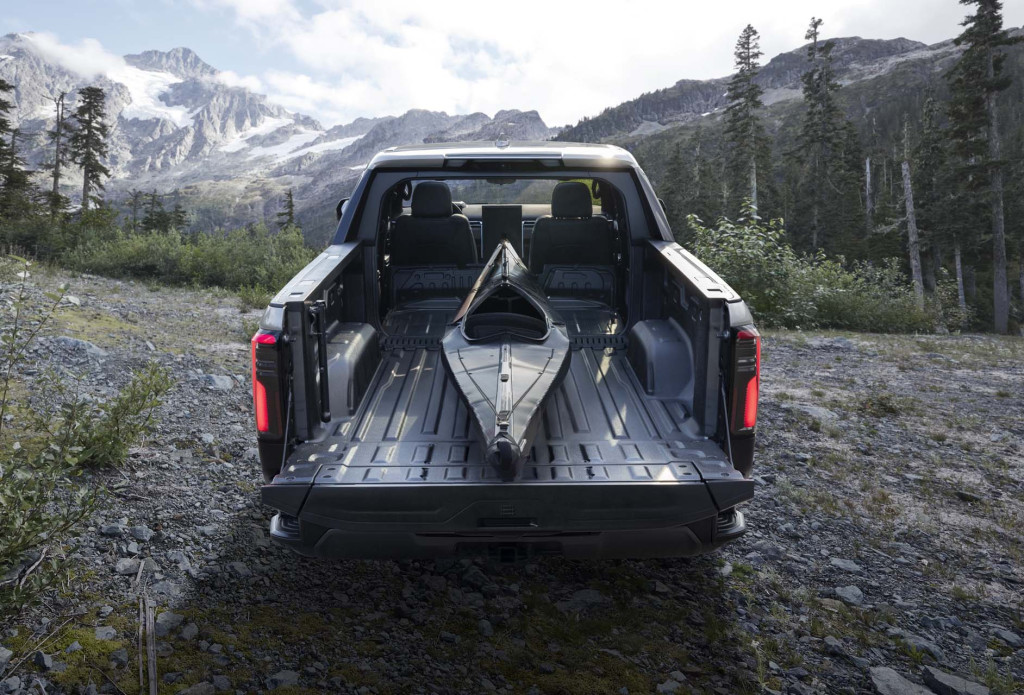
2024 GMC Sierra EV Denali Edition 1
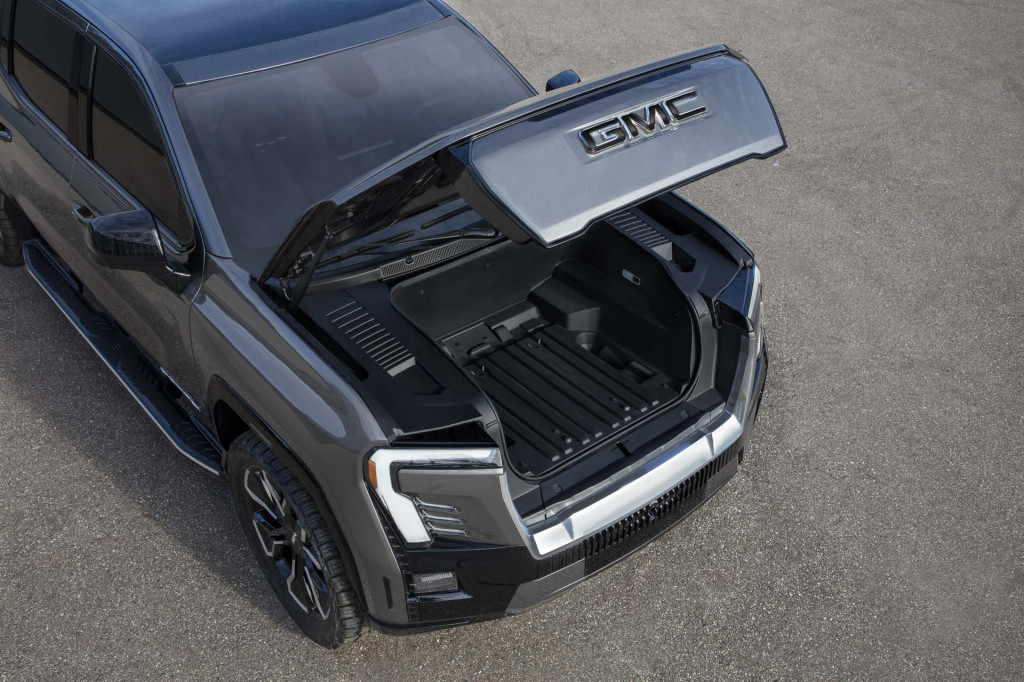
2024 GMC Sierra EV Denali Edition 1
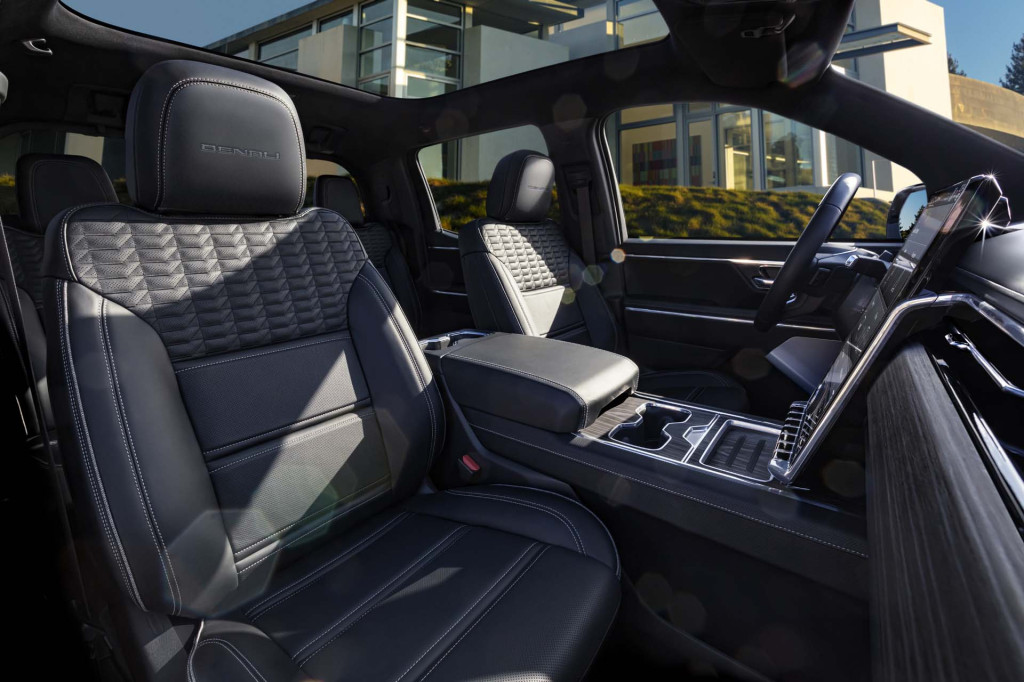
2024 GMC Sierra EV Denali Edition 1
Like the Silverado EV, the Sierra EV offers a super-versatile midgate setup—meaning that the bed of the truck can be expanded to fit items up to 11 feet long, while still accommodating passengers in the back seat. Think of it as wiggle room to balance out your needs, depending on the job.
An adaptive air suspension also improves ride comfort and allows the truck to be raised or lowered by about two inches.
The 2025 GMC Sierra EV also ups its max towing capacity 500 pounds versus last year—to 10,500 pounds.
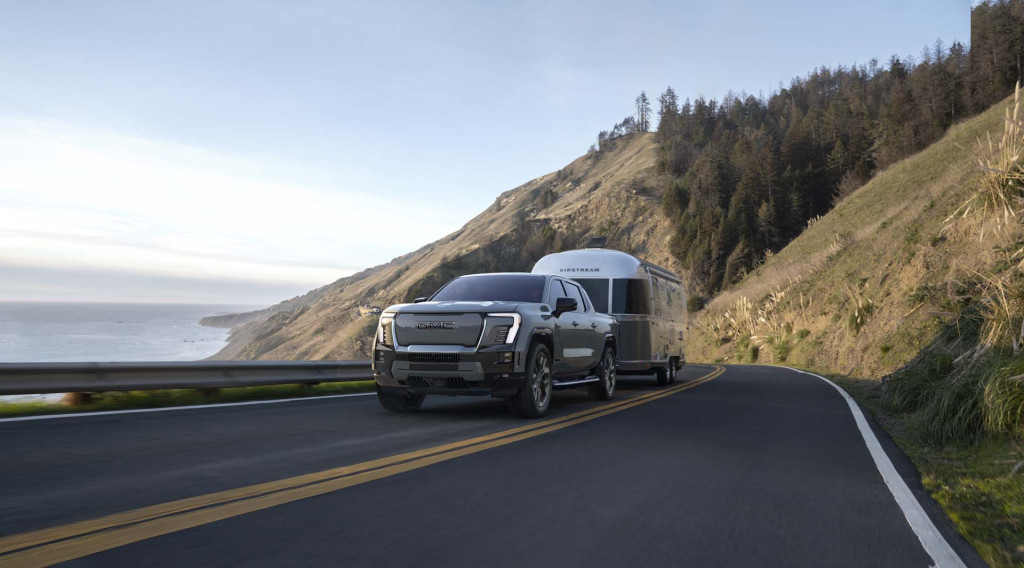
2024 GMC Sierra EV Denali Edition 1
GMC says that those upcoming Elevation and AT4 trims of Sierra EV will arrive in the first half of 2025. Here, it might be useful to look to the gasoline Sierra, where the Elevation models get more blacked-out trim plus suspension and towing upgrades and add a few more convenience features, while AT4 models get an off-road-tuned suspension and skid plates. But exact details won’t come until some months later, when the arrival of these models will surely, once again, bring some lower prices to this electric truck lineup.


Report: Apple worked with China’s BYD to develop EV batteries
Prior to ending its much-discussed electric-vehicle project, Apple worked with Chinese automaker BYD on batteries, Bloomberg reported on Wednesday.
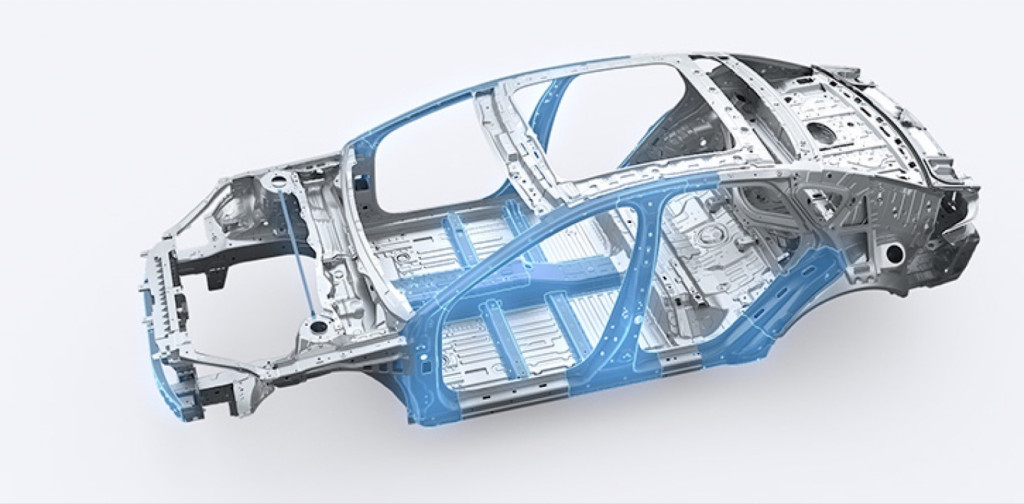
A partnership between the two companies started around 2017, according to the report, with the goal of developing lithium-iron phosphate (LFP) battery cells for the Apple car. BYD has much experience with this tech, claiming cooling and safety improvements for its Blade battery introduced in 2020.
BYD Han EV
Apple reportedly assigned Alexander Hitzinger to the effort. Hitzinger was technical director of the Porsche 919 hybrid race-car project before joining Apple as head of product design for its special projects group, a position he held from 2016 to 2019 before returning to the Volkswagen Group, where he worked on autonomous driving and an Audi EV project.
The team also reportedly included 50 engineers led by Apple’s Mujeeb Ijaz, with Michael He, Vice President of BYD’s battery business, representing that company. A larger team, rumored to be about 2,000 people, worked on the car project itself. Sometimes referred to as “Project Titan,” had been discussed in media reports since 2014, although little concrete information was ever released.
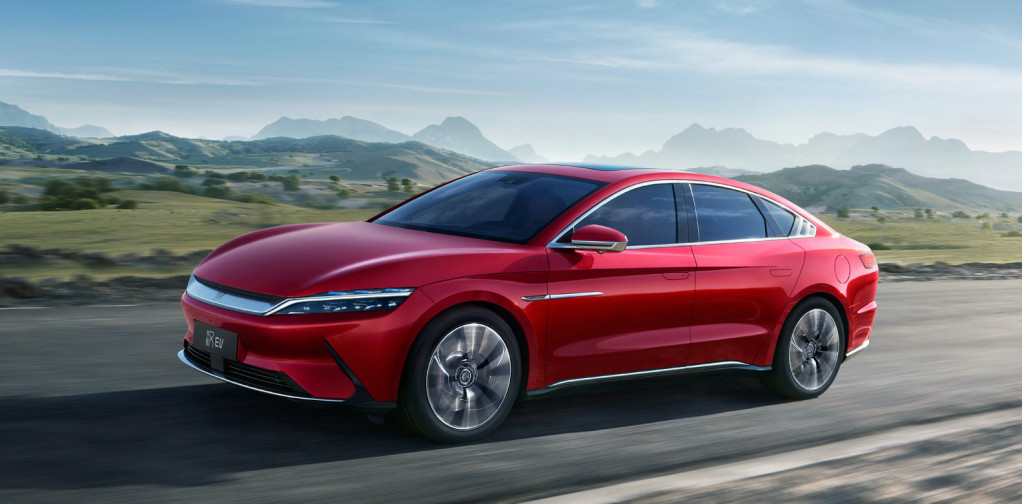
BYD Han EV
Apple reportedly moved away from the partnership and began exploring battery tech from other companies. Two reports in 2021 claimed Apple was seeking LFP batteries from both BYD and fellow Chinese firm CATL, with possible U.S. manufacturing. Reports in December 2020 also claimed Apple was pursuing a “monocell” design for batteries that freed up more space.
After reportedly being scaled back to a basic vehicle without previously-hoped-for autonomous driving, Apple cancelled the electric car project earlier this year. Apple’s further involvement in the auto industry will likely be limited to the CarPlay phone-mirroring system it currently supplies to automakers.

California police call EVs “nearly unusable”
- California police forces are seeing the Tesla Model 3 and Model Y as too tight for police duty
- There’s no official Tesla police package, and few other EV options
- Police-duty F-150 Lightning pickups have been better received—and other patrol EVs are on the way
Tesla electric cars have convinced many civilians to make the switch from internal combustion, but they aren’t winning many fans at police departments.
Electric police cars are starting to appear in greater numbers in California, which aims to phase out sales of most new cars with combustion engines by 2035. SF Gate recently interviewed police chiefs from three Northern California cities, who highlighted numerous issues with the Tesla Model 3 and Model Y as patrol cars.
Most automakers develop police packages for existing passenger cars, but Tesla hasn’t done so. Instead, the California police departments bought standard Teslas and had them converted by aftermarket companies, making them effectively custom jobs. In the case of the Ukiah Police Department, that meant relying on aftermarket firm Unplugged Performance, located about 500 miles from its headquarters.
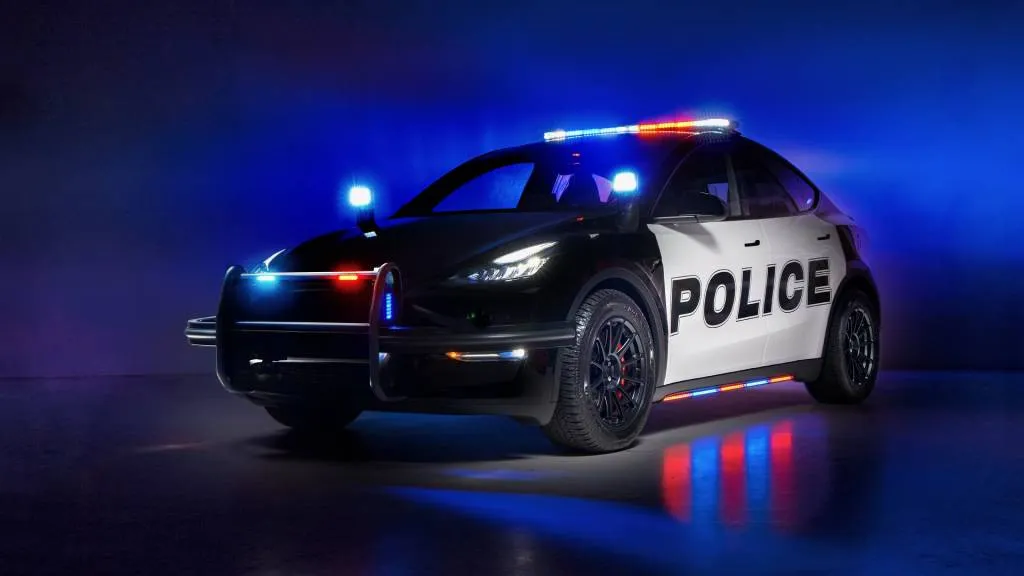
Tesla Model Y police car by Unplugged Performance
While it’s possible to equip them with lights, radios, and other police equipment, the Model 3 and Model Y lack the interior space for police work, according to the report. One police chief told SF Gate that the Model 3 only had room in the back for one prisoner, while another said the tight fit for officers wearing duty belts and bullet-resistant vests made Model Y patrol cars “nearly unusable.”
California cops aren’t the only ones dissatisfied with Tesla police cars. In 2022, two Spokane Police Department Model Y crossovers received “scathing reviews” from officers. That police departments are still turning to Tesla highlights the lack of options for fully electric police vehicles, but more choices are becoming available.
The Fort Bragg Police Department gave its F-150 Lightning pickup trucks a more positive review. It’s acquired five since 2022—on its own initiative, rather than via a government mandate—and they were cheaper than replacing decommissioned police cars with gasoline vehicles due to incentives, the department’s chief told SF Gate. Fort Bragg plans to make its nine-vehicle fleet all electric within two years.
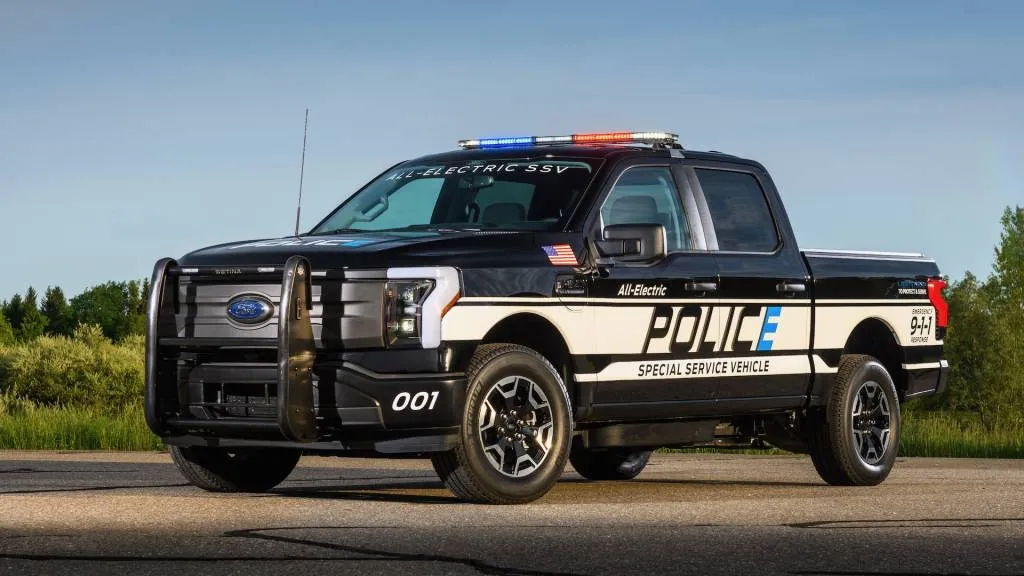
2023 Ford F-150 Lightning Pro SSV
The F-150 doesn’t have the space issues of the Model 3 and Model Y. Its bed can be used to store equipment or the abandoned bicycles and shopping carts cops are sometimes tasked with picking up. The Ford is also a known quantity to both aftermarket equipment suppliers, so maintenance and repairs are less of a challenge.
More EVs are also reporting for police duty. Another California police department—in the City of Irvine—recently took delivery of a Tesla Cybertruck. And Stellantis has teased a Dodge Charger Daytona police car, likely in a bid to maintain the police business from the previous-generation Charger sedan.

Mexico’s own EVs could rival India and China, face Trump trade rules
- Mexico is aiming to develop its own EV manufacturing and supply chain
- At present, global automakers’ Mexico plants assemble EVs and other vehicles for the U.S.
- The push could be a preemptive move vs. Trump tariff policy
Mexico is developing a small electric car to rival cheap imports from China and India.
In her Oct. 1 inaugural address, Mexican President Claudia Sheinbaum said prototypes of the EV had already been built, Bloomberg reports. The project, dubbed Olinia, aims to develop domestic supply chains for EV-related components.
“We are going to generate supply chains so that everything that is in the electric car is manufactured in the country and we import as little as possible,” Sheinbaum told Bloomberg and other media outlets in a briefing.
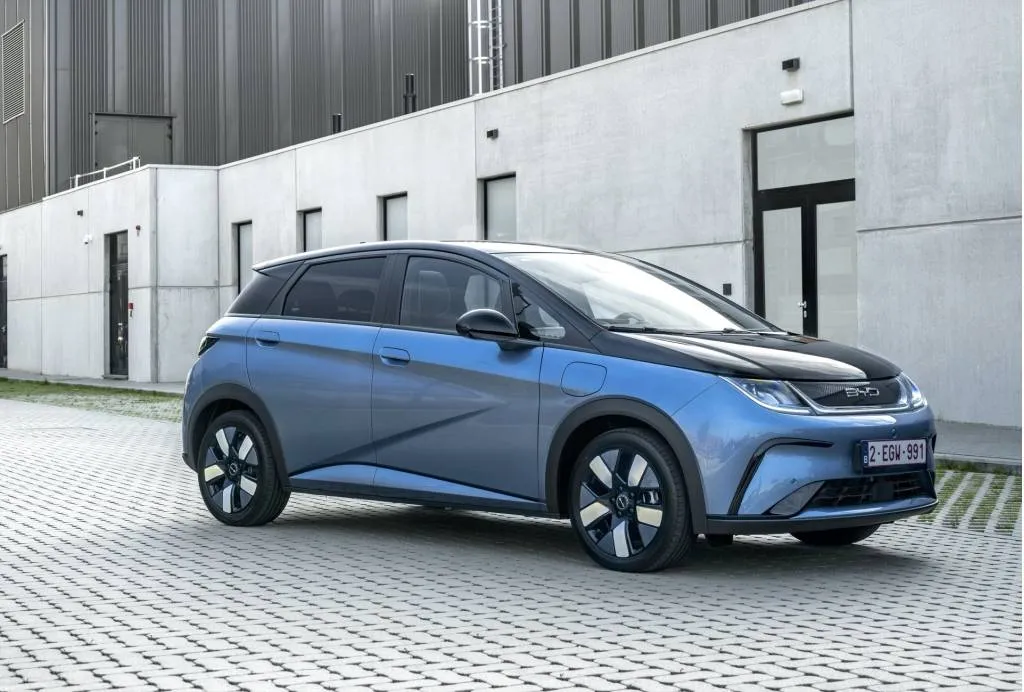
BYD Dolphin EV – Euro spec
Sheinbaum didn’t name specific companies that would be involved in the project, the report noted, but said there were already several in Mexico manufacturing components such as electric motors, and that “the idea is to bring them together with Mexican researchers so that they can assemble this electric vehicle.”
The all-Mexican EV would likely compete with Indian imports, which are being used as taxis in parts of southern Mexico, as well as low-cost Chinese imports from automakers like BYD, which is looking to increase sales in Mexico even as top officials pledge to curtail Asian imports, Bloomberg noted.
Right now, Mexico builds hundreds of thousands of U.S.-bound vehicles annually, but it buys few of them— especially EVs. GM invested big in its Mexico plant as a hub for EV assembly, and BMW is expanding its Mexico plant to manufacture EVs starting in 2027. Meanwhile Tesla was considering Mexico but now appears to have snubbed it.
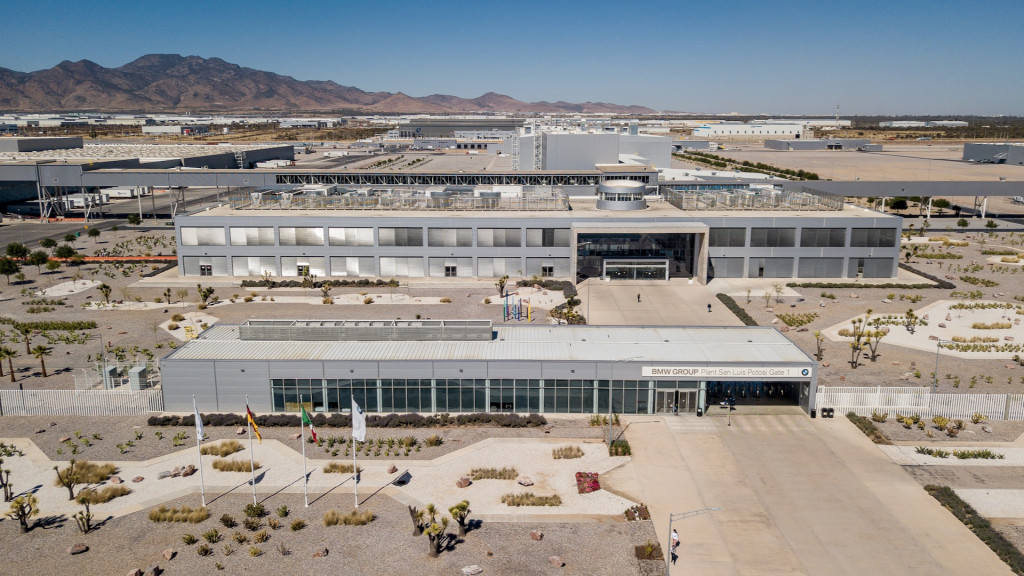
BMW Group Plant San Luis Potosí in Mexico
It’s unclear if a small EV designed to compete against the cheapest Indian and Chinese models would be a viable product in the U.S., but if it were sold here it could face incredibly steep tariffs depending on the outcome of the 2024 U.S. presidential election.
Donald Trump has promised a 100% tariff on Mexico-built vehicles sent to the U.S.—EVs or not. Trump’s policy also hints at dissolving what was once known as NAFTA. Are Mexico’s moves preemptive? While Mexico’s new president hasn’t called that out specifically, it’s hard to imagine not.

These US states come up short on public chargers per EV
The total number of U.S. EV charging stations has increased by 32% since 2023, but that growth has been unevenly distributed among the states, Here Technologies found in a new study.
Here, which provides map data to automakers for use with navigation systems and location-based services, ranked charging infrastructure based on how far EV drivers must go to find a charger, how quickly they can charge, the number of EVs on the road in a given state, and the estimated likelihood of finding an unoccupied charger upon arrival.
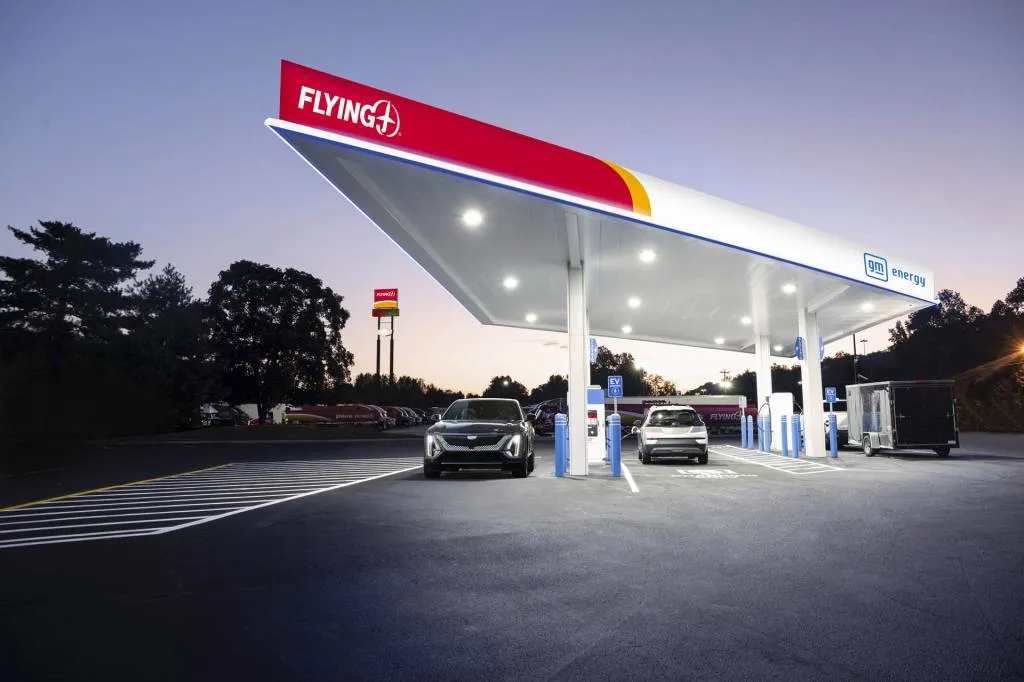
GM and Pilot Company’s EV charging network
States were ranked on all four factors, with a maximum 25 points each for a total possible score of 100. Delaware received the highest score at 79.4, followed by the District of Columbia (72.5). Massachusetts and Nevada tied for third place at 64.2, followed by Connecticut, which scored 63.7 points.
The lowest-ranked state was Alaska, at 19.6 points. Arkansas was one place up from the bottom with 33.3 points, with Idaho (35.3 points), Nebraska (37.3 points), and Minnesota (40.7 points) just above it.
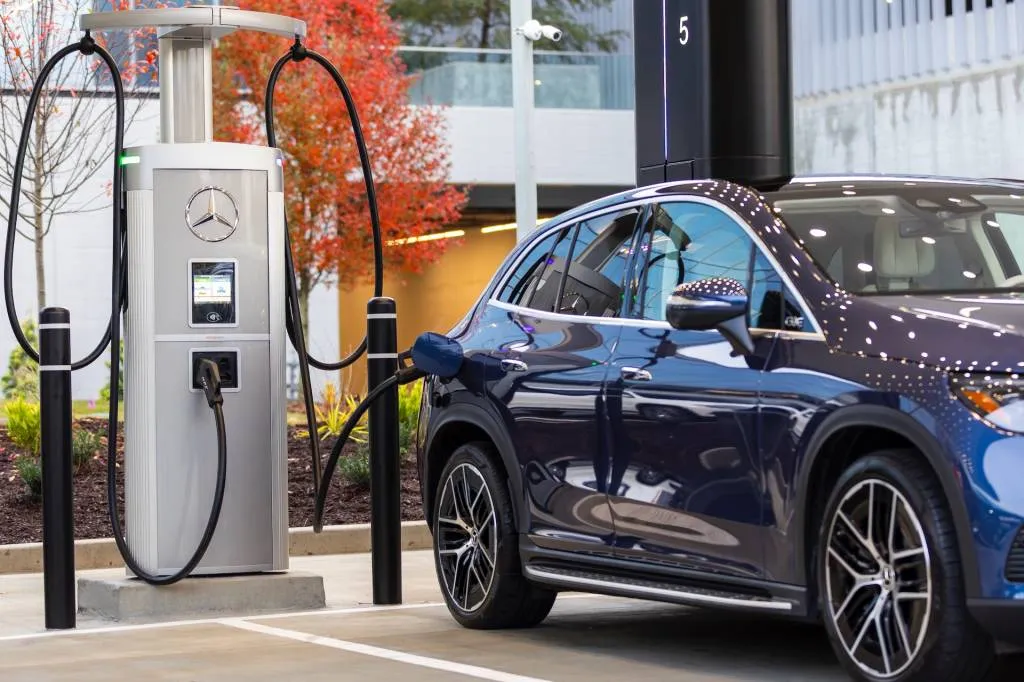
Mercedes-Benz EV Charging Hub in Sandy Springs, Georgia
Looking at specific metrics, Delaware, Tennessee, Louisiana, Texas, and Indiana, saw the most significant improvements in charging infrastructure, according to Here. Kansas, Massachusetts, Maine, and Nebraska were the most reliable overall, with 98% of chargers within their borders operational at the time of the study. Alaska, D.C., and Hawaii all had above-average levels of inoperable chargers, with more than 10% nonfunctional at the time of the study.
Regional disparities are also apparent in the slow rollout of the national EV charging network funded by the Bipartisan Infrastructure Law. States are responsible for determining how the federal money is spent, and they’ve been moving at different speeds in implementing charging-infrastructure plans, slowing the rollout of the network.

BMW CEO says Europe needs to cancel the 2035 gas-engine ban
- Europe needs to rethink its looming ban on vehicles with a gas engine, according to BMW’s CEO
- BMW CEO Oliver Zipse said the ban will force automakers to rely on China
- There’s concern about battery supply and competing with Chinese EVs
BMW CEO Oliver Zipse on Tuesday called for an end to Europe’s planned phaseout of new internal-combustion vehicle sales halfway through the next decade, arguing that it will force European automakers to rely on batteries from China.
Speaking to Reuters and other media at the 2024 Paris auto show, Zipse said the attitude toward the plan for 100% EV sales by 2035 was “trending towards one of pessimism,” adding that “a correction” of this target “would also afford European OEMs less reliance on China for batteries.“
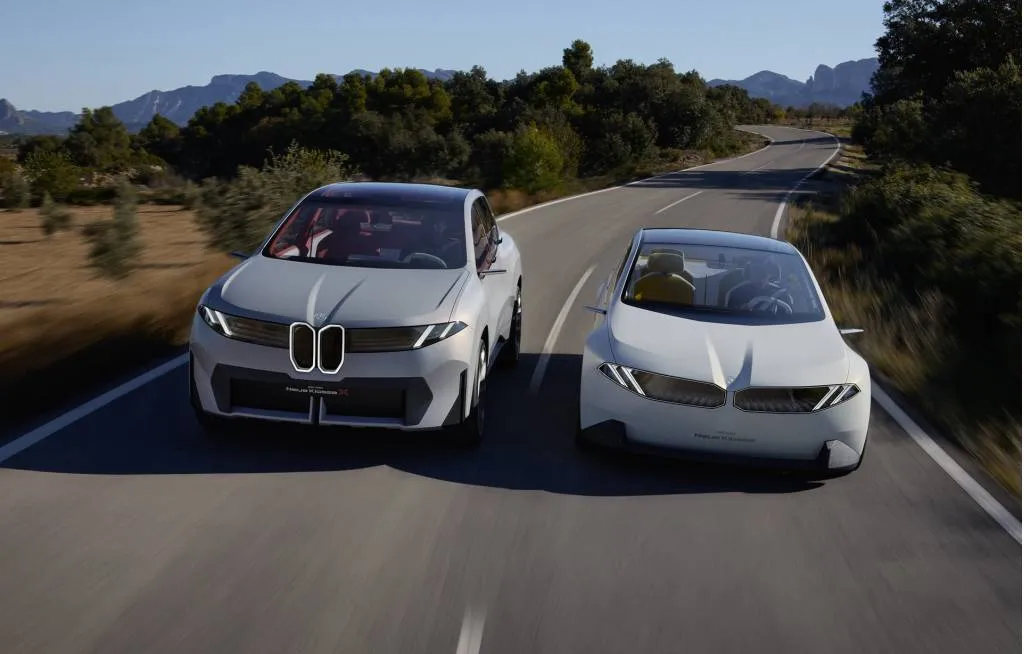
BMW Vision Neue Klasse X concept
The European Union introduced this target in 2021, and in March 2023 member countries enacted the stricter emissions standards that will bring the industry to the 2035 target. The law been repeatedly challenged by automakers as well as the Italian government, although Volvo and 49 other companies recently signed a declaration urging EU officials to stay the course.
BMW already contracts with China’s CATL, as well as South Korea’s Samsung SDI. Both companies have factories in Europe, but German automakers have also been pressured to purchase batteries from companies headquartered in Europe. A $2 billion deal with Sweden’s Northvolt was supposed to check that box for BMW, but the automaker nixed it earlier this year. Northvolt has since announced plans to cut costs and scale back its operations.
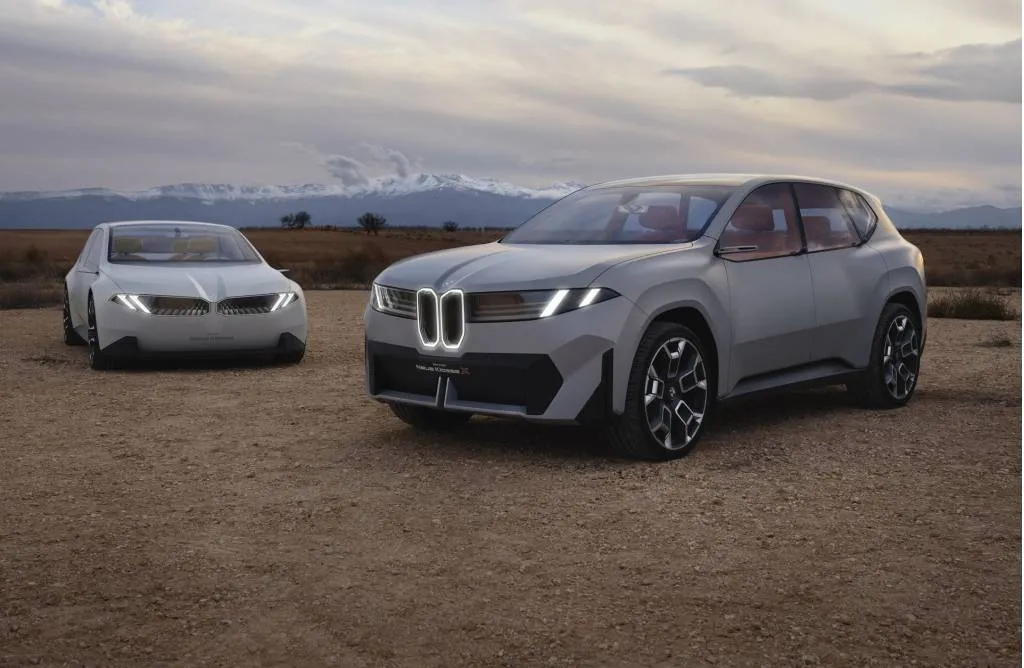
BMW Vision Neue Klasse X concept
BMW will need more batteries as it ramps up manufacturing of its next-generation Neue Klasse EVs, which shift to cylindrical cells and a new EV-specific architecture. Production is scheduled to start at two European sites in 2025, with production at a North American factory in Mexico following in 2027.
In addition to batteries, there’s concern in Europe that Chinese EVs themselves will pose a competitive threat to local companies. While the EU has placed tariffs on electric vehicles imported from China on top of its standard 10% import duty for cars, though, it has considered lowering tariffs for certain Chinese automakers.