
Category: General

2025 Kia EV9 carries on with $700 price increase
Kia’s EV9 three-row electric SUV carries over into its second model year essentially unchanged, but with a $700 price increase for the Light Long Range model.
Pricing for the 2025 Kia EV9 starts at $56,225 (with the mandatory $1,325 destination charge added in) for the Light Standard Range, the only model with the smaller 76.1-kwh battery pack. The Light Long Range upgrades to a 99.8-kwh pack for $61,225 with destination. Both Light models have a single-motor rear-wheel drive powertrain. Light Standard Range models are rated at 215 hp and 258 lb-ft of torque with smaller pack while Long Range models are rated at 201 hp.
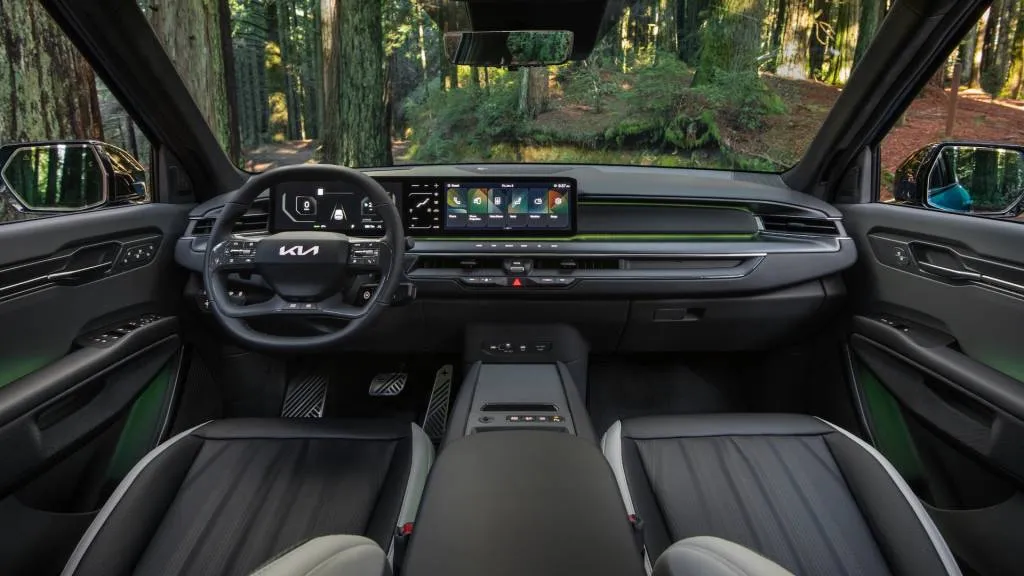
2025 Kia EV9
The rest of the lineup consists of Wind ($65,225), Land ($71,225), and GT-Line ($75,225) models with the larger pack and dual-motor all-wheel drive powertrains. All three all-wheel drive models are rated at 379 hp, while GT-Line models see an increase from the standard 443 lb-ft of torque to 516 lb-ft, which also drops the 0-60 mph time to a sports-car-like 5.0 seconds.
EPA-rated range is unchanged, topping out at 304 miles for the Light Long Range. That decreases to 230 miles for Light models with the smaller battery pack, while Wind and Land models are rated at 280 miles. GT-Line models have larger wheels that contribute to a 10-mile range penalty.
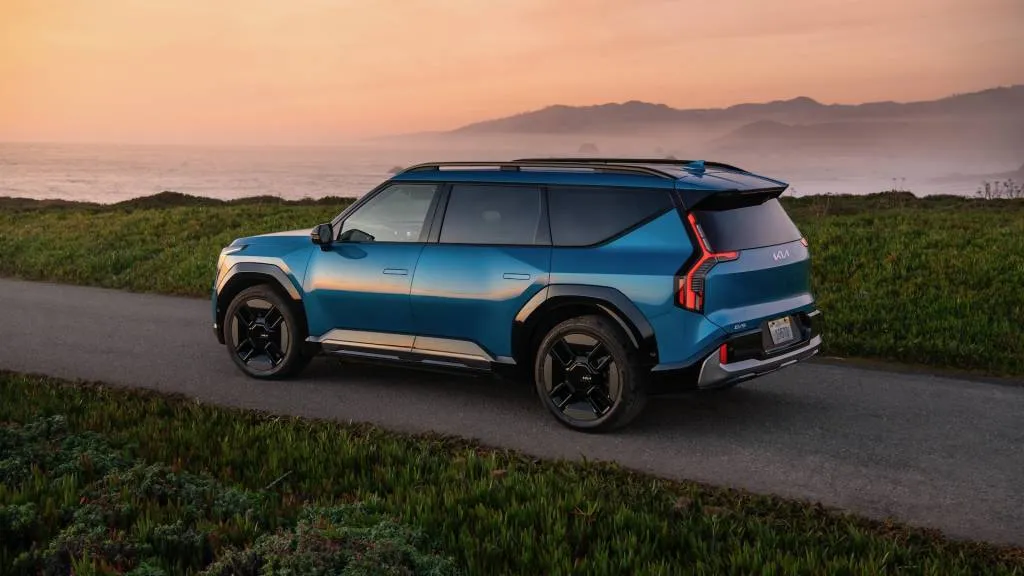
2025 Kia EV9
Arriving for 2024 as the second Kia model based on the E-GMP dedicated EV platform, the EV9 quickly drew critical and consumer attention. We named it Green Car Reports Best Car To Buy 2024, and early demand quickly led to dealer price gouging.
The 2025 models are already subject to one recall to address a software issue that could cause digital gauge clusters to fail. This recall, which also affects some 2024 models, is the second one for the EV9 recently. Another one addresses a separate software issue related to the optional remote parking system.

GM CEO says company still committed to ditching tailpipes by 2035
- GM still plans to only sell EVs for its light-duty passenger vehicles by 2035
- The automaker’s backed off its current EV sales targets
- GM expects to be the first U.S. automaker outside of Tesla to turn a profit on EVs
General Motors still aims to eliminate tailpipes from its light-duty passenger vehicles by 2035, CEO Mary Barra said in an interview with The New York Times.
GM announced the all-electric pledge in 2021 as a key part of achieving net-zero carbon emissions by 2040. Barra said at the time that about 75% of GM’s carbon impact comes from the tailpipe emissions of the vehicles it sells. The 2035 target would see that go down to zero for light-duty vehicles, while still leaving GM an opening to continue selling heavy-duty trucks with internal-combustion engines.
2025 Chevrolet Blazer EV
The first steps toward that goal were predicated on the rollout of GM’s new EV battery and propulsion system, until recently branded Ultium. That hasn’t gone smoothly, but GM is still committed to ditching tailpipes, Barra said, adding that the automaker is on track to start making EVs profitable by the end of the year. It would be the first U.S. automaker to do so outside Tesla, which has made money solely off EVs sales since 2021 after profiting for years on sales of emissions credits.
That optimistic outlook assumes issues GM has had so far in its EV ramp-up will be short-term. Barra said the automaker has largely solved the production issues that got this ramp-up off to slow start and have led to the delay of of some EVs, while touting the supposedly imminent arrival of the $35,000 version of the Chevrolet Equinox EV that will be a key affordability play until a new Bolt EV arrives as a 2026 model.
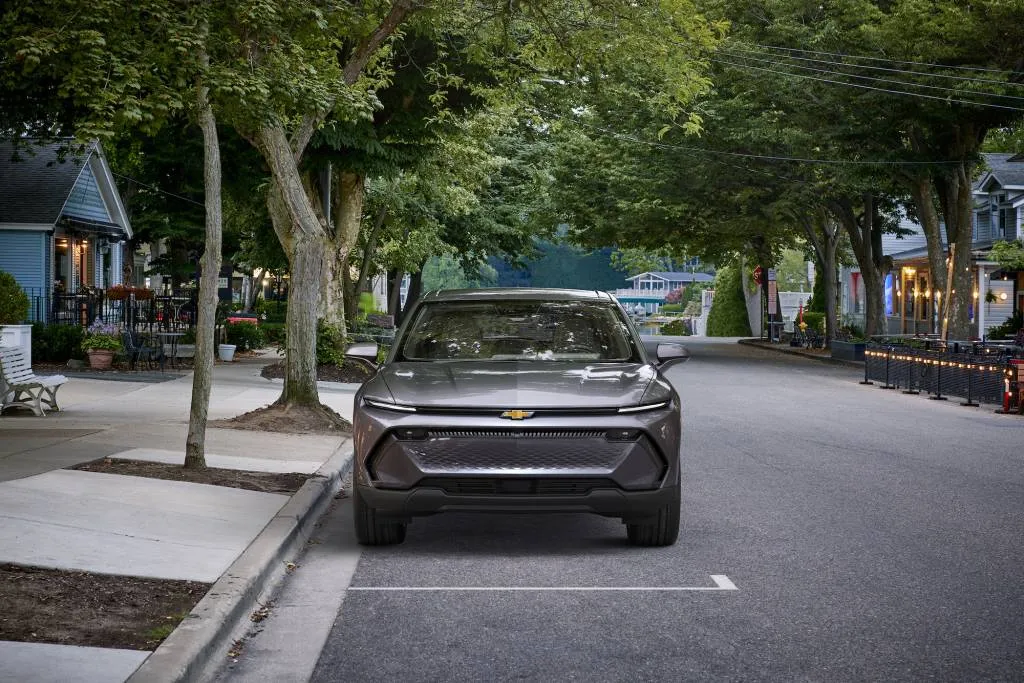
2025 Chevrolet Equinox EV
Barra said earlier this year that GM will miss a target, announced in 2022, to have production capacity for one million EVs by 2025, claiming the market is “not developing.” But there’s still time between now and 2035 for that development to take place. And while Barra has expressed surprise that EVs have become political, she said GM won’t change course regardless of which party wins the presidency in November—despite the proudly anti-EV stance of the Republicans.
GM is still making changes, though. The automaker earlier this month pulled the plug on the Ultium name for its EV batteries and related components, and is moving ahead with plans to adopt lithium iron phosphate (LFP) cells to lower costs.

Kia EV9 recalled because digital gauge cluster can fail
Kia is recalling 14,163 EV9 electric SUVs because their digital instrument clusters could go blank while the vehicles are being driven.
The vehicles, a mix of 2024 and 2025 models, received an over-the-air software update in August that may have introduced a software logic error, according to the National Highway Traffic Safety Administration. This can cause instrument-cluster screens to go blank intermittently, preventing the driver from seeing the speedometer, odometer, and turn signal indicators.
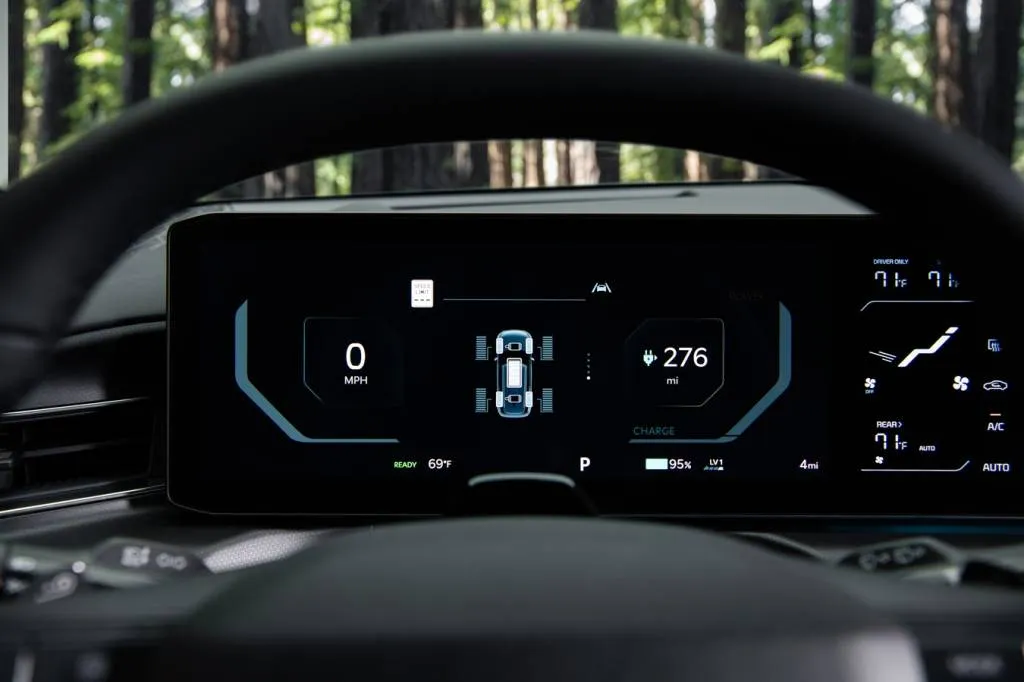
2024 Kia EV9
The “underlying system functionality” of these indicators is not affected, the NHTSA noted, but because the software issue prevents the information from being seen by the driver, it’s a safety issue. Screen failures that block vital information or controls fall into the safety realm, which is also why Tesla was forced to recall 135,000 vehicles in 2021 to fix faulty touchscreens that could cause loss of the rearview camera display and other functions.
Kia first became aware of the issue after a series of customer complaints, but told the NHTSA that it was unaware of any crashes, injuries, or fatalities related to the issue.
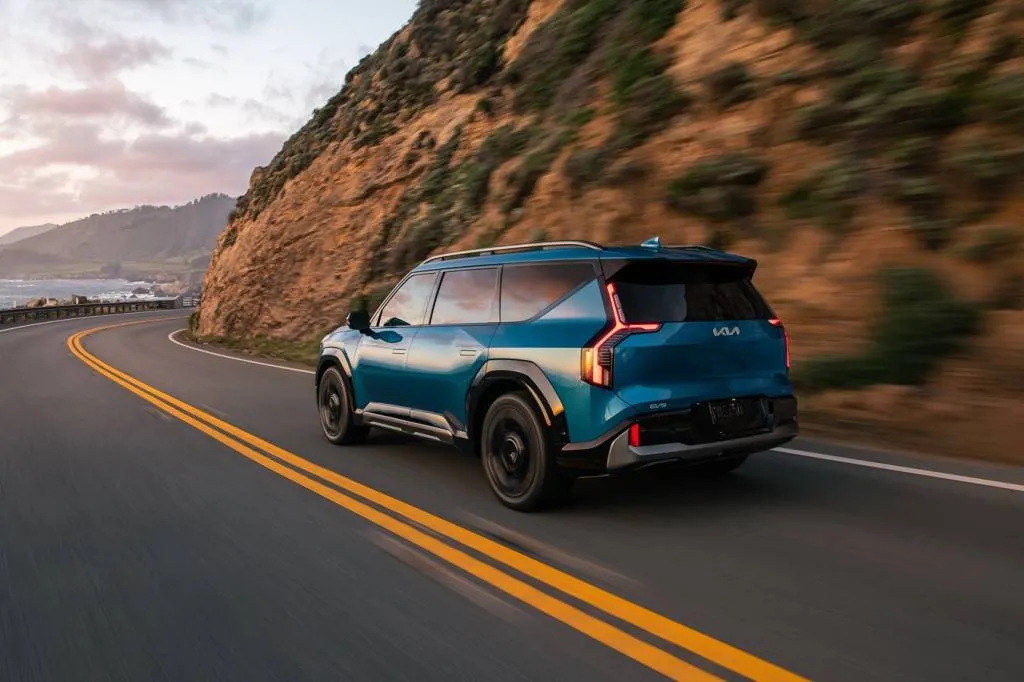
2024 Kia EV9
The automaker will push another over-the-air update to address the issue, but customers can also take their cars to dealerships to have the software updated. Kia plans to mail owner notification letters Oct. 31. Owners can also contact Kia customer service at 1-800-333-4542 for more information. Kia’s reference number for this recall is SC326.
This is the second recent recall for the EV9, which debuted for the 2024 model year offering up to 304 miles of range on less than 100 kwh of battery capacity, and pricing that topped out at $75,395 to land underneath the federal EV tax credit cap. The other recall addresses a remote parking system issue in 12,400 models equipped with that optional feature.

Review: 2025 Volkswagen ID.Buzz tags nostalgia, re-ups minivans
- U.S. spec is 3-row, 10 in. longer than Euro version out two years ago
- Larger 91-kwh battery pack, higher-power rear motor
- EPA range up to 234 miles, 10-80% in 26 min.
- Starts at $61,545, spans to $71,545 for top 1st Edition AWD
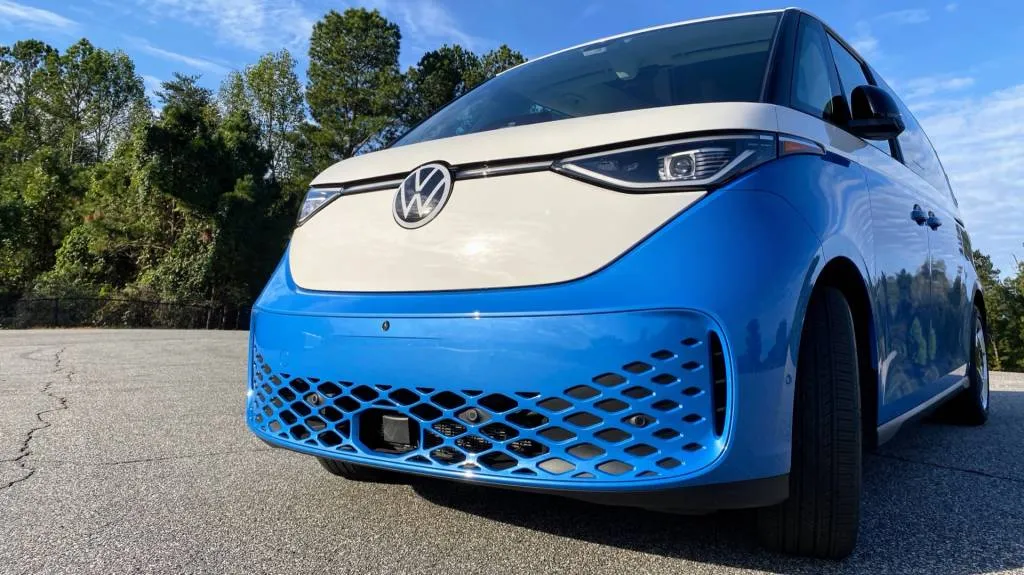
VW’s electric Bus reboot is finally arriving in the U.S.. And by design, it’s hard to imagine a better way that VW might have positioned an electric van for the past and the future, all at once.
Everybody wants one. Sure, it’s late and it’s been wracked by decades of false starts and concept vehicles, and by now the original Hippies may have ended their traveling days. But across generations, everyone has stories and feels tinges of nostalgia upon seeing the nose of this van and the signature two-tone themes.
This past week I drove the ID.Buzz not in San Francisco but on the rural back roads and through the suburban communities of north Georgia. Based on the diversity of questions, gawkers, and thumbs-ups—love from a tattered Tacoma, an Explorer, and a Cybertruck—it took all of 10 minutes to see that mass-market demand for this thing beyond “blue” America and counterculture hotpots is on the verge of boiling.
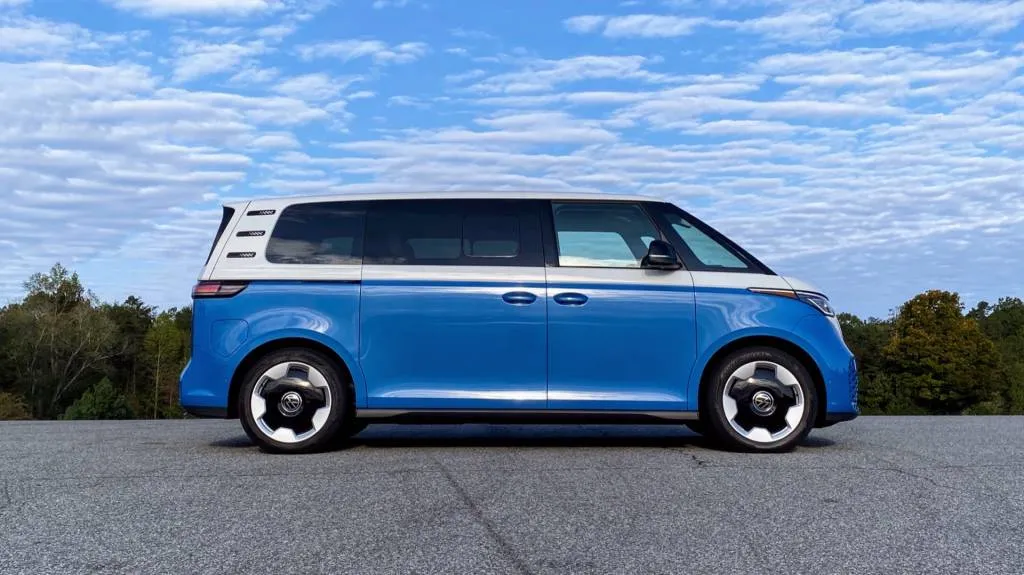
2025 Volkswagen ID.Buzz
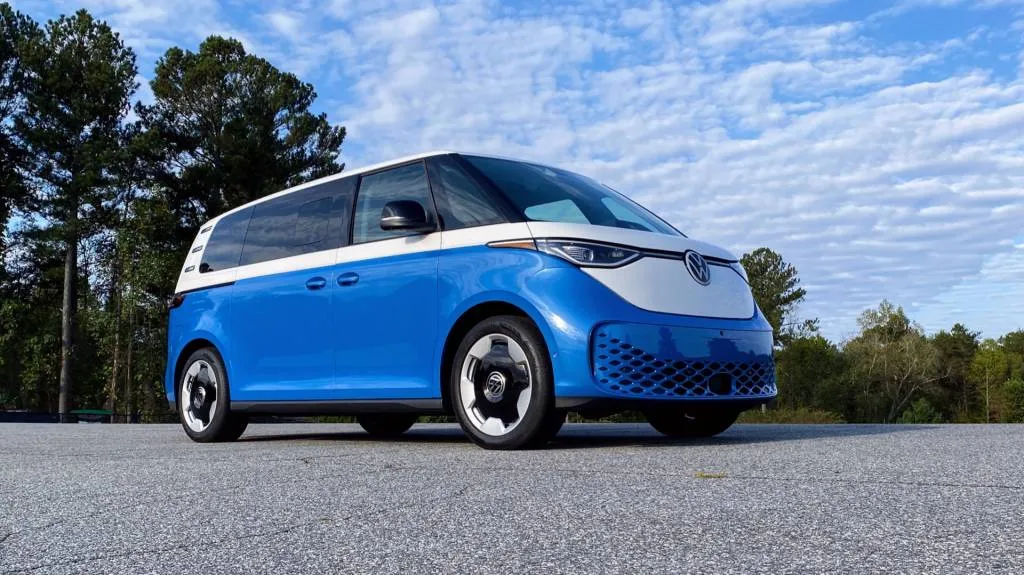
2025 Volkswagen ID.Buzz
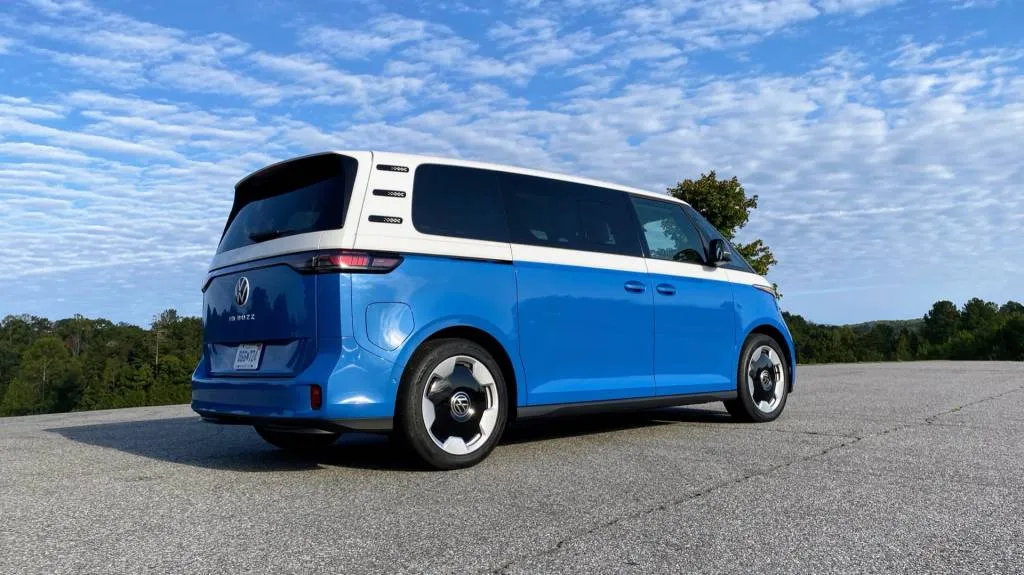
2025 Volkswagen ID.Buzz
The ID.Buzz gets smiles everywhere it goes and hums above the frequency of American EV discord, whether or not it’s electric, which is no small feat this election year. Of course it’s electric, and who cares if it’s electric, all at once.
If VW was fretting about the timing, it made me wonder if the late arrival helps this thing realize its potential—because the ID.Buzz isn’t an awkward, two-dimensional homage to the past.
ID.Buzz styling hits highs, won’t harsh your mellow
Unlike a long list of vehicles in recent automotive history—including, let’s be honest, VW’s New Beetle—the Buzz doesn’t push its retro waves so insistently that it harshes your mellow. The Buzz offers just the right amount of retro-fun on the outside, but inside the Buzz is just a great van that takes full advantage of its EV platform.
The ‘50s and ‘60s air-cooled cues may be there, but from the inside out, from any angle but the front, the Buzz is more a reboot of the Eurovan formula. It’s (almost) a flat-floor box on wheels, with three rows of seating, good for up to seven, and a huge amount of versatility and cargo space.
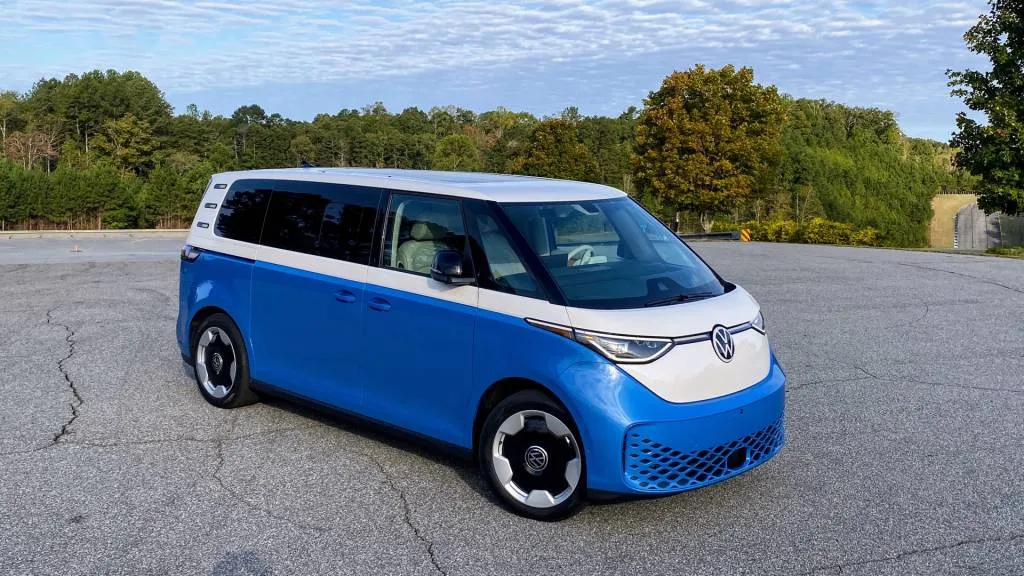
2025 Volkswagen ID.Buzz
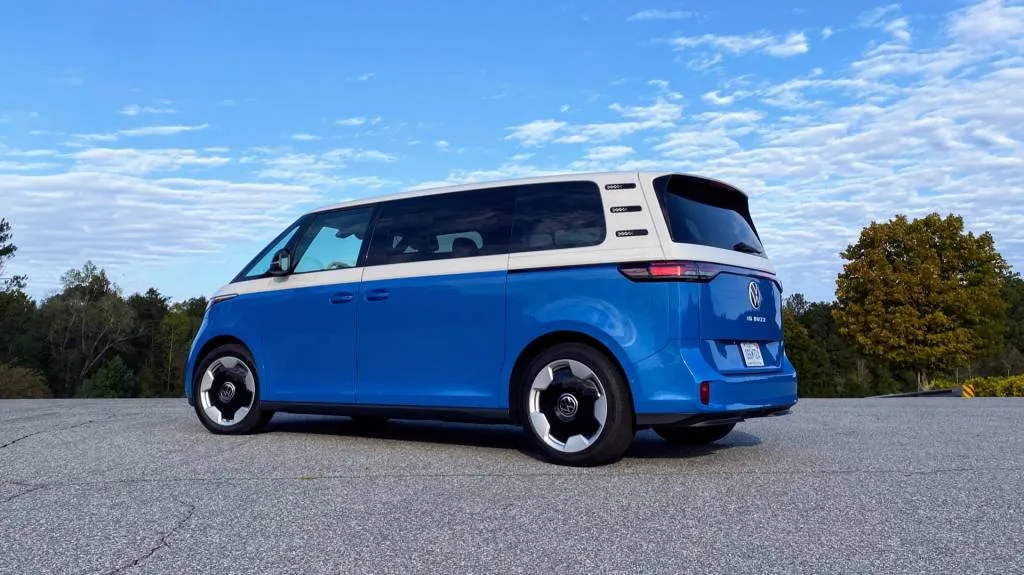
In U.S. form, the ID.Buzz is offered in a series of seven different two-tone schemes pairing various colors with white, or a Cherry Red-and-gray two-tone, or monochromatic white, gray, or black. And for now and the foreseeable future the ID.Buzz comes to the U.S. only in this three-row form, with an overall length of 195.4 inches, riding on a very long wheelbase of 127.5 inches. Its overall height of 76.2 inches makes it about 10 inches taller overall than VW’s ID.4 crossover, while still offering 6.1 inches of ground clearance that should be just fine for getting down two-tracks on the way to campsites or trailheads.
VW ID.Buzz impressions: Quick and quiet, precise but heavy
VW decided at some point that it couldn’t launch the ID.Buzz in the U.S. with its original standard-wheelbase form factor—thus adding two long years to its arrival date. So for us, the upgrades include about a 10-inch stretch, a new infotainment interface, software improvements, and a more powerful rear motor—as well as a bigger 91-kwh battery (vs. the 82-kwh pack in those Euro versions).
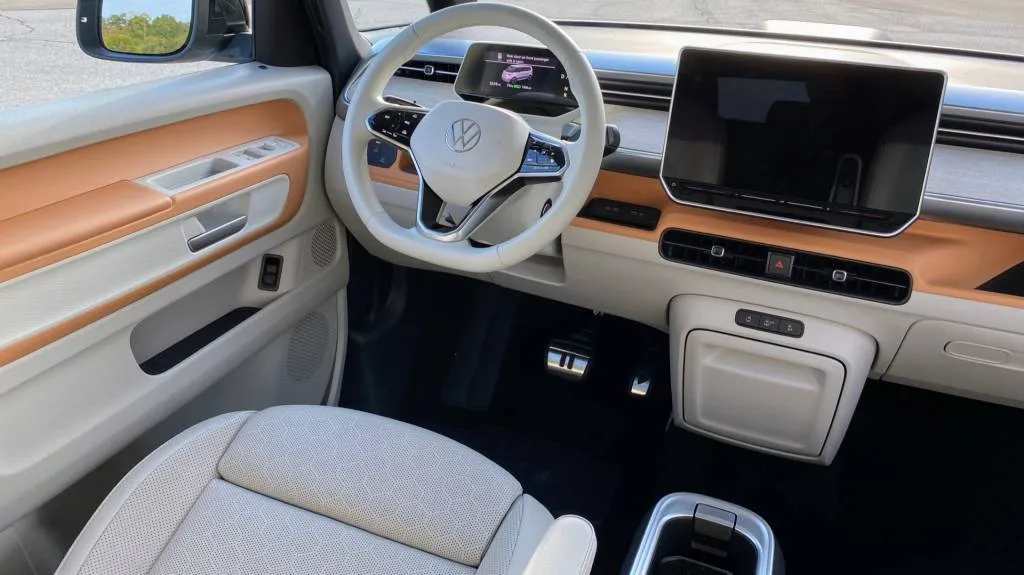
2025 Volkswagen ID.Buzz
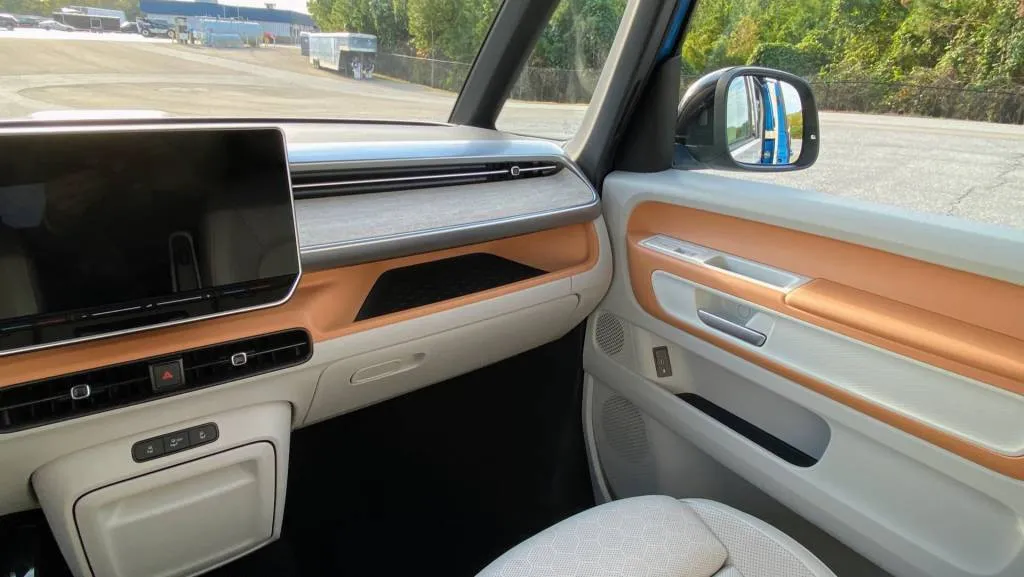
2025 Volkswagen ID.Buzz
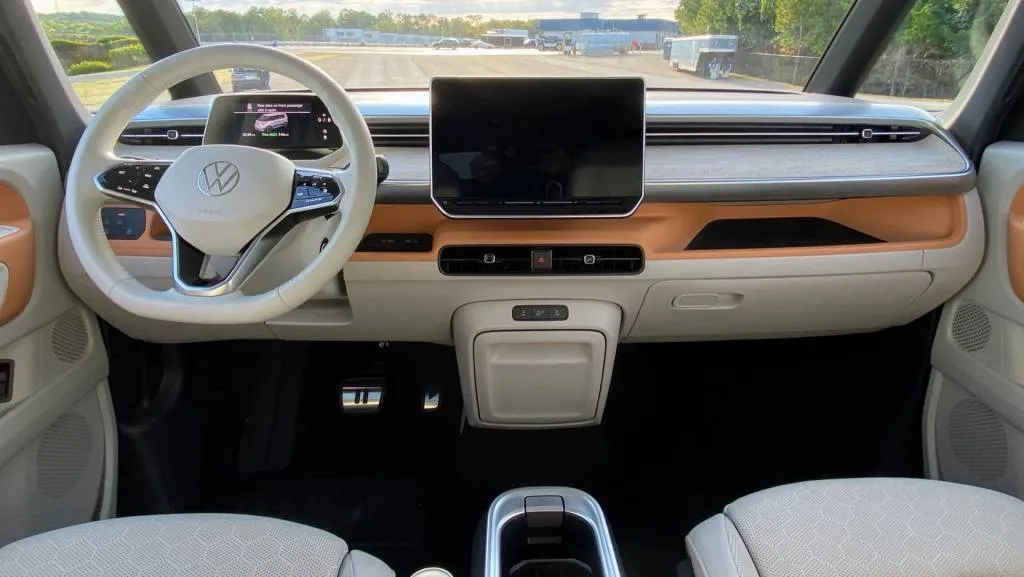
2025 Volkswagen ID.Buzz
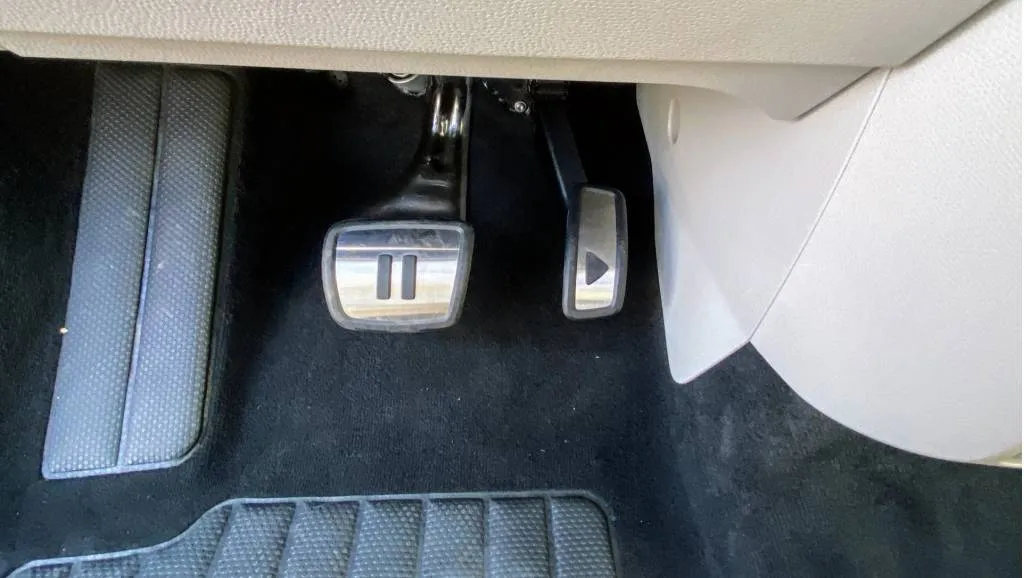
2025 Volkswagen ID.Buzz
How does the ID.Buzz drive? In a word: heavy. Yes, you do feel all three tons. It’s also softly sprung, and clearly tuned more for a compliant ride than for handling. But thanks to the low center of gravity and precise steering, it’s never a handful. And if you’ve done plenty of drive time in full-size, truck-based vans and minivans alike, it’s a driving experience that’s clearly in the minivan zone. The ID.Buzz is quite wide, at 78.1 inches without the mirrors, and on the narrow Georgia backroads, with no shoulder, I appreciated its predictable behavior and easy lane placement.
In parking lots, the same thing goes, within the reality that it’s every bit as long as some three-row SUVs. In single-motor rear-wheel-drive form as the one I drove, the turning circle is an amazing 37.4 feet, although AWD versions will raise that to 42.7 feet. Having real, old-fashioned, through-the-windows outward vision—beyond camera systems and beeping sensors—really helps.
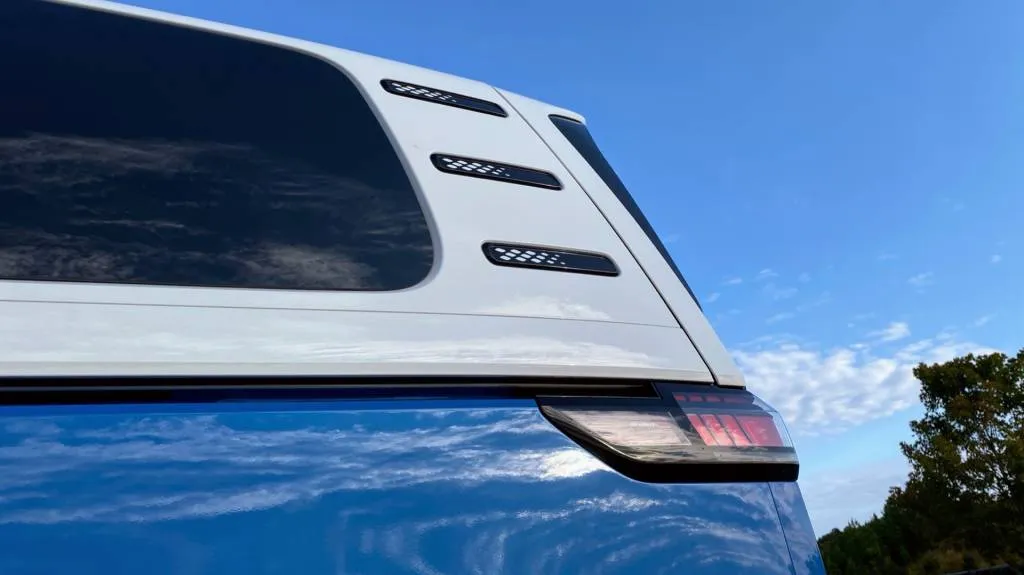
2025 Volkswagen ID.Buzz
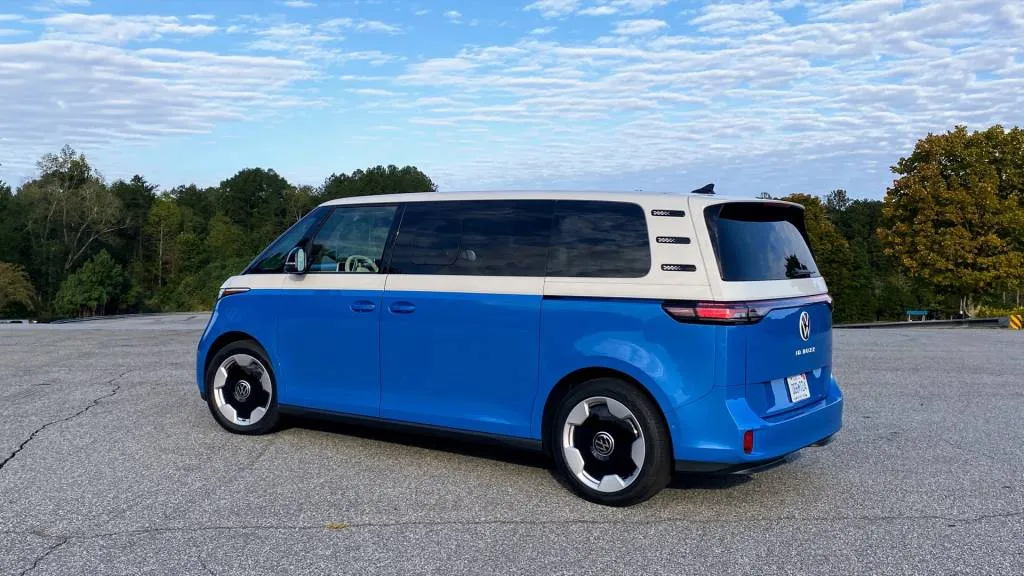
2025 Volkswagen ID.Buzz
2025 Volkswagen ID.Buzz
While VW hasn’t outlined any serious changes to suspension tuning in refreshing this model for the U.S., this ID.Buzz didn’t provide as much nosedive under hard braking as we experienced with a drive in the shorter version a couple years ago—perhaps a benefit of the longer body.
The ID.Buzz gets VW’s own uprated electric drive unit (called AP550 and now used in the 2024 VW ID.4) at the rear wheels, making 282 hp and 413 lb-ft of torque. Those upcoming AWD versions will get the same drive unit at the rear wheels plus an inductive motor at the front wheels, making 99 lb-ft of torque and upping the total output to 335 hp.
Although one editor who drove the ID.Buzz called it sluggish, I found it to be plenty perky with the single-motor setup. 0-60 mph times will be 6.0 seconds in dual-motor form, according to VW, while rear-wheel-drive versions like the one we drove take it to about 7.5 seconds. Towing capacity for the ID.Buzz is 2,600 pounds for a braked trailer, or 1,650 pounds unbraked.
Yes, it’s heavy. Even in its leaner rear-wheel-drive form that we test-drove, it officially weighed in at just 32 pounds short of three tons. Add the dual-motor AWD setup and you’re at 6,197 pounds.
2025 Volkswagen ID.Buzz
ID.Buzz range and efficiency
As in other VW EV products, a twist of the shifter allows access to either the ‘D’ mode, which lets you glide with minimal regeneration, or the ‘B’ mode, which dials up regen somewhat but remains quite mild. Switching the drive mode to Sport makes each of these levels slightly higher, with Sport and ‘B’ a good companion for hilly, twisty roads, but there’s still nothing quite like a one-pedal mode here. But brake pedal feel and blending are exactly what they need to be—predictable and progressive.
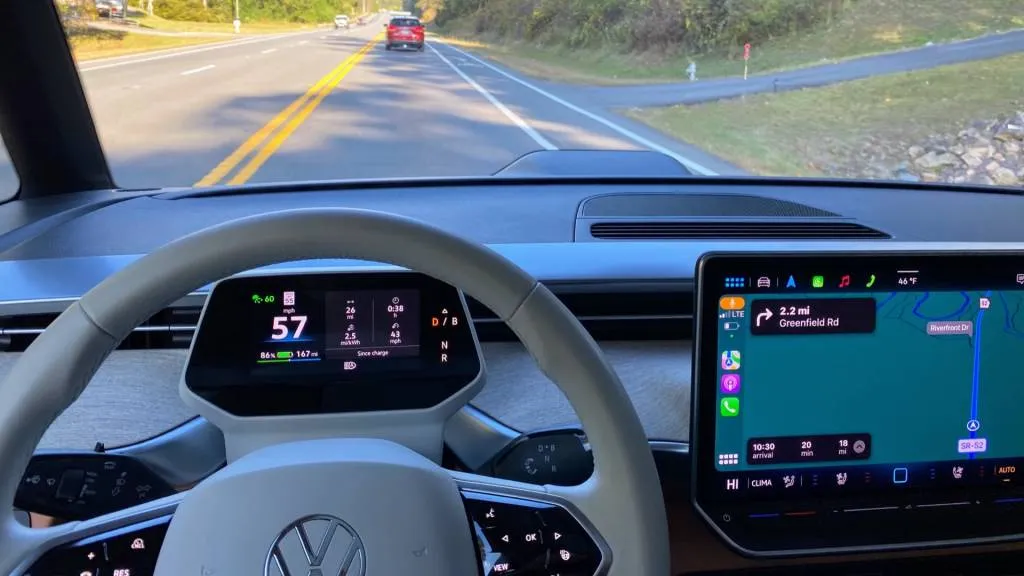
VW says that the ID.Buzz gets 2.5 miles per kwh (83 MPGe) combined, with the EPA highway cycle yielding 2.2 mi/kwh (75 MPGe). In a 110-mile loop up into low mountains, including some U.S. freeway speeds, fast-moving backroads, and mid-speed suburban streets, with outside temps around 50 degrees Fahrenheit, I averaged 2.6 mi/kwh according to the trip computer. Then, on an easygoing highway cruise, most of it pretty level at 65-70 mph, I averaged 2.4 mi/kwh.
2025 Volkswagen ID.Buzz
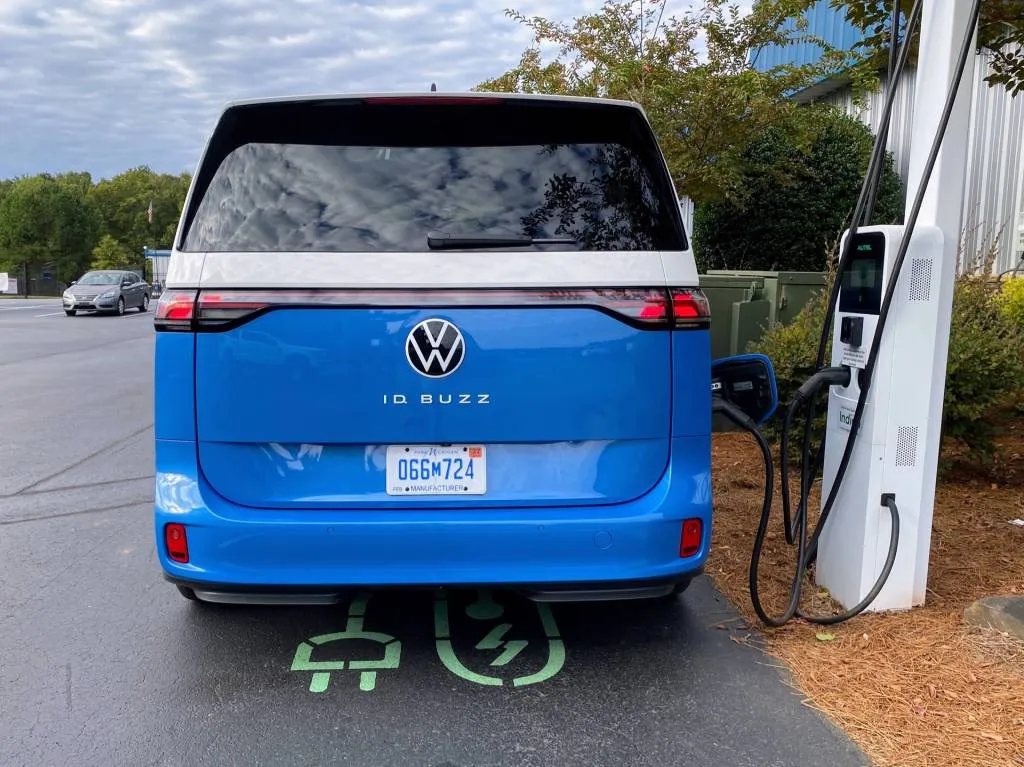
We charged the ID.Buzz, too, with Level 2 charging that flexed its 11-kw onboard charger, and with some DC fast-charging. In an experience that admittedly wouldn’t mimic what most owners would have on a road trip, we plugged a 160-kw CCS connector in at 44% and still saw a peak of 117 kw around 49%, with the state of charge reaching 90% in about a half-hour. VW says that DC fast charging at up to 200 kw enables a 10-80% charge in as little as 26 minutes.
In all, while a 100% charge amounts to as little as 191 miles according to the gauge cluster, we saw better, with our results roughly corresponding to the Buzz’s EPA range rating of 234 miles (or 231 mi. in AWD form).
2025 Volkswagen ID.Buzz
Trip planning is built into the native navigation system, and it will start preconditioning of the battery pack to access the maximum charge rate automatically with a charging stop along the route, or with a press of the virtual button on the screen. And if you want to bypass it all and go with the mapping app of your choice, you can still pair your phone for Apple CarPlay or Android Auto. I mixed it up between CarPlay and the built-in interface, and both sides worked great.
Buzz bins of flexibility, space, tech here
The three-row VW ID.Buzz also has a lot of flexibility in door bins and various storage places. The tall console between the front seats can lift completely out of the vehicle, as a sort of mini-cooler if you wish, and the pull-out drawer with cupholders and more storage stows away neatly to keep it feeling airy and spacious. Two levels of door bins and a dash tray give you plenty of space for the smaller pieces of a road trip.

2025 Volkswagen ID.Buzz
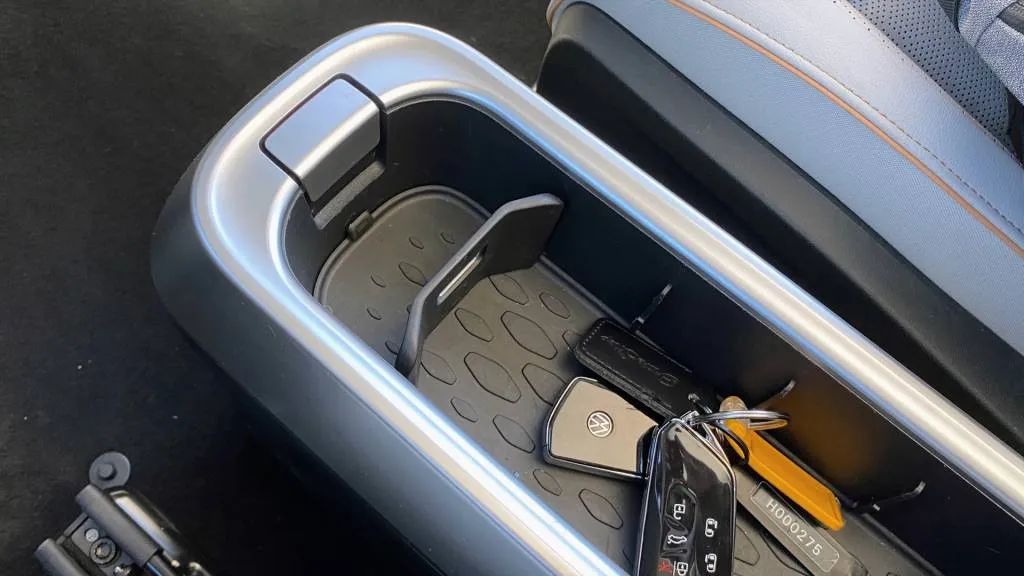
2025 Volkswagen ID.Buzz
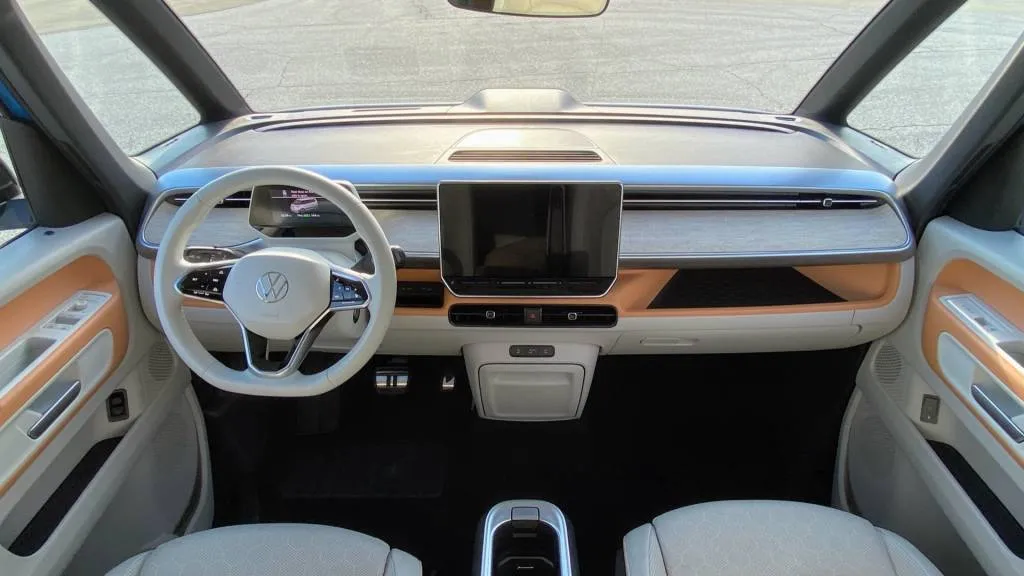
2025 Volkswagen ID.Buzz
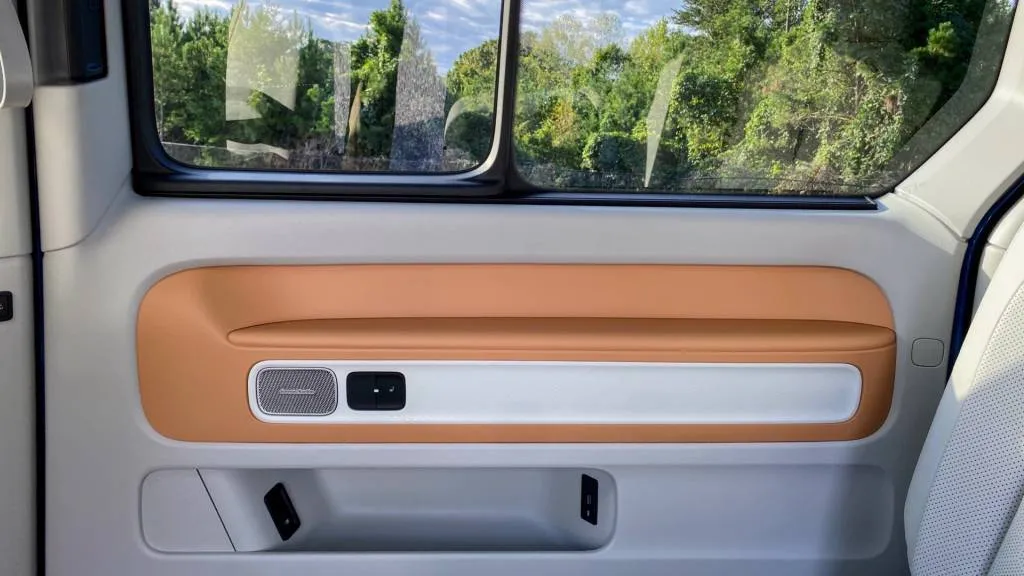
I found the grippy phone shelf just to the right of the steering wheel to be an ideal place for my phone to charge wirelessly without sliding around. And in the effort to kit this model out a bit better for three rows, there are now eight USB-C ports on board. Front seats are heated, cooled, and power-adjusted, providing an inbound armrest plus an upright driving position and the kind of back support I like for longer trips.
The sliding door powers open and closed in a way you’ll find absolutely familiar if you ever had premium minivans in the household—and, it just barely stays out of the way of charging-in-progress, we found. The biggest choice ID.Buzz buyers might face, other than the color, of course, will be the seating layout—trading out the middle bench in our model for second-row captain’s chairs and a six-passenger capacity (the only way for AWD versions).
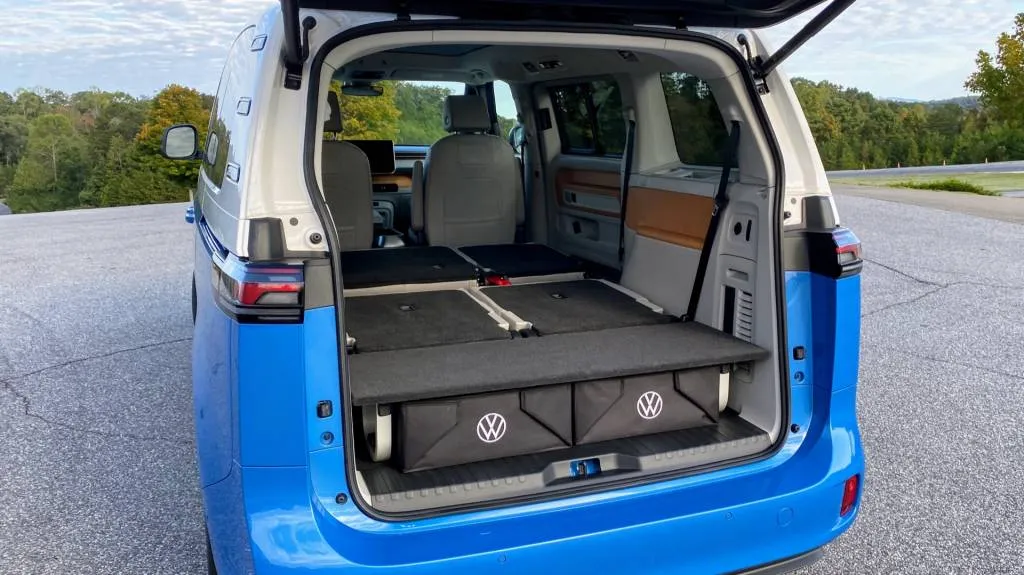
2025 Volkswagen ID.Buzz
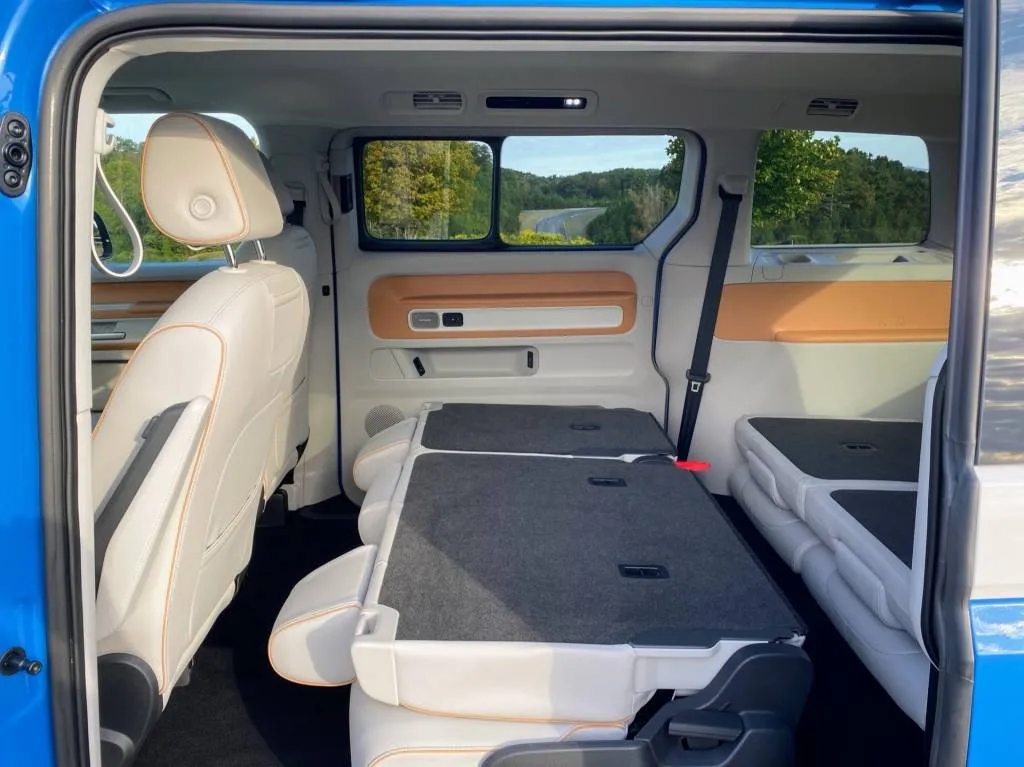
2025 Volkswagen ID.Buzz
2025 Volkswagen ID.Buzz
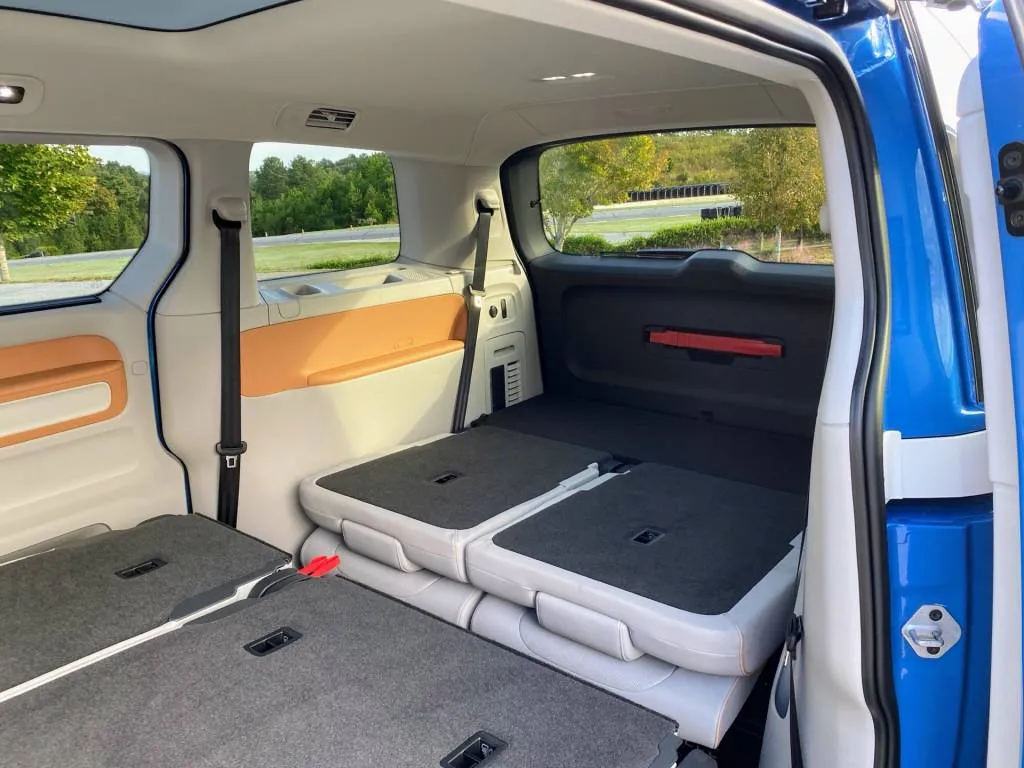
Although the far-back cargo area of the Buzz appears a little strange at first look, with baskets underneath a sturdy hinged door, the folded third row, and the folded second row all line up at the same level—save for a gap of a few inches between the second and third row. If you want to sleep in the thing, that’s nothing a good piece of plywood won’t solve. Remove the seats—they’re heavy—and the rearmost section bumps up to again require some sort of level-up, if you plan to sleep, live, or otherwise inhabit this vehicle for something other than just driving.
VW is guessing that the majority of Buzz customers will come from “large SUVs.” It boasts more interior space than the Atlas, in the footprint of a Cross Sport. VW also claims best-in-industry third-row legroom versus. other American-market vehicles.
2025 Volkswagen ID.Buzz
2025 Volkswagen ID.Buzz
2025 Volkswagen ID.Buzz
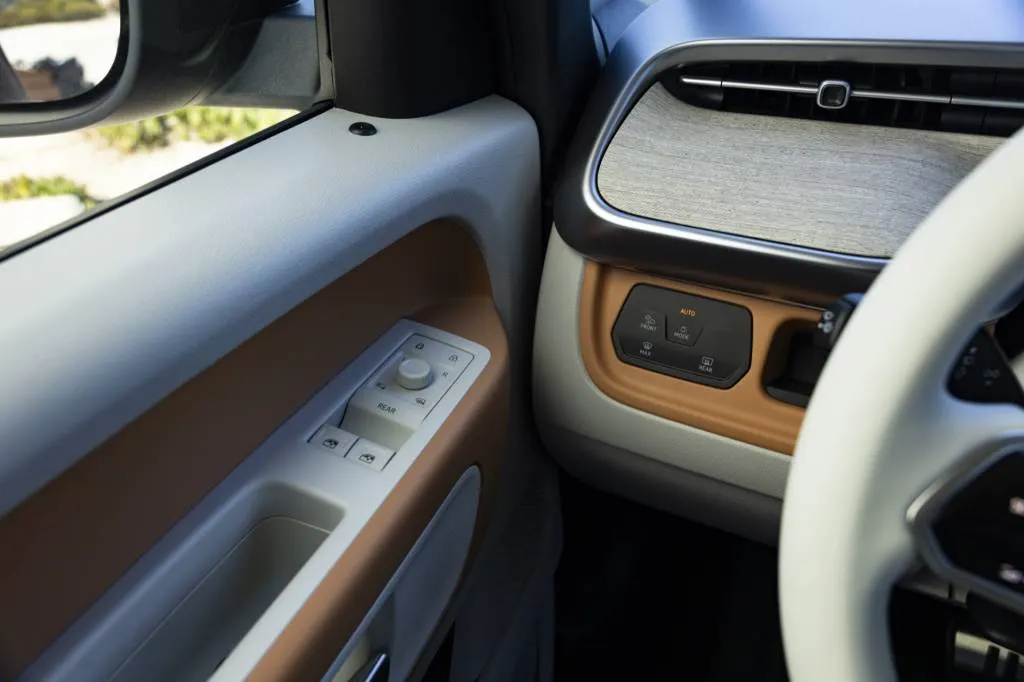
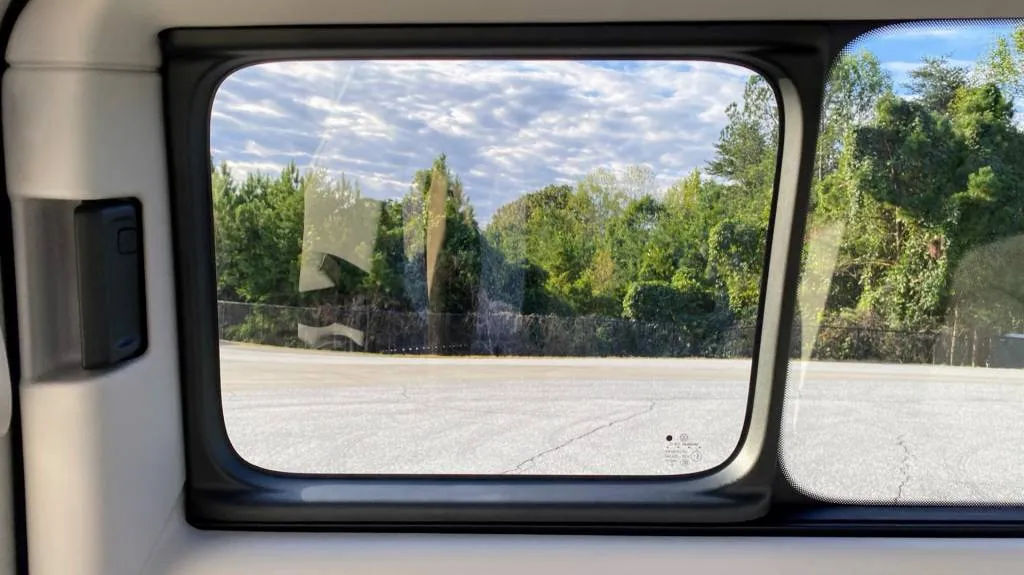
One thing VW has carried over from the ID.4 and the Euro-spec ID.Buzz is its one-fits-all power window controls, combining the front and rear window operation—for the otherwise very cool rear window-within-a-window in back—into one switch. Here it’s even more potentially overwhelming and confusing. VW, why did you subject us to this?
My only other dynamic gripe follows what’s otherwise a compliment—the absence of engine noise and great isolation of road-surface noise. Just above 65 mph we noticed some whooshing wind noise in the zone between the front pillar and the side mirror, which wound itself almost to a whistle by 80 mph. I should note the version I drove was still officially a pre-production prototype, so window sealing may not have been up to production snuff.
The ID.Buzz, in U.S. form, achieves a coefficient of drag of 0.29, according to VW, and the top speed is up to 99 mph (from 90 in earlier Euro versions).
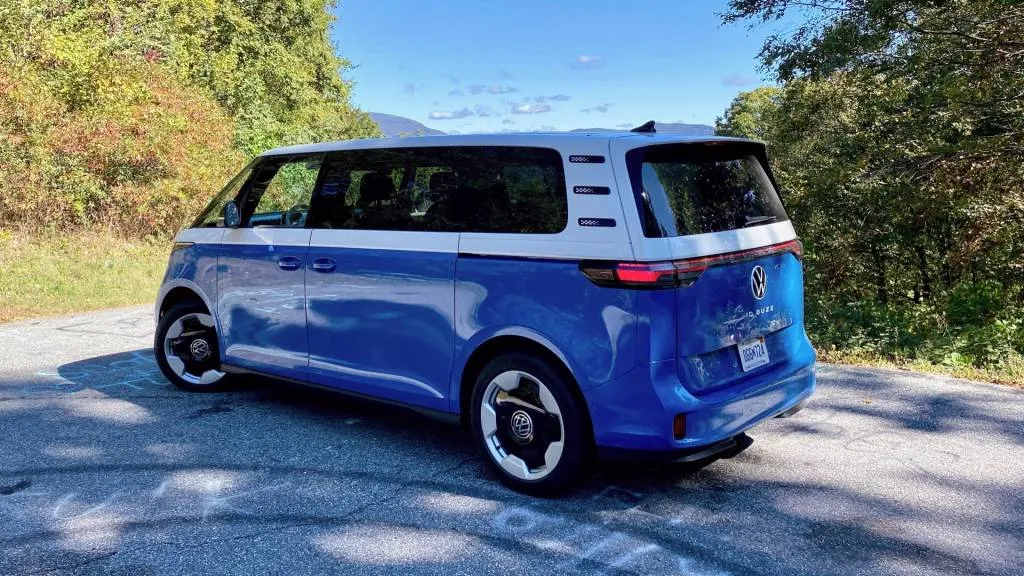
2025 Volkswagen ID.Buzz
ID.Buzz prices: The start of a bad trip?
The pricing and positioning of the Buzz is the only bad trip here. It’s just confounding
Because of the way it was implemented—pragmatic interior, retro cues on the outside, but not overdone—the biggest puzzle in all of this is how and why VW sees the ID.Buzz as a niche model.
The Buzz starts at $61,545, including the $1,550 destination fee, with the Pro S, which includes all the active-safety tech, three-zone climate control, a power tailgate and power sliding doors, heated second-row outboard seats, and the quicker, revamped 12.9-inch infotainment system. Pro S Plus versions add the retractable tow hitch, a head-up display, Harmon Kardon premium sound, and in AWD versions only, the captain’s chairs layout and a heated windshield. The top 1st Edition costs $67,045 in single-motor form or $71,545 with AWD and adds the panoramic roof and two-tone look (optional separately), roof cross bars, and floor mats.
Our test ID.Buzz, a Pro S Plus in Cabana Blue and Candy White on the outside ($995 extra), with a Dune interior and the optional $1,495 electrochromic panoramic roof—huge, at 67.4 inches long and 40.8 inches wide—adds up to $67,535. That glass became a pearlescent gray as the sun shone on it. VW says that and the retractable trailer hitch are firsts for the brand in America.
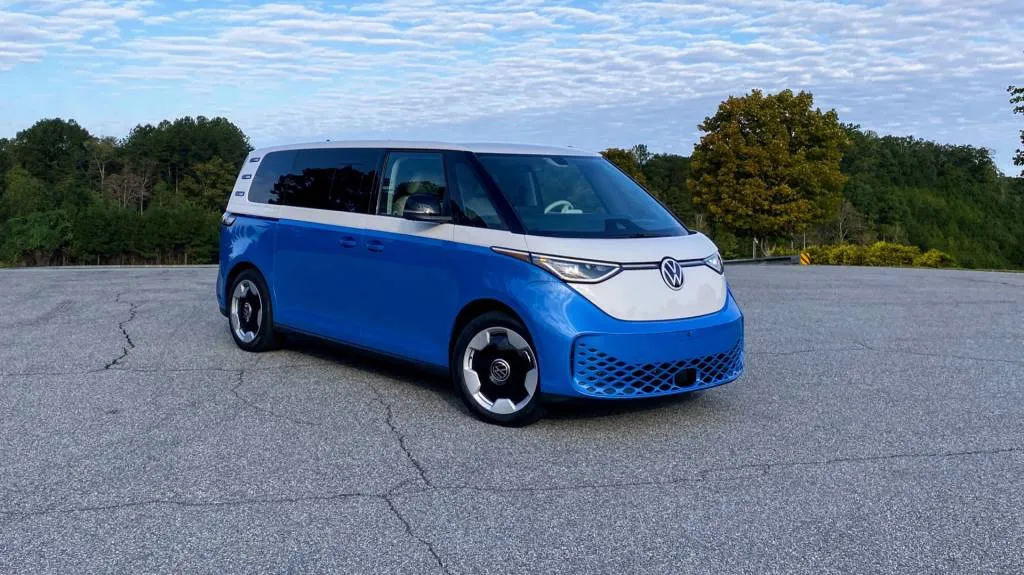
2025 Volkswagen ID.Buzz
VW has no plans to build the ID.Buzz in the U.S. anytime soon, so there’s no hope for a $7,500 tax credit (although discount leases are likely via the EV leasing loophole). It didn’t even develop the Buzz through normal passenger-vehicle channels, instead turning to its commercial-vehicles unit to realize this product—which seems like it should have been a Golf-like project at the core of the company’s survival.
In 1965, when Microbus sales started to accelerate and get wrapped into the counterculture, the average cost of a new vehicle was about $2,650, and the admittedly no-frills Microbus lineup topped out around $2,550. According to the federal government’s official consumer price index calculator, VW’s $2,550 then would equate to about $25,400.
Today, the average price of a new vehicle today stands at around $48,000, and VW’s choice to sell this vehicle at 25% above that clearly underscores that they see it as a premium vehicle, a niche model that may come and go.
But in this format, the ID.Buzz could command a market of one for years. Remember when minivans made a design statement? The Chevy Astro Van, the Ford Aerostar, the Pontiac Trans Sport and the other “dustbuster” vans from GM, the Toyota Previa: This is just as head-turning, with staying power.
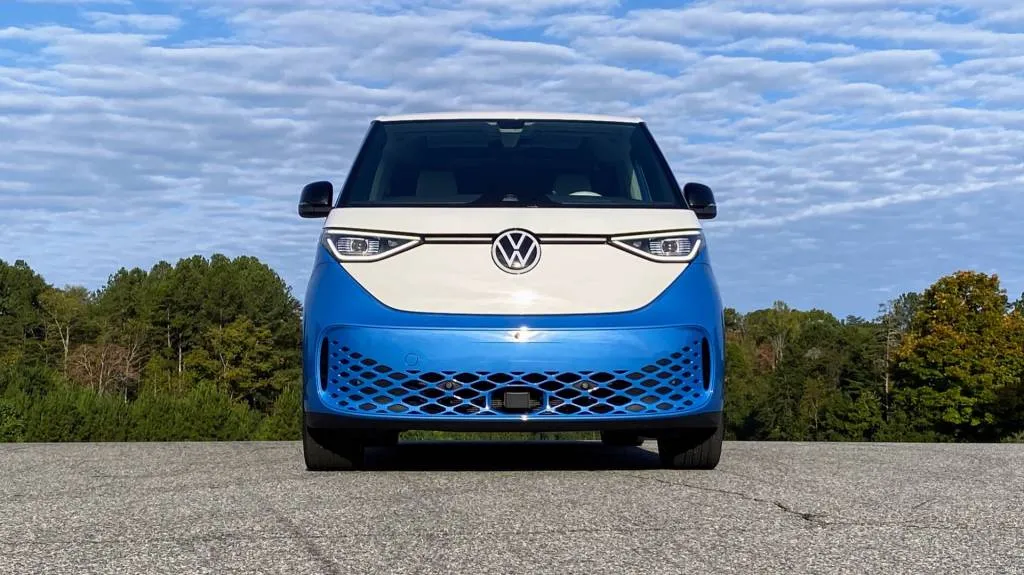
2025 Volkswagen ID.Buzz
The ID.Buzz really needed to be a just-the-basics $40,000 vehicle, sold much like Scion was selling its vehicles some years back, plus a modular interior and an endless lineup of official VW accessories. It would have sold like crazy—to businesses, to younger active types, even to families seeking to have a vehicle they can change the configuration of over the years—and it would have answered dealerships’ trepidation over the sustainability of the retail model in the EV era.
As it is, the ID.Buzz is a great product that limits the future of the brand in the U.S. within a ridiculously narrow bandwidth.
Will priced-out ID.Buzz buyers buy a Kia EV9 or base Rivian R1S instead? Will VW dealers behave with their markups? Let the craziness begin.

Ford tells some EV owners to stop using Tesla Supercharger NACS adapter
Ford is telling some electric vehicle customers to stop using the North American Charging Standard (NACS) adapters it provided for charging at Tesla Supercharger stations.
Ford led the industry last year in announcing a shift to the Tesla charge port, and in February it announced that it would ship free adapters to customers in late March. But last week the automaker issued a bulletin warning some customers not to use the adapters due to a “potential issue” that could result in reduced charging speeds, or potentially even damage to a vehicle’s charge port.
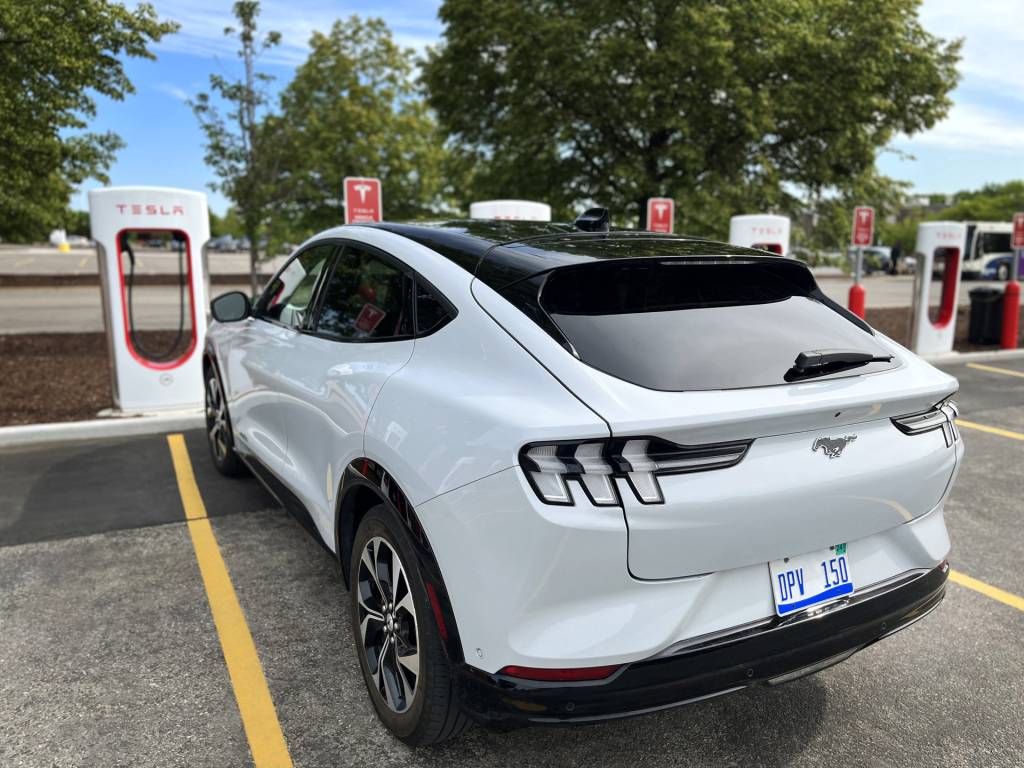
Ford Mustang Mach-E at Tesla Supercharger station
The issue applies to a specific batch of NACS adapters, which will be replaced free of charge in what Ford is classifying as a customer service action rather than a full recall, reports InsideEVs.
“Ford identified a potential issue with a batch of adapters sent earlier in the year where over time, continued usage may result in reduced charging speeds,” the automaker said in a statement to InsideEVs. “Ford does not recommend using the identified adapter.”
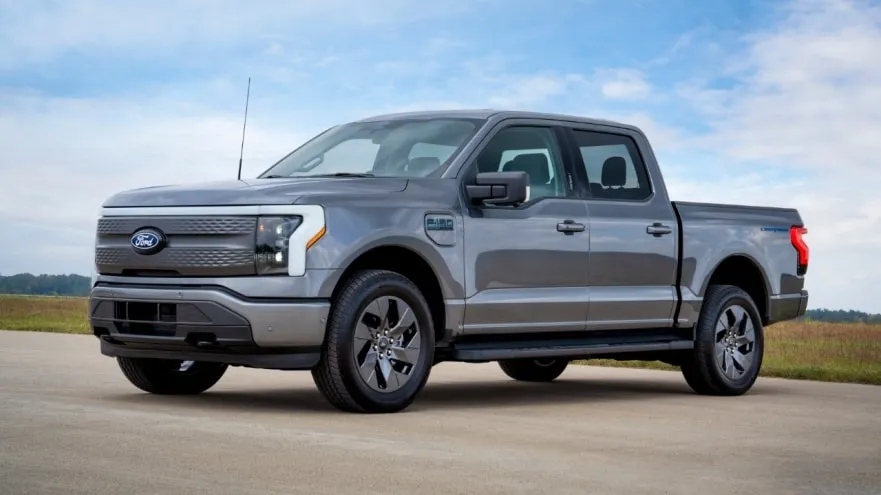
2024 Ford F-150 Lightning Flash
The automaker plans to begin shipping replacement adapters the week of Oct. 28, so that customers have time to check their shipping addresses. Retail customers should check the listed address in their FordPass accounts and update, if necessary, by Oct. 24. If the address is correct, no action is required. Fleet customers will be notified and asked to confirm their address directly by their National Account Manager.
As of Friday, InsideEVs reported that General Motors and Rivian have not experienced such issues with their Tesla NACS adapters, with Rivian confirming via a spokesperson that “drivers may continue to use their NACS adapters normally at this time.” While most other EV brands are shifting to the NACS port, only Ford, GM, and Rivian have shipped adapters so far.

Mercedes-Benz opens battery recycling plant in Germany
As automakers continue to ramp up EV production, they’re already thinking about what to do with battery cells once vehicles reach the end of their useful lives. To that end, Mercedes-Benz opened a battery recycling center in Germany.
Located in Kuppenheim, in the southern part of the country, Mercedes claimed in a press release that the facility will be able to recover up to 96% of valuable materials such as lithium, nickel, and cobalt for reuse in new batteries through an “integrated mechanical-hydrometallurgical” process.

Mercedes-Benz battery recycling plant in Kuppenheim, Germany
Being deployed for the first time in Europe, according to Mercedes, this process starts with the mechanical separation of plastics, copper, aluminum, and iron from the battery-electrode materials, leaving what Mercedes refers to as a “black mass.” Cobalt, lithium, and nickel are separated from that mass in a chemical process.
This separation process takes place at a lower temperature—around 176 degrees Fahrenheit—than other processes, making it less energy-intensive, according to Mercedes. The automaker claims the recycling plant will be net carbon neutral thanks to the use of 100% green electricity, including a rooftop solar array.

Mercedes-Benz battery recycling plant in Kuppenheim, Germany
At full capacity, Mercedes estimates that the plant will be able to process up to 2,755 tons of material annually, which will help support production of more than 50,000 battery modules for new Mercedes EVs.
The new plant could create a bigger footprint for battery recycling in Europe to match China, which Bloomberg in 2023 estimated had the most battery recycling capacity, and the U.S., where the Biden administration has made recycling a priority alongside battery manufacturing. But the recycling market is not expected to heat up right away due to the relatively limited supply of recyclable batteries, owing in part to their long lifetime in the EVs they were originally installed in.

2025 Ford Mustang Mach-E adds standard heat pump, costs $38,490
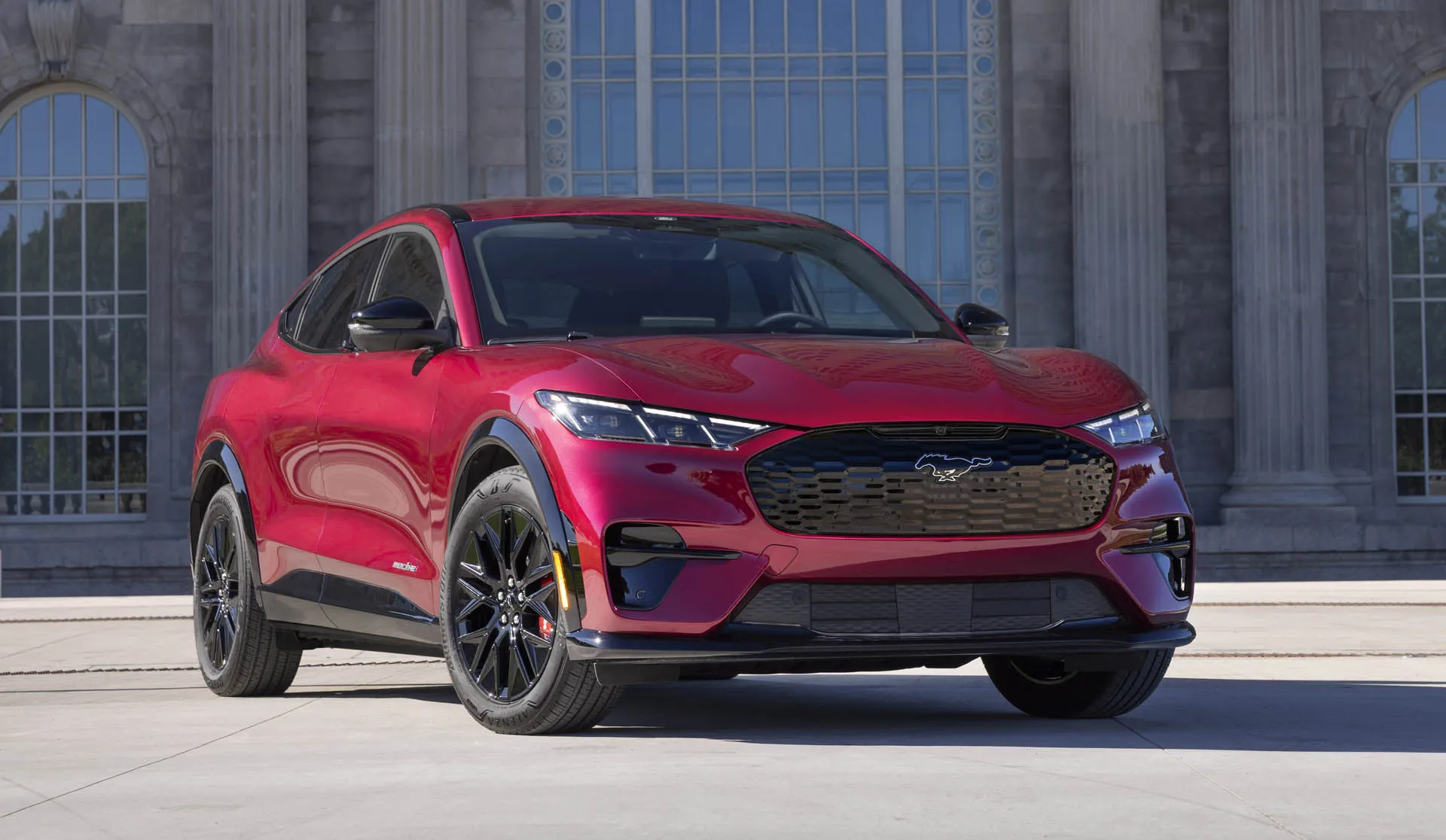
- Ford gave the 2025 Mustang Mach-E a heat pump
- 2025 Mustang Mach-Es get Ford’s BlueCruise version 1.5
- The 2025 Ford Mustang Mach-E costs $38,490
The Ford Mustang Mach-E received a host of updates for 2024, including faster charging, more range on some trims, and polished performance credentials in the form of a new Rally variant and an optional performance upgrade for the Mach-E GT. But the 2025 model still gets a few updates as well.
Among those updates is a standard heat pump that, as previously shown in other EVs, generally means improved efficiency in cold weather, on longer trips. That helps address cold-weather range loss in EVs, an area where the Mach-E may have room for improvement. It had fairly high cold-weather range loss compared to other EV models in a 2023 study by battery-firm Recurrent.
The available BlueCruise 1.5 hands-free highway driving system (2024 models had version 1.3) adds automated lane changes, initiated when the vehicle ahead is moving slower than the system’s set speed, or when a car is following too closely in the passing lane. BlueCruise itself comes with one year of free access on GT and Rally models (it’s a $495 option on Select and Premium models) if the system is activated at vehicle purchase (otherwise, customers get a 90-day trial). When ordering, customers can purchase BlueCruise via a one-time fee, or set up a subscription plan.
A new Ford Connectivity Package includes connected navigation that enables an EV trip planner features, 5G wifi, and entertainment apps like YouTube (which only works while parked) and Alexa. The latter ports over one of the headline features of the Ford Digital Experience infotainment system rolling out in other models—but so far not the Mach-E.
Also new for 2025 is a Sport Appearance Package that applies some of the visual accoutrements of the Mach-E GT to lower-priced models. It includes the GT’s front fascia, grille, and red Brembo-branded front brake calipers, as well as black 19-inch wheels. Inside, the package adds red accent stitching and sport pedals, while all Mach-E models switch to a column-mounted shifter, replacing the previous rotary dial.
Range is likely to remain at a maximum 320 miles with rear-wheel drive and the 91-kwh (usable) Extended Range battery pack, or up to 250 miles with the 72-kwh Standard Range pack. All-wheel drive is also available with both packs, with range likely staying at 300 miles with the Extended Range pack and 230 miles with the Standard Range pack.
Mach-E GT models turn output from the dual-motor powertrain up to 480 hp and 600 lb-ft of torque. The optional GT Performance Upgrade increases torque to 700 lb-ft and allowing the Mach-E to gallop from 0-60 mph in a Ford-estimated 3.3 seconds and through the quarter mile in 11.8 seconds. The Mach-E Rally combines the GT powertrain with rally-ready tires, suspension, and software tuning.
Pricing starts at $38,490 (all prices include a mandatory $1,995 destination charge) for a Select base model with rear-wheel drive and the Standard Range Pack, and $41,990 for the Premium grade. All-wheel drive adds $3,000 to the MSRP for both grades, while the Extended Range pack costs $3,750 on Premium models. It’s $5,250 on the Select, and can only be ordered with all-wheel drive. GT and Rally models, which are only available with the larger battery pack, cost $54,490 and $57,990, respectively.
—
UPDATED to clarify that BlueCruise is initially available to customers for one year if activated at the time of vehicle purchase, before any subscription plans or other fees come into effect.

Looking at how the election outcome might sway U.S. transportation policy (Episode 272)
Mobility expert Selika Josiah Talbott and SkillFusion CEO Elaina Farnsworth offer a pragmatic look at how the 2024 election results could bolster mobility innovation, affect the zero-emission transition and impact the American workforce of the future.