
Category: General

Scout Traveler vs. Rivian R1S: Comparing electric SUVs
The first true challenger to Rivian’s R1S off-road electric family hauler has come out of the shadows. VW’s Scout will be developing its off-road electric SUV aiming squarely at Rivian R1S.
Years away, the electric Scout Traveler SUV will be the most direct Rivian R1S rival when it arrives, which is targeted to happen in 2027.
Scout said the Traveler shown is a concept that is 85% production intent. Here’s a look at how the Scout SUV stacks up against the Rivian.
What are the Scout Traveler and Rivian R1S?
How much does the Scout Traveler and Rivian R1S cost?
-
The Rivian R1S costs $77,700 including an $1,800 destination charge, and it can be optioned up to about $110,000 today.
-
Quad-motor models returning next year will check in at about $120,000.
-
Scout said the Traveler will cost less than $60,000, though originally the electric SUV was said to start in the $40,000s.

Scout Traveler SUV concept
Which has more range: the Scout Traveler or Rivian R1S?
-
Rivian goes the distance, with between 270 and 410 miles of EPA-rated range.
-
Scout said the Traveler will have up to 350 miles of range.
-
Scout will offer a Harvester option on the Traveler, which adds a range-extender. Scout said the range-extender has no mechanical connection to the wheels, and gives the Traveler up to 500 miles of driving range with the small gas engine acting as a generator.
What size battery does the Traveler and Rivian R1S have?
-
The Rivian R1S can be had with a 92.5- 109.4-, or 141.5-kwh (usable) battery pack.
-
Scout hasn’t talked battery pack sizes for the Traveler, yet.
How fast do the Scout Traveler and Rivian R1S charge?
-
The Rivian R1S runs a 400-volt electrical architecture and has a max charge rate of 220 kw.
-
Scout said the Traveler runs on a more future-ready 800-volt electrical architecture with project peak charge rate of 350 kw.
-
The Rivian R1S has bidirectional charging capabilities, and Scout said the Traveler will as well.
-
The Scouts will launch with Tesla’s NACS charge port; Rivians currently have CCS charge ports
-
Rivians already have Tesla Supercharger access via an adapter.
How many motors does the Scout Traveler and Rivian R1S have?
-
Rivian R1S can be optioned with dual-, tri-, or quad-motor powertrains with power outputs ranging from 533 hp to 1,025 hp and up to 1,198 lb-ft of torque.
-
Scouts will have two motors, one per axle, with up to nearly 1,000 lb-ft of torque. Scout isn’t talking hp at this time.
Which is quicker: the Scout Traveler or the Rivian R1S?
-
The Rivian R1S is quicker, by a lot.
-
Rivian R1S can do 0-60 mph in 4.5 seconds or as little as 2.5 seconds depending on the powertrain.
-
Scout said the Traveler will do 0-60 mph in 3.5 seconds.
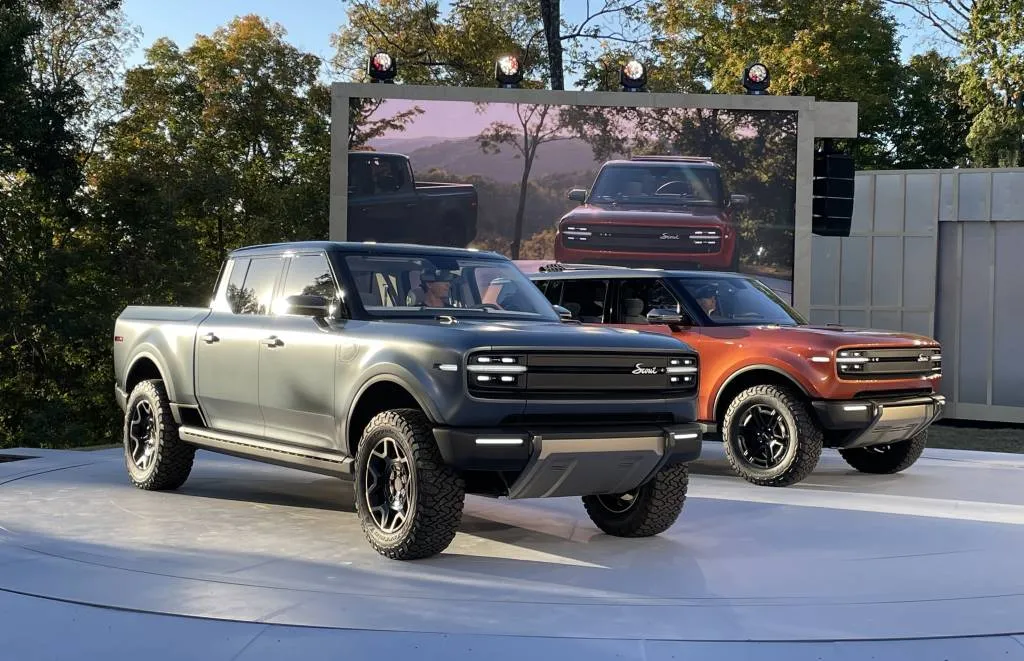
Scout Traveler SUV and Terra pickup concepts
How large are the Scout Traveler and Rivian R1S and how many do they hold?
-
At 207.9 inches long the Scout Traveler is 7.1 inches longer than the Rivian R1S.
-
Every Rivian R1S has seating for seven passengers with two bucket seats up front, three seats on the second-row bench, and room for two in the standard third row.
-
The Scout Traveler is a two-row SUV with seating for either five or six passengers.
-
Scout Traveler buyers will choose between a pair of front bucket seats with a center console or three-person bench seat.
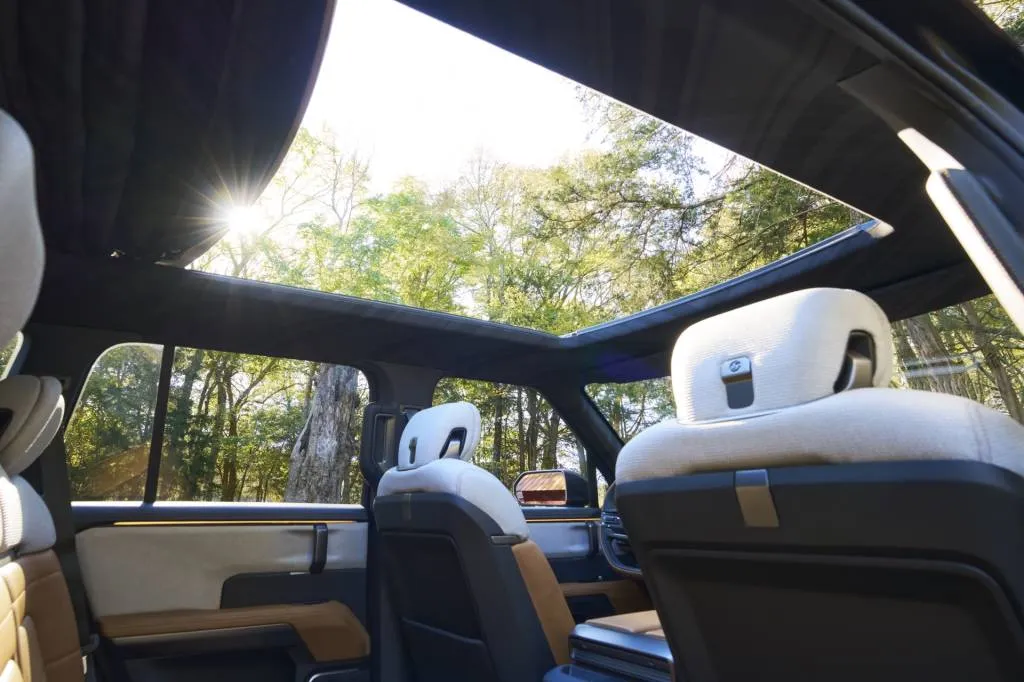
Scout Traveler SUV concept
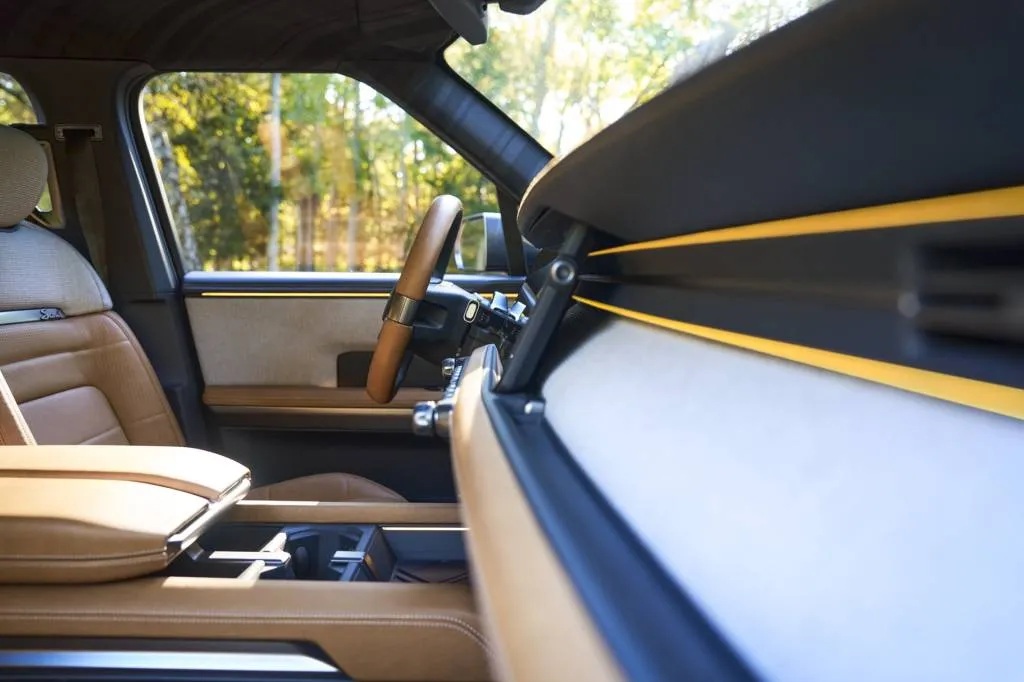
Scout Traveler SUV concept
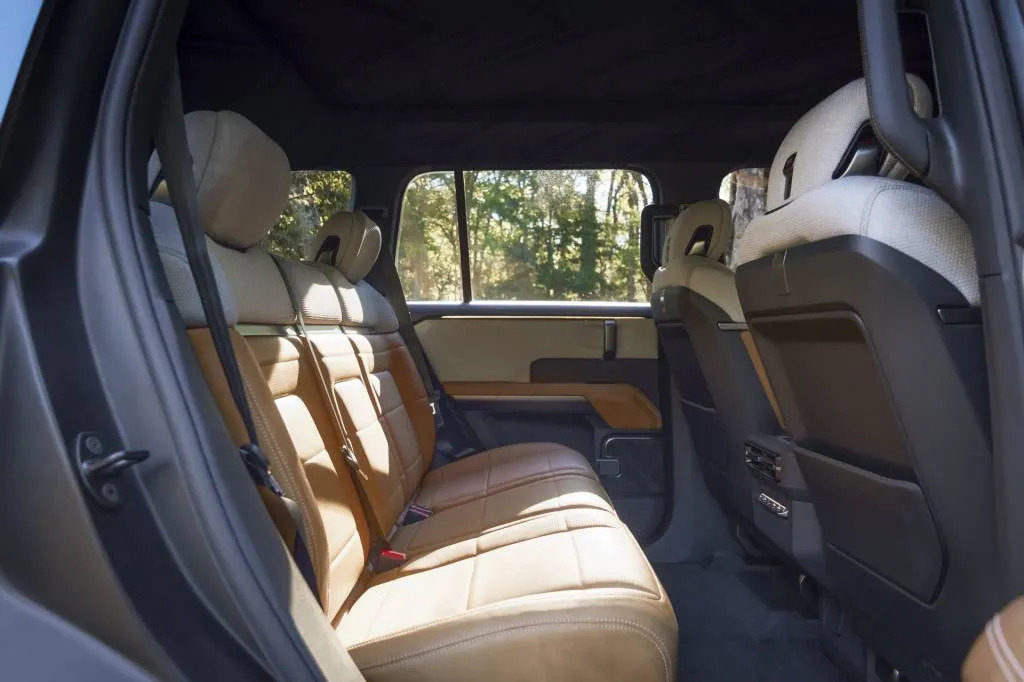
Scout Traveler SUV concept
What kind of controls do the Scout Traveler and Rivian R1S have?
-
The Rivian R1S relies mostly on a 15.6-inch touchscreen, which is augmented by a 12.3-inch digital gauge cluster and 6.8-inch touchscreen for the second row.
-
The Scout Traveler has a 16.2-inch touchscreen augmented by hard switches and dials for the climate control and auxiliary systems. A 12.3-inch digital gauge cluster sits in front of the driver.
When can I buy the Scout Traveler and Rivian R1S?
What kind of suspensions do the Scout Traveler and Rivian R1S have?
-
The Rivian R1S features independent suspension at both ends.
-
Rivian’s ride on an air suspension paired with a hydraulic kinetic anti-roll system, which replaces conventional anti-roll bars.
-
The Scout Traveler has a solid rear axle with independent front suspension, but Scout hasn’t divulged full engineering details yet.
Where are the Scout Traveler and Rivian R1S made?
-
The Rivian R1S is produced in Normal, Illinois.
-
The Scout Traveler will be produced in South Carolina.
Are the Scout Traveler and Rivian R1S good off-road?
-
Yes and probably.
-
The Rivian R1S sends power to all four wheels, can be lifted to have 15.0 inches of ground clearance, and can ford up to 43.0 inches of standing water.
-
The Scout Traveler will send power to all four wheels, have mechanical front lockers and front sway bar disconnect, both of which are things the Rivian lacks, will have over 12.0 inches of ground clearance, and will be able to ford nearly 36 inches of water.
How much can the Scout Traveler and Rivian R1S tow and haul?
-
The Rivian R1S has a tow rating of 7,700 pounds and is rated to carry up to 1,764 pounds of payload.
-
The Scout Traveler is expected to carry a tow rating of over 7,000 pounds and be rated to haul nearly 2,000 pounds of payload.
Green Car Reports Newsletter
Sign up to get the latest green car and environmental news, delivered to your inbox daily!
I agree to receive emails from Green Car Reports. I understand that I can unsubscribe at any time. Privacy Policy.

Scout Terra vs. Rivian R1T: Comparing electric trucks
The Scout Terra electric truck has the Rivian R1T in its sights, along with a bevy of other electric pickups.
Said to enter production in 2027, the Scout Terra will be an off-road, adventure-ready electric truck that cribs from Rivian’s playbook.
Although billed as a production-intent concept that’s 85% of what will be made in the U.S. in 2027, the Scout Terra remains years away. Here’s how it stacks up against the present-day Rivian R1T.
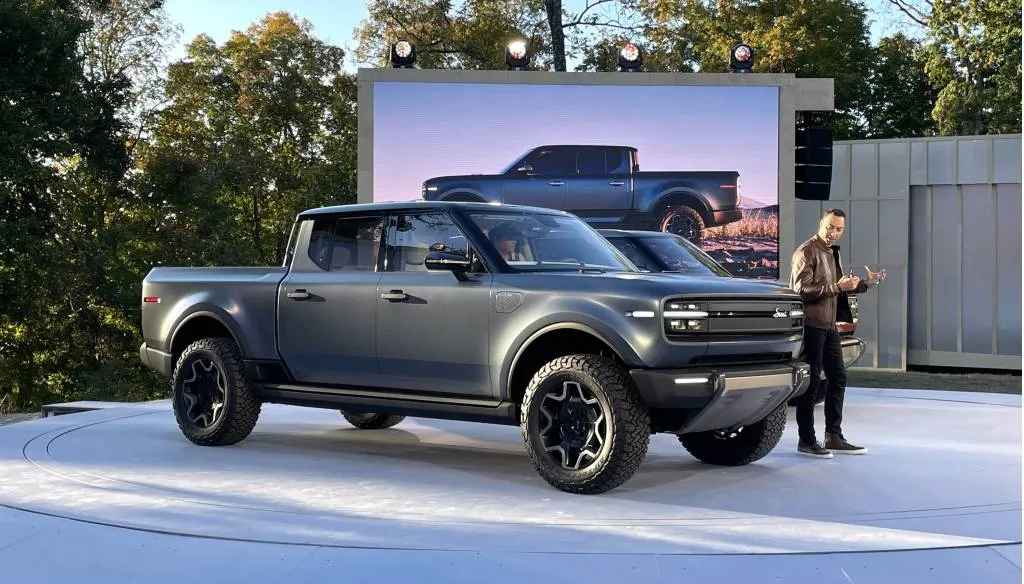
Scout Terra pickup concept
What are the Scout Terra and Rivian R1T?
How much does the Scout Terra and Rivian R1T cost?
-
Rivian R1T costs $71,700 including an $1,800 destination charge, can be optioned up to about $110,000 today.
-
Upcoming quad-motor R1Ts will check in at about $120,000 next year.
-
Originally Scout said the Terra pickup would cost more than the Traveler SUV, which was to start in the $40,000s; now both are said to cost less than $60,000.
Which has more range: the Scout Terra or Rivian R1T?
-
The current Rivian R1T goes further on a charge than a future Scout Terra might.
-
Rivian’s R1T has between 270 and 420 miles of EPA-rated range.
-
The Terra electric truck will have up to 350 miles of range, according to Scout.
-
The Terra will offer a Harvester option, which adds a gas-powered range-extender and a tailpipe. The range-extender will encompass a series hybrid system, with no mechanical connection to wheels, according to Scout.
-
The Harvester range-extender might enable up to 500 miles of driving range.
How large is the Scout Terra and Rivian R1T and how many passengers do they hold?
-
The Scout Terra is larger than the Rivian.
-
The Rivian R1T seats five.
-
The Rivian R1T measures in at 217.1 inches long, which is 14.6 inches shorter than Ford F-150 Lightning.
-
Scout Terras will seat five or six passengers with two rows of seats.
-
Scout will offer front bucket seats with a center console or three-person bench up front
-
The Scout Terra measures in at 229.2 inches, which is nearly the size of a Ford F-150 but over 10 inches longer than the Rivian R1T.
What kind of controls do the Scout Terra and Rivian R1T have?
-
The Rivian R1T relegates almost all controls to a 15.6-inch touchscreen with almost no buttons to speak of outside the steering wheel.
-
There’s a 12.3-inch digital gauge cluster for the driver and 6.8-inch touchscreen for the second-row occupants.
-
Scout Terras have a 16.2-inch touchscreen along with hard switches and dials for the climate control and auxiliary systems.
-
Scout said accessories will be able to tie into the hard controls along with a smartphone app.
-
A 12.3-inch digital gauge cluster sits in front of the driver in the Terra.
What size battery does the Scout Terra and Rivian R1T have?
-
The Rivian R1T can be optioned with a 92.5- 109.4-, or 141.5-kwh (usable) battery pack.
-
Scout hasn’t talked battery pack sizes for the Terra, yet.
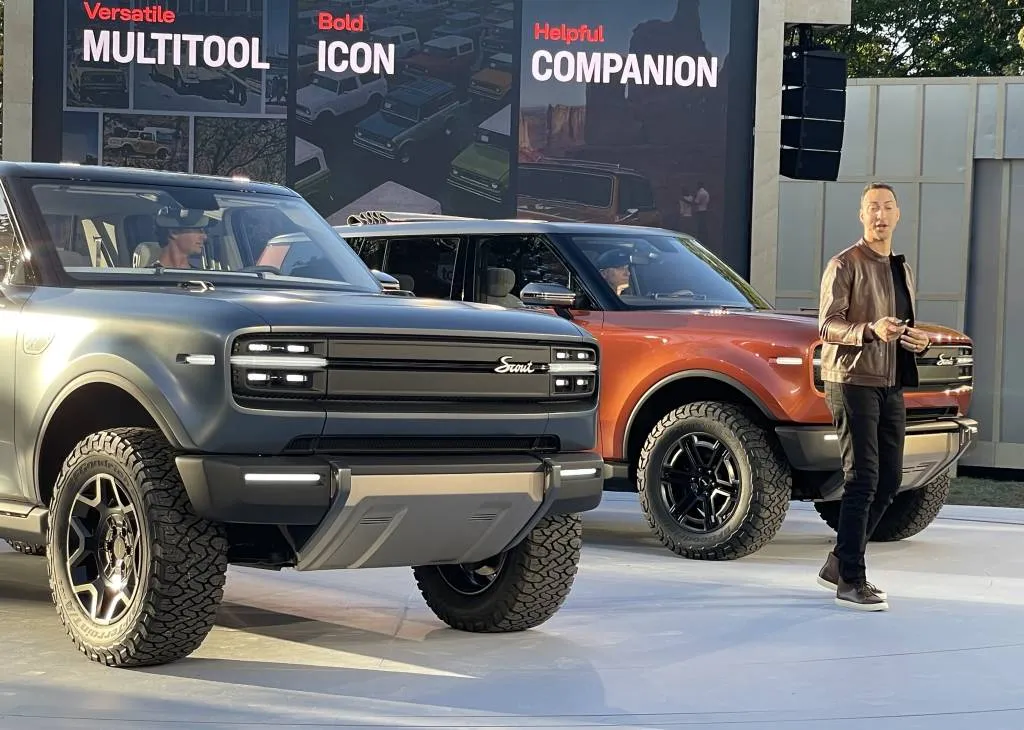
Scout Traveler SUV and Terra pickup concepts
How fast do the Scout Traveler and Rivian R1S charge?
-
The Rivian R1T runs a 400-volt electrical architecture and has a max charge rate of 220 kw.
-
Terra will run on a more future-proof 800-volt electrical architecture with a projected peak charge rate of 350 kw.
How many motors do the Scout Terra and Rivian R1T have?
-
Rivian R1Ts can be optioned with dual-, tri-, or quad-motor powertrains with power outputs ranging from 533 hp to 1,025 hp and up to 1,198 lb-ft of torque.
-
Scout Terras will have two motors—one per axle—with up to nearly 1,000 lb-ft of torque. No hp has been discussed, yet.
Which is quicker: the Scout Terra or the Rivian R1T?
-
Rivian R1T, by a healthy amount.
-
Rivian R1T sprints 0-60 mph in just 2.5 seconds.
-
The slowest R1T does 0-60 mph in 4.5 seconds.
-
The Terra will do 0-60 mph in 3.5 seconds, according to Scout.
When can I buy the Scout Terra and Rivian R1T?
What kind of suspensions do the Scout Terra and Rivian R1T have?
-
The Rivian R1T features an independent suspension at both ends.
-
The R1T rides on air suspension paired with a hydraulic kinetic anti-roll system, which replaces conventional anti-roll bars.
-
The Scout Terra has a solid rear axle with independent front suspension, but Scout hasn’t divulged full engineering details yet.
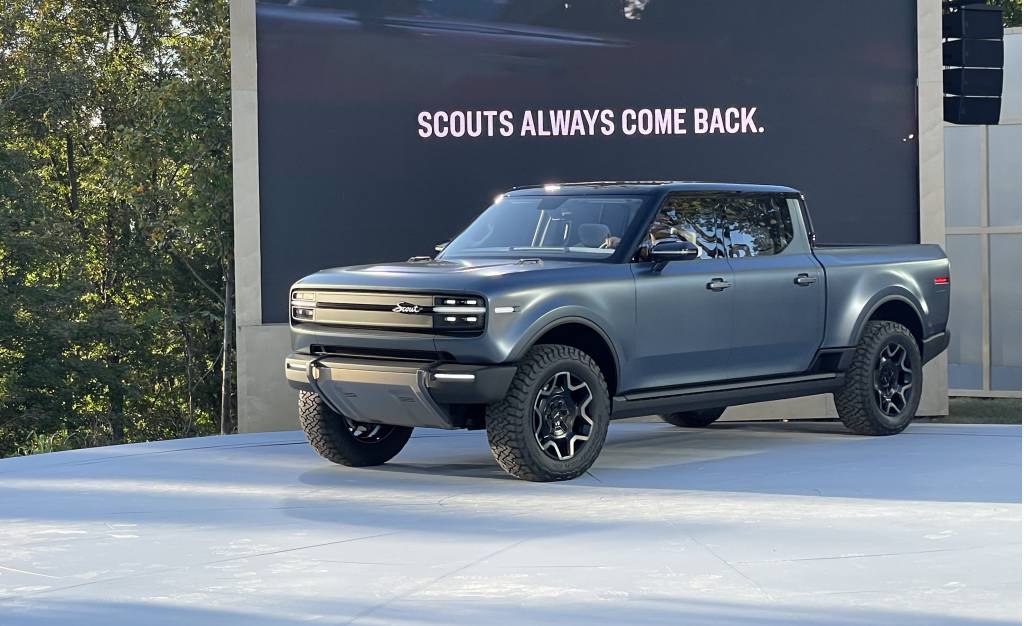
Scout Traveler Terra pickup concept
Where are the Scout Terra and Rivian R1T made?
-
Rivian puts the R1T together in Normal, Illinois.
-
Scout will assemble Terras in South Carolina.
Are the Scout Terra and Rivian R1T good off-road?
-
Yes and probably.
-
The Rivian R1T sends power to all four wheels, can be lifted to have 14.9 inches of ground clearance, and can ford up to 43.1 inches of standing water.
-
The Scout Terra will have over 12.0 inches of ground clearance, and will be able to ford nearly 36 inches of water.
-
The Scout Terra will send power to all four wheels, have mechanical front lockers and a front sway bar disconnect (all things the Rivian lacks)
How much can the Scout Terra and Rivian R1T tow and haul?
-
The Rivian R1T has a tow rating of 11,000 pounds and is rated to carry up to 1,764 pounds of payload.
-
The Scout Terra is expected to arrive with a tow rating of over 10,000 pounds and be rated to haul nearly 2,000 pounds of payload.
-
The Rivian R1T has a 4.5-foot bed.
-
The Scout Terra has a 5.5-foot bed.
Green Car Reports Newsletter
Sign up to get the latest green car and environmental news, delivered to your inbox daily!
I agree to receive emails from Green Car Reports. I understand that I can unsubscribe at any time. Privacy Policy.


Elon Musk calls $25,000 EV “pointless,” says future is autonomous
- A $25,000 EV is pointless and silly, according to Tesla CEO Elon Musk
- The future is autonomous in Musk’s view
- But Musk reiterated that we need to make EVs affordable for everyone
In the automaker’s third-quarter earnings call, Tesla CEO Elon Musk did an about face from the idea of a $25,000 electric vehicle that he had previously promoted.
Tesla will only build a $25,000 EV as a robotaxi designed for autonomous ride-sharing, Musk said in response to a question about when investors can expect a conventional EV from the automaker at that price point, according to a summary of the exchange from InsideEVs.
“Basically, having a regular $25,000 model is pointless. It would be silly. It would be completely at odds with what we believe,” Musk said, adding that “I think we have been very clear that the future is autonomous.”
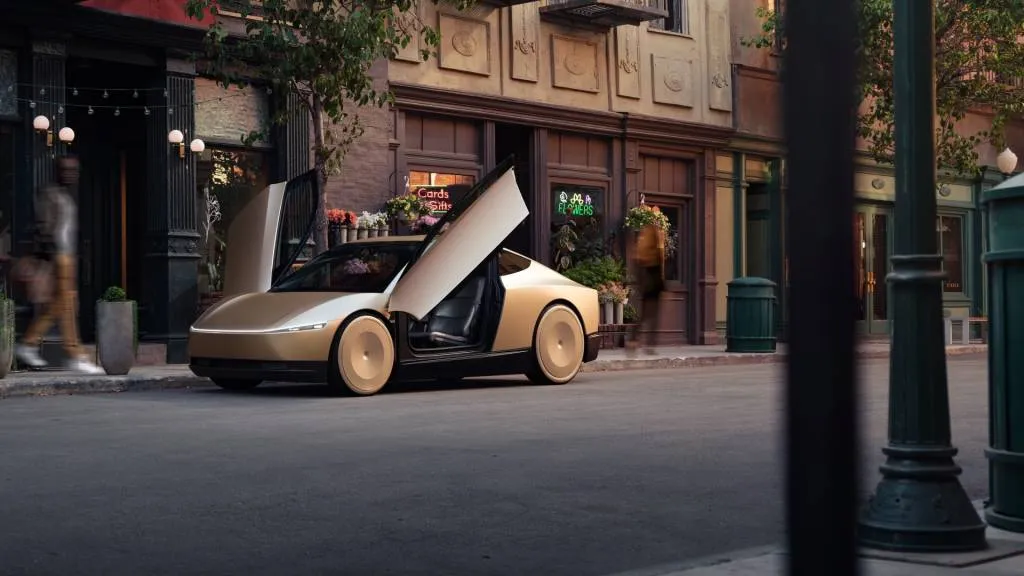
Tesla Robotaxi Cybercab
Tesla revealed its vision of this future in the form of the autonomous Cybercab and Robovan concepts at an event earlier in October. The Cybercab, a two-seater that doesn’t have a steering wheel or any pedals, will launch “before 2027” and cost less than $30,000, Musk said at the event. But this all-in approach to autonomous driving is a relatively recent development.
Musk has discussed plans for a $25,000 Tesla since 2020, when he made the idea of a “compelling” entry-level EV the focus of Tesla’s Battery Day presentation. At the time, Musk said affordability would be enabled partly by the scaling up of large-format batteries and improved chemistries—including lithium iron phosphate (LFP)—and that the $25,000 EV would arrive by 2023.
Tesla has sent conflicting signals on the project since then. In 2021 a top Tesla executive in China said the affordable EV was under development there. Some time later Musk said the company wasn’t working on a $25,000 EV, and that the robotaxi project was more important.
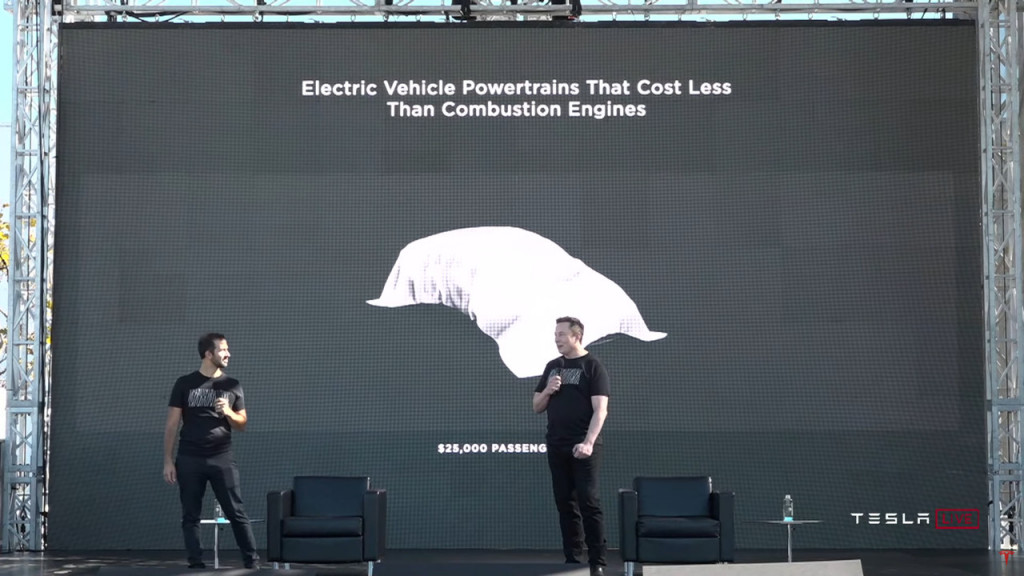
$25,000 Tesla teased for 2023 – Battery Day
In January of this year, Tesla reportedly reportedly made a call to suppliers in preparation for an affordable model due to arrive in 2025. The report’s sources implied a total annual output for the model, codenamed Redwood, of more than 500,000 units.
In a presentation and Q&A for investors the following day, neither the company nor Musk described the $25,000 Tesla project. However Musk spoke to some of the rationale for such a model, noting that many of the bestselling internal-combustion vehicles globally cost less than the Model Y and Model 3 currently do. Another report in April said the project had been completely nixed which, combined with Musk’s comments in the Q3 investor call, would seem to be the end of the matter. But not quite.
During the same call, Musk also said that “we need to make EVs affordable for everyone, including making total cost of ownership per mile competitive with all forms of transportation,” adding that “Preparations remain underway for our offering of new vehicles—including more affordable models—which we will begin launching in the first half of 2025.”

Costco jumps back into EV charging, puts their brand on it
- Costco is returning to EV charging, with a first location assuring reliability and a different approach
- Charging station was set up in seven weeks—shorter than a Tesla Supercharger station
- Electric Era uses battery storage, AI load management, claims 98%+ uptime per port
- Retailer has not announced any plans to get rid of its popular gas pumps
Costco is putting charging back into its offerings—with a DC fast-charging location at its new warehouse store in Ridgefield, Washington, and what sounds to be the start of a new focus on EV charging for the retail giant.
The firm tasked with charging at this location, Electric Era, claims that it has been able to deploy this new fast-charging station in just seven weeks—from contract signature all the way to station launch.
That’s warp speed, even by Tesla Supercharger standards. In California, for instance, where an accelerated buildout of public charging is needed, charging stations have sat for months waiting for last steps—and according to a recent report, utilities typically take 17 weeks after work on a charging station is completed to simply connect it to the grid.
Electric Era, calls itself an “end-to-end EV charging solution partner.” It builds battery storage into its charging stations from the start, with software utilizing AI to help manage load and keep it under a particular peak—cutting the necessary transformer size by more than 60%. It boasts that this station will deliver 98%+ uptime per port.
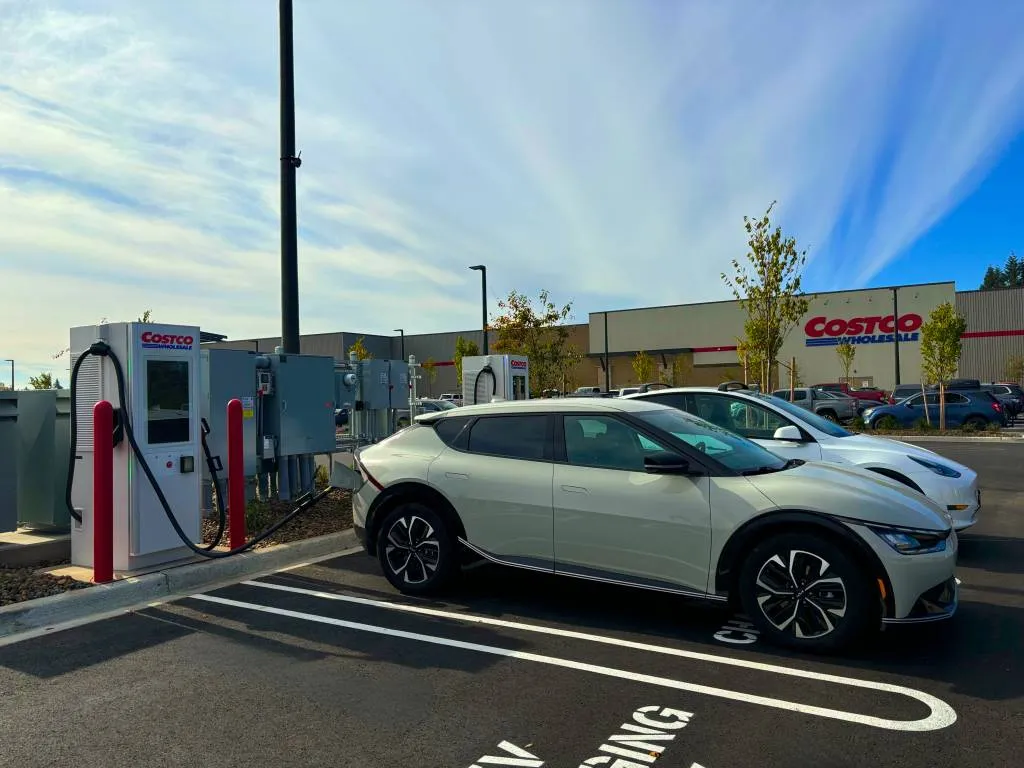
Costco Electric Era EV charging station
The partnership with Costco focuses on reliability, cost efficiency, and “unmatched access-to-market,” according to Electric Era, which allows an approach that’s “tailored to the needs of large retailers like Costco,” according to the company. It claims to have autonomous monitoring of its stations “via high-rate telemetry” and 24/7 on-call operators who can troubleshoot and dispatch.
Electric Era says that its system offers customizable 32-inch full-screen displays for personalized messaging and promotions.
Especially of note here is that this charging station is branded with Costco, not Electric Era. Green Car Reports has reached out to Costco to clarify the extent of the arrangement, but for now the closest thing to compare it to might be Walmart, which in 2023 signaled a parting of ways from Electrify America with an announcement that it would be shifting toward its own Walmart EV fast-charging network.
For now, the charging company told GCR that it’s in “ongoing discussions with Costco to explore potential future locations.”
A Consumer Reports study from earlier this year found that big-box stores and fast-food chains aren’t providing enough EV chargers to support customers or the communities around them.
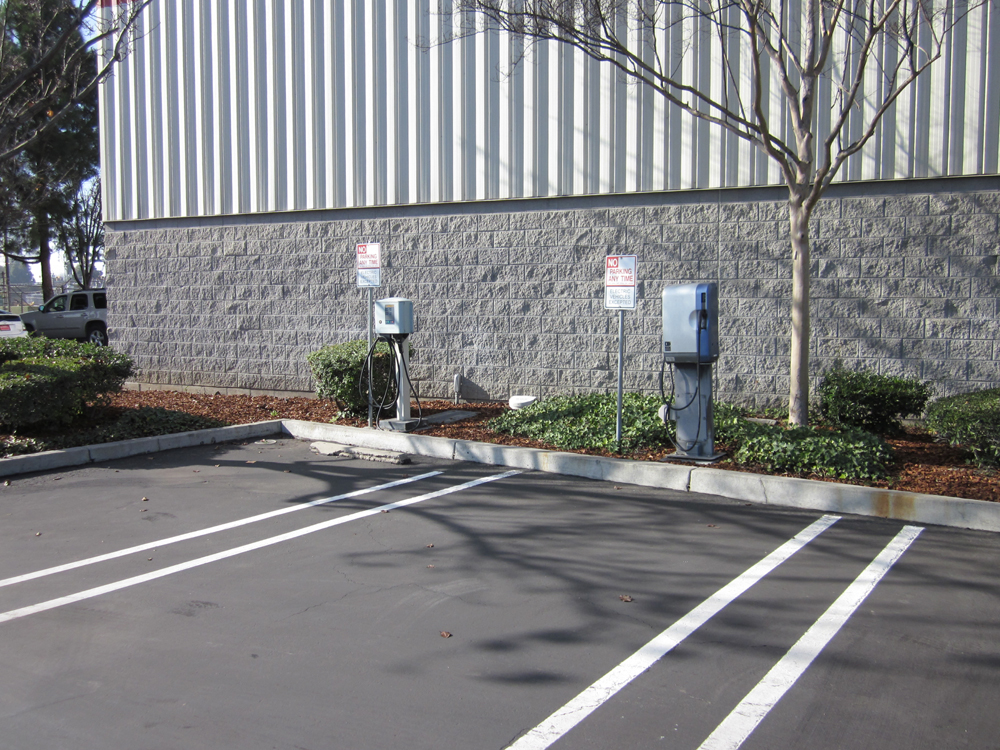
EV charging station at Costco
Costco isn’t new to EV charging. It was one of the first big-box retailers—in the late 1990s—to install destination (L2) charging stations at many of its California locations. Most of those didn’t have J1772 connectors to plug easily into the Nissan Leaf and, with an adapter, the Tesla Model S, but Costco instead opted to pull the plug on its EV chargers in 2011 and 2012.
The retailer has for a long time relied on its gas stations as a traffic-driver for its retail stores, and it currently operates gas stations at the majority of its warehouse stores, with most open 24 hours a day. And like shopping at the stores themselves, gassing up at Costco requires a membership.
A top executive said just last year that it had no plans to retire those lucrative gas stations. But perhaps by keeping that and adding EV charging to the menu it can win even more retail hearts.

Stellantis tackling EV aerodynamics with $29.5M wind tunnel
- Stellantis upgraded its wind tunnel to the tune of $29.5 million
- The upgrades focused on aero efficiency to help with EV range
- What used to take hours can now take minutes to change with the recent wind tunnel upgrades
Stellantis on Wednesday unveiled a $29.5 million upgrade of the wind tunnel at its main research and development facility in Auburn Hills, Michigan, giving engineers an enhanced tool to further improve efficiency and EV range.
Upgrades to the wind tunnel, which has been in continuous operation since 2002, include provisions for specific measurements of airflow resistance around wheels and tires, Stellantis said, adding that wheels and tires can account for up to 10% of real-world aerodynamic drag.
Vehicles remain static, with belts suspended on cushions of air turning all four wheels. A fifth moving belt represents the effect of travel over a road surface. Compressed air drives the belts at speeds up to 140 mph, while the tunnel is capable of generating wind speeds of up to 160 mph, according to Stellantis. The automaker uses similar wind-tunnel technology at other facilities globally, but the Michigan facility can accommodate larger vehicles—including EVs based on the STLA Large and STLA Frame platforms.
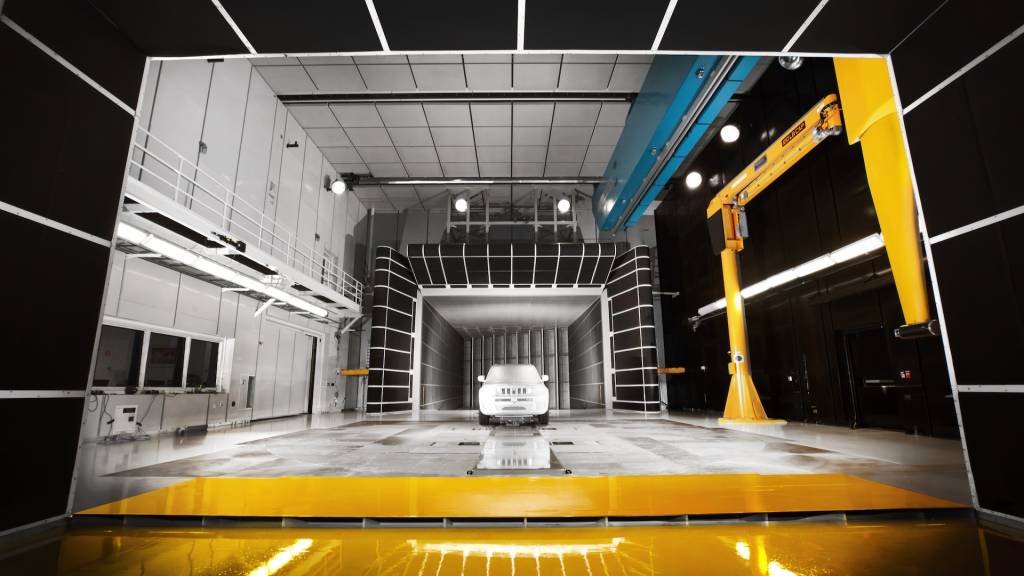
Stellantis wind tunnel in Auburn Hills, Michigan
Increased automation also means that changes of wheelbase and track that can take up to two hours in conventional wind tunnels can now be done in minutes, according to Stellantis. This lets the wind tunnel continue to act as a vital complement to virtual simulations.
“This apparatus is a great addition to virtual tools, which may not account for factors such as tire deformation that can compromise aerodynamics,” Mark Champine, head of Stellantis’ North American engineering technical centers, said in a statement. “With this technology we can replicate such conditions and capture real-time data to explore solutions.”
The wind tunnel is part of an estimated $85 million commitment to facility upgrades specified in a 2019 Stellantis contract with the UAW. However, the automaker is also reportedly looking to sell its Arizona proving grounds.
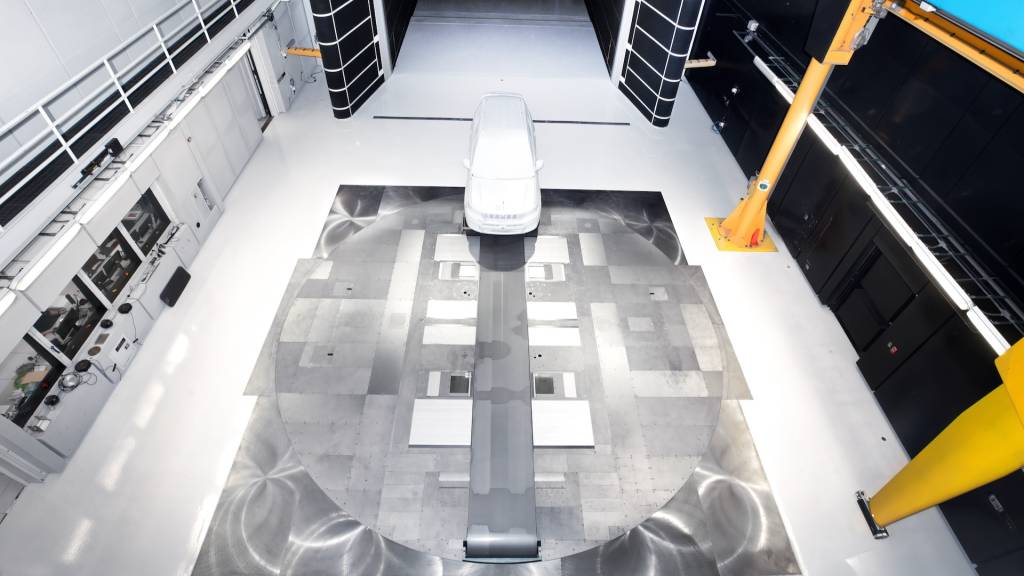
Stellantis wind tunnel in Auburn Hills, Michigan
The need to maximize EV range without further growing battery-pack sizes has revived a century-old obsession with aerodynamics—one that Stellantis is familiar with. The Chrysler Airflow debuted in 1934 with wind-tunnel-tested styling that proved controversial at the time. The Airflow name was revived in 2022 for an electric SUV concept, although it’s still unclear whether that vehicle or a next-generation minivan will be the Chrysler brand’s first EV.
Also of aerodynamic note is the 2024 Dodge Charger Daytona, based on the STLA Large platform and also being used to test solid-state batteries. The electric muscle car uses an innovative front airfoil to reconcile the blunt front end reminiscent of the classic 1968 Charger with modern aero requirements. The Daytona name, which denotes all-electric models, also references the Charger Daytona race car, which used a pointed nose cone and tall rear wing to minimize aerodynamic drag on NASCAR oval tracks.
Stellantis is targeting 50% U.S. EV sales and 100% European EV sales by 2030, with 75 models globally by that time.

Feds investigating Tesla Full Self-Driving after four crashes, one fatality
- The NHTSA is looking at the safety of Tesla’s Full Self-Driving system
- Four crashes have been documented while Tesla’s Full Self-Driving system was engaged, one was fatal
- Tesla CEO Elon Musk doubled down on self-driving cars with the Cybercab
The National Highway Traffic Safety Administration (NHTSA) has opened an investigation into the Tesla Full Self-Driving driver-assistance system following four documented crashes, including one fatal 2023 crash, reports Reuters.
The investigation, which is the first step before the NHTSA can demand a recall on safety grounds, covers 2016-2024 Tesla Model S and Model X electric cars with the optional system, as well as 2017-2024 Tesla Model 3, 2020-2024 Tesla Model Y, and 2023-2024 Tesla Cybertruck pickups—essentially every vehicle that could be optioned with Full Self-Driving.
The NHTSA said it opened the investigation after four crashes where the system was engaged during reduced-visibility conditions such as sun glare, fog, or airborne dust. This includes a November 2023 crash in which a pedestrian was killed in Rimrock, Arizona, after being struck by a 2021 Tesla Model Y, according to the agency. Another crash under investigation involved a reported injury.
![Tesla Model 3 dashboard in Autopilot testing with IIHS [CREDIT: IIHS]](https://evautoinsider.com/wp-content/uploads/2024/10/feds-investigating-tesla-full-self-driving-after-four-crashes-one-fatality.jpg "Tesla Model 3 dashboard in Autopilot testing with IIHS [CREDIT: IIHS]")
Tesla Model 3 dashboard in Autopilot testing with IIHS [CREDIT: IIHS]
The investigation will include a review of Full Self-Driving’s ability to “detect and respond appropriately to reduced roadway visibility conditions.” The NHTSA has also asked Tesla if any other similar crashes have occurred under reduced roadway visibility and whether the automaker has made any updates that may affect Full Self-Driving in such conditions, according to Reuters.
Despite its name, Tesla’s website acknowledges that Full Self-Driving still requires active driver supervision and does not make cars truly autonomous. There are no self-driving cars currently available for consumers to buy.
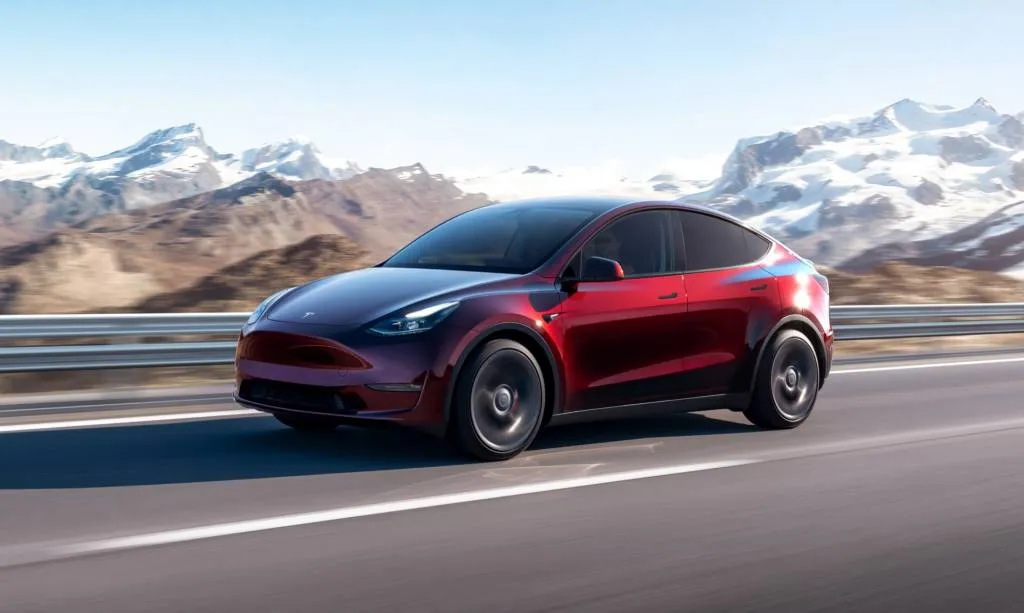
2024 Tesla Model Y. – Courtesy of Tesla, Inc.
In 2023, the NHTSA requested that Tesla issue a recall to restrict the behavior of Full Self-Driving, saying the system posed “an unreasonable risk to motor vehicle safety.” Later that year, Tesla disclosed that the U.S. Justice Department had issued subpoenas related to the Full Self-Driving and Autopilot systems. Tesla continues to offer Full Self-Driving as an $8,000 option, down from a high of $15,000 in 2022.
The investigation comes as Tesla CEO Elon Musk doubles down on autonomous driving. Earlier this month, Musk staged a showy reveal of an autonomous $30,000 two-seat Cybercab he said would arrive before 2027, as well as a 20-seat autonomous shuttle concept dubbed Robovan.

Stellantis to test solid-state batteries in Dodge Charger Daytona EVs
Stellantis will test solid-state battery cells from Massachusetts-based Factorial in a fleet of Dodge Charger Daytona electric vehicles starting in 2026, the two companies announced Wednesday.
The test fleet “will enable the validation of Factorial’s technology and assessment of its performance in real-world driving conditions,” the companies said. It will also help Stellantis gauge whether Factorial’s solid-state cells can be integrated with its EV-focused STLA Large platform—which underpins the Charger, Jeep Wagoneer S, and other upcoming models—on a commercial scale.

Factorial solid-state battery cell
It’s also yet another step toward commercialization of Factorial’s battery tech, which the company has been slowly advancing toward over the past few years. Factorial began providing test cells to automakers in 2022. The following year, Factorial opened what it billed as the largest U.S. solid-state EV battery plant yet in a Boston suburb.
Stellantis invested $75 million in Factorial in 2021. Other automaker investors include Hyundai and Mercedes-Benz. Earlier this year, Factorial announced that its Solstice solid-state cell developed in collaboration with Mercedes could boost EV range by up to 80% through greater energy density.
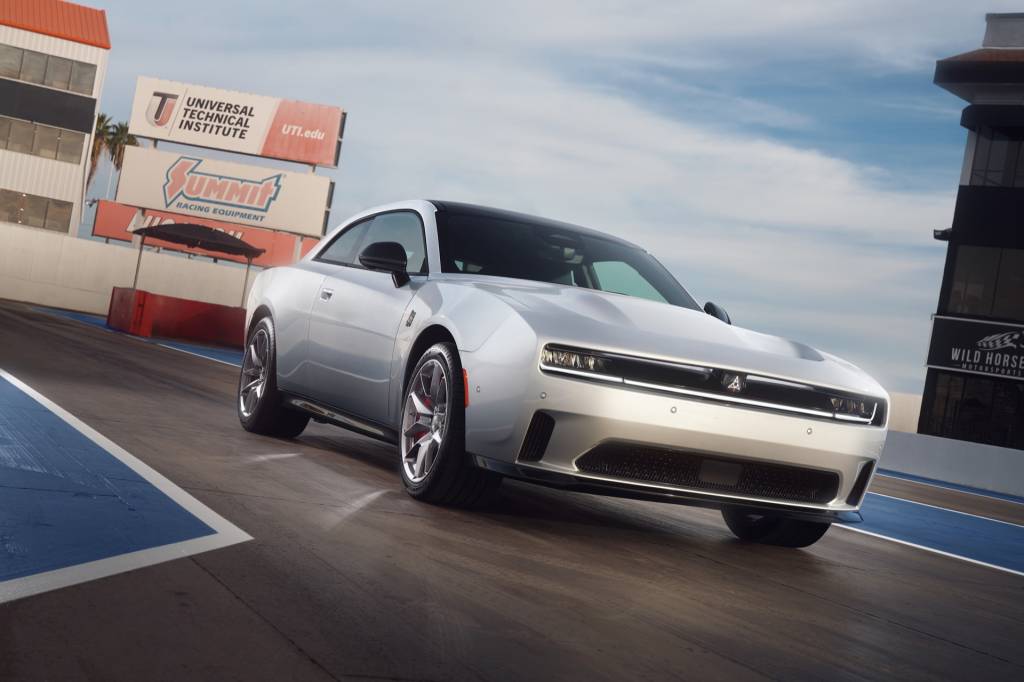
2024 Dodge Charger Daytona
Other automakers are also funding solid-state battery tech. Volkswagen has partnered with QuantumScape, while Nissan and Toyota are running in-house development programs. Earlier this year, Toyota confirmed plans to begin manufacturing solid-state cells in 2026 or soon after then, albeit likely in small amounts for low-volume EVs.
Meanwhile, the Charger Daytona is expected to arrive at dealerships before the end of the year with a $61,590 base price for the entry-level R/T model. It’s expected to return 317 miles of range with a 100.5-kwh (93.5-kwh usable) battery pack comprised of conventional lithium-ion cells.

Arkansas might be sitting on 19 million tons of lithium
- Lithium in a Smackover Formation could provide nine times the global demand for EV batteries
- The lithium deposits could be the key to U.S. battery production
- Lithium mining was extensive in North Carolina until the 1980s
A lithium deposit located in southwestern Arkansas could hold enough of the metal to satisfy global EV battery demand nine times over, according to a U.S. Geological Survey (USGS)-led study.
The study, based on water testing and machine-learning analysis, estimates between five million and 19 million tons of lithium in the Smackover Formation. Even the low-end estimate is equivalent to more than nine times the global demand for lithium use in EV batteries in 2030, as currently estimated by the International Energy Agency (IEA), the USGS notes.
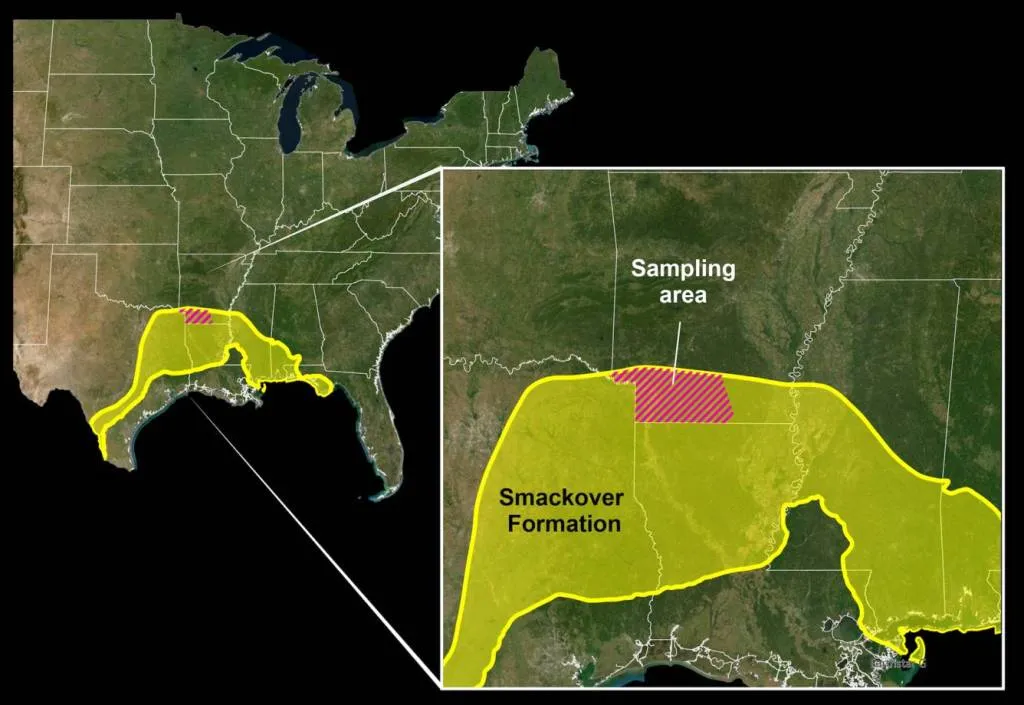
Smackover Formation identified as a potential U.S. lithium source (via USGS)
Also extending under parts of Alabama, Florida, Louisiana, Mississippi, and Texas, the Smackover Formation is a remnant of an ancient sea that dates from the Jurassic period. It’s known for rich deposits of oil and bromine, but the USGS believes lithium can be commercially extracted from the brine (high salinity water) brought to the surface during oil and gas extraction operations.
The U.S. currently imports more than 25% of its lithium, according to the USGS. Despite having one of the largest supplies of lithium, U.S. production faltered in the 1990s due to cost issues. More than 80% of global lithium is sourced from Australia, Chile, and China, with the latter nation controlling more than half of the world’s lithium processing and refining capacity, according to a 2022 CNBC report.
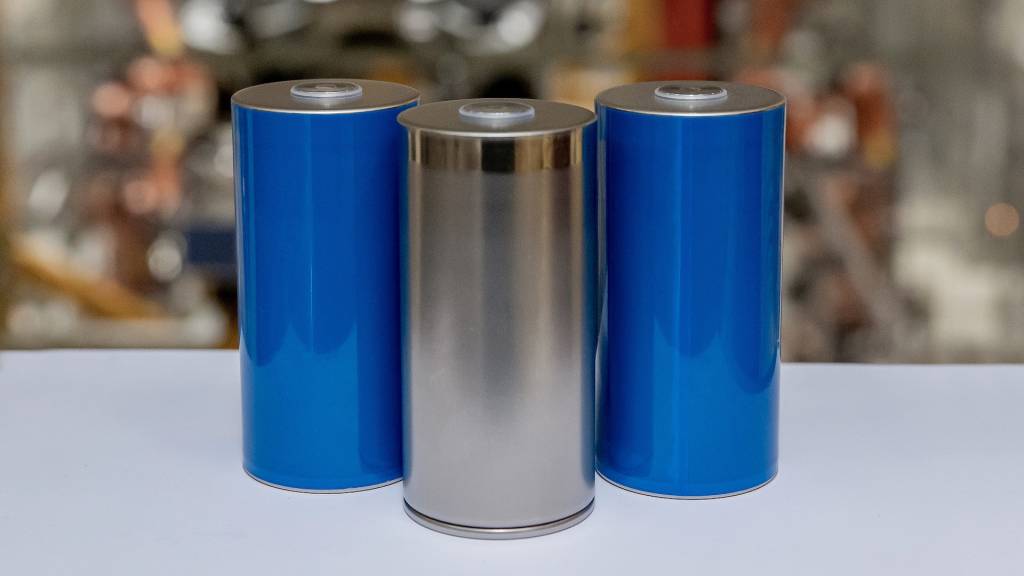
BMW cylindrical battery cells
But the USGS estimates that there is enough lithium brought to the surface in oil-production brine waste streams in Arkansas to cover current estimated U.S. lithium demand. That would help achieve the Biden administration’s goal of building a domestic EV supply chain. The administration has already turned to the Defense Production Act to ramp up availability of lithium and other battery materials, and added raw-material sourcing requirements to the federal EV tax credit, in support of those goal.
Efforts have also been made to restart lithium production in areas where it once thrived. In 2019, a mining company sought permits for a new lithium mine near Charlotte, North Carolina. Lithium was mined extensively in the North Carolina foothills until the 1980s.