
Author: EVAI

Ford pushes EV routing update for Tesla chargers, Google Maps
Drivers of Ford Mustang Mach-E and F-150 Lightning electric vehicles are getting more EV trip-planning options, via Google Maps, in Ford’s latest over-the-air software update.
Part of Android Auto, this feature makes use of vehicle data to show an estimated battery level upon arrival at a destination, suggest charging stops along the way, and estimate the amount of charging time needed. The feature was announced at CES 2024 in January but is now rolling out, Ford product manager Anthony Phillips explained last week in a LinkedIn post.
Ford already offers Apple Maps EV trip planning, via Apple CarPlay, on the Mustang Mach-E and F-150 Lightning. That system, as this Google system, taps into the vehicle’s state-of-charge data and includes battery preconditioning functions.

2025 Ford Mustang Mach-E Rally
The update also lets Google Maps show Tesla Supercharger stations, where Ford EV owners can charge with adapters the automaker began shipping earlier this year (some of which already need to be replaced). For all DC fast-charging stations, trip planning includes en-route preconditioning of the battery pack once one of these stations is selected as a stop.
This feature requires both the most recent Ford over-the-air (OTA) update for vehicles and the most recent version of Google Maps for smartphones. Once drivers have downloaded both, they can access EV route planning by opening Android Auto.

2024 Ford F-150 Lightning Flash
In addition to the Apple CarPlay or Android Auto trip planning, Ford also offers its own embedded navigation features.
Google first added EV charging sites to its navigation app in 2018, but only as points of interest. Only in early 2023 did it announce a deeper level of data on charging stations, allowing some EVs with Google built-in features to contribute state-of-charge and range estimates necessary for dynamic navigation with charging stops. This has been essentially limited to brands using Google-based infotainment systems, including Volvo, Polestar, Cadillac, Chevrolet, and GMC.
Meanwhile, as this Ford update rolls out, Google also on Friday marked the debut of new Gemini AI-curated Maps functionality, which appears to extend to route planning, and previewed it as headed into Rivian vehicles.

Google teases AI summaries in Rivian EVs
The tech giant pointed to its initial ability set as able to generate custom visualizations relating to EV chargers, services, and more.
“Next month, Rivian will start using this feature to show summaries of restaurants, shops and supermarkets on their infotainment screens—so drivers can quickly and easily learn more about a place,” said Google.
Ford couldn’t yet comment to Green Car Reports on how this next twist will impact the in-vehicle experience, but it’s clear that it’s among the automakers aiming to provide drivers with plenty of information to make road trips easier.

Verstappen wins wild 2024 F1 Brazilian Grand Prix
 Max Verstappen won a rain-soaked 2024 Formula 1 Brazilian Grand Prix Verstappen looks set to win fourth-straight Drivers’ Championship McLaren leads the Constructors’ Championship Red Bull Racing’s Max Verstappen made one of the most impressive drives of his career to take home victory at a chaotic 2024 Formula Brazilian Grand Prix, held on Sunday…

Chevrolet Silverado EV gets Sidewinder feature, GMC’s CrabWalk for Chevy
The Chevrolet Silverado EV is getting its own version of the CrabWalk mode already available on its GMC Sierra EV sibling, Chevy confirmed Friday.
Chevy’s version is called Sidewinder, not CrabWalk, but it provides essentially the same functionality. It utilizes the Silverado EV’s rear-wheel steering to turn all four wheels in the same direction, allowing for diagonal driving at speeds up to 20 mph.
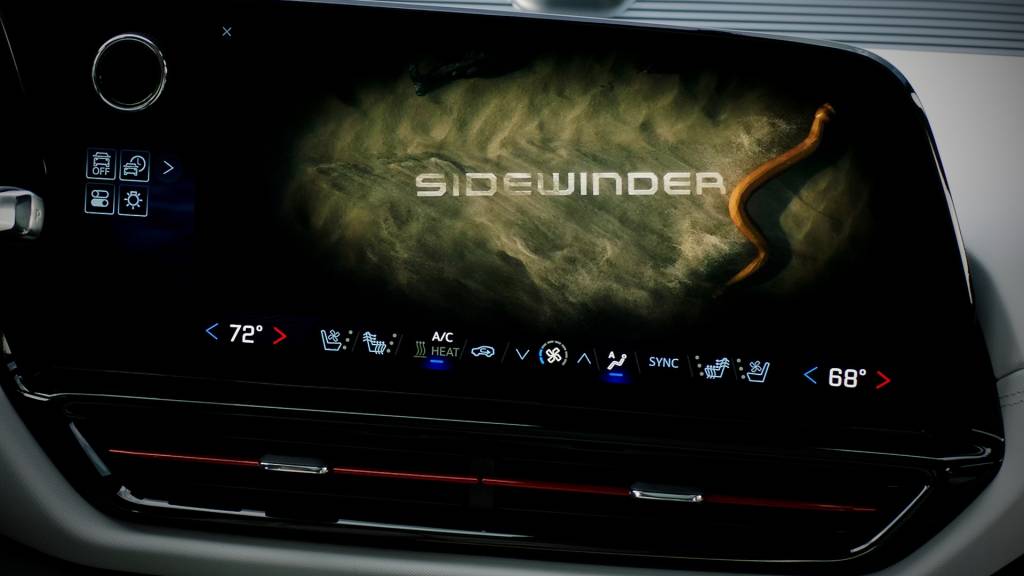
2025 Chevrolet Silverado EV Sidewinder mode
Drivers can select Sidewinder mode by going to the Rear Steering page under the Controls menu in the infotainment display. Graphics on the display, as well as a confirmation message in the instrument cluster, appear when the mode is activated.
Sidewinder mode is standard on the 2025 Chevrolet Silverado EV RST and will be added to 2024 Chevrolet Silverado EV RST First Edition models via an over-the-air update. That update will be pushed to both leftover 2024 models still on dealer lots and trucks already in customer hands, Chevy confirmed.

2025 Chevrolet Silverado EV
The CrabWalk-branded version of this feature first appeared on the GMC Hummer EV, and was standard on the 2024 GMC Sierra EV Denali Edition 1. That was the main difference between the Edition 1 and the Silverado EV RST First Edition—the low-volume launch versions of each truck. The same feature will also be available on the 2025 Cadillac Escalade IQ SUV, branded as Cadillac Arrival Mode.
Other changes to the Silverado EV for 2025 include range increases to 460 miles for the RST grade and 492 miles for the base WT model, with the larger Max Range pack, plus a new LT grade slotting in between those models.

2025 Genesis G80
 What kind of car is the 2025 Genesis G80? What does it compare to? The Genesis G80 is a midsize luxury sedan, available with a pair of turbocharged gas engines and the fully electric Electrified version. Competitors include the Cadillac CT5, Mercedes-Benz E-Class, Volvo S90, and BMW 5-Series. Is the 2025 Genesis G80 a good car? The Genesis G80 is…

Ferrari says 90% of its cars built are still on the road today
 If you don’t like the look of the latest Ferrari F80 hypercar or the Purosangue SUV, get used to it. Chances are they’ll be sticking around for a long time. “More than 90% of the total Ferrari production—beyond 300,000 cars—is still on the road,” Andrea Scioletti, head of Ferrari pre-owned, said in an interview with Australia’s Drive…

Watch A Porsche Taycan Turbo GT Go Head To Head With A Lucid Air Sapphire
- The Porsche Taycan Turbo GT and Lucid Air Sapphire are two of the most powerful sedans ever built.
- In a new video, Edmunds pits them head-to-head on in a race that incorporates drag race, braking and cornering performance.
- The Porsche may be lighter and have a two-speed transmission, but it can’t match the tri-motor Lucid Air in acceleration.
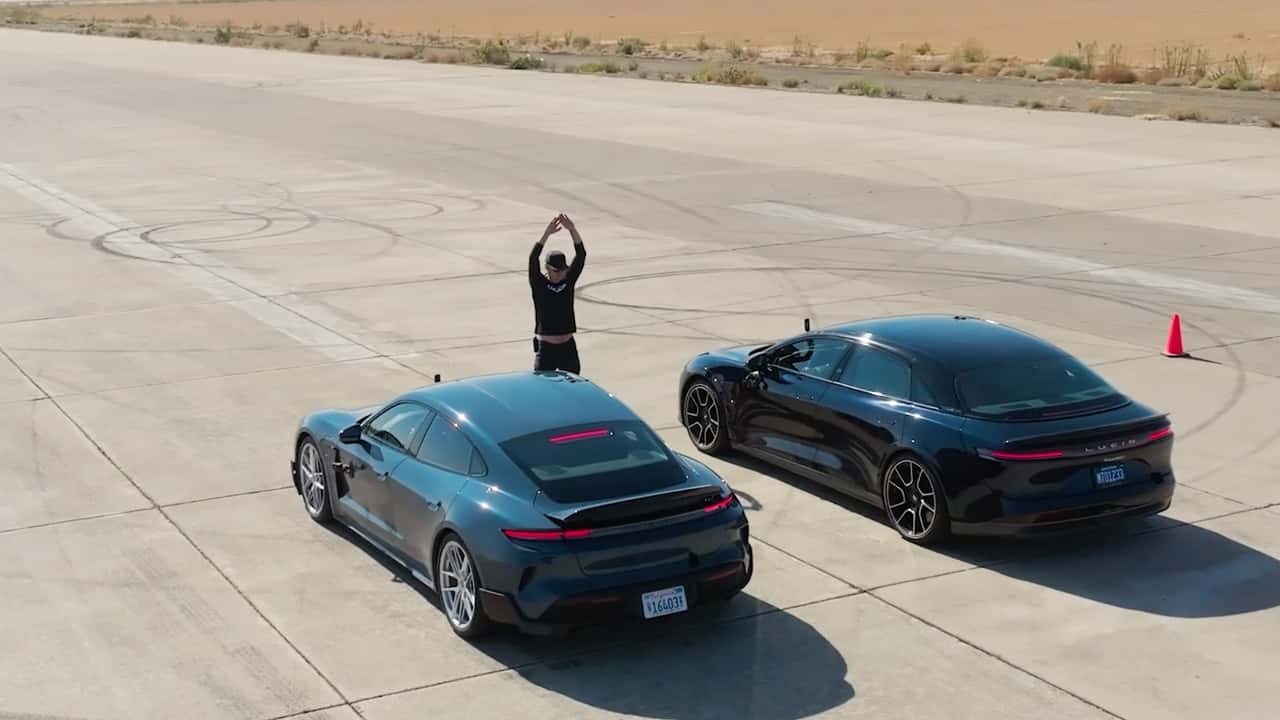
In 2000, a four-digit horsepower figure in a production car was unheard of. In 2006, Bugatti made it possible in the hypercar market. In 2024, you can get over 1,000 hp in a pickup truck, in a hypercar in a family sedan. Among those family sedans, two reign supreme: The Lucid Air Sapphire and the Porsche Taycan Turbo GT. Now, Edmunds has pitted them against each other.
And yes, me leaving out the Tesla Model S Plaid was intentional. Because it’s one thing to provide 1,000 hp. It’s another to build a chassis and braking system that can handle that output competently, then tune them well enough for everyday customers. That matters here, because Edmunds‘ U-Drag race involves braking and cornering, in addition to the quarter-mile drag race. I’ve driven a Model S Plaid hard on a canyon road, and I can only describe the braking experience as “frightening.” A Taycan Turbo S on the same road was a lot more fun, and quicker in the real world. And now, there’s the Taycan Turbo GT.

[embedded content]
The ultra-Taycan offers 777 hp and 855 lb-ft of torque in every day usage, far from the quad digits. But hit the “boost” button and you can get 1,092 hp and 988 lb-ft for 10 seconds. It also has a two-speed transmission to help its high-speed acceleration, and carries a few hundred fewer pounds than the bigger Lucid Air Sapphire.
That extra cash buys you something: Bragging rights. As the U-Drag shows, the Taycan can’t keep up with the Lucid on the drag race portion, and its braking and cornering performance aren’t enough to overcome its power deficit. I’d think that Porsche’s two-speed transmission would help as speeds increase, but the 457-hp gap means the Lucid keeps pulling away. If straight-speed is your drug, the Lucid Air Sapphire is the best dealer in town.
But that doesn’t mean it’s the better performance product. While Edmunds’ test does incorporate a high-speed U-turn, it doesn’t involve as much cornering as a race-track test. There, I’d expect the lighter Porsche to edge out the Lucid, as the Turbo GT achieved a Nurbürgring EV lap record. Even if Xiaomi may have beaten that record, Lucid hasn’t. Yet. So if you want a brutally fast EV sedan, you can’t go too wrong with either car.
Share this Story

Polestar delivers brand’s first EVs not made in China
Polestar on Friday confirmed its first customer deliveries of U.S.-built electric vehicles.
Every Polestar model to date has been manufactured in China, but the 2025 Polestar 3 is assembled at a South Carolina plant shared with Volvo. Production started there in August following software-related delays.

First U.S. Polestar 3 deliveries
The Polestar 3 is a platform-mate of the Volvo EX90, which is built at the same South Carolina plant. But where the Volvo offers three rows of seats, the Polestar sticks to two, with total seating for five, with a sportier character. It offers up to 315 miles of range from a 111-kwh battery pack, with a standard dual-motor all-wheel-drive powertrain rated at 489 hp and 620 lb-ft of torque, or 517 hp and 671 lb-ft in optional Performance Pack spec.
The Polestar 3 has a base price of $74,800 that’s under the $80,000 federal tax-credit cap for electric SUVs. But even with that, and U.S. assembly, it’s unlikely to qualify for a federal tax credit for the foreseeable future. In addition to more stringent sourcing requirements, new “foreign entity of concern” language disqualifies subsidiary companies if a “parent entity” in China, Russia, Iran, or North Korea holds more than 50% in the company.

First U.S. Polestar 3 deliveries
Polestar has said it will pass on a $7,500 credit for leases, following the approach of other automakers in exploiting what’s being called the EV leasing loophole. This allows use of a provision intended for commercial vehicles by automakers with captive financing arms to claim a credit and pass the savings on to customers even if vehicles don’t otherwise qualify.
Building cars in the U.S. does at least avoid recently-hiked tariffs on Chinese EVs. In a more complex solution to the same problem, U.S.-market versions of the coupe-like Polestar 4 will be built at a Renault plant in South Korea. That’s scheduled to start in the second half of 2025.

2025 Alfa Romeo Stelvio
 What kind of vehicle is the 2025 Alfa Romeo Stelvio? What does it compare to? The Stelvio is a luxury crossover SUV with peppy performance and snug seating for five. Rivals include fellow Europeans like the BMW X3, Mercedes-Benz GLC-Class, Audi Q5, and Jaguar F-Pace. Is the 2025 Alfa Romeo Stelvio a good SUV? It’s a pretty and…

Chevrolet Silverado EV Sidewinder feature cribs GMC’s Crabwalk
 The 2025 Chevrolet Silverado EV is getting its own version of GMC’s CrabWalk mode, a feature that was missing when the electric pickup truck debuted as a 2024 model. Chevy confirmed on Friday that its version of CrabWalk is called Sidewinder mode, making use of a name General Motors trademarked in 2022. While the name may be different, the…

Kalmar 9X9 hits the ‘Ring for some testing
 Kalmar 9X9 spotted at the Nürburgring Car uses 993-generation Porsche 911 chassis Only nine examples planned and deliveries to start by mid-2025 Fresh from its debut in August during 2024 Monterey Car Week, the Kalmar 9X9 supercar has been spotted testing at Germany’s Nürburgring racetrack ahead of a planned start of deliveries in…