
Author: EVAI

2025 Mercedes-Benz C-Class
 What kind of vehicle is the 2025 Mercedes-Benz C-Class? What does it compare to? The C-Class is Mercedes-Benz’s compact sedan, though it’s fairly roomy inside. Compare it to the BMW 3-Series, Audi A5, and Genesis G70. Is the 2025 Mercedes-Benz C-Class a good car? These are highly appealing choices with lovely style, lots of tech, and…

Karma Invictus debuts as limited-edition performance Revero
 Karma Revero series plug-in hybrid spawns Invictus performance flagship Upgrades include carbon-fiber body panels and track-tuned suspension Production limited to 30 units worldwide California’s Karma Automotive is gearing up to launch a range of high-performance electric vehicles in the form of the Gyesera sedan and Kaveya sports car, plus an SUV…

Politics may be weighing less on EV interest, despite election
As the 2024 U.S. presidential election reaches its conclusion, politics may be playing less of a role in EV interest, data from research firm AutoPacific shows.
AutoPacific’s EV Consumer Insights Study from June 2024—when election rhetoric was already charged—surveyed 12,000 Americans, including a mix of electric vehicle and plug-in hybrid owners, non-owners with interest in EVs, and those who totally reject EVs.
In line with previous studies, owners of these vehicles tended to be more left-leaning, with 54% of current EV owners and 60% of current plug-in hybrid owners identifying as Democrats compared to 30% of EV owners and 26% of plug-in hybrid owners identifying as Republicans. The gap shrinks for “acceptors” who either intend to get or will consider an EV in the future, at 46% Democrat, 28% Republican, and 24% Independent or third party.
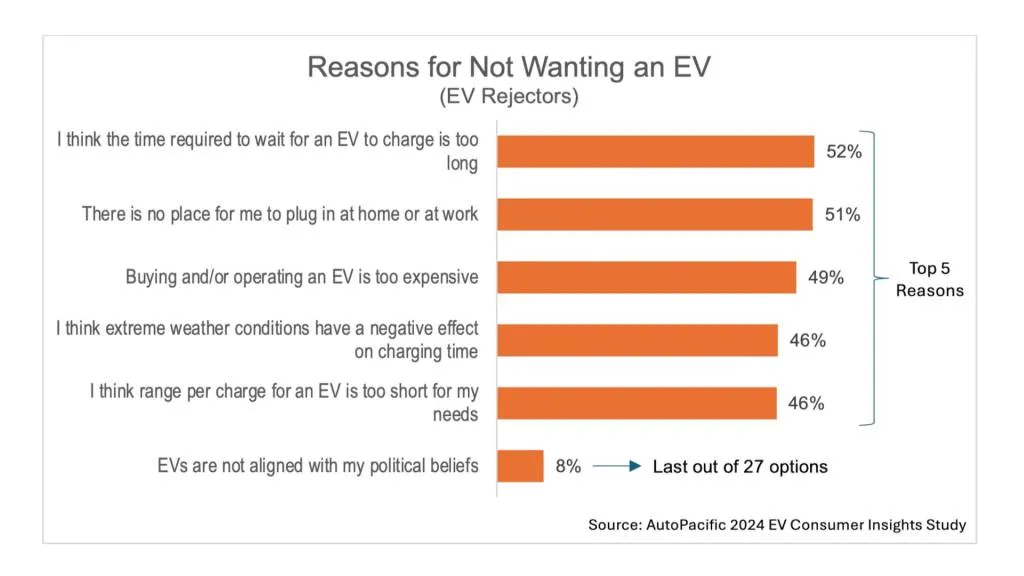
Reasons for not wanting an EV (from AutoPacific 2024 EV Consumer Insights Study)
However, Americans generally aren’t rejecting EVs for political reasons, according to AutoPacific. Just 8% of respondents said they would not consider an EV because “EVs are not aligned with my political beliefs”—down from 10% the previous year. Of that group, 62% identified as Republicans and 13% identified as Democrats.
Political beliefs were ranked last among 27 options for not considering an EV. The top concerns were belief that charging times were too long (52%), that respondents did not have a place to charge at home or at work (51%), and concern that EVs are too expensive to buy and/or operate (49%).
Such results should be a relief to auto industry CEOs. The push to make EVs political has surprised General Motors CEO Mary Barra and saddened Rivian CEO RJ Scaringe, the two executives said earlier this year.
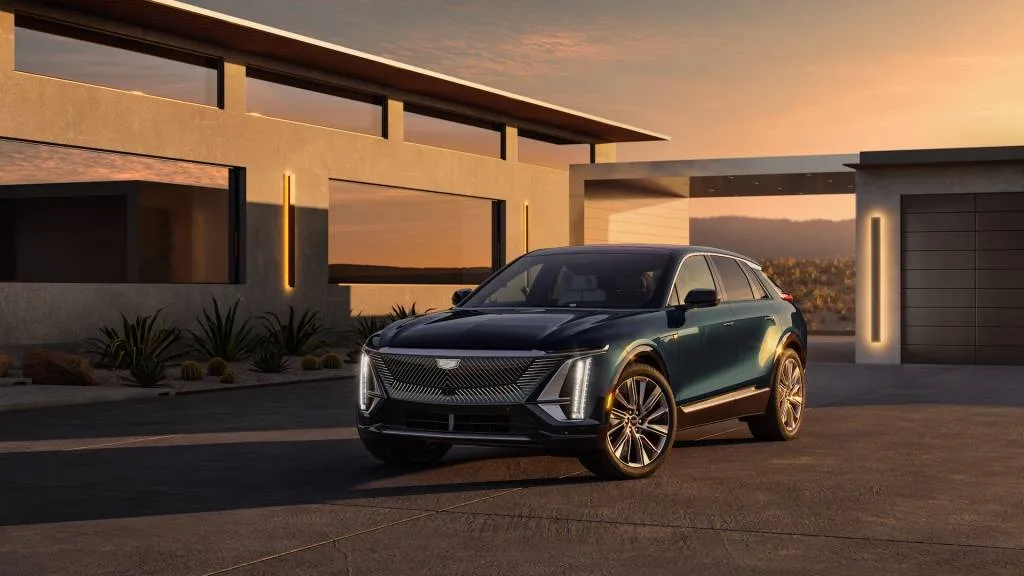
2025 Cadillac Lyriq
Republicans, on the other hand, might want to consider that anti-EV rhetoric puts them on the losing side of this issue. Donald Trump has suggested that he plans to gut EV policy, while relying on tariffs to increase the portion of goods—including vehicles—made in America.
Yet a 2022 poll conducted by a leading EV advocacy group found that such a divide between Republicans and Democrats is disconnected from reality, with bipartisan support for EV-friendly policy.
It’s left many Republicans puzzled about when the tide turned against EVs as representing energy independence and why politicians are detached from their constituencies, in this case—even when top Republicans have now become closely aligned with Tesla CEO Elon Musk.

Chevrolet Bolt EV recalled again to prevent possible battery fire
- The latest recall addresses the failed software fix for the previous Bolt EV fire recall
- The software fails to detect modules that need replacement
- The recall is limited to 107 Bolt EV and Bolt EUV models
General Motors is once again recalling the Chevrolet Bolt EV because the installation of diagnostic software to address a previous battery-fire recall may have been done incorrectly.
The incorrectly-installed software could fail to detect defective battery modules that require replacement, increasing the risk of a potential fire, according to GM. Just 88 different 2020-2022 Chevrolet Bolt EV hatchbacks and 19 different Chevrolet Bolt EUV models have this issue.
This is the second recall related to battery diagnostic software in Bolt EV models. GM issued a recall this past July when it internally identified that its service system software would, in some cases, allow a technician to process a vehicle’s warranty claim without complete installation of the software.
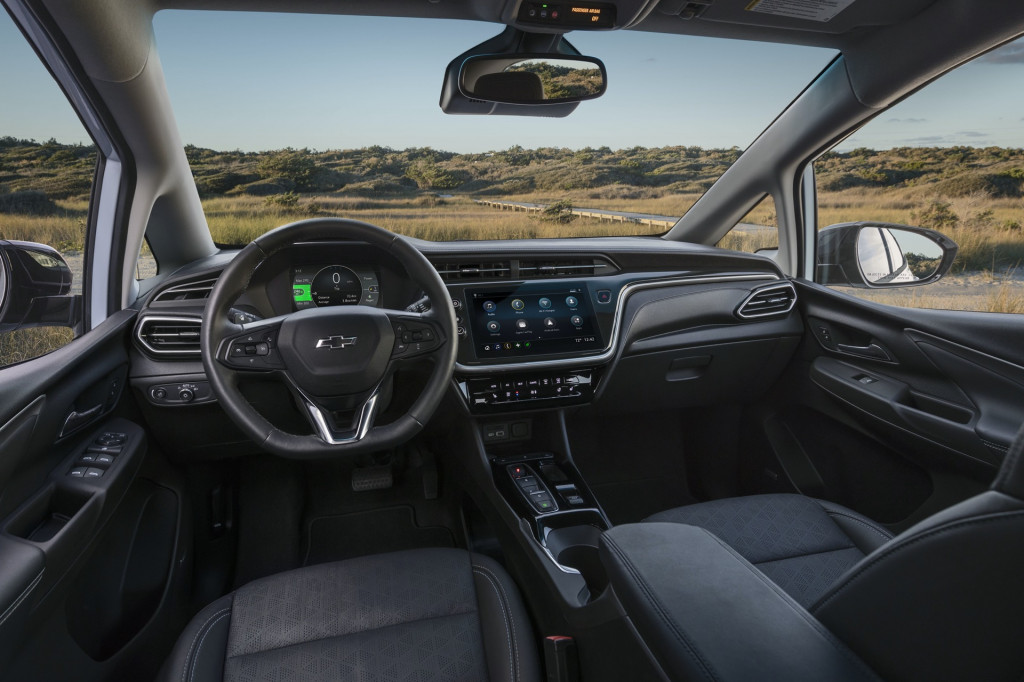
2022 Chevrolet Bolt EV
This time, the recall stems from a customer complaint that a 2022 Bolt EUV remained limited to 80% state of charge after an “evaluation period,” and thus past the point where the software should have been restricting charging, GM said in recall paperwork. It attributes this to a “malfunction in the software programming tool,” adding that it is not aware of any incidents related to this issue.
Instructions for owners of affected vehicles are the same as the previous software-related recall: Set the target charge level to 90%; avoid depleting the battery below 70 miles of range remaining; park outside after charging; do not charge the vehicle indoors overnight.
Owners will have to take these steps while waiting for an appointment with dealers, who will reinstall the diagnostic software free of charge. GM plans to mail owner notification letters Dec. 16, and owners can contact a dedicated Bolt EV Concierge Team at 1-833-382-4389. GM’s reference number for this recall is N242470160.

2022 Chevrolet Bolt EV
Like the previous software-related recall, this is a very small subset of GM’s massive 2021 battery recall effort, which eventually spanned all 140,000 Bolt EV and Bolt EUV models in North America. Many owners of earlier 2017-2019 Bolt EVs ended up with new battery packs, resulting in more driving range than they originally had.
As part of a class-action settlement against GM and battery supplier LG Energy Solution, owners are also likely eligible for $700 to $1,400 in compensation.
The Bolt EV went out of production in December 2023, but as GM reported in July it remained Chevy’s top-selling EV for the first half of 2024. GM CEO Mary Barra said earlier this year that when it returns later in 2025 the 2026 Chevy Bolt EV will be the most affordable EV in the U.S.
—
UPDATED with clarification from GM that the software issue relates to the ability to detect battery modules that need replacement.

Costco offering up to $2,000 off EVs and PHEVs, again
Costco is once again offering members discounts on electric vehicles and plug-in hybrids, this time covering 10 all-electric models and two plug-in hybrids from Cadillac, Chevrolet, GMC, Polestar, and Volvo.
Running from Nov. 1, 2024 to Jan. 2, 2025, the biggest discount is $2,000 off the purchase or lease of a 2025 Polestar 3 electric SUV, as well as the purchase or lease of a 2024 or 2025 Volvo XC90 plug-in hybrid. Built in the U.S., the Polestar 3 recently started deliveries, while the XC90 is due to get a major refresh partway through the 2025 model year.

2024 Volvo C40
A $1,500 discount is also available for 2024 and 2025 Volvo XC60 plug-in hybrids, while all-electric 2024 Volvo XC40 Recharge and C40 Recharge models are eligible for a $1,000 discount. The two EVs are due to be renamed, with the XC40 Recharge becoming the EX40 and the C40 Recharge becoming the EC40.
A $1,000 discount is also available for a number of General Motors EVs. The list includes the Cadillac Lyriq, Chevy Blazer EV, Chevy Equinox EV, Chevy Silverado EV, GMC Hummer EV Pickup and SUV, and the GMC Sierra EV.

2025 Cadillac Lyriq
Costco offered deals on many of the same models earlier this year, along with a $2,000 discount on the Polestar 2. It also offered a $1,000 discount on the Blazer EV in December of last year. It’s also offered substantial discounts of up to $3,000 on Audi EVs in the past.
The company is now also jumping back into EV charging to support the vehicles it’s incentivizing. Costco was one of the first big-box retailers to install Level 2 charging stations at some locations. It did so in the 1990s, but pulled the plug on its original stations in 2011 and 2012. Now it’s adding them back, although a top executive said just last year that Costco has no plans to retire its lucrative gas stations.

Toyota goes concept heavy at 2024 SEMA show
 Toyota brought almost a dozen concepts to 2024 SEMA show Concepts based on various SUV, pickup truck, and sports car models Toyota teased introduction of Modellista parts in U.S. Toyota pulled out all the stops for its 2024 SEMA showcase, with the automaker turning up to the Las Vegas show’s opening day on Tuesday with almost a dozen concepts…

2025 Porsche Macan EV
 What kind of vehicle is the 2025 Porsche Macan? What does it compare to? An electric compact crossover, the Macan EV sells alongside the gas Macan. It takes on the Tesla Model Y, Ford Mustang Mach-E, and Audi Q6 E-Tron. Is the 2025 Porsche Macan a good SUV? It’s about as practical as any compact SUV, but the Macan EV is fast, agile, and…

2025 Jeep Wagoneer, Grand Wagoneer prices cut by up to $7,000
 The 2025 Jeep Wagoneer is priced from $59,945, excluding destination The new starting price is $3,000 less than the previous year Standard equipment has been increased despite the lower pricing Jeep has sharpened prices on its 2025 Wagoneer and Grand Wagoneer in an effort to boost sales of what is already a strong seller for the brand. The 2025…

Bentley Boss: Second EV phase begins around 2027, third around 2035
As the automaker prepares to launch its first all-electric models, Bentley CEO Frank-Steffen Walliser believes electric vehicles are about to undergo rapid change.
The auto industry is now coming to the end of the first phase of EV development, Walliser said in a recent interview with Autocar. The second phase, which Walliser expects to begin around 2027, is shaping up to be something of a technological holding pattern as automakers look to grow EV adoption while awaiting new battery tech.
Bentley Continental GT Speed in Gravity Grey
“In the second phase, you’ll get bigger batteries, longer ranges, and greater usability,” Walliser said. “Some will say their batteries are too big, but their long ranges will help customers make the switch and get over their range anxiety.”
The third phase, which Walliser predicts will start around 2035, will see further development of battery chemistries and maturation of charging infrastructure, allowing for smaller battery packs and reduced vehicle weight. Perhaps conditions will then finally be right for Bentley to finally commit to EVs long-term.

Bentley Continental GT Speed in Gravity Grey
In 2020, Bentley laid out plans to make its entire lineup plug-in hybrids by 2026 and all-electric by 2030. And in 2022, the automaker said its first EV would arrive in 2025. After a change of plans, that first all-electric model is now set to debut in 2026, with a market arrival in 2027.
The delays are in line with a bearish view of luxury EVs from management. In another interview earlier this year, Walliser said the luxury-car market was rejecting EVs.
This wouldn’t be the first time Bentley has gotten cold feet. The automaker first began discussing EVs in 2016, showing a pair of concepts, only to back away by 2019 following a change in leadership.

2025 Mercedes-Benz EQE electric SUV costs $79,050
- Base prices for EQE SUV lineup carry forward unchanged
- EQE SUV continues with CCS charge port, amid shift to Tesla NACS
- Base model is priced for the EV tax credit (purchase), but it appears not to qualify
Mercedes-Benz continues to offer its EQE electric vehicle in both sedan and SUV body styles, with the latter receiving only small changes for the 2025 model year.
The only changes to report are newly-standard rear-seat headrest pillows, a center airbag between the front seats, and digital key functionality. Most models are now also available with front-seat headrest cushions and soft-close doors. A new paint color—Manufaktur Moonlight White Metallic—also joins the palette.
The 2025 Mercedes-Benz EQE SUV is once again offered in single-motor EQE 350+, dual-motor EQE 350 4Matic and EQE 500 4Matic, and AMG EQE performance guises. EQE 350+ models produce 288 hp and 417 lb-ft of torque, while EQE 350 4Matic models increase torque to 564 lb-ft.
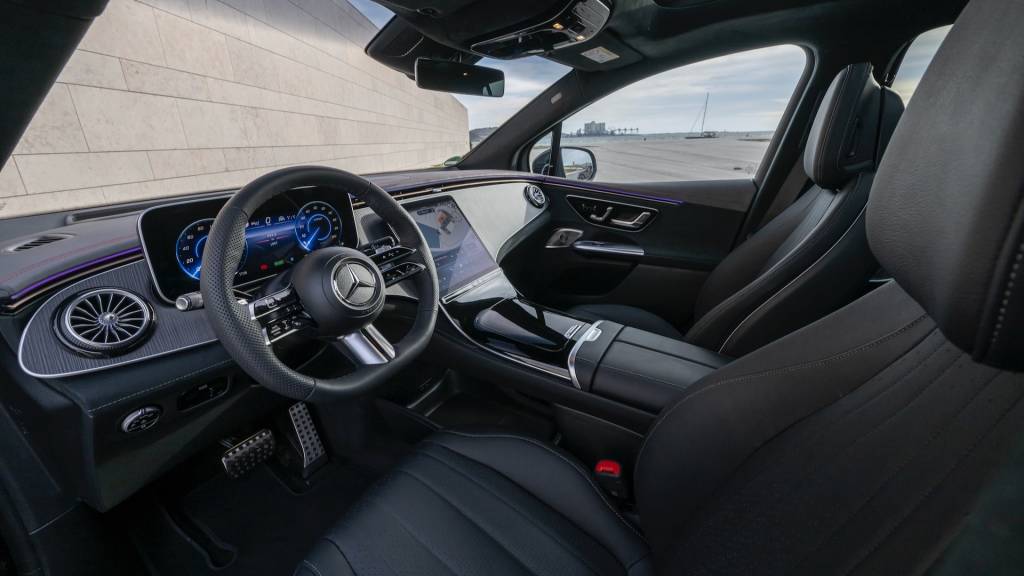
2025 Mercedes-Benz EQE SUV
The EQE 500 4Matic steps up the dual-motor powertrain to a higher combined output of 536 hp and 633 lb-ft, while the AMG EQE dials things up even further with 677 hp and 738 lb-ft and a 0-60 mph time of 3.4 seconds. That compares to 4.6 seconds for the EQE 500 4Matic, 6.2 seconds for the EQE 350 4Matic, and 6.3 seconds for the EQE 350+.
While the 2025 Mercedes-Benz EQE sedan receives a bigger battery pack expected to yield more range, it appears the EQE SUV will stick with its 108-kwh pack. Expect EPA range to remain at 307 miles for the single-motor EQE 350+, 282 miles for the EQE 500 4Matic, 265 miles for the EQE 350 4Matic, and 235 miles for the AMG EQE SUV.
Mercedes plans to adopt the Tesla North American Charging Standard (NACS) port for future models, but for now the EQE SUV continues to use the Combined Charging Standard (CCS) port. A maximum power rate of 170 kw allows for a 10%-80% charge in 32 minutes, while a 9.6-kw onboard charger can fully recharge the pack from a 240-volt source in 9.5 hours.
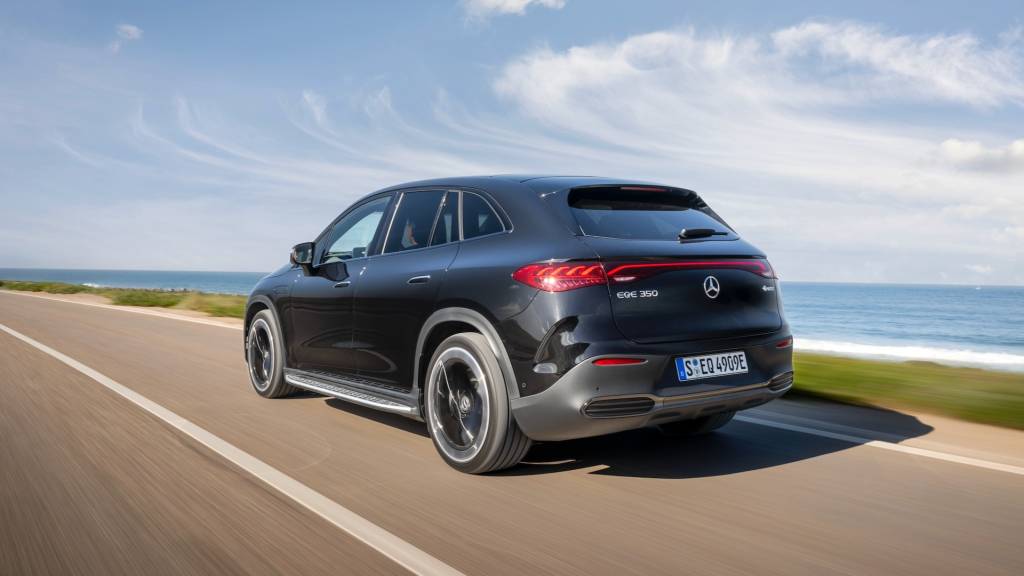
2025 Mercedes-Benz EQE SUV
Introduced for the 2023 model year, the EQE SUV is the middle model in the Mercedes electric crossover lineup. It sits between the EQB—an all-electric derivative of the gasoline GLB-Class—and the 3-row EQS SUV. It received an updated regenerative braking system for the 2024 model year, shared with the EQE sedan and the EQS models.
Pricing starts at $79,050 (including a $1,150 destination fee) for both the EQE 350+ and EQE 350 4Matic models. This pricing, which is unchanged from the 2023 model year, previously allowed the Alabama-built EQE SUV to slide under the price cap for the federal EV tax credit. But this Mercedes no longer qualifies after stricter rules related to battery-material sourcing went into effect at the beginning of 2024. The EQE 500 4Matic and AMG EQE are priced at $90,650 and $110,450, respectively.