
Author: EVAI

Dodge Hornet GLH starts production in 2025
 A couple of years ago, Dodge rolled out a pair of Hornet GLH concepts to showcase various tuner parts it was considering offering through its Direct Connection aftermarket parts portfolio. Now, there’s confirmation that a Hornet GLH model is headed for production—and soon. Quoting comments made by Dodge CEO Matt McAlear during a…

Automakers want Trump DOT to restart EV charger funding
Last week’s U.S. Department of Transportation (DOT) announcement placing a freeze on the federal government’s EV charging infrastructure program has already prompted responses from a range of industry interests—including at least one that counts automakers among its membership.
In a statement first reported by Reuters, the Electric Drive Transportation Association (EDTA) asked the Trump administration to restore the National Electric Vehicle Infrastructure (NEVI) program, which the organization called “an effective and important element of a truly strategic energy policy that promotes U.S. innovation, domestic investment, and energy security.”
The EDTA counts six automakers among its members. Ford, General Motors, Mitsubishi, Nissan, Stellantis, and Toyota are part of the group along with 20 other interests including charging networks, charging-hardware suppliers, and the retail giant Walmart. Although this pushback was a statement of the group and its interests, it’s unclear which companies might have, for instance, signed onto a letter pushing for this rollback of Trump administration policy.
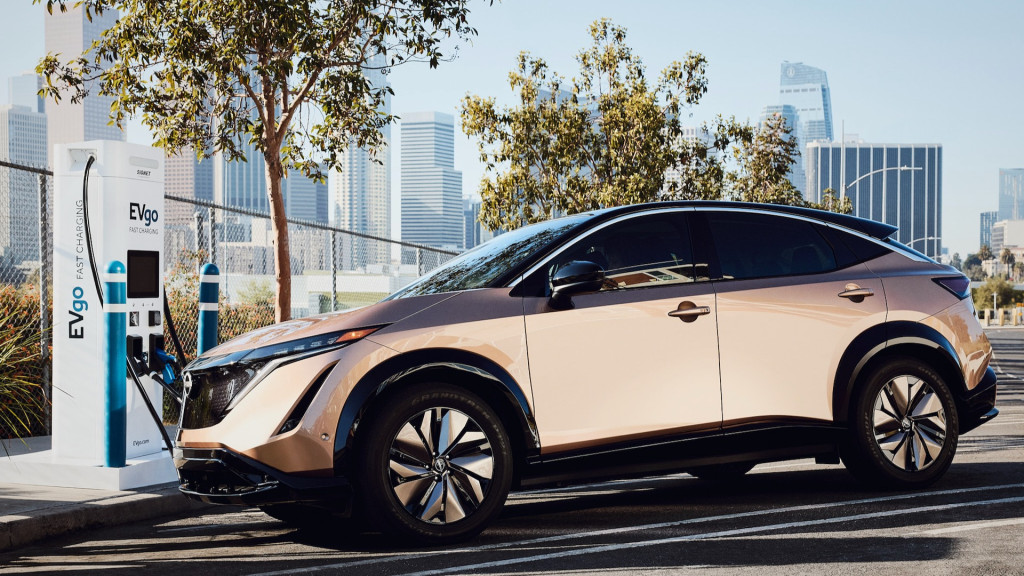
2023 Nissan Ariya at EVgo charging station
“We urge the Administration to quickly resume the critical work of the program and minimize uncertainty for states and their businesses, who have invested in infrastructure to serve local and national goals for advanced transportation,” the EDTA statement said.
The Trump DOT move announced last Thursday rescinds previous guidance for the program, which was created under the 2021 infrastructure law to disperse funding for a $7.5 billion national network, on the way to a target of 500,000 EV chargers. The agency said it would fund projects already approved but freeze funding for new projects until revised guidance is issued.
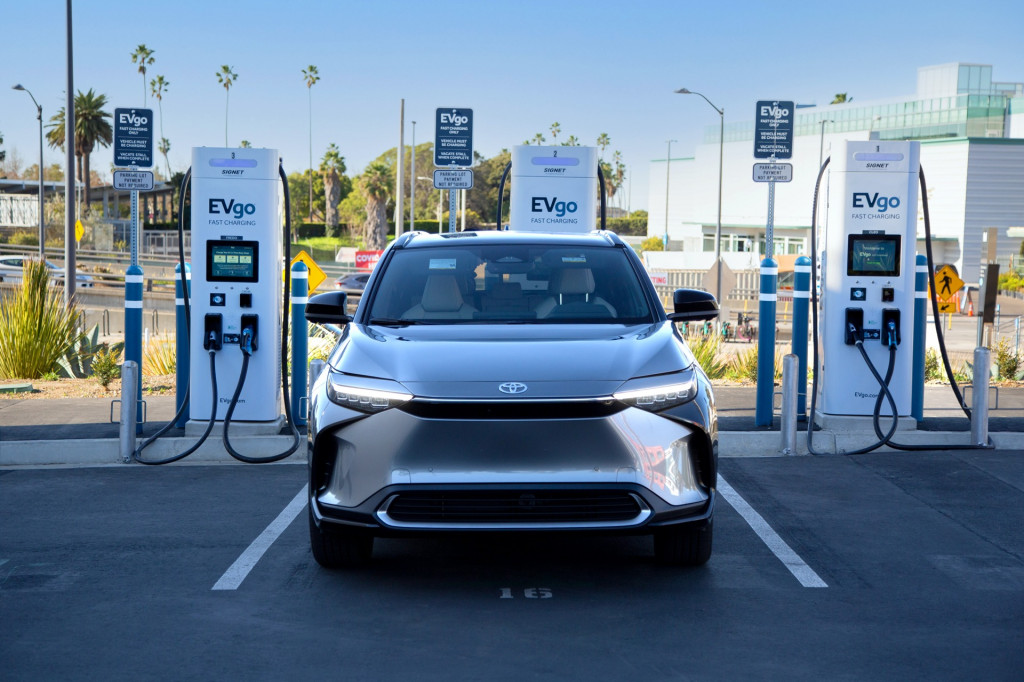
2023 Toyota bZ4X at EVgo charging station
Under the NEVI framework, states issue plans showing how they would spend available funding. The DOT has said it will make states submit new plans once altered guidance is complete, which is likely to create additional uncertainty and slow a process that was just beginning to pick up speed, even if the money isn’t actually taken away.
Several of the EDTA’s member automakers are also partners in Ionna, which has suggested that it will take advantage of the NEVI program to reach its goal of 30,000 chargers by 2030. That plan makes Ionna the most likely charging-network rival to Tesla, which has already won many NEVI contracts. That creates more financial risk to charging companies, as the funding is placed in limbo—and a growing conflict of interest as Tesla CEO Elon Musk continues to act as an unofficial advisor to the Trump Administration.

Rivian opens electric van sales to all fleets
- Rivian EDV for fleet customers starts at $82,900
- Up to 161-mile range from 100-kwh LFP battery pack
- Amazon already has more than 20,000 Rivian electric vans, of its ordered 30,000 by 2030
Rivian electric vans will soon be carrying more than just Amazon packages.
On Monday the automaker announced that it is opening sales of its commercial vans to fleet customers beyond Amazon, which originally got Rivian into the commercial vehicle business.
Rivian was exclusive with Amazon for such vehicles initially, starting in 2019, when it announced an order for 100,000 vans by 2030 as part of a $440 million investment in Rivian. But Rivian has been looking to expand sales to other customers once its exclusivity with Amazon ended. The automaker has been trialing vans “with several large fleets” to lay the groundwork for that, according to a Rivian press release.
Called the EDV (short for Electric Delivery Van), the first examples headed out into the world making Amazon deliveries in 2021. Amazon now has more than 20,000 of the vans in its fleet, according to a Rivian press release.
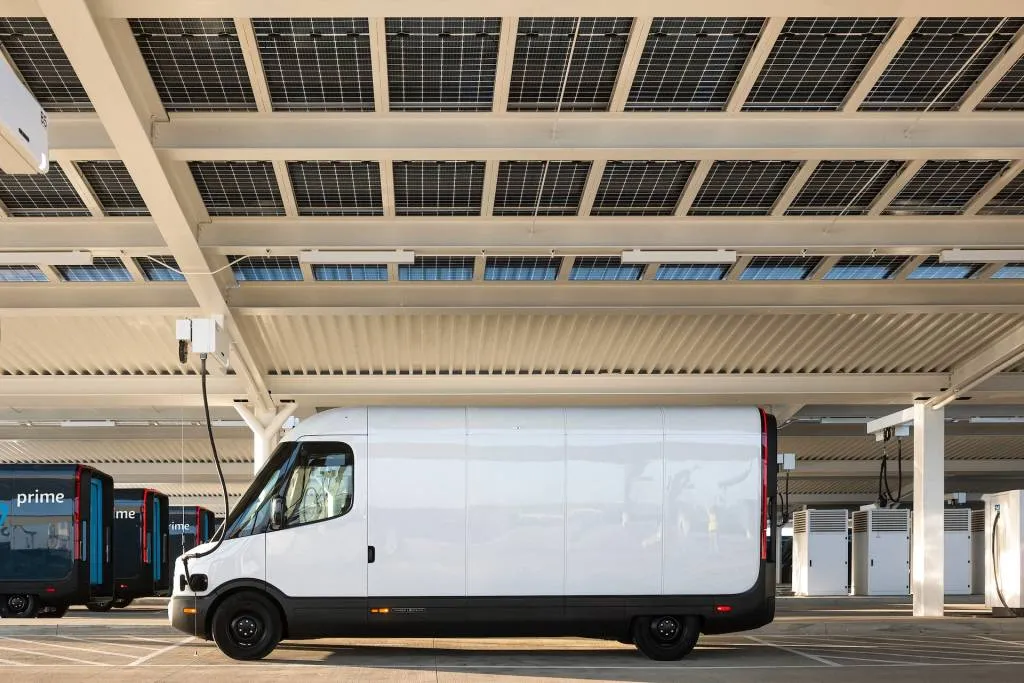
Rivian Commercial Van
Now dubbed the Rivian Commercial Van, the mass-market version shares design cues with the EDV used by Amazon. It will be offered in two configurations badged 500 and 700 priced at $82,900 and $86,900, respectively, including the $3,000 destination fee. The shorter 500 measures 248.5 inches long with a 157.5-inch wheelbase, while the 700 stretches to 278 inches long, with a 187-inch wheelbase.
The 500 has 487 cubic feet of cargo space and a 2,663-pound payload rating, while the 700 has 652 cubic feet of cargo space and a 2,258-pound payload rating. Both versions have a gross vehicle weight rating (GVWR) of 9,500 pounds.
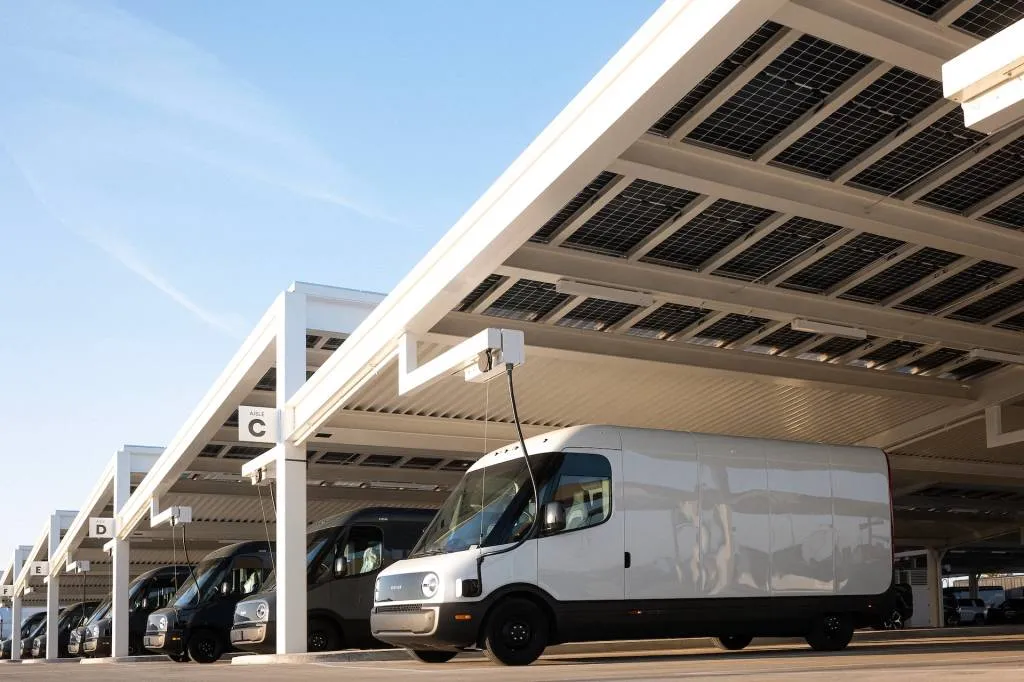
Rivian Commercial Van
Both versions are front-wheel drive, with a single motor providing 320 hp and 299 lb-ft of torque. A lithium iron phosphate (LFP) battery pack with 100 kwh usable provides up to 161 miles of range in the 500 and 160 miles in the 700—both based on EPA drive cycles but not official EPA ratings. While Rivian has said it will adopt the Tesla NACS connector for its passenger vehicles at some point, the Commercial Van will start shipping with a CCS connector providing 100 kw of DC fast-charging power. The AC charging rate is 11 kw.
Other automakers also offer electric vans but many, such as the Ram ProMaster EV, Mercedes-Benz eSprinter, and Ford E-Transit, are electrified versions of combustion designs. General Motors’ Chevrolet BrightDrop vans, on the other hand, leverage the same component set as the automaker’s current electric passenger vehicles. Mercedes is also planning electric vans based on a dedicated architecture, called Van.EA, to be previewed by a concept vehicle later this year.

2025 Mitsubishi Outlander gets interior updates and $1,300 price bump
 Mitsubishi on Monday announced that the revised 2025 Outlander crossover will start at $31,140, including a destination fee of $1,495, in base ES front-wheel drive form. Full pricing will be announced on Feb. 24. The base price represents a $1,300 increase over the equivalent 2024 model, but Mitsubishi claims the 2025 Outlander will boast a number…

2026 Volvo EX30 Cross Country EV straps on snow boots
The Volvo EX30 electric vehicle began arriving at U.S. dealerships last month, but only in top Twin Motor Performance guise. Other versions are on the way, though, including the more rugged EX30 Cross Country, which was unveiled in Sweden Monday.
Volvo previewed the Cross Country with a concept vehicle that was unveiled alongside the production version of the standard EX30 in 2023, and the design hasn’t changed much from concept form. The Cross Country features increased ground clearance, skid plates, and 18-inch wheels that can be fitted with all-terrain tires. A load carrier, roof basket, and mud flaps are among the optional accessories offered within Cross Country Experience packages.
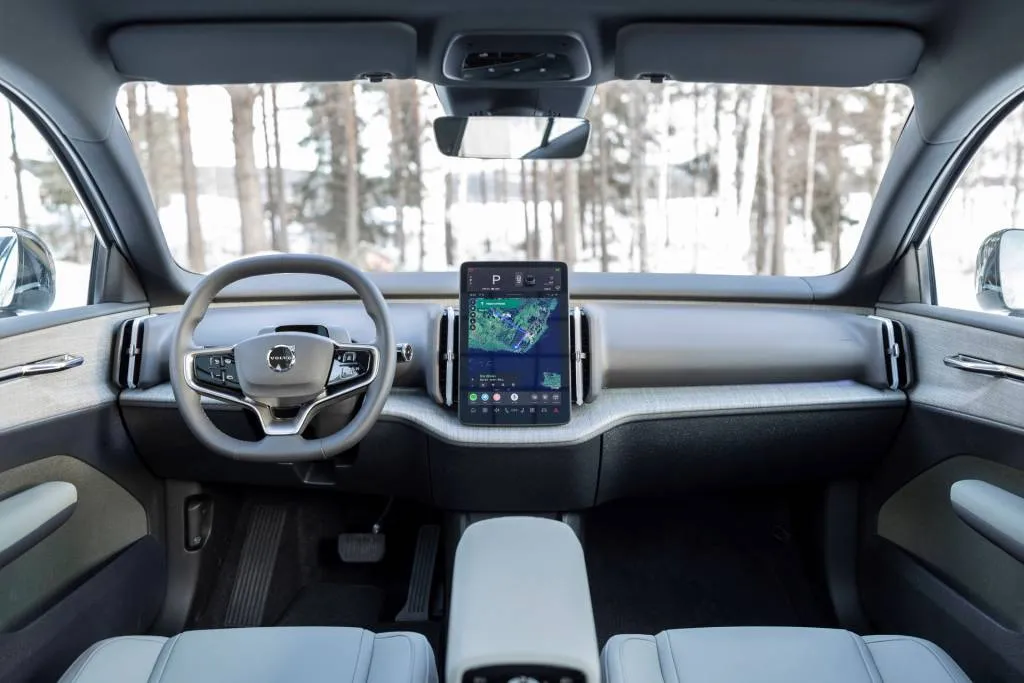
2026 Volvo EX30 Cross Country
Blacked-out panels and the front and rear also carry over from the concept, along with wheel-arch extensions. The front fascia includes a topographical representation of the Kebnekaise mountain range in northern Sweden, which Volvo says serves as an inspiration for its designers.
The EX30 Cross Country will come standard with dual-motor all-wheel drive, but Volvo hasn’t confirmed whether it will be tuned for the same 422 hp and 400 lb-ft of torque as current Twin Motor Performance models.
The Cross Country is also likely to use the same 69-kwh nickel manganese cobalt (NMC) battery pack as other U.S.-market EX30 models, with EPA range to be disclosed at a later date. Other dual-motor versions of the EX30 are currently EPA-rated at 253 miles, and Volvo projects that they can DC fast charge from 10%-80% in less than 30 minutes. That charge time is expected to apply to the Cross Country as well.
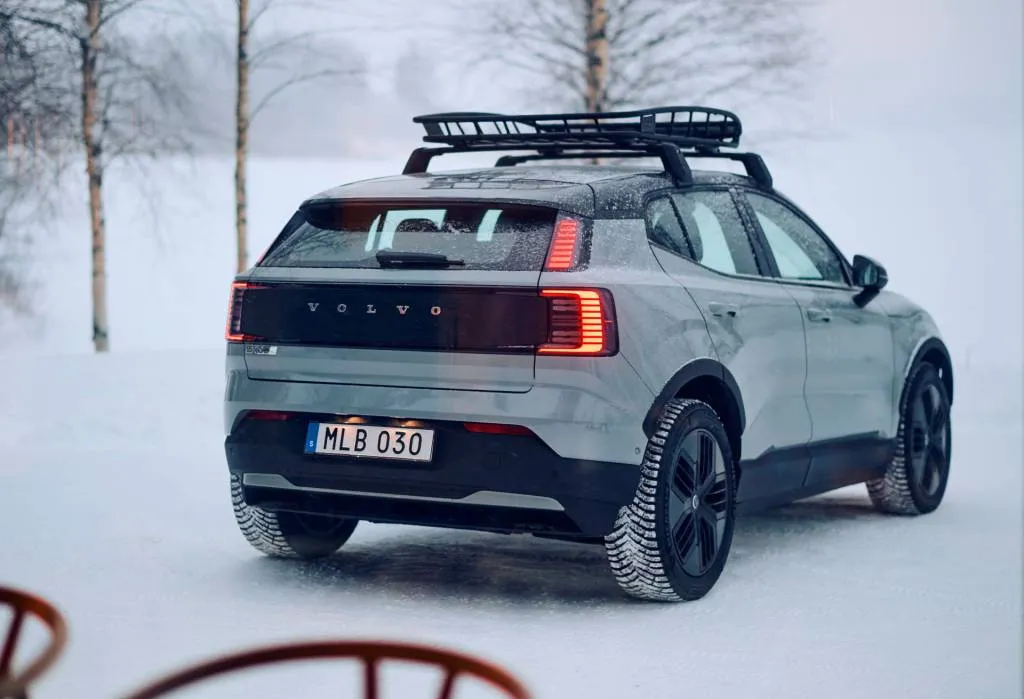
2026 Volvo EX30 Cross Country
Volvo initially planned to bring the EX30 to the U.S. last summer, but the launch was delayed after new tariffs were imposed for EVs made in China, complicating the automaker’s plans to source the first vehicles from that country before shifting production to Belgium. The China-made EX30 then reached U.S. dealerships in January only in its top dual-motor form, with a starting price of $46,195.
Volvo has promised that a single-motor version of the EX30 is still on the way, with a base price of $36,245. The single-motor EX30 and Cross Country are both expected to appear before the end of the 2025 calendar year, meaning they’ll likely be considered 2026 models.

2025 Chevrolet Blazer EV SS arrives for $61,995
The 2025 Chevrolet Blazer EV SS is due to arrive soon, with a lot more power, at a $61,995 base price including the mandatory $1,395 destination fee.
That price, which is now shown in Chevy’s online configurator, is the same as what Chevy quoted last September when it detailed the 2025 Blazer EV lineup, and about $3,500 less than when the Blazer EV SS (short for Super Sport) was initially confirmed.
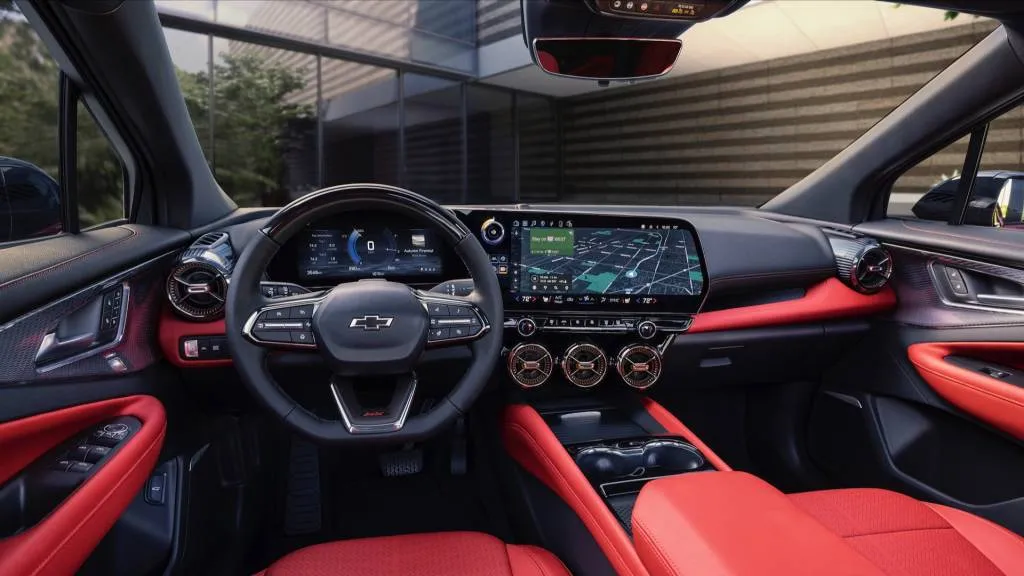
2025 Chevrolet Blazer EV SS
Pricing isn’t the only thing that’s fluctuated since this model was announced in 2022. At that time, Chevy said its dual-motor all-wheel-drive powertrain would develop 564 hp and 684 lb-ft of torque using the Wide Open Watts (WOW) performance mode. That changed to 595 hp and 645 lb-ft when Chevy reconfirmed the Super Sport in late 2023. But it’s now been finalized at 615 hp and 650 lb-ft of torque, a Chevy spokesperson confirmed to Green Car Reports.
Chevy also lists a 3.4-second 0-60 mph time that’s consistent with its previous claims of a sub-four-second time. A retuned suspension is part of the package as well, but it doesn’t appear that Chevy performance-enhancing changes are as extensive as those of the Hyundai Ioniq 5 N, which its maker claims is just as quick, and we’ve found to be truly track-capable. However, it’s also a bit pricier, at $67,475 with destination.
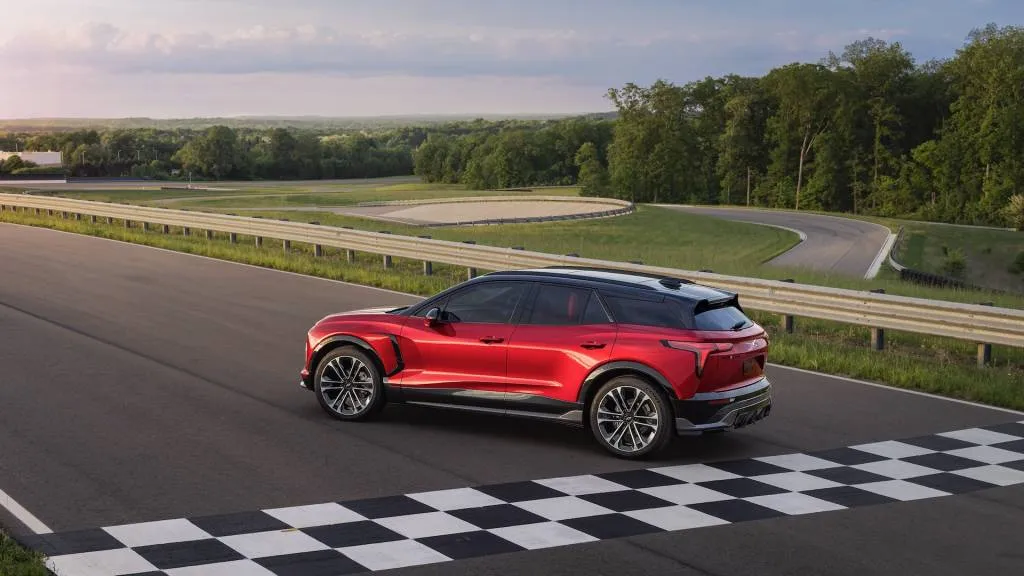
2025 Chevrolet Blazer EV SS
The automaker previously confirmed that the AWD SS would use the same 102-kwh battery pack as RWD RS models (all other models have an 85-kwh pack) but EPA range had not been confirmed at press time.
An initial 2024 Chevy Blazer EV test drive left us impressed with this electric SUV’s efficiency and range. Software issues led to a pause in sales in December 2023, though, and Chevy cut prices the following March, making for a rough initial model year. For 2025, certain models get a boost in both EPA range and output, while a base front-wheel-drive model arrives at the opposite end of the lineup from the range-topping SS.
—
UPDATED: An earlier version of this story listed the Blazer EV SS’ base price with destination as $62,490. The correct price is $61,995.

Apple’s “F1” movie starring Brad Pit trailer reveals drama in the corners
 Apple’s Formula 1 movie will be titled “F1” The movie, starring Brad Pitt, will hit theaters June 27, 2025 Real F1 teams will play a supporting role in the movie Two trailers for “F1” have been released, one during Super Bowl Sunday We now have a title and two railers for Apple’s Formula 1 movie starring Brad Pitt. The movie is called simply “F1,”…

2027 Genesis GV90 spied with Neolun concept-inspired design
 Genesis has been spotted testing a full-size electric SUV, expected to be called the GV90 The Genesis Neolun concept unveiled in 2024 previewed the design A market launch in 2026 is currently anticipated Genesis’ biggest SUV at present is the midsize GV80, but the automaker has been spotted testing a full-size offering tipped to be badged as the…

Porsche aims for profits with new gas and plug-in hybrid cars
 Due to slowing EV growth, Porsche is now focusing on developing additional gas and plug-in hybrid models Costs associated with the development have led Porsche to cut its profit forecast for 2025 Porsche may terminate the contracts early for the bosses of its finance and sales divisions Porsche has warned that its 2025 profits will take a major…

Future GM EVs might be able to juggle two charge ports at once
General Motors is looking at different ways to utilize electric-vehicle bidirectional charging capability and multiple charge ports, a newly surfaced patent filing shows.
Published by the United States Patent and Trademark Office (USPTO) Dec. 26, 2024, after being filing by GM Jun. 22, 2023, the document deals less with specific hardware and more with usage schemes and control strategies—and how to balance current in and out of different charge ports.
What it could lead to is a greater flexibility for charging or discharging EVs at any given time, as energy storage devices.
GM lays out a few examples of how this capability can be combined with multiple charge ports, including using one port to charge an EV while using the second port to send power to an external energy-storage system.
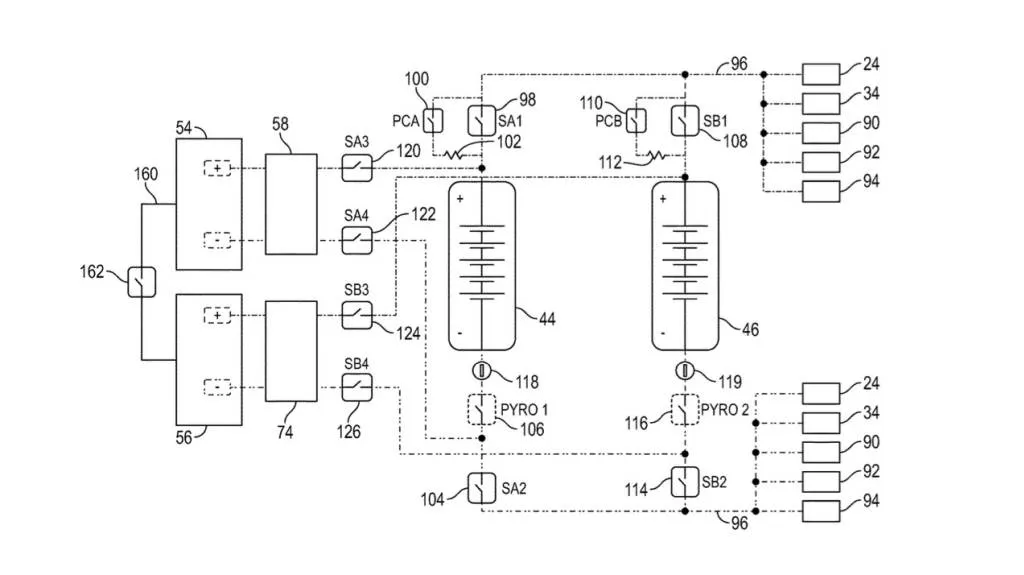
General Motors multi-port bidirectional charging patent image
Another possibility is “daisy-chained” vehicles, with only one vehicle actually plugged into a conventional charging station. That vehicle would then be connected to a second vehicle via its other charge port. That second vehicle could in turn be used to charge a third vehicle in a similar manner, according to GM.
This will require a new generation of charge controllers, the patent underscores, and a new range of thinking about how people will use bidirectional charging capability. A fleet of compatible vehicles would be required as well.
GM has expanded bidirectional charging across its lineup, but only with one charge port as of yet. It’s already laid out what large electric trucks might be able to do with multiple charge ports in a separate patent filing, though.
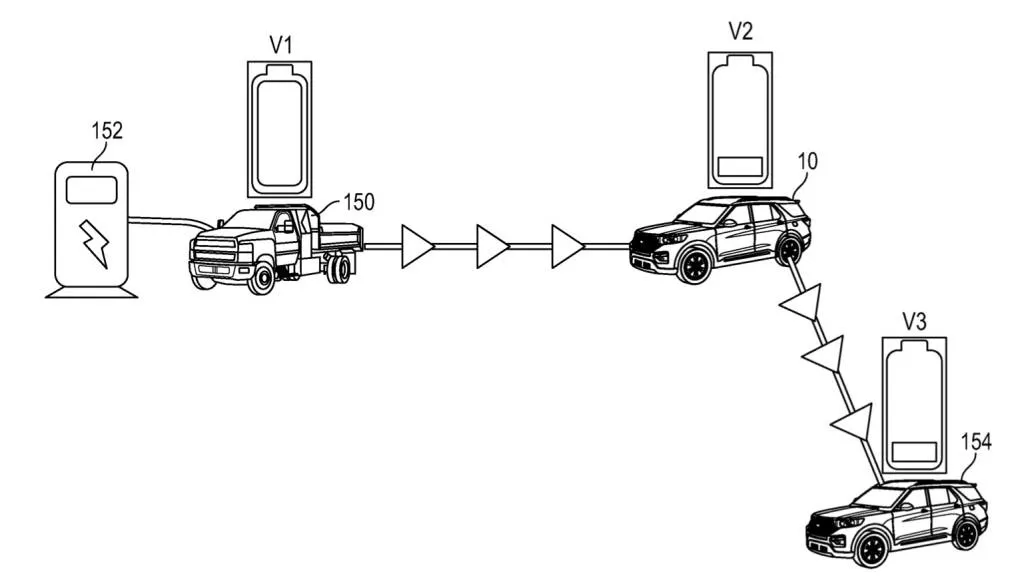
General Motors multi-port bidirectional charging patent image
Ford has also, in a patent, previously laid out what multiple charge ports might accomplish. That includes connecting multiple EVs in series, similar to what GM is discussing here.
Other automakers, such as Tesla, have also discussed adding bidirectional charging capability, while Volvo has shifted that capability into a separate energy business. But it might take mandates like the one proposed by California to further scale up bidirectional charging—and unlock some of the possibilities GM apparently sees in the tech.