
Author: EVAI

Oil industry pushes back versus softened fleet mpg standards
The oil industry last week launched a legal challenge versus the U.S. EPA and its latest light- and medium-duty vehicle standards set for the 2027-2032 model years.
The case was filed by the American Petroleum Institute (API), which represents members ranging from valve makers to Shell and Exxon Mobil. Joining in are the National Corn Growers Association, over accusations that corn ethanol wasn’t taken into account as a “critical and effective climate solution,” and the American Farm Bureau Federation, which claims that the standards will drive up the cost of farm vehicles “and force farmers to rely on a charging network that does not yet exist in rural areas.”
Also behind the lawsuit on the car-and-light-truck side is a group of six auto dealers, mostly from middle America, “representing sixteen brands and collectively operating dozens of dealerships in major markets across the country.” There are about 18,000 new-car dealerships in the U.S.
A press release accompanying the filing of the lawsuit called the EPA standards an electric vehicle mandate, although that accusation was omitted from the actual case petition.
Challenging the inevitability of plug-in vehicles
The case challenges the EPA rules for 2027-2032 confirmed in March and book noted in the federal register in April. These rules fit in with the Biden administration’s efforts to curb greenhouse-gas emissions, reduce smog-forming emissions, and boost public health. The standards clearly don’t mandate EVs, although based on the way they’re structured the EPA projected that EVs might make up 56% of new-vehicle sales by 2032—in order for full-line automakers to keep delivering large, gas-guzzling trucks as well.
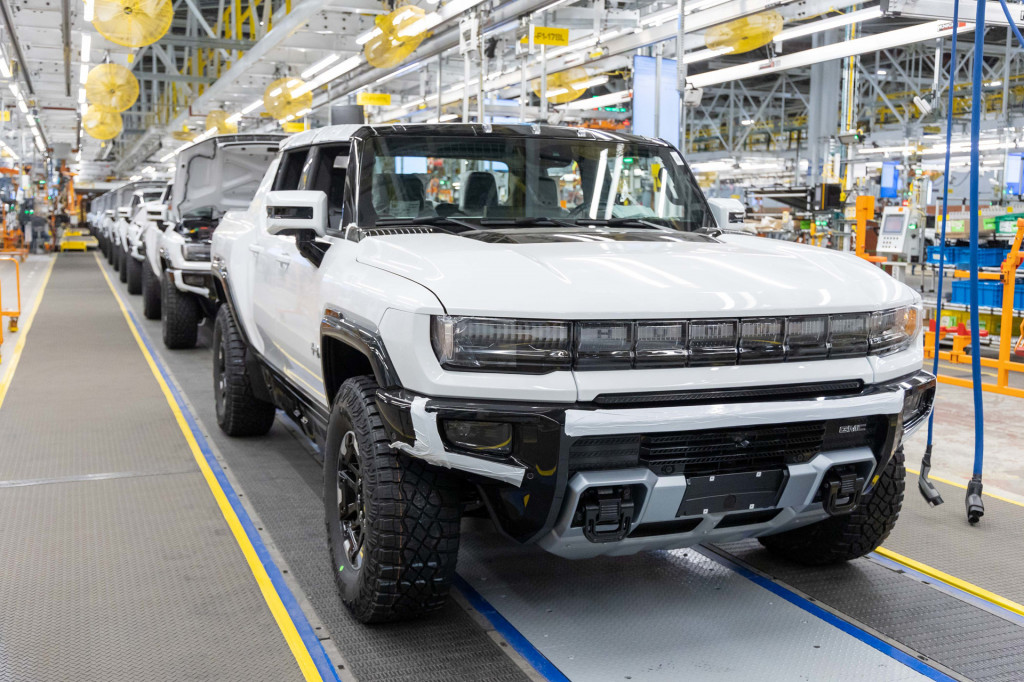
2022 GMC Hummer EV pre-production at Factory Zero plant in Detroit, Michigan
Over the long term, these rules will go hand-in-hand with the investments in EV and battery infrastructure championed by the Inflation Recovery Act.
“EPA’s final rule exceeds the agency’s statutory authority and is otherwise arbitrary, capricious, an abuse of discretion, and not in accordance with law,” the plaintiffs petition.
The EPA had already reeled back these latest 2027-2032 rules versus the tougher ones, finalized in 2022, that call for increases of 8% in 2024 and 2025 and 10% in 2026. Those rules were shaped in part to make up for a rollback under President Trump that cut the annual fleet improvement from about 5% in Obama-era rules to just 1.5%, and although steeper they were not met with the same level of pushback from the oil industry.
MPG rules have already been softened
Corresponding final rules for Corporate Average Fuel Economy (CAFE) revealed earlier in the month and meant to coordinate with the EPA standards, go easy on truck and SUV mpg versus what was originally proposed—prescribing an annual improvement for 2027-2031 of just 2% for passenger cars and 2% for light trucks for those model years.
The pushback also goes against the greener image that a number of big, multinational oil companies—now seeing them as energy companies—want to maintain. Shell, for instance, has shed some of its gas stations in favor of EV charging, and BP, notably, spoke out to acquire any stranded Tesla Supercharger sites when the EV maker pulled back on its buildout of fast-chargers.
Hertz and BP Pulse partner for EVs and charging
Meanwhile 13 states plus the District of Columbia have adopted a California plan mandating EVs, working toward 100% EVs and plug-in hybrids by 2035. In April, the U.S. Court of Appeals for the D.C. Circuit once again rejected a challenge to California’s precedence in establishing pollution limits.
Up until now, automakers have mostly supported these final rules publicly and in an investment sense, although lobbying efforts might show otherwise. Most appear to recognize that the EV shift is a good thing for global competitiveness.
The organizations haven’t stopped with cars. A companion lawsuit filed Tuesday essentially did the same for trucks, challenging the EPA’s heavy-duty truck emissions standards, also announced in April.
Last month, Presidential candidate Donald Trump allegedly offered to nix Biden EV incentives in exchange for a $1B campaign donation from Big Oil. But a regulatory landscape that’s more lopsided than ever might not be the future that even the oil industry would wish for.

Why do EVs cost more to insure than hybrids in 2024?
As more data rolls in from the insurance industry, an unfortunate trend has persisted for electric vehicles: They cost more to insure.
And there are enough of them in the vehicle fleet now to underscore that it’s no longer a matter of insurance companies covering themselves for the unknowns of a new vehicle type.
Based on calendar-year results examined by the insurance analytics team at LexisNexis Risk Solutions, EVs now have a 17% higher claim frequency and 34% higher claim severity versus what the firm considers “traditional segments.”
“Consequently, the number of paid claims, as well as the total claims payment amount for EVs has risen faster than the number of EVs as a percentage of the total PPA market over the year,” underscored LexisNexis in its report, out Thursday.
While the EV fleet in 2023 was 1.5% of the insured vehicle fleet, it represented 1.7% of all paid claims and 2.3% of the total claims payment, it says, citing its own proprietary analysis.
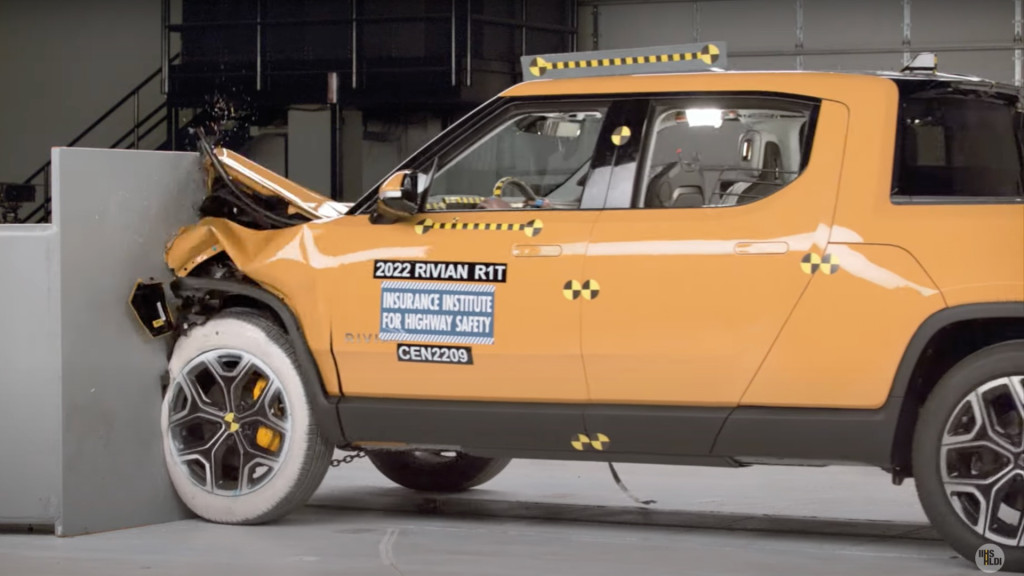
2022 Rivian R1T IIHS crash testing
As Consumer Reports found last year, EV insurance costs hundreds of dollars more annually versus comparable gasoline models, hybrids included. Based on the general factors presented by LexisNexis, plus the high cost of battery replacement, that’s not looking likely to change anytime soon.
EVs aren’t all bad news to risk-minded insurers. According to the Highway Loss Data Institute (HLDI), EVs are stolen less than gasoline cars.
More EVs didn’t cool the risk pool
As the report points out, 2023 was truly a big year for EVs out in the real world. EV sales increased 54% versus 2022, to 1.4 million in the U.S. That meant the total number of EVs insured grew by 40%, to 3.9 million vehicles, including plug-in hybrids, while insured private passenger vehicles grew just 1.2% to 265 million.
That bigger pool of owners and drivers—and vehicles—wasn’t enough to swing the odds more in EV drivers’ favor, however.
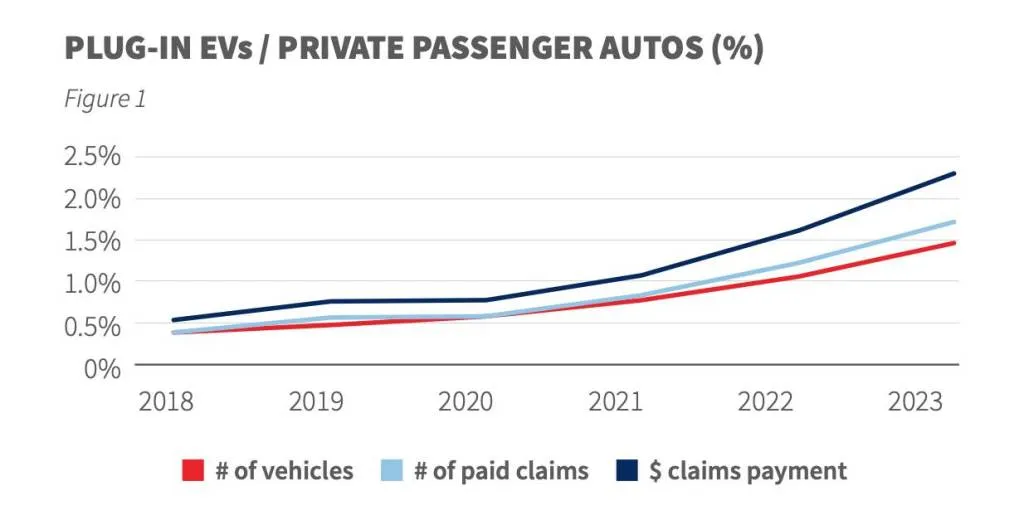
LexisNexis EV insurance claims trends – 2024 report
“Higher frequency and severity of EV claims have contributed to an escalating profitability challenge for all EV insurers,” the firm said, later stating: “Differing driving experiences in electric vehicles (EVs) have contributed to higher and more severe claims than internal combustion engine (ICE) vehicles.”
Green Car Reports has reached out to LexisNexis to understand what these driving experiences are, and if it’s referring to urban environments, less cautious driving, or some other factor.
Riskier driving, and it goes beyond EVs
American motorists in 2023 were riskier nearly across the board. Speeding, driving under the influence (DUI), and distracted driving offenses all went up, emerging well above pre-pandemic levels. DUI offenses were up nearly 9% in the first six months of 2023 versus the first six months of 2019.
Overall, across all types of vehicles, body injury severity rose by 20% from 2020 to 2023, while the severity of material damages (in amount claimed) has risen 47%.
A greater percentage of EV drivers were actively shopping around for lower rates, the firm observed—above the record levels of policy shopping and switching in 2023. That was spurred by sharp rate hikes inflicted by insurers starting in Q2 2022 that persisted at least through 2023—leading to an unprecedented 14% hike in insurance premiums for 2023 as a whole, year over year.
The high price of EV insurance has led Tesla to create its own insurance product. Tesla Insurance remains available in 12 states, and in all but California it uses a real-time algorithm impacting rates and based on driving habits.
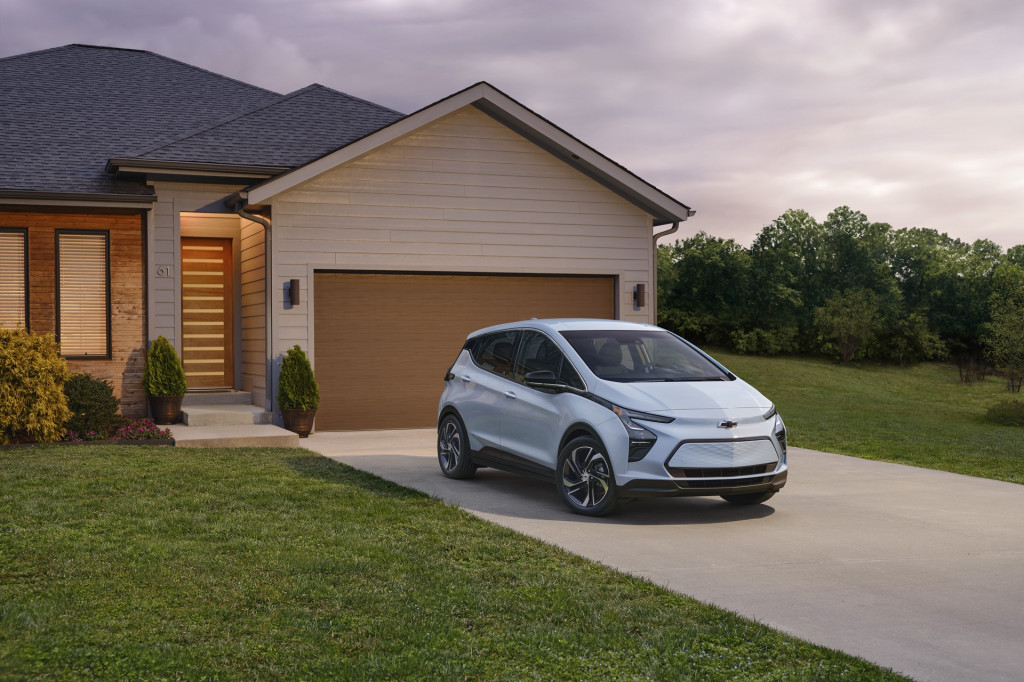
2023 Chevrolet Bolt EV
LexisNexis was involved in a scandal in which GM shared driver-specific data on Chevy Bolt EV driving habits with the firm through its OnStar Smart Driver program—with many drivers not at all aware that they’d been enrolled by the dealership.
Meanwhile, insurers aren’t doing well on promptness or satisfaction. Two of five, or 40% of respondents, said that it had taken a month or longer to get the full payment from the insurer, and 46% of those involved in such a claim were dissatisfied with the experience. So there’s lots of room for insurers’ improvement—and, perhaps, competition for those safe drivers.

Most American-made car brand? Tesla, Honda dominate top 20 list
 The South has usurped Detroit as home to the most American-made cars EVs account for 4 out of the top 10 most American-made cars Honda and Acura manufacture 9 out of the top 20 most American-made cars Where do babies come from? Explaining this answer to a curious child is far easier than answering the dauntingly complex question of where does my…

Test drive: 2024 Volvo S60 Recharge PHEV is better in charge
 It’s been nearly a decade since Volvo first started rolling out plug-in hybrids in the U.S., and while the formula for them hasn’t changed a whole lot, a couple of important details have. One of them is that Volvo’s made the batteries larger every few years, leading to more plug-in electric range, improved hybrid drivability, and…

Stellantis recalls 1.16M Jeep, Ram, Dodge, and Chrysler cars
 More than 1.16 million newer vehicles from Dodge, Ram, Jeep, and Chrysler have been recalled in North America An issue with the rearview camera projection has plagued millions of cars since the tech was mandated in 2018 A software update remedies the issue, but it must be completed at the dealer Stellantis has recalled 1,033,433 Dodge, Jeep, Ram…

2025 BMW X3 preview
 The X3 compact crossover is BMW’s second-bestselling model behind the X5, and a redesigned 2025 BMW X3 rolls into the new year with updated engines and a forthcoming fully electric model expected for 2026. This preview will be updated once we drive it. What kind of vehicle is the 2025 BMW X3? What does it compare to? The popular X3 seats…

2025 BMW X3 revealed with striking design, bigger size
 The 2025 BMW X3 will cost $50,675 The 2025 BMW X3 will be built at BMW’s plant in Spartanburg, South Carolina No plug-in hybrid powertrain exists in the 2025 BMW X3 lineup BMW on Tuesday revealed a new generation of its top-selling X3 compact crossover. The newcomer starts sales later this year as a 2025 BMW X3 and will carry a starting price of…

U.S. House Appropriations Committee OKs budget bill with CARS Rule ban
The U.S. House Appropriations Committee’s approval gives the Federal Trade Commission $388.7 million in funding but blocks the agency from using that money to roll out or enforce the CARS Rule on auto dealerships.

2025 Audi E-Tron GT: Flagship performance EV ups efficiency, range
The 2025 Audi E-Tron GT gets a boost in range, efficiency, and power as part of a mid-cycle refresh revealed Monday.
Styling hasn’t changed much from what we’ve become familiar with since the E-Tron GT was unveiled in 2021, although there are new front fascia designs for the different grades. Audi has put more effort into improving performance—along the lines of updates recently given to the related Porsche Taycan for 2025.
The base E-Tron GT has been dropped. The entry-level grade is a new 670-hp S E-Tron GT. The carryover RS E-Tron GT is now the middle child of the lineup, and sees output increase from the previous 647 hp to 845 hp. A new RS E-Tron GT Performance grade sits atop the range with 912 hp. It’s capable of 0-62 mph in 2.5 seconds, while top speed is limited to 155 mph.
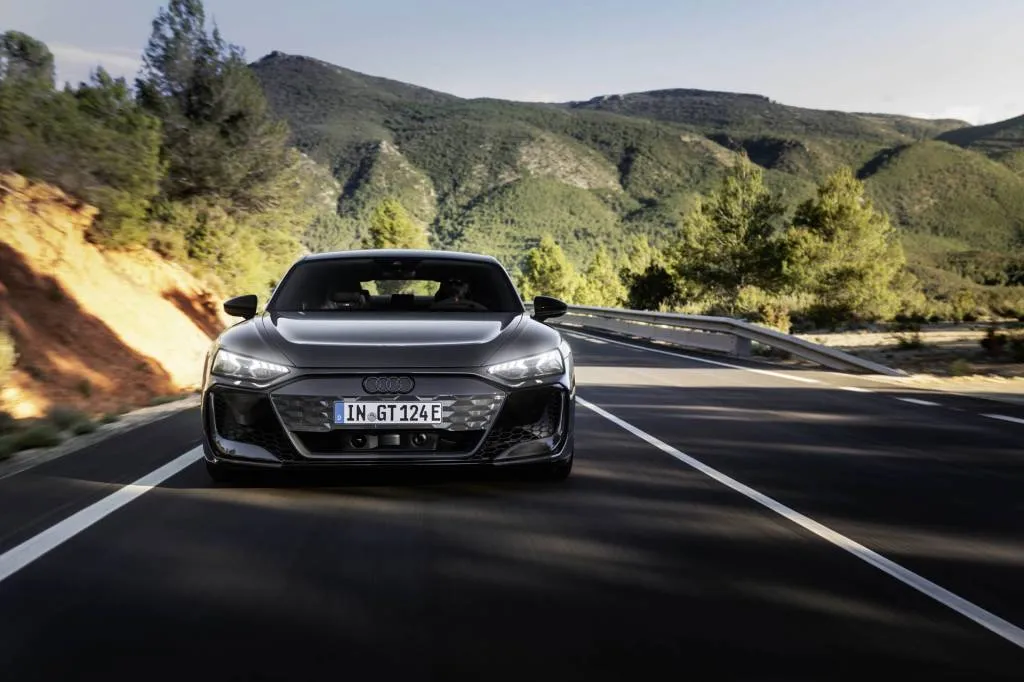
2025 Audi RS E-Tron GT
Dual-motor all-wheel drive remains standard across the board; you won’t find a single-motor version, or one with three motors like the Audi SQ8 E-Tron performance electric SUV. All models also feature a boost function that delivers 94 hp in 10-second intervals.
All models use the same 105-kwh battery pack as the updated Taycan. The pack sits lower and, at 1,378 pounds, weighs slightly less than the previous 83.7-kwh pack despite its higher capacity. Charging power increases from 270 kw to 320 kw, enabling a 10%-80% charge in 18 minutes. The maximum energy recoverable via regenerative braking also increases from 290 kw to 400 kw.
Audi estimates a maximum 378 miles of range as measured on the European WLTP testing cycle. An equivalent EPA figure will be lower, but could still improve on the current E-Tron GT’s 249-mile rating.
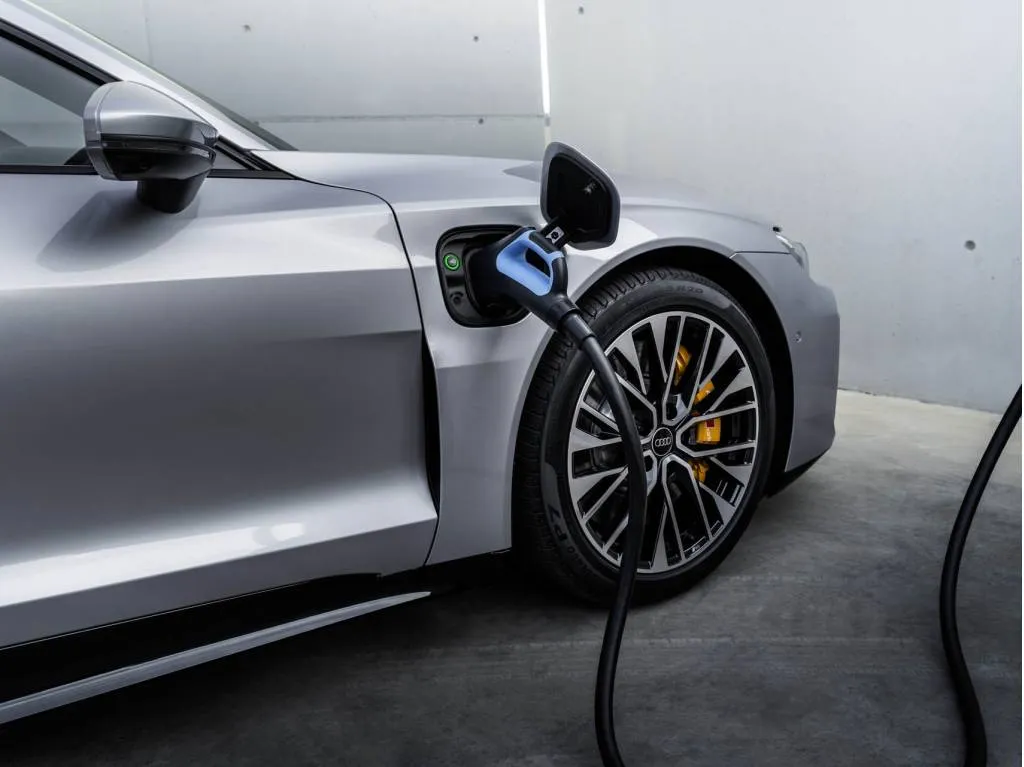
2025 Audi S E-Tron GT
Other changes include more powerful 10-piston front brake calipers, with standard steel rotors on the S E-Tron GT, a tungsten carbide-coated rotor design on the RS models (this is also optional on the S), and available carbon ceramic rotors. Strengthened driveshafts, recalibrated electronics for controlling torque distribution, and new dual-valve dampers shared with the updated Taycan round out the chassis changes.
In a first drive of the 2025 Taycan we found it makes good on the mission, not letting up on the poise and high-speed stability that made this model a standout for road trips—now with even more real-world range. With the pre-facelift E-Tron GT, touring comfort was prioritized over Taycan sharpness—which actually made it our preference for long-distance blasts.
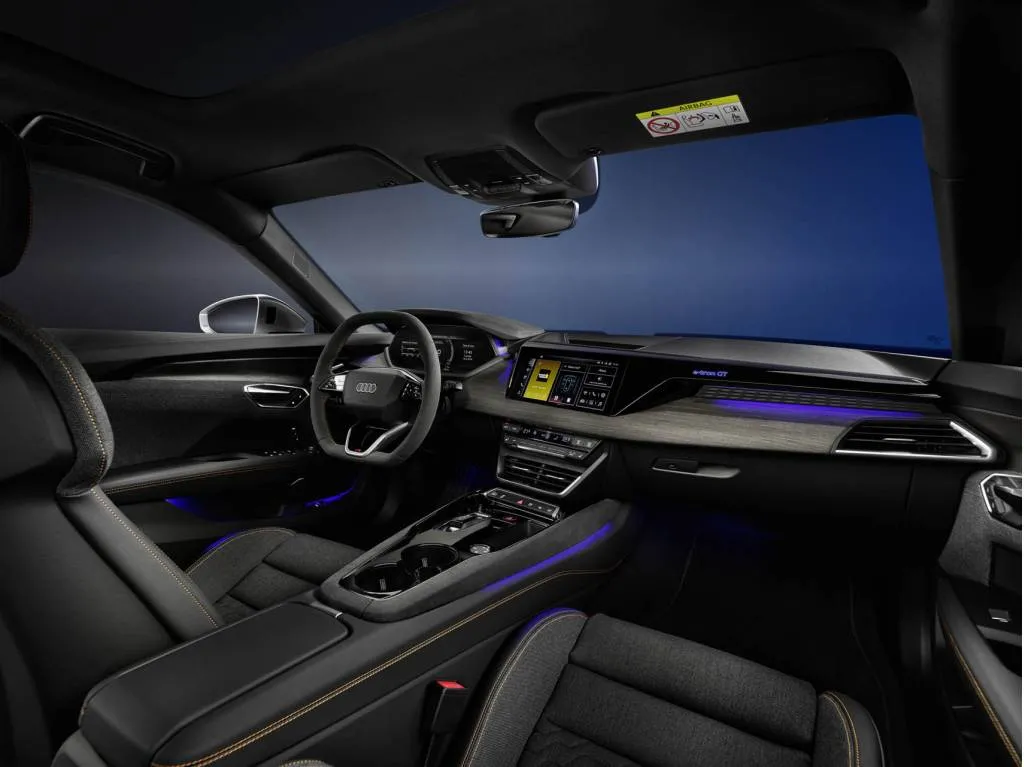
2025 Audi S E-Tron GT
Inside, the seats, steering wheel, and door sills were redesigned. Audi continues to use its own interface for the E-Tron GT, with a digital instrument cluster that now shows battery temperature, maximum possible charge rate, a completion forecast, and preconditioning status.
Pricing information and launch timing for the U.S.-market 2025 Audi E-Tron GT will be announced at a later date. Production is expected to stay at Audi’s factory in Böllinger Höfe, Germany.