
Category: General

Report: Feds to formalize foreign entity rules for EV tax credit
The U.S. Treasury Department could issue clarifications on federal EV tax-credit eligibility rules as early as Friday, reports Transport Topics.
Citing anonymous sources familiar with the matter, the report claims the federal government is ready to issue rules relating to its “foreign entities of concern” requirement. Specifically, vehicles with battery components or critical minerals from companies controlled by certain countries the U.S. does not have friendly trade relations with would not qualify for a $7,500 federal tax credit. This has remained at the “proposed guidance” stage, but the Biden administration appears ready to formalize it.
As Green Car Reports has pointed out before, the proposed rules suggest that products from some automakers that are set to build EVs in the U.S.—like Volvo and Polestar—might not be eligible because of their Chinese ownership and control.
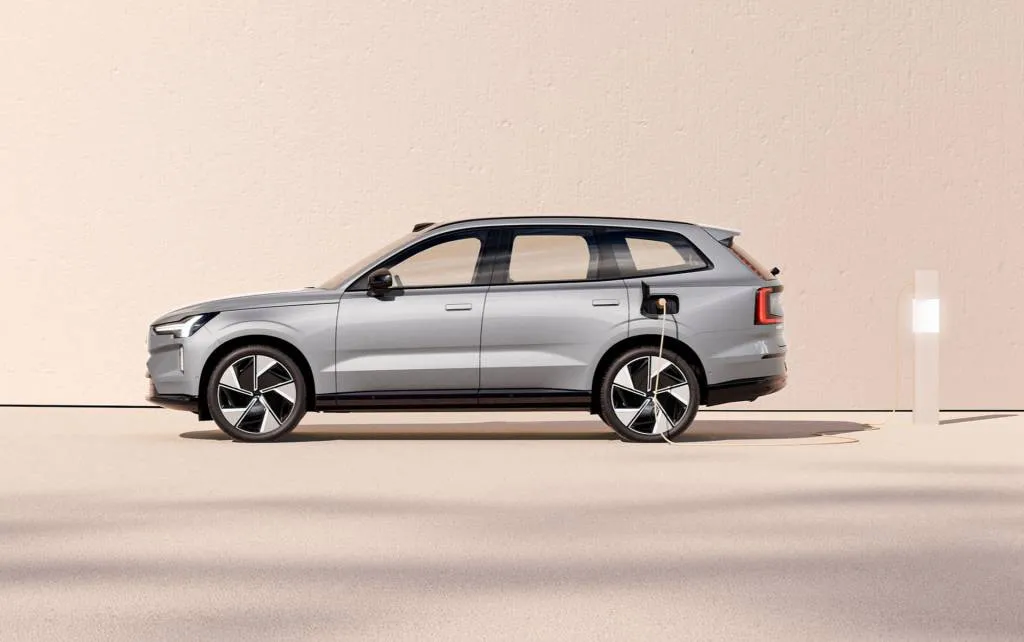
2025 Volvo EX90
Some proposals have looked at establishing a specific threshold of traceable battery minerals, aiming to quantify the amount of material from countries with which the U.S. does not have a free trade agreement, Forbes reports. But these could still limit the number of vehicles that qualify for the federal tax credit.
Just this year, new requirements for battery sourcing pushed some EVs off the list of qualifying vehicles—some temporarily. General Motors, for instance, had to make last-minute sourcing changes in its Ultium EVs.
Most EVs for sale in the U.S. have American-made batteries—but there are certainly some noteworthy exceptions like the North American-made Ford Mustang Mach-E. But if the U.S. opts for a particularly strict and narrow interpretation of the rules, then there may be a greater and renewed attention paid to EV battery recycling.
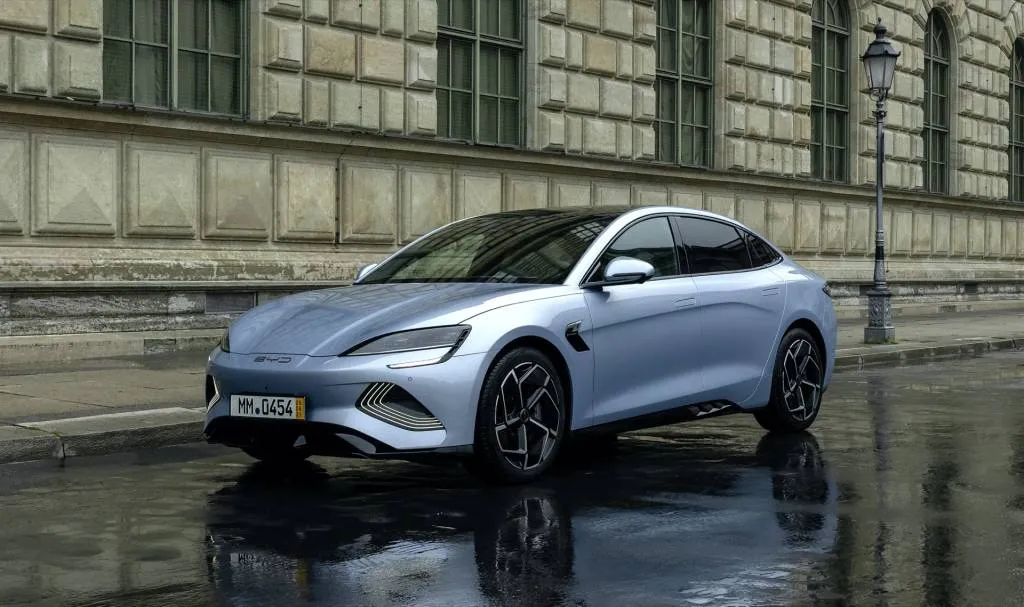
BYD Seal
In 2023, the U.S. eased concerns from a group of other countries with a trade pact that assured Japan, South Korea, and the European Union that battery components from these trade partners would be included in tax-credit eligibility.
Ultimately, the interpretation of the rules will likely determine how and when China’s massive EV buildout reaches the U.S. market. China now faces a glut of EV and EV battery production facilities.

Costco deal saves up to $2,000 on these EVs and PHEVs
Costco is once again offering deals on EVs and plug-in hybrids for its members.
Between May 1 and July 31, the retail chain is offering a $1,000 incentive on 2024 and 2025 Volvo models, including the 2024 XC40 and C40 Recharge EVs and XC60 Recharge and XC90 Recharge plug-in hybrids, as well as 2025 XC60 and XC90 plug-in hybrid models.
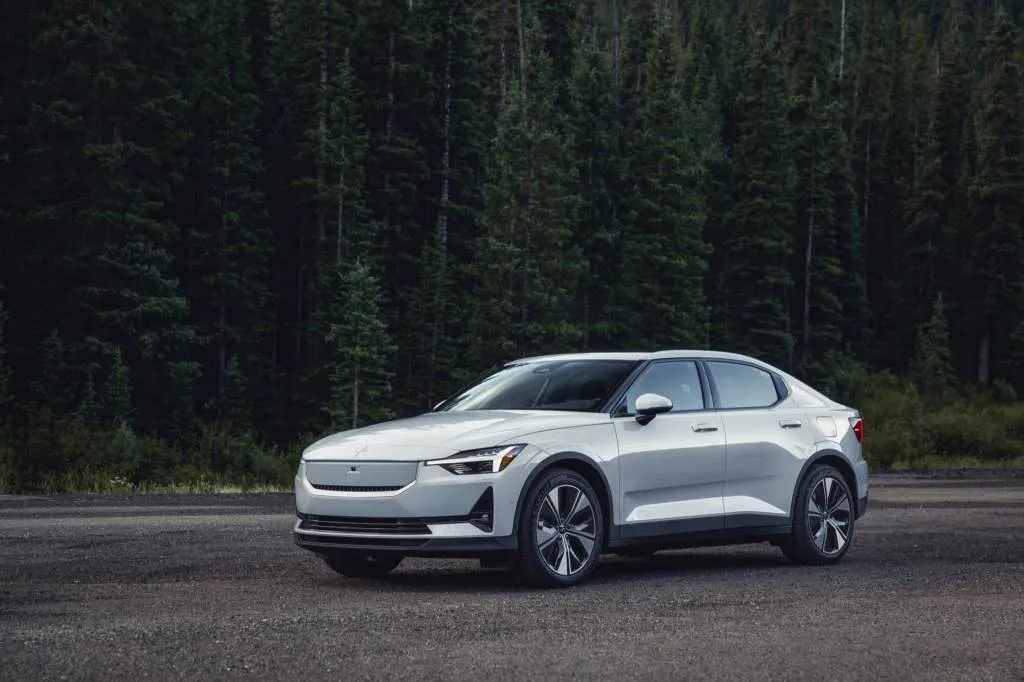
2024 Polestar 2 single motor
The XC40 Recharge and C40 Recharge are essentially the same vehicle, with the C40 Recharge having a more coupe-like body style. Both perform better and return more range for 2024 with a new rear motor and rear-wheel-drive focus. Volvo is in the process of rebadging the XC40 Recharge and C40 Recharge as the EX40 and EC40, respectively, to fit in with its updated EV naming scheme.
Costco is also offering incentives of $1,000 for the three General Motors EVs—the Cadillac Lyriq, Chevrolet Blazer EV, and Chevrolet Equinox EV—as well as a $2,000 incentive for the Polestar 2.
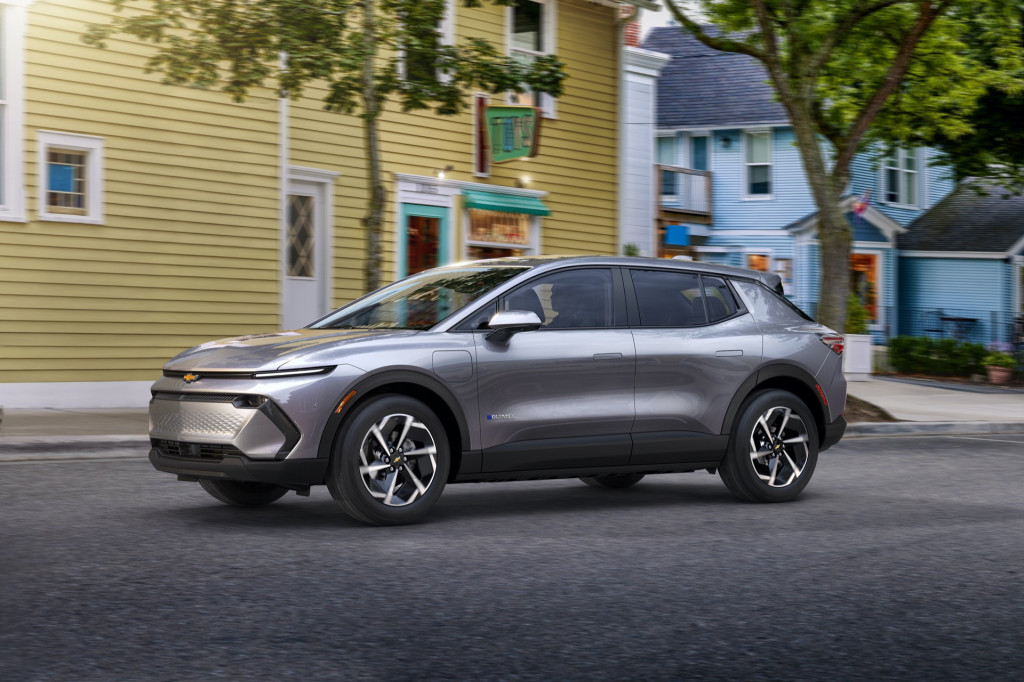
2024 Chevrolet Equinox EV
The Polestar 2 has received a similar makeover as its Volvo XC40 Recharge and C40 Recharge platform mates, switching from front-wheel drive to rear-wheel drive in single-motor form. That’s made the Polestar more satisfying to drive.
GM, meanwhile, has cut the priceof the 2024 Chevy Blazer EV by thousands in its inaugural model year. The Equinox EV is due to start arriving at dealerships very soon, but it will be awhile before the most affordable versions are available. Chevy has already announced another incentive on that model allowing Bolt EV drivers an extra $3,000 off, though, so at least some customers may be able to get an Equinox EV at a truly low price.

Lucid Gravity prototype, Toyota hydrogen plans, California EV sales: Today’s Car News
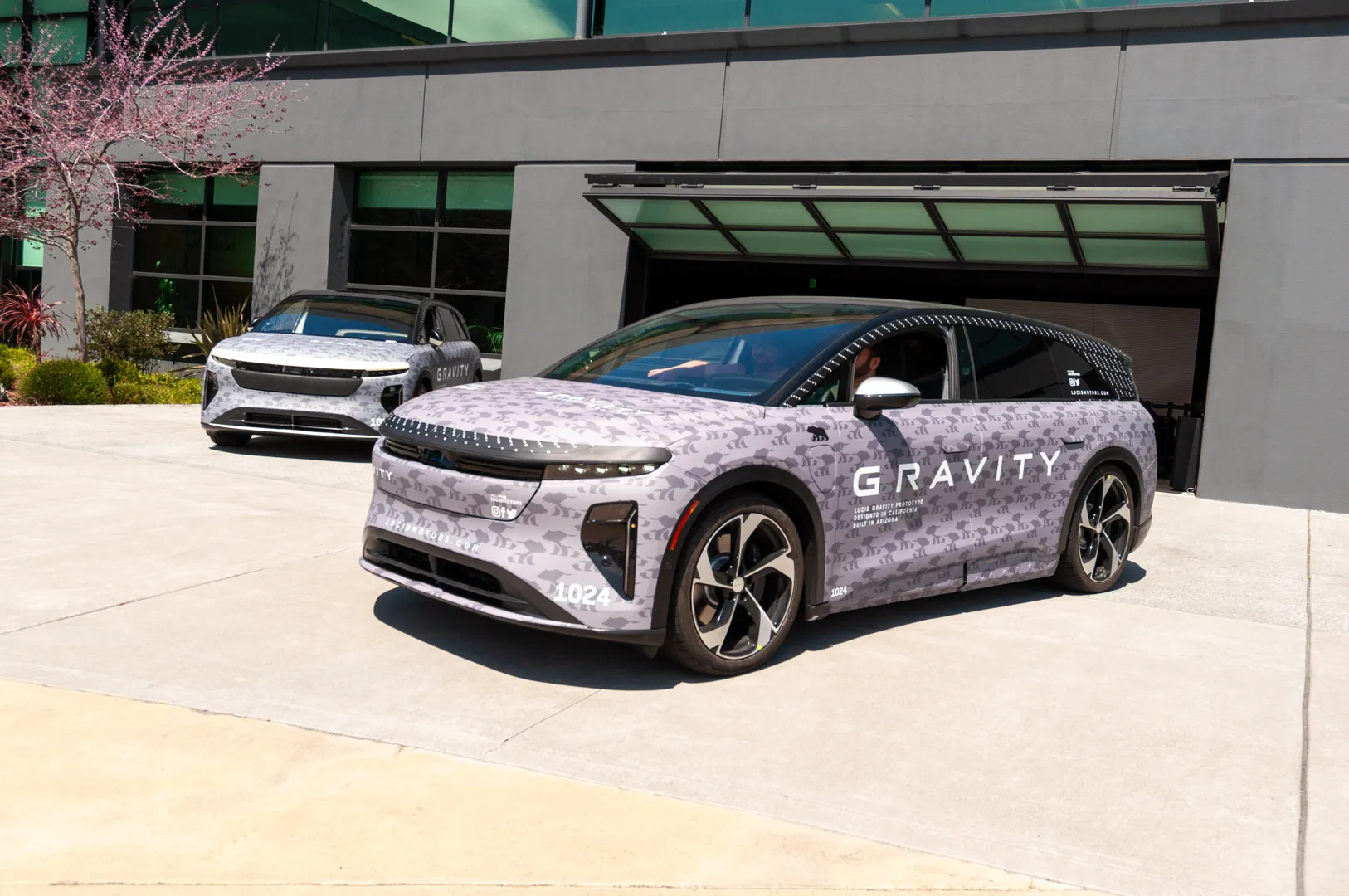
Stagnant Tesla sales flatten EV growth in California. Toyota sets up shop for all things hydrogen. And a drive of the Lucid Gravity tells us that it’s built on a layer of Air but adds much more. This and more, here at Green Car Reports.
A brief Lucid Gravity prototype test drive was enough to tell us that this upcoming EV will offer a unique layout and a different driving experience than any other three-row electric SUV.
Are electric vehicle sales down in California? A quarterly report out this week underscored some of the complexities of the current EV market. Overall EV deliveries were pulled downward by sagging Tesla sales but mostly countered by strong sales of EVs from other brands, including Hyundai. So overall, EV sales are up in California versus the previous quarter, but with growth of the market as a whole they’ve skewed downward in market share.
And Toyota is looking to localize U.S. hydrogen fuel-cell development of all kinds with the opening of a California Hydrogen Headquarters. Toyota’s H2HQ will showcase a flexible microgrid and lead the application of fuel cells in trucks, stationary power generation, and more.
_________________________________
Green Car Reports Newsletter
Sign up to get the latest green car and environmental news, delivered to your inbox daily!
I agree to receive emails from Green Car Reports. I understand that I can unsubscribe at any time. Privacy Policy.


Prototype test drive: Lucid Gravity might defy segments
Is that a minivan? Is that a wagon? Is that an SUV?
The answer to these questions in order is no, kind of, and yes. The Lucid Gravity is the startup automaker’s upcoming crossover SUV, but in many ways it redefines the genre in terms of packaging, design, and how it drives.
Here’s what I learned after an ever-so-brief stint behind the wheel of an early alpha build prototype before it headed to the crusher.
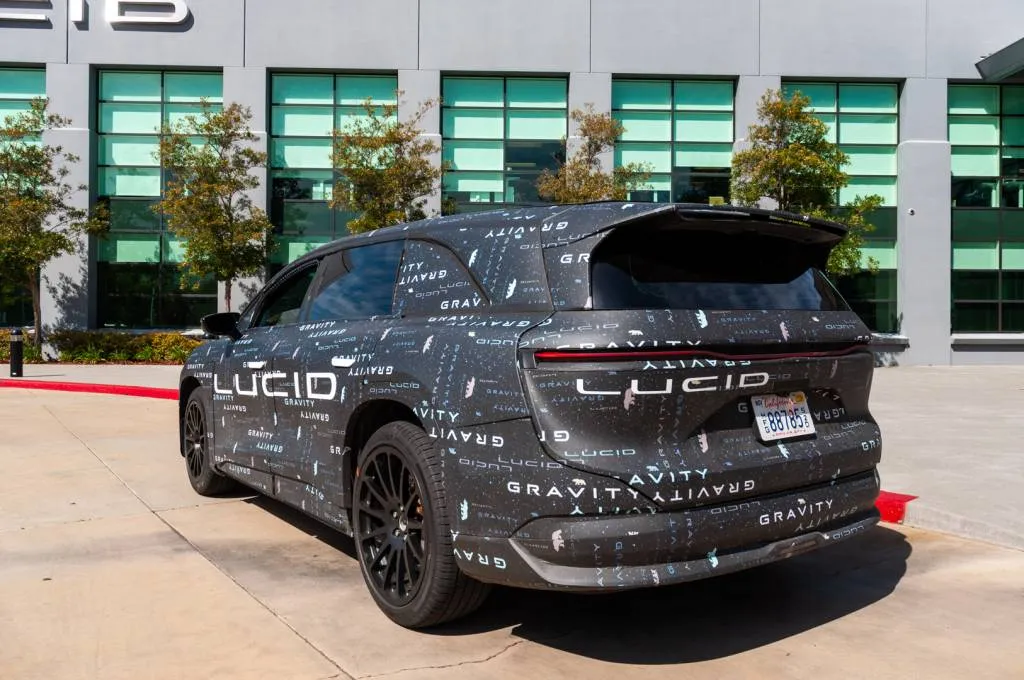
Lucid Gravity prototype
Lucid’s electric SUV will be a chameleon
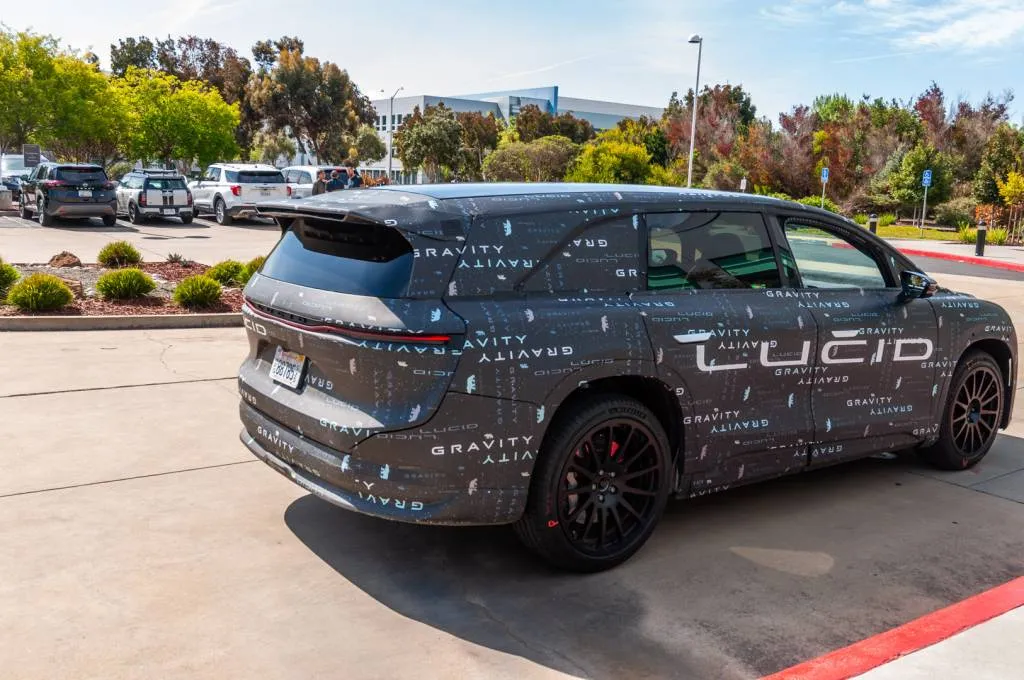
It all comes down to the angle in which the Lucid Gravity is viewed. The camo-clad prototypes I saw in various stages of development made it more challenging to decipher its proportions. It’s kind of wild what a bunch of tape will do to a car’s visual appearance.
From the side the Gravity looks like a squished SUV or a bulked-up wagon. The long greenhouse, cab-forward proportions, and tall beltline add to the overgrown wagon feel in a good way. This isn’t going to be another car cosplaying an SUV.
From the rear, from the right angle, there’s a serious Chrysler Pacifica likeness. And I mean that as a compliment to both the Gravity and Pacifica. Both are pretty sharp vehicles for their respective classes and have some things in common. The Gravity might be the first crossover SUV in history with a third-row seat that tucks into a rear well.
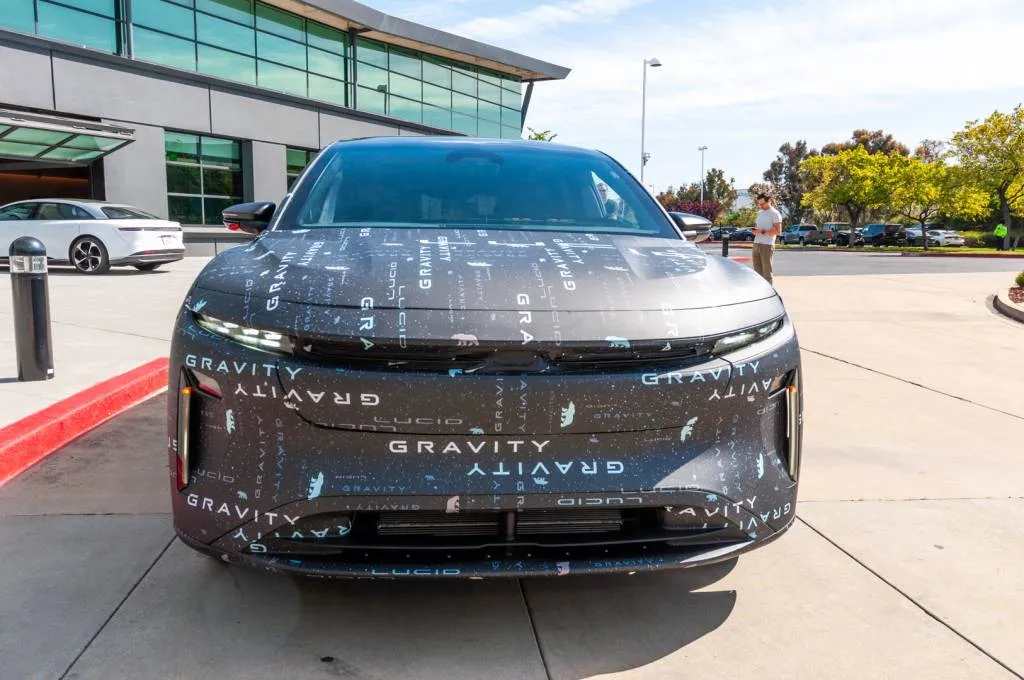
Lucid Gravity prototype
The most SUV-like angle is when looking at the Gravity head-on. It’s visual mass, and height, are the most apparent, especially when parked next to a slinky, low-slung Air. The front end’s height is accentuated by the vertical LED light pipes sitting at both corners.
I also get a strong sense that, just as with the Air, the Gravity will be a vehicle where color matters greatly in terms of how it looks and its perceived presence.
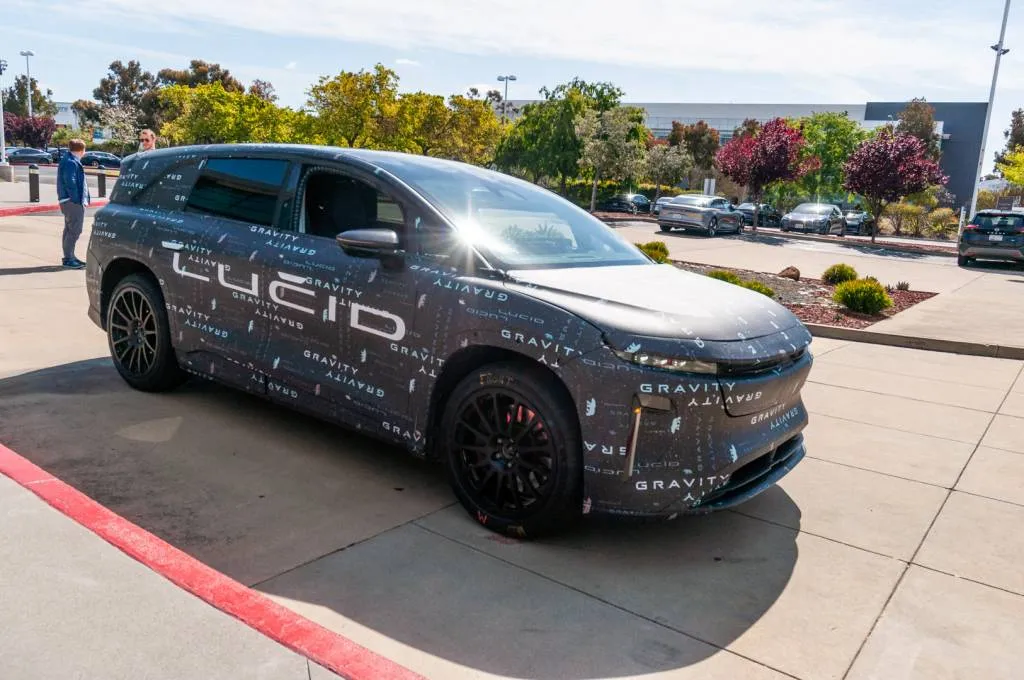
Lucid Gravity prototype
Gravity rides on air
The folks at Lucid weren’t ready to fully discuss various packaging of different trims and options, but the Gravity I drove rode on a three-chamber air suspension. Launch cars will all likely feature this system, which will seemingly be the most expensive and advanced. Less expensive models will utilize a single-chamber design I didn’t get to experience.
As I opened the door to the alpha build Gravity prototype, which was a suspension and platform mule, the car didn’t wake up. One of my engineer chaperones asked me to close the door and let him reset the car. I opened the door a second time and the Lucid came to life. Sort of.
Lucid Gravity prototype
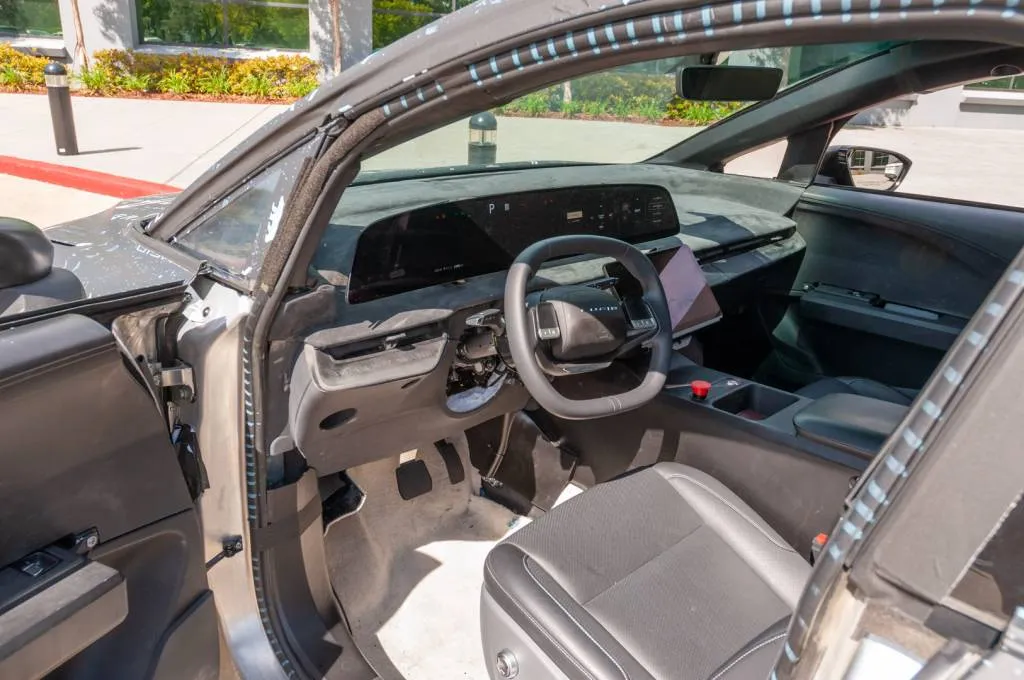
The prototype digital gauge cluster instantly lit up with some warning lights. There are fixed digital buttons on the left similar to the Air sedan, plus basic controls displaying the climate control temp and steering wheel adjustment controls. The dashboard had some wrapping on it so as to not look haggard; the gauge cluster was missing its back plate; and the center touchscreen didn’t bother to come to life. And the hacked-together interior featured the requisite (for any development vehicle) red stop button—in case we quickly needed to shut everything down.
As I slid into the driver’s seat a Lucid spokesperson noted these weren’t even the Gravity’s seats. These were seats ripped out of an Air because the prototype Gravity seats were needed in a newer mule being tested on the road.
This translated to a seating position that wasn’t production-correct, and it meant that my view of the 34.0-inch curved OLED digital gauge cluster was obstructed by the squircle steering wheel intended to help the situation.The steering wheel itself was a prototype and the touchpads on either side were blanks. It felt different than anything I’ve ever used to steer before. The squircle shape is flatter than what’s used in the Chevrolet Corvette, while the diameter felt perfect and proportional to the vehicle. It’s a better concept than a yoke if a car isn’t going to have a steer-by-wire system with only 180-degrees of steering input.
Lucid Gravity prototype
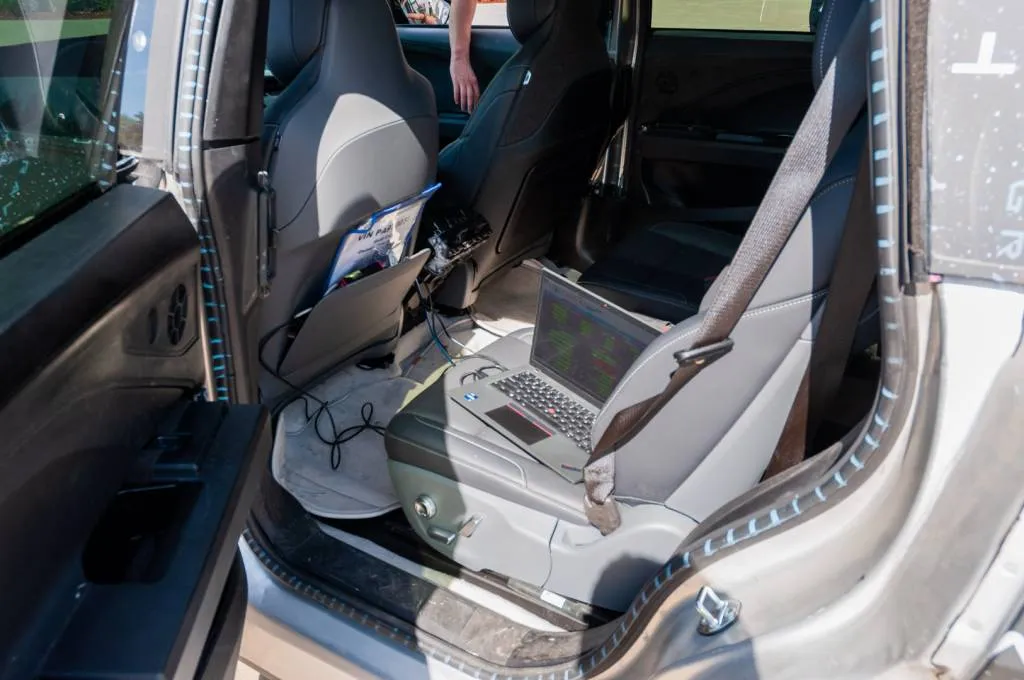
The suspension tune and powertrain’s output was controlled via a computer hooked directly into the car’s systems via an ethernet cable from the rear seat by an engineer. As I guided the Gravity prototype out of Lucid’s parking lot I asked which mode the powertrain and three-chamber air suspension was in. “It’s equivalent to Smooth in the Air,” the engineer responded—referring to the softest setting. In the Gravity, this will bring in the vicinity of 500 horsepower, which is 60-70% of the powertrain’s output.
I punched it with the accelerator matted to the floor and the Gravity’s dual-motor powertrain launched us back into our seats as the overgrown wagon took off. I let up quickly as this was a public road. By my own estimation, 60 mph came in less than 4.0 seconds. It’s quick even in its slowest setting.
Navigating to a faster-moving four-lane suburban road I picked up the pace a bit. Cresting a hump in the road, admittedly with probably a little too much speed, caused the steering to go light and numb as the suspension unloaded and the mass went up. The landing was smooth and controlled.
Lucid Gravity prototype
Air Sapphire influence in Gravity ride and handling
The engineer sitting in the front right seat told me the team aims to scale the ride and body control from ulta luxurious and soft—softer than in the Air sedan—to ultra sporty with fine body control similar to that of the Air Sapphire. “Breadth of capability” is the name of the game, I was told.
The engineering team had me drive to a side road with a sharp left-hander that led into a straight and then a sweeping right-hand turn. This all led into a long straight road that ended with a parking lot. The team said I could hustle the Gravity through all this to see the breadth of the current suspension tuning and practicality of the squircle steering wheel.
My first crack at this makeshift road course was with the suspension and powertrain cranked to 11, or what would be known as Sprint mode in an Air. Earlier in the drive I was warned the car was “low on juice” so I would never get the full beans. Total output should check in at over 800 hp in Sprint mode.
The suspension kept the Gravity shockingly upright with little body roll despite the speed at which we were going around the turn. It partly felt like an overgrown Porsche Cayenne, or something one might find rolling out of the Mercedes-Benz AMG buildings. The inside wheels clawed at the pavement and I could feel the push and pull of the power shifting as the Gravity hustled around the first corner. The second corner was more sweeping and the Gravity was clearly capable of much more than this road could show me.
While initially all Gravitys will be dual motor–one at each axle delivering all-wheel-drive—a triple-motor model with Sapphire badging is expected at some point. The Lucid team was mum on the topic, but did tell me that lessons from Sapphire’s torque vectoring are being applied to the Gravity through the electronic stability control system and brake system plus the rear motor.
Lucid Gravity prototype
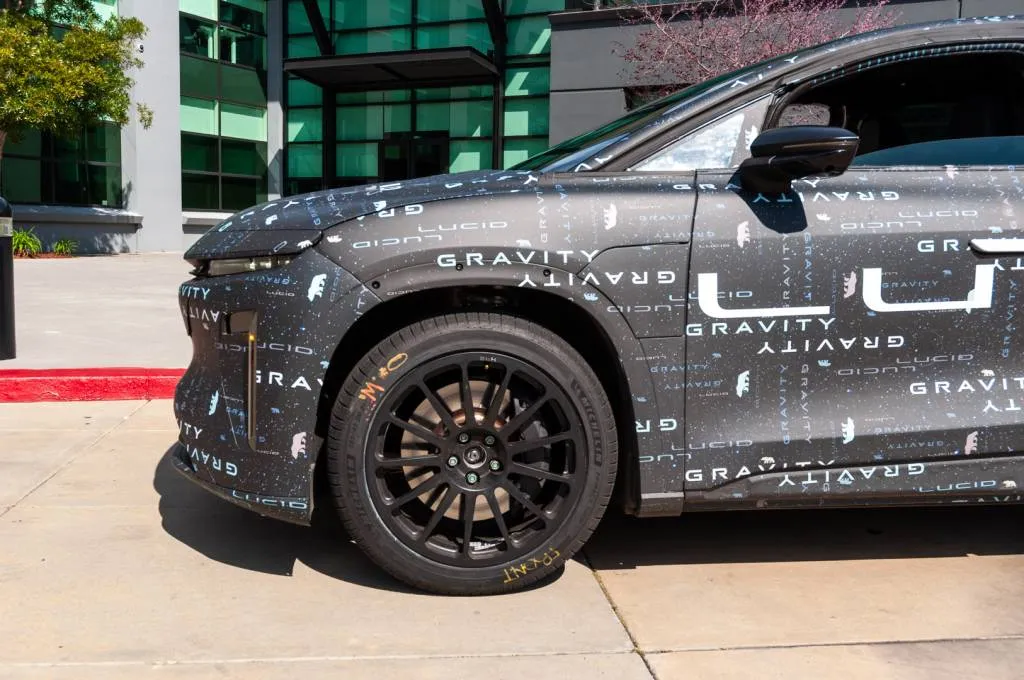
The prototype rolled on the Gravity’s mid-spec staggered 21-inch front and 22-inch rear wheels wrapped in Michelin all-season tires, but it lacked the rear-wheel steering system production cars will have with the three-chamber air suspension. That means the production car will have an even sharper turn-in than what I experienced.
The engineer in the rear seat of the Gravity clicked a few keys on the computer as the prototype neared the beginning of this make-believe road course again. “OK, we should be in something similar to the base Smooth mode again” he said. Nobody seemingly cared if I punched it, so I did. As the Michelins clawed the Gravity’s weight noticeably shifted much more than the first time as the softer suspension parameters allowed a lot more lean, and I had no choice but to keep the speed lower as the body rolled. While still controlled, the Gravity suddenly made me more aware of its heft.
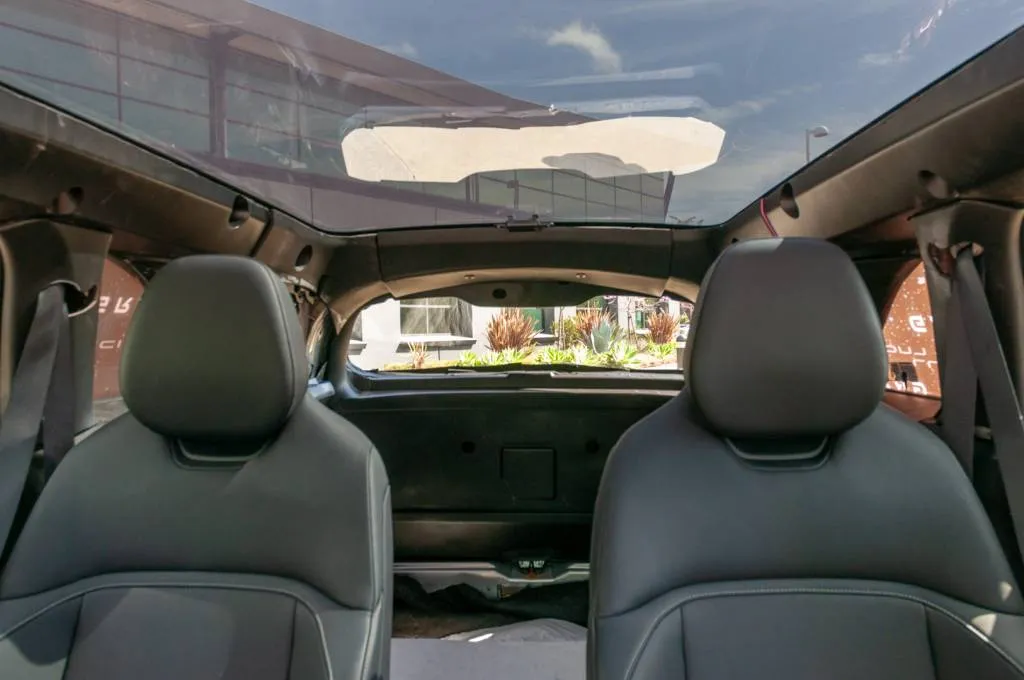
Lucid Gravity prototype
Lucid Gravity feels like an Air wagon
Despite the incorrect seating position, I did get a solid sense of what it feels like to be inside the Gravity on the road. The view from the front seat back through the rear window reminded me of driving a wagon. That was mostly due to the shape of the rear window itself, which is compressed due to the squished roofline. Note that the prototype didn’t have a third-row seat in it, and the second-row seats weren’t production-spec.
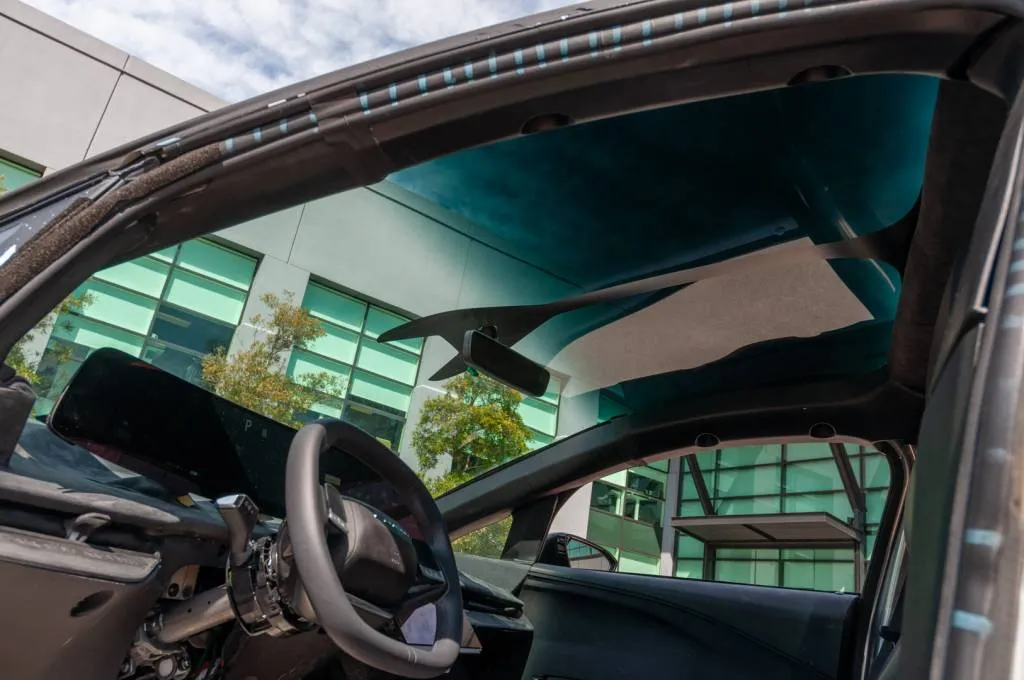
Lucid Gravity prototype
The view forward, the placement of the front pillars, the vast windshield into the glass roof, and the overall feel from the driver seat reminded me of an Air that has been supersized. If a futuristic sport wagon that rode a bit too high existed, this might be it.
Walking away from my brief stint in the early suspension and chassis Gravity prototype one thing became clear: No other electric car on the market drives like or looks like this thing. It’s seemingly going to deliver family comfort for a daily commute and sporty driving dynamics for the long way home in a way no other electric seven-seater delivers yet.

EV market share sags in California, though EV sales are up
It’s a complicated time for the nation’s largest EV market. California EV sales increased in the first quarter of 2024, but market share still fell, according to a new quarterly report from the California New Car Dealers Association (CNCDA).
The absolute number of EVs sold in California grew from 89,741 in the fourth quarter of 2023 to 90,296 in the first quarter of 2024, the report found. But EV market share still decreased from 21.5% at the end of 2023 to 20.9% in Q1 2024. That’s because new-car registrations grew overall, with even more non-electric vehicles being sold. The rise of EV sales by volume rather than share is a trend that continues from the previous quarter.
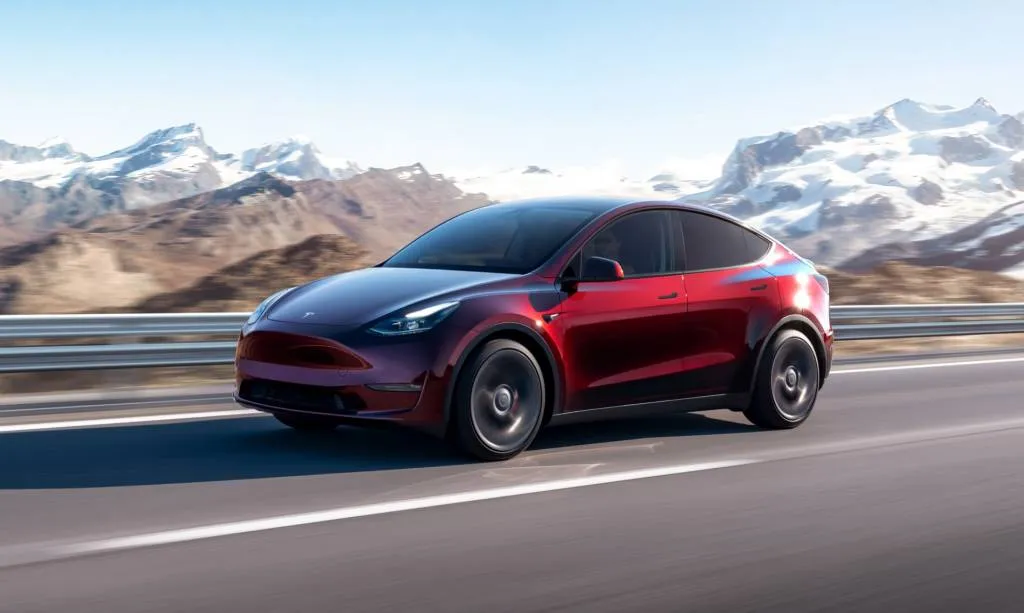
2024 Tesla Model Y. – Courtesy of Tesla, Inc.
Tesla’s EV sales lead in California also continues to shrink, the report found. Tesla registrations were down 7.8% from the previous quarter, which itself saw a 9.8% decline in registrations for the once-California-based automaker.
Without a deeper dive into the trends, it might be argued that sagging Tesla sales, not sales of EVs of other brands, are what have caused the recent flattening for EVs in California and elsewhere. That’s because Legacy automakers are selling more plug-in vehicles, the report noted. Mercedes-Benz and BMW saw the highest increases in California in Q1, posting 3% and 2.4% gains, respectively.
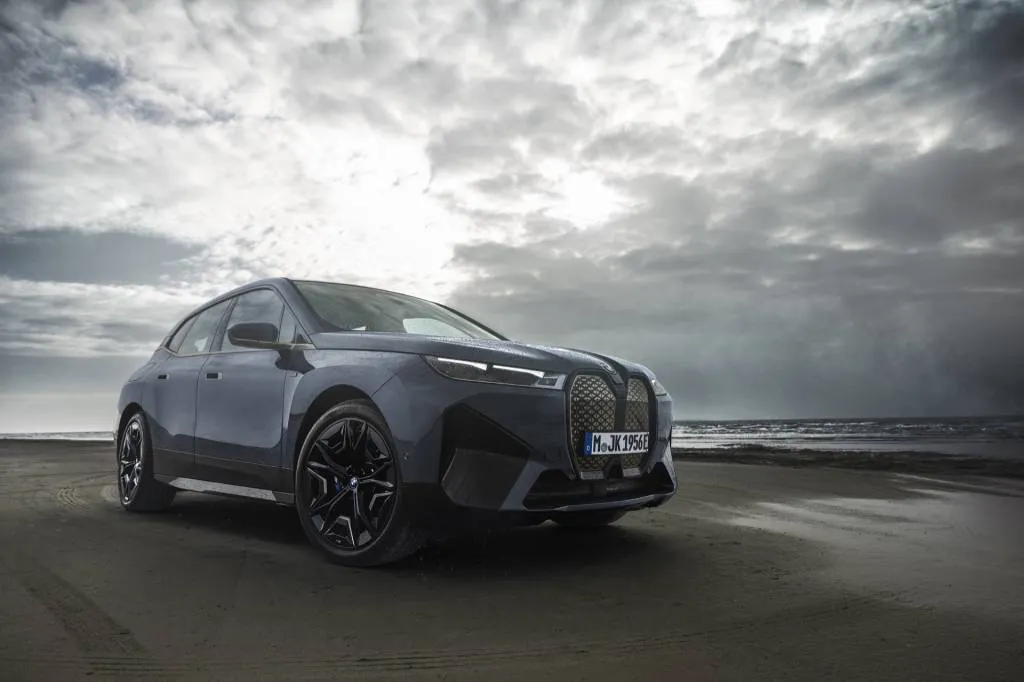
2024 BMW iX
EV sales through franchised dealerships also increased 14% in Q1, while direct sales—the model used by Tesla and some startup automakers—saw a 3% drop. Franchised dealerships account for 66% of “alternative powertrain types” in California, according to the CNCDA.
Even with EV sales rising in the rest of the country, California remains near a third of the nation’s EV sales. And even with this market-share hiccup, in the state, one of four new vehicles sold in California has a charge port—although some are plug-in hybrids rather than all-electric models.

Used EV price drop, Lexus UX hybrid mpg, die-cast electric G-wagen: Today’s Car News
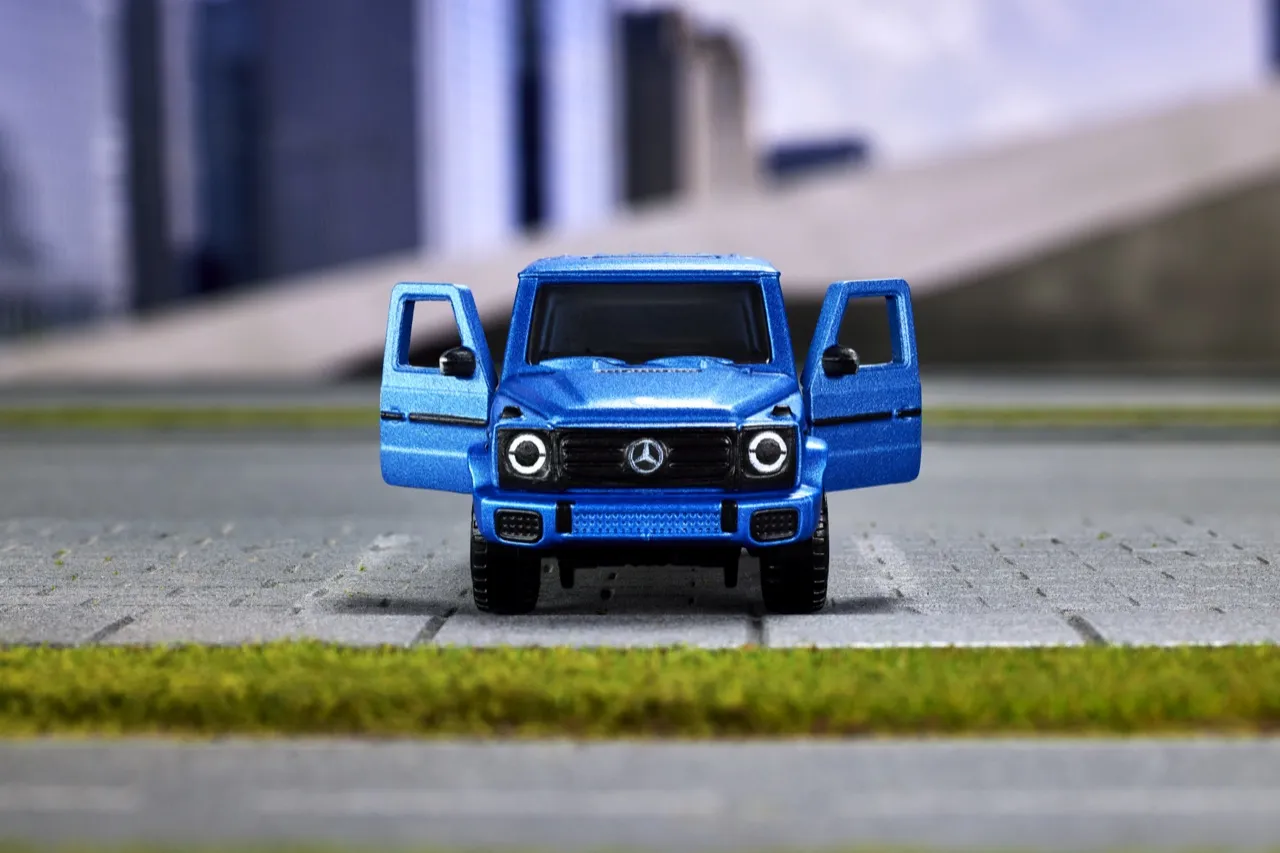
The Mercedes G-wagen EV goes die-cast, with a sustainability twist. Used EVs are selling at lower prices than last year. And the most affordable Lexus gets more fuel-efficient. This and more, here at Green Car Reports.
The 2025 Lexus UX 300h has gone hybrid-only, and the most popular AWD version of this model gets a noteworthy gas-mileage boost. The UX 300h AWD now gets 43 mpg combined, and it starts around $40,000.
According to an annual update from the retail giant CarMax, the most popular used EVs cost up to $5,000 less than last year. Once again, that list includes the Tesla Model 3, Tesla Model Y, and Nissan Leaf—all down significantly. And this year’s list of top-selling EVs included fewer non-Tesla luxury EVs.
While last week marked the debut of the 2025 Mercedes-Benz G 580 with EQ Technology—the electric G-wagen to the rest of us—this week a more affordable version arrives. With a premium die-cast electric G-wagen made of recycled metal and sustainable plastic from Mattel’s Matchbox, and a mass-produced version of that on the way this fall, those dreaming of electric off-roading have a way to show it off.
_________________________________

Report: Top-selling used EVs cost up to $5,000 less than last year
The average price of the most popular used EVs has dropped by up to $5,000 compared to last year, according to retailer CarMax.
Sales data from September 1, 2023 to February 29, 2024, showed that the top EVs at CarMax were the Tesla Model 3, Tesla Model Y, and Nissan Leaf. They were also the top sellers in a previous CarMax report published in 2023, but since then average prices for all three have dropped. The current report showed average prices of $34,045 for the Model 3, $43,896 for the Model Y, and $18,465 for the Leaf.
Overall, among the list of top sellers, average prices are $3,000 to $5,000 less than last year, according to CarMax.
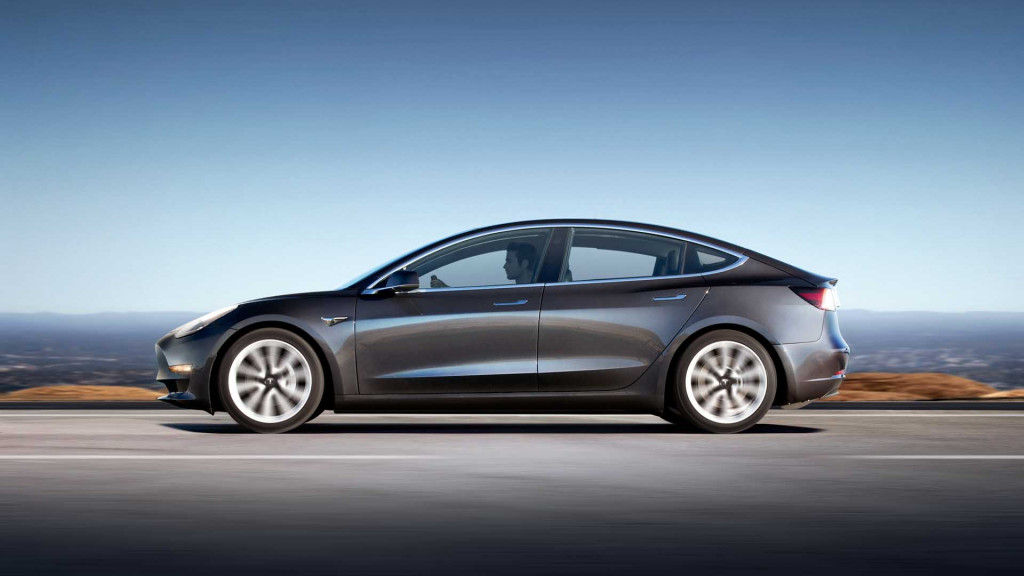
2020 Tesla Model 3
Fewer EVs from luxury brands were in the top 10 sellers this time around as well, with only four luxury models represented compared to six before. That appears to have helped lower the ceiling on used EV prices.
Those prices ranged from $22,000 to $72,000 last year, but while the lower number is the same, the upper end was $46,000 this time. CarMax partly attributes that to the elimination of the Tesla Model X from the list and lower average prices for the Model S, which is ranked ninth on this year’s list. The only non-Tesla luxury car to make the top 10 this year was the sixth-place Audi E-Tron.
And it’s not that EV interest is lagging. The report also showed a steady increase in monthly search volume on the CarMax website for electric models. EV search volume increased 177% from January 2021 to February 2024, according to the report.
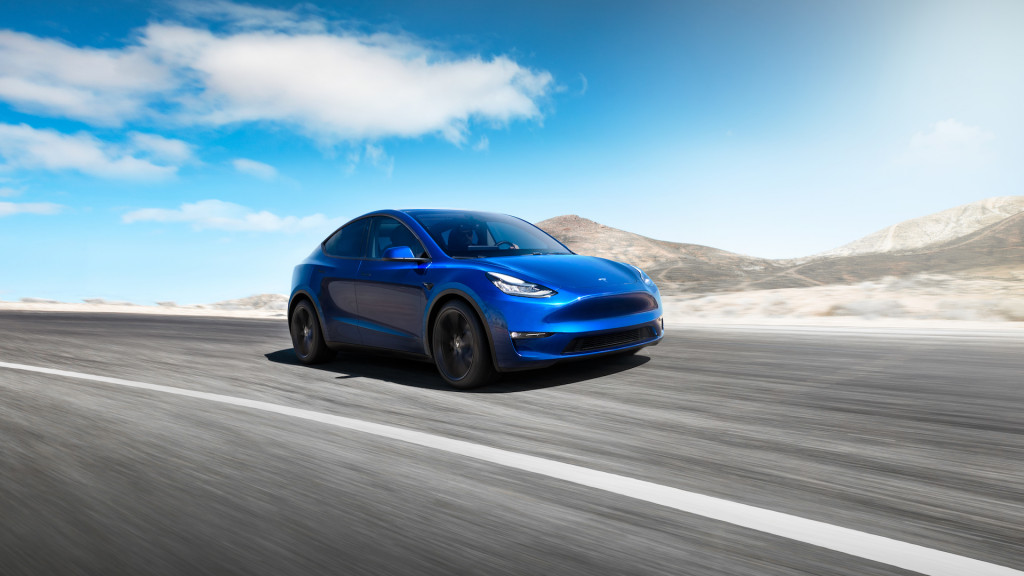
Tesla Model Y
New and used EV prices soared in 2020 and 2021, and by midyear 2022 some were warning that it might soon collapse without more affordable options.
This continues to be an entirely different set of market dynamics as just two years ago. About 16 months ago, in October 2022, several analysts said that prices had peaked and the market had started to stabilize. About six months after that, the Model 3 started to nosedive in its used values and the rest of the Tesla lineup and EV market followed some months later.
While the prices are quite different, some of the trade-in patterns CarMax noted with last year’s report have continued. The Honda Civic and Toyota Tacoma were once again the most popular trade-ins for a Model 3, for example.

Matchbox marks Mercedes’ electric G-wagen with a sustainable twist
The first-ever electric version of the Mercedes-Benz G-Class—also known as the “Gelandewagen” or “G-wagen”—is getting the Matchbox treatment with a sustainable twist to match its electric powertrain.
Formally known as the Mercedes-Benz G 580 with EQ Technology (a name that might prove difficult to fit on the packaging), the electric G-wagen Matchbox die-cast car will be made from 99.5% recycled metal and a minimum of 81% ISCC-certified sustainable plastic.
Finished in South Seas Blue Magno (a color from Mercedes’ Manufaktur personalization division) with a black interior, the 1:64-scale toy car in a limited-edition premium version retailing for $29.99 at MattelCreations.com. A mass-produced version will be available for $2.99 at regular retailers this fall.
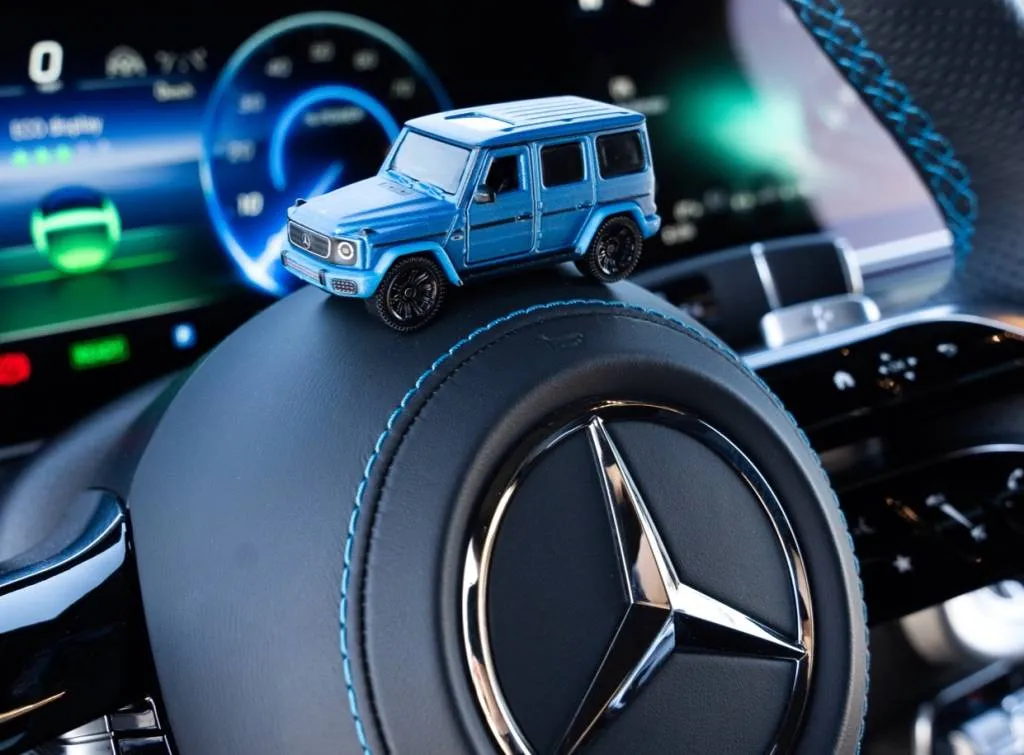
Matchbox Mercedes-Benz G 580 with EQ Technology premium die-cast
The Matchbox G-Class EV is no outlier. There are now scale die-cast toys or models of virtually every green car on the market from recent years—from a Chevy Volt to a Fisker Karma. Some of them might possibly end up getting kids dreaming of EVs—just as this Tesla Radio Flyer did.
As for the real thing, the G 580 with EQ Technology arrives for the 2025 model year with a 579-hp quad-motor powertrain, G-Steering four-wheel steering, and a G-Turn party trick that allows the car to pivot in a tight circle.
So far, though, the electric G-Wagen lacks the silicon-anode battery chemistry that was due to provide it with some additional weight-saving eco-credentials. It instead launches with a 116-kwh battery pack using more conventional lithium-ion chemistry. Range from the massive pack will likely land at around 250 EPA miles, while 200-kw DC fast charging should be able to charge the pack to 80% in about a half-hour.