
Category: General

Here’s how wireless charging could cut costs for commercial EVs
Two recent wireless charging pilot programs show the potential for the technology’s use with commercial EV fleets.
The Indiana Department of Transportation and Purdue University are working to outfit a quarter-mile stretch of U.S. Highway 231 in West Lafayette, Indiana, for wireless charging of electric trucks. A test truck provided by Cummins will drive over this section of road in tests starting next year, according to a Purdue University press release.
Construction of the test road section began April 1 and is expected to continue into the fall. This follows laboratory tests to see if sections of highway concrete and pavement could handle the weight of loaded trucks.

Indiana roadway to be used in dynamic wireless charging test (photo via Purdue University)
The Purdue-designed charging hardware is intended to work at higher power levels than other systems demonstrated in the U.S. so far, the university claims, making it better suited to heavy-duty vehicles. If tests prove successful, Purdue and the Indiana state government hope to add charging to a longer stretch of highway within the next four to five years.
This dynamic wireless charging—in which vehicles are charged as they drive along—has already been the subject of tests and pilot programs in Michigan, Sweden, and Israel. Stellantis tested the idea with an electric Fiat 500 in 2022, and a Ford patent filing indicates the Blue Oval is working on it as well.
Wireless-charging company WiTricity also recently launched a six-month pilot program with International Transportation Service LLC to test wireless-charging tech on a fleet of Ford E-Transit vans at the Port of Long Beach. In this case, vehicles park over a pad to charge, with performance claimed to be equivalent to conventional Level 2 AC chargers.
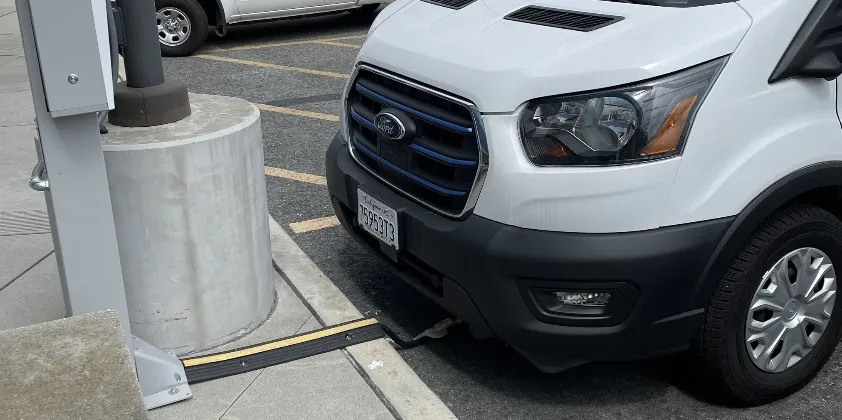
Ford E-Transit with WiTricity wireless charger
There are several potential benefits of wireless charging, including greater accessibility to charging that could allow for smaller EV batteries, which could in turn reduce the cost and weight of these vehicles. And overall, wireless charging could make EVs more livable on a day to day basis by eliminating cables and connectors.
The higher level of automation allowed for by wireless charging also helps set the stage for self-driving electric cars, as it would remove one more point of human involvement in the process. But self-driving cars themselves must prove to be reliable and commercially viable—definitely not a given.

Ford’s Lisa Drake on the EV, hybrid future (Episode 252)
Ford’s vice president of electric vehicle programs and energy supply chain shares her outlook on the future of EVs amid a slowdown in sales growth and explains why systemic change is necessary to create more opportunities for women in the industry.

Kia EV3 debut, Silverado EV review, Bolt EV settlement, ID.7 delay: The Week in Reverse
Which electric SUV was teased as quicker than the Tesla Model Y Performance?
How much real-world range do Teslas lose over the first three years?
This is our look back at the Week In Reverse—right here at Green Car Reports—for the week ending May 24, 2024.
In a first drive of the 2024 Chevrolet Silverado EV RST, we found this big electric pickup to be just average in real-world efficiency, and its 1,500-pound payload capacity is modest versus other full-sizers; but given its huge battery pack it likely won’t disappoint for highway range and occasional towing. With its Wide Open Watts (WOW) performance mode it’s very quick, while smooth and quiet for the mission. Just don’t expect to stay fully connected to your own smartphone.
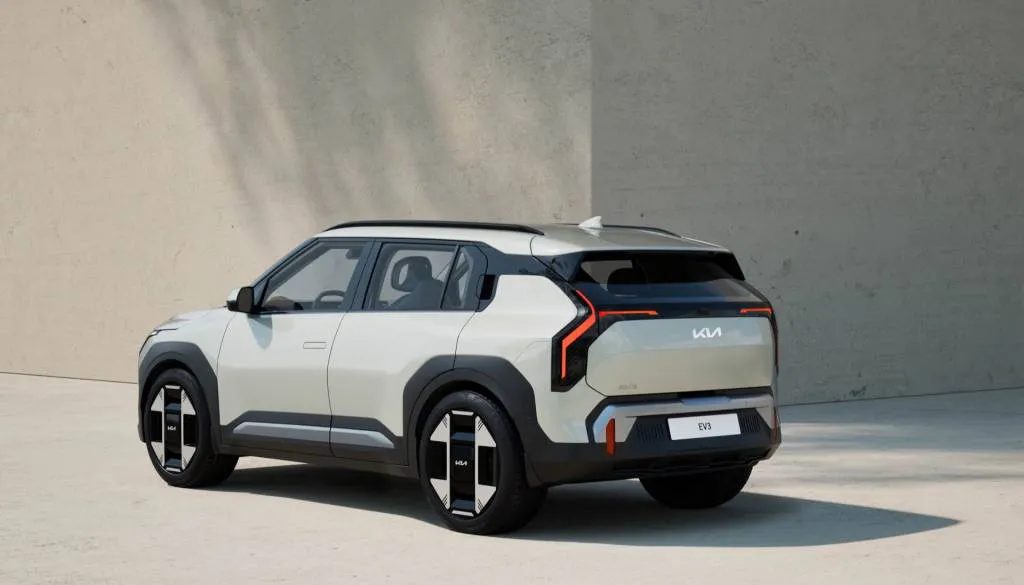
Kia EV3
Kia has revealed the production-bound EV3 electric SUV, and it closely follows both the EV3 concept and the much larger EV9 that’s already on sale. Although not yet confirmed for the U.S., this model is already set for Korea and Europe and with its larger battery pack will go well beyond 300 miles on a charge. And it could make a lot of sense in America at a starting price near the $35,000 originally teased.
The 2025 Honda Civic Hybrid lineup coming this summer will return nearly 50 mpg, the automaker revealed Tuesday, as well as pep and performance that may rival that of the sporty Si model. Civic hybrids, with a larger engine than what’s been used in past versions of this model and a choice of sedan or hatchback layouts, are aiming for 40% of Civic sales.
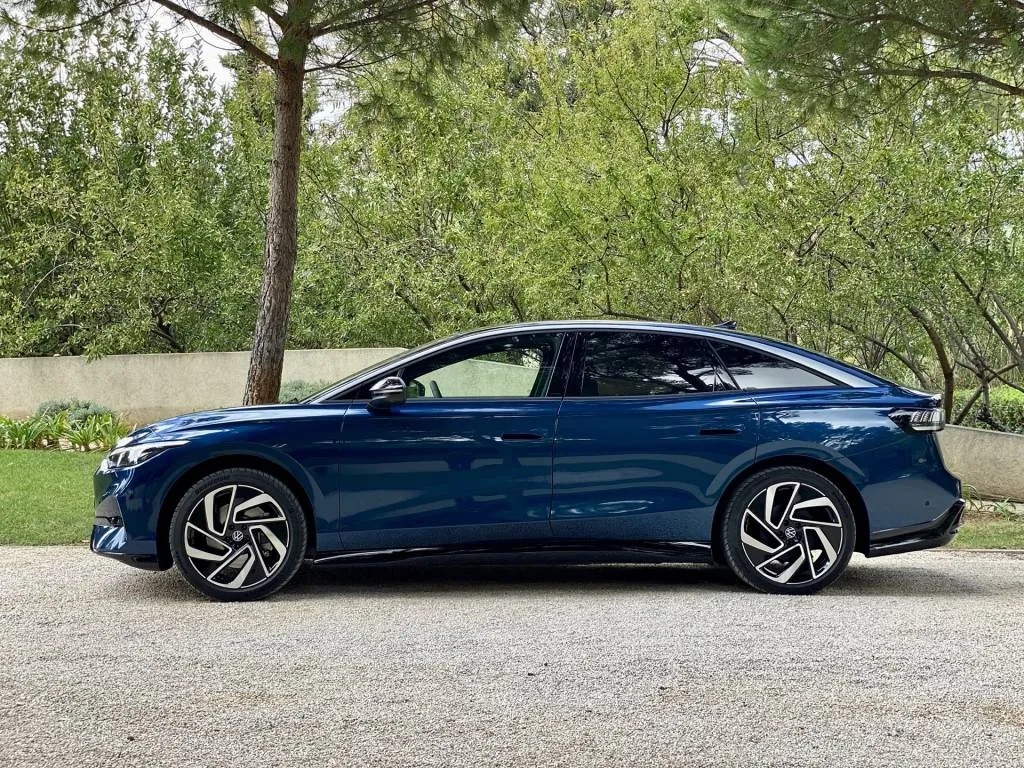
2025 Volkswagen ID.7
The Volkswagen ID.7 EV has been delayed for the U.S., VW confirmed Wednesday. It provided no new timeline for the aero-savvy hatchback, but it verified that this decision doesn’t affect the arrival of the ID.Buzz electric Microbus, still due later this year in extended-length American form.
The upcoming 2024 Jeep Wagoneer S EV could out-accelerate the Tesla Model Y Performance and be the quickest model from the off-road-focused brand ever, it revealed Wednesday in a teaser. The Wagoneer S is set for a May 30 reveal.
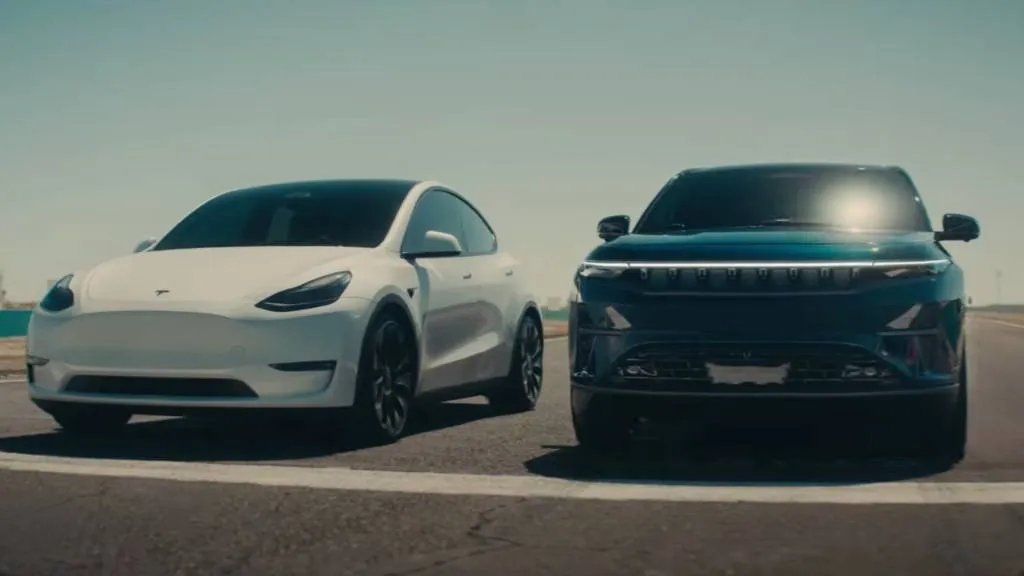
Jeep Wagoneer S vs. Tesla Model Y Performance
Final class-action settlement documents that mean many Chevy Bolt EV owners might get up to $1,400. The settlement money will even apply to those who’ve already received a completely new battery.
GM is reportedly considering an affordable Chevy Camaro EV as part of its rollout of Ultium electric vehicles. In a different approach than what Ford has used for the Mustang Mach-E, the Camaro EV would be a car, not a crossover, according to a recent report citing GM president Mark Reuss. Is this related to the automaker’s plan for cylindrical batteries and, potentially, a lower-profile version of the platform. And on the other hand, GM is pushing ahead with plug-in hybrids. They’re due in 2027, executives recently confirmed, so as to help with stricter fuel efficiency and emissions standards. GM has already hinted that trucks may be first in this rollout, and GM hasn’t sold a U.S. PHEV since the Volt departed after 2019.
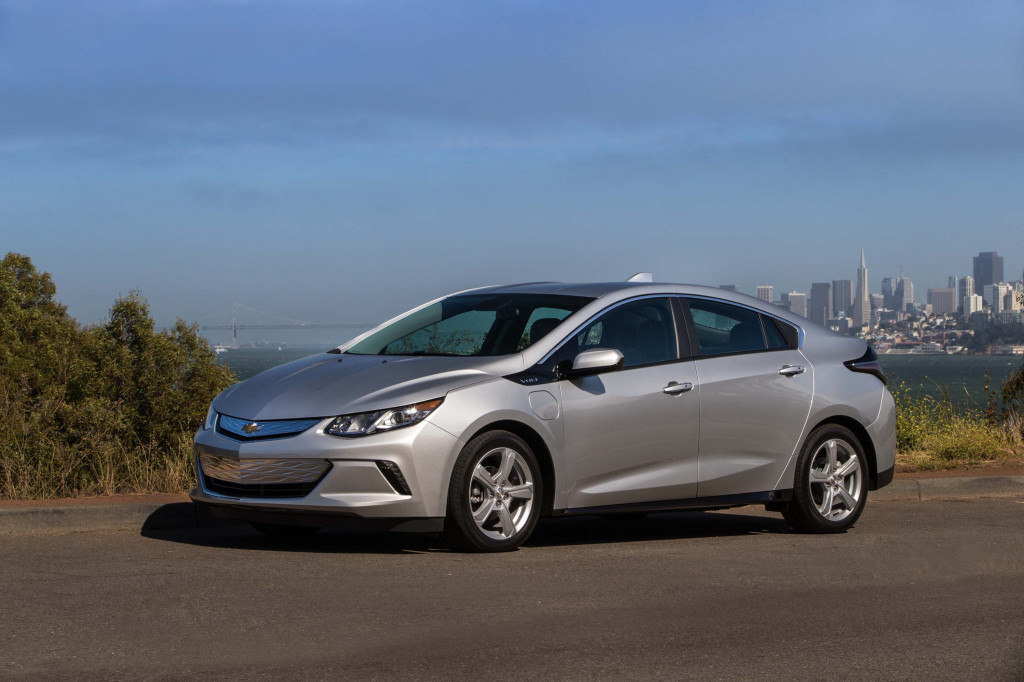
2019 Chevrolet Volt
Versus last year, interest in EVs is waning, according to a new J.D. Power study. Its analysts saw a decline in consideration of EVs by new-car shoppers for the first time since it started tracking it in 2021, and it suggests it’s partly related to the lack of affordable EVs—an especially important aspect for younger Gen Z and Gen Y shoppers.
After several years, charging hardware and stations that use the Megawatt Charging Standard (MCS) are starting to roll out. These stations, and their corresponding faster charging rates for big electric trucks, may render the superior fueling speeds of comparable hydrogen vehicles a moot point.
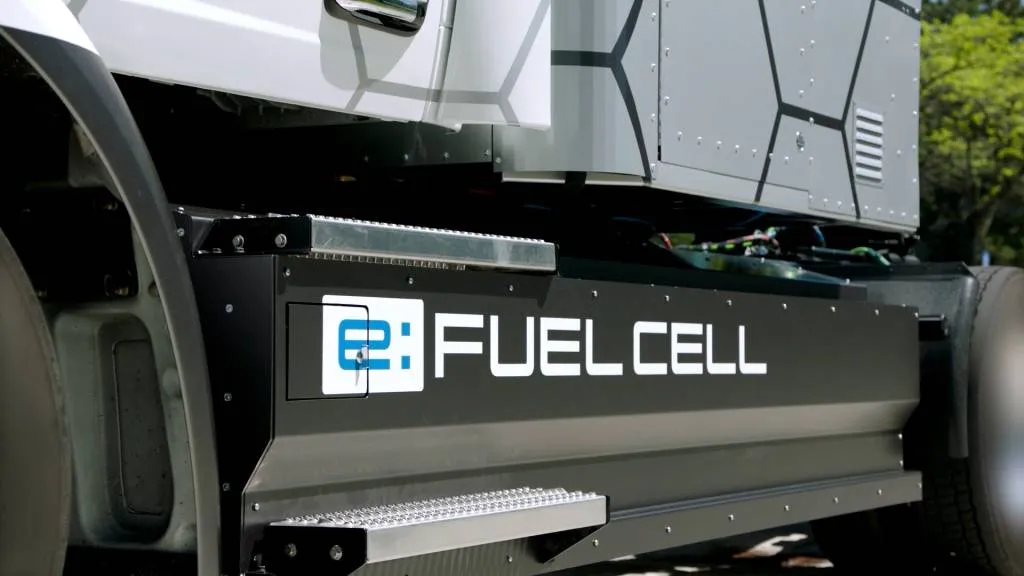
Honda Class 8 Hydrogen Fuel Cell Truck Concept
Honda is introducing a hydrogen fuel-cell semi project at the Advanced Clean Transportation (ACT) expo for fleet vehicles, and it signals the start of a new project and the company’s emphasis of fuel-cell tech for uses beyond passenger vehicles.
Two lawmakers are demanding that the Department of Energy report the projected emissions created by federal hydrogen hubs. The $8B project aims to scale up hydrogen production for trucking and more, but it needs to do so in a way that can be held up versus diesel as a strong improvement—and oddly, that piece of information was omitted from the original framework.

Gravity curbside EV charger
The charging network Gravity has revealed distributed access points in the form of “trees” for urban streetside EV fast-charging. Set to provide up to 500 kw with no utility upgrades, these stations built onto streets could form a network “more expansive than Tesla’s current Supercharger network,” according to the company.
Wondering how much real-world range Teslas lose in the first several years? Data from thousands of Model 3 and Model Y vehicles shows that they don’t lose very much, but they don’t exactly start near the EPA ratings either.
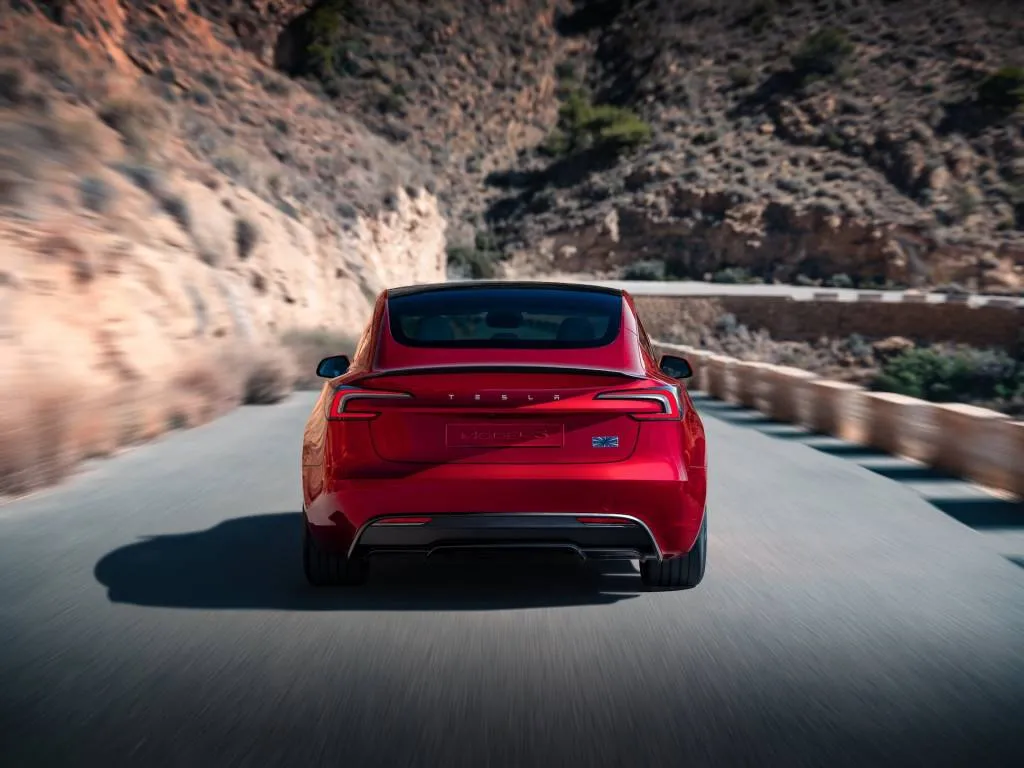
Tesla Model 3 Performance
And according to a survey released this week, younger U.S. drivers are more open to the idea of Chinese EVs, despite data privacy concerns. Those under 40 are also more likely to consider Chinese vehicles of any kind made in Mexico as a tariff workaround. It’s unclear how wrapped up these ideas are in the lack of affordable EVs from existing automakers in the U.S.
_______________________________________

Silverado EV review, hydrogen hub emissions, Millennials and Chinese EVs: Today’s Car News
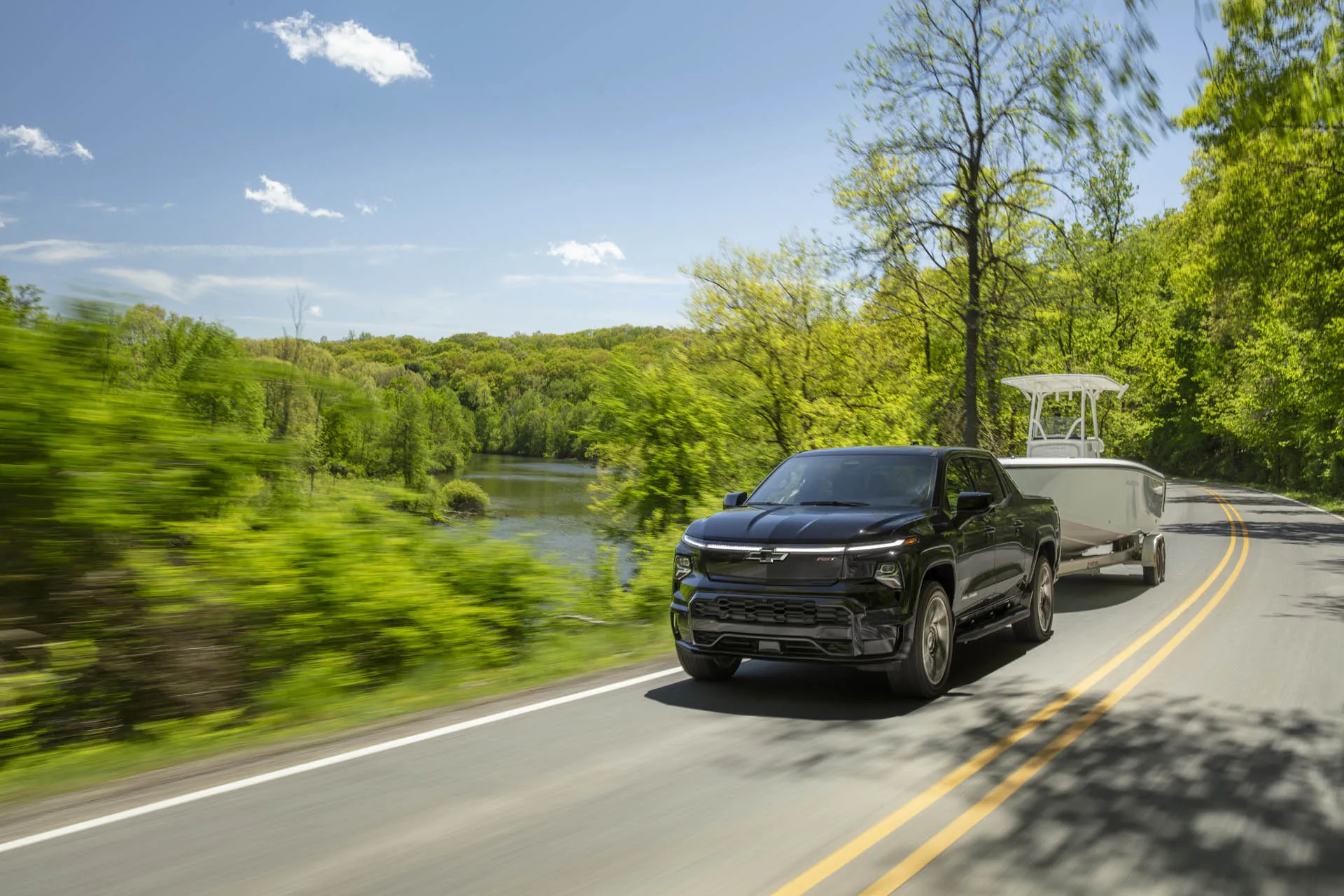
We drive the Chevy Silverado EV and, like everyone else, seem to have some mixed feelings. Younger U.S. drivers might be more open to Chinese EVs. And the hydrogen hubs costing taxpayers billions of dollars will be how much cleaner than diesel overall? This and more, here at Green Car Reports.
In a first drive of the 2024 Chevrolet Silverado EV RST, we found this big electric pickup to be just average in real-world efficiency, and its 1,500-pound payload capacity is modest versus other full-sizers; but given its huge battery pack it likely won’t disappoint for highway range and occasional towing. With its Wide Open Watts (WOW) performance mode it’s very quick, while smooth and quiet for the mission. Just don’t expect to stay fully connected to your own smartphone.
Two lawmakers are demanding that the Department of Energy report the projected emissions created by federal hydrogen hubs. The $8B project aims to scale up hydrogen production for trucking and more, but it needs to do so in a way that can be held up versus diesel as a strong improvement—and oddly, that piece of information was omitted from the original framework.
And according to a survey released this week, younger U.S. drivers are more open to the idea of Chinese EVs, despite data privacy concerns. Those under 40 are also more likely to consider Chinese vehicles of any kind made in Mexico as a tariff workaround. It’s unclear how wrapped up these ideas are in the lack of affordable EVs from existing automakers in the U.S.
_________________________________

Survey: Younger US drivers are more open to Chinese EVs
Younger U.S. drivers are more open to driving vehicles from Chinese brands than their older counterparts, according to a new AutoPacific survey. But concerns about how Chinese brands manage data privacy were high regardless of age.
No vehicles from Chinese brands are currently sold in the U.S., and that’s unlikely to change due to new tariffs. But nearly half of survey respondents said they were familiar with Chinese vehicle brands, and about 35% said they could consider purchasing a vehicle from a Chinese brand.
Respondents under 40 were much more likely to consider a vehicle from a Chinese brand, though, with 76% expressing some interest. That declines steadily by age group, with only about 26% of those 60 and older willing to consider buying a car from a Chinese brand, according to AutoPacific.
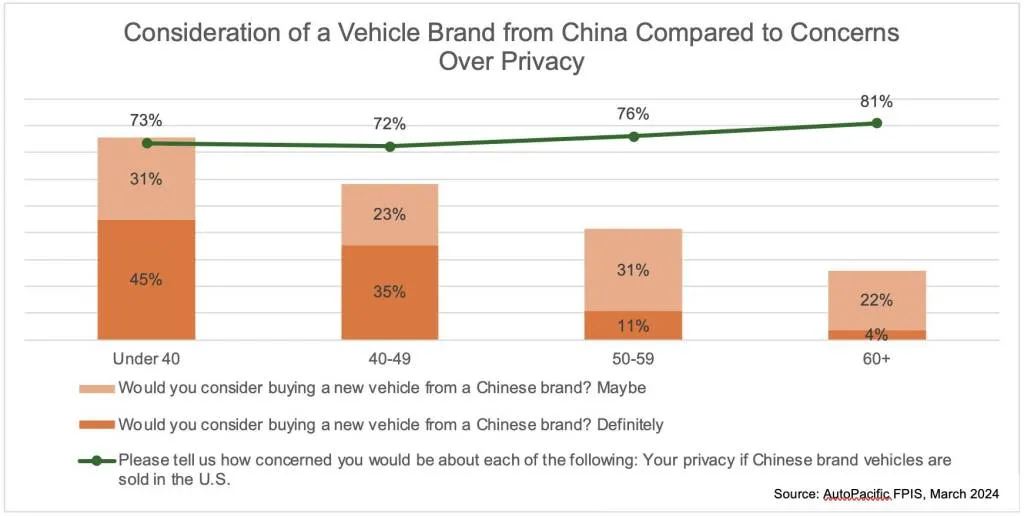
Consideration of vehicle brand from China compared to privacy concerns (from AutoPacific survey)
Data privacy gave respondents pause, though, with 44% saying they would be very concerned about their privacy if Chinese-brand vehicles were sold in the U.S. with another 34% saying they would be somewhat concerned. Despite higher interest in purchasing a car from a Chinese brand, 73% of respondents under 40 still said they were concerned about privacy. And even that may change, analysts believe.
“Privacy concerns about Chinese-brand vehicles are likely to eventually subside given that most of the connected smartphones, smart watches, laptops, and connected home devices, we are comfortable using every day are in fact manufactured in China,” AutoPacific president Ed Kim said in a statement.
Data privacy can also be an issue with cars already sold in the U.S. As a Bolt EV data scandal recently showed, no drivers of connected vehicles can be completely certain their driving data isn’t going to be misused or misinterpreted.
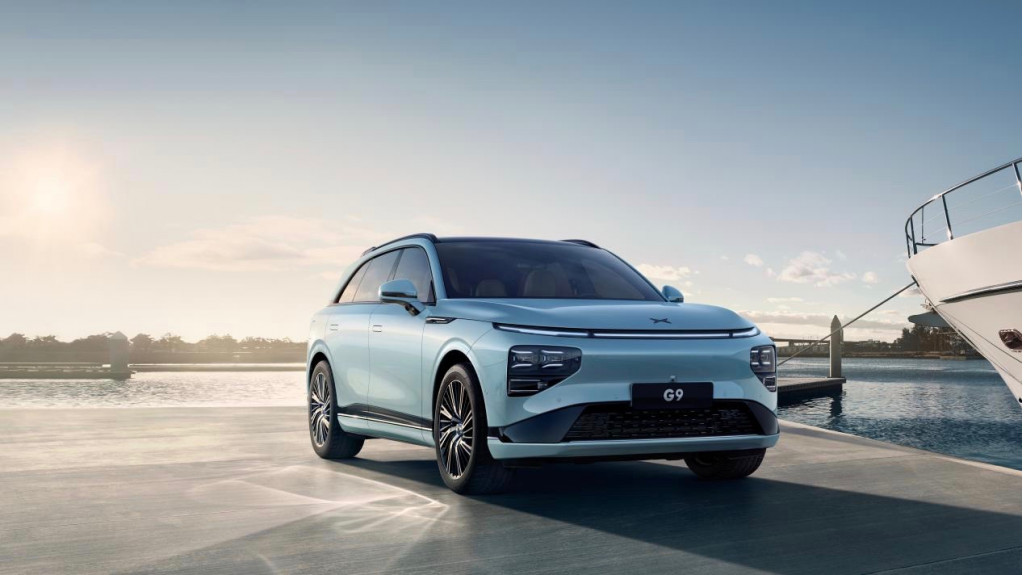
Xpeng G9
The survey comes about a week after the Biden administration hiked tariffs to try to keep Chinese EVs out, placing a 100% tariff on cars built in China. It effectively goes along with plans to tighten the EV supply chain in order to qualify for the federal EV tax credit of up to $7,500.
The administration aims to bolster American manufacturing and union jobs with these measures, but they also cut against the goal of reducing emissions by putting more EVs on the road. As Bloomberg New Energy Finance recently calculated, China now makes enough batteries to support global EV production. Chinese automakers also sell more affordable EVs—something currently lacking in the U.S.—in the markets where they currently operate.
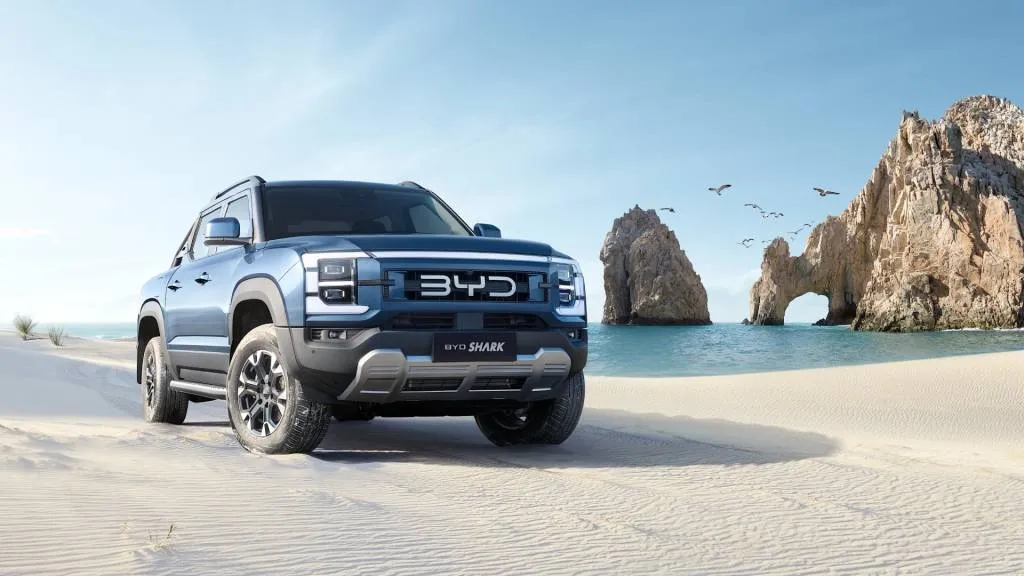
BYD Shark plug-in hybrid pickup
Mexico is broadly seen as the workaround, and China’s BYD made the global launch of its plug-in hybrid pickup in Mexico the same morning as the tariff announcement. EVs assembled in Mexico currently qualify for the federal EV tax credit, and may avoid the new tariffs as well, AutoPacific notes.
North American assembly also seems to be of interest to consumers, as 37% of survey respondents said they would consider a car built in Mexico and then sold in the U.S. And 16% said knowing a Chinese-brand car was assembled in the U.S. would increase their purchase consideration. So perhaps—like the Japanese, Korean, and German automakers before them—Chinese automakers could win over consumers and government officials by building locally.

Review: 2024 Chevy Silverado EV RST arrives for civilians
The 2024 Chevrolet Silverado EV full-size electric pickup truck was first delivered in Work Truck specification to fleet buyers nearly a year ago; but only now can civilians take one home.
The first retail version to arrive is the top-of-the-line 2024 Chevy Silverado EV RST First Edition. We had a chance to spend several hours driving through the largely flat precincts around Detroit, putting almost 100 miles on a black example that stickered just south of $100,000.
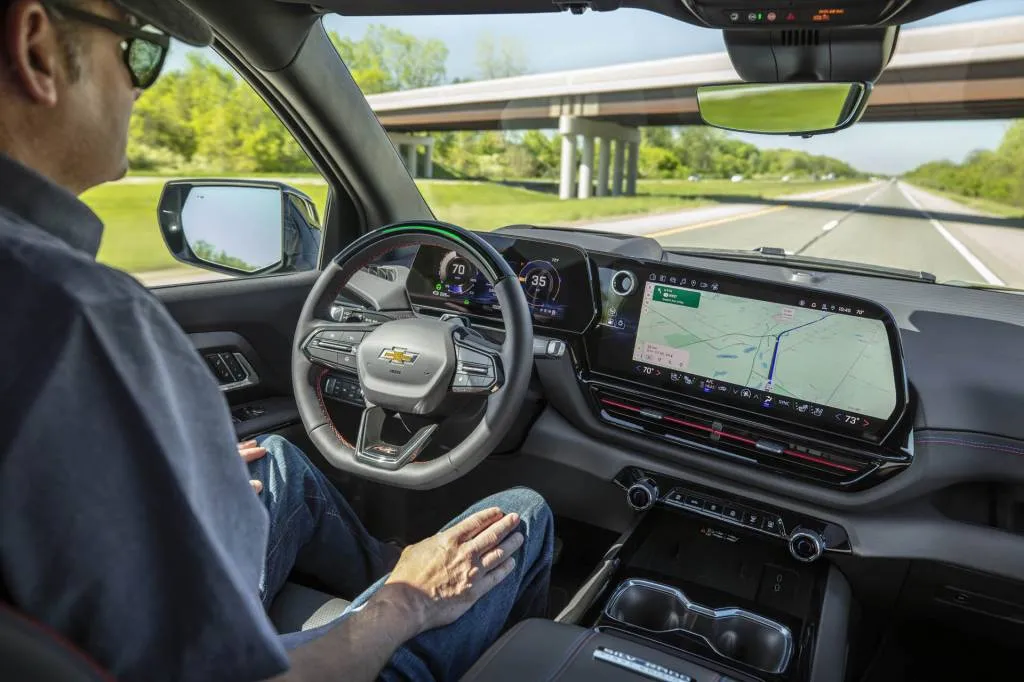
Chevrolet reps declined to discuss the specifications of the trims that will be lower in the lineup than the RST. The RST adds numerous features not offered on the basic Work Truck, including an air suspension that raises or lowers the truck a couple inches, rear-wheel steering, a full-length glass cabin roof, 24-inch alloy wheels, optional Super Cruise hands-free cruise control, and multiple drive modes.
Silverado EV range, efficiency: Average
A major selling point of the Silverado EV lineup is an EPA-rated combined range of up to 450 miles from its roughly 205-kwh capacity (the RST First Edition is estimated at 440 miles). That’s more than any other electric truck on the market, and it should reassure shoppers who can afford one that they won’t run out of range unexpectedly.
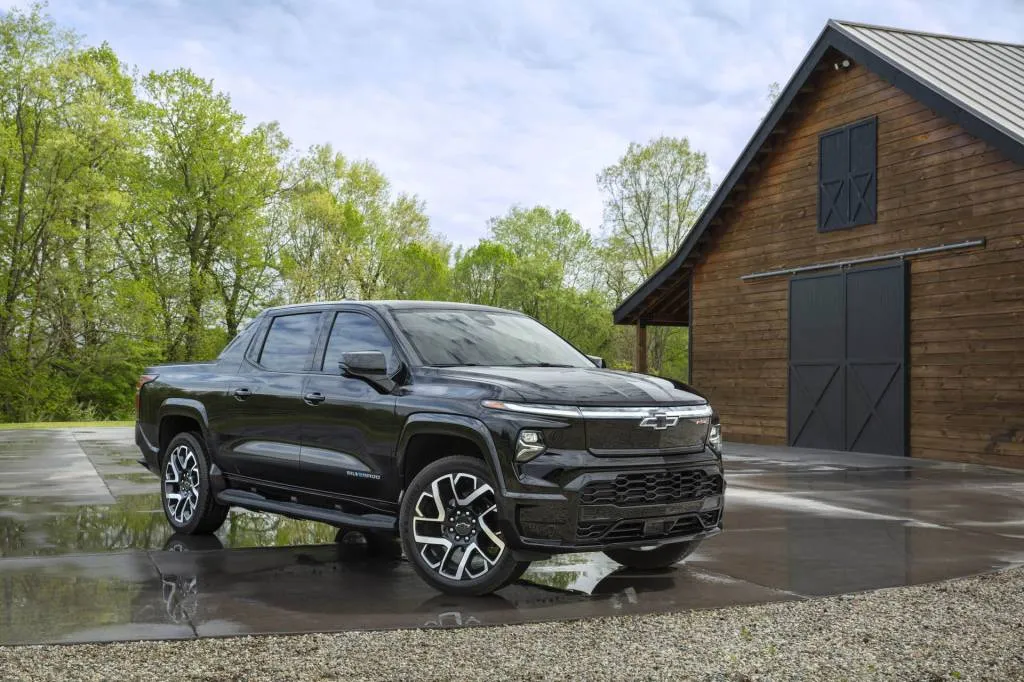
2024 Chevrolet Silverado EV
Our drive route mixed rural Michigan roads and fast Interstate traffic up to 80 mph. Over 100 miles of mixed traffic, we saw efficiencies of 2.0 to 2.2 miles per kilowatt-hour. That’s roughly the same as Green Car Reports got in a week-long test for a Ford F-150 Lightning. It suggests that the Silverado EV, with longer rated range and weighing more than four tons, may be slightly more efficient than its cross-town rival.
Bidirectional charging for home backup duty is on the way as well.
Chevy quotes the payload at 1,500 pounds. Rated towing capability of the Silverado EV we tested is 10,000 pounds, and Chevy provided both an EV powerboat on a trailer and an enclosed car trailer for test towing.
No figures on the efficiency hit from towing were given, but the onboard navigation from Google takes into account any towing and adjusts range and charging stops accordingly. Super Cruise also works with towing,
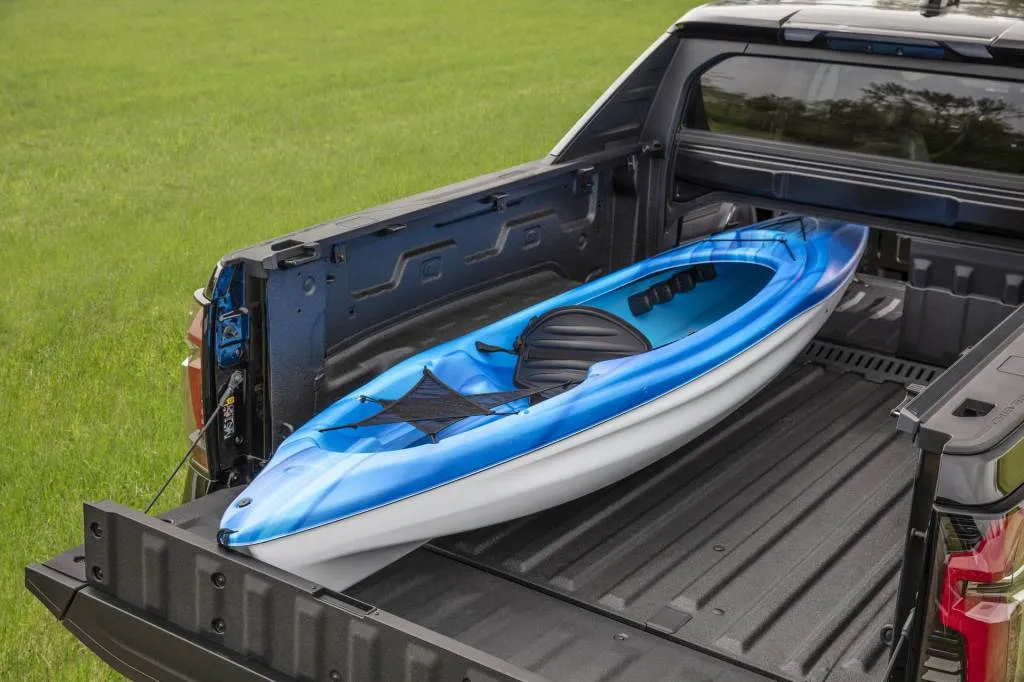
2024 Chevrolet Silverado EV
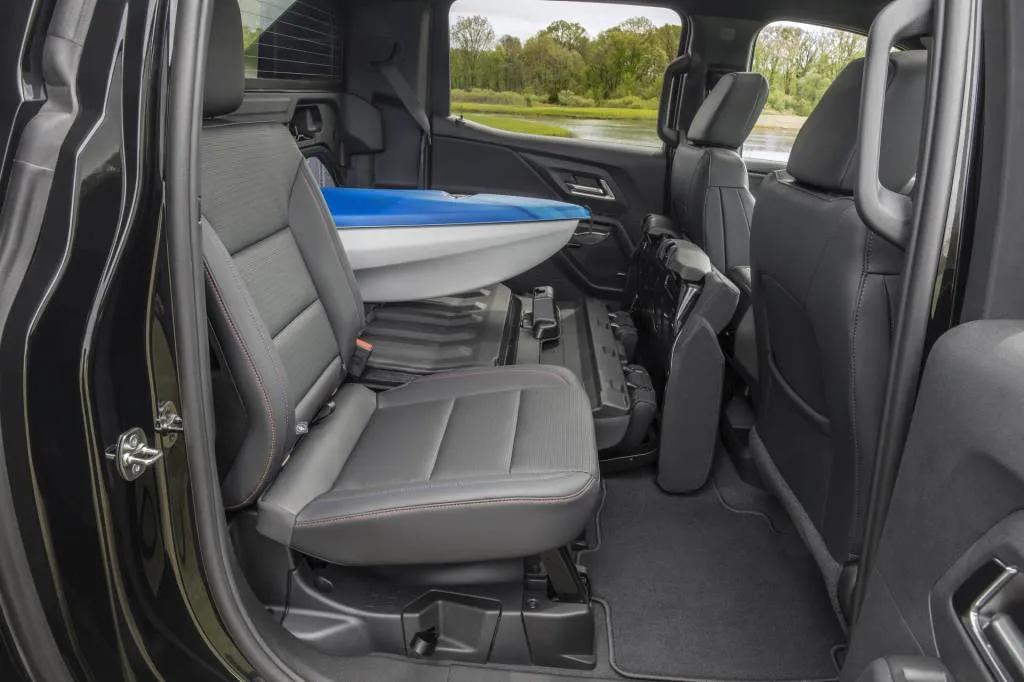
2024 Chevrolet Silverado EV
Chevy Avalanche redux, made electric
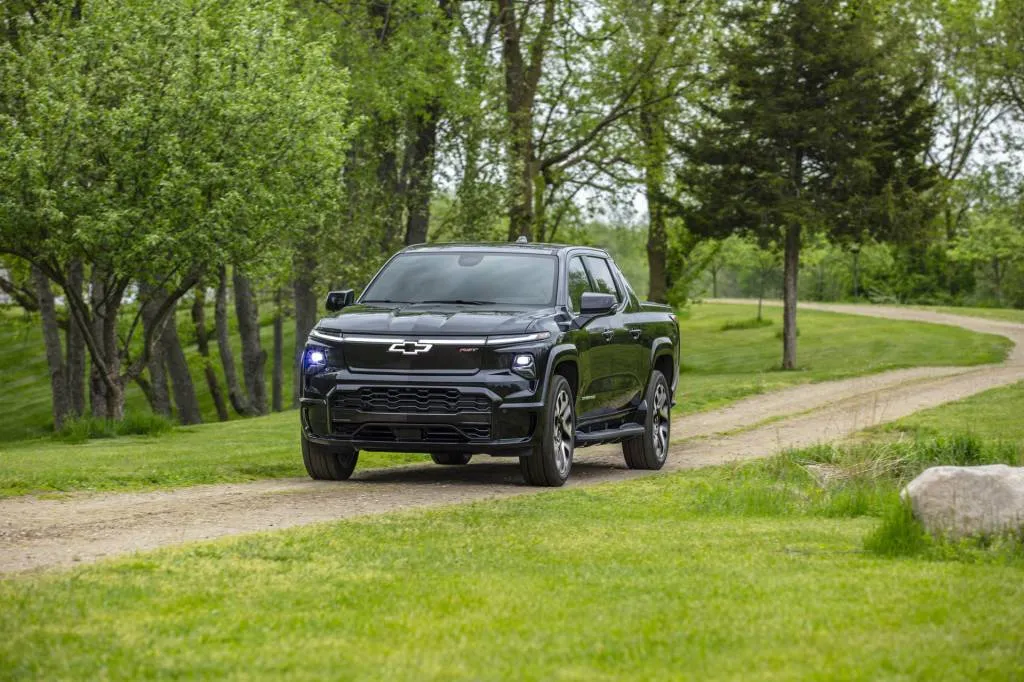
The first electric Silverado pickup truck shares little beyond a name with its gasoline- and diesel-powered namesakes. It’s lower and sleeker than those ICE models and a clean-sheet-of-paper design, if you don’t count the level of sharing with the GMC Hummer EV, upcoming Cadillac Escalade IQ, and other models. The front end is scaled down, with slim LED headlights and a blanking panel that signals “grille,” a four-door cabin, and a pickup bed integrated into the cab body.
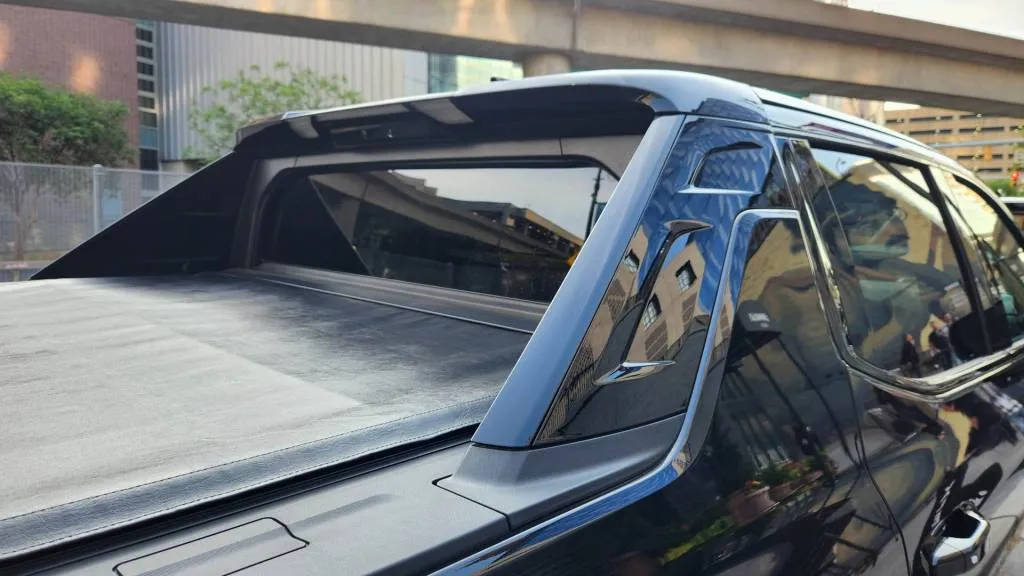
The Silverado EV, in fact, is the electric reincarnation of the 2002-2013 Chevrolet Avalanche, an early four-door sport truck with that same integrated pickup bed. Even the sail panels connecting the roof to the bed sides are similar—as is the midgate that opens up and folds down to extend the bed floor and allow cargo to be carried behind the front seats right up to the tailgate. (Chevy execs, however, consistently give the side eye to any suggestions their new electric truck could have been named “EValanche”…oh well.)
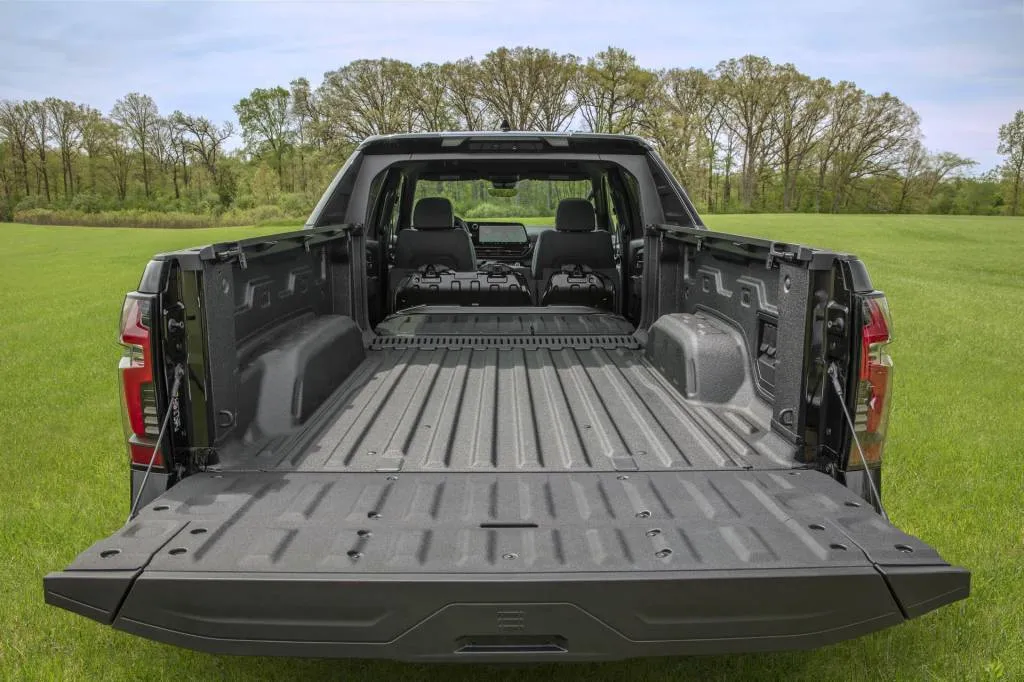
2024 Chevrolet Silverado EV
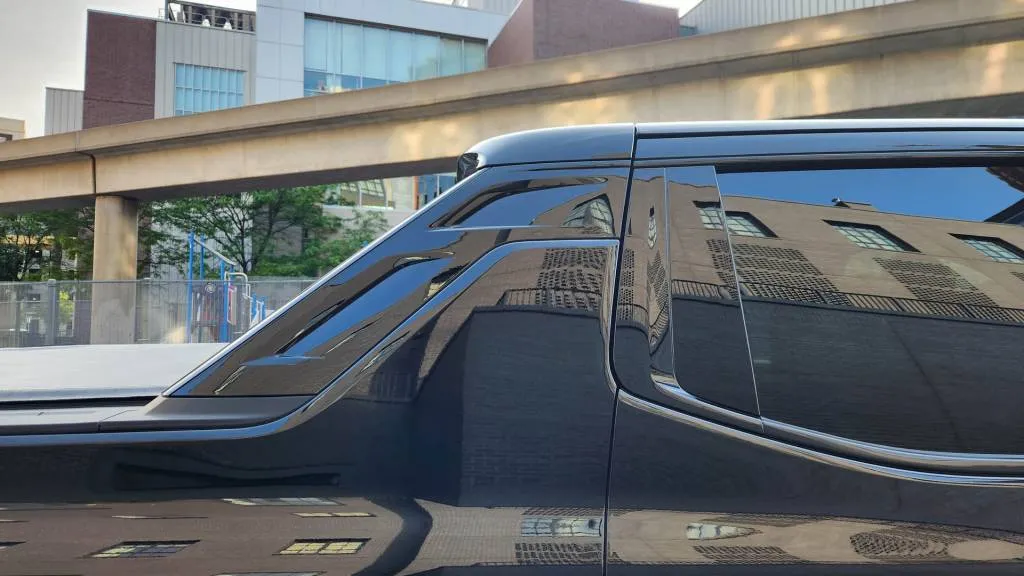
2024 Chevrolet Silverado EV
2024 Chevrolet Silverado EV
The drawback of the neo-Avalanche design is that Silverado EV Work Trucks can’t use the same specialized “upfit” accessories—tool chests, industry-specific bed caps, etc.—that the gas versions do. That distinguishes the Silverado EV from the Ford F-150 Lightning, for which it’s a selling point.
Inside, the cabin mixes soft-touch materials where you’re likely to feel them with fine-dot-patterned hard plastic on dash surfaces and other expanses. The top-end models we drove had contrast stitching and seat upholstery that indicated they were the “First Edition” versions.
Silverado EV performance: Fast, heavy
On the road, the Silverado EV’s performance is adequate to keep up with traffic in its normal drive mode. Flooring the accelerator provides acceleration that will let this large and heavy truck slip into gaps, overtake at will, and generally move through traffic as fast as you want it to.
On the 24-inch wheels of the RST First Edition version, it corners well, with the air suspension keeping it flat. That and a low battery pack under the cabin floor help ensure it leans less on any given corner than a similar full-size pickup with a combustion engine. But drivers who pay attention will be aware there’s a great deal of weight being restrained by those 24-inch tires. The rear-wheel steering makes the truck feel much more agile than expected, with a 42-foot turning circle that all but allows a U-turn on a two-lane road with wide shoulders.
2024 Chevrolet Silverado EV
Chevrolet refused to quote power or torque ratings for normal use. The sole stats provided were up to 754 horsepower and 785 pound-feet of torque when the driver deliberately calls up Wide Open Watts (WOW) mode. It’s analogous to the “Watts To Freedom” (WTF) mode on the GMC Hummer EV with which the electric Silverado shares much of its underpinnings.
We tested WOW mode on a couple of standing-start acceleration runs, and the quoted 0-to-60-mph acceleration time of 4.5 seconds seems entirely reasonable. Equally impressive was its full-force emergency stop; the anti-lock brakes brought the 8,500-pound truck to a full stop in a slightly shorter distance than we expected. We found the Silverado EV RST First Edition model smooth and quiet on most road surfaces, though like most EVs, road and wind noise are magnified by the absence of powertrain noise or vibrations.
Silverado EV is smooth, quiet, capacious
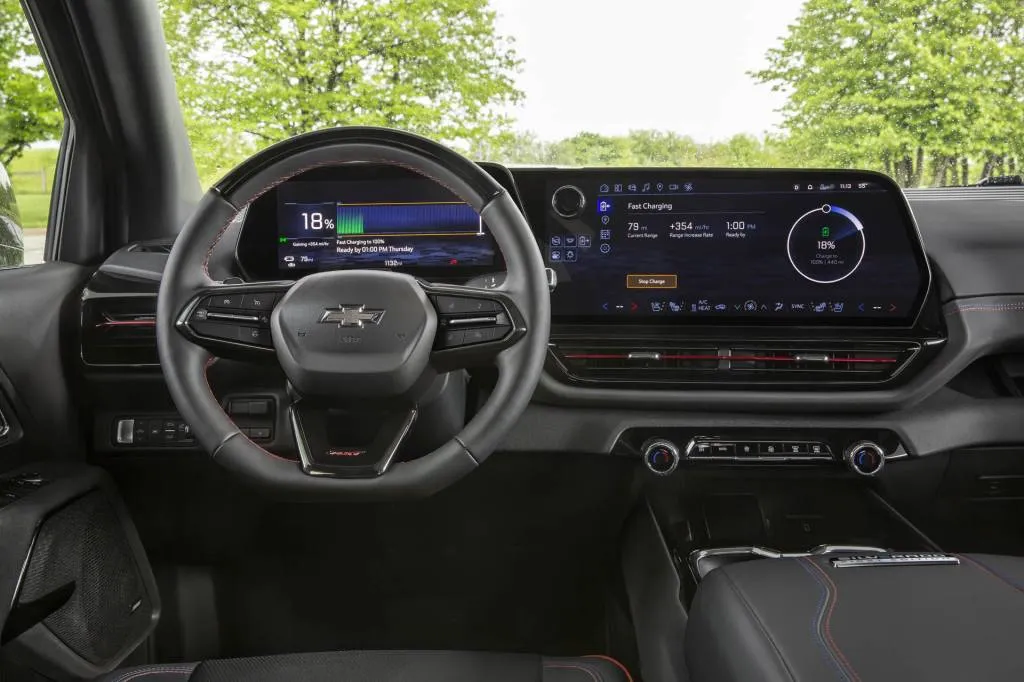
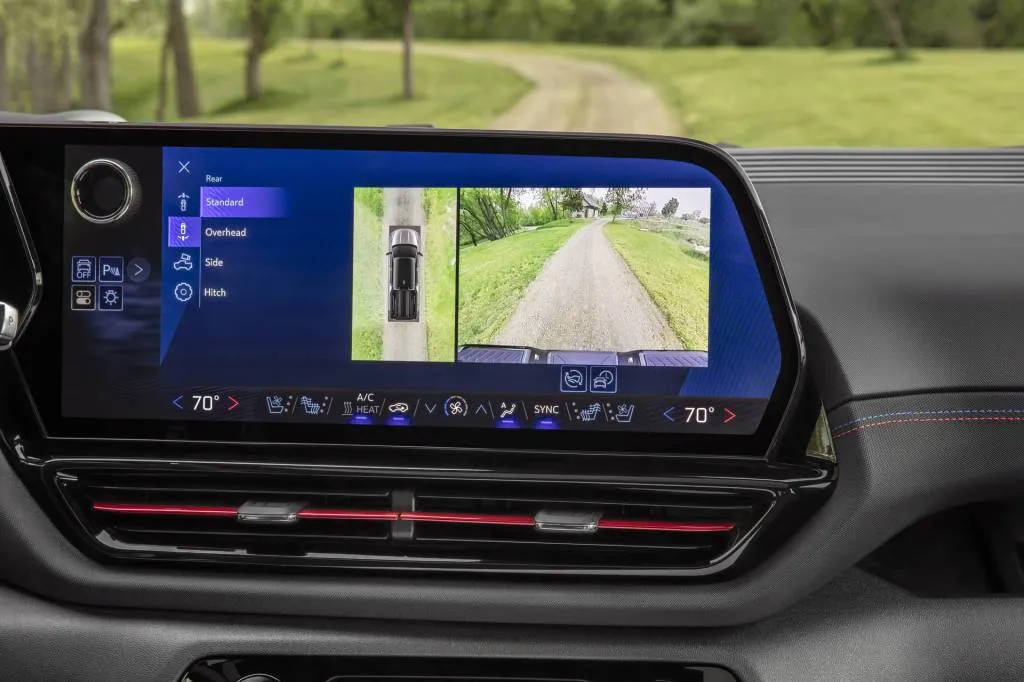
Using the fixed running boards to climb up into the cabin, our first impressions included the wide console between the seats—now required for full-size pickups—and the large horizontal instrument cluster and central touchscreen. Front seats are comfortable and widely adjustable, and large door mirrors provide a wide field of rear vision. The rearview mirror includes conventional and video rear views, and the head-rest of the rear center seat folds down to open up that rear view for the mirror view.
2024 Chevrolet Silverado EV
2024 Chevrolet Silverado EV
2024 Chevrolet Silverado EV
The rear cabin floor is flat, making this one of few vehicles where three U.S.-sized adults can comfortably occupy the rear seat. Outward vision is good to the rear and rear sides, though elevating the driver’s seat as high as it will go is the best way to see over the relatively high, bluff hood. Build quality on our RST First Edition test truck appeared excellent.
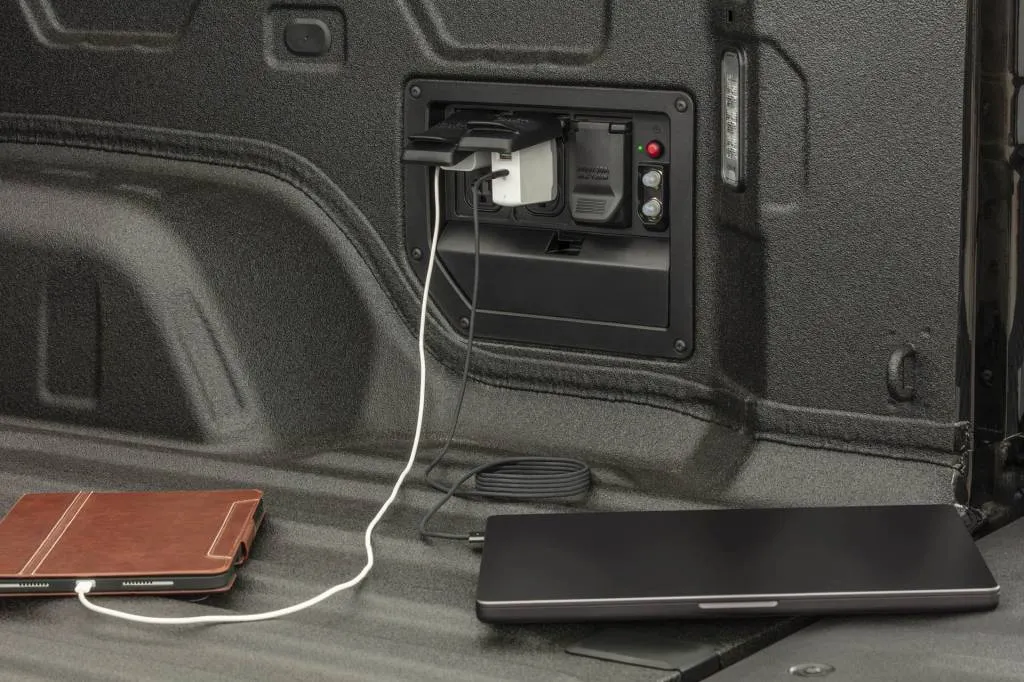
A front trunk offers 10.7 cubic feet of lockable storage. A static display compared the cargo length (up to 10 feet 10 inches) offered in the bed of the Silverado EV (with midgate open and Multi-Flex tailgate down, load restraint up) versus its electric-pickup competitors: Tesla Cybertruck, Ford F-150 Lightning, and Rivian R1T. No surprise, the Chevy won.
2024 Chevrolet Silverado EV
2024 Chevrolet Silverado EV
2024 Chevrolet Silverado EV
GM and Google take control of Silverado EV dash
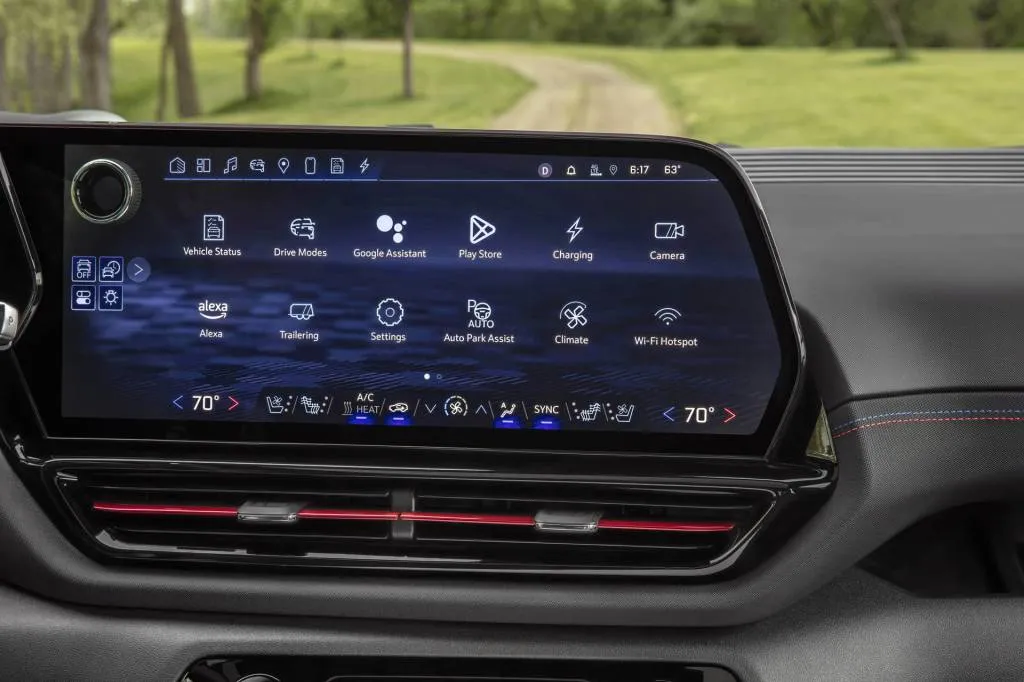
Like Chevrolet’s last few new electric vehicles, including the Chevy Blazer EV and Chevy Equinox EV, the Silverado EV foregoes the expected Android Auto and Apple CarPlay smartphone mirroring.
GM staff pointed out another prominent EV maker—without ever saying the word Tesla—has never offered those features in its vehicles.
As it is, Google Assistant provides Google Maps navigation that integrates with the truck’s battery state of charge, routing it via fast-charging stations where destinations exceed its substantial range, and telling drivers how long to stay there and what battery charge will remain at their next stop. In other words, just as Tesla has done for 10+ years.
Buyers will need to check carefully whether their favorite apps have been approved by Google and GM for download through the vehicle’s Play Store. The one other routing app we saw was Waze, which isn’t integrated with the battery. For EV charging locations, Plugshare (ditto) was included—but not A Better Routeplanner or Chargeway.
Users must sign into those in-dash apps through the vehicle to use them. GM reps were notably unable to say who owns the data on drivers’ app usage, routing, destinations, song choices, and all the rest. GM has said it expects to earn significant revenue from digital services provided by the car, but the navigation in the Silverado EV will be free for 8 years—perhaps more. GM reps were unable to say whether free access would last beyond that point, or what it might cost once the free trial ends.
—
Chevrolet provided airfare, lodging, and meals to enable Green Car Reports to bring you this first-person drive report.

Kia EV3 revealed, Jeep Wagoneer S teased, curbside fast-charging: Today’s Car News
Jeep teases its Wagoneer S with a Model Y Performance faceoff. Kia reveals its stylish compact EV3. And could streetside fast-charging work across U.S. urban areas? This and more, here at Green Car Reports.
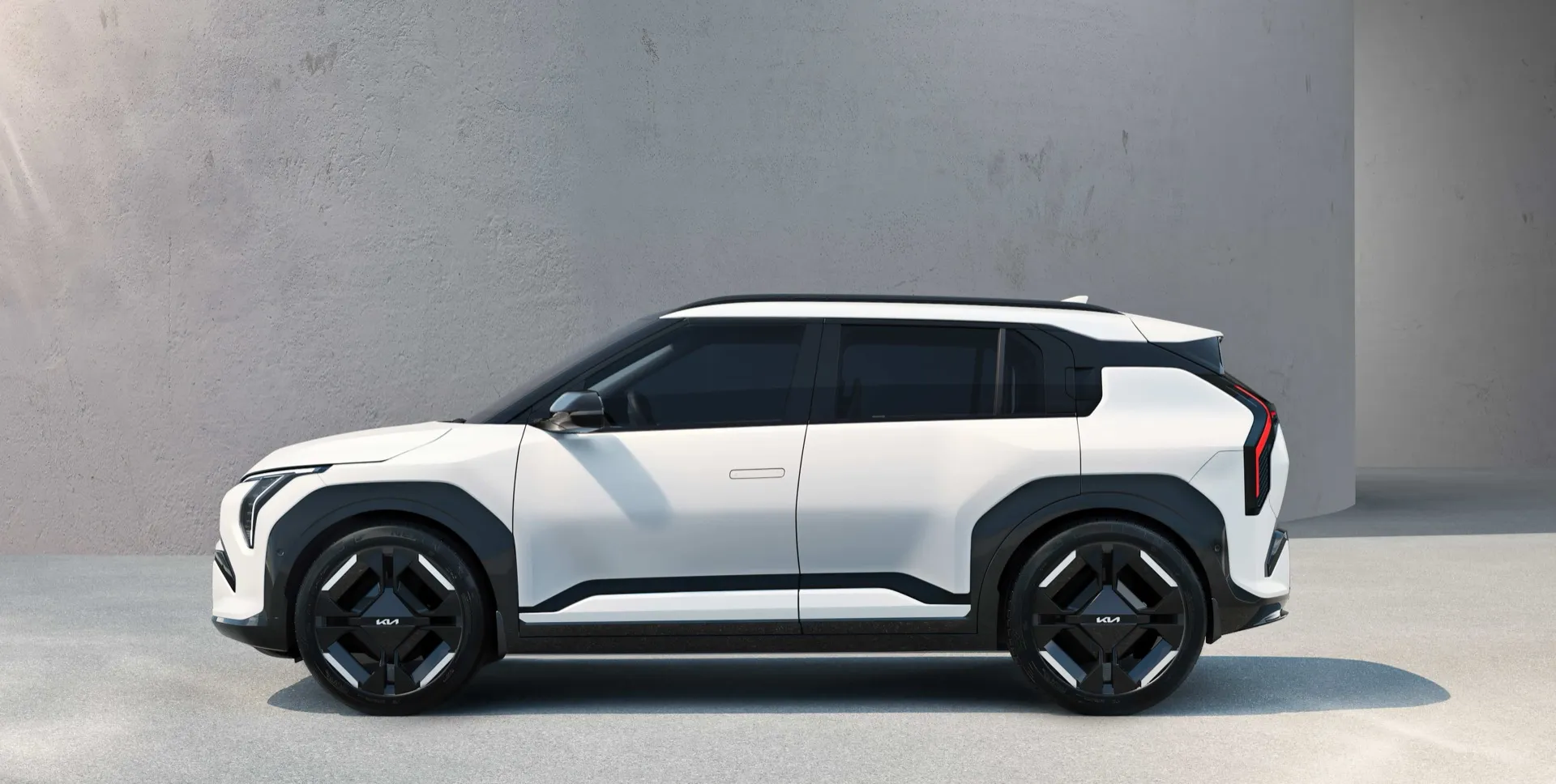
Kia has revealed the production-bound EV3 electric SUV, and it closely follows both the EV3 concept and the much larger EV9 that’s already on sale. Although not yet confirmed for the U.S., this model is already set for Korea and Europe and with its larger battery pack will go well beyond 300 miles on a charge. And it could make a lot of sense in America at a starting price near the $35,000 originally teased.
The upcoming 2024 Jeep Wagoneer S EV could out-accelerate the Tesla Model Y Performance and be the quickest model from the off-road-focused brand ever, it revealed Wednesday in a teaser. The Wagoneer S is set for a May 30 reveal.
The charging network Gravity has revealed distributed access points in the form of “trees” for urban streetside EV fast-charging. Set to provide up to 500 kw with no utility upgrades, these stations built onto streets could form a network “more expansive than Tesla’s current Supercharger network,” according to the company.
_________________________________
Green Car Reports Newsletter
Sign up to get the latest green car and environmental news, delivered to your inbox daily!
I agree to receive emails from Green Car Reports. I understand that I can unsubscribe at any time. Privacy Policy.

2024 Jeep Wagoneer S EV: Tesla Model Y rival set for May 30 reveal
Stellantis on Wednesday released a new teaser video for the 2024 Jeep Wagoneer S showing that the electric SUV has the Tesla Model Y in its sights.
A voiceover declares that Jeep is “taking on America’s bestselling EV brand,” setting up a race between a Wagoneer S (albeit a pre-production one) and a Model Y Performance. In the video, Jeep quotes a 3.4-second 0-60 mph time for the Wagoneer S (with rollout subtracted), while Tesla’s website currently lists a 3.5-second 0-60 mph time for the Model Y Performance.
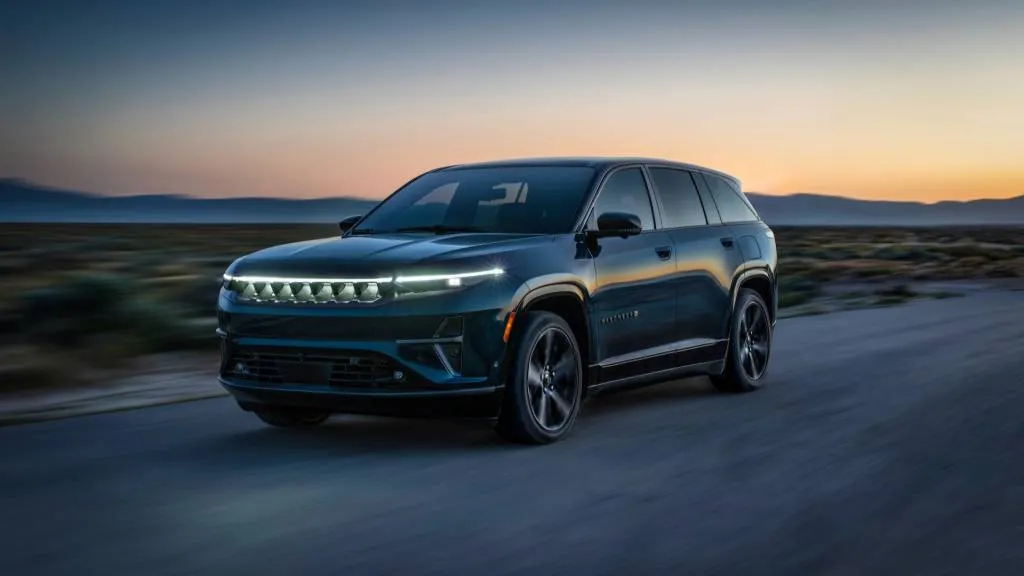
2024 Jeep Wagoneer S
This also gives the Wagoneer S the quickest 0-60 mph time of any production Jeep to date, beating the old gasoline Grand Cherokee Trackhawk, the automaker notes. Like the Model Y Performance, the Trackhawk is 0.1 second slower than the Wagoneer S.
The Trackhawk still has bragging rights when it comes to power, though. While impressive, the Wagoneer S’s 600 hp and 617 lb-ft of torque falls short of the 707 hp and 645 lb-ft generated by the Trackhawk’s supercharged V-8 engine. Granted, those specs only apply to the pre-production Wagoneer S, as does a range estimate of more than 300 miles.
[embedded content]
Jeep first showed the Wagoneer S in concept form in September 2022 alongside the more rugged Recon off-roader, described as “brother” to the Wrangler. The production version is scheduled for a full reveal May 30, with sales starting this fall.
Jeep otherwise seems quite focused on plug-in hybrids at the moment. It recently confirmed a Gladiator 4xe plug-in hybrid pickup is U.S.-bound, while Europe will get a 4xe version of the Avenger crossover that was just detailed Wednesday. Jeep also sidestepped EVs with this year’s batch of off-road concepts for the annual Easter Jeep Safari; all had engines on board.