
Category: General

Tesla Model 3 Long Range RWD returns to top Ioniq 6 in range
- The rear-wheel drive Tesla Model 3 Long Range has returned
- The Model 3 Long Range costs $42,490, which is $5,000 less than the AWD model
- Tesla says the Long Range Model 3 goes 363 miles—2 miles more than the Hyundai Ioniq 6 SE
Tesla has added a rear-wheel drive Long Range version of the updated Model 3, which undercuts the all-wheel drive Long Range model by $5,000.
First spotted by Reuters, the new Tesla Model 3 Long Range rear-wheel drive appeared in the automaker’s online configurator Thursday with a base price of $42,490 before destination. Tesla lists a 363-mile range, compared to 341 miles for the $47,490 Model 3 Long Range all-wheel drive, or 358 miles for the previous Model 3 Long Range.
That gives today’s rear-wheel drive Long Range the most range of any current Model 3 variant, and it makes this model the longest-range Model 3 yet.
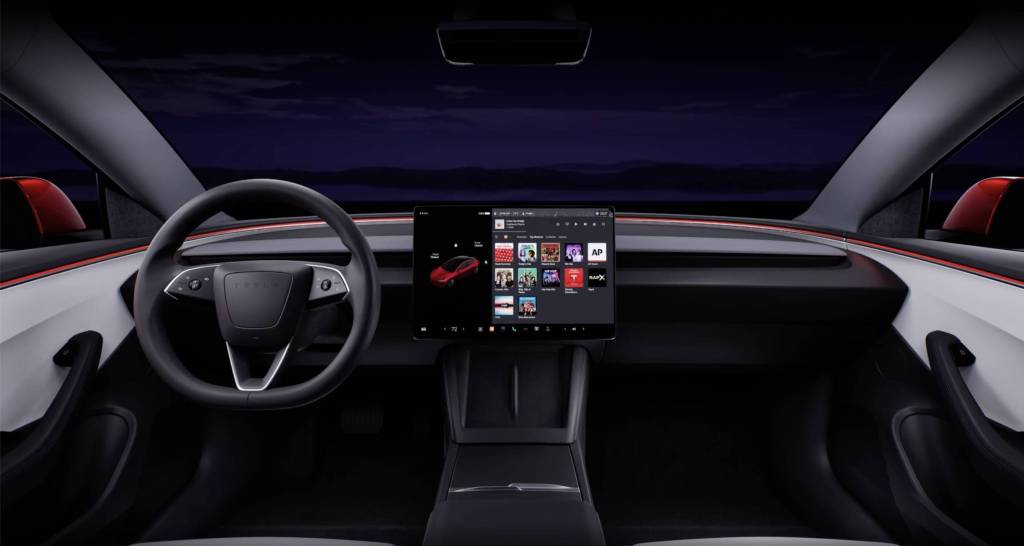
Tesla Model 3 (Europe-market refresh)
It also undercuts its lead U.S.-market rival, the Hyundai Ioniq 6, in both price and range. The 2024 Ioniq 6 SE costs $43,600 and is EPA-rated for 361 miles of range—although Tesla uses a different adjustment factor for its range ratings that may mean the Ioniq 6 still outperforms it in real-world range.
A single-motor powertrain gives the rear-wheel drive Model 3 Long Range a Tesla-estimated 0-60 mph time of 4.9 seconds—about a second quicker than the Ioniq 5 SE—and a 125-mph top speed.
Tesla launched the updated Model 3, codenamed “Highland” by the automaker, in the U.S. in January. The refresh brought revised exterior styling, a quieter cabin, and additional convenience features like cooled front seats, dual wireless device charging, and an 8.0-inch rear screen for passengers. Tesla also removed most physical controls, forcing drivers to rely more on the 15.4-inch touchscreen.
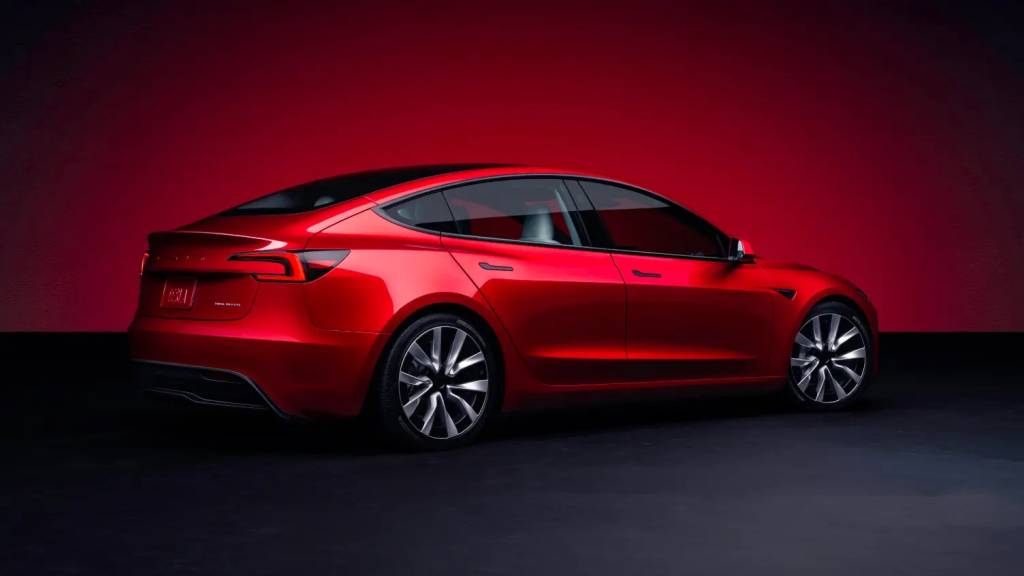
Tesla Model 3 (Europe-market refresh)
In the U.S., the Model 3 Highland was initially offered in base rear-wheel drive form (priced at $38,990 before destination) in addition to the all-wheel drive Long Range configuration. The Model 3 Performance returned in April, boasting adaptive suspension, a 2.9-second 0-60 mph time, and a $52,990 base price (since raised to $54,990). So the rear-wheel drive Model 3 Long Range brings the number of Highland variants to four.
The related Tesla Model Y hasn’t yet received the Highland—er, Juniper—updates, but price cuts to the crossover in April made it cheaper than the Model 3 by up to $5,000, once the $7,500 federal EV tax credit is factored in.


Deal lays path to solid-state batteries for a million VW EVs annually
- VW’s PowerCo could eventually make up to 80 gigawatt-hours of solid-state cells annually
- QuantumScape and PowerCo will combine forces to scale up production
- Production timeline and location weren’t specified
Volkswagen’s PowerCo battery unit and the solid-state battery tech firm QuantumScape on Thursday announced a path toward the industrialization and mass-production of solid-state lithium-metal batteries for electric vehicles.
Through an agreement, in the form of a non-exclusive license, PowerCo will be able to make up to 40 gigawatt-hours of battery cells annually using tech from the solid-state firm, with the option to up that to 80 gigawatt-hours—enough for a million EVs annually.
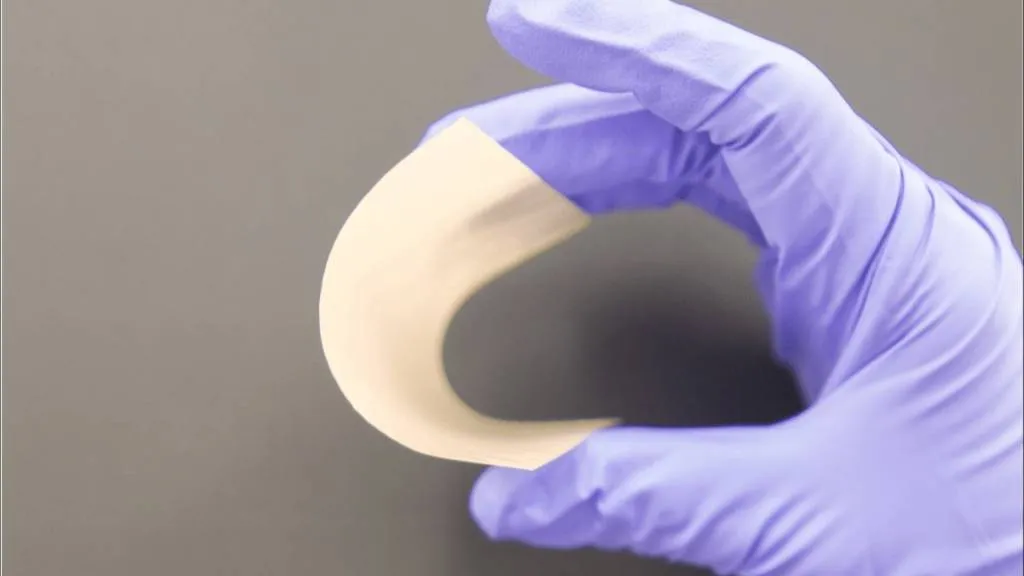
QuantumScape ceramic separator
QuantumScape’s solid-state tech uses ceramic separators to allow a pure lithium-metal anode for higher energy and power density, with faster charging. As with other solid-state battery cell technology, QuantumScape has long ago proven that the idea is valid in a laboratory and smaller-scale environments, but scaling up mass-production—for use over years in vehicles—has been the challenge.
To that, the companies say that they’ll combine core competencies, with “a combined workforce initiative” to accelerate the scaling-up of production and these cells’ integration into VW’s vehicles.
A location for the potential future manufacturing of solid-state cells was not disclosed, nor was a timeline.

VW Salzgitter cell facility
Volkswagen broke ground on its first EV cell “gigafactory” in July 2022, at the same time it formalized the PowerCo. business unit overseeing it. The facility in Salzgitter, Germany, serves as a hub for VW’s global battery activities and the starting point for what VW called a “global battery offensive” created around localized battery production by market and a vertically integrated battery supply chain aiming to cut cell costs by 50%.
That German battery factory is producing a new prismatic unified cell format that’s due to be used with the automaker’s upcoming Scalable Systems Platform (SSP) for electric vehicles starting in 2026 and will eventually be installed in 80% of the EVs from the VW Group by the end of the decade.
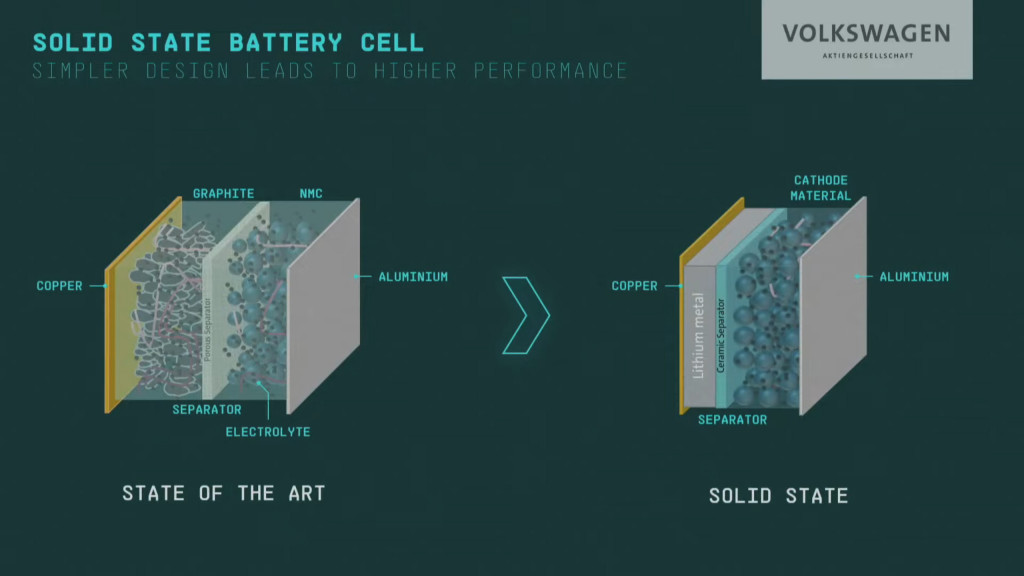
VW Power Day – solid-state composition
At its 2021 Power Day, VW called solid-state battery tech its “end game” in the shift to EVs, noting that it didn’t see the tech arriving until 2025 or later—in small volume at first. It saw solid-state tech as enabling 80% fast-charges in just 12 minutes.
VW has seen solid-state cells and QuantumScape as part of its long-term plan for more than a decade already. It’s been collaborating with the firm since 2012. Toyota is developing solid-state cells with Panasonic and sees the tech “ready for commercial use” by 2027 or 2028. Honda sees them as enabling affordable small EVs, while Nissan is working to develop its own solid-state cells and sees potentially game-changing EV packaging advantages from them.

2025 Chevy Equinox EV costs $34,995 for 319 miles, gets power boost
Chevrolet appears to have held true on the arrival of an Equinox EV version that costs just $34,995 and is set to deliver well over 300 miles of range. But it’s arriving for the 2025 model year, rather than 2024.
The GM brand said Thursday that the base 2025 Chevrolet Equinox EV LT will be available “soon.” It rides on 19-inch machined wheels and doesn’t hold back on any of the tech, including the big 17.7-inch infotainment touchscreen with 11-inch information screen, a full suite of active-safety features, and remote and hands-free start capabilities. But it does go with cloth, manually adjustable seats and the absence of the bun warmers and steering-wheel heaters that can make winter EV ownership much easier.
The Equinox EV’s $34,995 base price, which Chevy had originally confirmed for 2024, includes the $1,395 destination fee and is likely to carry over the same 319-mile EPA range rating as current 2024 Equinox models with front-wheel drive, from an 85-kwh battery pack. It will be eligible in 2024 for the $7,500 EV tax credit, Chevy says, so that effectively drops the price to just $27,495.
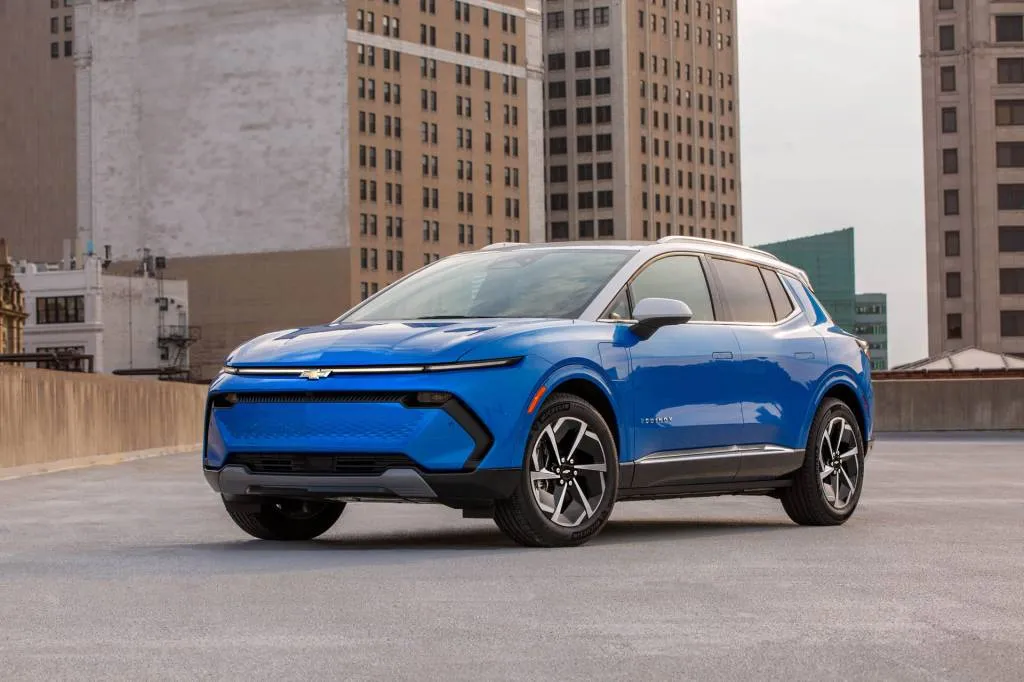
2024 Chevrolet Equinox EV
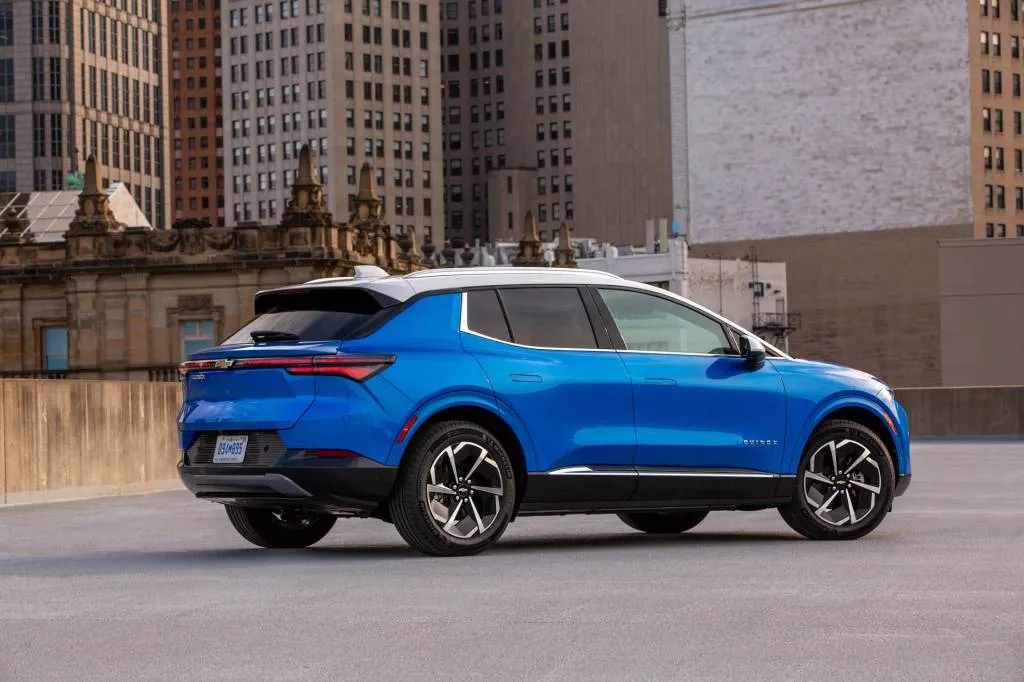
2024 Chevrolet Equinox EV
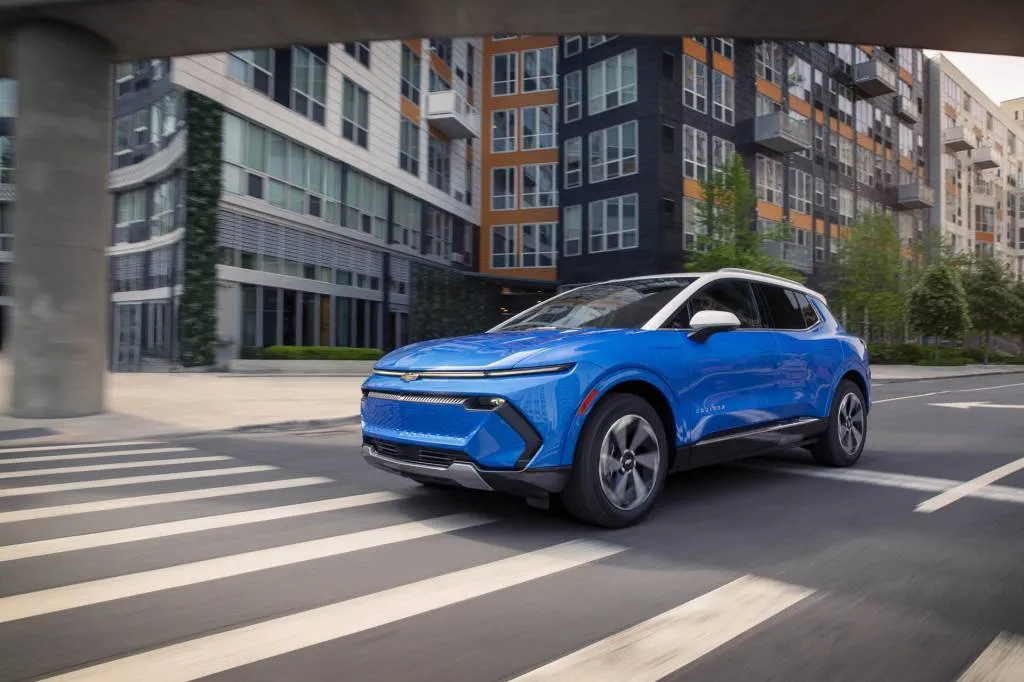
2024 Chevrolet Equinox EV
The 2025 versions of this updated EV will make slightly more power and torque than their 2024 counterparts, Chevy also revealed—220 hp and 243 lb-ft in single-motor front-wheel-drive form, or 300 hp and 355 lb-ft in dual-motor all-wheel-drive form. Those figures represent a boost of 7 hp and 7 lb-ft with FWD and 12 hp and 22 lb-ft with AWD.
Chevy hasn’t yet confirmed how much extra all-wheel drive costs on the LT, but for 2024 the premium is $3,300.
The model that Chevy launched as the 2LT has been revamped as part of an option package for 2025, adding up to $43,295. A “Comfort and Active Safety 2 Package” slots in between at $36,995, while at the top of the lineup the model Chevy formerly called the 3LT now costs $46,395.
With those options piled on, the 2LT gets roof rails, a rear wiper, a power liftgate, a power driver seat, heated front seats, a heated steering wheel, and adaptive cruise control. The 3LT adds front-seat cooling, power front passenger seat adjustment, heated wiper parking, heated rear outboard seats, dual-zone climate control, and 21-inch alloys.
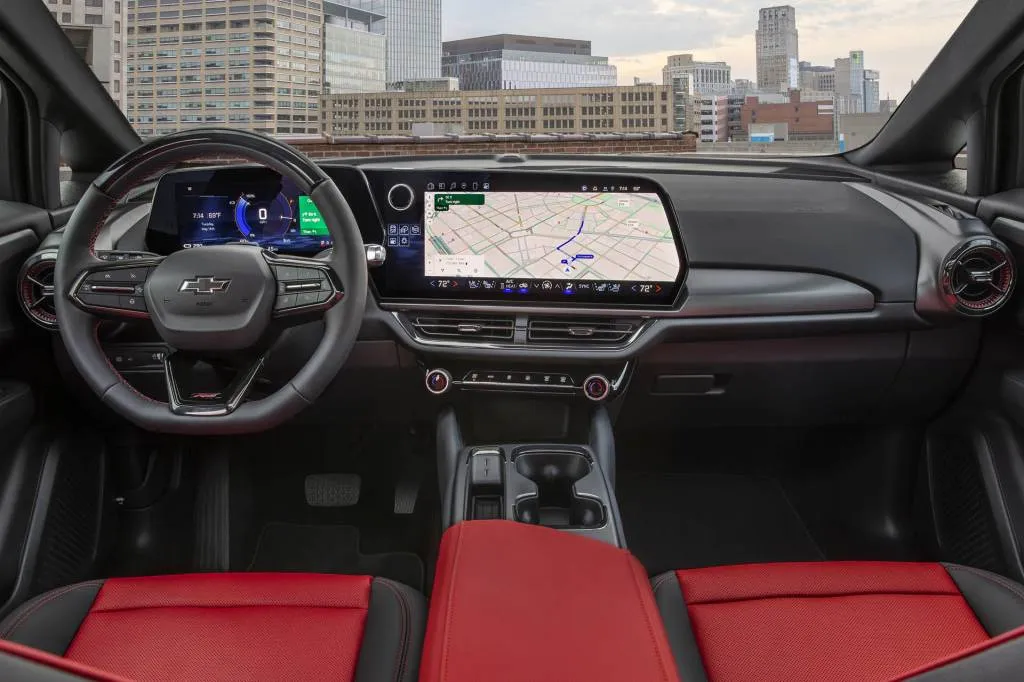
2024 Chevrolet Equinox EV
Chevy notes that top-level LT and RS trims now include a head-up display and rear camera mirror.
At the top of the 2025 Equinox EV lineup is the RS. What had been sold as the 2RS (21-inch wheels, black roof, flat-bottom steering wheel) is now badged the RS, priced at $44,795, while the previous 3RS (dual-zone climate, power passenger seat, heated rear seats, and more) is an option package on top of that, costing $47,890.
In a first drive of the 2024 Chevy Equinox EV in May, Green Car Reports found this entry GM EV to be the new “normal” for American EVs, with a package that’s satisfying to drive and use.
The Equinox EV’s pricing recalibration goes along with what Chevy recently did for the slightly upmarket Blazer EV. The 2025 Blazer EV also gets a lower base price for existing LT and RS versions.
Currently, with the arrival of the $34,995 base model, the Equinox EV is one of the lowest-priced EVs for the U.S. market. GM CEO Mary Barra has already also promised that it’s not Chevy’s lowest-priced EV—and the upcoming 2026 Chevy Bolt EV will be the most affordable U.S. EV.

Polestar 6 electric convertible may get spicy BST edition
- Polestar’s Concept BST contemplates a spicy 6 electric convertible
- The 6’s still on the docket for 2026
- Polestar CEO Thomas Ingenlath says more BST editions are coming
While the Polestar 3 SUV swings for efficient performance and the Polestar 4 swings for body-style-curious buyers, the upcoming Polestar 6 might be swinging at Tesla.
Still two years away—and still a dark-horse candidate to beat the second-generation Tesla Roadster to production—the Polestar 6 has gained a concept edition that may lead to a high-performance production model.
The Polestar Concept BST has made its debut ahead of this weekend’s 2024 Goodwood Festival of Speed, where it will be shown to the public for the first time. Polestar has scheduled its original 6 Concept to run the Goodwood hill over the weekend while the Concept BST is on display.
The BST version, according to Polestar CEO Thomas Ingenlath, is the convertible electric car “turned up to 11.” (“Spinal Tap” references may die out in our lifetimes, but not yet.) It wears concept-specific bodywork such as a wider track and flared fenders which house 22-inch forged alloy wheels.
The aerodynamic add-ons include a vented hood with a new front splitter, and a massive rear wing like the one found on Porsche’s GT3 cars and the $300,000-plus Ford Mustang GTD. What’s good for gas can be good for electric cars, too.
The Concept BST drapes its motorsport silver paint in racing graphics. The interior has yet to be shown.
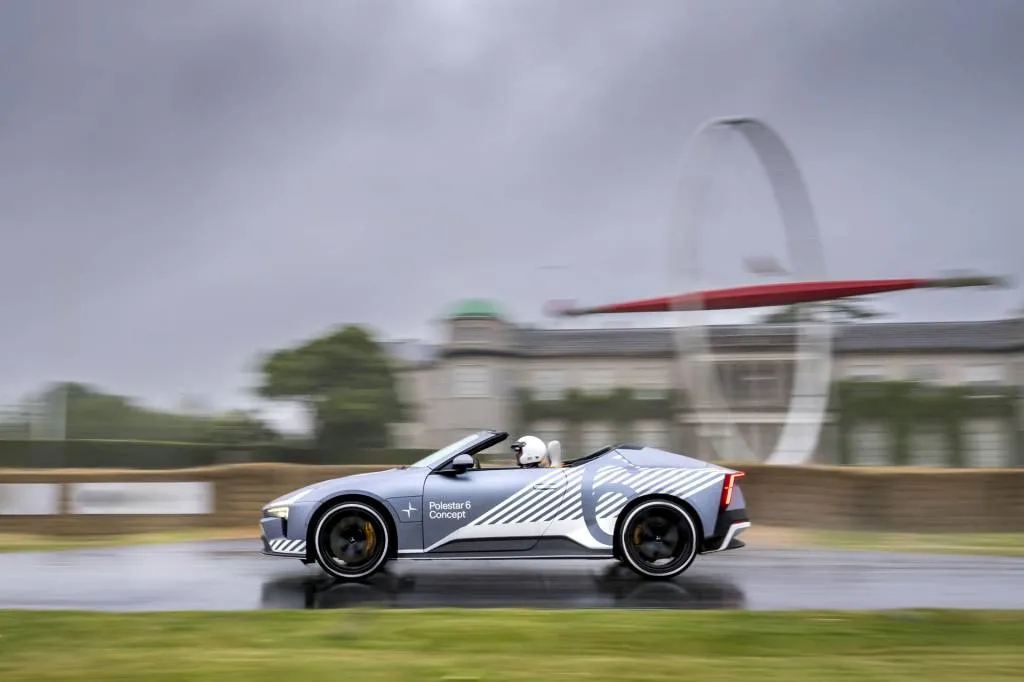
Polestar 6 Concept AT 2024 Goodwood Festival of Speed
Polestar first showed the 6 concept in 2022 and promised production by 2026. In concept form, it sports a twin-motor powertrain with a battery pack of an unspecified size. The setup produces a promised 884 hp and 663 lb-ft of torque, delivers all-wheel drive, and shoots to 60 mph in under 3.2 seconds as it cruises to a mooted top speed of 155 mph. An 800-volt electrical architecture is likely to help enable high fast-charging rates. Polestar has not confirmed any powertrain upgrades for the BST edition.

Genesis GV60 gets the first Magma treatment, in 2025
- Genesis confirmed its GV60 Magma for production in 2025
- The first public look at the production model comes this week at the 2024 Goodwood Festival of Speed
- Genesis plans a Magma for every model
The rolling design statement that is the Genesis GV60 gets a performance edition in 2025.
The South Korean luxury brand confirmed on Thursday that it will produce the GV60 Magma concept shown at this year’s New York Auto Show. This weekend, the car will make its production debut at the 2024 Goodwood Festival of Speed.
The GV60, a Green Car Reports Best Car To Buy 2023 finalist, recently gained a lower-priced version with more range for the 2024 model year.
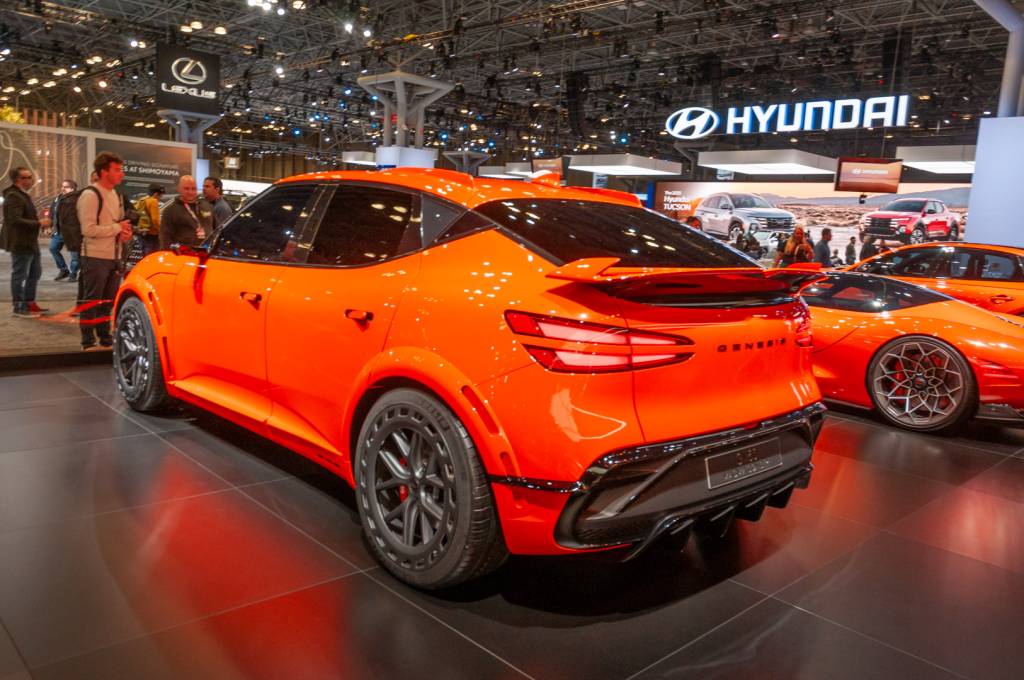
Genesis GV60 Magma concept
Sales will begin in South Korea by the third quarter of next year, with a European launch set to follow by the fourth quarter of 2025. Genesis hasn’t confirmed when the vehicle will arrive in U.S. showrooms, though it chose New York for its global debut.
Genesis confirmed that it hopes to build a Magma version of every model in its lineup, though it has not said whether the Magma updates will apply to EV versions of existing models, such as the Electrified G80 sedan (which may grow a new long-wheelbase edition soon) or the Electrified GV70 crossover SUV, which it now builds in Alabama.
Separately, Genesis may also develop and sell more hybrids and plug-in hybrids, as the rate of EV sales growth has slowed.
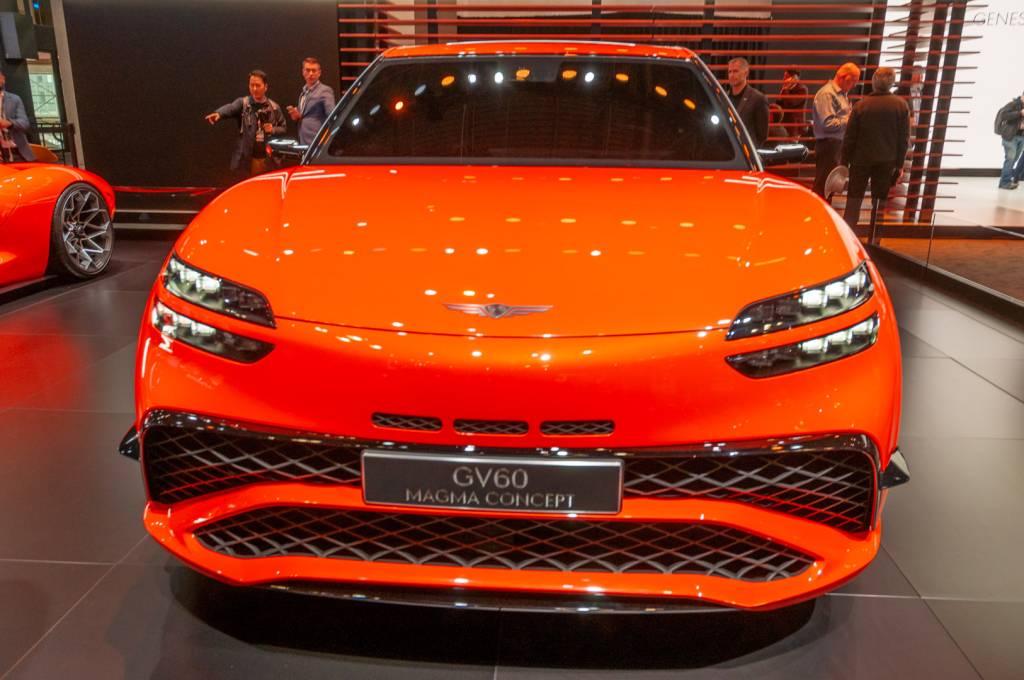
Genesis GV60 Magma concept
Magma cars will get sport-tuned suspensions and will ride lower, but no performance upgrades have been confirmed. The GV60 Magma concept does have upgrades to its cooling systems, and presumably, power output. It could end up with performance in the range of the blistering-quick Hyundai Ioniq 5 N, since the vehicles share their E-GMP architecture.

Toyota joins Ionna EV charging network, stations due in 2024
- Toyota and Lexus EV drivers will have access to Ionna
- Toyota has made an undisclosed investment in Ionna, becoming the eighth automaker to do so
- Ionna will support the NACS charge port set to be adopted in future Toyota EVs
Toyota has joined the fledgling North American EV fast-charging network Ionna, the companies jointly announced Wednesday.
With an undisclosed investment in the charging network, that brings the total number of automakers invested in the network to eight.
Ionna, which now includes Toyota/Lexus in addition to BMW Group, General Motors, Honda, Hyundai, Kia, Mercedes-Benz, and Stellantis, has said that it will build a network of more than 30,000 high-power fast-charging connectors across the U.S. and Canada, including both urban and highway-adjacent locations.
The charging network started emerging from stealth mode in June, when it hinted that work was already well underway on its first chargers, with its first U.S. charging stations still due to open in 2024.
Toyota and Lexus drivers will have access to the charging network as it rolls out its chargers, the company confirmed, although it didn’t detail how or when. Currently the automaker only sells the Toyota bZ4X and Lexus RZ electric vehicles in the U.S., but more EVs are on the way in the next couple of years, including a three-row electric SUV set to be made in Kentucky plus a fully electric Toyota Highlander, also with three rows, set to arrive in 2026.
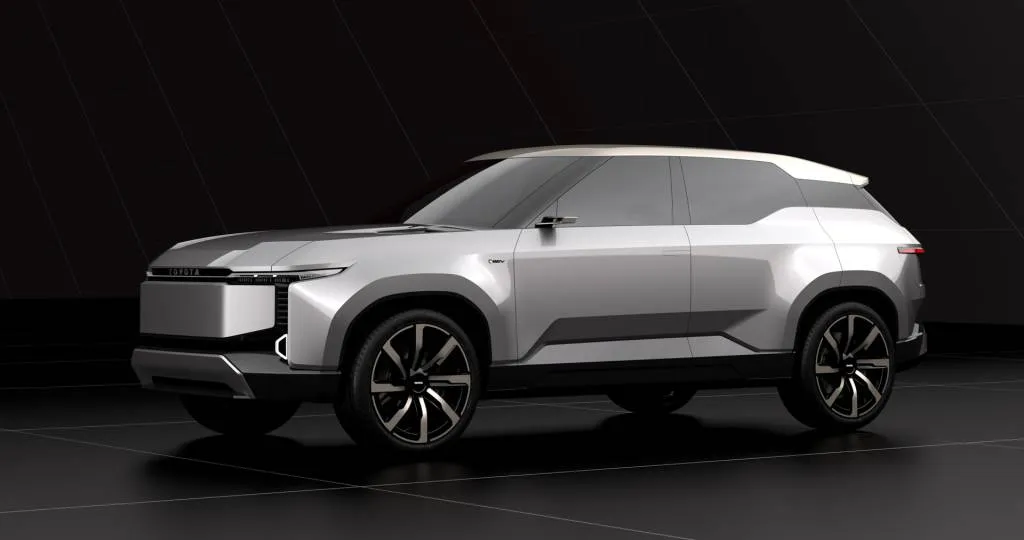
Toyota Land Cruiser Se concept
Both of those models are due to debut with the Tesla-based NACS charging interface, based on Toyota’s timeline for adopting it. Ionna has said that 350 kw will be a minimum supported power for the network’s connectors, and it’s voiced its commitment to both the NACS and CCS connector standards
Ionna was first revealed in July 2023, with its proposed scale amounting to the closest rival yet to the Tesla Supercharger network. It aims to be powered by renewable energy, and will fully support reservations, route planning, and Plug & Charge technology for fewer credit-card swipes or app handshakes.
Locations will be different, too, versus existing locations favored by major networks like Electrify America. That means remote corners or islands in big-box retailer parking lots will likely no longer be the template.

No, extreme heat doesn’t cause people to get stuck in EVs
- Summer heat waves do mean a temporary drop in EV range
- They won’t “brick” your battery, but they can accelerate degradation (aging) of the pack
- Avoid 100% charges in the heat if you can
How hot is too hot for EVs, and will the next heat wave brick it, leaving you stranded?
The answer isn’t nearly as sensational as the headlines some have written already this summer, or the questions that follow.
Just as hot weather puts a range of components for gasoline vehicles under additional stress, heat waves do potentially put more wear on EV batteries. But to put it all in perspective and bust a misinformation myth, that’s all it is for EVs—wear.
EV batteries can degrade faster in hot weather. They simply don’t fail suddenly though and leave owners stuck—although of course it’s possible that the heat may affect the reliability of the grid or charging stations owners rely on.
“I can probably count on one hand the number of times we’ve seen a car lose range quickly and unexpectedly, and the team has not had a reason to believe that any of them were due to a single heat wave,” said Garberson, head of growth and research at the EV battery health analysis firm Recurrent.

Recurrent EV battery health
Based on Recurrent’s data from 20,000 EVs, there’s no red-line temperature at which EV batteries “brick,” or at which the damage to batteries suddenly accelerates.
To put it bluntly, heat isn’t going to brick your EV.
Fries, cigarettes, and other bad habits
According to Garberson, it’s better to think of EV batteries’ heat exposure as drops in the bucket, or factors that could be likened to human aging and bad habits that might accelerate the aging process like smoking or using tanning beds. Prolonged exposure can alter the rate of the electrochemical reactions in the battery, ultimately leading to a shorter life—defined by whatever point the useful range has degraded to a point where the EV no longer covers the distance, charges, or performs to an expected level.
As such, battery replacements aren’t an expected expense at a particular number of miles, one that will suddenly render the car unusable. As Recurrent’s data has shown, for instance, Tesla range degradation does happen in a pronounced way over the first three years but really flattens out after that.
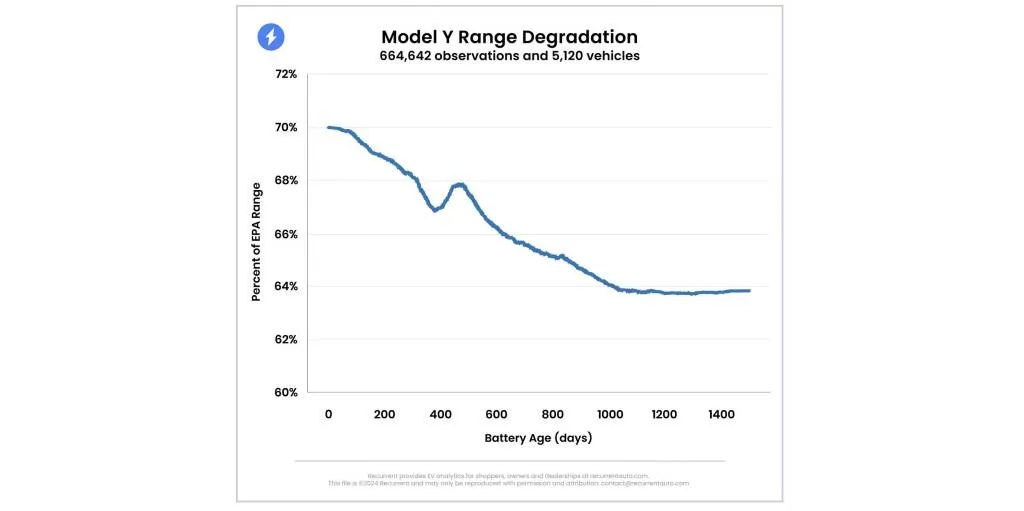
Tesla Model Y range degradation (via Recurrent)
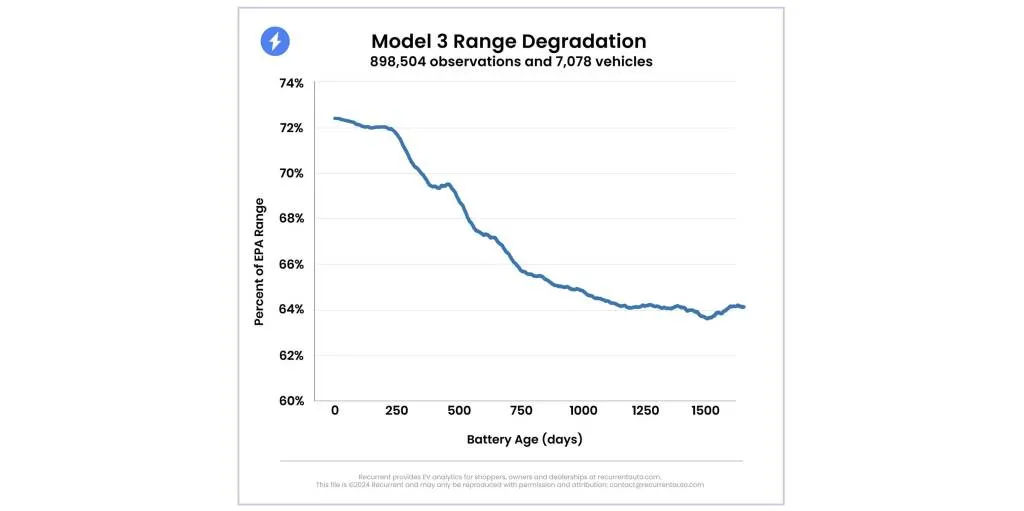
Tesla Model 3 range degradation (via Recurrent)
Due to their smart liquid-cooling systems, frequent fast-charging isn’t likely to affect degradation in Teslas and most other modern EVs. These systems and improved chemistries have eliminated some of the concerns over accelerated degradation.
A few early EVs simply didn’t do well with heat and saw accelerated battery degradation as a result of heat exposure. The most noteworthy of those are the earliest model years of the Nissan Leaf; a new “lizard” battery chemistry introduced in 2015 mostly solved that, and Nissan has since reported back that Leaf battery packs are lasting a very long time.
Taking care of your EV in the heat
That said, there are some pieces of practical advice for keeping your battery pack safe and cool in the heat—and some of it is the same that applies the rest of the year, only more so. Don’t charge the battery all the way to 100% if you don’t have to. And certainly don’t charge it fully and then park the vehicle.
Park in the shade if it’s very hot and sunny. Parking over blacktop that’s been in the midday sun will give your battery pack, which is typically on the underside of the vehicle, an unexpected heat soak in the worst possible way.
Also, leave your battery half-charged if you have to leave it out in the heat, as the battery is more stable that way. Recurrent has noted that if you’re able to set a charge limit (of 70%, for instance), owners can leave the car plugged in during that hot weather and active thermal management might activate at a lower temp than it otherwise would.
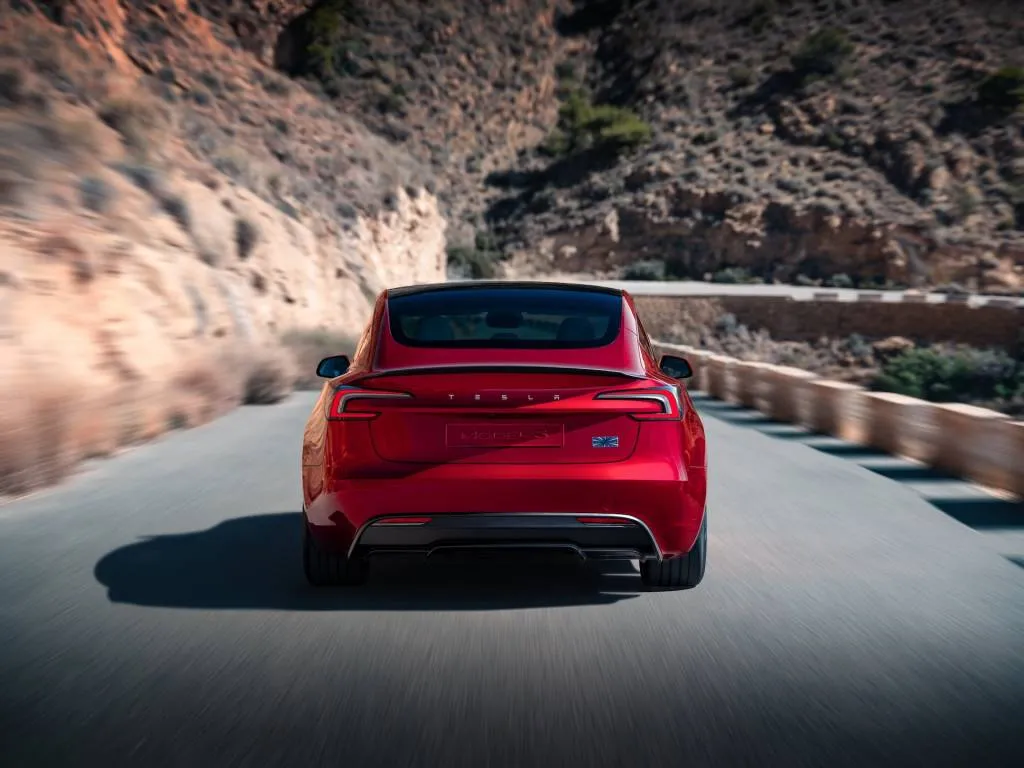
Tesla Model 3 Performance
Don’t be surprised if range takes a heat-wave hit—temporarily
EVs don’t lose a lot of range in most weather that’s considered very hot. That’s because most EV batteries are in their thermal sweet spot right around room temperature—where a vehicle’s climate control system also wouldn’t need to do much work. And their climate systems don’t have to change the temperature of the cabin by that many degrees.
As Recurrent calculates, EVs might only lose 5% of their useful range at 90 degrees, but by 95 degrees they’ll lose 15% and by 100 degrees the loss adds up to 31% in all—still less than some owners note in winter use.
Apples to apples, if your vehicle doesn’t have a heat pump and relies on resistive heating not unlike that inside a toaster or hair dryer, cooling an EV 20 degrees costs less energy than heating it 20 degrees. Part of the reason is that EV cooling doesn’t have to work against the waste heat of a combustion engine.
A bottom line to remember is that cold weather doesn’t cause the permanent damage to EV batteries that hot weather can, but just like the heat, it leads to temporary range loss. Be prepared; follow your battery’s state of charge; and remember that your range estimator is only that and doesn’t see the heat wave coming.

Electrify America opens fast-chargers in Moab for electric off-roading
Electrify America now has 350-kw DC fast-chargers up and running on the network and positioned to help fully electric off-roaders or recreational visitors take in nearby Arches National Park or Canyonlands National Park.
The chargers, announced last May among 20 new fast-charging sites in Utah, are being supported by Electrify Commercial, EA’s unit that supplies hardware to businesses and commercial fleets, and implemented by regional utility Rocky Mountain Power.
The site at Moab includes eight chargers capable of those 350-kw rates, with a design intended to accommodate electric trucks and trailer-towing. At this point, the GMC Hummer EV remains the only off-road-focused EV capable of accepting that full charge rate.
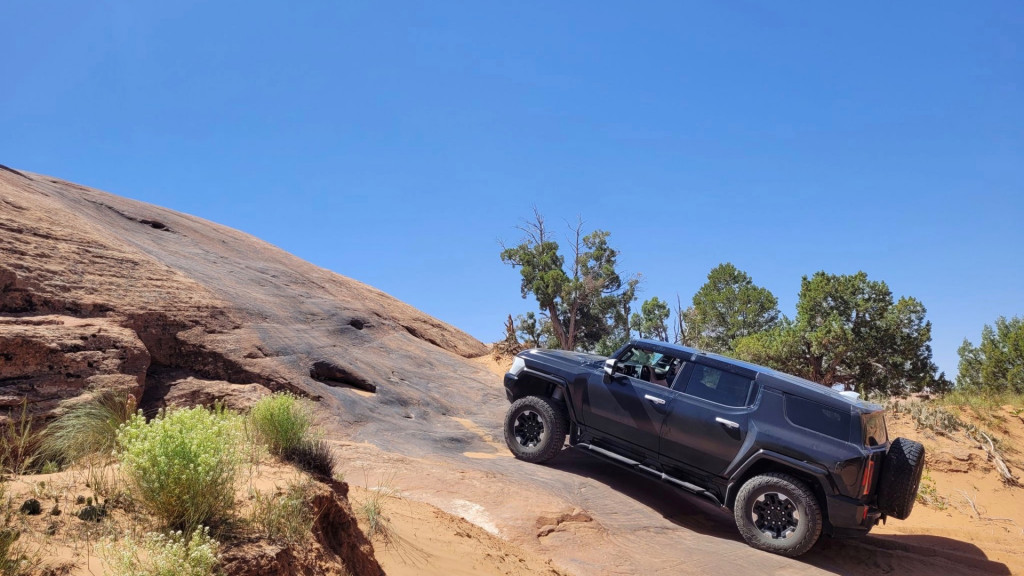
2024 GMC Hummer EV SUV testing in Moab
As Electrify America said last year, pricing for these independently run chargers may be different than those on EA’s own network, but they’ll be part of the network’s app and payment system just like other stations.
Rivian in 2022 announced Level 2 charging at glamping sites near Moab, Jeep sees the area as a spiritual home for the brand and in recent years it has revealed a series of electrified off-road concepts at Moab.
Green Car Reports Newsletter
Sign up to get the latest green car and environmental news, delivered to your inbox daily!
I agree to receive emails from Green Car Reports. I understand that I can unsubscribe at any time. Privacy Policy.