
Category: General

VW ID.Buzz conversion vans brings good vibes into electric era
- A camper conversion of the VW ID.Buzz is in the works
- Deliveries of the VW ID.Buzz conversion van will begin in November
- The camper conversion is being done by a third-party independent of VW
A Seattle-based company is offering Volkswagen ID.Buzz camper van conversions that channel the groovy vibe of VW Microbus hippie-mobiles.
Peace Vans, which specializes in camper-van builds, is offering three such conversion options for the all-electric ID.Buzz, with deliveries scheduled to begin in November of this year. This is being done independently of VW, which does not have an official partner for camper-van conversions in the U.S. So far the automaker only plans to offer camper-friendly accessories for the ID.Buzz.
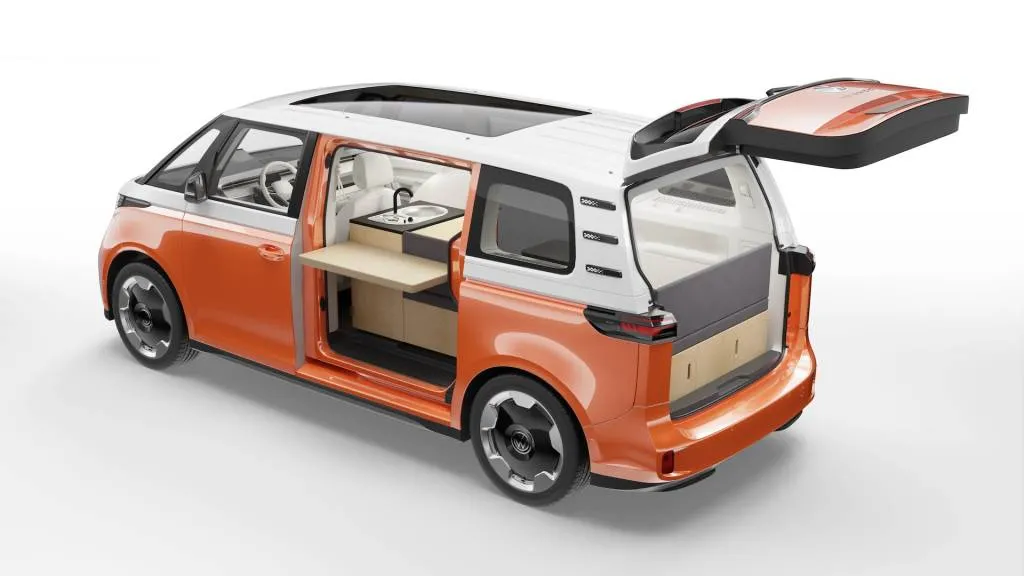
Volkswagen ID.Buzz.Camper by Peace Vans
The company’s Buzz.Camper is billed as a complete mobile home with a lounge area that converts into a bed, cabinets, a cooktop, a sink, and an onboard water storage. This requires removal of both rear rows of seats (the ID. Buzz will be sold in the U.S. only as a three-row passenger van). An alternative DOT-approved rear-seat setup is under development, which Peace Vans hopes to have approved by mid- to late-2025.
The Buzz.Box is more foodie-focused, with a modular rear-kitchen assembly that takes the place of the third row of seats. It includes a 25-liter refrigerator, a cooktop, a sink, water storage, and multiple prep surfaces, plus wireless device charging and integrated light and sound systems. A Buzz.Boz.Sleeper adds what Peace Vans calls an “almost queen size” sleeping platform that requires folding the second-row seats.

Volkswagen ID.Buzz.Box.Sleeper by Peace Vans
VW still hasn’t released U.S. pricing for the ID.Buzz itself, but Peace Vans is charging $7,995 for the Buzz.Box and $10,995 for the Buzz.Box.Sleeper installations, on top of the price of the vehicle itself. Pricing for the Buzz.Camper option will be released in the third quarter of this year. Peace Vans will also sell a limited number of pre-built ID.Buzz campers, allowing customers to take delivery of the vehicles with the conversion work already done.
Peace Vans is also working on a version of the iconic “pop top” roof from vintage VW vans for the ID.Buzz. The company hopes to have it ready in late 2025, and will give customers who purchase its other ID.Buzz conversions spots at the head of the line. And it notes on its website that all designs are still a work in progress and subject to change as development work continues. But, given how long it’s taking for the ID.Buzz to reach the U.S., potential customers are nothing if not patient.

2025 Volvo EX90 price hiked $3,300, still missing features
- The 2025 Volvo EX90 now costs $81,290
- The updated pricing includes a $3,300 price increase due to material costs
- The 2025 Volvo EX90 is in production in South Carolina
The 2025 Volvo EX90 has gotten $3,300 more expensive ahead of the planned start of U.S. deliveries later this year, reported Automotive News.
Volvo’s website now lists the base price as $81,290 with the mandatory $1,295 destination charge, meaning it now exceeds the $80,000 price cap for the federal EV tax credit. When it announced pricing last November, Volvo said the U.S.-made EX90 would start at $77,990 with destination.
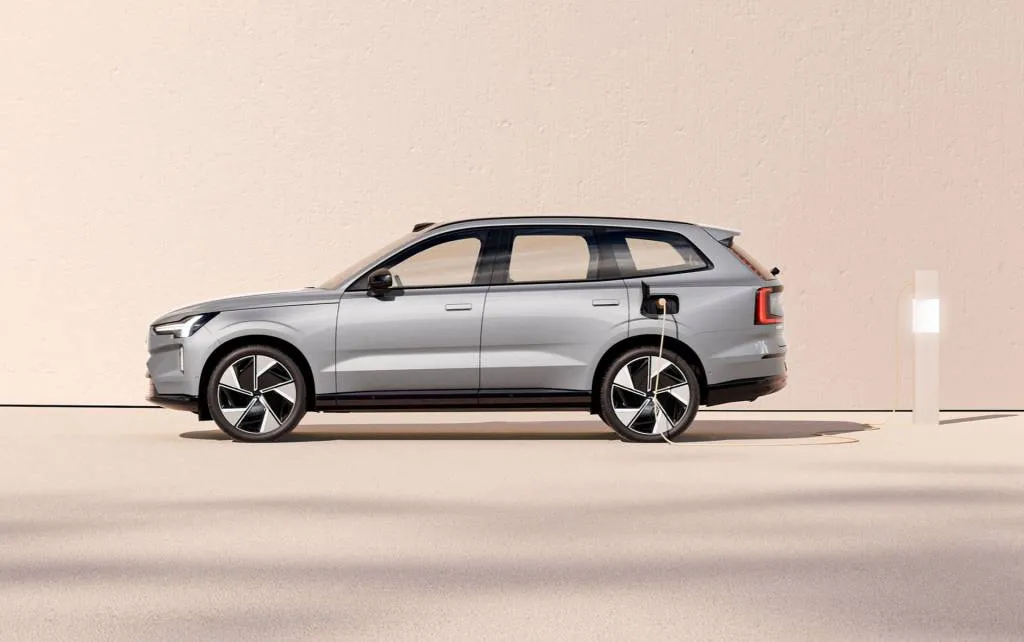
2025 Volvo EX90
A Volvo spokesperson told Automotive News that the price increase was due to higher material costs, adding that the higher pricing was announced to dealers and pre-order customers June 26 and that the website was updated the same day. Volvo began accepting pre-orders last November, but no “firm orders or non-refundable deposits” were placed before the price change was announced.
Volvo in June told customers that the first EX90 vehicles would ship without some features, including some driver aids, Apple CarPlay, and Plug & Charge and bidirectional charging, and that an unresolved battery-drain issue might cause early-build vehicles to use some energy while parked. The automaker said at the time that missing features would be added of free of charge via over-the-air updates, which would also address the power-draw issue.
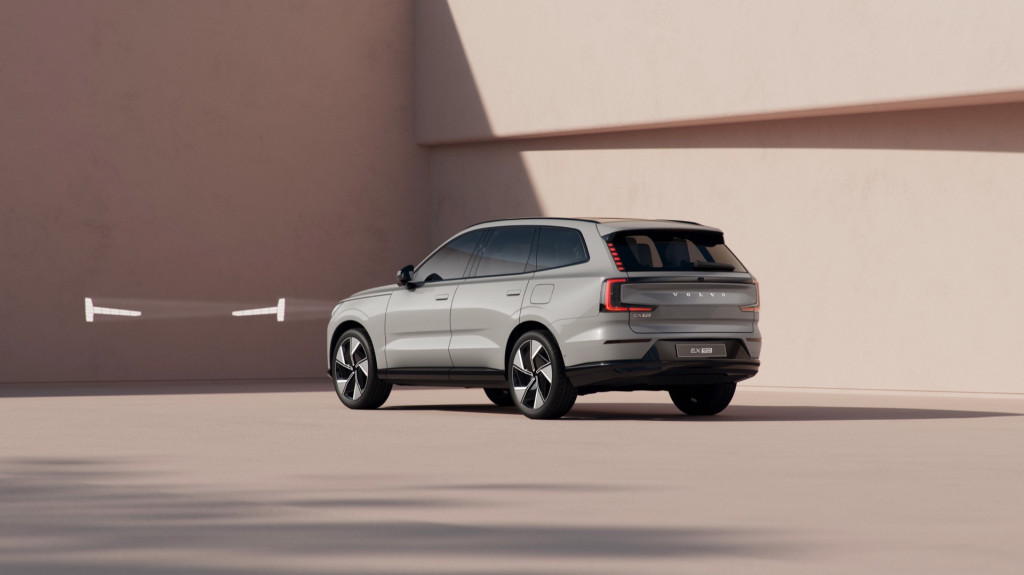
2025 Volvo EX90
Unveiled in November 2022, the EX90 was originally scheduled to start deliveries in early 2024, but was held back due to software issues that apparently weren’t completely resolved. Volvo now plans to deliver the first U.S. customer cars in the second half of this year, and has already started production of the EX90 at its South Carolina factory.
The Polestar 3 is slated to be built alongside the EX90 in South Carolina, and was held back by the same software issues. The two SUVs are built on the same platform, but the Polestar will be sold only with two rows of seats, while the Volvo is exclusively a three-row model. It’s unclear if the Polestar 3 will also ship with missing features, or whether Polestar will raise prices.

Acura teases concept previewing US-built EV on its own platform
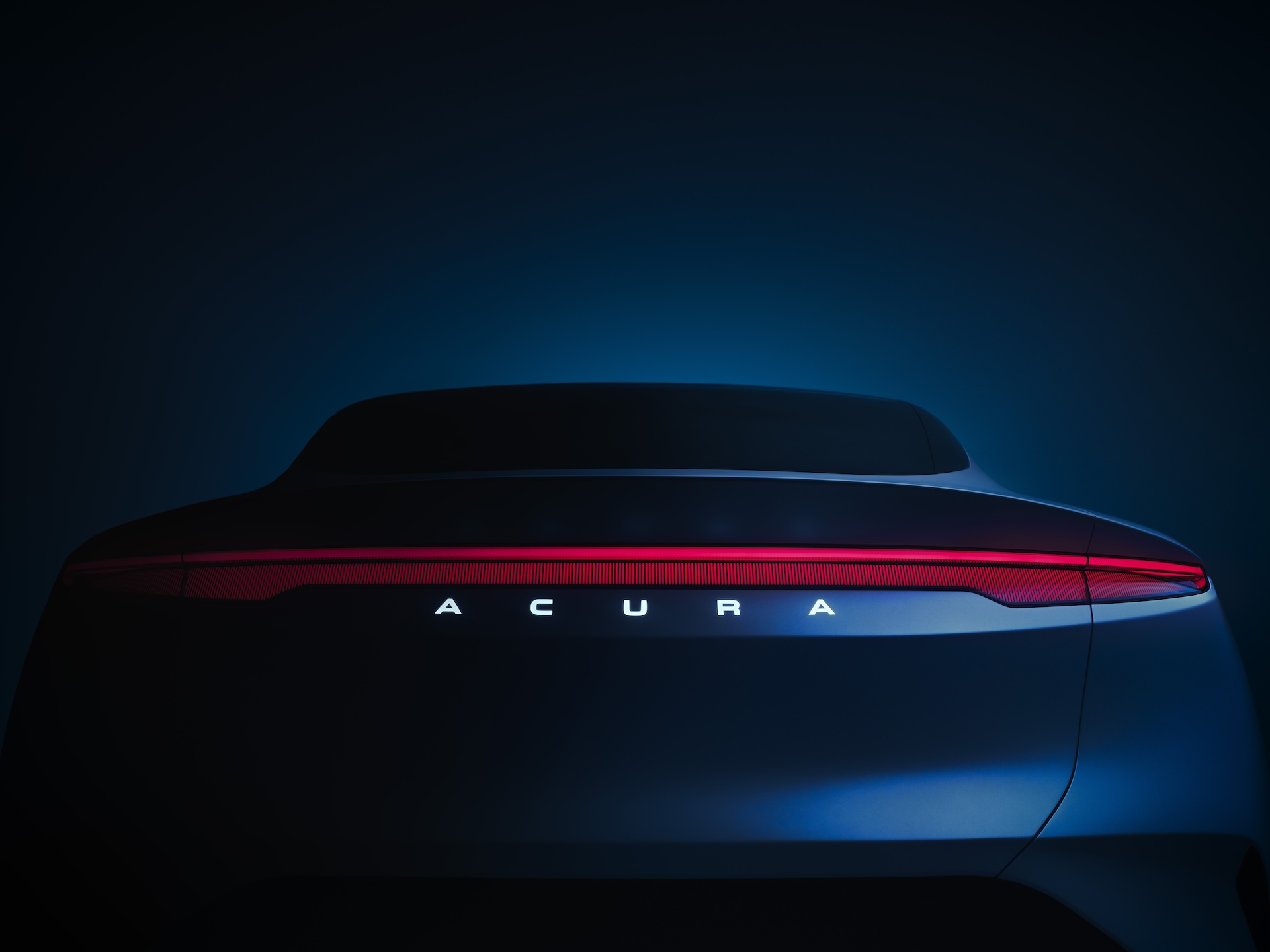
- Acura teased an electric SUV concept that will debut in Monterey next week
- The production version of the electric SUV concept will ride on Acura and Honda’s own BEV platform
- Acura will build the electric SUV in its Marysville Auto Plant in Ohio
Acura is due to debut an electric SUV concept at this month’s 2024 Monterey Car Week, and Friday it teased the upcoming EV in a photo.
Although the teaser photo doesn’t reveal much, Acura has confirmed that the depicted vehicle is based on an in-house-developed dedicated EV platform, and destined to spawn a production model to be built in Ohio.
Acura and its Honda parent have been slow to bring credible electric vehicles to the market, at least in the U.S., but they plan to accelerate things this decade.
The new EV push has already started with the 2024 Acura ZDX and 2024 Honda Prologue, though both SUVs ride on General Motors’ Ultium EV platform and battery technology set and are built at GM plants.
For their next generation of EVs, Acura and Honda plan their own platform, and in the U.S. production will take place at a revamped Marysville Auto Plant in Ohio. The batteries will also be sourced from an Ohio plant Honda is establishing with LG.
The platform will feature an electric and electronic (E&E) architecture that will utilize Honda’s own vehicle operating system and in-vehicle software, including a new generation of user interface and digital services. The platform is flexible enough to support vehicles in various segments, though the first vehicles will be in the “mid-to-large” segments, Honda has confirmed. The targeted range will be 300 miles or more.
The first Honda vehicle to ride on the platform is expected to be a member of the recently announced 0 (Zero) Series family of EVs. The first 0 Series EV will be a U.S.-built model starting sales in 2026, and that’s likely when the Acura SUV previewed by the concept will also arrive at showrooms.
Monterey Car Week runs Aug. 9-18 and includes multiple car-enthusiast events like The Quail, A Motorsports Gathering and the prestigious Pebble Beach Concours d’Elegance. Acura hasn’t said at which event the concept will be presented, but these showcases of luxury and performance auto enthusiasm are a great place to usher in a formative EV.

NACS or CCS: ChargePoint EV chargers follow Tesla Magic Dock
As automakers and charging networks move to adopt the Tesla North American Charging Standard (NACS) for EV fast charging, ChargePoint is releasing new hardware that combines Tesla and non-Tesla connector types.
The ChargePoint Omni Port can accommodate NACS and Combined Charging Standard (CCS) connectors, as well as the SAE J1772 connector for AC charging that is normally incorporated into CCS ports. The Omni Port will be incorporated into new charging stations, and retrofitted to some existing stations, ChargePoint said in a press release.
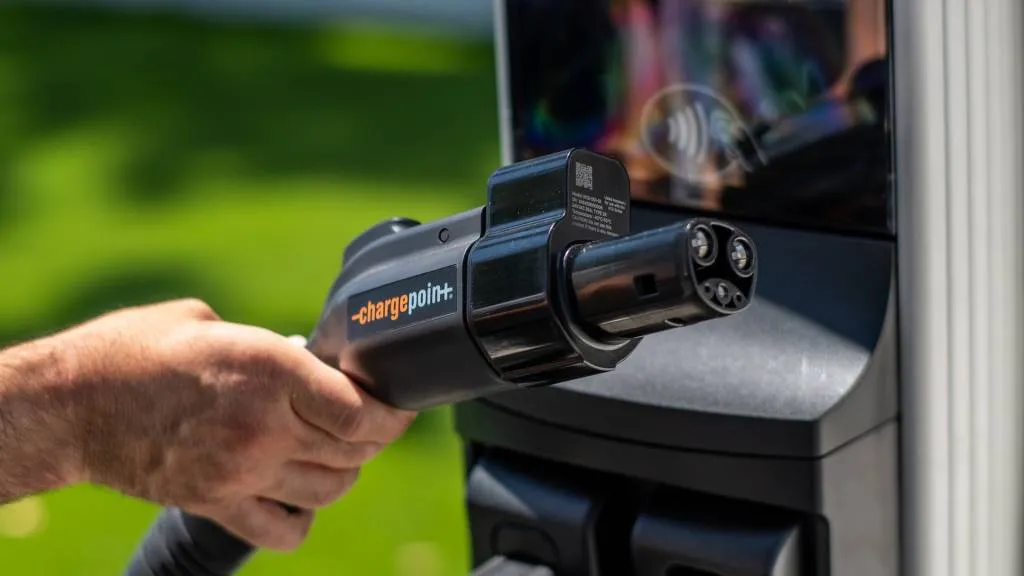
ChargePoint Omni Port
Drivers simply enter their vehicle’s make and model into the ChargePoint app and tap to start charging. The charging station will then automatically release the correct connector for their vehicle. This is similar to what Tesla does with its Magic Dock, and it could help eliminate hassles in charging at sites with multiple connector types.
With all necessary hardware permanently attached to each charging station, drivers don’t need to find a parking spot that matches their vehicle’s connector type, or deal with adapters that could get lost or stolen. Omni Port is also UL-approved, so drivers don’t have to worry about cheap adapters that aren’t up to safety standards.
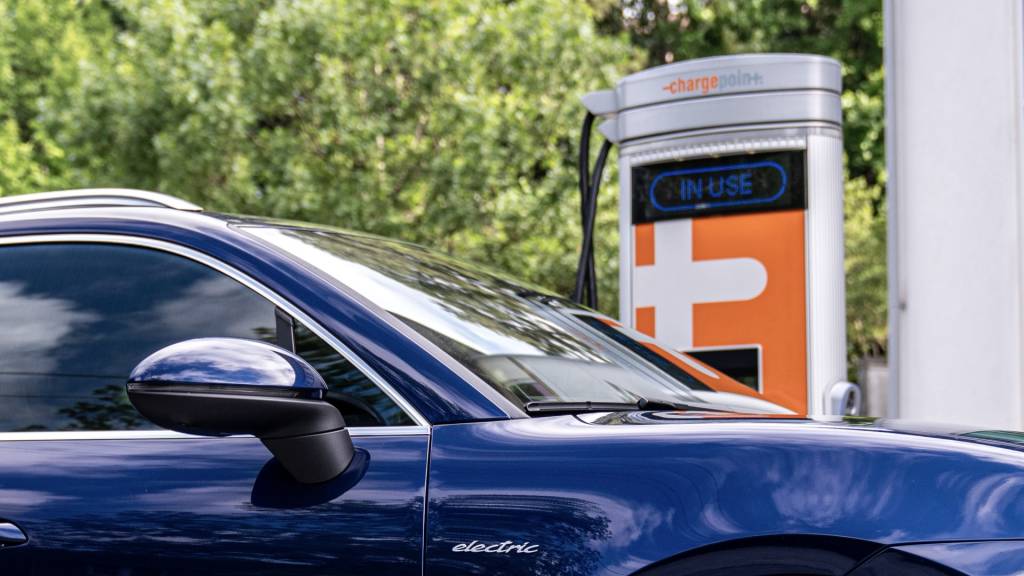
Porsche Macan EV at ChargePoint charger
Omni Port connectors will begin shipping by the end of 2024, ChargePoint said. The company will also retrofit them onto its existing CP6000 Level 2 AC public charger and Express Plus Power Link 2000 DC fast charger at a “nominal cost” to operators.
As of June 2024, ChargePoint includes a total of 62,536 chargers across 34,569 locations, according to the Department of Energy’s Alternative Fuels Data Center. That breaks out to 2,783 locations with DC fast charging and 31,789 with AC charging. Achieving decent reliability for those stations across different makes and models with different charge ports will be a challenge, but streamlined hardware seems like a good start.


Tesla Electric partners with SunRun to bolster Texas grid
Tesla customers will soon use home energy-storage systems to support the Texas power grid.
A partnership between Tesla Electric, a retail electricity provider operated by the automaker’s Tesla Energy, and solar company SunRun announced Tuesday is enrolling customers a program that will use Tesla Powerwall battery packs to supplement the grid during periods of high demand.

Tesla Powerwall – Courtesy of Tesla, Inc.
SunRun said that it has already enrolled 150 of its customers, and plans to further ramp up enrollments from there. Enrollment is open to SunRun customers who have that company’s solar panels connected to Tesla Powerwall batteries, and who have chosen Tesla Electric as their electricity provider.
While the company is enrolling them, these customers will actually be participating in a pilot program run by the Electric Reliability Council of Texas (ERCOT), which operates the state’s electricity grid. They’ll receive $400 per Powerwall for participating in the program for the 2024 calendar year. SunRun will also earn incremental revenue from the program.

Tesla Powerwall – Courtesy of Tesla, Inc.
Battery backups can help bolster the grid in the event of severe weather, SunRun noted. Just three weeks ago, Hurricane Beryl caused power outages that, the company said, impacted nearly three million homes and businesses. And in 2021 a winter storm knocked out large portions of the Texas power grid.
This marks SunRun’s first pilot program in Texas, but the company has experience with home backup batteries. SunRun is Ford’s preferred installer for the backup power system sold with the F-150 Lightning, which was also used in a 2022 study by California utility Pacific Gas & Electric looking at how such hardware could interconnect with the grid. SunRun also provided free battery backup systems to low-income households in California through a state-funded program announced in 2020.

2024 Dodge Charger Daytona EV charges up for $61,590
- Dodge’s first EV will be the Charger Daytona R/T and Daytona Scat Pack
- 2024 Dodge Charger Daytona models arrive to dealerships later this year
- 2024 Dodge Charger Daytona R/T costs $61,590; Charger Daytona Scat Pack costs $75,185
The 2024 Dodge Charger Daytona is not like other electric vehicles. The three- and five-door hatchbacks hurtle the performance brand into its electric future by embracing all the muscle car machismo of its past. As for range and efficiency—the typical pride points of an EV launch— Dodge CEO Tim Kuniskis was characteristically blunt: “I don’t care.”
“It’s not designed to get you 500 miles of range,” Kuniskis crowed to a media gathering a week before the global debut in March. “This is designed to be the ultimate performance car until we come out with the Banshee, of course.”
At launch later in 2024 the lineup will kick off with the 2024 Dodge Charger R/T that costs $61,590 including a $1,995 destination fee. A more powerful Charger Daytona Scat Pack costs $75,185.
The Daytona Banshee will arrive last, late in 2025. The Charger Daytona BEVs go on sale later in 2024, and will be followed by the five-door variants early in 2025. At around the same time, Dodge will rock you with a Hurricane twin-turbo 3.0-liter inline-6 tuned to up to 550 hp in Charger Sixpack models. The new Charger effectively absorbs the Challenger two-door slot, even though Kuniskis says there are plans for the Challenger.
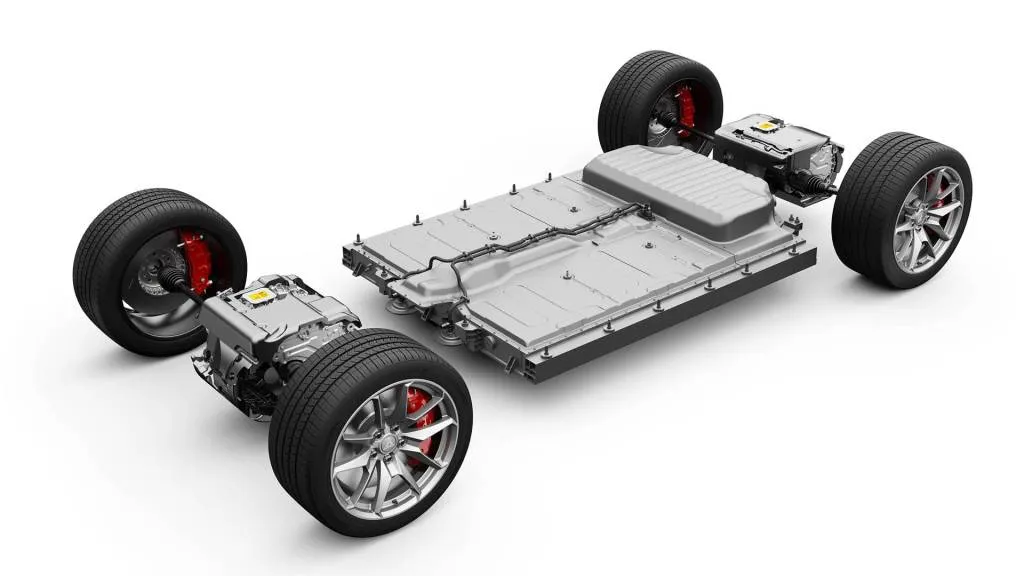
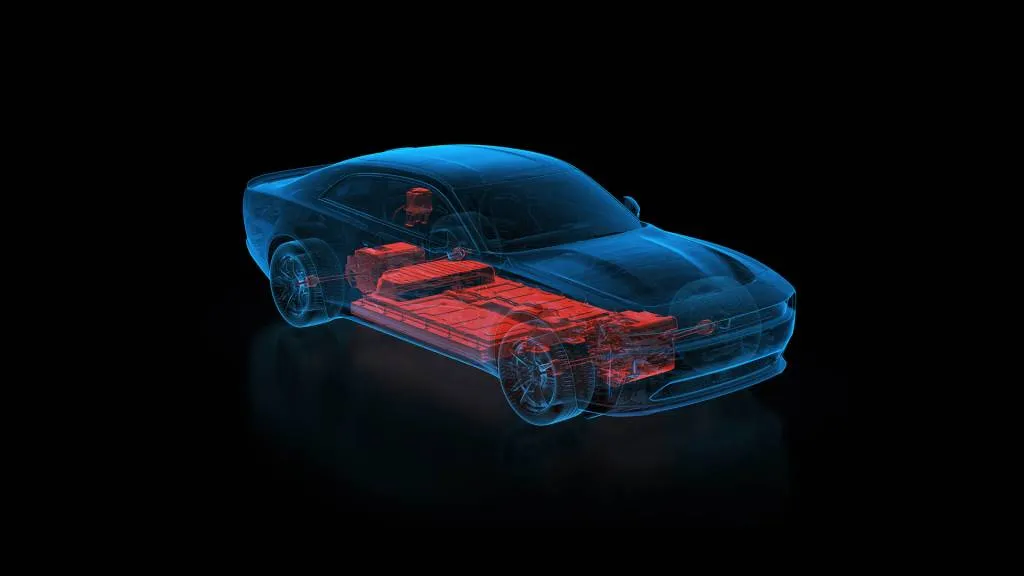
“We are gonna displace superchargers and replace them with kilowatts and Power Shots,” Kuniskis said about the Charger cadence as well as intimating future product that will include utility vehicles. “When we first started working on this platform, it was a very risky decision. The most efficient EV platform in the world is a skateboard. We made the decision at the time to do multi-energy to have multiple vehicles on that same platform.”
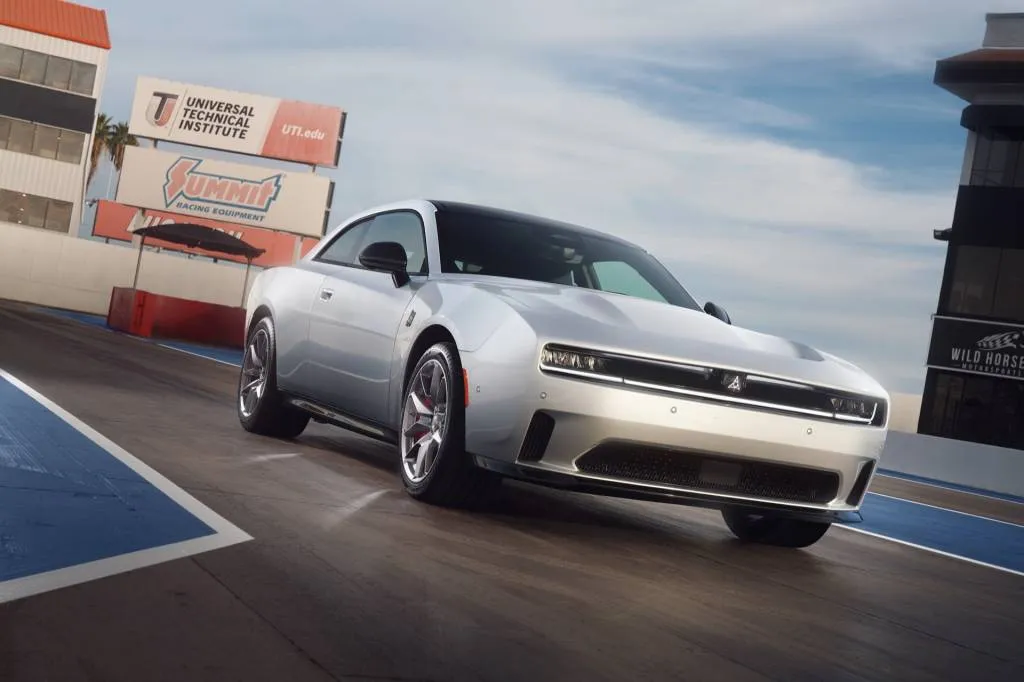
2024 Dodge Charger Daytona
2024 Dodge Charger Daytona range and performance
In spite of the performance posturing, the 2024 Charger Daytona still has an estimated 317 miles of range for the entry-level R/T model, while the Scat Pack scoots to 260 miles, courtesy of a 100.5-kwh (93.5-kwh usable) nickel-cobalt-aluminum lithium-ion battery pack.
2024 Dodge Charger Daytona
Utilizing the brand’s STLA Large platform, the Daytonas have two drive units with 250-kw permanent magnet synchronous motors, one for each axle for standard all-wheel drive. For the initial launch year, both the R/T and Scat Pack will come standard with a Direct Connection upgrade kit from Dodge’s performance parts arm that provides 15-second boosts of an extra 40 hp, as long as you allow 30 seconds between each boost. Dodge brands this the Power Shot, and it’s accessible via a steering wheel button opposite the drive mode button so you don’t have to fiddle with a toggle or touchscreen when you need more power. Next year, the Power Shot kits will cost extra.
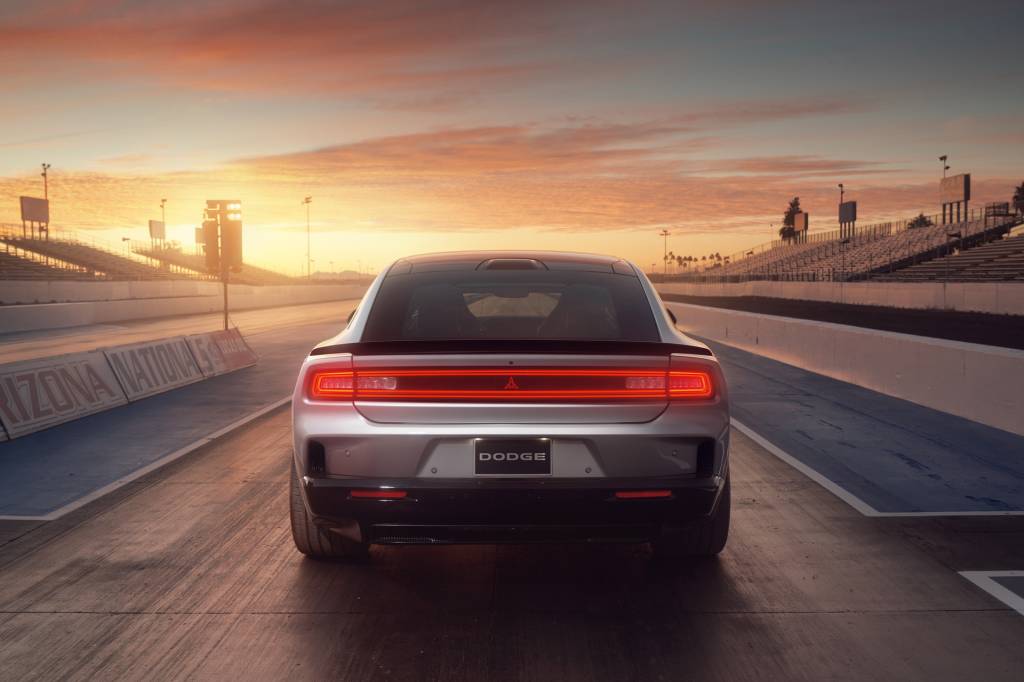
The Stage 1 Power Shot on the R/T leads to a total output of 496 hp and 404 lb-ft of torque. Dodge estimates a 0-60 mph time of 4.7 seconds, a quarter-mile of 13.1 seconds, and a top speed of 137 mph.
The Stage 2 Power Shot juices the Scat Pack to 670 hp and 627 lb-ft. It specs out to a 0-60 mph time of 3.3 seconds, a quarter-mile of 11.5 seconds, and a top speed of 134 mph.
2024 Dodge Charger Daytona
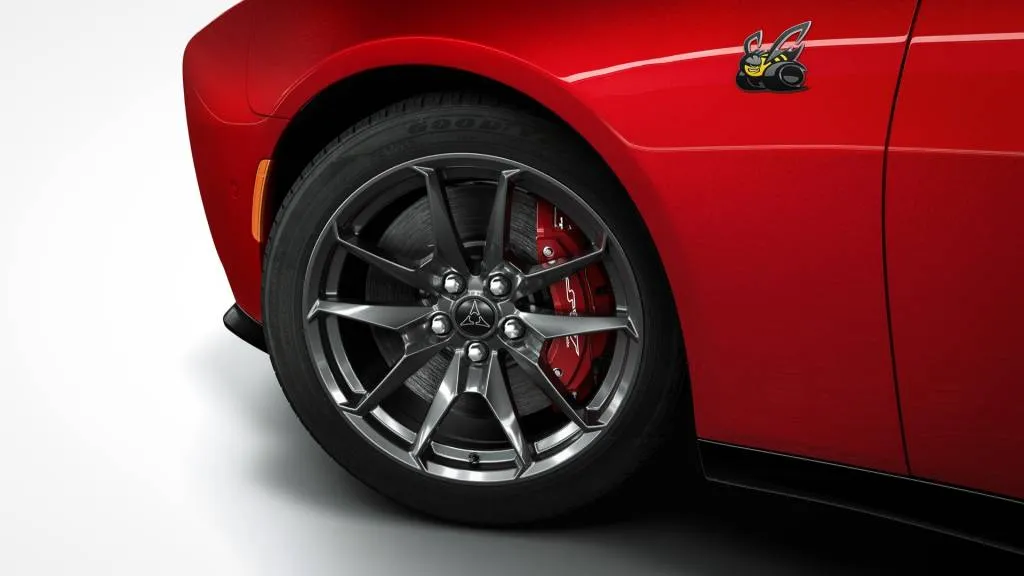
Also standard for just the first year is the largest brake package ever offered on a Dodge, consisting of 6-piston Brembo front and 4-piston rear calipers clamping down on 16.0-inch rotors. One-pedal driving is not part of the plan, though paddle shifters enable three levels of regenerative braking.
The front drive unit disconnects power to the wheels and improves range and efficiency based on drive mode, while the rear unit has a mechanical limited-slip differential for better traction out of corners. Drive modes include the usual suspects, while Scat Packs get Drag, Drift, and Donut modes that cut or limit power to the front axle and neuter the traction control system.
A chambered Fratzonic exhaust that uses speakers under the body that are amplified through resonators, similar to a muffler resonator, or like a pipe organ. Inside it’s augmented by electronics and altogether makes what Dodge calls “Hellcat levels of sound.” It can be disabled via a stealth mode. It could even vibrate the car like a V-8, or it can be muted in stealth mode.
2024 Dodge Charger Daytona
The Scat Pack Track Package adds adaptive dampers to the multi-link front and rear suspension, and of course there’s a launch control function. Exclusive to the Scat Pack Track Package are staggered tires on the 20 inch wheels, with Goodyear Eagle F1 Supercar 3 305/35ZR20 up front on 11-inch wide wheels and 325s on 11.5-inch wide wheels in back.
The standard R/T wheels are 18 inches, but the EPA range estimate is based on the 20 inchers. Dodge did not provide a range estimate for 18-inch wheels.
The range and performance estimates are impressive considering one other spec: both Charger Daytonas weigh a whopping 5,838 pounds.
2024 Dodge Charger Daytona
Charger Daytona draws the EV muscle car
The 2024 Daytona looks nearly identical to the Dodge Charger Daytona SRT Concept unveiled in August 2022, with a nip and a tuck to appease regulators. At 206.6 inches, it’s half a foot longer than the outgoing Dodge Charger, but it’s wide enough for Dodge to call it the widest passenger car this side of a dually heavy duty truck.
The key characteristic feature of that concept and one that carries over with aerodynamic purpose is the R-Wing front blade topping the nose. Dodge didn’t tout the coefficient of drag, but the way the nose dives down reflects the almost platypus-like inspiration from the original 1968 Dodge Daytona Charger, which also had a 23-inch-tall wing at the rear. The R-Wing itself is “air neutral,” Dodge exterior designer Scott Krugger told Green Car Reports.
“By having [the nose] dive down, it’s 11 aero counts better [minus 0.011 to the coefficient of drag] than having a texture like a grille or breather that goes into an engine compartment.”
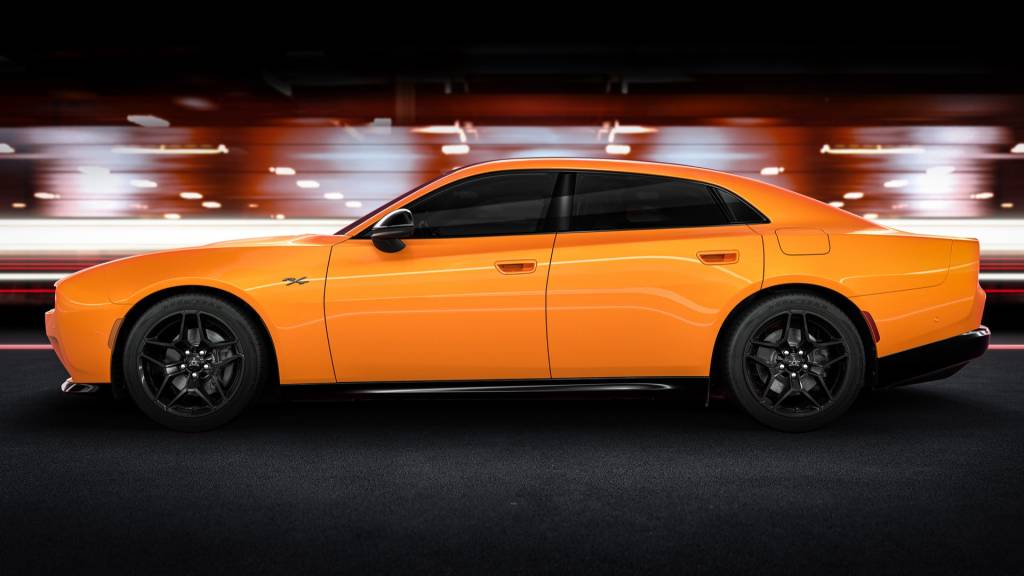
The wing helps give the Charger Daytona the brand’s trademark muscular presence. A front single light bar curls up at the edges to underscore the wing, stretching the fascia horizontally. The suggested line edges around the smooth sides into a body line that rises gracefully yet powerfully into the hatch. The 5.6-inch ground clearance and taller ride height are visually reduced with a black underbody that also rises up into the hatch beyond the rear wheels. Even though it’s an inch taller at 59.0 inches than the outgoing Charger, it still presents as wide and mean, and the sweeping C-pillars on the five-door model embodies those classic muscle car cues even more.
2024 Dodge Charger Daytona
Charger Daytona crosses over with a hatch
It’s a beautiful car, and it looks like no other EV on sale right now. We weren’t able to test the interior roominess of the five-door model, but the hatch opens up 133% more cargo room than in the outgoing Charger, Dodge says. There’s about 23 cubic feet of space, but even with the hidden floor it’s shallow, so if you want to fit the four track tires as Dodge promoted, you’ll have to flip down the 60:40-split rear seats that opens it up to 38.5 cubic feet of space.
That might be the best use of the rear seats for passengers above 6 feet tall, as the available fixed glass roof eats into headroom. Yet the 37.2 inches of legroom matches most compact crossovers, so four people could fit in comfort as long as the gangly folk go up front.
Also up front is a 1.5-cubic foot frunk to stow the charging cord.
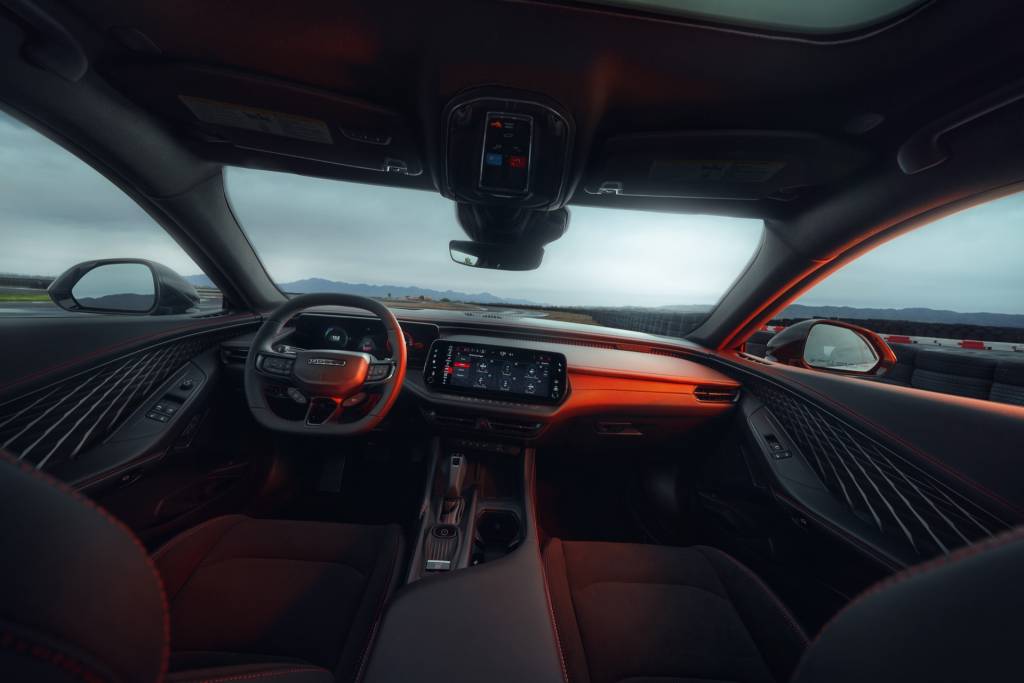
2024 Dodge Charger Daytona
The Dodge Charger Daytona charges at up to 183 kw
The 400-volt architecture supports a peak DC fast-charge rate of 183 kw, so on an available 350-kw DC charger the Daytona’s battery would charge from 20-80% in about 28 minutes. At home on a 240-volt connection, the Daytona’s 11-kw onboard charger fills the battery from 20-80% in 5.5 hours, or from 5-80% in about seven hours. Expect 10 hours for a full state of charge. Dodge will adapt the Tesla-derived NACS protocol in 2025.
Standard equipment includes a 10.3-inch digital instrument cluster (or an available 16.0-inch cluster) horizontally aligned with a 12.3-inch touchscreen with wireless Apple CarPlay and Android Auto, as well as a wireless smartphone charger. Standard driver-assist tech includes automatic emergency braking with pedestrian detection, active lane control, adaptive cruise control down to a stop, blind-spot monitors, and a driver-attention monitor.
Built in Windsor, Ontario, Canada, but with Samsung battery packs imported from Korea for the first year, the Charger Daytona won’t qualify for the federal EV tax credit on purchase, according to Sam Abuelsamid, principal analyst for Guidehouse. Sometime in 2025, the Stellantis-Samsung joint venture plant in Kokomo, Ind. are planned to be producing the packs, and should qualify for the EV credit at purchase.

Lucid CEO: Will take years for competition to catch up
- The 2025 Lucid Air Pure is the most efficient vehicle sold in the U.S.
- Lucid CEO Peter Rawlinson said competitors are years behind
- Rawlinson believes efficiency is the key to EVs
Lucid Group CEO Peter Rawlinson is confident that the automaker has built up a substantial advantage in EV efficiency.
The 2025 Lucid Air Pure achieves 146 MPGe in EPA testing and 5.0 miles per kwh based solely on its 420-mile range rating, making it the most efficient U.S.-market vehicle regardless of powertrain type, Lucid has said. In a LinkedIn post, Rawlinson added that it will take rivals years to reach this mark at their current rate of progress.
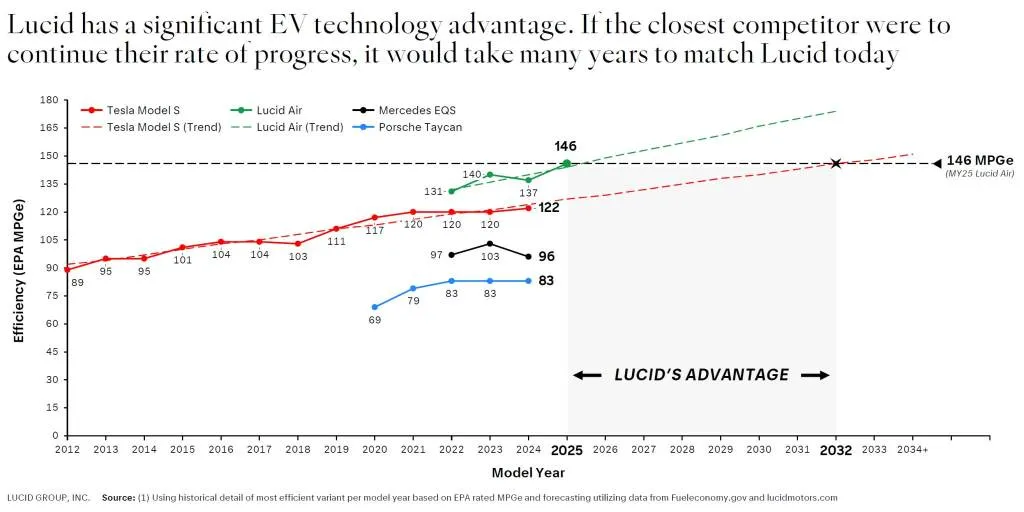
Lucid graph comparing Air efficiency with Tesla Model S, Porsche Taycan, and Mercedes-Benz EQS
Rawlinson’s post included a graph comparing the historical improvements in MPGe of the Tesla Model S, Porsche Taycan, and Mercedes-Benz EQS sedan to the Air, using data from the EPA’s fueleconomy.gov website. At its current rate of progress, Tesla could match the Air Pure’s 146 MPGe in 2032, according to Lucid, while Porsche and Mercedes are even further behind.
“Efficiency is of critical importance in making a better, lighter, more spacious, longer-range vehicle, and directly impacts the cost of manufacture,” Rawlinson said. “Therefore, efficiency is arguably the single most valid litmus test of a company’s core EV technological capability.”
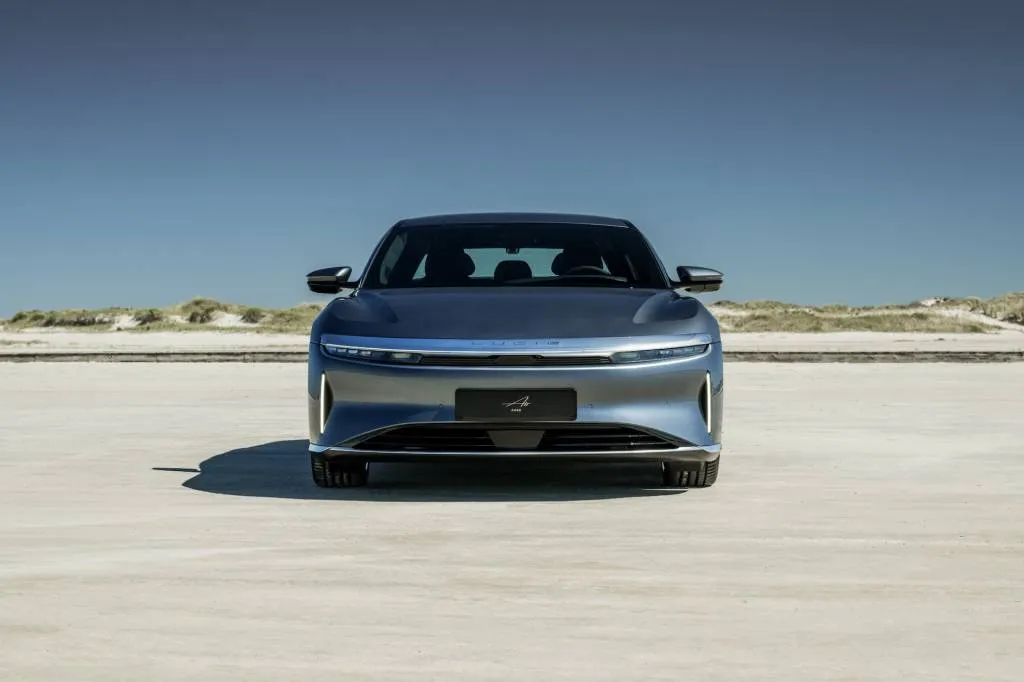
2025 Lucid Air Pure
A more efficiency EV can travel farther on a given amount of electricity, allowing for a reduction in battery-pack size that has numerous benefits including lower cost, weight reduction, and smaller demand for raw materials. It’s why efficiency, not range, is what drives Lucid engineering. The Air Pure relies on a fairly large 84.0-kwh pack to achieve its EPA range rating and its $71,400 base price isn’t considered affordable.
Lucid hopes to apply some of its efficiency-focused engineering to a less-expensive model dubbed “Project Midsize” that’s slated to debut in 2026, following the launch of the Lucid Gravity SUV later this year. Both projects will likely be funded in part by a fresh $1.5 billion cash injection from Saudi Arabia’s Public Investment Fund (PIF), which is already Lucid’s largest shareholder.

Ford Mustang Mach-E sets distance record, drives 569 miles on a charge
A U.K.-based team has set a Guinness World Record for longest distance traveled by an EV on a single charge, covering 569 miles and 3,379 feet in a Ford Mustang Mach-E.
The record attempt was staged July 27 by the team, which was sponsored by fleet management company Webfleet, and took just over 24 hours, according to Autocar. The version used was a single-motor Mach-E Premium with the larger Extended Range battery pack, with 18-inch wheels shod in EV-specific tires from Bridgestone.

Ford Mustang Mach-E sets Guinness World Record for distance driven on a single charge
The Mach-E was driven on U.K. public roads, including 21 miles at an indicated 0% battery capacity. The electric SUV averaged 6.25 miles per kwh, which far surpasses the official WLTP rating of 3.8 miles per kwh for this version of the Mach-E in the U.K. market.
While the loop was designed to “emulate real-world driving conditions,” according to Webfleet, breaking the record likely required unrealistically conservative driving. The version of the Mach-E used for the record attempt is WLTP-rated at 372 miles of range. The equivalent EPA rating is 320 miles.
[embedded content]
The previous record was set in September of last year by Chinese automaker Zeekr with a 563.971-mile journey in Hangzhou, China. Nio claimed last year that an ET7 sedan equipped with its new 150-kwh battery pack traveled 650 miles on a charge during a 14-hour trip between the Chinese cities of Shanghai and Xiamen, but this apparently wasn’t recognized by Guinness.
The Mercedes-Benz Vision EQXX concept also covered 746 miles on a charge during a 2022 trip from Germany to the U.K., but it isn’t a production car. The EQXX does however demonstrate engineering that could improve the efficiency of future Mercedes EVs, helping them to escape the weight spiral that afflicts current models.