
Category: General

Review: 2025 Hyundai Ioniq 5 N enthusiast EV shows it’s worth the wait
The good folks at Hyundai have scrambled my brain with the 2025 Ioniq 5 N, a devilish little electric compact crossover that might just be a motorsports game-changer.
Most electric vehicles are a blast to drive in a straight line, with incredible acceleration and accessible power. But their weight becomes a liability on the race track, and battery cooling can put a damper on the fun well before running through a charge.
Like many “sporty” versions of best-selling cars—think the Toyota Corolla GR or the Acura Integra Type S—the Ioniq 5 N gets more power, a wider stance, and upgraded tires. The car still has all the tech features we’ve come to expect in a Hyundai like automatic emergency braking, a driver-assistance system that helps ease fatigue on the highway trips, wireless Apple CarPlay and Android Auto, and a large digital gauge cluster and infotainment screen.
However, the company wanted to build an EV that would entice ICE enthusiasts over to the electron world. By and large, enthusiasts don’t care about tech features. Instead, we want emotion. We want to feel connected to the car, like the vehicle is an extension of ourselves. We want to feel joy and excitement and yes, just a touch of fear.
Whoo boy does this thing rock.

2025 Hyundai Ioniq 5 N – Emme Hall
Green Car Reports sent me out to Laguna Seca Raceway with five specific questions—in bold below—to answer. I spent the day amidst professional drivers and Hyundai engineers, dutifully fulfilling my assignment and wondering at the absurdity of hooning a ridiculously powerful car on a compelling track and getting paid for it. Y’all, it was a good day.
Does N Grin Boost put a grin on your face in the Ioniq 5 N? Did you use it on the track?
N Grin Boost is the equivalent to a go-fast gold coin in a video game. Press the red button labeled NGB on the steering wheel and the Ioniq 5 N gives you all 641 horsepower and 568 pound-feet of torque for 10 seconds. Drivers can do this as long as the battery is at a 30% or higher state of charge.
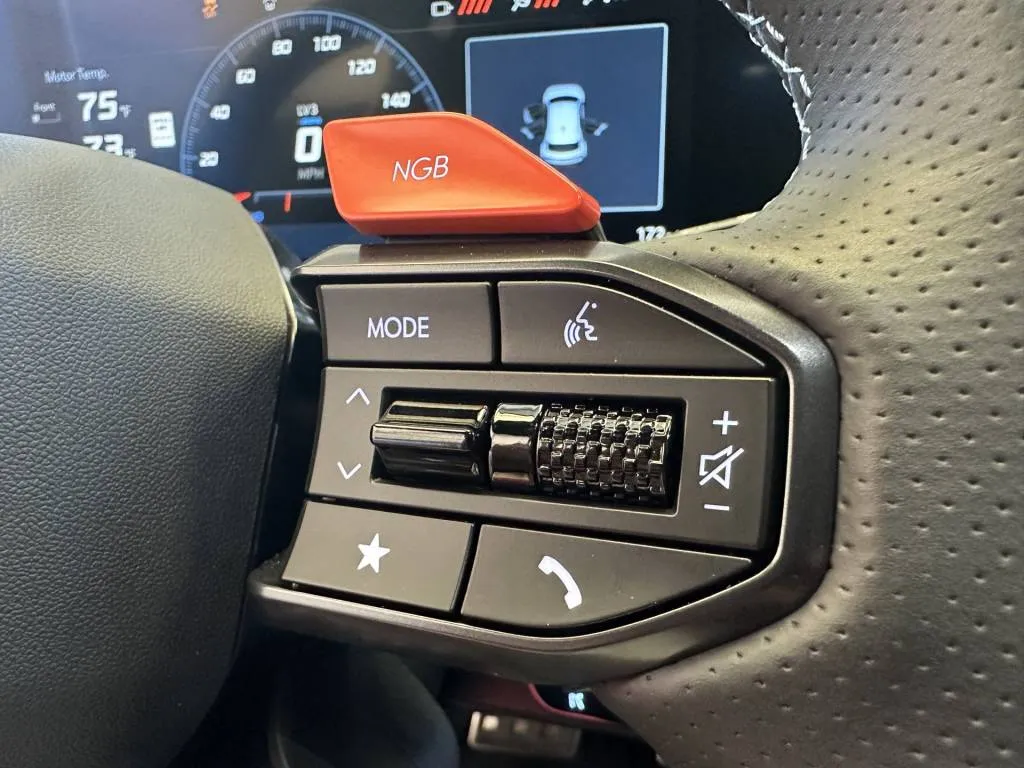
2025 Hyundai Ioniq 5 N – Emme Hall
Laguna Seca Raceway is a complicated track with plenty of blind crests, tricky decreasing-radius turns and a 0.2-mile front straight. This straight, I figured, would be a good place to boost, and thus grin.
I’m not quite sure how fast I was going when I hit the button. I had just finagled my way out of turn 11, a 90-degree left-hand turn, so it couldn’t have been more than 35 or 40 miles per hour. I floored the accelerator, waited a few seconds and smacked my right thumb on that NGB button.
Did I grin? Yes. Did I also panic? Again, yes. I had been using one of Hyundai’s pre-programmed propulsion sounds—more on that in a minute—and as soon as the NGB kicked in, all went silent. It was like I was suddenly in a hyperspace vortex where time and physics meant nothing.
Space, however, was in full effect as I careened towards turn one, a blind crest that turns slightly left that has terrified me every single time I’ve been to this track. I risked a brief glimpse of my speedometer and saw 105 miles per hour.
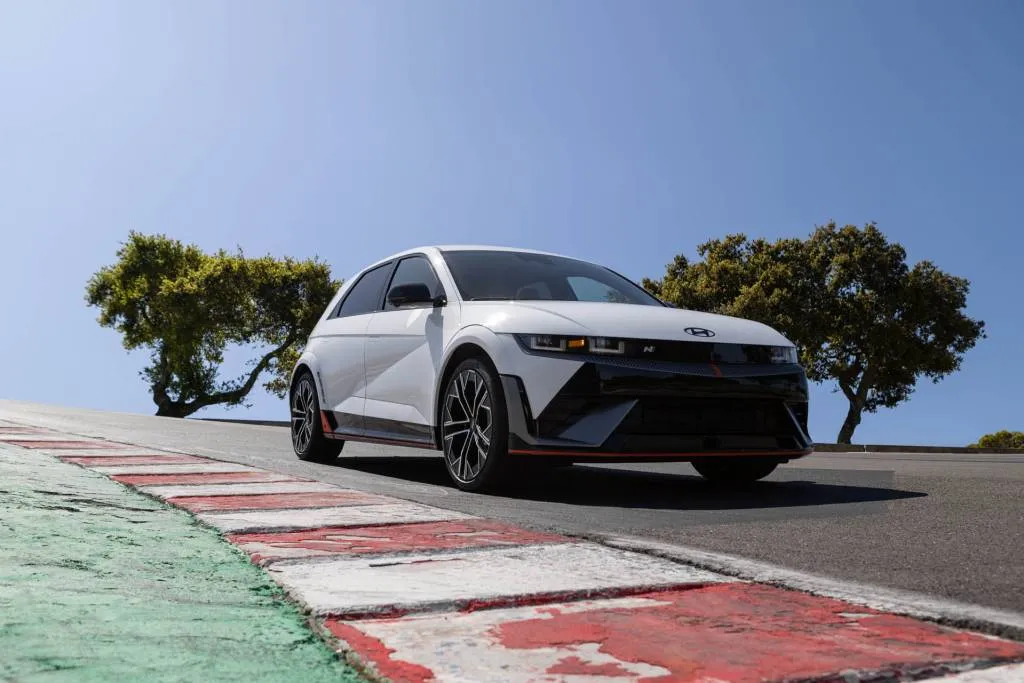
2025 Hyundai Ioniq 5 N
“This is fine,” I thought. “I’m fine, everything is fine.”
I managed to stay in the throttle over the crest without any kind of Code Brown moment, but the hysterical laughter that came out of me served as a reminder that I was indeed experiencing a tiny bit of fear. I got on the brakes hard and somehow managed to get through turn 2, the Andretti Hairpin, before NGB deactivated itself, the fake noises came back on and I was back to a slightly more manageable pace.
Hyundai later told me that NGB can be set to one of three audible sounds and doesn’t have to be silent. In retrospect it was kind of cool for the car to go quiet, as it was very clear something was happening. I just wasn’t necessarily prepared for it.
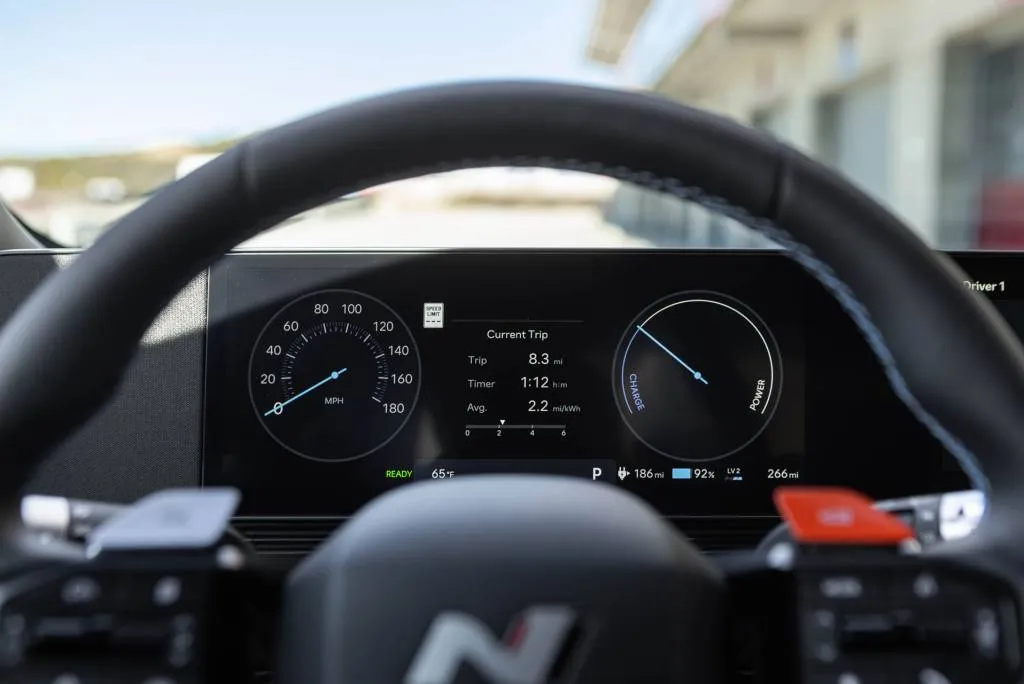
2025 Hyundai Ioniq 5 N
How do the fake gearshifts work in the Ioniq 5 N? Why did Hyundai choose this and did it ever consider a two-speed gearbox?
The Ioniq 5 N plays games with the driver with a simulated shiftable transmission, while it’s actually just running its motor up the rev range. Sure, I could keep it in Auto mode and let the two electric motors spin all the way up to 21,000 rpm, or I could let the computer in the N e-Shift feature manipulate my emotions a bit, keeping the motor—my perception of the motor—at a maximum of 7,750 rpm and divided into eight steps, making me feel more at one with the car.
Combined with the simulated sounds—and be patient, I’ll get there—shifting the car gave me a much more visceral experience. Auto mode is fine for toddling to the grocery store, but this is Laguna Seca, dammit. I wanted to feel like I was driving the car. I wanted to be in control.
The way the Hyundai engineers developed the simulated shifts is so simple it borders on genius and surely borrows from a driving simulator. When in manual mode, if I use the right paddle to upshift, the torque briefly drops then blips up, all in a nanosecond. From the driver seat it felt at minimum like a gentle push, but when I was on the throttle it was enough to jolt my head back a little, just like a real transmission would do when under load.
Coming into corners I could downshift and get some engine braking to help slow the car down, and put a few electrons back in the 84-kwh battery (more capacity than any other Ioniq 5). For science, I tried exiting turn 11 in fourth gear and the car protested with a noticeable lag, just like it would with an actual manual transmission.
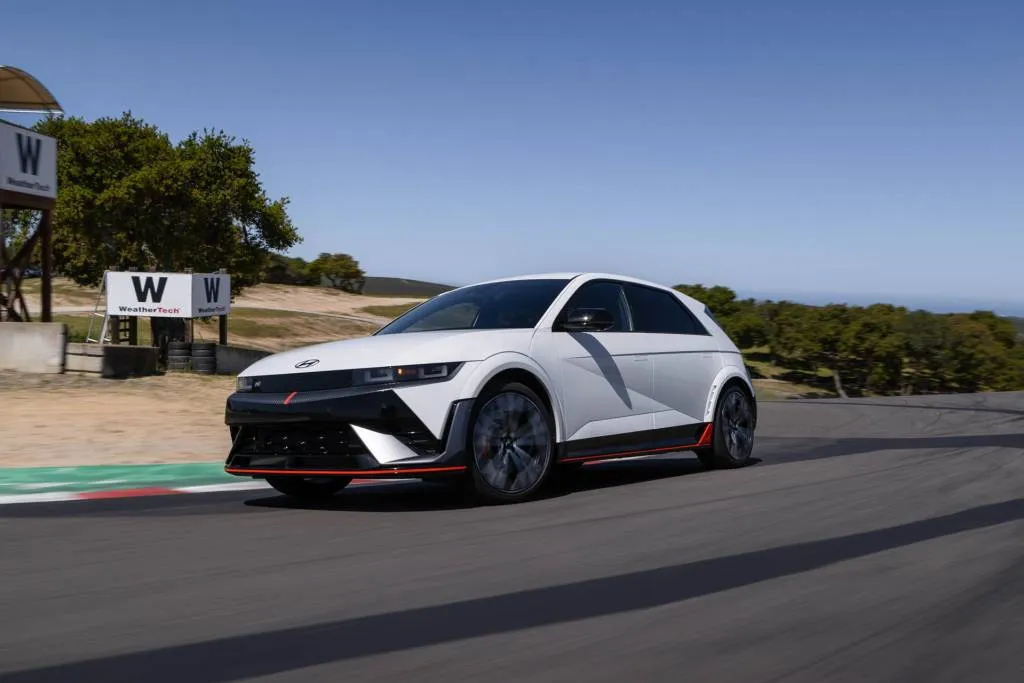
2025 Hyundai Ioniq 5 N
Hyundai could have gone the Porsche Taycan route and opted for a two-speed transmission, but again, it’s looking to build a bridge for ICE enthusiasts to cross over to The Democratic Republic of EVs. The company knows enthusiasts like manual transmissions and while this doesn’t have a clutch pedal, it at least gives the driver a modicum of control.
Joonwoo Park, Vice President N Brand Management Group, told me that a two-speed transmission would also add weight and cost. By eschewing a real, physical thing and merely adding a few lines of weightless code to its simple single-speed transmission, Hyundai adds lightness and helps keep the price of the Ioniq 5 N to $67,475 including $1,375 for destination.
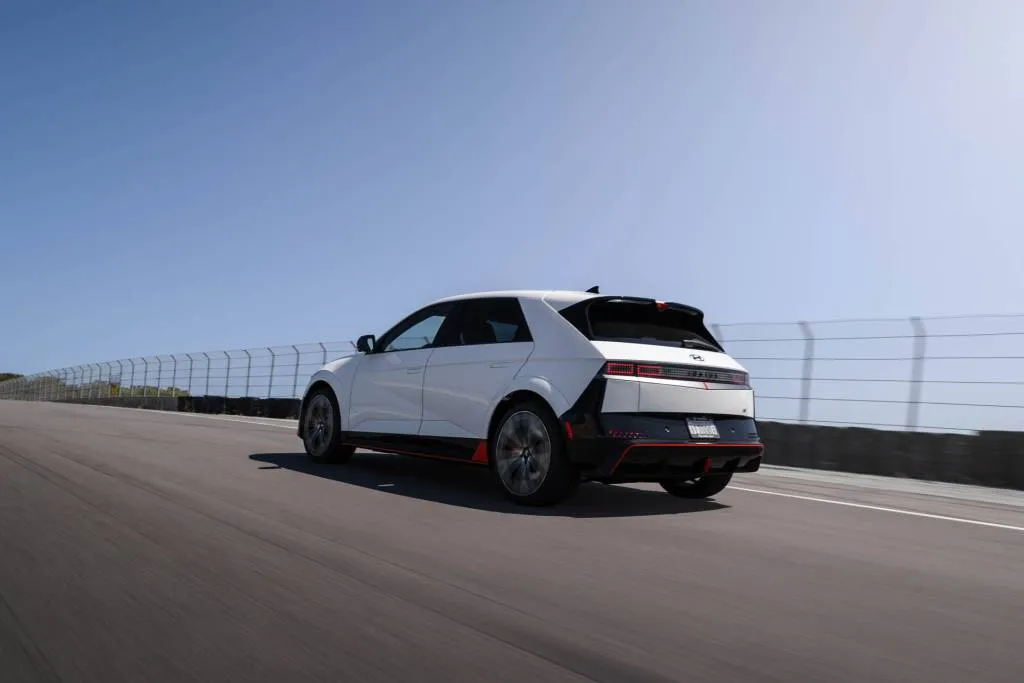
2025 Hyundai Ioniq 5 N
What about the Ioniq 5 N propulsion sounds themselves? What was the inspiration for this “simulated” part of its experience?
Okay, let’s talk about the sound! Hyundai has incorporated what it calls N Active Sound+ into the myriad choices drivers can make in the Ioniq N 5. Of course, you can have no sound, just the slight metallic whirr or the electric motors spinning up. That’s great for everyday driving but track shenanigans call for drivers to use all their senses, aural included.
The best sounding option by far is called Ignition. This is based on the 2.0-liter turbo four-cylinder engine found in the Elantra N, complete with lift-off pops and gurgles. My first session on the track was in silent mode with the single-speed gearbox doing its own thing. When I turned on the N e-Shift and the N Active Sound+, I got the physical motion of snapping off gears with the paddle shifters and the audible cues of a throaty little engine. Suddenly I was much more invested in the experience, and my time shows it. Sure, I’m no Max Verstappen, but my second session went by much quicker than the first, and it was much more fun to boot.
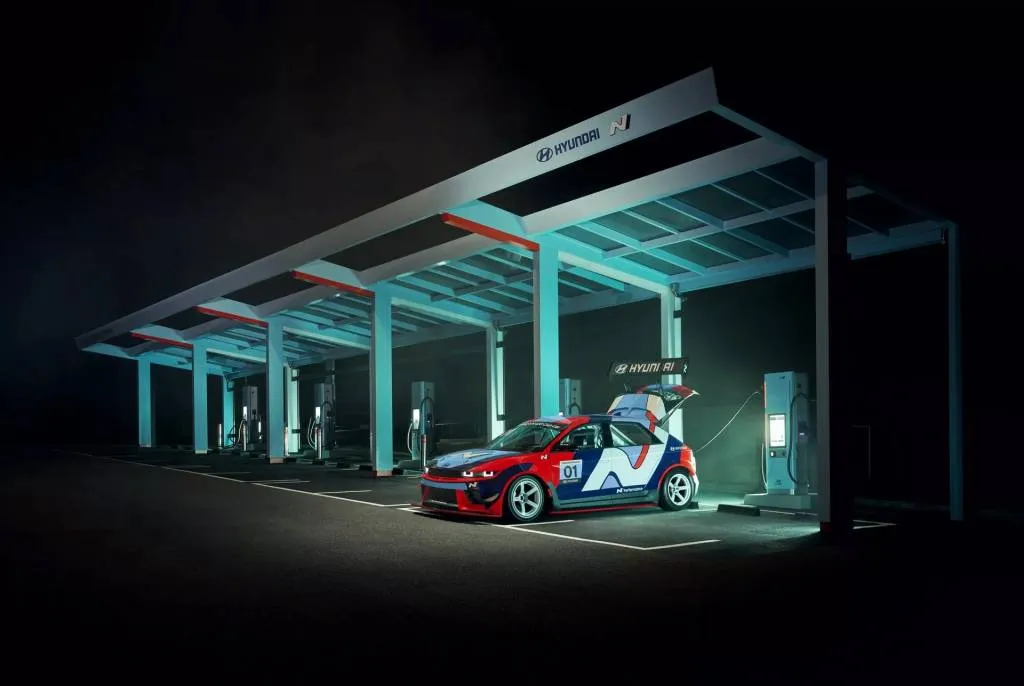
2024 Hyundai Ioniq 5 N eN1 Cup race car
The sound is pumped into the car from eight speakers, but also released to the unsuspecting pedestrian through two external speakers. Park said that those participating in the new eN1 Cup racing series in South Korea with the Ioniq 5 N may one day get to choose their own bespoke sound, so fans know who is coming around that corner and on to the straight.
I think I’d want mine to sound like a Mötley Crue guitar riff, but I digress.
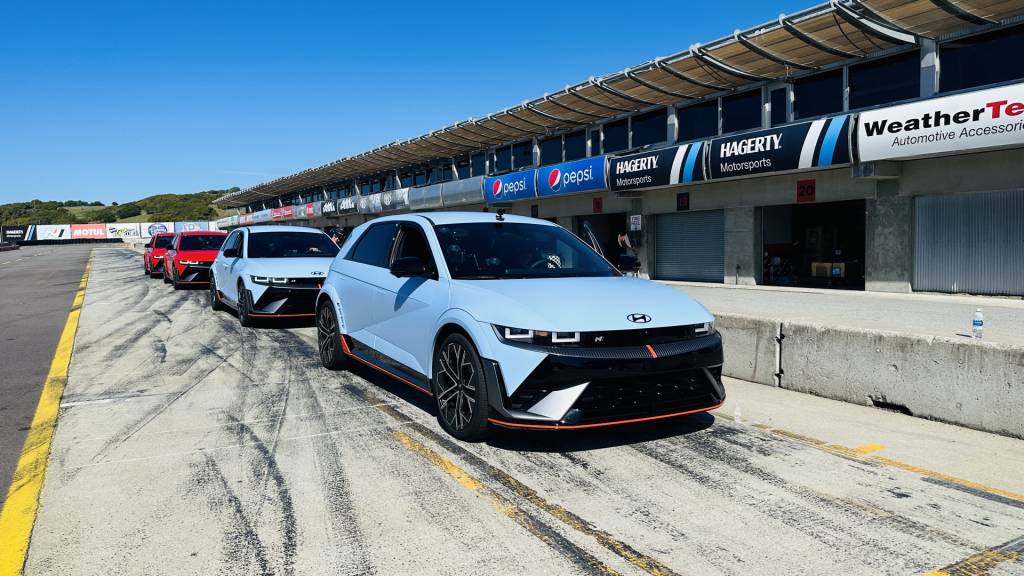
2025 Hyundai Ioniq 5 N – Emme Hall
Preconditioning is as much about getting the most track time as it is getting the quickest charge. How does this all work in the 2025 Hyundai Ioniq 5?
Of course, EVs have a few disadvantages when it comes to running hot and heavy on the track. Sure, an ICE vehicle will likely need more fuel during a day of track driving, but it’s a task completed in five minutes or less. With an EV, there are so many other components that come into play to make sure the batteries can deliver the most power and recharge quickly.
First, there is power delivery. The battery in the Ioniq 5 N can be set for a sprint race with an optimal battery temperature of 86 to 104 degrees Fahrenheit or an endurance race, where the temperature should be a bit cooler, between 68 and 86 degrees or so. Keep in mind that these numbers are for optimal performance, not range. During my time on the track I lost 10% of my charge in each of my two endurance sessions and the battery temperature stayed around 70 degrees. I used 16% of my battery juice in my one sprint session ending with a battery temperature of 93 degrees.
The Ioniq 5 N has triple the amount of cooling surfaces as the regular Ioniq 5, a cooling element inside the battery and its own separate radiator as well. Further, the computer can tell the driver how long it will take to reach optimal temperature, so she knows just how long before the next track session is a go.
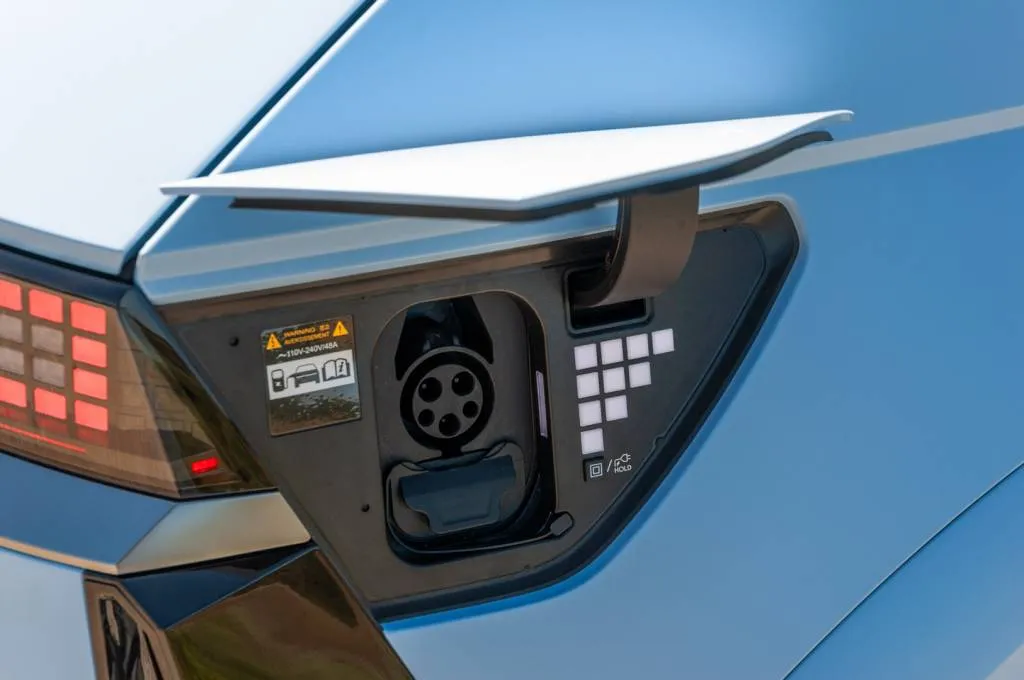
2025 Hyundai Ioniq 5 N
When it comes to charging, the Ioniq 5 N can fast-charge at a peak of about 235 kw thanks to its 800-volt architecture. However, anyone with any experience with an EV knows that rate is not guaranteed. Not only does the charger need to be reliable enough to deliver the power; the battery pack needs to be ready to accept it. Like most EVs, the Ioniq 5 N can condition the batteries for charging, getting temperatures in that sweet charging spot between 68 and 86 degrees.
Hyundai has installed 10 high-speed chargers at the Inje Speedway in South Korea to support its new eN1 Cup racing series. It also hopes to put chargers at tracks around the world including the famous Nurburgring, where the company says the Ioniq 5 N can do two laps flat-out of the nearly 13-mile track in Endurance mode.
As for charging at Laguna Seca, Hyundai had to hire a few trucks with generators to keep the electrons flowing. There are Tesla Superchargers but the Ioniq 5 N does not have NACS capability, nor is the station a Magic Dock station. Nuts.
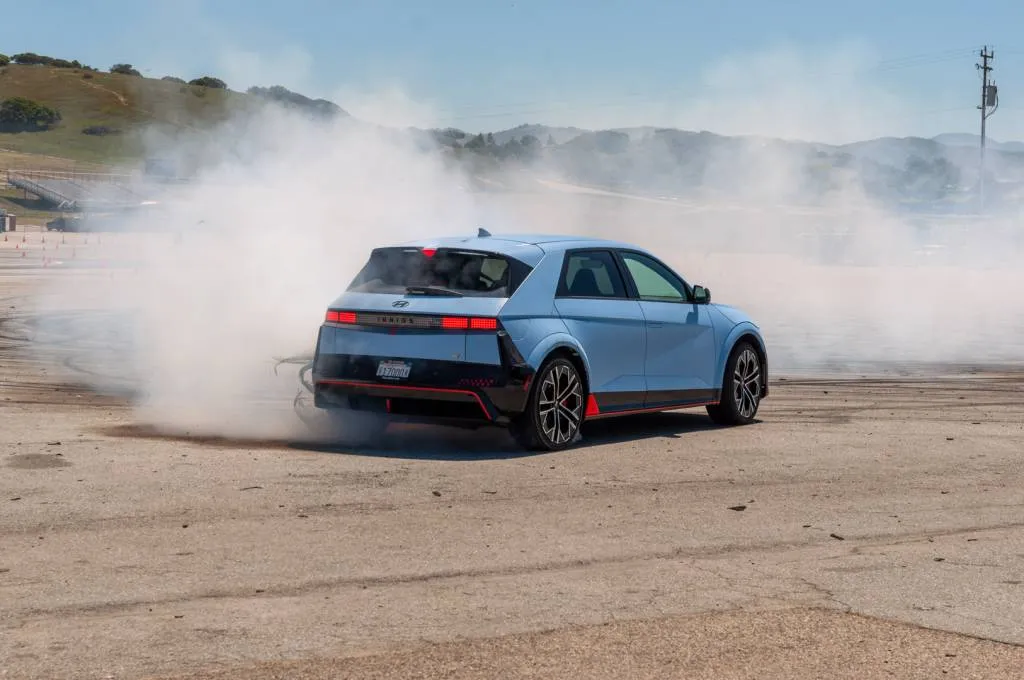
2025 Hyundai Ioniq 5 N
Overall, does the Ioniq 5 N compare to the EV6 GT in driving thrills—and in driving range?
Although the Kia EV6 GT might be built on the same platform as the Ioniq 5 N, the two are hardly comparable. Don’t get me wrong, the EV6 can generate 576 horsepower and 545 pound-feet of torque from its two electric motors—close—and it shares a few features with the Ioniq 5 N like an electronic limited-slip differential and a drift mode, but not its larger battery and intensified pack cooling. At the end of the day the EV6 GT is a quick car that can carve a canyon or two. It’s not a track car.
The EV6 GT doesn’t have an e-Shift feature nor deliver any audible cues, both of which enhance the Ioniq 5 N to the, ehem, nth degree. The Hyundai also has distinct settings for the motors, the steering, the electronic limited-slip differential, suspension and steering feel and the driver can push close to 100-percent of the torque to the rear wheels if he so desires.
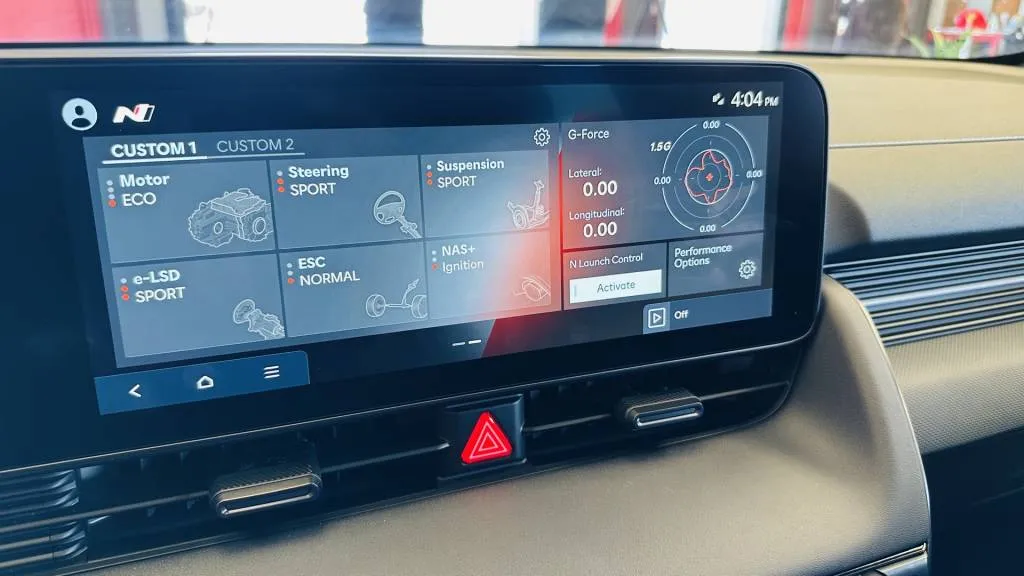
2025 Hyundai Ioniq 5 N – Emme Hall
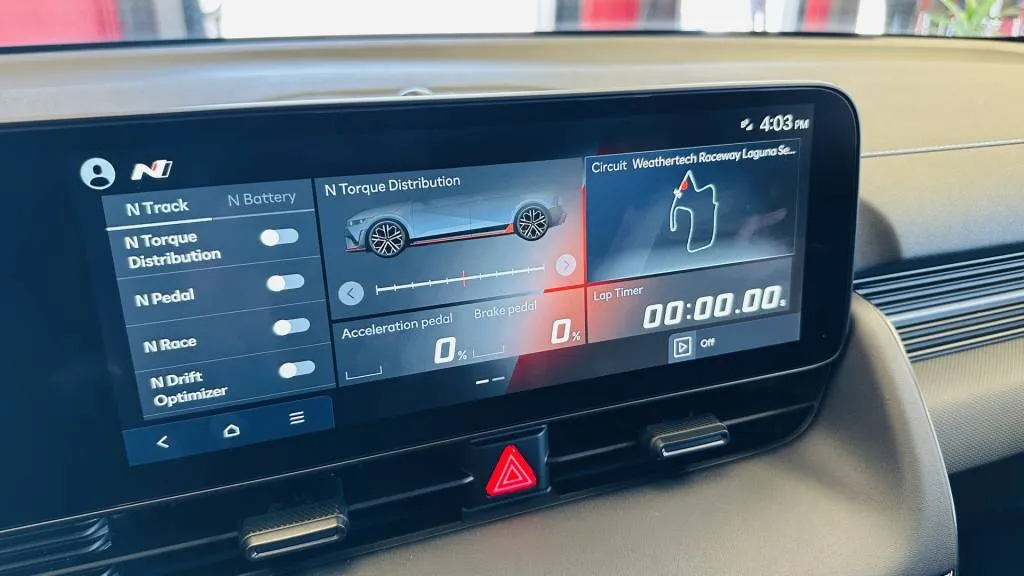
2025 Hyundai Ioniq 5 N – Emme Hall
There are even two different kinds of brake regeneration: I-pedal with your standard levels of regen or N pedal, which is meant more for weight transfer. Select this setting and the 0.36g of regen not only slows the car before a turn, but really gets the weight moved to the front, helping the Pirelli P Zero tires grip through the turns. Yeah, you’ll hear some squealing but trust me, the grip is there. The EV6 GT with its less sticky Goodyear Eagle F1 shoes just can’t compare.
As for driving range, well, that’s a tough one. I got to sample the Ioniq 5 N on public roads, but not for an extended amount of time. Hyundai says the 84-kwh battery is good for 221 miles of range—less, of course, while hooning on a track. Meanwhile the 77.4 kWh battery in the Kia EV6 GT can eke out 206 miles. Again, I would expect it to be difficult to hit that EPA number if you exploit the GT’s power at every green light.
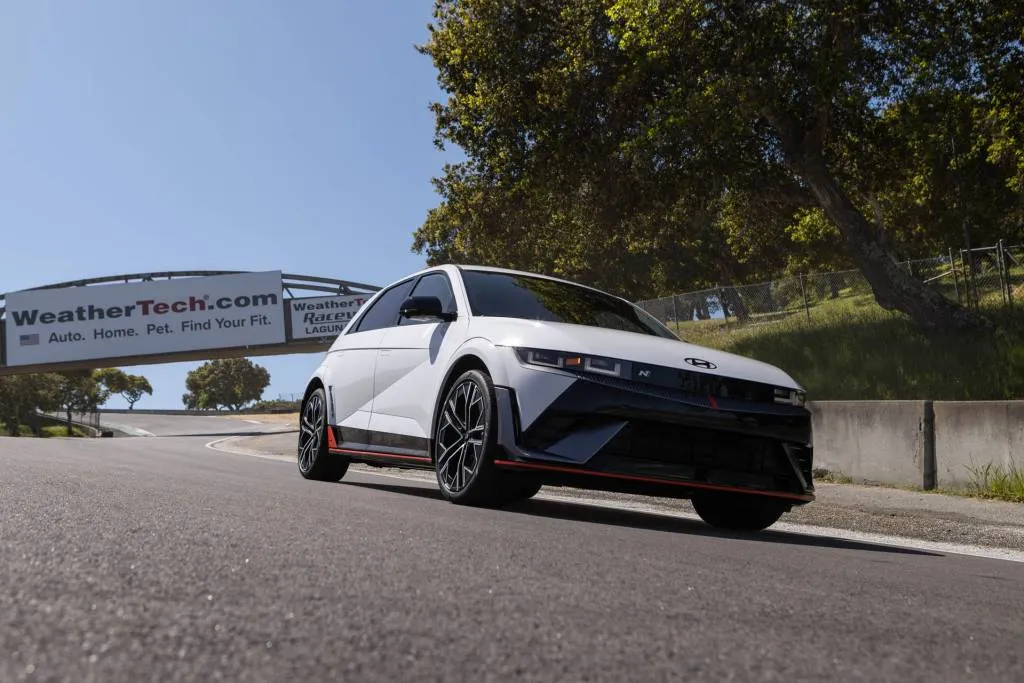
2025 Hyundai Ioniq 5 N
Hyundai Ioniq 5 N summary: Driving joy
By the time I left Laguna Seca I was worn out. I had pushed through the fearsome turn 1 at triple digits, bothered Hyundai engineers with technical questions and loved every second of it. While the 2025 Ioniq 5 N might be a rolling computer with myriad complicated settings, it produced more emotion and amusement than I thought possible from an electric vehicle.
This isn’t a car about saving the world with a green powertrain. It isn’t about making a commute safer with advanced driver’s aids or even about pushing the boundaries of all-electric range. No, the Ioniq 5 N is about driving joy. And I’m here for it.

2025 Mercedes-Benz eSprinter adds smaller battery, shorter wheelbase
The Mercedes-Benz eSprinter electric van debuted for the 2024 model year with a long 170-inch wheelbase, a large 113-kwh battery, and a high roof. For 2025, it adds a shorter 144-inch-wheelbase version, a smaller 81-kwh battery, and a shorter standard roof, the brand announced on Monday.
In that configuration, the base price falls from $74,181 to $63,545 before the mandatory destination charge. Like the 2024 model, the 2024 eSprinter is offered with a choice of 100-kw (134-hp) and 150-kw (201-hp) rear-mounted permanent-magnet motors. Both versions are limited to 75 mph.
The short-wheelbase, small-battery, small-motor, low-roof configuration becomes the payload leader in the lineup, with the ability to carry up to 3,516 pounds, almost 500 pounds more than the bigger body style. The lower roof and shorter wheelbase cut down cargo space from 488 cubic feet to 319 cubic feet.
The smaller battery cuts range to 192 miles on the more lenient European WLTP test cycle, versus 273 miles with the tall roof and larger pack. A U.S. EPA rating isn’t available, but with a relatively light load the eSprinter gets close to that in real-world U.S. driving. Like the bigger battery, it has a lithium-iron phosphate (LFP) chemistry, and it can DC fast-charge at up to 115 kw. It also has the same 9.6-kw onboard charger that allows an overnight charge on a 240-volt outlet.

2025 Mercedes-Benz eSprinter
The shorter wheelbase and smaller battery give fleet buyers more options to best fit with their needs, though the eSprinter lineup still leaves plenty of room for vehicles such as campers, overlanders, and other more luxurious private use. The Mercedes Van.EA platform due in 2026 may be the answer to buyers interested in those types of vehicles, and it could offer the dual-motor all-wheel-drive configuration this version lacks. Mercedes has said Van.EA vehicles will sell alongside current eSprinters for awhile.
Standard safety systems on the 2025 eSprinter include automatic emergency braking that adds intersection assist. A new Sideguard Assist system combines with blind-spot monitors to detect other road users in a “danger area” on the passenger side of the vehicle and warn the driver with flashing LED lights and acoustic warnings.
A new optional Moving-off Information Assist system works in a similar manner, but’s aim is to prevent crashes when the driver sets off. It detects road users 12 feet in front of the van and 19.6 inches to the sides. It warns the driver of an impending collision at speeds up to 6 mph.

2025 Mercedes-Benz eSprinter
A new front camera enables active lane control. Also new for 2025 are adaptive cruise control, traffic-sign recognition, active lane control enabled by a new front camera, and a surround-view camera system.
The 2025 Mercedes-Benz eSprinter is available to order now, and is set to arrive in the second half of the year.

Rivian grades chargers, China’s battery problem, EV ownership cost: Today’s Car News
China is making too many EV batteries. Rivian is applying real-world letter grades to EV fast-chargers for smoother route planning. And despite depreciation woes, many EVs still pay back big over five years of ownership. This and more, here at Green Car Reports.
Rivian has announced that it’s rating EV fast-chargers for real-world reliability—and including those letter-grade ratings in its route planning and interface. It’s a situation that may put some pressure on networks to prioritize reliability, and in the meantime it may favor Tesla Supercharging and its generally superior reliability.
According to a recent deep dive into EV cost of ownership, half of new 2024 EVs cost less over five years versus ICE models—despite depreciation, which was far greater this past year.
And China now makes enough batteries for global EV production, according to data analyzed by Bloomberg New Energy Finance this past week. In 2023, manufacturing capacity was already double what global battery-cell demand amounted to for EVs and energy storage combined, and if companies keep to announcements there may be even more of a gap between supply of cells and demand by EV plants.
_________________________________
Green Car Reports Newsletter
Sign up to get the latest green car and environmental news, delivered to your inbox daily!
I agree to receive emails from Green Car Reports. I understand that I can unsubscribe at any time. Privacy Policy.

Rivian EV route planner will grade charging networks
Rivian announced Monday that its vehicles will plan routes around charger reliability in a new way—by grading each real-world charge site.
The change is part of Rivian’s Software Update 2024.11.01, which rolls out to its vehicles, including the R1T electric pickup and R1S electric SUV, starting Monday. With it, route planning will favor those chargers that have a better record of reliably charging its vehicles.
Rivian notes that whenever a driver of its vehicles plugs into a fast charger, the vehicle logs a set of data including the charger’s peak rate, payment success, and overall session success. After there are enough sessions for that charger, good or not, it’s given a reliability grade from A (best) to F (worst).
As Rivian showed in provided images, the grades will be visible during route planning and in navigation and charging interfaces. According to Rivian, it’s the first automaker tool to make such a distinction and include collective reliability info in charger recommendations—and route-planning decisions.

Rivian charging grades for trip planning – Software Update 2024.11.01
Now, in Rivian’s trip planning and navigation, drivers will be steered toward charging sites with A and B grades as much as possible. As before, Rivian drivers can use preferences to set a route, filter chargers, and navigate to a destination, with the potential to dynamically change it along the way if stops are added.
The grading system will roll out for all fast-charging sites its vehicles can use, it says, including those on its own Rivian Adventure Network as well as multiple other networks—including Tesla Supercharger locations, which are now widely enabled and require the Rivian-provided adapter.
It also notes that ease of payment applies to these charger reliability scores. So while Superchargers and some other networks fully support direct-billing plug-and-charge capability, those without it might see their grades impacted by payment issues.
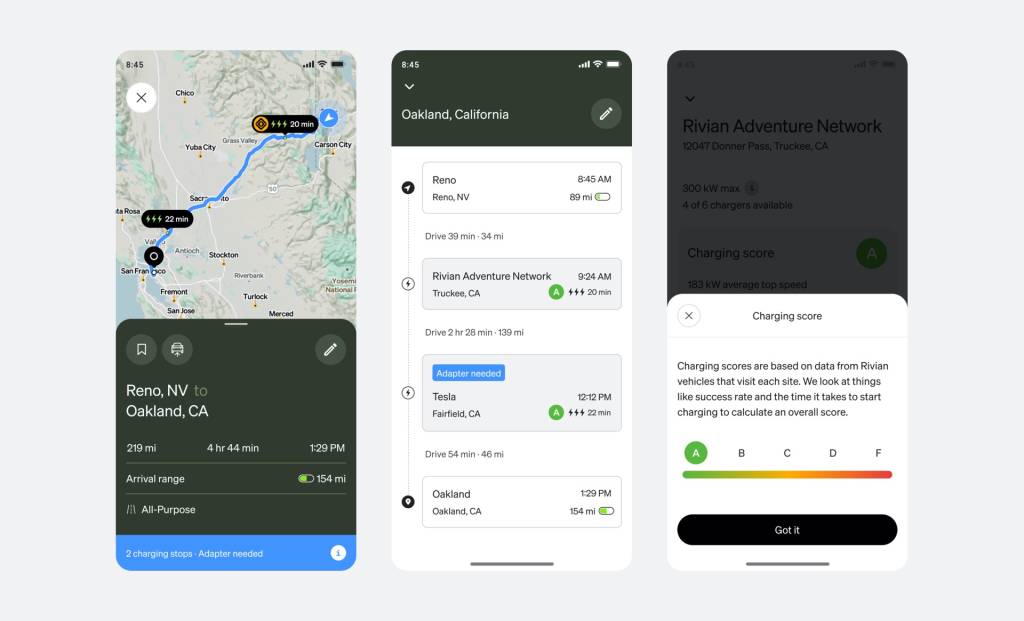
Rivian charging grades for trip planning – Software Update 2024.11.01
Rivian says that in choosing a fast-charging site, the vehicle’s peak rate may be above that of the charger, and in that case it clearly indicates so with a click of the information icon.
Although Rivian at no point directly says that it might choose a slightly slower charger that’s far more reliable over one that’s a speedy crapshoot, that appears to be the gist of it—and the real-world consequence, perhaps.
Charger reliability is surely top-of-mind for automakers, EV drivers, and prospective buyers alike. A 2022 UC Berkeley study found fast charging in abysmal shape in the Bay Area, with various hardware “nonfunctioning.” There, earlier this year, some criticized Electrify America’s most recent plan for being short on measures to address charger reliability.
The Biden administration’s Joint Office of Energy and Transportation has, with the buildout of NEVI-supported fast-chargers, laid out the basis for tracking charger reliability, although it’s oriented more toward where to make investment in the future rather than what works best at present.
Not just for Rivian but for any EV brand, finding a charger that simply works—and works at a charge rate that shows off the capabilities of the vehicle—is important for making a positive impression. With Rivian’s high-profile grade system, perhaps it will instill on charger networks that better uptime and reliability really do make good business sense.

Report: China now makes enough batteries for global EV production
China already has enough battery manufacturing capacity to supply all global EV production, according to Bloomberg New Energy Finance.
BNEF estimates to global battery-cell demand for both EVs and energy storage came in at around 950 gigawatt-hours in 2023—but manufacturing capacity was more than twice that, at around 2,600 gigawatt-hours.
China’s declared 2023 battery production alone was close to the actual global demand, according to BNEF, which notes that the U.S., Canada, Europe, and India are now incentivizing local battery production to compete with China—making the gap between supply and demand even greater.
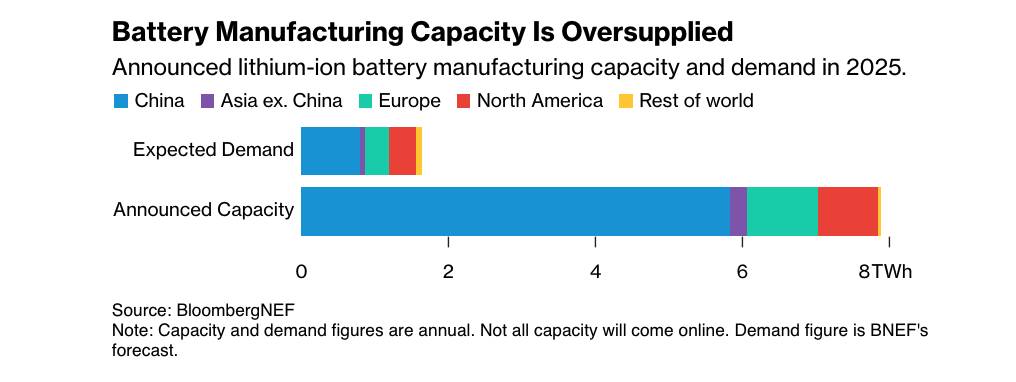
Announced battery manufacturing capacity and demand in 2025 (via Bloomberg)
BNEF reported 7,900 gigawatt-hours of annual battery manufacturing capacity announced by the end of 2025, but demand projections of just 1,600 gigawatt-hours. And that assumes continued, steady global EV sales growth, as well as growth in energy-storage use. Even half that total announced manufacturing capacity would be enough to equip every new car sold globally next year with a 50-kwh battery pack, BNEF calculates.
Overambition in building EV battery factories, along with a global lithium glut, after concerns of short supply just a few years earlier, has caused battery prices to drop inside and outside China across passenger cars, commercial vehicles, and energy storage.
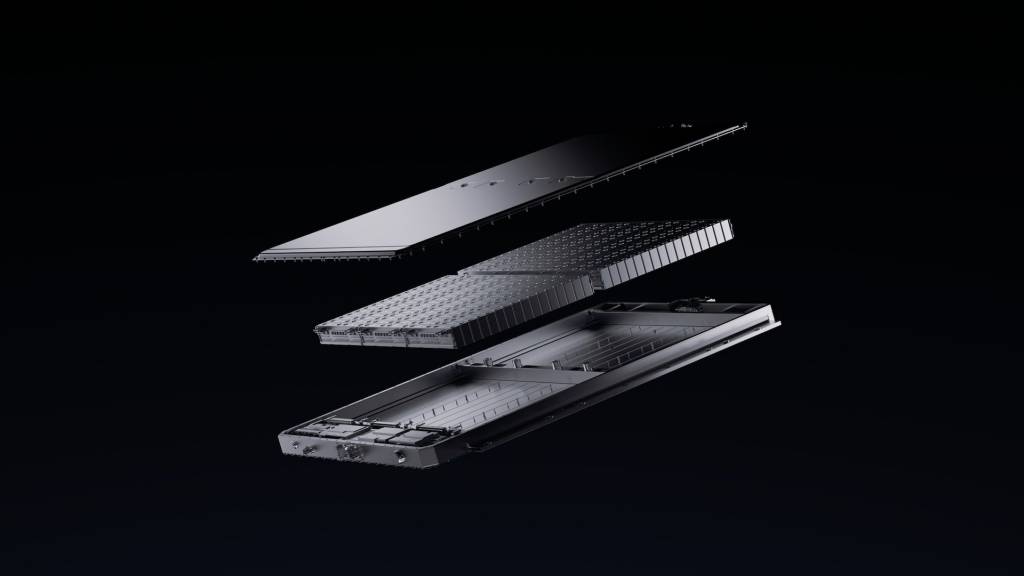
CATL Shenxing battery
There was concern over some price hikes in the costs of batteries in 2022. But as the Department of Energy reminded us earlier last year, battery costs have kept falling if you consider inflation and look at it in constant dollars.
A recent International Council on Clean Transportation (ICCT) study suggested that will help them reach cost parity with gasoline models within a couple of years—sooner than anticipated. And Goldman Sachs analysts expect a 40% drop in battery prices that will help boost sales, with or without subsidies.

Half of 2024 EVs have lower 5-year ownership cost vs. ICE
Many EVs have a lower five-year cost of ownership than comparable gasoline models, according an annual roundup from Vincentric, a source for ownership cost calculations for websites and automakers.
Vincentric’s analysis covers eight factors: depreciation, fees and taxes, financing, fuel cost, insurance, maintenance, opportunity cost and repairs. It assumes new vehicles are driven 15,000 annually over the first five years of ownership.
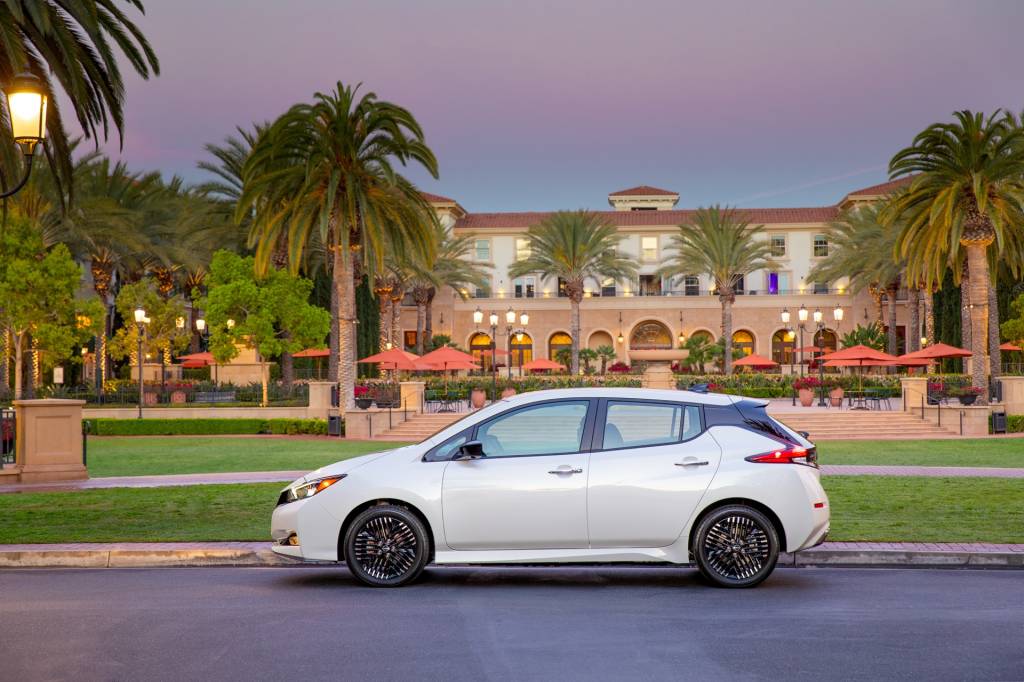
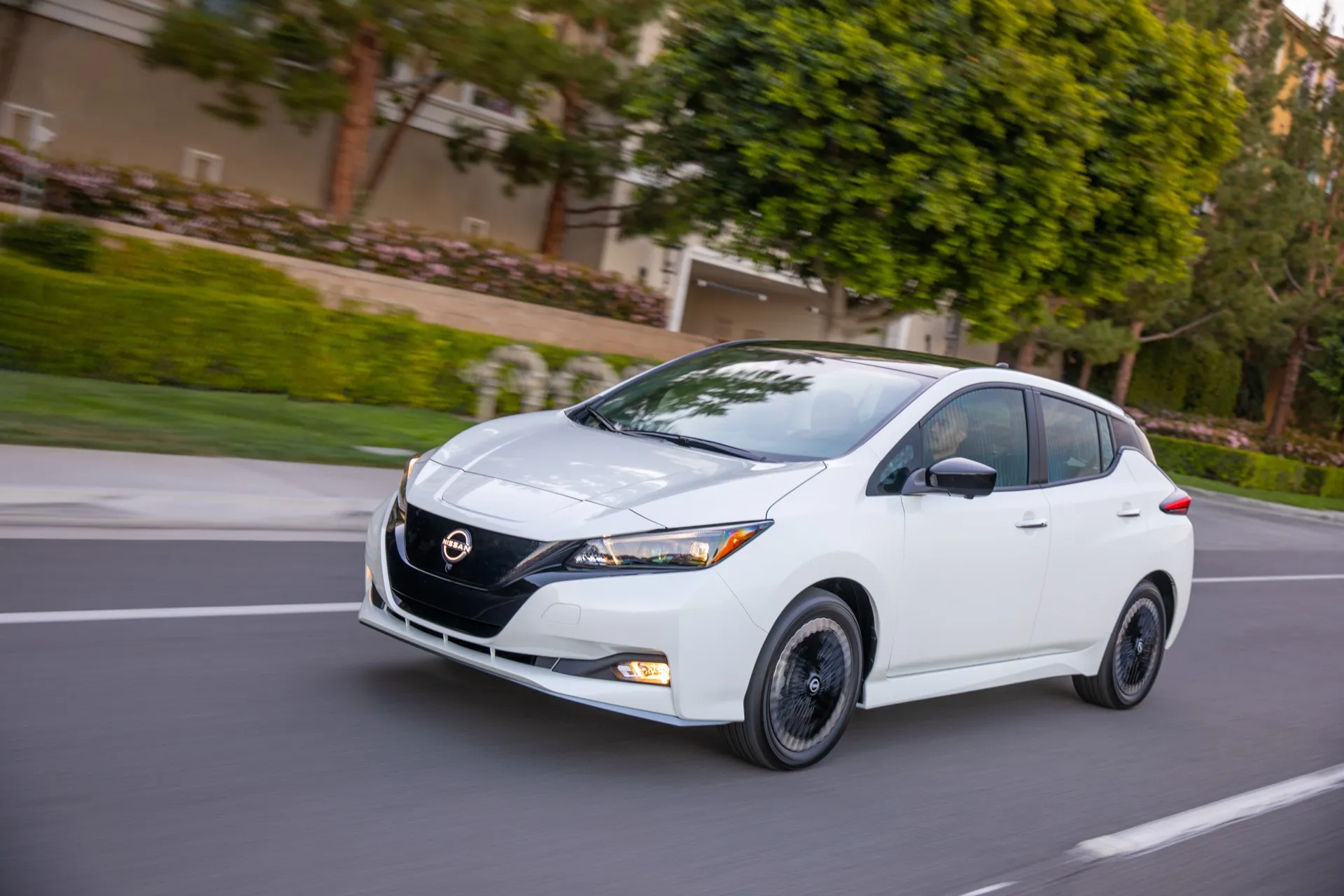
2024 Nissan Leaf
In its latest analysis, Vincentric found that 20 of 41 electric models (49%) cost less to own over five years than their gasoline counterparts. That’s down from the 2023 analysis, in which 52% of EVs surveyed had lower ownership costs than gasoline vehicles.
Depreciation is where EVs continue to lag behind gasoline vehicles, largely due to higher purchase prices, according to Vincentric. The loss of the federal EV tax credit for many models hasn’t helped, either. But analysts note that EV costs are expected to drop in the next few years, potentially allowing them to achieve price parity with gasoline models. That’s likely to happen because of continually falling battery prices, driven down by excess manufacturing capacity and more availability of raw materials.
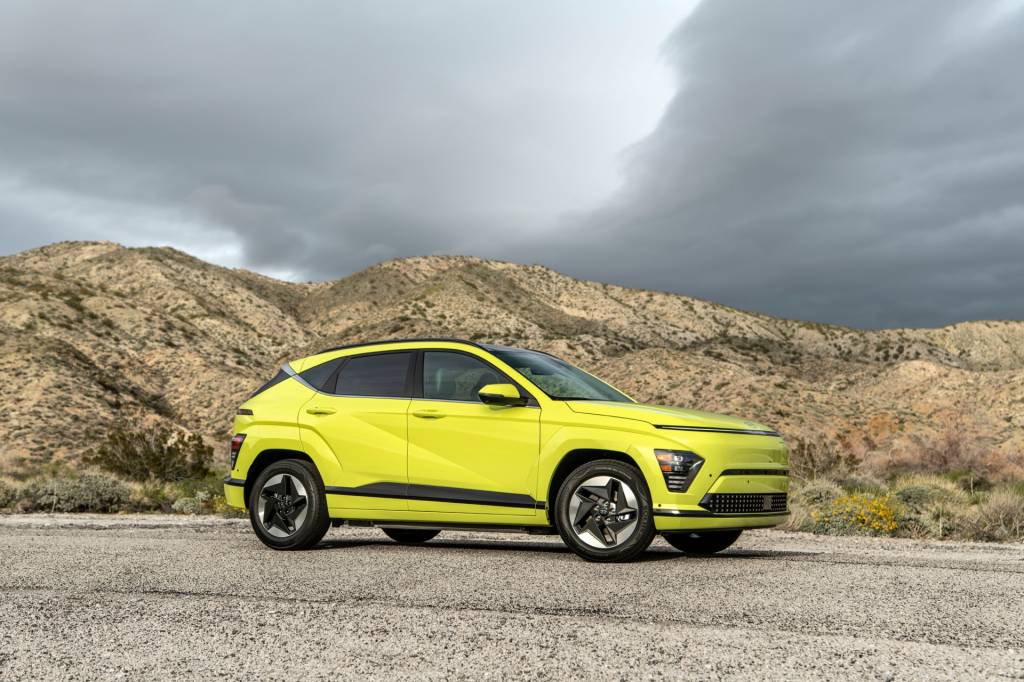
2024 Hyundai Kona Electric
Vincentric also found that 19 of the 41 EVs surveyed for 2024 recouped their price premiums in seven years, with eight of those EVs already having a lower purchase price than an equivalent gasoline model.
It’s a reminder that ownership-cost advantages can vary based on a variety of factors, such as where you live and the type of vehicle. A 2020 Consumer Reports study found that the ownership-cost advantages of EVs were particularly strong for SUVs and pickup trucks, for example.

Greg McGuire explores Mcity’s next chapter (Episode 246)
The managing director of the connected and autonomous vehicle test track details the facility’s evolution into a makerspace for mobility innovation that encompasses a data engine and mixed-reality tech development.

Fiat 500e review, F-150 Lightning price cut, diesel hybrids, curbside EV chargers: Today’s Car News
Do EVs need a breakthrough in battery energy density before they make environmental sense?
And which luxury EV is bringing back the appearance of an internal combustion grille? Will fake tailpipes come next?
This is our look back at the Week In Reverse—right here at Green Car Reports—for the week ending April 12, 2024.
In a first drive of the 2024 Fiat 500e electric car, Green Car Reports found that this fashion accessory and short-range EV remains a good fit for the city—with many of the same limitations as the first-generation 500e sold on the West Coast.
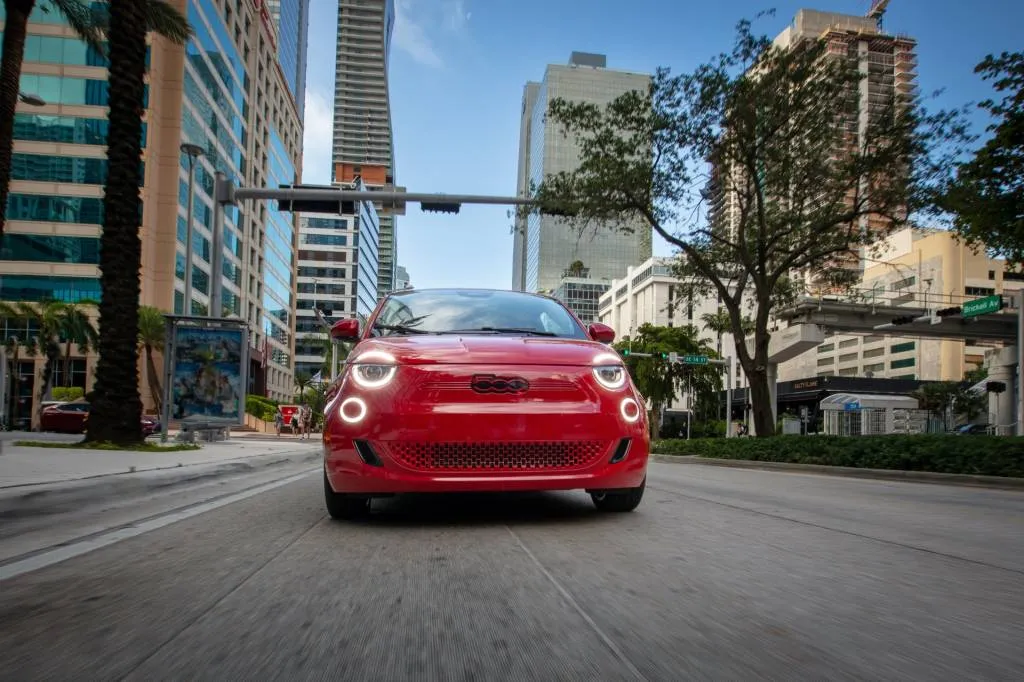
2024 Fiat 500e
The 2024 Ford Mustang Mach-E boasts more range and faster charging—as well as quicker acceleration for much of the lineup—at a price thousands less than when the 2023 Mach-E arrived a year ago. The Mach-E now offers up to 320 miles of EPA range, according to Ford. Top-performance Mach-E GT versions with the Performance Upgrade are also now capable of outperforming the Tesla Model Y Performance, Ford claims.
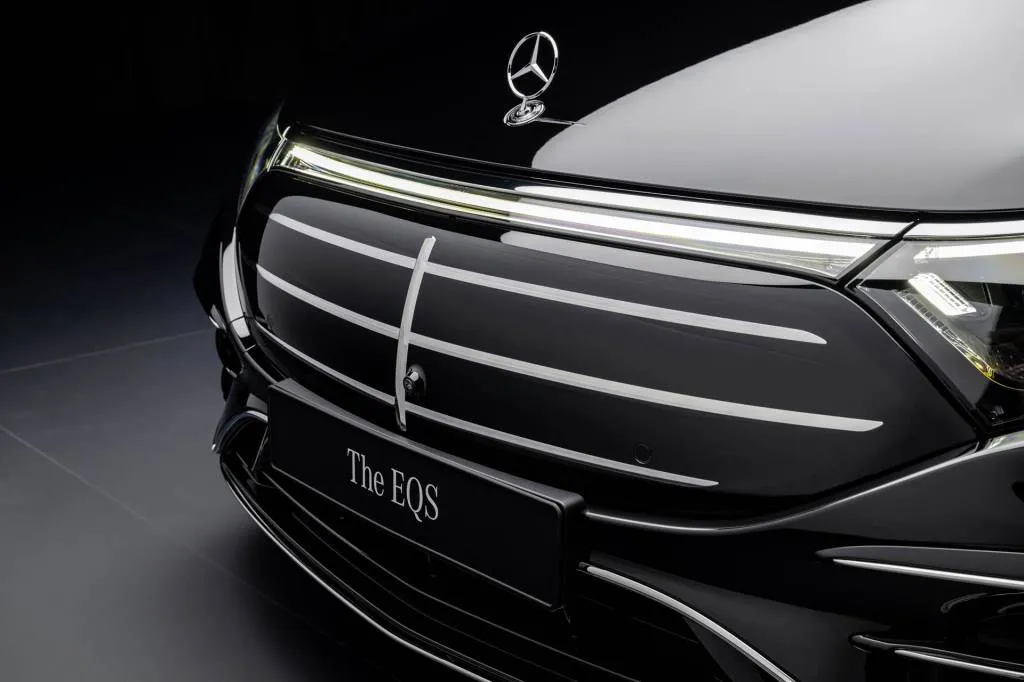
2025 Mercedes-Benz EQS
The big 2025 Mercedes-Benz EQS hatchback is getting an extensive refresh for the new model year, including more battery capacity and driving range, improved brakes, and a limousine-like rear seating package. A grille that attempts to mimic that of the gasoline S-Class is also part of the revamp.
Ford is also already reversing course on recent F-150 Lightning price hikes. It’s cut 2024 F-150 Lightning prices by up to $5,500—with the recently introduced Flash version offering the biggest price cut and several mid-range models cut by thousands.
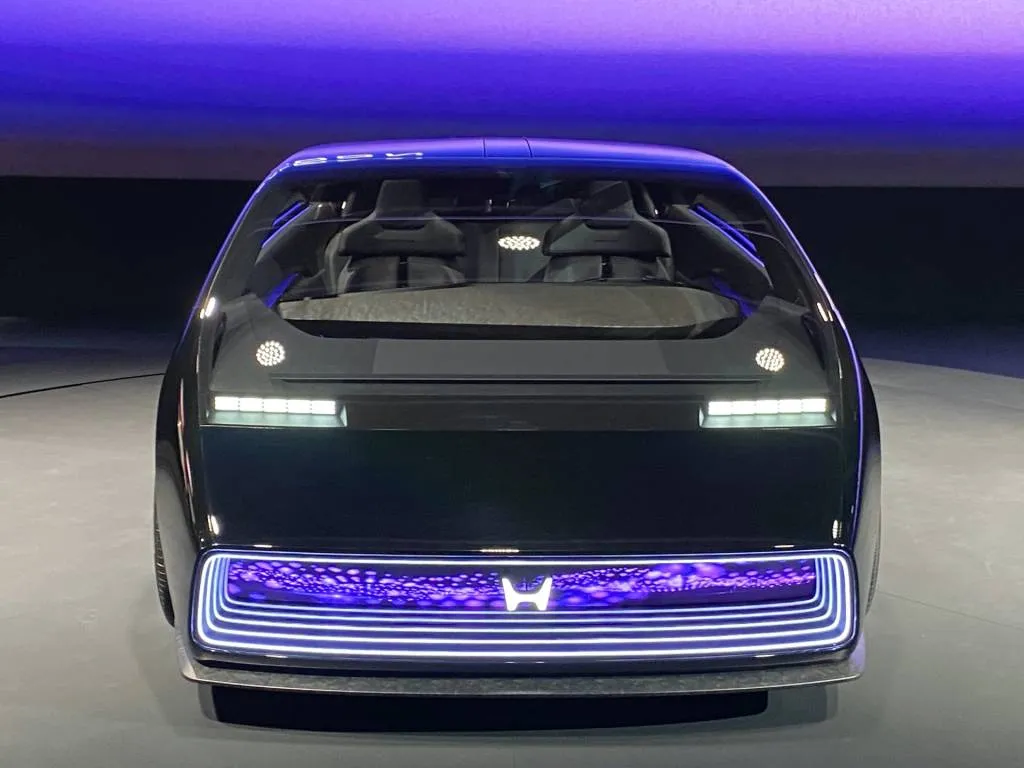
Honda Saloon Concept – 2024 CES
Honda touted the flexibility being built into its Ohio EV hub, which might build hundreds of EVs a day or a mix skewing heavily to hybrids, depending on demand. Included in the buildout for the brand’s next-generation EVs are 31-foot-tall, 6,000-ton die-cast machines that outdo those used at Giga Texas.
Kia last week detailed plans for its shift toward EVs and electrified powertrains through the decade, and it hasn’t budged in its target of 1.6 million Kia EV sales annually by 2030. But it does now see about 800,000 annual hybrid, plug-in hybrid, and fuel-cell sales by then—making electrified vehicles 58% of its mix in 2030.

Voltpost streetside EV charger
A significant number of U.S. curbside EV chargers appears to soon be on the way. Voltpost announced plans to roll out its lamppost-based EV chargers in major U.S. metro areas including New York, Chicago, and Detroit. These Level 2 AC chargers will have 20 feet of retractable cable and a supporting app, and installation costs a fraction of what siting and installing a separate charger would.
Toyota had previously suggested that it would stop selling diesels in passenger vehicles. But it continues to sell diesel SUVs across most regions, even in Europe. And in recent remarks an Australian executive for the company insisted that diesel “is not going to die off anytime soon,” and hinted that diesel might be paired with hybrid powertrains “particularly for heavy vehicles.”
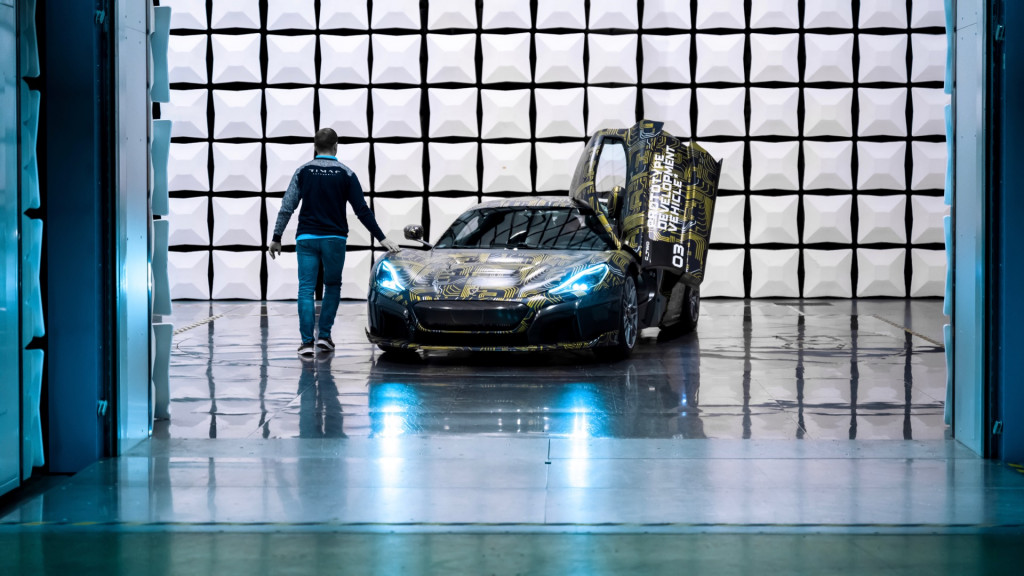
Rimac C_Two electromagnetic-emissions testing
Rimac announced that it will help BMW with next-gen EV batteries, as the company that started with a BMW EV conversions, and then a supercar maker, now also shifts roles to a high-tech supplier.
Stellantis CEO Carlos Tavares last week claimed that EVs need a “breakthrough” in battery-cell energy density before they make sense from an environmental standpoint versus combustion vehicles—partly because of all the extra weight and raw materials. That stands in stark contrast to the overwhelming majority of academic papers and calculations from everyone ranging from environmental organizations to automakers, suggesting that EVs in their present state of tech pay off quickly in CO2 and overall environmental impact.

PSA Group CEO Carlos Tavares and GM CEO Mary Barra
With a bill signed into law last week, New Jersey is marking up EV ownership with an additional $1,000 upfront fee that applies on top of other existing registration fees. While it effectively replaces the role of the gas tax for EVs in funding road maintenance, it could amount to a disincentive toward the state’s adoption of California’s EV mandate and its goel to hit 50% EV sales by 2027 and 100% by 2035.
Despite long-held plans to align with California emissions standards, Connecticut and Maine have delayed adopting California’s EV sales mandate with recent decisions. EV advocates, concerned this will push out adoption of the rules to later in the decade, point to misinformation campaigns from fossil-fuel-funded groups.
Ford, GM, and Stellantis have been relying on sales of expensive full-size pickup trucks to effectively bankroll the EV push. But now, will sagging sales due to high interest rates impact the future EV product rollout?
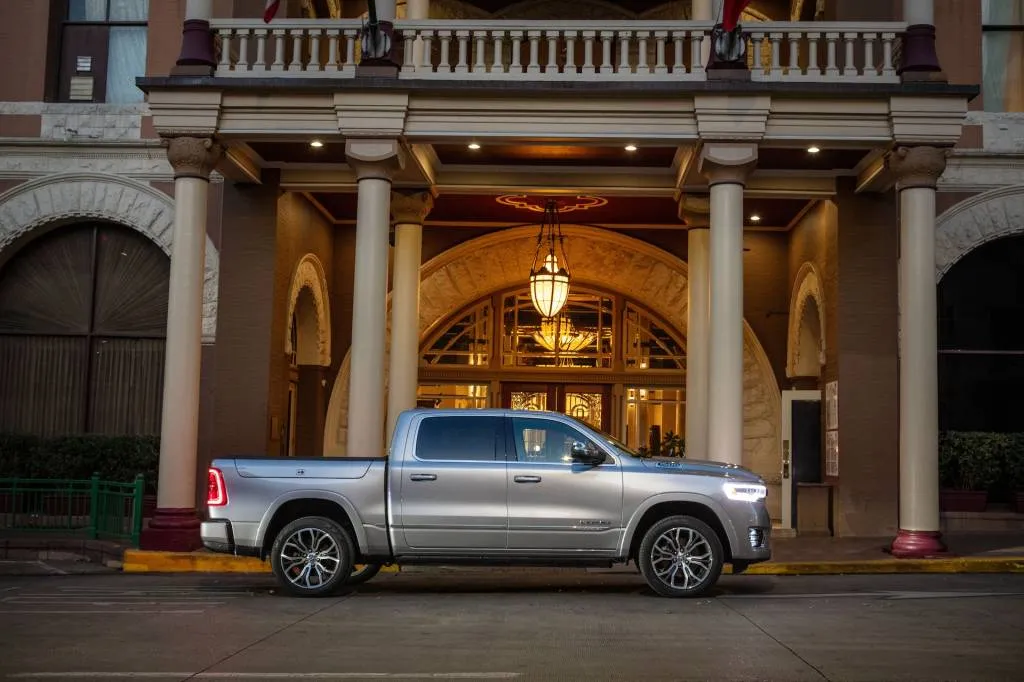
2025 Ram 1500 Tungsten
Electric passenger cars plus electric trucks of all kinds could add up to 65% of today’s total grid demand by 2050, noted a study out this week from the Natural Resources Defense Council and EPRI, which represents utilities. But according to the study, efficiency improvements to EVs could pay off big by reducing that load, cutting costs for all Americans and not only those who are driving an EV by then.
And according to polling results out this week from Gallup, American EV ownership is growing, yet fewer car shoppers are considering EVs who don’t already own one. Gallup found these results to be increasingly tied to political affiliation and noted, as various other studies have, that older Americans are less likely to buy (and consider) EVs.
_______________________________________