
Author: EVAI

Tesla Superchargers are getting longer cables for non-Tesla EVs
- Tesla’s installing longer cables on its Superchargers
- Superchargers can now detect when a non-Tesla EV is plugged in
- Tesla’s Supercharger software will take into where a vehicle’s charge port is located
Tesla is installing longer cables and making other changes to accommodate EVs from other brands at its Supercharger DC fast-charging stations.
The official Tesla Charging account on X (formerly known as Twitter) the social media network owned by Tesla CEO Elon Musk, recently posted that the automaker is increasing the number of longer-cable V4 chargers and expects them to outnumber short-cable chargers within the next 18 months.
Tesla has also modified over 1,500 sites to avoid drivers blocking a charging space to reach a charger, and has updated the software that tells Tesla drivers which charging stalls are available, according to the same post.
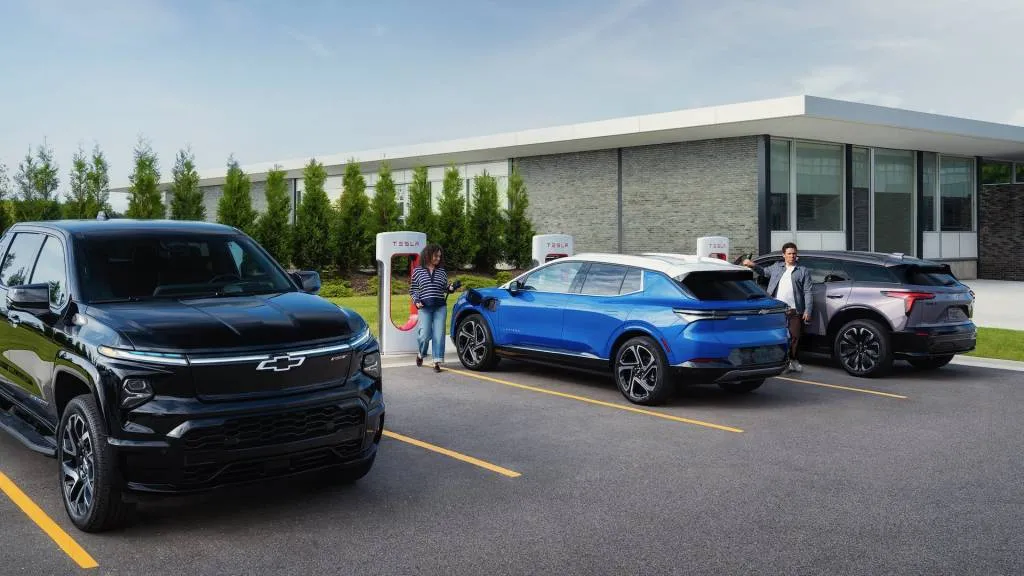
Chevrolet EVs at a Tesla Supercharger station
To further account for EVs potentially blocking spaces to plug into chargers with short cables, Tesla claims it can now detect when an EV with a charge port located somewhere other than the left rear or right front of the vehicle is plugged in at shorter-cable spots in an effort not to overpromise on charger availability.
This is possible because Tesla can now detect what type of vehicle is plugged in, Max de Zegher, Tesla’s director of charging in North American said in an X post, adding that the charger-availability algorithm now refreshes about every 15 seconds.
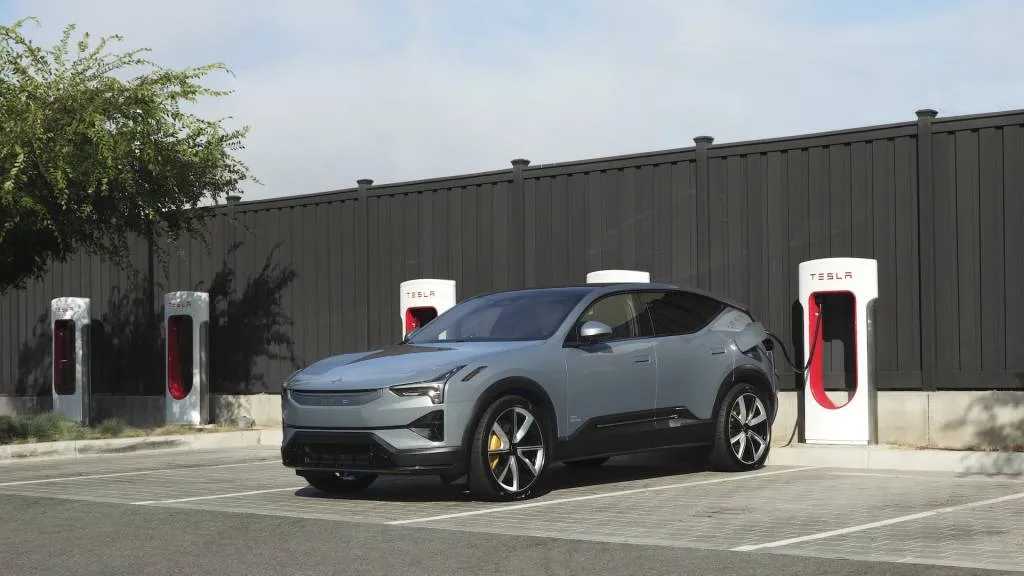
Polestar 3 at a Tesla Supercharger station
A migration of most major car brands to Tesla’s North American Charging Standard (NACS) began in May 2023 with Ford, followed the formalization of NACS as a true standard by the SAE and the backing of that standard by the Biden administration, which has prioritized funding for expansion of public charging. Musk, meanwhile, nearly shuttered the Supercharger team earlier this year before backtracking and promising a $500 million expansion of the network.
Such expansion will likely be needed as more automakers equip their EVs to charge at Supercharger stations. To date, Ford, General Motors, Rivian, Polestar, and Volvo have made adapters available to customers, while the first non-Tesla EVs with built-in NACS ports are expected to appear in 2025.

Hyundai recalls 145,000 Ioniq and Genesis EVs for loss of drive power
- 145,235 Hyundai and Genesis EVs have been recalled
- The recall stems from a potential issue with the onboard charger
- The issue results in a potential loss in drive power
Hyundai is recalling 145,235 electric vehicles from its main brand and Genesis luxury brand because of a potential issue with onboard chargers that could cause vehicles to enter a fail-safe driving mode with reduced power.
The recall includes 2022-2024 Hyundai Ioniq 5, 2023-2025 Hyundai Ioniq 6, and 2023-2025 Genesis GV60 models. Those three are based on the same E-GMP dedicated EV platform. Other vehicles in the recall population, including 2023-2025 Genesis Electrified GV70 SUVs and 2023-2024 Genesis Electrified G80 sedans, are electric variants of internal-combustion models.
Integrated charging control units in the affected vehicles may become damaged by certain electrical loads, preventing them from charging the vehicles’ 12-volt batteries, according to the National Highway Traffic Safety Administration (NHTSA). This triggers the fail-safe mode, which initially allows full power but gradually decreases available power over time.
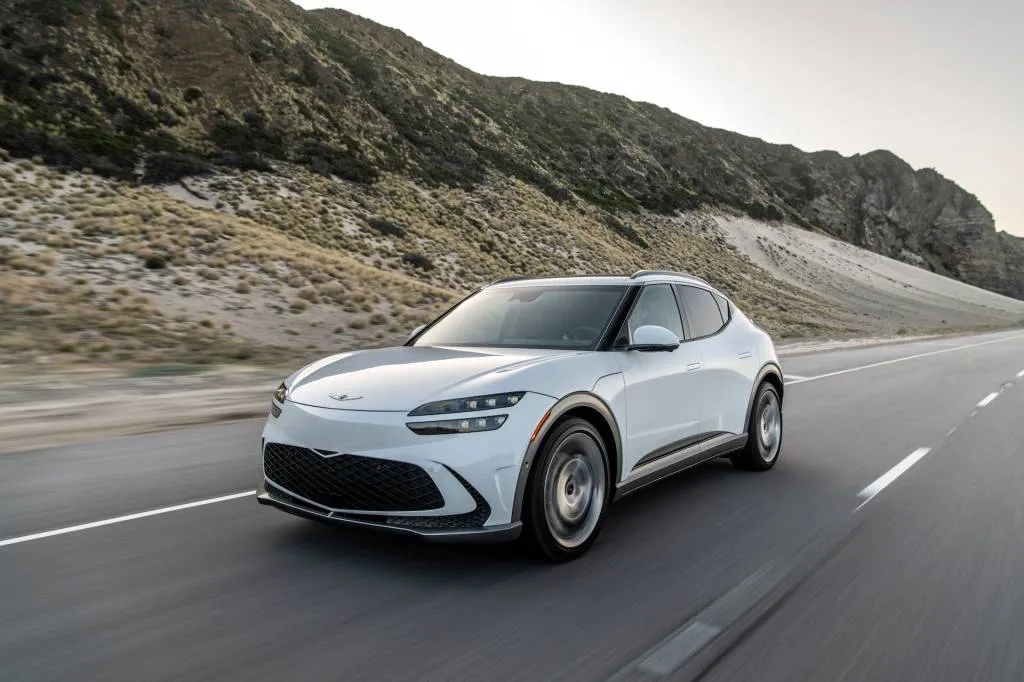
2024 Genesis GV60
Drivers will see warnings on the dashboard and hear audible chimes if this fault occurs, the NHTSA said, adding that other vehicle functions such as steering and brake assist, as well as airbags, will remain functional.
The remedy involves updating the charging control unit’s software, as well as inspection of the unit and its fuse, with replacement as needed. All of this will be done free of charge by Hyundai and Genesis dealers.
Hyundai plans to mail owner notification letters Jan. 17, 2025. Owners can also contact Hyundai customer service at 1-855-371-9460 or Genesis customer service at 1-844-340-9741. Reference numbers are 272 for Hyundai and 025G for Genesis. Some of the recalled vehicles are involved in a previous recall, but will need to have the new recall work completed as well, according to the NHTSA.
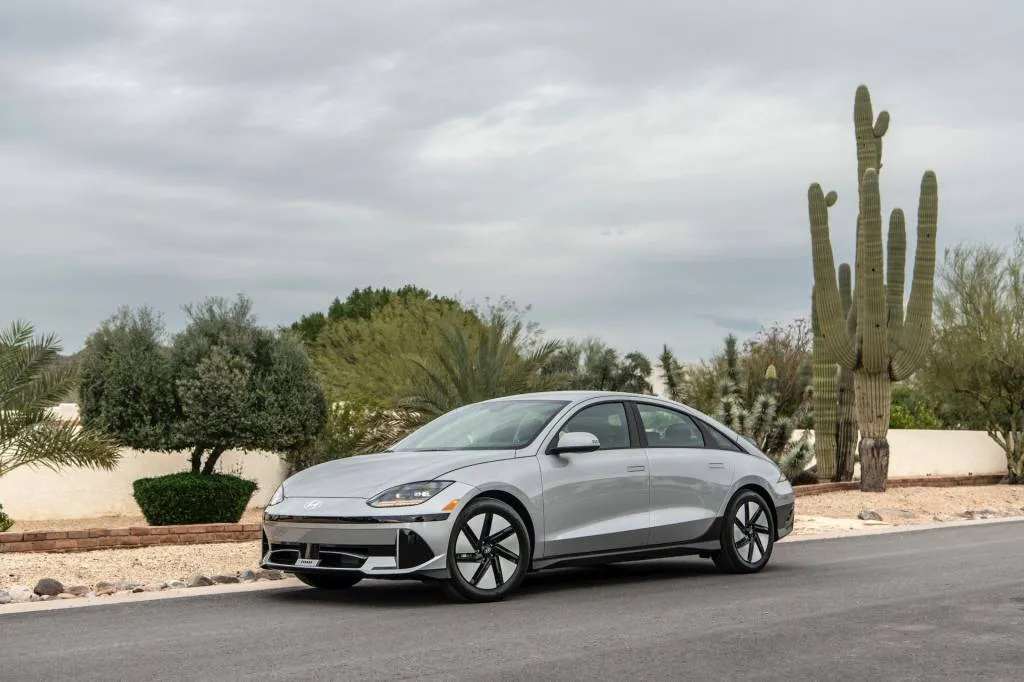
2024 Hyundai Ioniq 6
Automakers have been very slow to get rid of 12-volt electrical systems in new vehicles. One of the few vehicles to have made the switch so far is the Tesla Cybertruck, which uses 48-volt hardware that Tesla is now shopping around to other automakers.
Omission of 48-volt electronics is particularly surprising in Hyundai’s E-GMP vehicles, which incorporate various other advancements like 800-volt charging. Hyundai has even introduced a solution that does away with the old-style lead-acid 12-volt battery in some of its hybrids—but not any of its EVs thus far.

Rivian CEO: Dealer laws are “as close as you can get to corruption”

- Rivian CEO RJ Scaringe pointed to a “horrific state-by-state level of rules”
- Dealers’ lobbying efforts have made it hard for Rivian to interact directly with customers
- Rivian’s aware it has a service backlog, views it as a short-term problem
Rivian CEO RJ Scaringe isn’t a fan of U.S. dealership franchise laws. These laws work against the EV maker, which has a direct-sales model rather than franchised dealers.
On Wednesday during a roundtable with Green Car Reports and other media Scaringe said “we have this horrific state-by-state level of rules that are as close as you can get to corruption.”
The CEO was referring to franchise laws for car dealers, which are widely protected by heavy lobbying efforts.
“You essentially have lots of dealers that paid for lots of laws that make it really hard for us to interact directly with the customer,” Scaringe said.
Scaringe had been asked whether, after VW’s recent investment of $5.8 billion into Rivian, the U.S. EV maker might be able to leverage the dealer network of one of the world’s largest automakers.
Rivian’s CEO then noted with an upbeat smile that “Europe doesn’t have the same rules,” and “there’s certainly opportunities there.” Rivian plans to sell both the smaller upcoming R2 and R3 crossover SUVs in Europe, but the R1T and R1S are deemed too large for that market.
“Service is the bigger thing,” continued Scaringe. “You don’t need 5,000 retail location in the U.S. to sell 3 or 4 million cars a year. Tesla’s a good example,” he said.
“You do need a lot of service infrastructure,” Scaringe went on to say. But even that’s changing because historically a customer needed to go into a dealer anytime a car made a clicking noise.
Often, depending what is needed, that service can come to you. Rivian handles more than half of its service with its in-house mobile service crews going to customers rather than customers coming to them.
Scaringe admitted the automaker has a service backlog in the U.S., as it tries to build as much service infrastructure as fast as it can. But in some U.S. markets the product is scaling faster than the automaker can build out the infrastructure.
“That’s a short-term anomaly,” Scaringe said. Long-term the executive said the team believes it’s going to build a robust service infrastructure.
In Europe, Scaringe said there’s a question whether Rivian partners with someone for service. “It’s certainly an opportunity,” he added.
But in America, with the franchise laws, the possibility of Rivian partnering with anyone else for service would be complicated.

GM developing adaptive springs for suspension systems
 General Motors is looking to apply technology from adaptive dampers to springs for future suspension systems, a recently surfaced patent filing indicates. GM was a pioneer of magnetorheological dampers, which use a magnetic fluid to quickly alter damper firmness. In a patent application published by the United States Patent and Trademark Office…

2025 Dodge Durango
 What kind of vehicle is the 2025 Dodge Durango? What does it compare to? The 2025 Dodge Durango is a three-row midsize SUV with the option for ample—and another option for extreme—power underhood. It’s comparable to the Jeep Grand Cherokee, Ford Explorer, and Kia Telluride. Is the 2025 Dodge Durango a good SUV? The Durango can be…

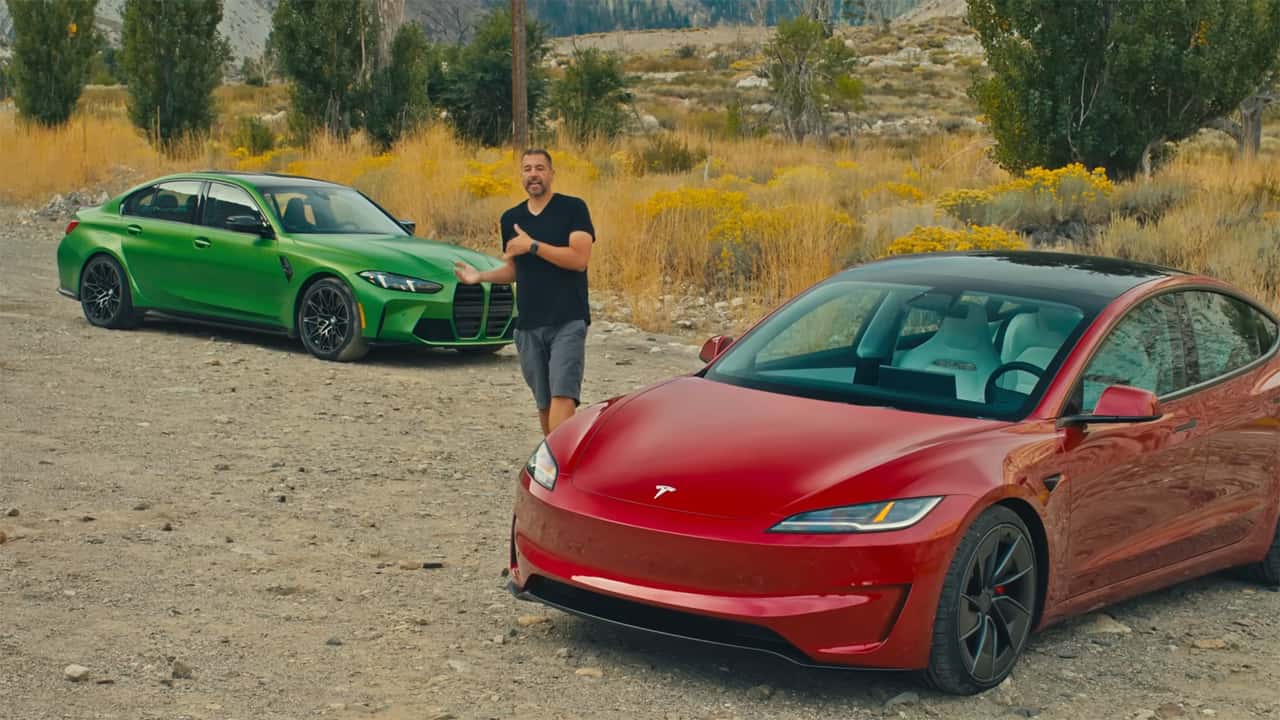
Tesla Model 3 Performance VS. BMW M3: ‘It’s Staggering’
- Hagerty pits the facelifted Tesla Model 3 Performance against the BMW M3 Competition xDrive.
- Both are all-wheel drive four-door sedans.
The BMW M3 is widely regarded as the benchmark in the sports sedan market. And no, your eyes are not deceiving you. Despite this being a website that specializes in writing about battery-powered cars, we need to recognize that BMW has mastered the art of producing a thrilling gas-powered four-door sedan that you can comfortably drive every day and take to the track now and then.
But here’s where the new Tesla Model 3 Performance comes into play. With new tech under the skin, such as better brakes and a fancy suspension, Tesla’s sportiest EV takes things up a notch and promises to be the best all-rounder, period. But is it so? Until we can get our hands on both a BMW M3 Performance xDrive and a Tesla Model 3 Performance, we’ll go by Jason Cammisa’s and Randy Pobst’s words, which were nicely laid out in the Hagerty video embedded below.
As a reminder, Camissa is a bona fide car journalist with two decades of experience reviewing cars, while Pobst is a multiple SCCA World Challenge GT champion.

[embedded content]
One of the biggest issues with the previous Model 3 Performance models was their inability to run multiple track laps at full speed without experiencing brake fade or some sort of powertrain limitation due to overheating. Now, though, it looks like Tesla dialed everything just right, with no brake fade after several hot laps in the Track Endurance mode. That said, the Endurance mode limits the EV’s top speed to preserve longevity, and it shows in the lap times.
After 15 minutes of continuous driving, the BMW M3 Competition was over 5,000 feet ahead of the Tesla Model 3 Performance, so there’s still work to be done. In a single-lap shootout, the M3 was also quicker than the Model 3, but by less than two seconds, with the EV’s biggest drawback being its tires.
91
As a daily driver, though, the Model 3 Performance is a great sports-oriented car, not just EV. The infotainment is great, although it doesn’t have Apple CarPlay, and the charging experience is excellent. However, the fact that there are no steering column stalks makes the Model 3 “dangerous,” according to Cammisa.
At the end of the day, however, the biggest issue is the price. The 2025 BMW M3 Sedan with rear-wheel drive and 473 horsepower starts at $76,000. Upgrading to the M3 Competition with xDrive all-wheel drive and 523 hp ups the price to $85,000. Add some options and you’ll soon pass the $100,000 mark.
Meanwhile, the Tesla Model 3 Performance, with dual-motor all-wheel drive and 510 hp, starts at $54,990. But, unlike BMW, Tesla doesn’t really sell optional extras, so what you see is what you get.
Is the BMW worth the extra $20,000 to $50,000? It’s a tough question to answer. Camissa said one could buy a Tesla Model 3 Performance and a Mazda Miata for the same price as a single BMW M3, which things into perspective. What’s your take?
Share this Story

2025 BMW X1
 What kind of vehicle is the 2025 BMW X1? What does it compare to? The 2025 BMW X1 is the automaker’s entry-level SUV, a small model that competes with the Audi Q3, Mercedes-Benz GLA-Class, and Volvo XC40. Is the 2025 BMW X1 a good car/SUV? The X1 is a refined small SUV with a roomy interior and decent pricing. It’s not too sporty…

Mercedes In-Drive moves braking system inside EV’s electric motor
- Mercedes In-Drive system mounts the brakes to the electric motor
- In-Drive is a friction-based braking system
- Mercedes has In-Drive in active testing, hasn’t given a timeline for production
Mercedes-Benz is rethinking how the braking system works, and where it’s located, in upcoming EVs.
In Germany last week, Mercedes-Benz engineers showed Green Car Reports one of its latest innovations dubbed In-Drive. It’s a system that relocates the entire braking system from inside the wheels to inside an EV’s electric motor housing.
The automaker didn’t commit to when, or which vehicle, the system might debut on and go into production, but it said the feature is already in active testing.

Mercedes-Benz In-Drive brake system
Referred to internally as “the brake of the future,” the In-Drive system is still a friction-based brake system that consists of a water-cooled brake disk that isn’t exposed to air. Mercedes engineers said they are still experimenting with different fluids. They want a lot of water in the unit to dissipate the heat, but they don’t want a giant radiator to assist. Completely enclosed, the brake discs reside on both sides of the electric motor.
Mechanical braking in EVs is only needed about 2% of the time while 98% of braking situations can be handled by regenerative braking, according to Mercedes engineers.
The new regenerative braking system in the 2026 CLA-Class, which will be the first EV on the automaker’s next-gen MMA platform, is capable of up to 200 kw of recuperation, according to Mercedes. The current EQS—a heavier car—is capable of up to 290 kw of recuperation, a Mercedes engineer said.

Mercedes-Benz In-Drive brake system
The Mercedes team said In-Drive is designed to be a lifetime system good for about 15 years and 186,400 miles (300,000 km), given it would theoretically only be engaged 2% of the time. Today’s brake pads only cover a small percentage of the brake disc, but the In-Drive system’s pads cover the entire surface area of the disc, which results in less force being used.
The In-Drive braking system could be mounted on a front axle that’s devoid of an electric motor, but the system would still sit in the center of the car and axle rather than by the wheels like today’s brakes.
Moving the brakes inboard shifts the weight to the center of the car and creates less unsprung mass, which will result in better handling.
By enclosing the brakes fully there’s no brake dust particulates and the wheels can be closed off to be more aerodynamic.
Mercedes-Benz paid for travel and lodging along with some German pretzels for Green Car Reports to bring you this firsthand report

Mercedes tech may enable EV batteries with mixed cell types
Mercedes-Benz has its eyes on solid-state batteries with its partnership with Factorial for battery cells, but the automaker’s already thinking one step beyond that.
In the future, Mercedes envisions mixed battery packs with different types of cells all wired in parallel rather than today’s series arrangement. The enabling factor to this is a new micro-converter the automaker’s developing in-house to replace today’s electrical inverter systems.
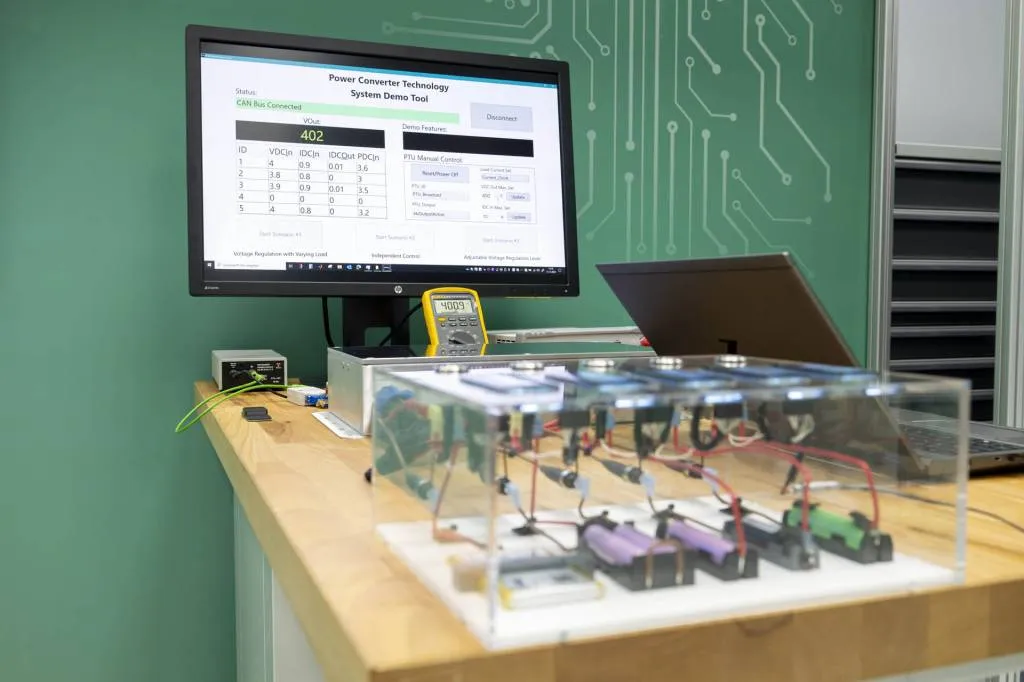
In Germany, Mercedes engineers showed working prototypes to Green Car Reports of the programmable micro-converters. The converters are about the length of a stick of gum and twice the width. They looked light and were encased in black plastic, but engineers were sure to keep us from touching the (presumably expensive) prototypes.
Mercedes-Benz micro-converters
The micro-converters can be connected directly to any number of cell pairs. This enables engineers to program and control individual cell pairings independently regardless of the state-of-charge. Engineers demonstrated this on a workbench, putting the mixed test cells under load and then independently turning on and off certain cell pairings.
Engineers said the new micro-converters open the possibility to mix-and-match cell types, chemistries, and more for various situations. The converters could enable a pack to have LFP cells, NMC cells, and solid-state cells all together, and they could call upon different types of cells for different conditions and situations to work in their optimal operating windows. That could open a new door for performance vehicles for the automaker’s AMG division.
The new approach could translate to faster charging rates, longer driving range, and more flexibility in pack design, according to Mercedes’ engineers.
Mercedes-Benz paid for travel and lodging for Green Car Reports to bring you this information.

Mercedes In-Drive considers moving brakes into an EV’s electric motor
 Mercedes In-Drive relocates the brakes to inside an EV’s motor housing In-Drive remains a friction-based brake system In-Drive is in active testing with no timeline for production announced Future Mercedes-Benz EVs might not have brakes sitting behind their wheels. Mercedes-Benz engineers in Germany showed Motor Authority its latest EV drivetrain…