
Author: EVAI

Green Car Reports’ Best Car To Buy 2025: What didn’t make the cut
 Polestar 3, Volvo EX90, Tesla Model 3 missed finals Lucid Gravity, Charger Daytona EV among models not quite arriving for this year’s list Volvo EX30 didn’t quite arrive in time, again Earlier this week we named five Green Car Reports Best Car To Buy 2025 finalists. The Chevrolet Equinox EV, Hyundai Kona Electric, Porsche Macan Electric, Rivian…

2026 Tesla Model Y Juniper refresh spied
 The Tesla Model Y is about to receive its first solid refresh. It was recently spied undergoing testing on public roads, and those photos show the updated Model Y should follow a similar path as the facelifted Model 3 that proceeded it in 2023. The updated 2026 Tesla Model Y is expected to go on sale in the spring of 2025. The refreshed Model Y is…

2025 Lexus LX revealed with new LX 700h hybrid flagship for $115,350
 Lexus reveals updated LX with new hybrid powertrain for $115,350 Chassis reinforcements to support hybrid powertrain promise to improve steering and stability Updated Lexus LX also gains rugged Overtrail grade Lexus on Thursday introduced a new hybrid powertrain to the LX full-size SUV for the 2025 model year, marking the first time Lexus’ largest…

Tesla sales fell in 2024
- After many years of gains, Tesla sales and deliveries dropped
- Tesla’s share of the U.S. EV market has fallen below 50%
- U.S. registration figures are yet to come
Tesla sales and deliveries turned downward in 2024, after a seemingly unstoppable trajectory of double-digit gains for many years.
Globally, Tesla delivered about 1,789,226 million vehicles in all of 2024, with production of about 1,773,443 million vehicles. Both of those figures are down versus the reported 1,808,581 deliveries and 1,845,985 vehicles made in 2023.
That’s just over a 1% drop in deliveries in 2024 and a nearly 4% drop in production for the year. And it might have been worse without a rally in the fourth quarter. Tesla noted that it posted a delivery record for Q4, at 495,570 vehicles.
To compare, a year ago Tesla was touting some very different results. Its 2023 deliveries and sales grew 38% and 35%, respectively, over 2022. Tesla’s 2023 sales surge was strong, and its sales numbers exceeded 2022 numbers every single month of the year according to DOE data. That said, China’s BYD continued to edge up on Tesla on the global front in 2023.
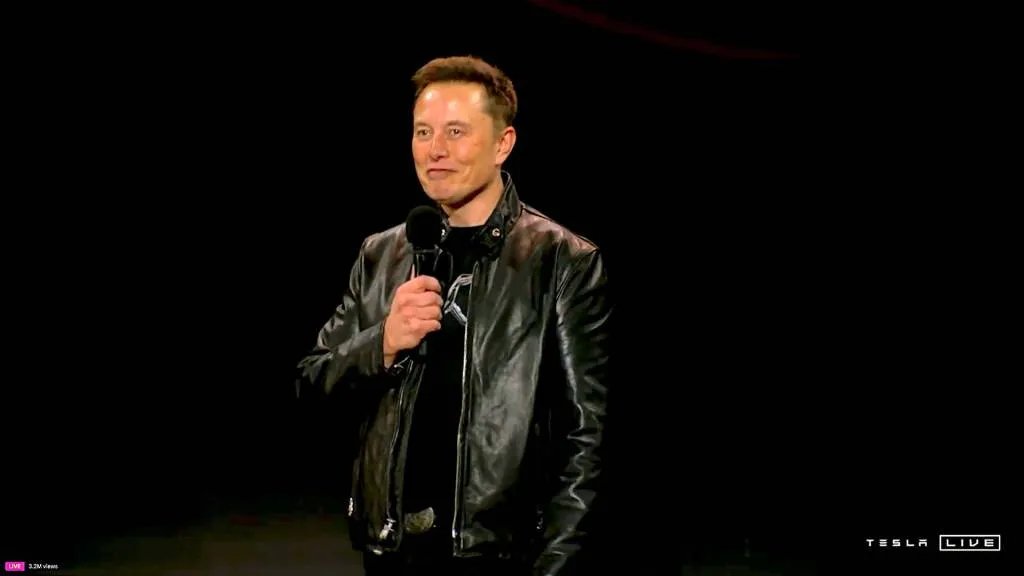
Tesla CEO Elon Musk at Cybercab event (screenshot) – Oct. 2024
In 2023, Tesla CEO Elon Musk became political and by extension so did Tesla in a way it never had been before. By April 2024, reputational studies were showing the relationship, as even more of the American car-buying public connected Tesla with Musk. At this point, it’s hard to ignore an array of consumer-sentiment data points suggesting that the world’s richest man may be getting in the way of Tesla sales growth, especially in California, where it’s held more than a tenth of the new-vehicle market.
Tesla’s share of the EV market shrank in 2023 despite price cuts, to around 50% of the U.S. EV market, and with 2024 EV sales expected to rise overall by about 20% versus 2023, it will certainly lose more of that in 2024. Tesla had continued those price cuts in 2024, with an April move that repositioned the Model Y below the Model 3, thanks to the federal EV tax credit that Musk has backed eliminating.
The Model 3 and Model Y composed the vast majority of Tesla’s global total. Just 94,105 of its global production and 85,133 of its global deliveries were of “other models”—likely including the Model S, Model X, Cybertruck, and Semi.
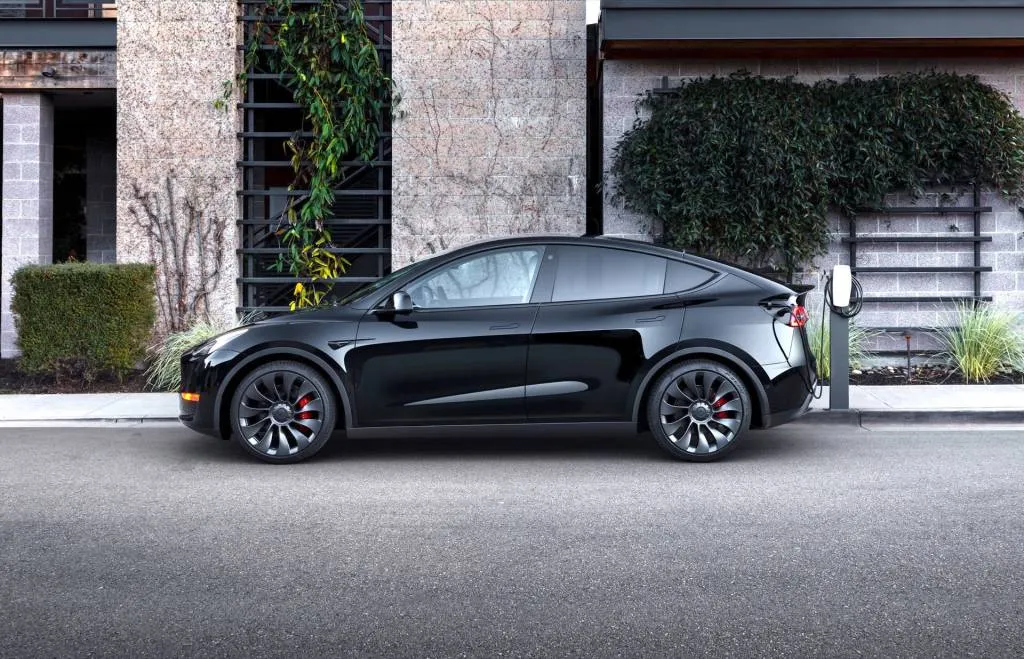
2024 Tesla Model Y. – Courtesy of Tesla, Inc.
As a footnote to this: It’s not yet clear whether Tesla saw sales sputter in the same way in the U.S., looking at the entire year. Through October they were down, however. Citing registration-based figures through that month, Automotive News tallied 499,870 sales through that month, versus 535,834 for the equivalent period in 2023.
Tesla doesn’t report U.S.-market sales figures, which generally rely on state registration numbers and their commensurate lag. But we’ll have an idea on those, and whether Tesla managed to achieve U.S. sales gains for the year, within a few weeks.

2025 Lexus LX flagship gains hybrid powertrain option fro $115,350
 Lexus expands the LX lineup for 2025 with a hybrid The hybrid system is unlikely to make a meaningful impact on fuel economy The Lexus LX 700h hybrid arrives at the beginning of 2025 and costs $115,350 Lexus has offered hybrid powertrains in its LS flagship sedan and LC flagship coupe for some time, and now it’s adding one to those models’ SUV…

Survey: 67% think government should provide EV purchase incentives
- Support for the federal EV tax credit stands at around 50%
- Nearly 80% of EV owners would buy another one without incentives
- Three out of five Americans want state and local EV incentives if Trump kills the federal credit
Even as the Trump Administration is expected to take aim at electric vehicle purchase incentives, they’re actually quite popular with car buyers, according to a new poll published by California-based EV advocacy group Veloz.
The poll, which was conducted by Probolsky Research for Veloz, asked respondents whether the government should provide such EV incentives—and 67% answered in the affirmative. However, that number shrank to 50% when respondents were asked about the federal government specifically.
Adding to the complexity of this picture, 61% of respondents said they wanted state and local governments to “increase their support and invest in electric vehicles” if the federal government ends EV incentives. That’s what California has pledged to do if the Trump Administration nixes the $7,500 federal EV tax credit.
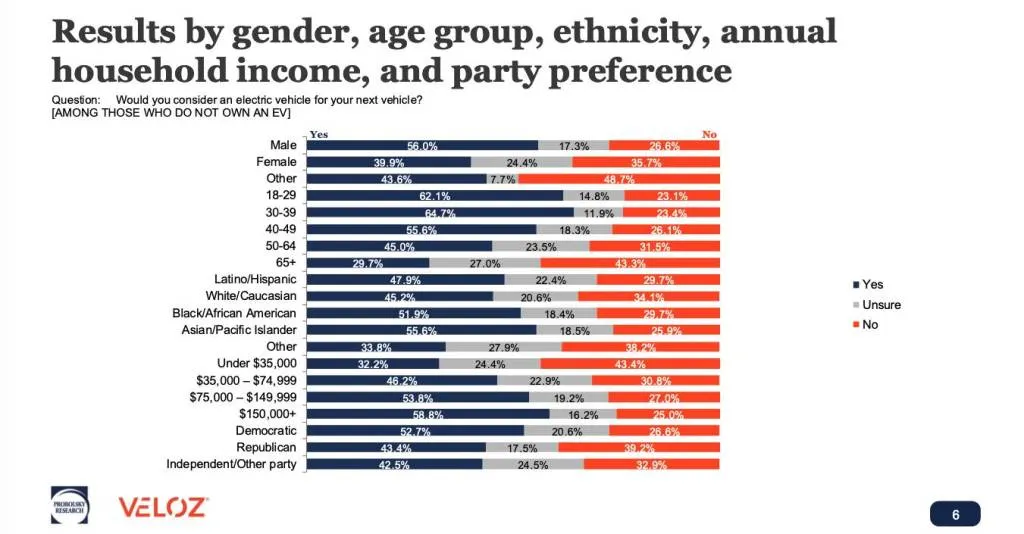
U.S. consumer interest in EVs (from 2024 Veloz poll)
If state and local governments don’t step up and provide this support, EV sales momentum may not be completely halted, the poll indicates. The majority of current EV owners (78.2%) said they would still choose an EV without any incentives that reduce the vehicle’s purchase price, as did 38.1% of non-EV owners.
These results are based on a sample of adult residents of California, Texas, Florida, New York, Pennsylvania (excluding Philadelphia metro), Georgia, Michigan, Washington, Colorado, Hawaii, and Maryland. Veloz and Probolsky Research claim this sample accurately represents the demographic characteristics of each state.
Michigan had one of the lowest rates of those who don’t now own an EV who would consider one. As a post-election report recently suggested, a high-level pro-Trump disinformation campaign (unanswered by Democratic candidate Harris) may have worked very effectively in swaying public opinion—perhaps in a way that sticks beyond the election.
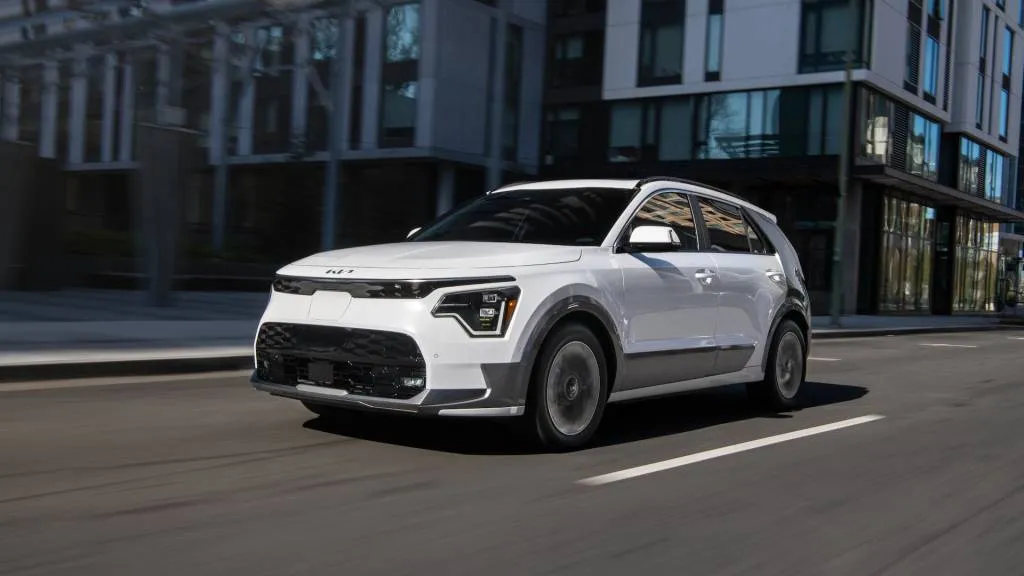
2025 Kia Niro EV
Regarding specific reasons for not choosing an EV, this poll emphasizes, along with so many others before it, that cost is the prohibitive part of EV adoption, with charging and battery concerns coming after that. Nearly half (48.4%) listed the cost to buy an EV as their main concern, with 38.7% citing charging and maintenance costs and 38.3% citing concerns that batteries won’t last long enough.
Yet cost savings were also the top reason for considering an EV. Saving money on gas was the main reason for both EV owners (51.9%) and non-owners (60.3%), followed by improving air quality.
So it seems that sensitivity to cost cuts both ways, with buyers potentially concerned that spending less money on gas will be cancelled out by a high purchase price and charging costs. That’s certainly something incentives could help address.

One of these 6 cars will be named Motor Authority Best Car To Buy 2025
 This year’s finalists for Motor Authority Best Car To Buy 2025 proves the electric age is upon us: only one finalist has a tailpipe. Starting with nearly 25 new or significantly updated luxury and performance vehicles, we whittled down the list of 2025 nominees to just six contenders. We then tested the finalists both on the street and the…

2025 Toyota GR86
 What kind of vehicle is the 2025 Toyota GR86? What does it compare to? The GR86, or simply 86, is Toyota’s reasonably priced, rear-wheel-drive sports coupe. It’s a near-twin to the Subaru BRZ, and it’s also worth comparing to the costlier Ford Mustang and Nissan Z. Is the 2025 Toyota GR86 a good car? It’s a gem. We (and…

Bugatti Tourbillon chassis deep dive
 The Bugatti Tourbillon marks a new era for the supercar builder not only by using a plug-in hybrid powertrain, but with the debut of a new platform replacing the one that formed the basis for both the Veyron and Chiron. In a video posted to Bugatti’s YouTube channeL—part of a series of deep dives into different aspects of the car—CTO…

Review: 2024 Porsche Macan Turbo Electric throws its weight around effectively
· Macan Turbo Electric has 288 miles of range
· It weighs a lot, but Macan Turbo Electric handles well
· With 800-volt architecture, Macan Electric can charge at up to 270 kw
Sporty electric vehicles face a major obstacle: weight. With the Taycan hatchback and wagon, Porsche has been able to—mostly—overcome that issue to create a sharp-handling and engaging car. Now it’s the compact Macan’s turn as it morphs into the Macan Electric.
I recently drove the 2024 Macan Turbo Electric—one of Green Car Reports’ Best Car To Buy 2024 finalists—and found that the transition of Porsche’s top-selling vehicle to fully electric power has its plusses and minuses for dynamics, as energy efficiency of course skyrockets.
Once again, Porsche mostly succeeds in making a sporty and engaging vehicle, even one weighing a few 9-volts shy of 5,400 pounds.
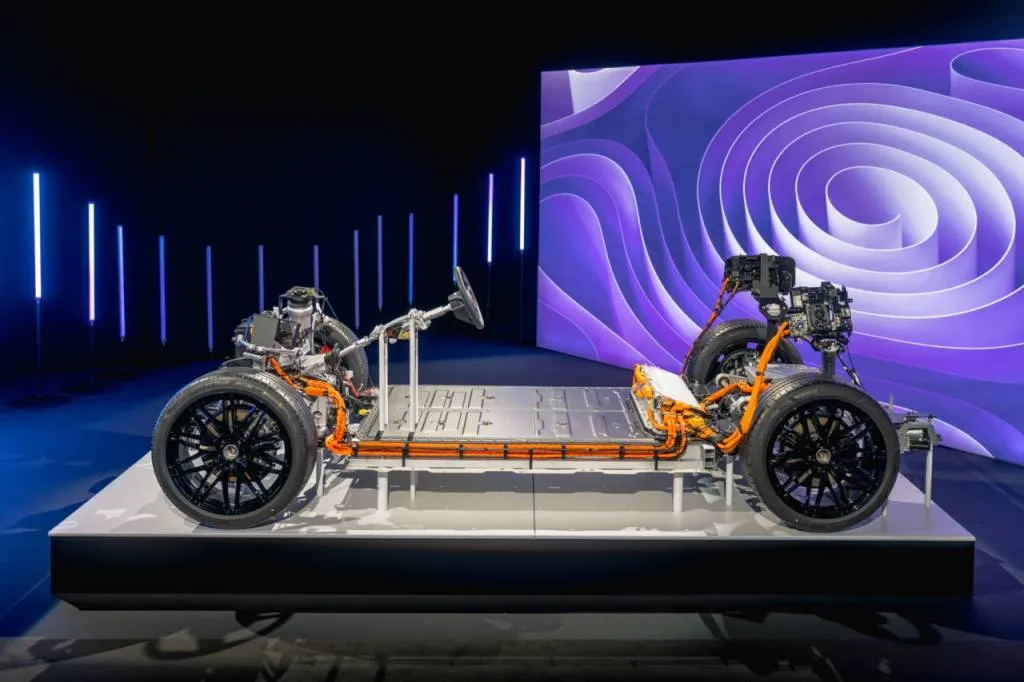
2024 Porsche Macan (electric)
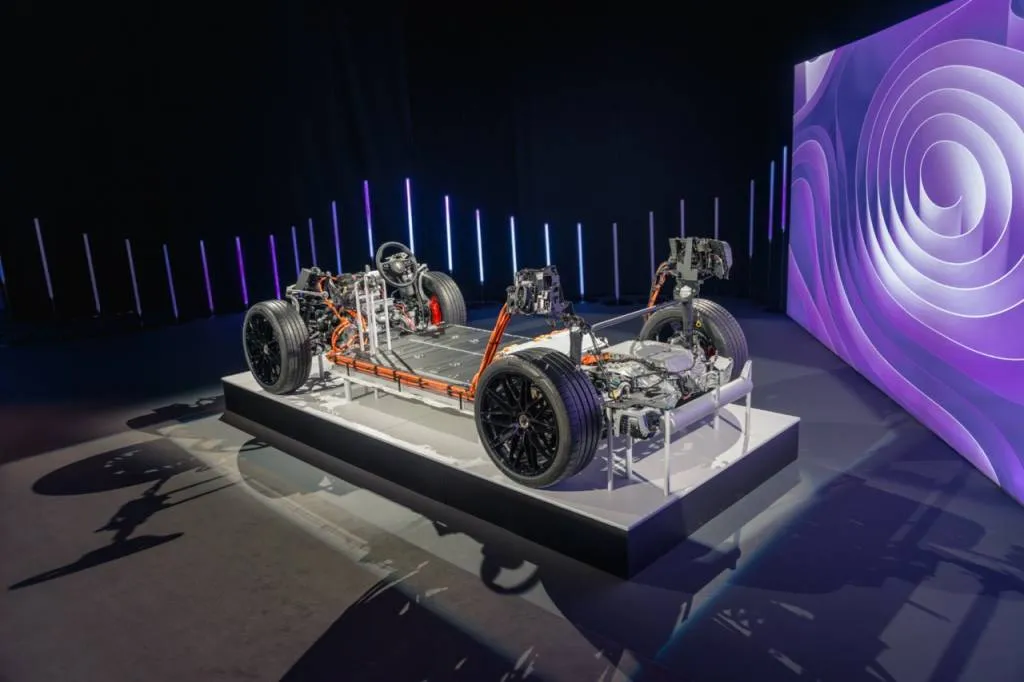
2024 Porsche Macan (electric)
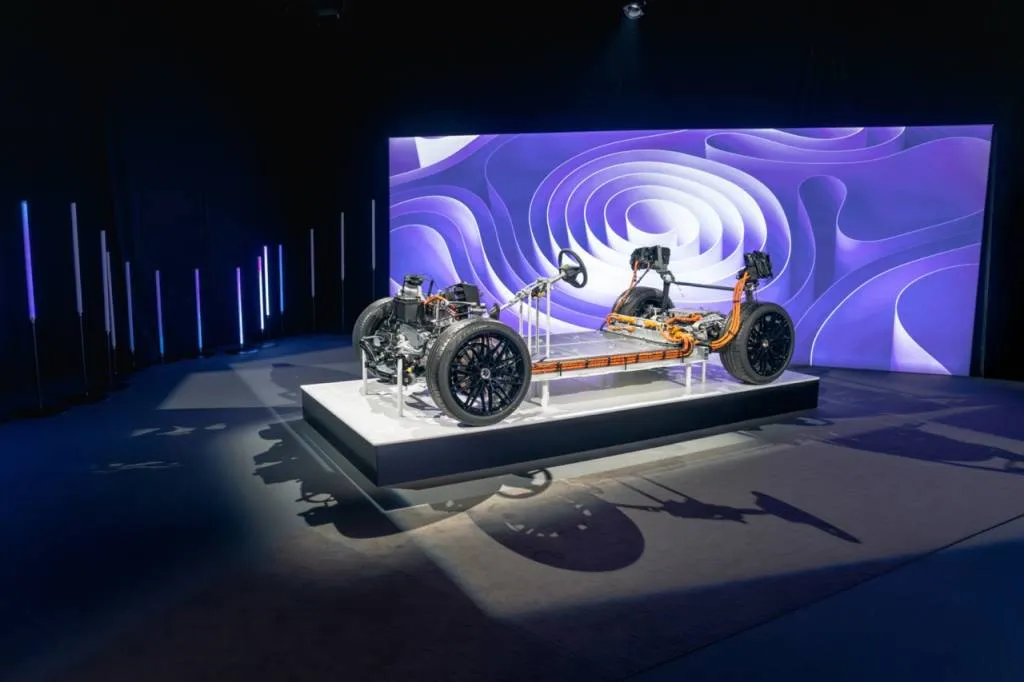
2024 Porsche Macan (electric)
Macan Electric marks debut of PPE
A decade ago, for the gasoline version of the Macan, Porsche engineers had to modify VW Group’s MLB platform to make the Macan handle like a Porsche rather than the very similar Audi Q5. This time around, they were involved from the start to create the new Premium Platform Electric (PPE) architecture.
That left little to do to the platform itself to get the Porsche character. According to a Porsche spokesman, the main change versus other PPE vehicles (most notably the 2025 Audi Q6 E-Tron) was to flip the rear motor 180 degrees to improve the weight distribution and leave space for the available rear-wheel steering rack to fit between the motor and battery. The result is a near-perfect 48:52 front-to-rear weight balance.
A skateboard-style electric platform, PPE makes room for an 800-volt, 100-kwh battery in the Macan Electric with 95 kwh of usable capacity. A duo of permanent-magnet motors, one on each axle, team up to produce 576 hp and 811 lb-ft of torque, which can improve to 630 hp and 833 lb-ft with 10-second shots of overboost. Porsche says the electric motors allow for five times faster control of the all-wheel drive system, and the distribution of power changes with the drive mode.
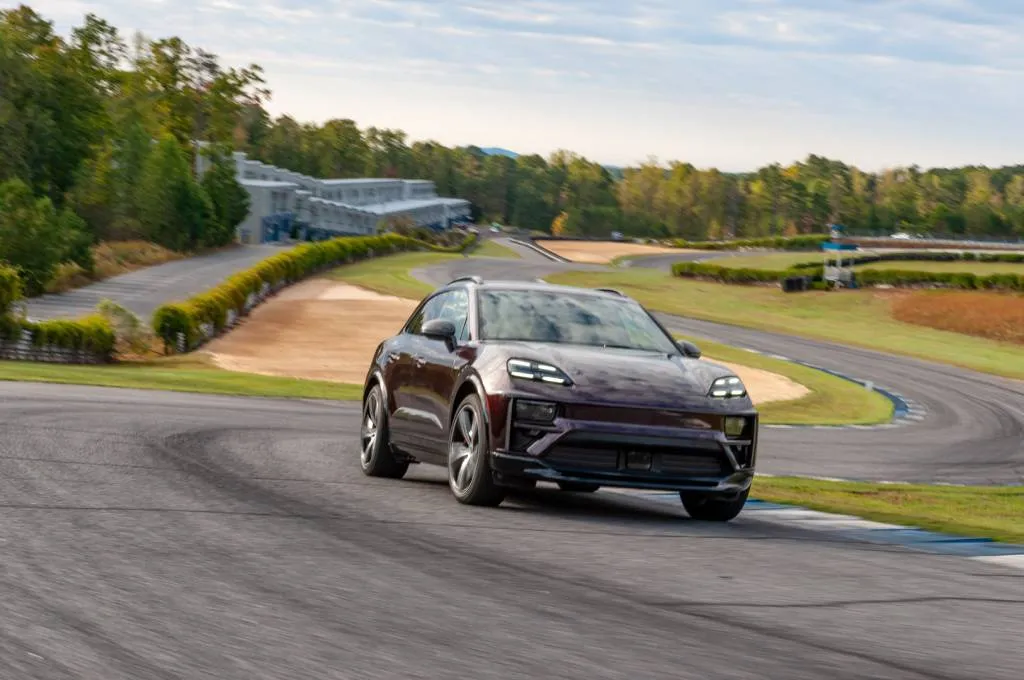
2024 Porsche Macan EV
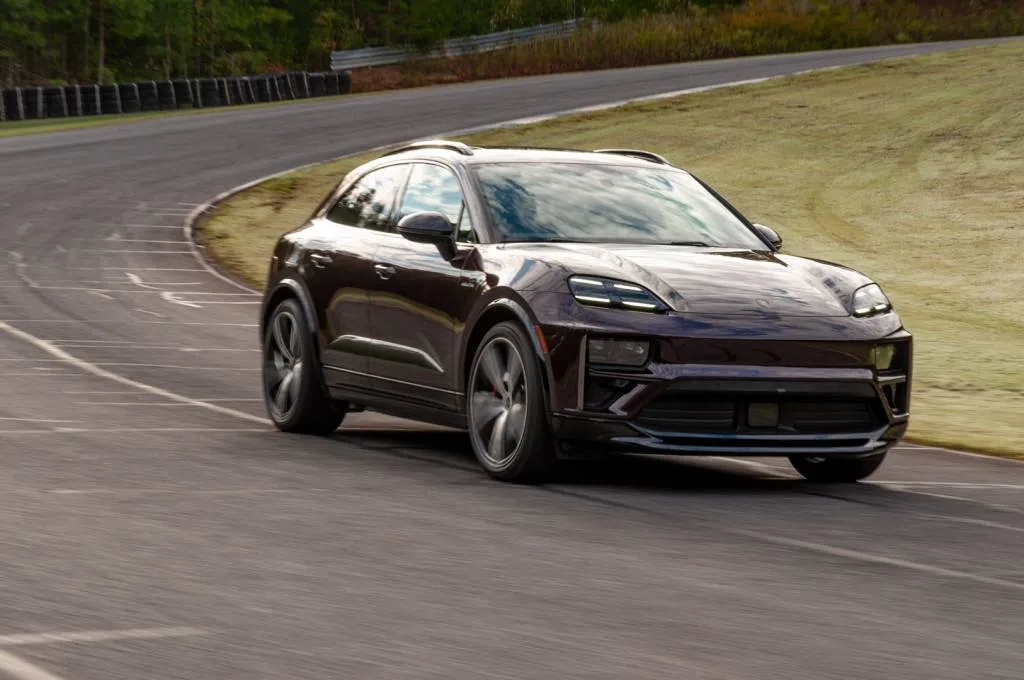
2024 Porsche Macan EV
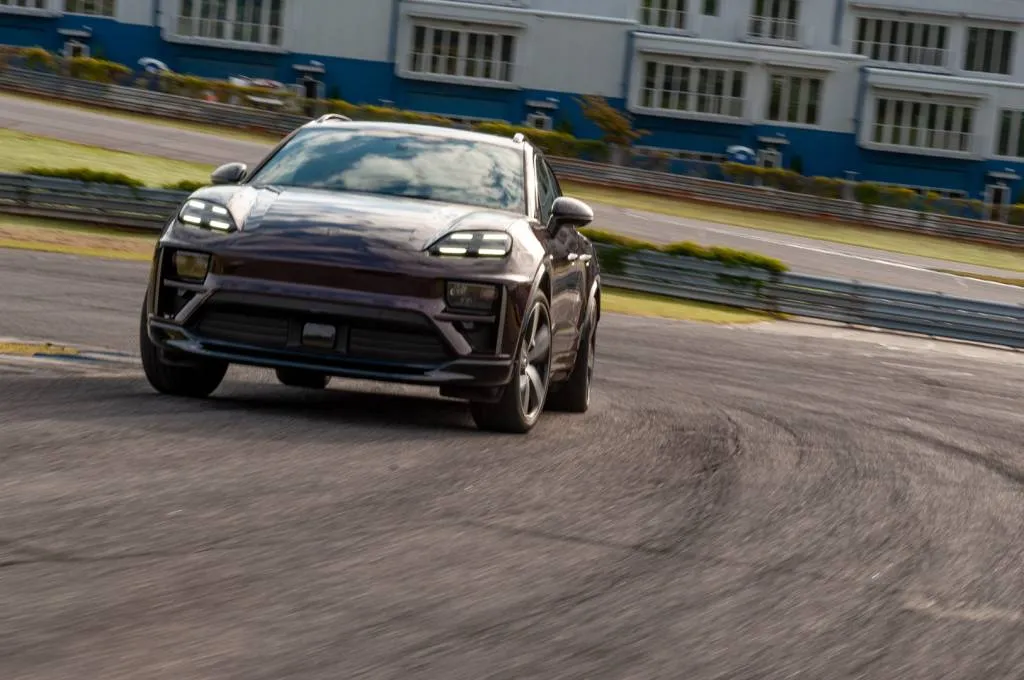
2024 Porsche Macan EV
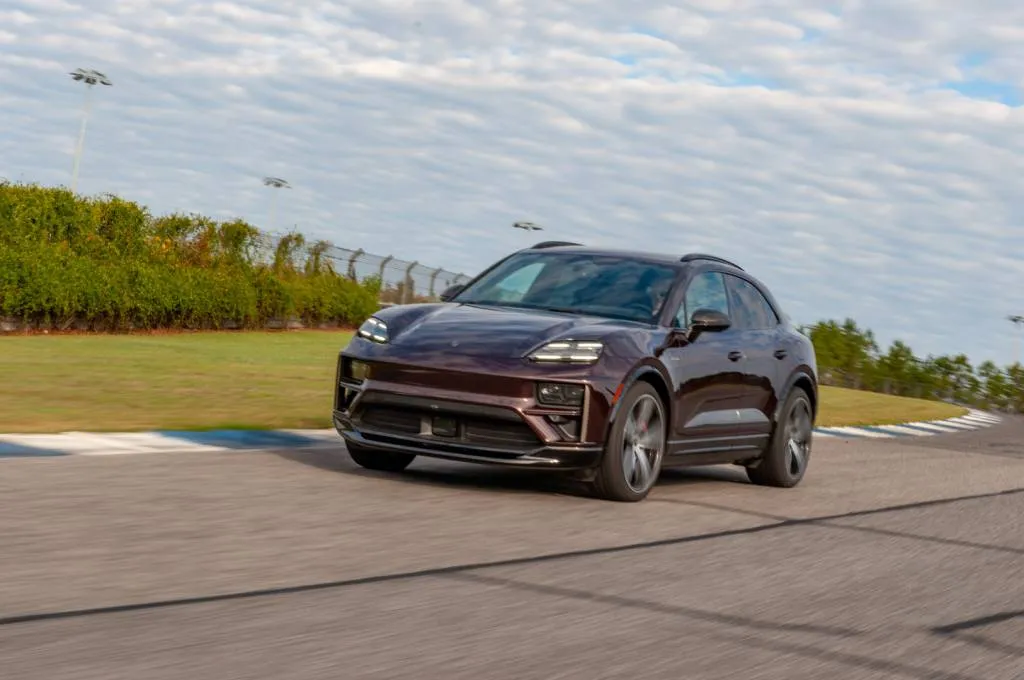
2024 Porsche Macan EV
Macan Turbo Electric: A Porsche-specific driving feel for an EV
Without much work needed on the platform itself, the Macan Electric gets Porsche-specific suspension tuning and a lot of performance equipment to create that Porsche feel, especially in the top-of-the-line Turbo model. Every Macan Electric has a four-corner air suspension, adaptive dampers, and a quick 14.2:1 steering ratio. The Turbo also comes with an electronically controlled locking rear differential and a set of 14.8-inch front rotors with 6-piston calipers (an inch larger than the base model with two extra calipers) and 13.8-inch rear rotors with single-piston floating calipers.
My Turbo tester also came with the optional rear-wheel steering and a set of 255/40R22 front and 295/35R22 rear Pirelli P Zero Corsa summer performance tires rather than the standard 20s on all-seasons. The rear steering can turn the rear wheels up to 5 degrees opposite of the fronts at low speeds and in phase with the fronts at high speeds for more stability.
My drive involved track time at Atlanta Motorsports Park and street drives on twisty northern Georgia roads. The Macan Electric performed admirably in both venues, well mostly. It felt familiar yet different at the same time. The steering had the quick, direct response expected in a Porsche, and the small-diameter steering wheel felt on point as well. While it provided some feel, it wasn’t the kind of telepathic feedback you get in gas-powered Porsches. That big, heavy wafer of battery between you and the road saps feel. The ride was always firm but never harsh, like a Porsche ought to be.
The battery had a noticeable effect on handling, both good and bad. On the track, the low center of gravity worked with the air springs and adaptive dampers to help this compact crossover turn in sharply. The difference, though, was the feel of a quick weight shift below me every time I turned into a corner. From there, the suspension took a set, leaned in a controlled manner (not bad for 6.7 inches of ground clearance in Sport+ mode, down from 7.2 inches regularly), and carved precise lines through even the tightest turns.
The brakes had a natural, progressive feel, and they held up well on the track, which is impressive given they had to arrest 5,393 pounds of SUV. The tires, on the other hand, didn’t. After about 25 laps around the 2.0 miles of Atlanta Motorsports Park, they frayed as big chunks of rubber separated from the edges. That could be the effect of all that weight, it could be the tires, or both. It’s likely both as the same model tires did the same thing on the Hyundai Ioniq 5N.
I was also impressed that track time didn’t sap too much battery or cause the motors and/or battery to overheat. Each four-lap session drained the battery by about 9%, so we were able to go for half a day without having to recharge the Macan Turbo Electric for more track sessions.
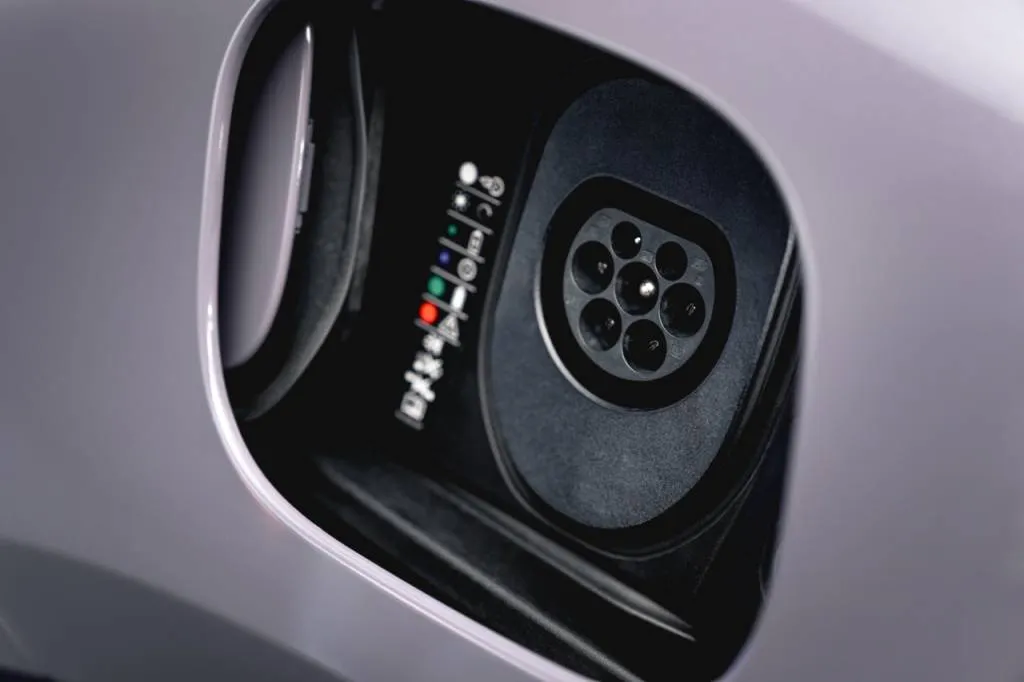
2024 Porsche Macan (electric)
Porsche Macan Electric charging and range
The battery can be treated as a single 800-volt unit or two 400-volt packs. Plug it into a 350-kw fast-charger on the driver’s side and the Macan Electric can charge at a rate of up to 270 kw, which will add 155 miles in 10 minutes or take 21 minutes to go from 10-80%. Make that a 400-volt charger, and software will treat it as two batteries, adding 75 miles in 10 minutes and going from 10-80% in 33 minutes. The charge port on the passenger side is only for a Level 2 (AC) home charger, which requires 10 hours to charge from 0-100%.
Even with all its power, the Macan Turbo Electric has good range. It’s rated for 288 miles on a charge, as is the 502-hp 4S model. The 402-hp 4 model has 308 miles and the 335-hp base model tops out at 315 miles with an efficiency of 2.9 miles per kwh.
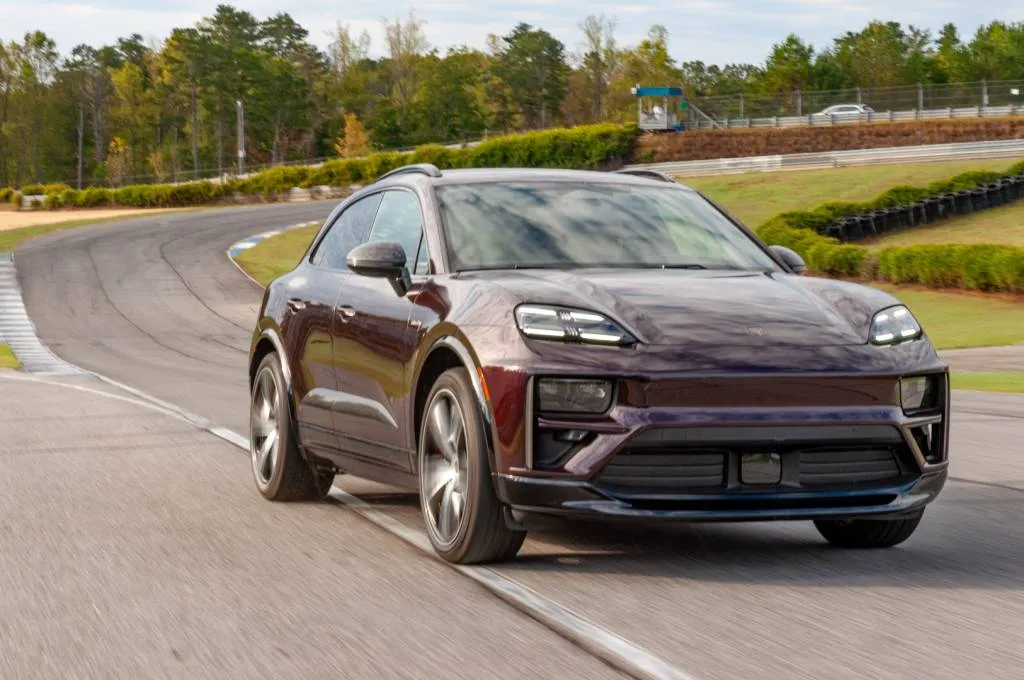
2024 Porsche Macan EV
Macan Turbo Electric: Power galore
The current top Macan gas model is the GTS. Its twin-turbo 2.9-liter V-6 makes 434 hp and 405 lb-ft of torque, which is good for a 4.1-second 0-60 mph run. While the Macan Turbo Electric weighs 1,000 pounds more, its 630 hp unlocks a 3.1-second run to 60 mph when using the standard launch control function. No launch control is needed to tap into that power at any time, though. The power comes on immediately, but it was well controlled on the track and didn’t upset the balance when rolling into the throttle on corner exit or even with dabs of maintenance throttle through longer corners. Thanks to the overboost function, max power was available in every straight because it resets whenever you let off the gas, for instance for a corner.
On the road, it has more power than you’ll ever need and can knock you back in your seat when flooring it in a straight line. It’s also content to toddle along at city speeds with conservative throttle application, and it doesn’t feel like a greyhound that always wants to run.
The tradeoff here is sound. Rather than the growl of the GTS’s twin-turbo V-6 or the throaty howl of a Porsche flat-6, the Macan Electric’s motors make no sound at all out of the box. For $490, Porsche will sell you a Porsche Electric Sport Sound that creates the spaceship whir we’ve come to expect in some EVs. It seems about right, and raises in pitch with more throttle, but doesn’t compare to a good engine sound.
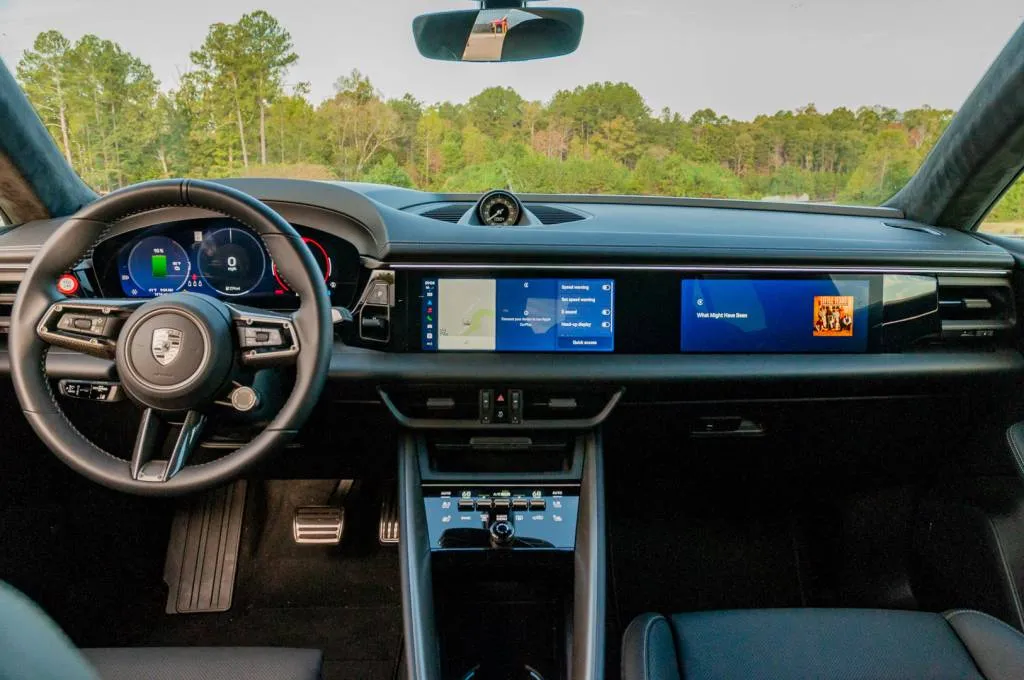
2024 Porsche Macan EV
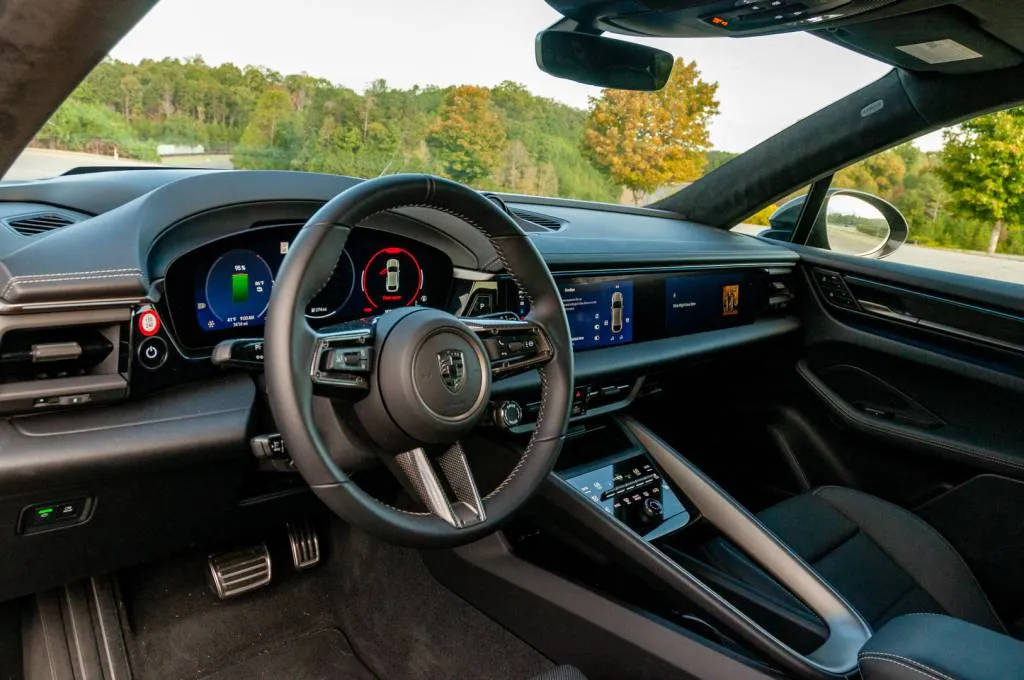
2024 Porsche Macan EV
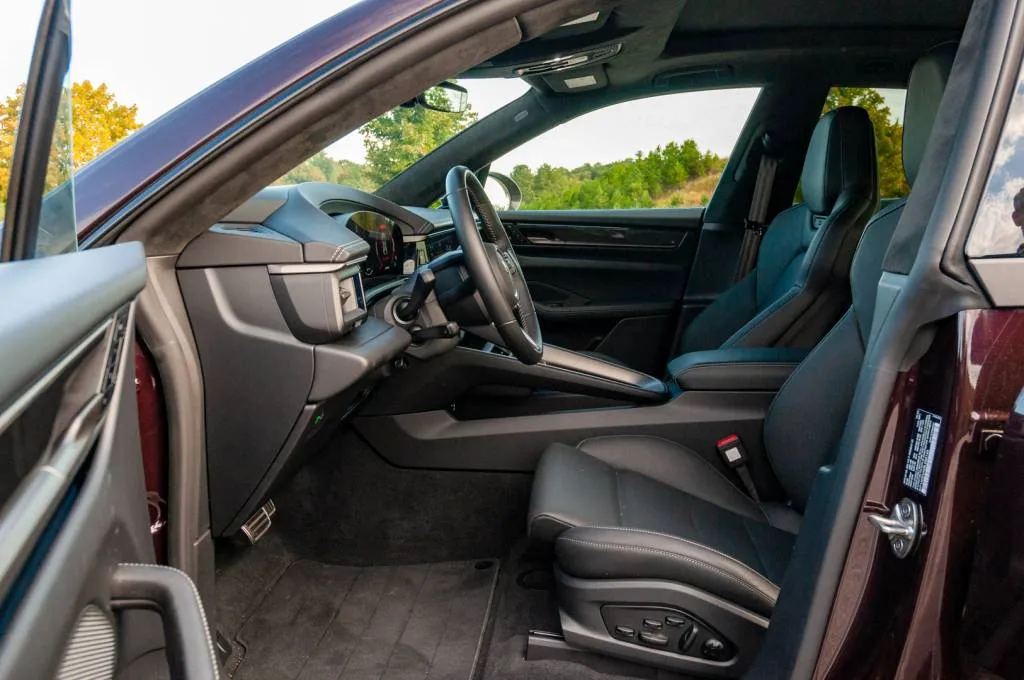
2024 Porsche Macan EV
Macan Electric cabin does it better than gas Macan
The Macan Electric stretches 2.3 inches longer than the gas model on a wheelbase that is 2.4 inches longer. The larger size gives it more rear seat space, though it is still cramped for tall passengers, and Porsche isn’t even pretending it’s meant for five adults as the brand calls it a 4+1 rather than a five-seater. The fast rear roofline also saps some space, as the Macan Electric tops out at 16.5 cubic feet behind the rear seat and 46.5 cubes with the rear seat folded down, figures that trail the gas model’s 17.7 and 53.8 cubes, respectively. A little of that space is added back in the form of a 2.9-cubic-foot front trunk.
Otherwise, the Macan Electric feels much like other recent Porsches as it takes a step forward versus the aging gas version. A small, knurled lever on the dashboard serves as the shifter like it does in the new Cayenne and Panamera, and the dash takes on the stacked horizontal shape of the 911. A small-diameter steering wheel fits the sporty character, and the Sport Chrono clock timer sits atop the center of the dash. Porsche provides few buttons, and the separate haptic touch controls for the climate system feel low-end.
The Macan Electric gets a standard 12.6-inch digital instrument cluster and a 10.9-inch infotainment touchscreen. The gauges aren’t hooded, and the scooped out area looks odd from the passenger seat, but I noticed no sun glare on the screen. Options include a head-up display with an augmented reality overlays and a 10.9-inch touchscreen for the front passenger that can control navigation, phone, and music functions, as well as connected home, steaming, and other apps.
The infotainment screen is home to the Sport Chrono timers, the My Porsche app, and a cloud-based charging planner that the Porsche says works faster than a native version.
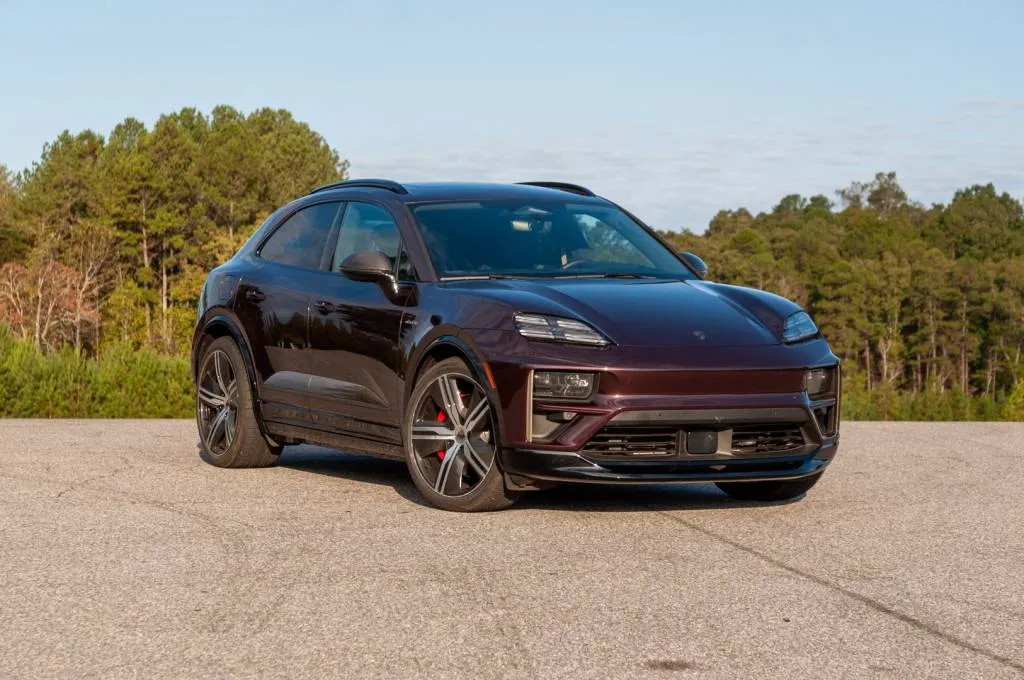
2024 Porsche Macan EV
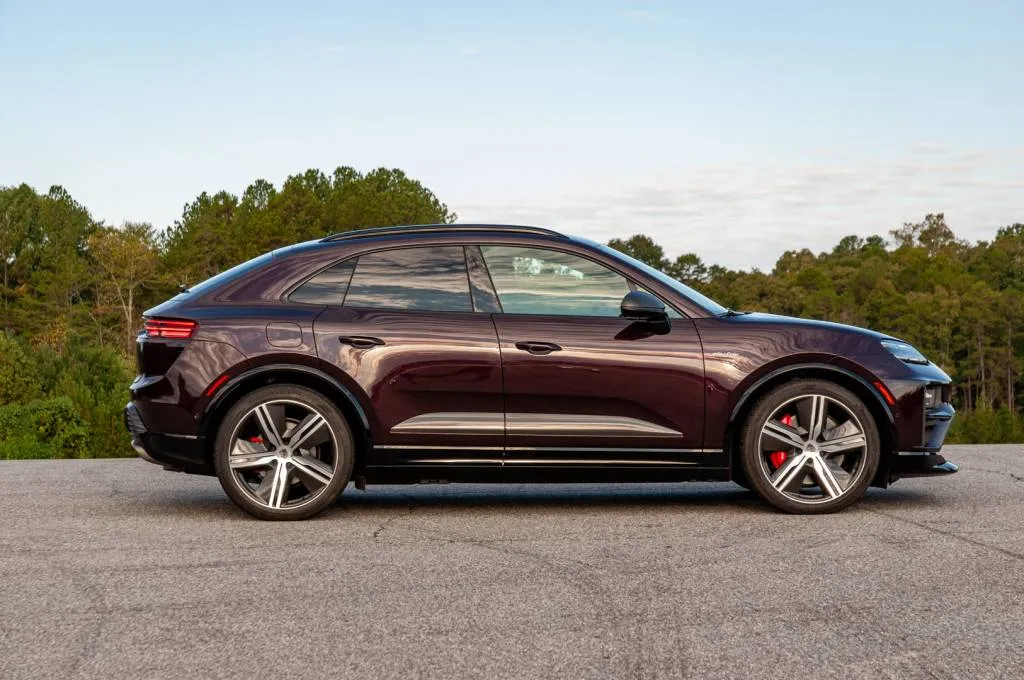
2024 Porsche Macan EV
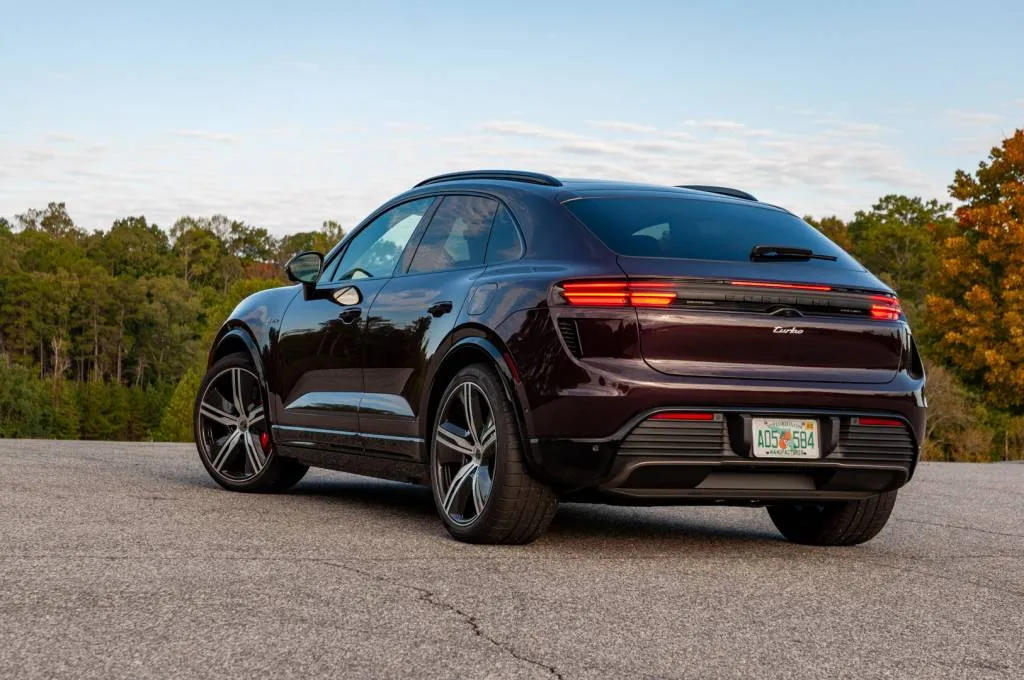
2024 Porsche Macan EV
Porsche Macan Electric price and features
While the 2025 Porsche Macan Electric starts at $77,295 with the addition of a base rear-wheel-drive Macan Electric, the Macan Turbo ups that to $107,295, including a $1,995 destination charge. It comes fully loaded, though, with leather upholstery, 8-way power-adjustable front seats, heated front seats, a heated steering wheel, wireless smartphone charging, ambient lighting, wireless Apple CarPlay and Android Auto, a panoramic roof, carbon-fiber interior trim, a power tilt/telescoping steering wheel, a synthetic suede roof liner, a 14-speaker Bose audio system, and all-season tires on 20-inch alloy wheels.
In true Porsche fashion, Porsche offers many options. My tester had rear-wheel steering ($2,040), the Sport Chrono Package ($980), 22-inch Exclusive Design wheels with carbon-fiber aeroblades ($7,410), the InnoDrive driver-assist system ($960), the passenger display screen ($1,570), the augmented reality head-up display ($2,520), Copper Ruby Metallic paint ($2,490), and the Premium Package $1,300) with four-zone automatic climate control, cooled front seats, and heated rear seats. That brought the price to $130,725.
That’s a heavy price for a heavy vehicle, but the 2024 Porsche Macan Electric wears its weight well and a high price is to be expected for a top-end Porsche. It’s faster than its gas brother, handles almost as well, feels similar inside, and looks like a next-generation model. It does it all while foregoing gas for electrons and, perhaps, by leaving our air a little cleaner in the process.