
Author: EVAI

Scout thinks EVs should be easy to repair yourself
Scout Motors wants owners to be able to repair its electric trucks without visiting a dealership unless absolutely necessary. Now it’s providing more detail on how it plans to make that happen.
When it unveiled concept versions of the Traveler SUV and Terra pickup truck last October, Scout claimed that approximately 80% of repairs could be performed without a dealership visit. In an interview with The Drive at CES 2025 this week, Scout Motors Strategy Director Ryan Decker said that will be made possible by components that are easy to remove for repair or replacement.
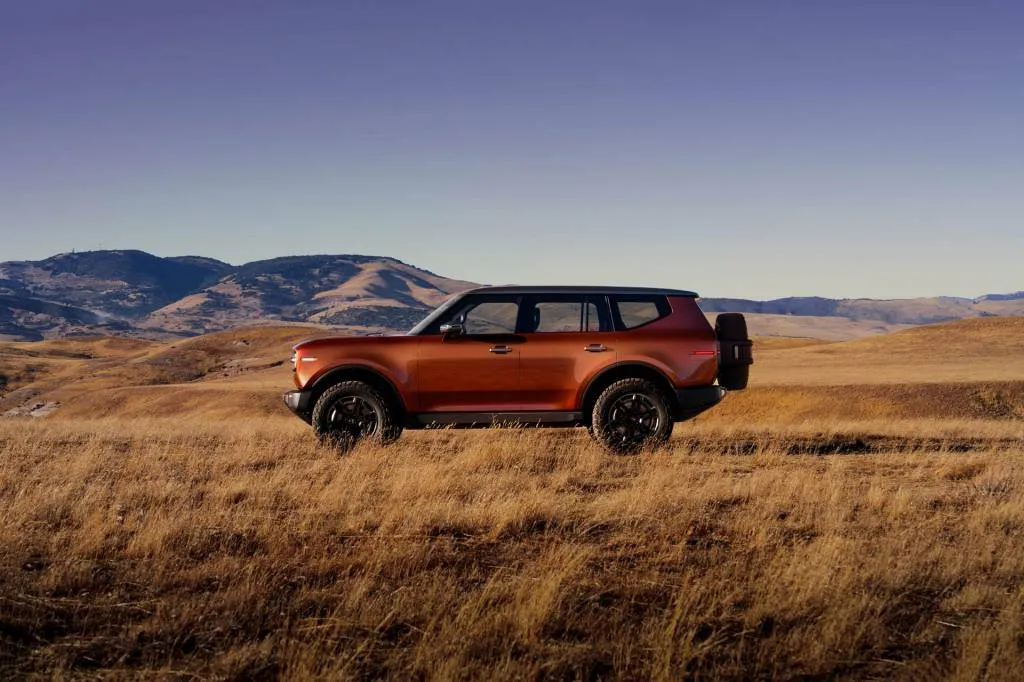
Scout Traveler concept
“Maybe things aren’t glued, they’re screwed, right? Things should be more easy to repair yourself,” Decker said.
This approach was implemented during the design process, with Scout avoiding the “seamless and fused” look of many modern cars in favor of discrete bumpers and body panels that are more accessible, Decker explained, adding that easily removable bumpers make more sense for the Scout vehicles’ intended off-road use.
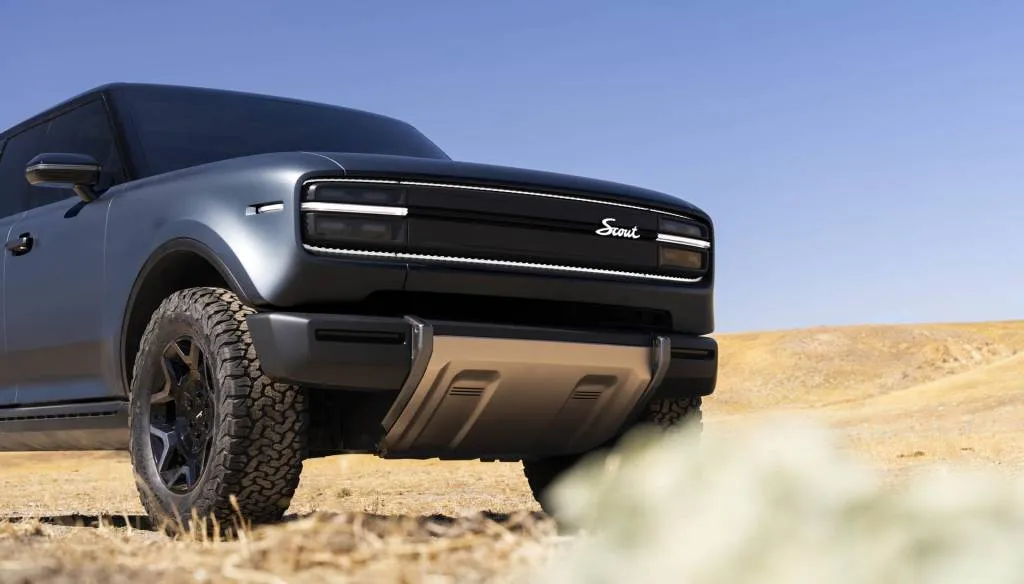
Scout Terra concept
Decker also promised “transparent” repair guides and manuals that will be easily accessible to customers, avoiding what he called the “black box” nature of other EVs. Just the willingness to let customers work on their vehicles is a big difference from Tesla’s initially negative attitude toward independent repair shops and customization.
Like Tesla, though, Scout intends to rely on a direct-sales model instead of franchised dealerships. That’s rankled franchisees of Scout’s parent company, Volkswagen, in California, who claim the move violates the state’s franchise laws because VW already relies on franchised dealerships for its other brands. For now, Scout is completing a $2 billion South Carolina factory with the aim of starting production in 2027.

Tesla Model S and X recalled due to torn airbags
Tesla is recalling a small number of 2024 and 2025 Model S and Model X electric vehicles because their driver’s-side airbags could tear during deployment—increasing the risk of injury to vehicle occupants.
The recall includes just 294 vehicles manufactured in a short window—Nov. 6 to Nov. 27, 2024. These vehicles may have received airbags that were damaged due to an assembly error by the supplier, according to the NHTSA.
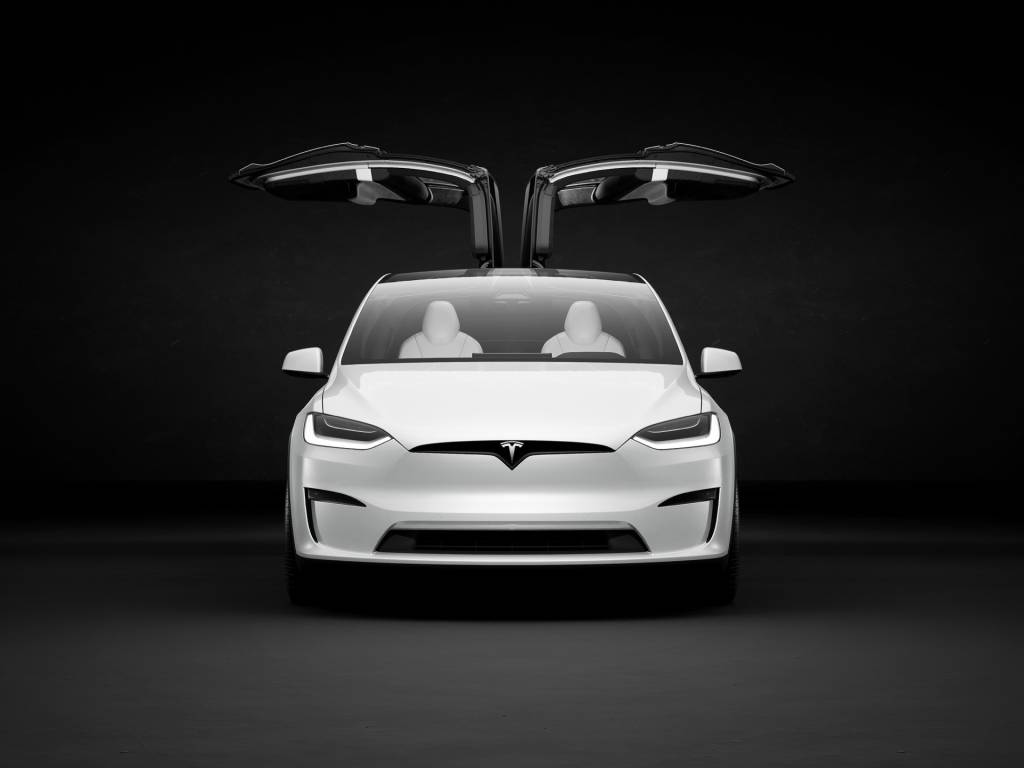
2024 Tesla Model X
In combination with other factors—a deep fold in the airbag and positioning of the windshield heat diffuser—this could cause the airbag to tear when it inflates. A torn airbag may not perform properly during a crash, presenting a greater risk of injury, the NHTSA noted.
Tesla was made aware of this issue by the supplier, which discovered it during acceptance testing of airbags. The automaker told the NHTSA that it is not aware of any crashes, fatalities or injuries related to this issue, or any related warranty claims.
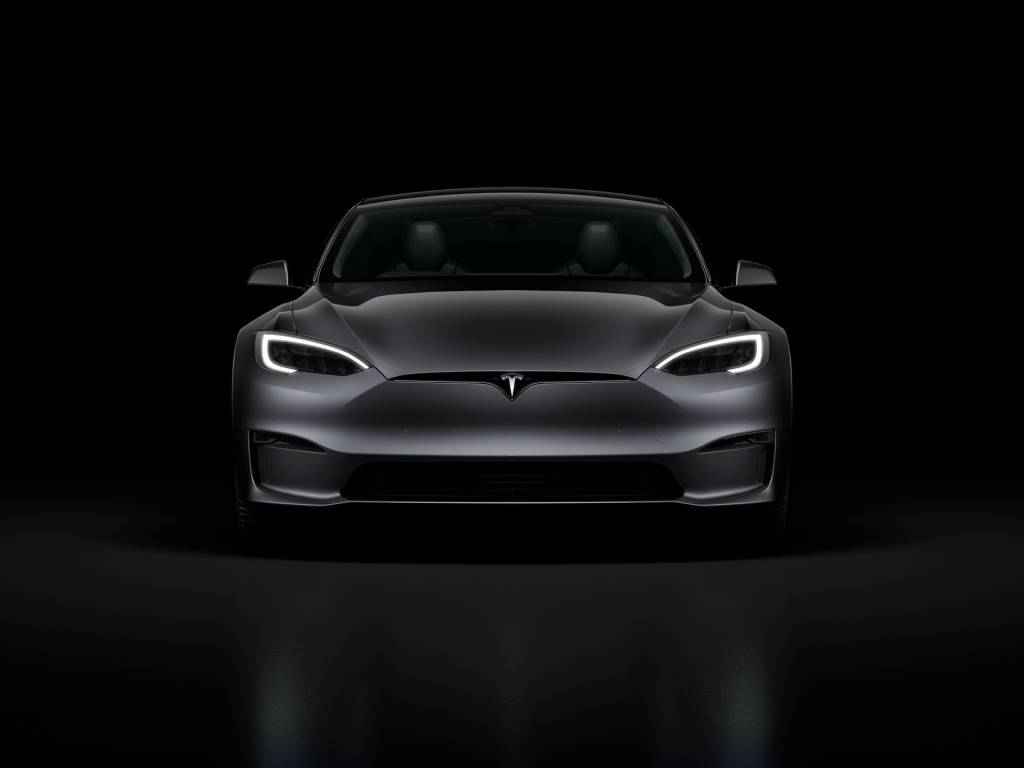
2024 Tesla Model S. – Courtesy of Tesla, Inc.
Tesla service centers will replace the airbag assembly free of charge. Tesla expects to mail owner notification letters on Feb. 21. Owners can also contact the automaker’s customer service department at 1-877-798-3752 for more information. Tesla’s reference number for this recall is SB-24-20-001.
Because it involves hardware, this recall can’t be addressed with a software update, as many Tesla recalls have been. Hardware-related recalls have become more common for the automaker thanks to the problem-plagued Cybertruck. It’s sold well in the U.S., but that couldn’t offset an overall decline in Tesla sales in 2024, on a global scale, after years of persistent double-digit gains.

2025 Chevrolet Corvette ZR1 costs $174,995, 1,064 hp comes standard
 General Motors on Thursday announced pricing for the 2025 Chevrolet Corvette ZR1, and confirmed that order books will open in mid-February. The base 1LZ coupe starts at $174,995, while the 1LZ convertible costs $184,995 (all prices include a $1,695 destination charge). A 3LZ grade is also available, adding heated and cooled nappa leather seats…

Scout CEO: Most people ordering the hybrid because of range anxiety
Reservations for Scout Motors’ range-extended models are outpacing those for pure electric versions, Scout CEO Scott Keogh said in an interview with Bloomberg at CES 2025 in Las Vegas this week.
The new Volkswagen Group brand plans to launch its Traveler SUV and Terra pickup truck in 2027 with a powertrain called Harvester that adds a gasoline engine acting as a generator to boost range. It’s estimated to provide 500 miles on a combination of gasoline and battery power, as opposed to 350 miles for battery-only versions.
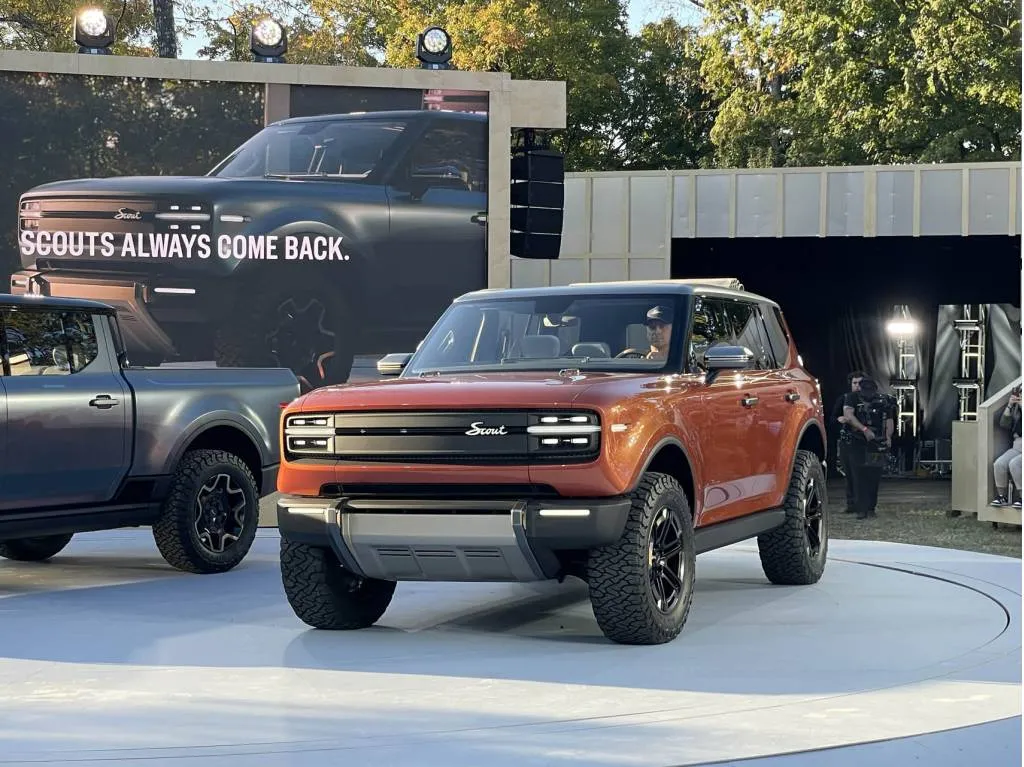
Scout Traveler concept
The Harvester models are attracting more reservations because of EV disinterest in “a portion of America” and concerns over lack of public charging stations, Keogh said, adding that the range-extended powertrain “gives us a 50-state vehicle” that can be sold in regions that are less EV-friendly. That perhaps includes red states like South Carolina, where Scout’s factory is being built.
“The two challenges we see with electrification, charging infrastructure—and of course this takes that all off the table—and plus there’s convenience,” Keogh said. “I think with those two things, a range extender makes a lot of sense.” The CEO added that the mix of all-electric or range-extended vehicles being produced can be easily adjusted to cover changes in demand.
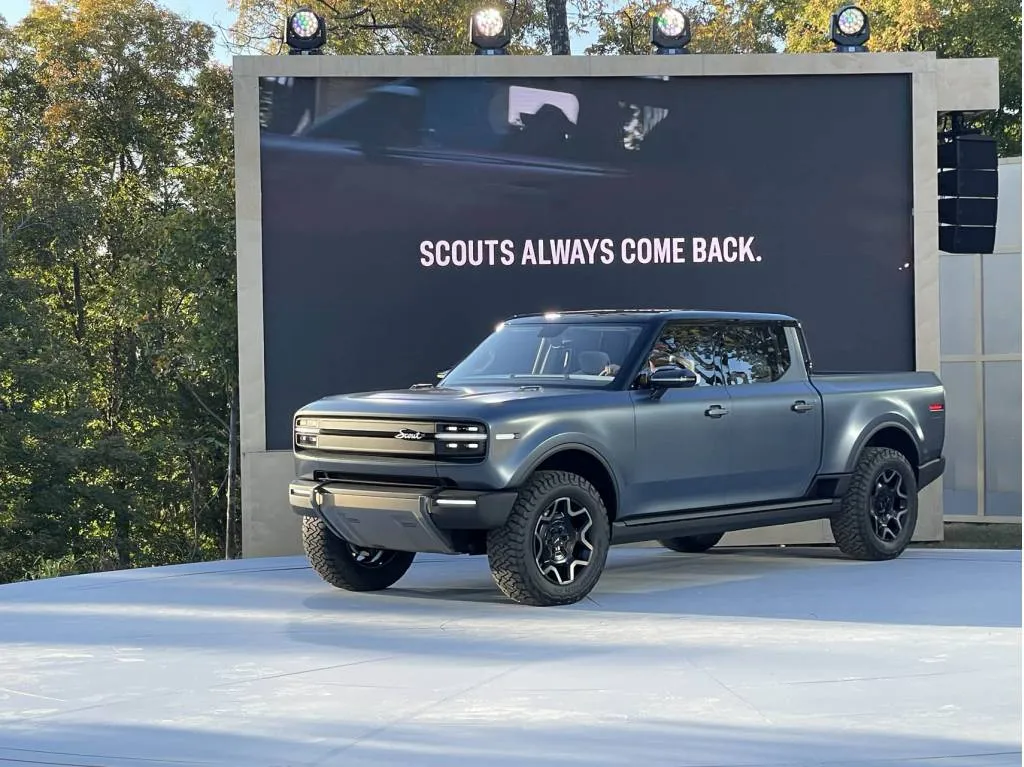
Scout Terra concept
The VW Group announced Scout in 2022, reviving a name originally used on trucks manufactured by International Harvester from 1961-1980. As a brand under the control of the parent company, VW Group, rather than VW of America, Scout is attempting to implement a direct-sales model similar to other EV-only brands like Lucid, Rivian, and Tesla. But VW’s franchised dealers are fighting that.
The Traveler and Terra pay homage to the original Scout trucks with retro styling, a body-on-frame architecture, and an emphasis on physical controls over touchscreens. But they’re still expected to boast some software-based features, like pet and camp modes, comparable to the more tech-forward EV brands. A third model is also reportedly in the works, but timing is uncertain.

Frankencar 2025: The best of the Motor Authority Best Car To Buy 2025 finalists
 The 2025 Frankencar is electric It’s a steal at $67,685 in make-believe land You’ll never find anything like it on the market The Hyundai Ioniq 5 N bested the competition to be named Motor Authority Best Car To Buy 2025. Each of the strong, and mostly electric, competitors posed its own argument for winning, but the Ioniq 5’s…

Ford recalls nearly 300,000 heavy duty diesel trucks
 Diesel trucks prefer to work, at least that’s what the latest Ford recall suggests. Ford Super Duty diesel pickup trucks that sat idle during the pandemic may have a fuel pump that failed due to aged biodiesel fuel deposits. A failed fuel pump could lead to a loss of engine power, making the work trucks idle in an even worse way than economically…

Mercedes-Benz EVs gaining Tesla Supercharger access in February
Starting in February, Mercedes-Benz electric vehicles will be able to charge at 20,000 Tesla Supercharger stations in the U.S., the automaker announced Thursday.
Supercharger access will be enabled via a software update installed by dealerships—not over-the-air. Customers will be contacted by Mercedes to schedule this. The update will preserve the plug-and-charge capability offered in current Mercedes EVs, allowing drivers to charge simply by plugging in, and allow Superchargers to show up on the Mercedes app and infotainment systems.
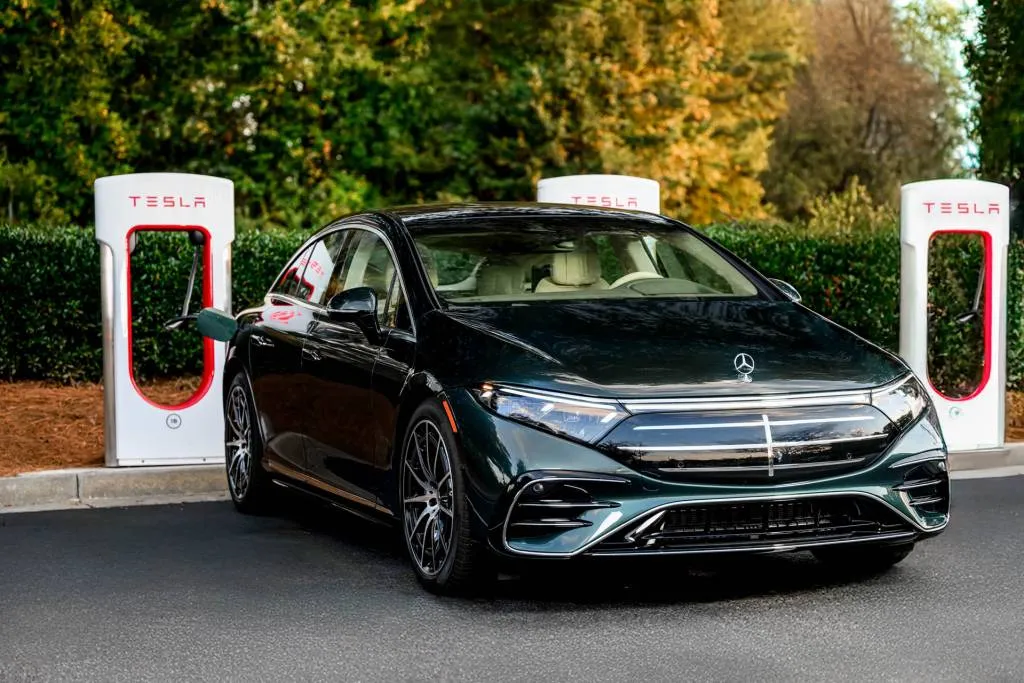
Mercedes-Benz opens Tesla Supercharger access
Adapters cost $185 and will also be distributed through dealerships. They’ll be available in the U.S. this quarter, Mercedes said, but Canadian drivers will have to wait until Q2. Pricing for that market will be confirmed at a later date. Between the U.S. and Canada, Mercedes expects drivers to have access to about 20,000 Supercharger stations.
Mercedes plans to build Tesla NACS ports into new vehicles for North American markets starting this year. So far the refreshed 2025 Hyundai Ioniq 5 is the only non-Tesla EV on sale with a NACS port—and it charges slower with it. That’s because most Tesla Superchargers can’t currently charge at 800-volt peak rates, which doesn’t apply to 400-volt Mercedes EVs on the road today.
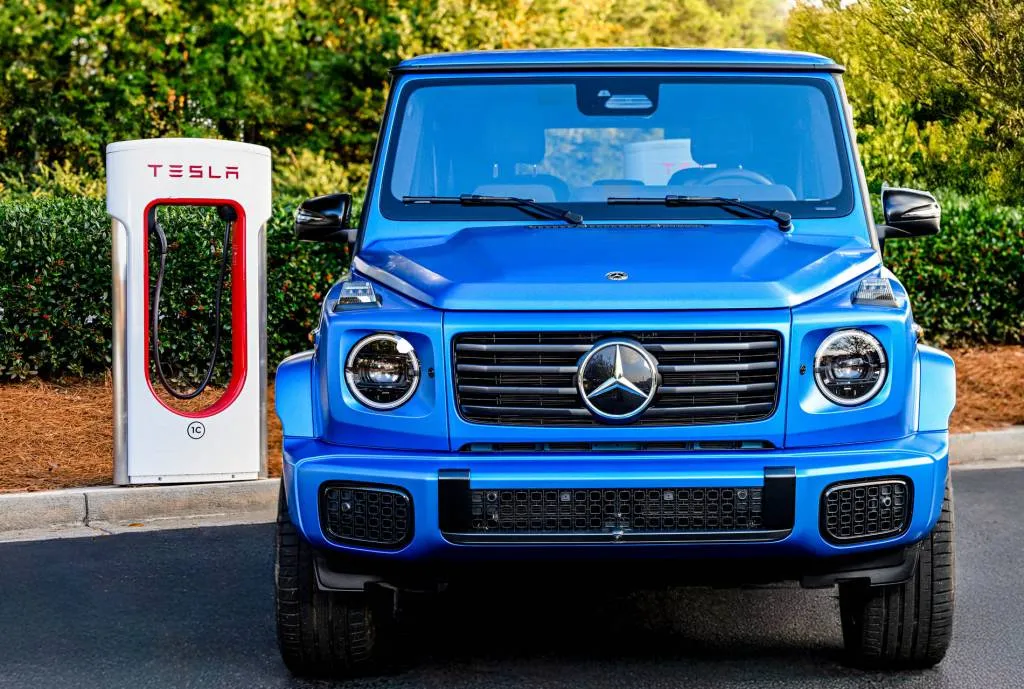
Mercedes-Benz opens Tesla Supercharger access
Mercedes joined the list of brands switching to NACS in July 2023, even as it was working on its own fast-charging network. The first location, featuring 400-kw DC fast chargers provided by ChargePoint, opened in Georgia in November 2023.
And it’s part of the Ionna charging network joint venture, along with seven other automakers. Ionna aims for 30,000 chargers across North America, with the first site scheduled to open later this year.

Volkswagen EVs gaining Tesla Supercharger access in June
Volkswagen will rollout Tesla Supercharger access for its EV customers this summer, when adapters will be ready for current CCS-equipped vehicles.
“We get access to the network in June/July, when we have an official VW adapter,” VW spokesperson Mark Gillies told PCMag at CES 2025 this week, adding that the automaker is still lining up suppliers to manufacture it. Note that this timeline only applies to the VW brand itself; Gillies could not speak to launch timing for other brands of the larger VW Group.
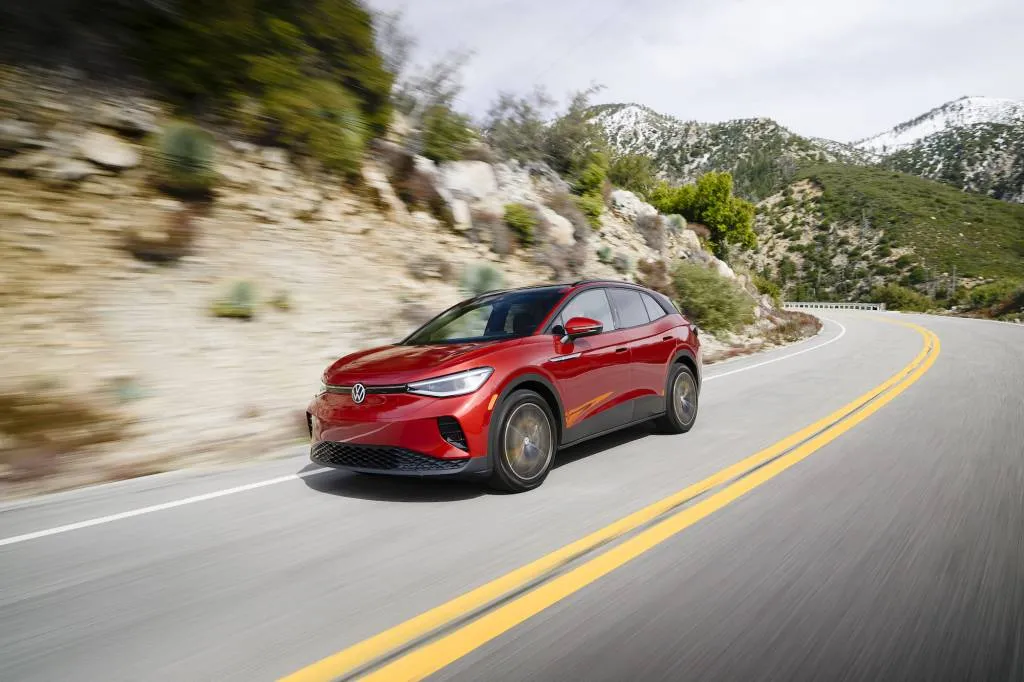
2025 Volkswagen ID.4
The three brands in the VW Group currently selling EVs in the U.S.—VW, Audi, and Porsche—announced Supercharger access and the eventual adoption of the Tesla NACS port in December 2023, alongside the new Scout brand. Scout isn’t planning to deliver its first vehicles until 2027.
This made the VW Group brands among the last to confirm a switch to the NACS port, as nearly all major EV brands in the U.S. market have now confirmed. But it’s also one of the few non-Tesla brands that’s already operating a sizable public charging network in the U.S.—in the form of Electrify America.
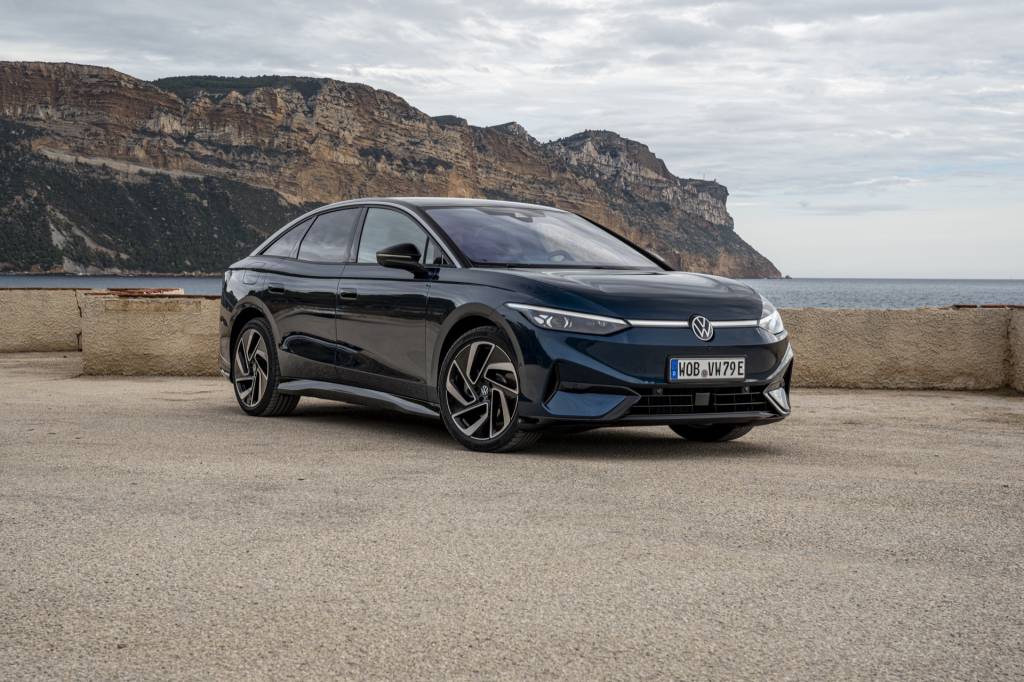
2025 Volkswagen ID.7
Electrify America was created as part of VW’s diesel-emissions cheating settlement, committing the automaker to spend $2 billion on charging infrastructure. VW has said that Electrify America will work to add NACS connectors at its charging stations this year, while continuing to use CCS connectors.
When it first announced Supercharger access, VW said it would also begin selling vehicles with NACS ports in 2025. So far the only automaker to do that is Hyundai, with the refreshed 2025 Ioniq 5. But it charges slower at most NACS ports compared to CCS ports because such vehicles can accept higher charge voltages than what’s allowed by Superchargers.

Feds investigating 2.6M Teslas over Smart Summon remote driving feature
The NHTSA on Tuesday said it is opening an investigation into 2.6 million Tesla electric vehicles in the U.S. over reports of crashes involving the automaker’s Actually Smart Summon remote-driving feature.
Launched in September, Actually Smart Summon is the current version of the Smart Summon remote valet feature Tesla introduced in 2019. It’s designed to move cars short distances in and out of parking spaces, with drivers controlling vehicles remotely via the Tesla smartphone app while keeping them within line of sight. Releasing an app button stops the car.
Reuters reports that the NHTSA is opening a preliminary evaluation into the feature after four crashes. The regulator will then decide whether to upgrade the evaluation into an engineering analysis, and then potentially compel Tesla to issue a recall.
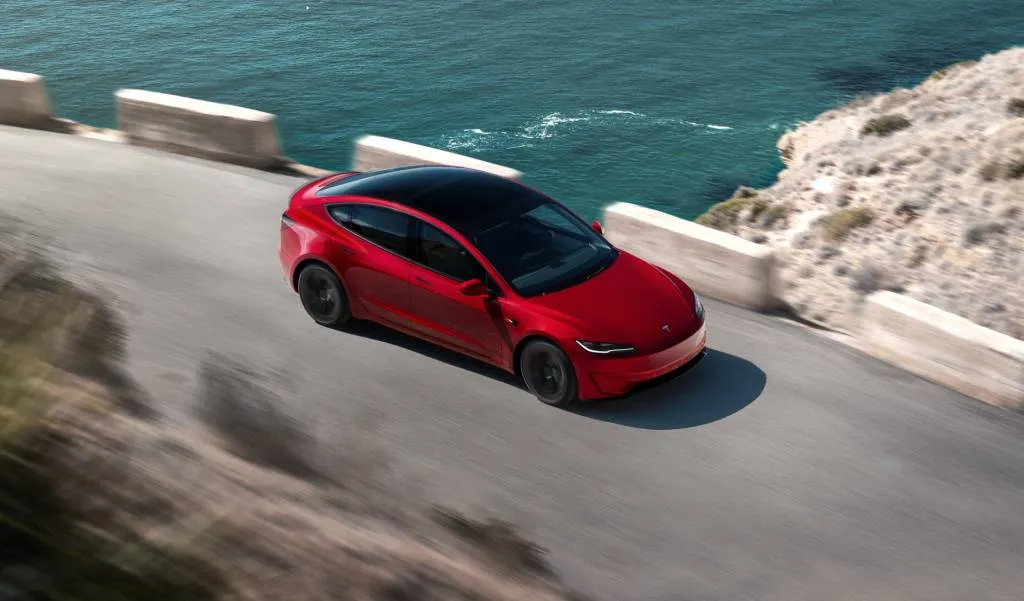
2024 Tesla Model 3 Performance
The NHTSA said it will assess Actually Smart Summon’s maximum speed, its use on public roads, and line-of-sight requirements, as well as potential connectivity delays related to using a smartphone for remote control. The investigation includes 2016-2025 Tesla Model S and Model X, 2017-2025 Model 3, and 2020-2025 Model Y vehicles.
The investigation was triggered by reports that vehicles failed to detect obstacles like posts and parked cars while being remotely operated, and that drivers had too little time to react before a crash.
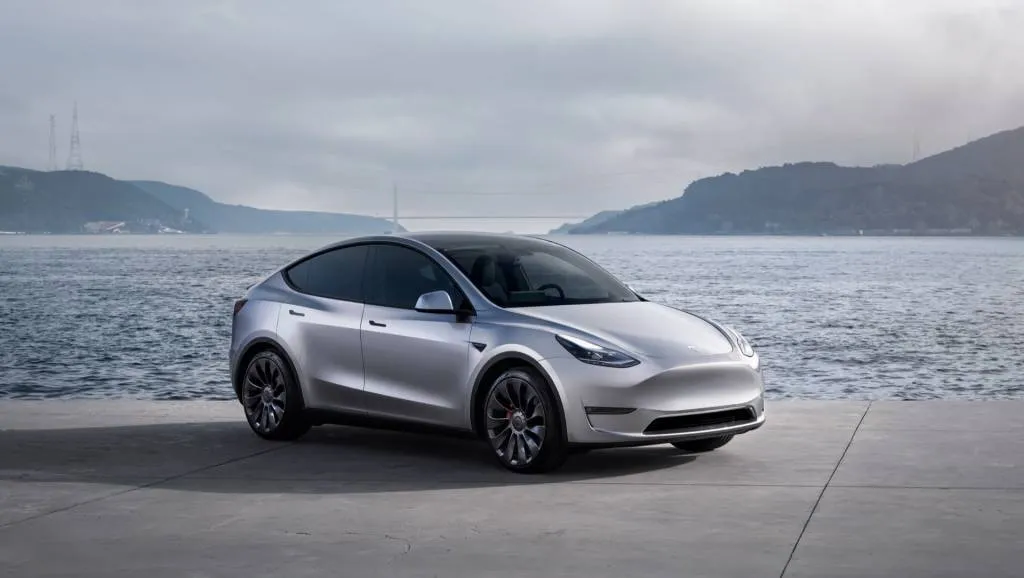
2024 Tesla Model Y. – Courtesy of Tesla, Inc.
This new investigation comes after the NHTSA in October opened an investigation into 2.4 million Tesla vehicles equipped with the misleadingly-named Full-Self Driving system after reports of four crashes—including one in which a pedestrian was killed after being struck by a Model Y.
In addition to two investigations, Tesla has had to deal with the troubled launch of its Cybertruck—which has now been recalled seven times—and saw sales fall in 2024. But Tesla CEO Elon Musk’s close relationship with president-elect Donald Trump creates the possibility that the incoming administration won’t pursue these investigations further.

Mazda plans to build an EV battery factory in Japan
Mazda on Monday announced a new Japanese battery plant that will assemble cylindrical cells into modules and battery packs for use in a planned electric vehicle based on a dedicated platform.
Located in Iwakuni City, in Japan’s Yamaguchi Prefecture, the plant targets 10 GWh of annual production, Mazda said. Cells will be supplied by Panasonic under an agreement between the two companies announced in June 2023 and approved by Japanese regulators in September 2024.
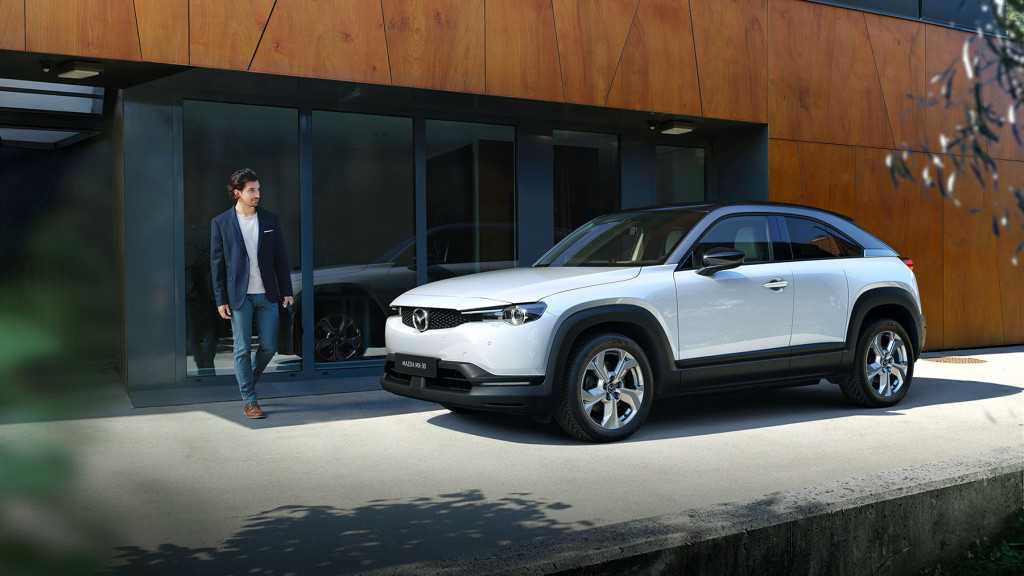
2023 Mazda MX-30 EV
Mazda previously launched the low-range MX-30 in both all-electric and range-extended form, and is partnering with China’s Changan Automobile on the EZ-6 electric sedan. But Mazda said modules and packs assembled at this new plant are destined for “Mazda’s first battery EV that uses a dedicated EV platform,” which will also be assembled in Japan. This likely refers to the electric SUV scheduled to launch in 2027 that Mazda confirmed in November 2024.
The original announcement of the cell supply deal with Panasonic also mentioned North American production of cells, likely from a new factory in De Soto, Kansas. Mazda hasn’t offered an all-electric model since the withdrawal of the MX-30 from this market, but has said that it will adopt the Tesla NACS charging connector for any future EVs it might sell here.
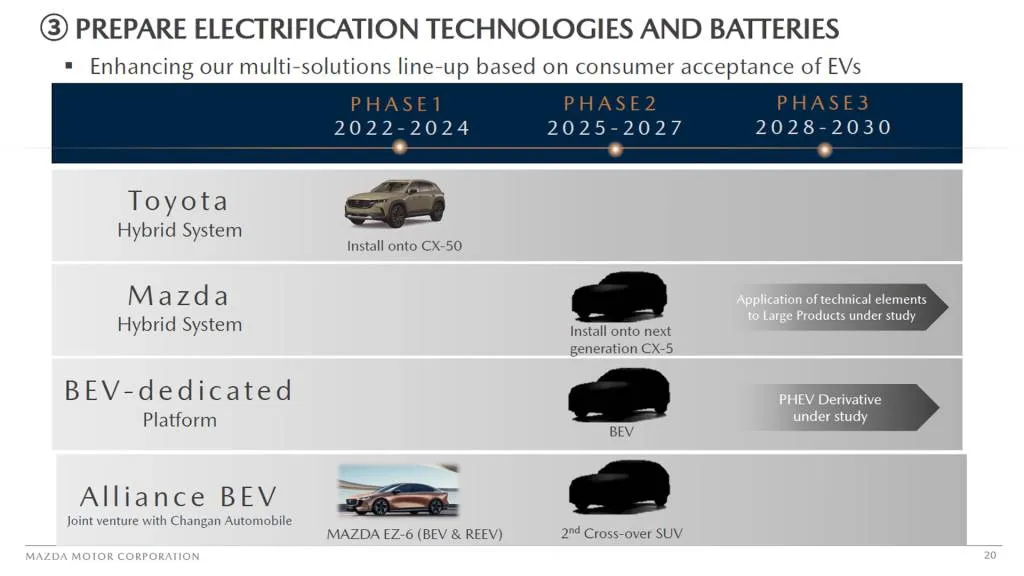
Mazda electrification plans for current decade
Mazda has indicated that longer-range EVs aren’t the future, but the use of cylindrical cells could yield efficiency gains. It’s the chosen cell of Lucid and Tesla—the two range-leading EV brands—with Panasonic supplying both.
Other automakers are also looking at cylindrical cells. BMW is expecting major efficiency improvements from them in its upcoming Neue Klasse EVs, and General Motors has hinted at them as part of an overall strategy of cell flexibility.