
Author: EVAI

1957 Chevrolet Corvette SS Project XP-64 heads to auction
 A piece of Corvette royalty will soon be offered to the public The car is considered the first purpose-built General Motors race car It is being offloaded by the Indianapolis Motor Speedway Museum, and is estimated to sell for between $5 million and $7 million One of the most significant Corvettes in history will be auctioned off this February…

2025 Subaru Forester Hybrid gets 35 mpg, costs $36,415
 2025 Subaru Forester Hybrid starts at $36,415 The AWD crossover SUV gets 35 mpg combined The Hybrid costs $3,000 more than a similarly equipped gas-only Forester Most compact crossovers now offer hybrid powertrains, but the Subaru Forester has been a notable exception. That changes this year. Revealed Thursday at the 2025 Chicago auto show, the…

Kalmar expands Safari-style Porsche 911 conversions with RS-7
 Kalmar has revealed a Safari-style conversion for the 997-generation Porsche 911 Upgrades include Kevlar composite parts and a ride height that extends to over 8.0 inches Kalmar says it won’t develop Safari-style conversions for any 911 generation beyond the 997 Danish performance marque Kalmar, known for its bespoke Porsche 911 restomods, has…

This is what the electric BMW M3 might sound like
 An electric BMW M3 is in the works and prototypes have been spotted A video provides a taste of the generated sound within the cabin of one of the prototypes The electric M3 is due around 2027 and will still have a gas-powered counterpart BMW is working on a new generation of electric vehicles, known as the Neue Klasse, and some of them will be…

2025 Jeep Wagoneer S Limited expand EV lineup for $66,995
The 2025 Jeep Wagoneer S electric SUV makes the transition to regular production after a truncated first model year.
Unveiled Thursday at the 2025 Chicago auto show, the 2025 Jeep Wagoneer S Limited grade joins the Launch Edition version that kicked off sales of Jeep’s first EV for North America late last year as a 2024 model. It’s priced at $66,995 (including a $1,795 destination charge)—$5,000 less than the Launch Edition that’s arrived for a brief 2024 model year.
The Limited will get the Launch Edition’s 600 hp and 617 lb-ft of torque, but only through an extra-cost over-the-air (OTA) update as part of an Propulsion Boost Package arriving later in the model year. Otherwise, true to the badging, it’s limited to 500 hp and 520 lb-ft.
That higher of the outputs helps make the Wagoneer S the quickest Jeep in history. In a first drive of the Launch Edition model, we found that it also strays from Jeep brand identity. A production version of the off-road-ready Wagoneer S Trailhawk concept shown last year would address that, but so far there’s no hint from Jeep that it’s on the way.

2024 Jeep Wagoneer S test drive review
The Wagoneer S Limited doesn’t have EPA range ratings yet, but it does have the same 100-kwh battery pack that can be charged from 20%-80% in 23 minutes and is rated at 303 miles in the Launch Edition. All Wagoneer S models include an offer of a 48-amp Level 2 AC home charger or credits of equivalent value for use at public charging stations.
The Limited carries forward some design elements from the Launch Edition, including a lack of chrome trim and standard 20-inch wheels. But those wheels have a machined aluminum finish instead of gloss black, and they’re accompanied by a black roof and mirror caps.

2025 Jeep Wagoneer S Limited

2025 Jeep Wagoneer S Limited
2025 Jeep Wagoneer S Limited

2025 Jeep Wagoneer S Limited
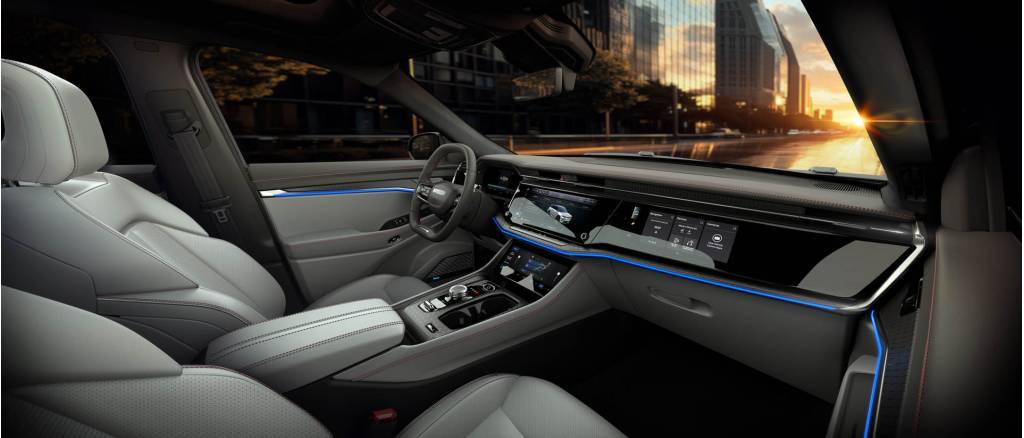
Inside, the Wagoneer S Limited can be equipped with the same three-screen arrangement as the Launch Edition, encompassing a 12.3-inch central display, 12.3-inch instrument cluster, and 10.2-inch front-passenger display. A dual-pane panoramic sunroof and 10-way power-adjustable heated front seats are standard as well, while a McIntosh high-end audio system is optional.

2025 Jeep Wagoneer S Limited lowers EV’s entry price to $66,995
 Stellantis on Thursday unveiled a lower-priced version of the Jeep Wagoneer S, the brand’s first electric vehicle for the North American market. The Wagoneer S went on sale late last year as a 2024 model in a single Launch Edition configuration priced at $71,995 with destination. At the 2025 Chicago auto show, Stellantis brought out a new Wagoneer…

2025 Jeep Wagoneer S Limited arrives for $66,995
 The 2025 Jeep Wagoneer S lineup expands with a new Limited trim It joins the previously available Launch Edition trim and starts at $66,995, including destination Limited lowers the Wagoneer S’s base price by $5,000, lowers output to 500 hp Jeep is making its electric midsize SUV, the Wagoneer S, more accessible for the 2025 model year with the…

VW confirms multiple sub-$25,000 EVs, teases likely ID.1
- Entry-level EV teased; likely ID.1 will start under $21,000 in Europe
- Nine new models by 2027, including ID.2all, electric Golf, electric T-Roc crossover
- Volkswagen hasn’t confirmed if any of those EVs are U.S.-bound
The big future that Volkswagen sees for its core brand brings it back to its roots: affordable small cars—at least for Europe.
On Wednesday, VW confirmed plans for an entry-level, fully electric small car starting at less than $21,000 (around 20,000 euros), due in 2027. While it gave employees a first look at the model, VW announced that it will be showing this entry EV to the public at the beginning of March.
The small EV, widely expected to be called ID.1, was pitched by Volkswagen Passenger Cars CEO Thomas Schäfer as “an affordable, high-quality, and profitable electric Volkswagen from Europe for Europe.”
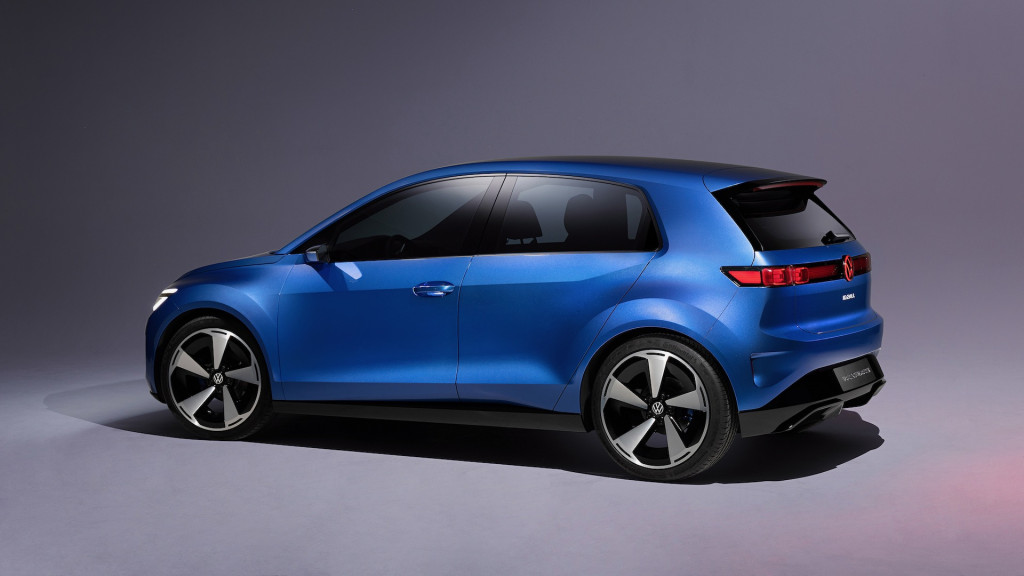
The likely ID.1, which even from the teaser photo above appears to channel some heritage from the successful Up—and fully electric e-Up—city car, will fit in its EV lineup next to the production version of the VW ID.2all, which comprises a small-car family that represents the evolution of VW’s MEB foundation for affordable EVs and is set for a 2026 introduction with a starting price under $26,000 (25,000 euros).

Volkswagen ID.2all concept
Volkswagen ID.2all concept

Volkswagen ID.2all concept
In all, VW plans nine new models by 2027, including the ID.2all and entry-level EV. so it’s unclear whether this model might see other markets like North America as also within its lens. Green Car Reports has reached out to Volkswagen of America for some context—and especially whether the recent cancellation of the ID.7 is any indication U.S. EV products will go in the same affordable direction.
VW didn’t confirm where these new European models would be built—Spain is the likely location, based on reports—but it did say it would keep its home Wolfsburg plant the core of VW as it shifts to EVs. That means shifting Golf production to Mexico to make room at Wolfsburg for a next-generation electric Golf and upcoming electric T-Roc crossover.
In 2019 VW envisioned a much higher volume for its EVs, targeting 15 million EVs across 50 EV models globally by 2028 with a strong focus on Europe, North America, and China, plus a second wave of models providing even more growth.
VW said Wednesday that globally it has sold more than 1.35 million ID vehicles since it introduced the product family in 2019, and last year it reached 383,100 EV sales.

Rivian and Volkswagen Group electrical architecture and software stack
As of yet VW’s progress has been hindered by an array of issues, ranging from supply chain and software issues to a Chinese market landscape that’s evolved to favor local EV makers. But a recent $5.8 billion investment and joint venture with Rivian extending to electrical architecture and software may help ease the way in future mass-market EVs, including small cars.

Planned merger between Honda and Nissan may be in trouble

- Nissan and Honda are “advancing various discussions” regarding proposed merger
- Honda reportedly proposed to make Nissan a subsidiary
- Merger is seen as potential lifeline for Nissan, would create one of world’s largest automakers
The anticipated merger between Honda and Nissan announced last December, may be encountering significant challenges that, according to reports, could potentially lead to its cancellation.
Initially, both automakers planned to finalize their decision by the end of January, but the deadline has been pushed back to mid-February. New tariff threats by the Trump administration are also likely to be weighing on the deliberations.
Now a series of reports citing insiders—and potentially part of the give-and-take of negotiation—indicate that Nissan is reconsidering its participation in the merger.
Citing several sources, Reuters reported on Wednesday that Nissan’s management expressed concerns over Honda’s proposal to make Nissan a subsidiary, a move that could diminish Nissan’s decision-making authority within the partnership. That report also appears to imply that negotiations have halted or that Nissan has withdrawn while it retains the option to restart negotiations.
Nissan, after that report, has issued a statement confirming that discussions have not ended. “Based on the memorandum of understanding signed on December 23 last year, Honda and our company are in the stage of advancing various discussions, including the contents of the report, and we plan to establish a direction and make an announcement around mid-February,”
Honda had not yet at the time of writing issued its own equivalent statement. Japan’s Asahi Shimbun also reported on Wednesday, perhaps as part of these “discussions,” that Honda executives are frustrated with Nissan’s slow progress in both the merger discussions and the implementation of a restructuring plan. This plan includes the reduction of 9,000 jobs and a 20% decrease in production capacity.
Unlike Honda, Nissan has been struggling with declining sales, particularly in the U.S. and China, raising uncertainty about its future without the merger. Without a clear path forward, the merger has been seen as a potential lifeline. The Financial Times in its own report on Wednesday highlighted that Nissan’s recent poor financial performance has caused its market capitalization to shrink to just one-fifth of Honda’s, altering the balance of power in the negotiations.
Mitsubishi, which is already partially owned by Nissan, was invited to join the merger. However, reports from January suggested that Mitsubishi preferred to stay out of the merger, citing its smaller size and concerns over losing independence within the combined entity.
Even without the merger, Honda and Nissan may deepen their collaboration. The automakers are already partnered in some areas. Honda and Nissan have been collaborating on EV and software development since early last year, and Mitsubishi joined the partnership last summer. Nissan and Mitsubishi also already share vehicle platforms and technology via their existing alliance, which also includes Renault. Mitsubishi has also collaborated with Honda in the past, most recently in battery leasing for EVs through a joint venture called Altna.
Combined sales of Honda and Nissan in 2023 totaled more than 8 million vehicles. That would make the merged automaker, estimated to have a value of around $58 billion, the third largest by sales volume after Toyota and the Volkswagen Group, which sold 11.2 million and 9.2 million vehicles in 2023, respectively.

Ionna scales up toward targeted 30,000 EV chargers by 2030

The U.S. EV charging network Ionna is picking up speed in its infrastructure build-out as the nascent network aims to make good on its promise of installing tens of thousands of electric vehicle chargers over the next five years.
It said on Tuesday in a press release that it is transitioning “from public beta to full-scale national release” following the opening of its first location and the conclusion of a testing program in 2024.
The testing program involved more than 4,400 charging sessions with more than 80 unique EV models, dispensing nearly 63,000 kwh of energy, according to Ionna. It added that the goal was to “stress-test” the network; now the focus shifts to the network build-out.
Ionna was initially backed by seven automakers, including BMW Group, General Motors, Honda, Hyundai, Kia, Mercedes-Benz, and Stellantis. Toyota joined Ionna in 2024. The network was announced in 2023 as the first potential rival to the Tesla Supercharger network in North America, and has steadily built momentum as plans for continued expansion of the Supercharger network have fluctuated.
Ionna now claims to have more than 100 contracted charging sites nationwide, and just this week announced new sites in Houston, Texas; Abilene, Kansas; and Wilcox, Arizona. Those join six already under construction. They’ll be accompanied by new tech features, including expanded Plug & Charge compatibility and Amazon “Just Walk Out” tech that lets drivers grab refreshments without having to wait in line.
Its first location is in Apex, N.C., in what Ionna refers to as a “Rechargery”—in a converted gas station.
Ionna hopes to have 1,000 new charging bays online by the end of the year, on the way to a goal of 30,000 bays by 2030 that was first announced in 2023. “Bays” is the metric Ionna uses in place of charging connectors. It essentially means charging spots, although each spot can have multiple connectors. Those connectors can be CCS or NACS, it has noted.