
Author: EVAI

Ferrari F1 team tests rain spray guards that look like fenders
 Ferrari this week tested new spray guards for its Formula 1 cars as the FIA looks to tackle the problem of visibility on wet tracks. The test, which took place at Ferrari’s own Fiorano circuit, saw Arthur Leclerc (brother of current Ferrari F1 driver Charles) driving last year’s race car with the experimental spray guards while Ferrari F1 reserve…

Toyota Ventures’ Jim Adler finds fresh opportunity for mobility investments (Episode 250)
The founder and general partner of the venture-capital firm details a new $300 million infusion from its namesake automaker, separates hype from reality in the AI boom, and discussions automotive’s convergence toward the energy realm.

Ferrari patents 3-motor electric car with sound generators
 Two patent filings hint at how Ferrari is planning to make up for the lack of engine noises in future electric cars. One patent application, published by the United States Patent and Trademark Office (USPTO) on March 21, and filed by Ferrari last year, is for a triple-motor EV with sound generators, plus inlets positioned near each of the motors…
Leo Michael cartoon: F&I words
Same-store finance and insurance gross profit per vehicle fell at five of the top six public auto dealership groups in the first quarter 2024 compared with the first quarter of 2023.

2025 Subaru Forester
 What kind of vehicle is the 2025 Subaru Forester? What does it compare to? The redesigned 2025 Subaru Forester marks the sixth generation of the popular compact crossover. It stands out from the longer Outback as being taller, boxier, and more utilitarian than adventuresome, though it has all the off-road capability of any other Subaru SUV. The…

Musk: Tesla Supercharger network plans $500M expansion despite layoffs
Despite recent layoffs, the Tesla Supercharger network is due for an expansion, CEO Elon Musk claims.
Tesla will spend “well over” $500 million on the Supercharger network this year, Musk said Friday on X (formerly Twitter), the social media network he owns, adding that this investment will fund “thousands” of new chargers and is separate from any operating costs needed to simply keep the current network going. For perspective, there are currently 25,507 Tesla Supercharger ports in the U.S. and 2,264 station locations, according to the Energy Department’s Alternative Fuels Data Center.
Musk earlier this month fired nearly the entire Tesla Supercharger team, including Rebecca Tinucci, the executive who has accelerated growth of the network in recent years and helped convince nearly the entire U.S. EV market to switch to Tesla’s North American Charging Standard (NACS) connector.
Just to reiterate: Tesla will spend well over $500M expanding our Supercharger network to create thousands of NEW chargers this year.
That’s just on new sites and expansions, not counting operations costs, which are much higher.
— Elon Musk (@elonmusk) May 10, 2024
Ford led the way in adopting the Tesla charge port, in May 2023, at a time of great expansion for the Supercharger network—and nearly every other U.S. EV brand soon stepped up to confirm they’d also make the switch.
In the year since Ford’s announcement, NACS has also become an official standard—SAE J3400. That’s paving the way for more charging networks to add the NACS connector, including BP, which just this week said it is looking to purchase stranded Supercharger sites should Tesla contract the network.
EV advocates may be hoping for increased reliability from switching to NACS, given the Supercharger network’s solid reputation in that area. But reliability gains across the industry will take more than a Tesla connector. With about 100 charging station manufacturers and 500 combinations of cars and chargers, it’s a lot that needs to be cross-compatible.
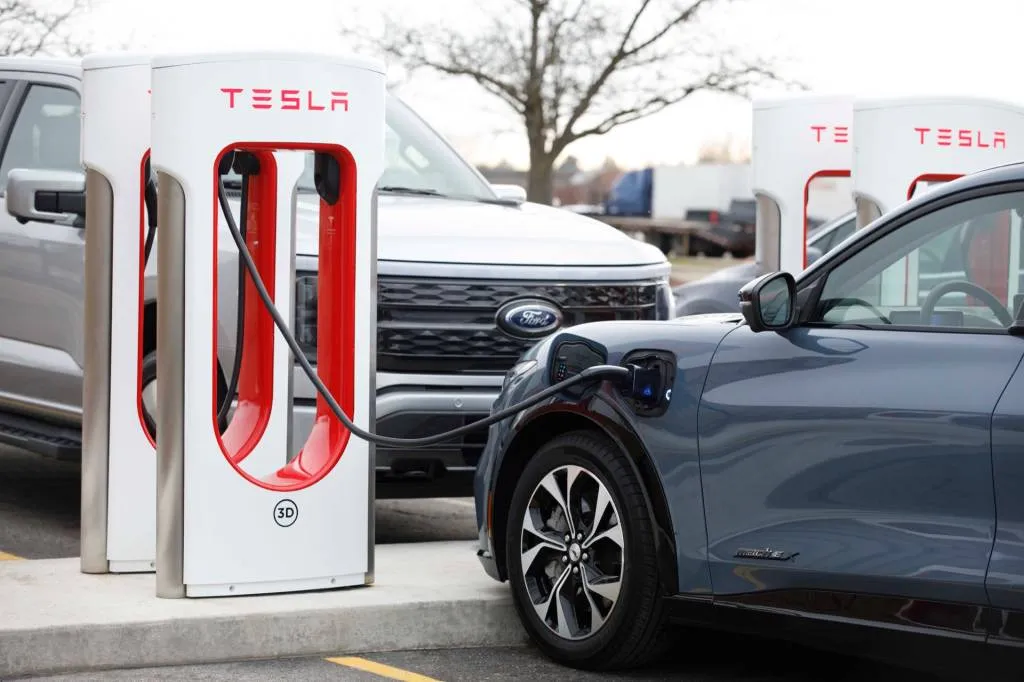
Ford EVs at Tesla Supercharger
Musk has also suggested in the past that the Supercharger network might charge extra for slow-charging non-Tesla EVs. We’ll see if that’s something the automaker introduces at some point soon.
There’s been little backstory about why the Supercharger division was nearly shuttered. Musk had recently actually praised the team as the key to its future. And he’s given no indication how the Supercharger network will continue to operate at its current level—let alone expand—after so many key personnel were dismissed.

Bentley Batur Convertible, BMW M4 CS: This Week’s Top Photos
 Bentley’s W-12 engine ceases production this summer, and the automaker is celebrating the run with a limited-edition model known as the Batur. This week Bentley revealed the Batur Convertible, whose production is even more limited than for the original coupe. Another limited-production car in the headlines this week was a new generation of BMW’s…

Ford teases 2025 Dakar Raptor truck, announces first drivers
 Ford has recruited two previous winners of the Dakar Rally to drive its Raptor-branded race truck in the 2025 running of the gruelling event. The automaker has confirmed that Carlos Sainz Sr. and Nani Roma will be two of the four drivers of the newly developed Dakar Ford Raptor. The father of Ferrari F1 driver Carlos Sainz Jr., Sainz Sr. has won…

Manthey-Racing upgrade for Porsche 718 Cayman GT4 RS reaches US
 Manthey-Racing continues to expand its offerings in the U.S., this time with an upgrade for the Porsche 718 Cayman GT4 RS. Manthey is a German motorsports and engineering company with close ties to Porsche, and has in the past been tapped to oversee some of Porsche’s racing programs. It recently entered the game of offering upgrades for some of…

BP’s Supercharger bailout, Trump’s Big Oil bet, big batteries in fuel-cell trucks: Today’s Car News

Trump reportedly offers to scrap EV-friendly EPA emissions rules. BP seeks to rescue stranded Supercharger stations as Tesla’s charging plans fizzle. And does going with a very large battery pack but no charge port make sense in fuel-cell semis and even pickups? Toyota thinks so. This and more, here at Green Car Reports.
Although big batteries and hydrogen fuel cells are often seen as two opposing ways to electrify trucks with no tailpipe emissions, Toyota is reworking the formula in its hydrogen fuel-cell semi to include both. With a supersized battery pack but no plug-in capability, Toyota makes more of the fuel-cell tech. Look for the same formula, potentially, in future pickups.
Former President and current Presidential candidate Donald Trump reportedly tried to collect $1 billion in donations from top oil executives at Mar-a-Lago over the promise that Trump would scrap stricter EPA emissions rules anticipated to drive up the sales of EVs. Although with many of these companies recast as diversified, greener “energy companies,” the extra pollution might not be the image they’re looking for.
And in a strange turn of events, the oil giant BP may rescue Tesla Supercharger sites left in the lurch after Tesla’s still puzzling decision to cut its Supercharger program. BP intends to spend $1 billion by 2030, with half of that investment to be made within the next two to three years. That will include 3,000 U.S. chargers, with some large-scale sites with 12 or more chargers, to be called Gigahubs.