
Author: EVAI

Porsche app gives EV drivers access to 75% of compatible US chargers
Porsche on Thursday announced an agreement in the U.S. with ChargePoint to include the network’s chargers in its My Porsche app starting in Q4 of this year.
With the app and its coordinated Porsche Charging Service, the arrangement will bring the total number of supported chargers to more than 86,000, according to Porsche. That aggregated total includes both the CCS DC fast chargers that you might make part of a highway road trip, and the J1772 AC chargers, otherwise referred to as destination charging or Level 2—or, simply, the type owners are likely to install at home.
At these public chargers, Porsche drivers won’t need to worry about individual payment details. That will be handled through a single account—an arrangement that’s becoming increasingly common among brands to support ease of ownership.
According to the Department of Energy’s Alternative Fuels Data Center, ChargePoint includes a total of 62,536 chargers across 34,569 locations. That breaks out to 2,783 locations with DC fast charging and 31,789 with destination charging.
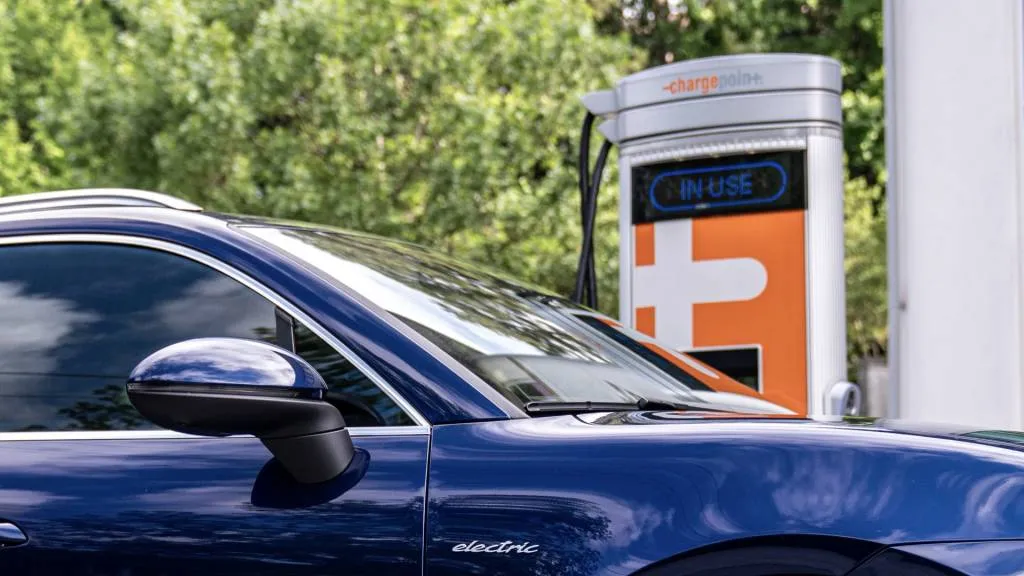
Porsche Macan EV at ChargePoint charger
Porsche Cars North America president and CEO Timo Resch called the move to include ChargePoint “well-timed as we look forward to the arrival of both the new Taycan arriving at Porsche Centers this summer but also the all-new Macan Electric later this year.”
Indeed, a refreshed 2025 Porsche Taycan delivers more range while keeping its 10-80% charging stops under 20 minutes, in some cases, with access to a 350-kw CCS connector. And the Macan electric SUV builds on that 800-volt charging tech, with an entry price of $80,450.
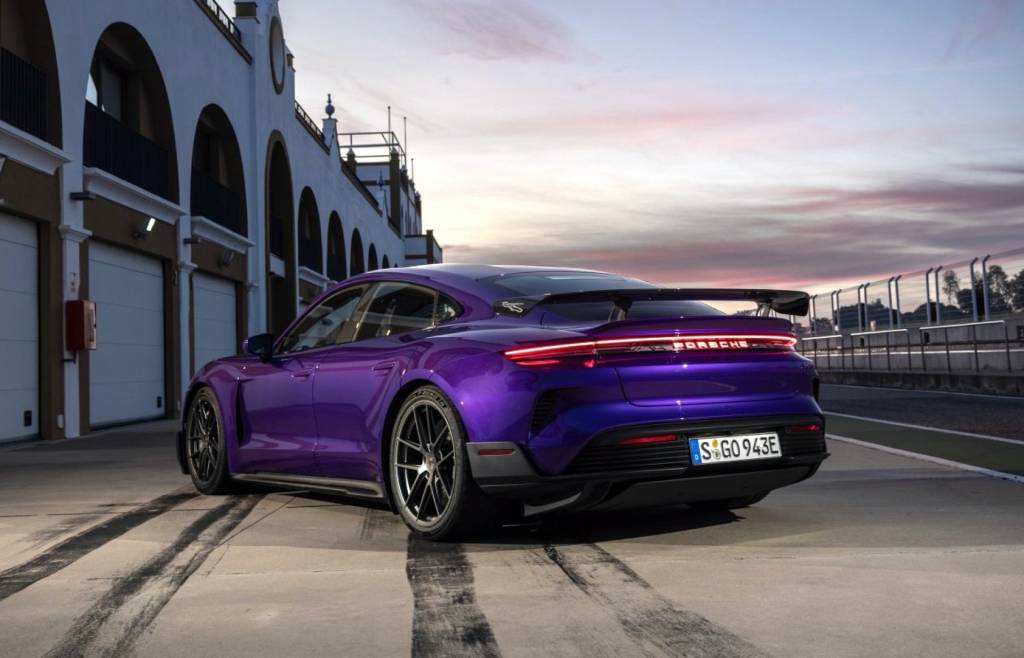
2024 Porsche Taycan Turbo GT Weissach package
Porsche, as part of the Volkswagen Group, announced in December that it would implement the Tesla-based NACS standard in future products for North America starting in 2025.
Porsche reiterated with Thursday’s announcement that it’s also still “exploring adapter solutions for existing vehicles to access the Tesla Supercharger network, starting in the first half of 2025.” It’s easy to understand how this isn’t particularly high-priority for Porsche; as Green Car Reports has underscored before, Taycan drivers likely won’t see peak charge rates on Tesla Supercharger V3 hardware, while the latest V4 hardware set for higher-voltage charging has been very slow to roll out.

Feds: 90% of eligible EV purchases get tax credit at point of sale
The majority of EV purchasers eligible for a federal tax credit have gotten the credit as a point-of-sale rebate since that option was added at the beginning of the year, The Treasury Department said in a press release.
As part of a revamp of the federal EV credit enacted under the Inflation Reduction Act (IRA), credits of up to $7,500 for new EVs and up to $4,000 for used EVs became available at the point of sale through dealerships January 1.
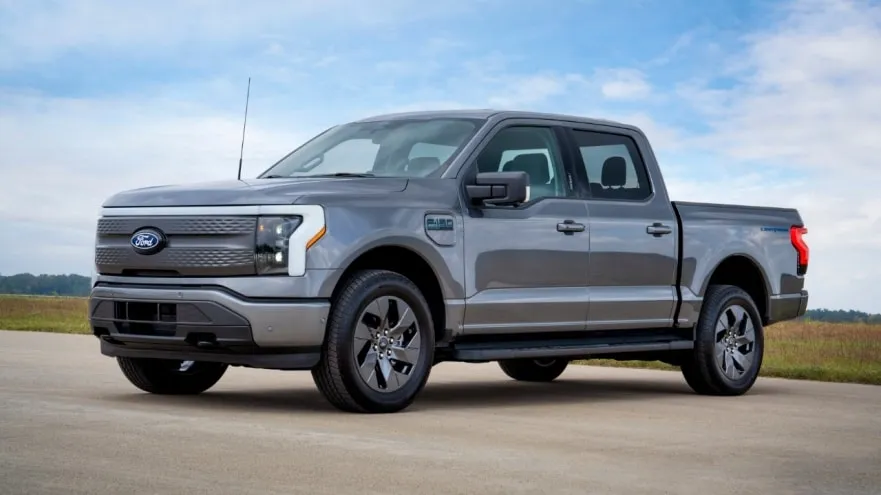
2024 Ford F-150 Lightning Flash
Since, then the Treasury Department claims to have issued more than 150,000 tax credits—125,000 of which were for new-vehicle purchases—equivalent to more than $1 billion in financial benefits. More than 90% of new-vehicle credits and approximately 80% of used-vehicle credits were issued as point-of-sale rebates, according to the Treasury Department.
Those take rates are impressive considering that not all eligible dealerships were registered with the IRS and ready to offer point-of-sale rebates at the beginning of the year, when the new policy took effect. The figures quoted by the Treasury Department indicate that most dealerships—or at least the ones that sell the most EVs—have since gotten onboard.
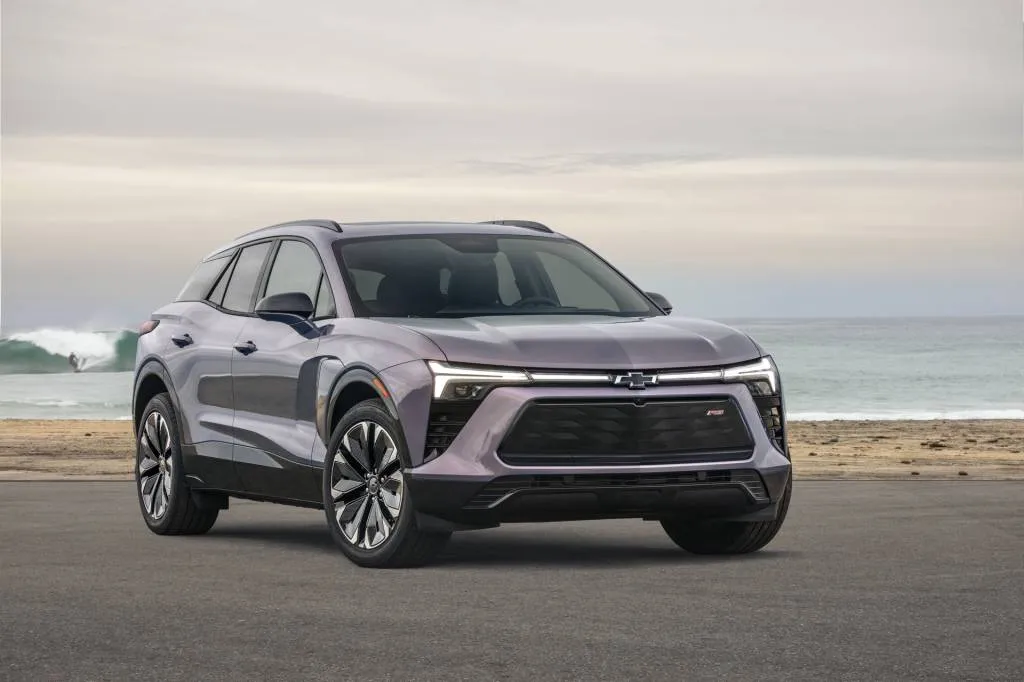
2024 Chevrolet Blazer EV RS
Allowing eligible EV buyers to collect the credit at the point of sale, rather than receiving it when they do their taxes, could enhance the effectiveness of the incentive. Buyers like the idea of a point-of-sale rebate so much that they would have settled for less money up front, a George Washington University study published in 2022 found.
Point-of-sale rebates aren’t limited to franchised dealerships, either. The tax credit can be claimed on Teslas at the time of purchase via its company-owned direct sales apparatus.

2025 BMW M2 now matches M3 on power
 BMW’s given the M2 a bump of 20 hp The updated 2025 BMW M2 will cost $66,075 BMW’s given M2 buyers new wheel, color, and trim options for 2025 BMW has updated the M2 together with the rest of the 2-Series range for the 2025 model year. While the updates to the 2-Series are relatively mild, the M2 gets a 20-hp bump in power, bringing total output…

2025 BMW 2-Series gets minor tweaks, price rise
 The 2025 BMW 2-Series will cost $40,375, Minor updates for 2025 to the 2-Series lineup includes new paint colors, wheels, and trim options The 2025 BMW 2-Series goes on sale in August A compact coupe with rear-wheel drive from a premium brand is hard to find these days, unless you’re willing to pay well over $50,000, but BMW still offers one in…

Tesla pushes for Musk’s $56 billion payout in run-up to shareholder meeting
Tesla Inc. is making a final push to convince shareholders to vote for CEO Elon Musk’s $56 billion pay package before its June 13 shareholder meeting.
Stakeholders weigh in on FTC CARS Rule case
Stakeholders in automotive finance and insurance have filed amicus briefs offering the 5th Circuit Court of Appeals additional perspectives as it considers the Federal Trade Commission’s impending CARS Rule for dealerships and the National Automobile Dealers Association and Texas Automobile Dealers Association’s challenge to it.

2025 Ford Mustang GTD Performance pack turns aero into speed
 Ford revealed the 2025 Mustang GTD’s interior The automaker outlined the Mustang GTD’s Performance pack and Lightweight pack Final pricing for the $325,000-plus Mustang GTD hasn’t been announced, yet The 2025 Ford Mustang GTD is edging closer to the start of production later this year, and Ford on Wednesday provided some fresh details on the car…

2025 Honda Civic review, 2025 Nissan Leaf, Ionna charging network: Today’s Car News
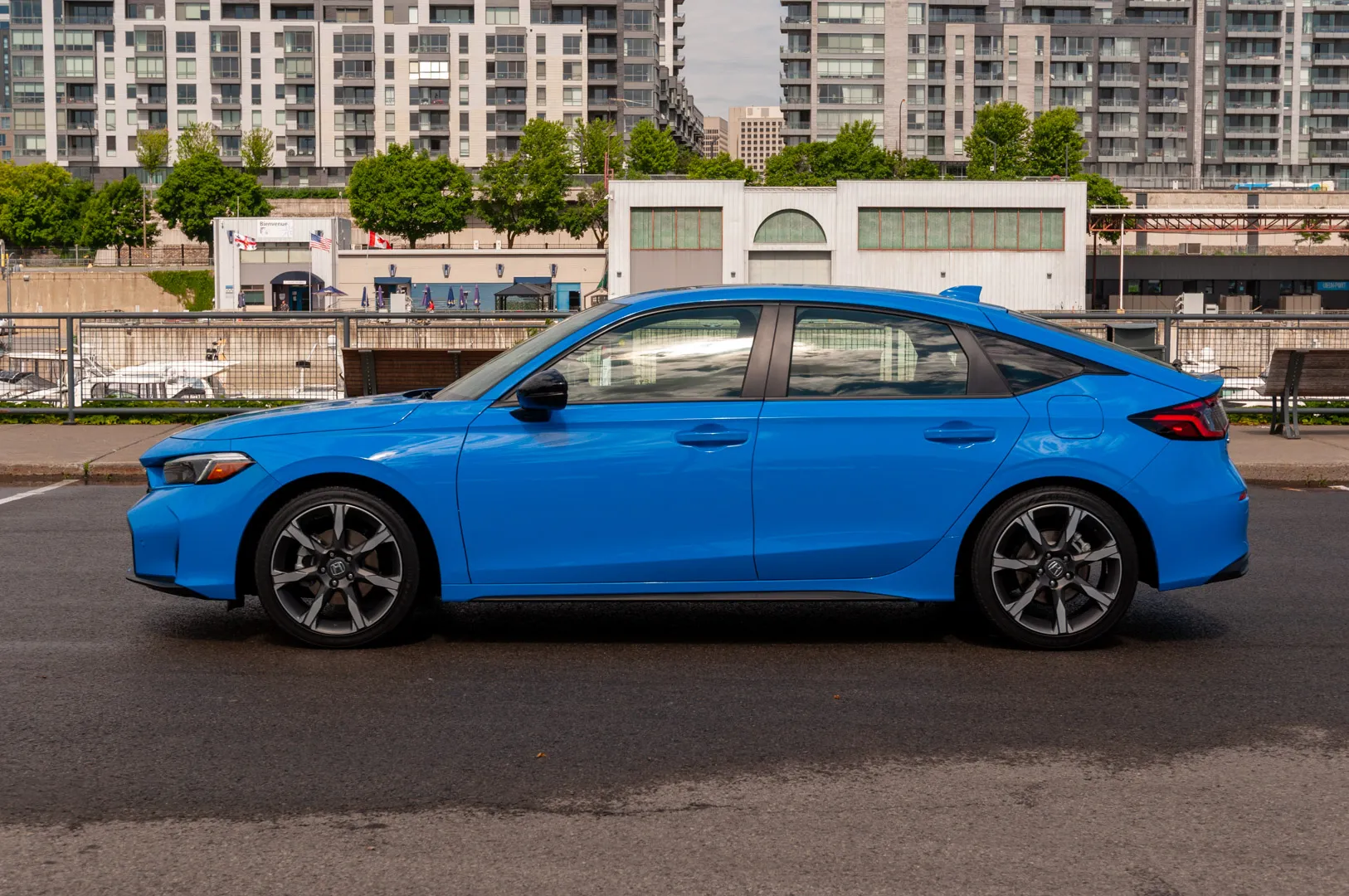
We take a first drive in the 2025 Honda Civic Hybrid. The 2025 Nissan Leaf loses its EV tax credit once again. And as Tesla’s Supercharger network stalls Ionna is rising. This and more, here at Green Car Reports.
In a review of the 2025 Honda Civic Hybrid, we found this models to be a class above the Toyota Corolla Hybrid, with a quieter, punchier, and more pleasant driving experience than the non-hybrid Civic. It’s a great way to get nearly 50 mpg with no compromise.
Just after Tesla Supercharging plans stalled, Ionna is rising. That’s the EV fast-charging network funded by seven automakers, and it anticipates opening its first U.S. charging stations in 2024, with eventual plans for 20,000 high-power urban and highway-adjacent fast-charging connectors. Ionna says it will support both the Tesla-derived NACS interface its funding automakers will soon adopt, as well as the CCS interface that most EVs are currently being delivered with.
And the Nissan Leaf has once again lost its $3,750 EV tax credit. While 2024 Nissan Leaf models at the dealership qualify for it, the 2025 Nissan Leaf that’s essentially carried over unchanged at face value does not. In what’s become a rollercoaster ride of eligibility, it’s not the only time this has happened, and Nissan says it’s working with its supplier AESC to recover the incentive on one of the market’s most affordable EVs.
_________________________________