
Author: EVAI

Porsche Might Reduce Taycan Production After Sales Tanked In H1 2024
Porsche reports that its global car sales during the second quarter of 2024 amounted to 78,305, down nearly 10% year-over-year. It was the fourth negative quarter in a row.
The sales issues also concern the all-electric Porsche Taycan model, which in Q2 noted a 48% year-over-year decline to 4,602 units. It was the second time Taycan’s sales were cut in half, but we also know that the model awaits its new 2025 model year version with a set of noticeable upgrades.
2025 Porsche Taycan is coming
In 2023, Porsche Taycan sales exceeded 40,000 units. So far this year, sales are less than 9,000. The new version is expected to boost results, but there are rumors that demand has weakened to a point where production must be reduced.
According to Stuttgarter Zeitung (via Electrive), Porsche is considering limiting the production of the Taycan to a single shift in response to weakened demand. There is no official confirmation of this rumor, but the German media described it as a “likely” scenario.
We assume that all depends on the inflow of orders for the upgraded Porsche Taycan version, which offers a higher capacity battery and longer range, quicker acceleration, and faster DC charging, among other improvements.
One of the most interesting parts of Stuttgarter Zeitung‘s article is that the slump in the global e-car markets is reaching Porsche with a slight delay compared to other manufacturers.
Porsche BEV sales in Q2’2024 (YOY change):

During the first half of the year, sales of the Porsche Taycan decreased by 51% to 8,838 units or 5.7% of the company’s total volume.
Porsche BEV sales in Q1-Q2’2024 (YOY change):
- Taycan: 8,838 (down 51%) and 5.7% share
including 2,054 in the United States (down 35%)
For reference, Porsche Taycan’s global sales in 2023 amounted to 40,629, 17% more than in 2022, and accounted for 12.7% of the total volume.

Porsche does not report the number of plug-in hybrid sales for the Cayenne and Panamera because they are counted together with ICE versions.
The slowdown in EV sales does not mean that Porsche will not continue its electrification efforts. In the second half of 2024, Porsche will launch the Porsche Macan, based on the Volkswagen Group’s all-new Premium Platform Electric (PPE) platform (see an overview here).
According to the company, the new model “recorded a very pleasing order intake,” indicating “great demand.”

2024 Porsche Macan
2025 Porsche Taycan Turbo GT
The all-electric successor to the Porsche 718, a two-seat EV, and the large electric SUV K1 from Leipzig are also on the horizon.
Share this Story

No, extreme heat doesn’t cause people to get stuck in EVs
- Summer heat waves do mean a temporary drop in EV range
- They won’t “brick” your battery, but they can accelerate degradation (aging) of the pack
- Avoid 100% charges in the heat if you can
How hot is too hot for EVs, and will the next heat wave brick it, leaving you stranded?
The answer isn’t nearly as sensational as the headlines some have written already this summer, or the questions that follow.
Just as hot weather puts a range of components for gasoline vehicles under additional stress, heat waves do potentially put more wear on EV batteries. But to put it all in perspective and bust a misinformation myth, that’s all it is for EVs—wear.
EV batteries can degrade faster in hot weather. They simply don’t fail suddenly though and leave owners stuck—although of course it’s possible that the heat may affect the reliability of the grid or charging stations owners rely on.
“I can probably count on one hand the number of times we’ve seen a car lose range quickly and unexpectedly, and the team has not had a reason to believe that any of them were due to a single heat wave,” said Garberson, head of growth and research at the EV battery health analysis firm Recurrent.

Recurrent EV battery health
Based on Recurrent’s data from 20,000 EVs, there’s no red-line temperature at which EV batteries “brick,” or at which the damage to batteries suddenly accelerates.
To put it bluntly, heat isn’t going to brick your EV.
Fries, cigarettes, and other bad habits
According to Garberson, it’s better to think of EV batteries’ heat exposure as drops in the bucket, or factors that could be likened to human aging and bad habits that might accelerate the aging process like smoking or using tanning beds. Prolonged exposure can alter the rate of the electrochemical reactions in the battery, ultimately leading to a shorter life—defined by whatever point the useful range has degraded to a point where the EV no longer covers the distance, charges, or performs to an expected level.
As such, battery replacements aren’t an expected expense at a particular number of miles, one that will suddenly render the car unusable. As Recurrent’s data has shown, for instance, Tesla range degradation does happen in a pronounced way over the first three years but really flattens out after that.
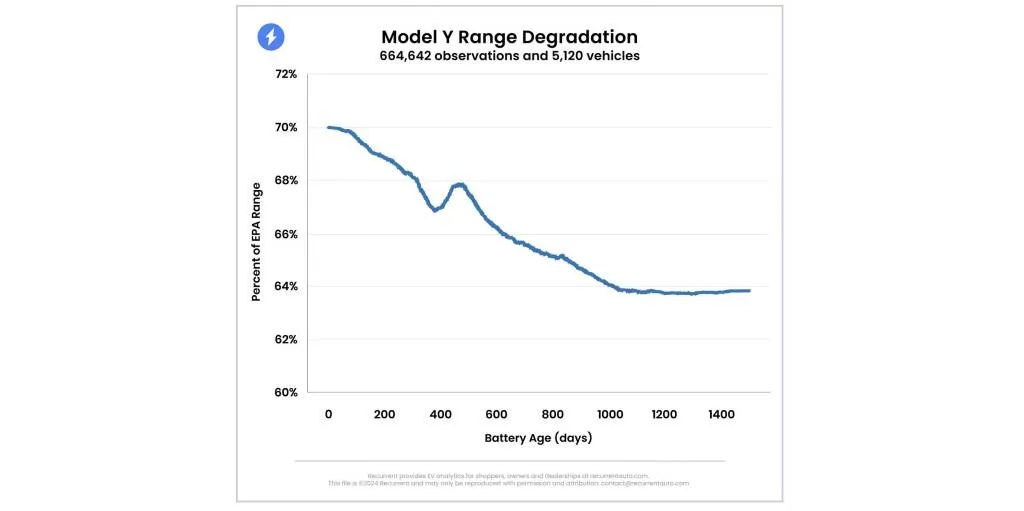
Tesla Model Y range degradation (via Recurrent)
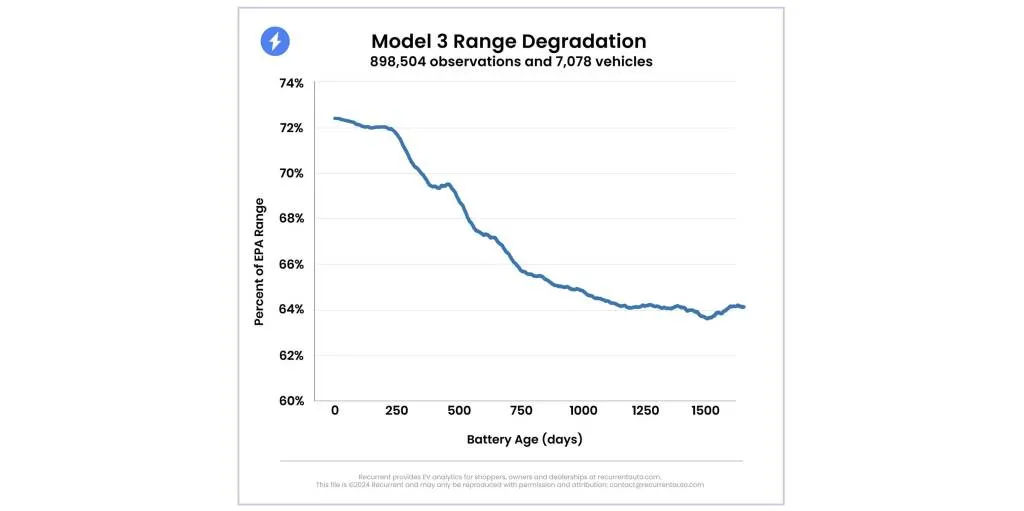
Tesla Model 3 range degradation (via Recurrent)
Due to their smart liquid-cooling systems, frequent fast-charging isn’t likely to affect degradation in Teslas and most other modern EVs. These systems and improved chemistries have eliminated some of the concerns over accelerated degradation.
A few early EVs simply didn’t do well with heat and saw accelerated battery degradation as a result of heat exposure. The most noteworthy of those are the earliest model years of the Nissan Leaf; a new “lizard” battery chemistry introduced in 2015 mostly solved that, and Nissan has since reported back that Leaf battery packs are lasting a very long time.
Taking care of your EV in the heat
That said, there are some pieces of practical advice for keeping your battery pack safe and cool in the heat—and some of it is the same that applies the rest of the year, only more so. Don’t charge the battery all the way to 100% if you don’t have to. And certainly don’t charge it fully and then park the vehicle.
Park in the shade if it’s very hot and sunny. Parking over blacktop that’s been in the midday sun will give your battery pack, which is typically on the underside of the vehicle, an unexpected heat soak in the worst possible way.
Also, leave your battery half-charged if you have to leave it out in the heat, as the battery is more stable that way. Recurrent has noted that if you’re able to set a charge limit (of 70%, for instance), owners can leave the car plugged in during that hot weather and active thermal management might activate at a lower temp than it otherwise would.
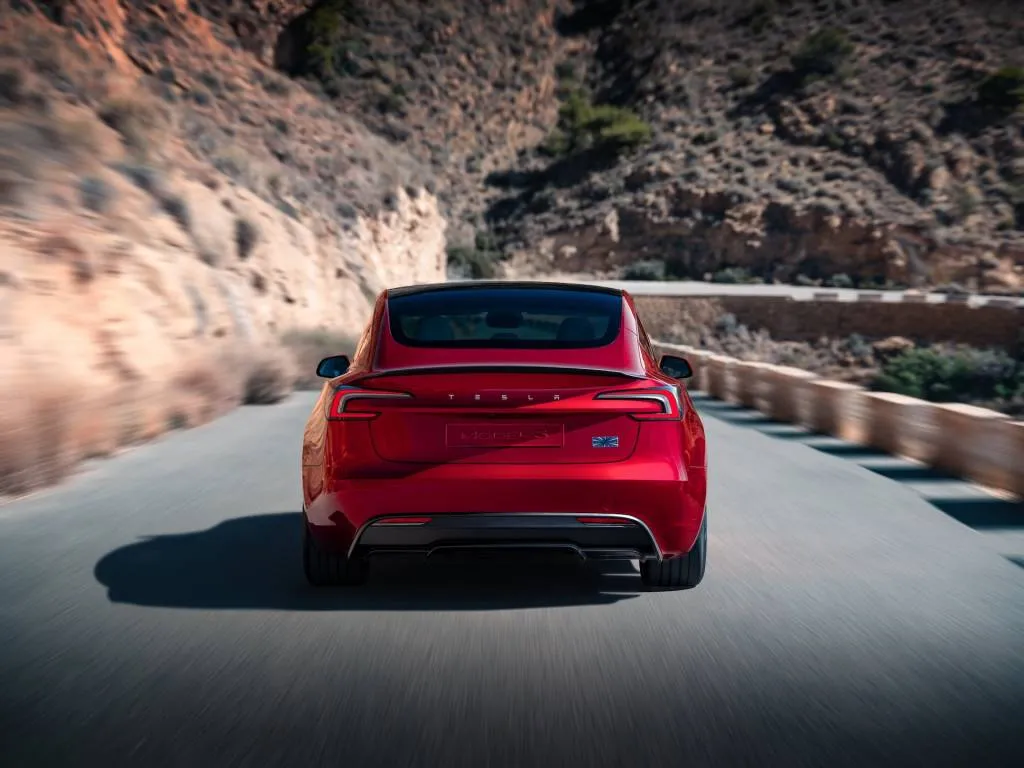
Tesla Model 3 Performance
Don’t be surprised if range takes a heat-wave hit—temporarily
EVs don’t lose a lot of range in most weather that’s considered very hot. That’s because most EV batteries are in their thermal sweet spot right around room temperature—where a vehicle’s climate control system also wouldn’t need to do much work. And their climate systems don’t have to change the temperature of the cabin by that many degrees.
As Recurrent calculates, EVs might only lose 5% of their useful range at 90 degrees, but by 95 degrees they’ll lose 15% and by 100 degrees the loss adds up to 31% in all—still less than some owners note in winter use.
Apples to apples, if your vehicle doesn’t have a heat pump and relies on resistive heating not unlike that inside a toaster or hair dryer, cooling an EV 20 degrees costs less energy than heating it 20 degrees. Part of the reason is that EV cooling doesn’t have to work against the waste heat of a combustion engine.
A bottom line to remember is that cold weather doesn’t cause the permanent damage to EV batteries that hot weather can, but just like the heat, it leads to temporary range loss. Be prepared; follow your battery’s state of charge; and remember that your range estimator is only that and doesn’t see the heat wave coming.

2025 Chevrolet Equinox preview
 This preview of the 2025 Chevy Equinox will be updated with full driving impressions when we test drive it soon. What kind of vehicle is the 2025 Chevrolet Equinox? What does it compare to? The 2025 Equinox is a five-seat crossover that compares with vehicles such as the Ford Escape, Nissan Rogue, and Toyota RAV4. Is the 2025 Chevrolet Equinox a…

Electrify America opens fast-chargers in Moab for electric off-roading
Electrify America now has 350-kw DC fast-chargers up and running on the network and positioned to help fully electric off-roaders or recreational visitors take in nearby Arches National Park or Canyonlands National Park.
The chargers, announced last May among 20 new fast-charging sites in Utah, are being supported by Electrify Commercial, EA’s unit that supplies hardware to businesses and commercial fleets, and implemented by regional utility Rocky Mountain Power.
The site at Moab includes eight chargers capable of those 350-kw rates, with a design intended to accommodate electric trucks and trailer-towing. At this point, the GMC Hummer EV remains the only off-road-focused EV capable of accepting that full charge rate.
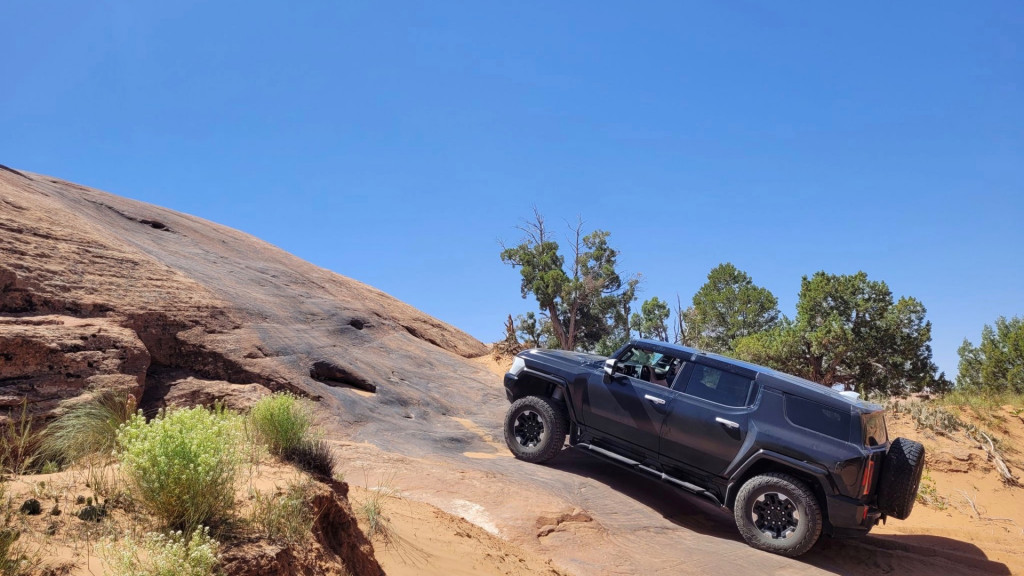
2024 GMC Hummer EV SUV testing in Moab
As Electrify America said last year, pricing for these independently run chargers may be different than those on EA’s own network, but they’ll be part of the network’s app and payment system just like other stations.
Rivian in 2022 announced Level 2 charging at glamping sites near Moab, Jeep sees the area as a spiritual home for the brand and in recent years it has revealed a series of electrified off-road concepts at Moab.
Green Car Reports Newsletter
Sign up to get the latest green car and environmental news, delivered to your inbox daily!
I agree to receive emails from Green Car Reports. I understand that I can unsubscribe at any time. Privacy Policy.

CATL poised to remain in global ‘pole position’ on EV batteries despite U.S. tariffs
CATL is rapidly climbing the list of the world’s largest suppliers as it pursues an aggressive global growth strategy.

Hyundai Elantra vs Toyota Corolla: Compare Sedans
 Hyundai Elantra or Toyota Corolla These two popular, compelling compact cars both offer inexpensive entry-level sedans, fuel-sipping hybrid editions, and spicy performance editions. The 2024 Toyota Corolla plugs in a familiar hybrid system—it’s on loan from the Prius hatchback—in a body that’s sedately styled, but still…

Review: The 2025 Porsche 911 GTS arrives as the anti-hybrid
 The 2025 Porsche 911 GTS brings a hybrid into the sports car lineup Porsche 911 GTS hybrids have 532 hp and 449 lb-ft of torque and do 0-60 mph in 2.9 seconds The 2025 Porsche 911 costs $122,095 while the hybrid GTS costs $166,895 A Porsche 911 hybrid seems like the answer to a question nobody asked. Hybrids were introduced to save fuel, reduce…
Fifth Third Bank settles CFPB forced auto loan insurance case for $5M
Fifth Third Bank has agreed to pay restitution to auto borrowers and a $5 million civil penalty to settle Consumer Financial Protection Bureau allegations it mishandled the “force-placed insurance” it applied to thousands of customer cars, the agency said.

Electrify America won’t allow EVs a full charge at busy stations
- Some Electrify America locations in California will limit charge to 85%
- “High-utilization station” locations were chosen for the pilot test
- Regular charging and idle fees apply
Electrify America is testing a strategy that may help alleviate wait times at some of its busiest stations by preventing customers from charging all the way to 100%.
Through a so-called Congestion Reduction Pilot, EA has targeted a series of “high utilization station” locations in Southern California that it’s limiting to a maximum 85% state of charge for DC fast-charging.
Unlike gasoline vehicles, which fill at about the same rate until the fuel nozzle’s automatic shutoff valve clicks, EVs don’t charge at a uniform rate. Generally speaking, an EV may take the same amount of time—or even more—to top off from 80% to 100% as it does to get to 80%. While the reasons as to why depend on both the EV’s battery pack and the charger, simply put it’s to keep the cells safe and avoid too much heat buildup.
So for charging-station operators—and EV drivers waiting in line on busy weekends—cutting people off at 85% could save a lot of time.
The pilot, which began in early July, is solely an Electrify America initiative, the company told Green Car Reports, with the goal simply to reduce congestion. It stated that the locations were chosen for their “high usage, long wait times and the proximity of other stations if customers wanted to charge to 100%.”
The network explained that it’s helped optimize charger availability with idle fees, hardware updates, and larger-format stations. “Nevertheless, some stations are experiencing long wait times.”
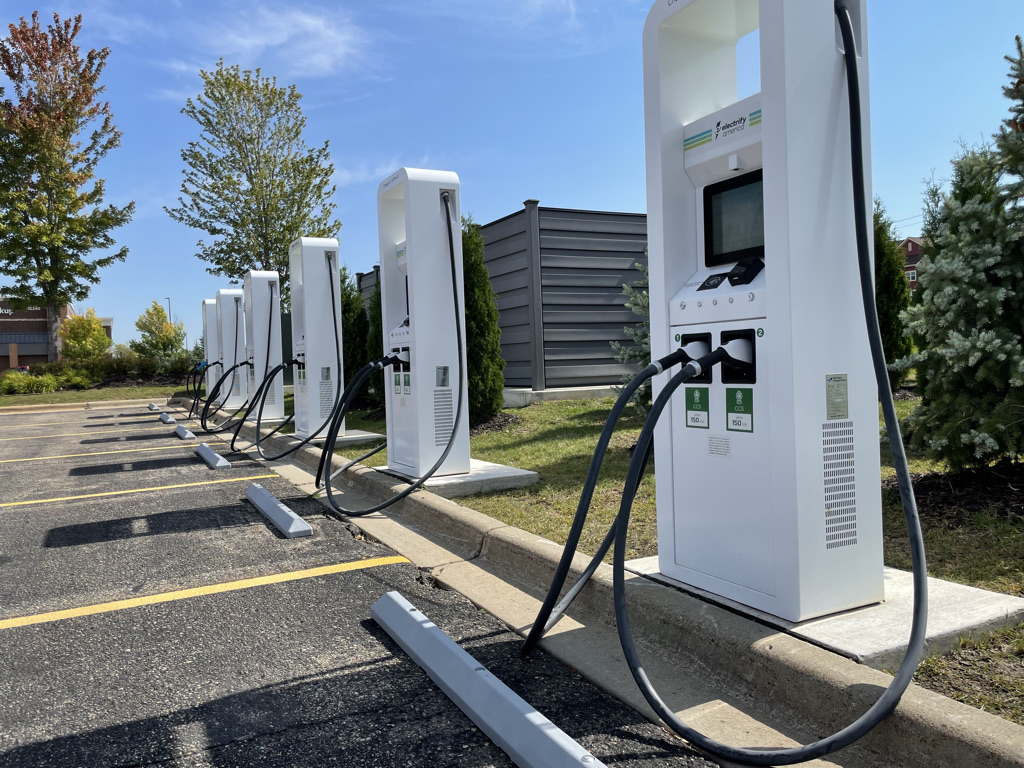
Electrify America chargers
Electrify America was created as part of a Volkswagen diesel settlement, with federal and California regulators, and for the most recent and final cycle of that it faced more scrutiny in California over reliability. Although the company doesn’t connect this pilot to its reliability push, it’s currently gathering feedback on how the limit works at those stations, and evaluating how it affects congestion and queueing. And depending on those takeaways it might roll the pilot out to a greater number of stations.
As EA states in an information page on the pilot, chargers will simply end the session once the vehicle reaches 85%. The network, which shifted to a station-specific pricing structure in 2023, applies idle fees after a 10-minute grace period, and those will continue to apply as normal, the network noted.
Even though Tesla laid off nearly its entire Supercharger team, CEO Elon Musk claims that the company plans a $500 million Supercharger expansion this calendar year. Electrify America has also underscored that it’s set to grow by 25% in 2024.