
Author: EVAI

Audi built the 16-cylinder super sedan it designed in the 1930s and never built
 The Auto Union designed a 16-cylinder sport sedan that never got built Audi, the automaker’s successor, just built it The Auto Union Type 52 debuted at the 2024 Goodwood Festival of Speed In the 1930s, Audi predecessor Auto Union designed a 16-cylinder sports sedan, but never built it. Ninety years later, it will finally make its public debut at…

Review: Jeep and Ram’s Hands-Free Active Driver Assist system debuts late and behind the leaders
 Hands-Free Active Driver Assist works mostly as advertised The system’s successor has already been announced Stellantis isn’t promoting the system It’s alright to be fashionably late, but you better arrive put together or with a heck of a story. In the case of Stellantis’ Hands-Free Active Driver Assist system, it’s…

These hybrids have AWD, top 40 mpg, cost less than $30,000
 Spoiler alert: They’re all Toyotas. Need some traction for a snowy winter commute, on a tight budget? If so, one of the market’s low-priced, high-mpg all-wheel-drive hybrids may be your best bet. There aren’t all that many all-wheel-drive hybrids to begin with. But if we set the cost ceiling in bargain territory by today’s…

Dealership insurance claims follow CDK cyberattack recovery
Some dealerships have already notified their insurance carrier about the June 19 CDK Global cyberattacks. Others are in wait-and-see mode.

Deal lays path to solid-state batteries for a million VW EVs annually
- VW’s PowerCo could eventually make up to 80 gigawatt-hours of solid-state cells annually
- QuantumScape and PowerCo will combine forces to scale up production
- Production timeline and location weren’t specified
Volkswagen’s PowerCo battery unit and the solid-state battery tech firm QuantumScape on Thursday announced a path toward the industrialization and mass-production of solid-state lithium-metal batteries for electric vehicles.
Through an agreement, in the form of a non-exclusive license, PowerCo will be able to make up to 40 gigawatt-hours of battery cells annually using tech from the solid-state firm, with the option to up that to 80 gigawatt-hours—enough for a million EVs annually.

QuantumScape ceramic separator
QuantumScape’s solid-state tech uses ceramic separators to allow a pure lithium-metal anode for higher energy and power density, with faster charging. As with other solid-state battery cell technology, QuantumScape has long ago proven that the idea is valid in a laboratory and smaller-scale environments, but scaling up mass-production—for use over years in vehicles—has been the challenge.
To that, the companies say that they’ll combine core competencies, with “a combined workforce initiative” to accelerate the scaling-up of production and these cells’ integration into VW’s vehicles.
A location for the potential future manufacturing of solid-state cells was not disclosed, nor was a timeline.

VW Salzgitter cell facility
Volkswagen broke ground on its first EV cell “gigafactory” in July 2022, at the same time it formalized the PowerCo. business unit overseeing it. The facility in Salzgitter, Germany, serves as a hub for VW’s global battery activities and the starting point for what VW called a “global battery offensive” created around localized battery production by market and a vertically integrated battery supply chain aiming to cut cell costs by 50%.
That German battery factory is producing a new prismatic unified cell format that’s due to be used with the automaker’s upcoming Scalable Systems Platform (SSP) for electric vehicles starting in 2026 and will eventually be installed in 80% of the EVs from the VW Group by the end of the decade.
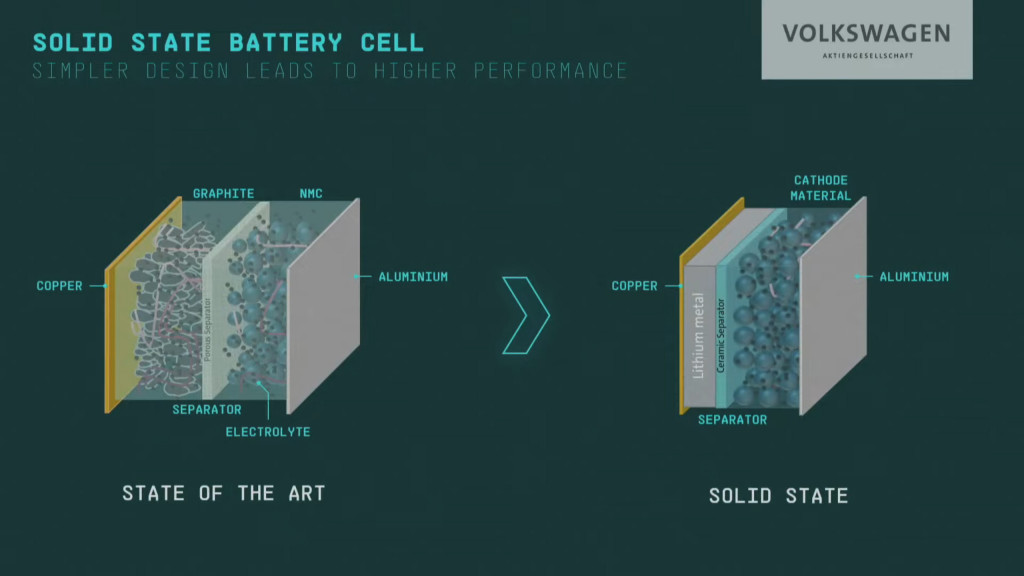
VW Power Day – solid-state composition
At its 2021 Power Day, VW called solid-state battery tech its “end game” in the shift to EVs, noting that it didn’t see the tech arriving until 2025 or later—in small volume at first. It saw solid-state tech as enabling 80% fast-charges in just 12 minutes.
VW has seen solid-state cells and QuantumScape as part of its long-term plan for more than a decade already. It’s been collaborating with the firm since 2012. Toyota is developing solid-state cells with Panasonic and sees the tech “ready for commercial use” by 2027 or 2028. Honda sees them as enabling affordable small EVs, while Nissan is working to develop its own solid-state cells and sees potentially game-changing EV packaging advantages from them.

Volkswagen ID.Golf Postponed To 2029 As More Delays Mount: Report
The all-new Volkswagen ID.Golf and other models based on the Volkswagen Group’s new Scalable Systems Platform (SSP) might enter the market later than expected.
According to a German publication, Manager Magazin (via Electrive), the market launch of the Volkswagen ID.Golf has been postponed by 15 months to 2029, while a large SUV called the T-Sport will not be ready until 2031, three years later than initially planned.
More challenges ahead of Volkswagen
Volkswagen struggles to substantially increase its current electric car sales. The first half of the year brought a slight decline, and now it seems that next-generation models might be launched later than planned.
The article says that the Volkswagen Group Board of Management made the decision to postpone SSP-based models on 2 July, although there is no official confirmation.
According to the report, several reasons behind the postponement exist, including the one that has affected Volkswagen for a long time—software issues. The all-new E3 2.0 software architecture for the SSP platform, developed in-house by Volkswagen’s software subsidiary Cariad, is behind schedule.
The recent announcement that Volkswagen is teaming up with Rivian on software, through a $5 billion agreement would be a sign that the software really might be an issue. There is also an unofficial hint that initially the SSP would use an “Adapted E/E Architecture”, before switching to Volkswagen-Rivian-developed software in early 2030.
The Volkswagen Group will have no choice but to use the current MEB, new MEB+ platforms, including the MEB-Small announced in 2021, and the new Premium Platform Electric (PPE), longer than initially planned. The SSP was expected to replace almost all other platforms with several versions of SSP and unified battery cells—at least that was the plan in 2021.

Volkswagen
Share this Story
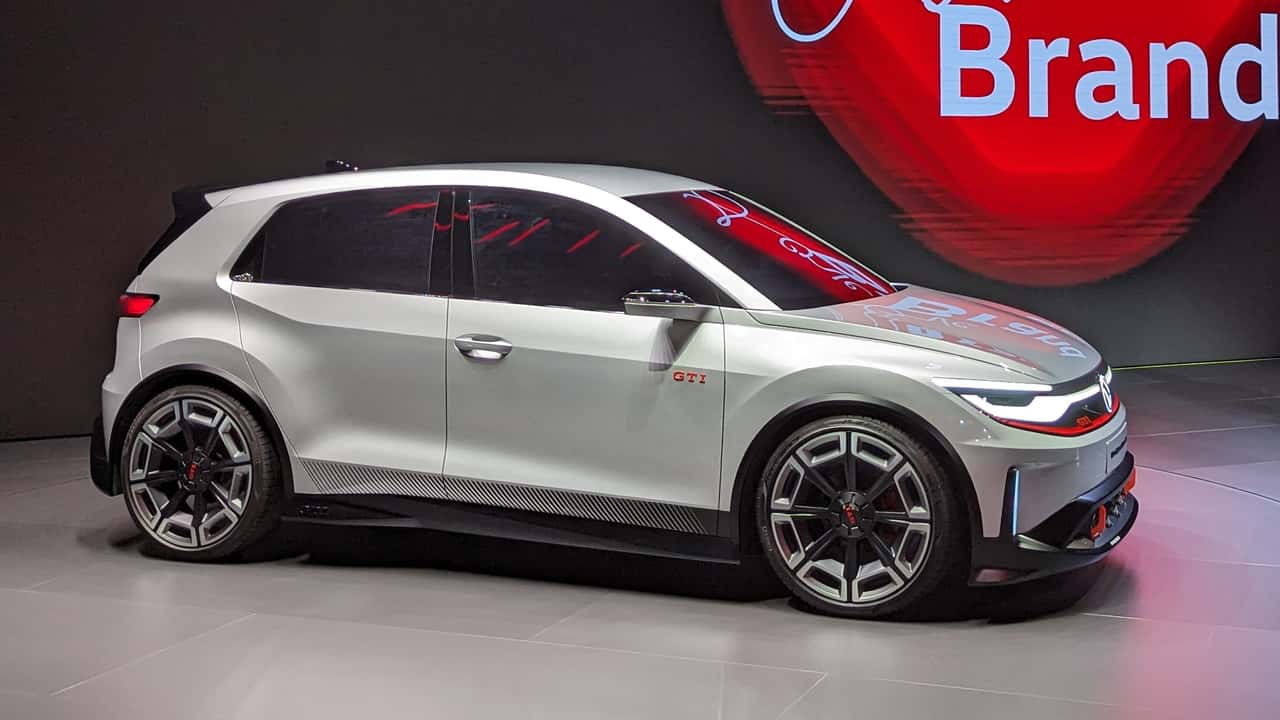

2025 Mercedes-Benz AMG GT 63 Pro focuses on aero and cooling
 2025 Mercedes-Benz AMG GT 63 Pro joins lineup as a track-focused coupe Enhanced cooling and aero defines the AMG GT 63 Pro Pricing will come closer to the AMG GT 63 Pro’s launch in 2025 The performance wizards at Mercedes-Benz AMG have cranked out yet another AMG GT coupe variant. On Thursday, the 2025 Mercdes-Benz AMG GT 63 Pro 4Matic+ debuted…

2025 Chevy Equinox EV costs $34,995 for 319 miles, gets power boost
Chevrolet appears to have held true on the arrival of an Equinox EV version that costs just $34,995 and is set to deliver well over 300 miles of range. But it’s arriving for the 2025 model year, rather than 2024.
The GM brand said Thursday that the base 2025 Chevrolet Equinox EV LT will be available “soon.” It rides on 19-inch machined wheels and doesn’t hold back on any of the tech, including the big 17.7-inch infotainment touchscreen with 11-inch information screen, a full suite of active-safety features, and remote and hands-free start capabilities. But it does go with cloth, manually adjustable seats and the absence of the bun warmers and steering-wheel heaters that can make winter EV ownership much easier.
The Equinox EV’s $34,995 base price, which Chevy had originally confirmed for 2024, includes the $1,395 destination fee and is likely to carry over the same 319-mile EPA range rating as current 2024 Equinox models with front-wheel drive, from an 85-kwh battery pack. It will be eligible in 2024 for the $7,500 EV tax credit, Chevy says, so that effectively drops the price to just $27,495.
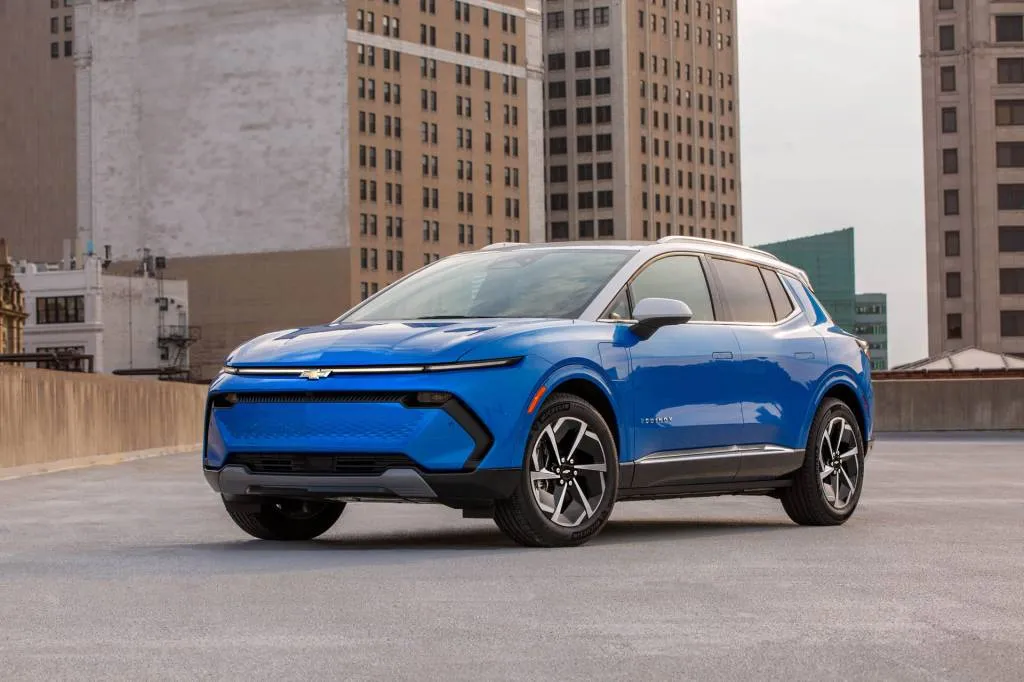
2024 Chevrolet Equinox EV
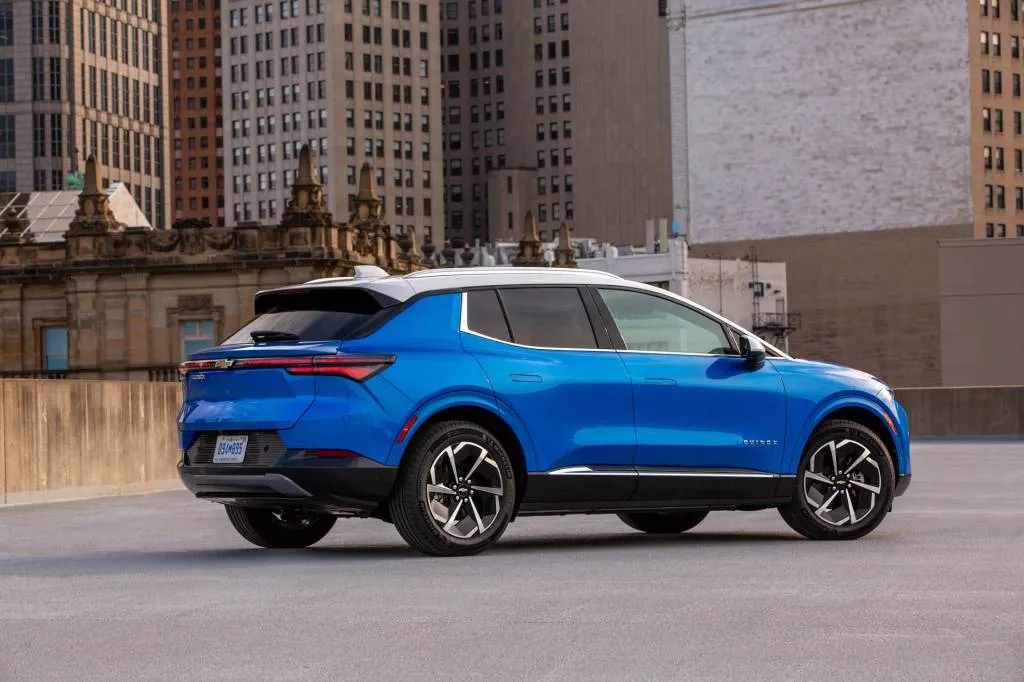
2024 Chevrolet Equinox EV
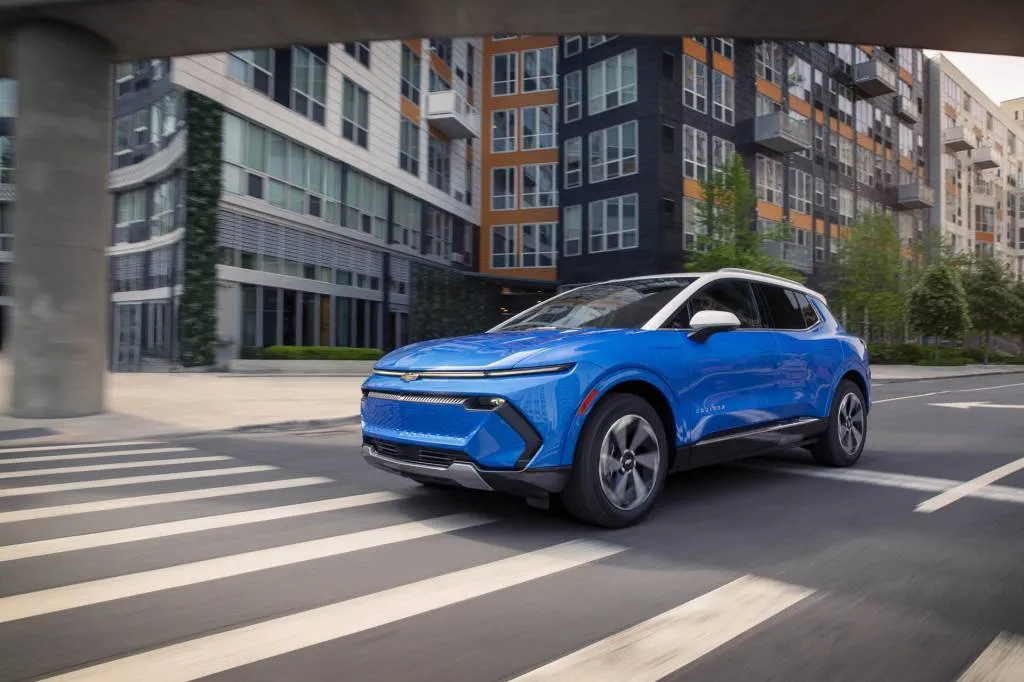
2024 Chevrolet Equinox EV
The 2025 versions of this updated EV will make slightly more power and torque than their 2024 counterparts, Chevy also revealed—220 hp and 243 lb-ft in single-motor front-wheel-drive form, or 300 hp and 355 lb-ft in dual-motor all-wheel-drive form. Those figures represent a boost of 7 hp and 7 lb-ft with FWD and 12 hp and 22 lb-ft with AWD.
Chevy hasn’t yet confirmed how much extra all-wheel drive costs on the LT, but for 2024 the premium is $3,300.
The model that Chevy launched as the 2LT has been revamped as part of an option package for 2025, adding up to $43,295. A “Comfort and Active Safety 2 Package” slots in between at $36,995, while at the top of the lineup the model Chevy formerly called the 3LT now costs $46,395.
With those options piled on, the 2LT gets roof rails, a rear wiper, a power liftgate, a power driver seat, heated front seats, a heated steering wheel, and adaptive cruise control. The 3LT adds front-seat cooling, power front passenger seat adjustment, heated wiper parking, heated rear outboard seats, dual-zone climate control, and 21-inch alloys.
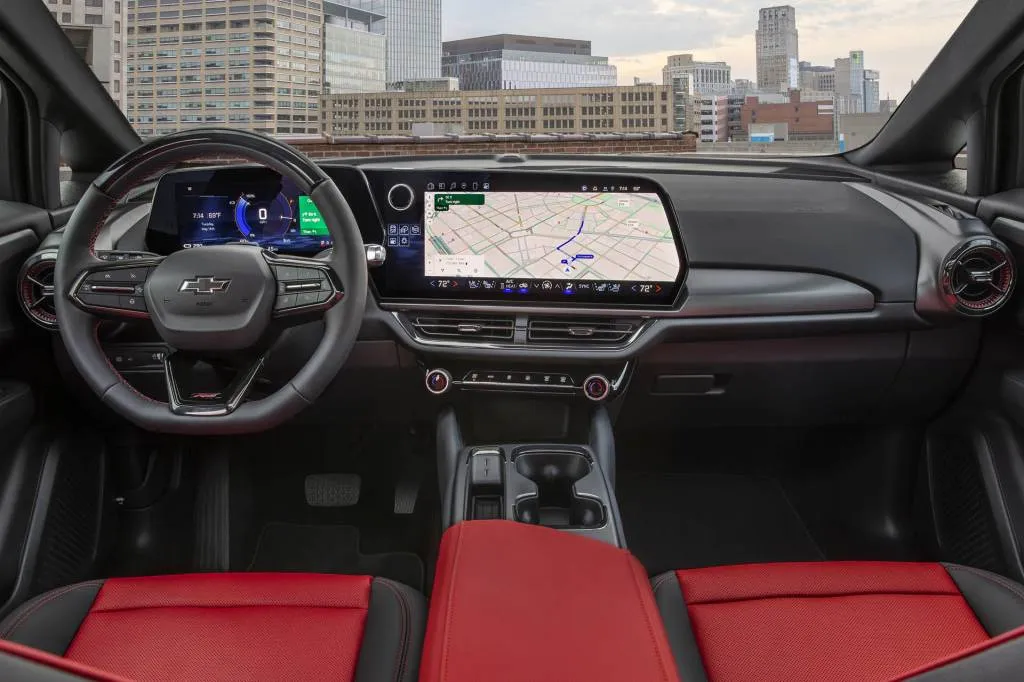
2024 Chevrolet Equinox EV
Chevy notes that top-level LT and RS trims now include a head-up display and rear camera mirror.
At the top of the 2025 Equinox EV lineup is the RS. What had been sold as the 2RS (21-inch wheels, black roof, flat-bottom steering wheel) is now badged the RS, priced at $44,795, while the previous 3RS (dual-zone climate, power passenger seat, heated rear seats, and more) is an option package on top of that, costing $47,890.
In a first drive of the 2024 Chevy Equinox EV in May, Green Car Reports found this entry GM EV to be the new “normal” for American EVs, with a package that’s satisfying to drive and use.
The Equinox EV’s pricing recalibration goes along with what Chevy recently did for the slightly upmarket Blazer EV. The 2025 Blazer EV also gets a lower base price for existing LT and RS versions.
Currently, with the arrival of the $34,995 base model, the Equinox EV is one of the lowest-priced EVs for the U.S. market. GM CEO Mary Barra has already also promised that it’s not Chevy’s lowest-priced EV—and the upcoming 2026 Chevy Bolt EV will be the most affordable U.S. EV.

Test drive: 2024 Defender 110 shrugs off Wrangler, Bronco
 The Defender now tussles with mainstream Wranglers and Broncos Defender charms include build quality, functionality, and strong powertrain options Expensive competition makes it seem almost reasonably priced Rivals from all around have the Land Rover Defender in their sights. Yet, the Brit still manages to stand alone. I spent a week living family…