
Author: EVAI

Audi Q6 E-Tron and A6 E-Tron get one year free fast-charging at Electrify America
Owners of Audi’s latest electric vehicles can now get one year of free DC fast-charging at Electrify America locations.
Electrify America confirmed Thursday that the 2025 Audi Q6 E-Tron crossover SUV just reaching dealerships now comes with this free-charging perk, and so will the 2025 Audi A6 E-Tron sedan when it arrives at showrooms this summer.
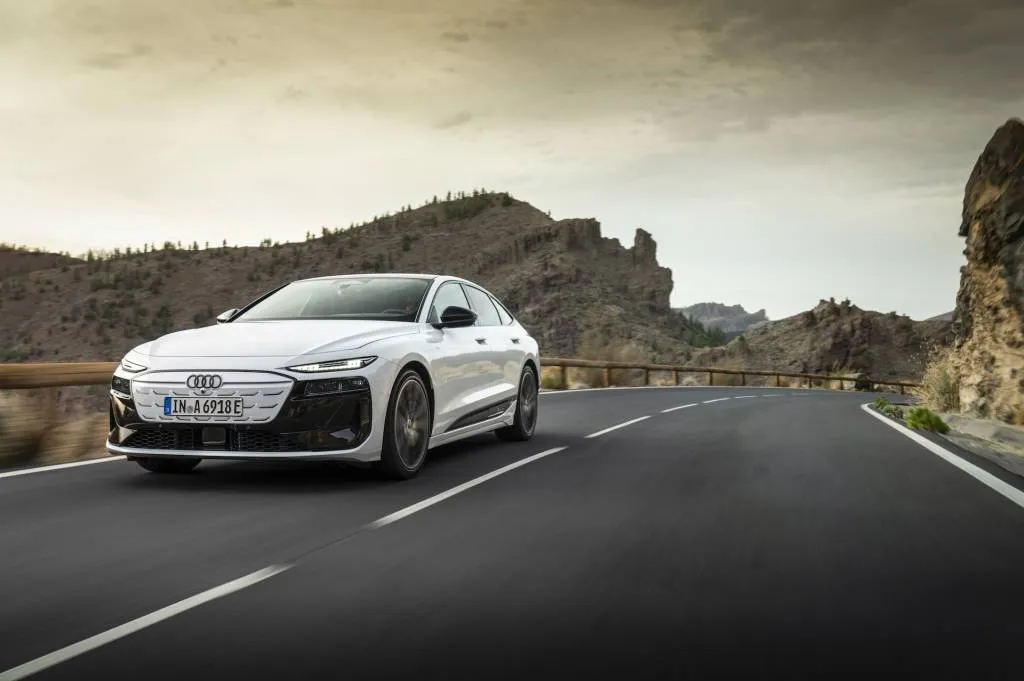
2025 Audi A6 E-Tron test drive review, Tenerife
In both cases, the free-charging clock starts at the date of purchase, but doesn’t come with any restrictions on the time or number of individual charging sessions, an Electrify America spokesperson confirmed to Green Car Reports. To gain this benefit, owners must enroll via the MyAudi app.
The Q6 E-Tron and A6 E-Tron also feature Plug & Charge, allowing drivers to initiate charging simply by plugging in at a public station, with automatic billing to a preset payment method. An initial login is also required to set this up, in this case with an Electrify America user profile.
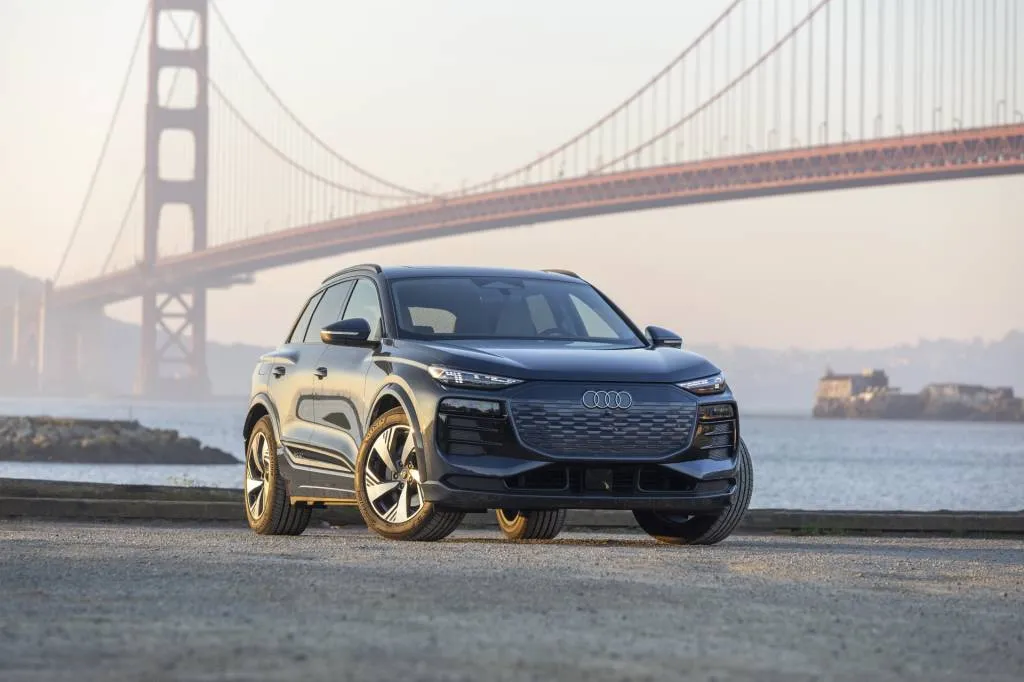
2025 Audi Q6 E-Tron
The Premium Platform Electric (PPE) both models share with the electric Porsche Macan also incorporates an 800-volt electrical architecture for faster charging, and the flexibility to enable 400-volt charging by splitting current between the two halves of the pack to get most out DC fast-charging equipment limited to less than 800 volts. The Q6 E-Tron to complete a 10%-80% charge in around 35 minutes in that lower-power configuration.
These PPE models join the Audi Q4 E-Tron, which shares the MEB platform with the Volkswagen ID.4 and ID.Buzz, and the E-Tron GT that’s a mechanical twin of the Porsche Taycan. They comprise the entirety of Audi’s EV lineup following the end of Q8 E-Tron production in February. That model, in its original E-Tron form, ushered in Audi’s electric era.

Karma reveals sultry Amaris series plug-in hybrid coupe
 Karma Automotive on Thursday unveiled the new Amaris series plug-in hybrid coupe during the company’s first Create Karma product presentation event held in Irvine, California. Karma was gearing up to launch a separate coupe, the fully electric Kaveya, in 2026, but the company on Thursday said it would delay that model to 2027 due to changing…

Bugatti Tourbillon gains Équipe Pur Sang package boasting 8 exhaust tips
 Bugatti’s Tourbillon hypercar, with its carbon-fiber chassis and V-16 plug-in hybrid powertrain generating 1,775 hp, seems nearly perfect—but Bugatti has found a way to elevate it even further: adding eight exhaust tips. That’s more than the famous six exhaust tips of the iconic Type 57SC Atlantic and serves as a nod to the two banks…

F1 personality Eddie Jordan dies aged 76
 Eddie Jordan, the charismatic former Formula 1 team owner and television personality, has died at the age of 76. Born in Dublin in 1948, Jordan initially pursued a career in banking before discovering his passion for motorsport. He began racing karts in the early 1970s, eventually moving up to Formula Ford and Formula Three. However, he is best…

Tesla Cybertruck recalled eighth time, exterior body panels can fall off
Over a year after it went on sale, the Tesla Cybertruck is still presenting issues that require recalls.
A recall of 46,096 electric pickup trucks announced Tuesday deals with their stainless steel exteriors. The cant rail, one of the exterior trim pieces, can fall off, according to the NHTSA. That can pose a hazard to other road users.
The stainless steel cant rail trim piece is attached to an electrocoated steel stamping with structural adhesive, according to recall documents. That adhesive apparently wasn’t up to the job, allowing the stainless steel piece to separate under certain conditions. If that happens, drivers may notice an unusual noise, or even see the part working its way out of position, according to the NHTSA.
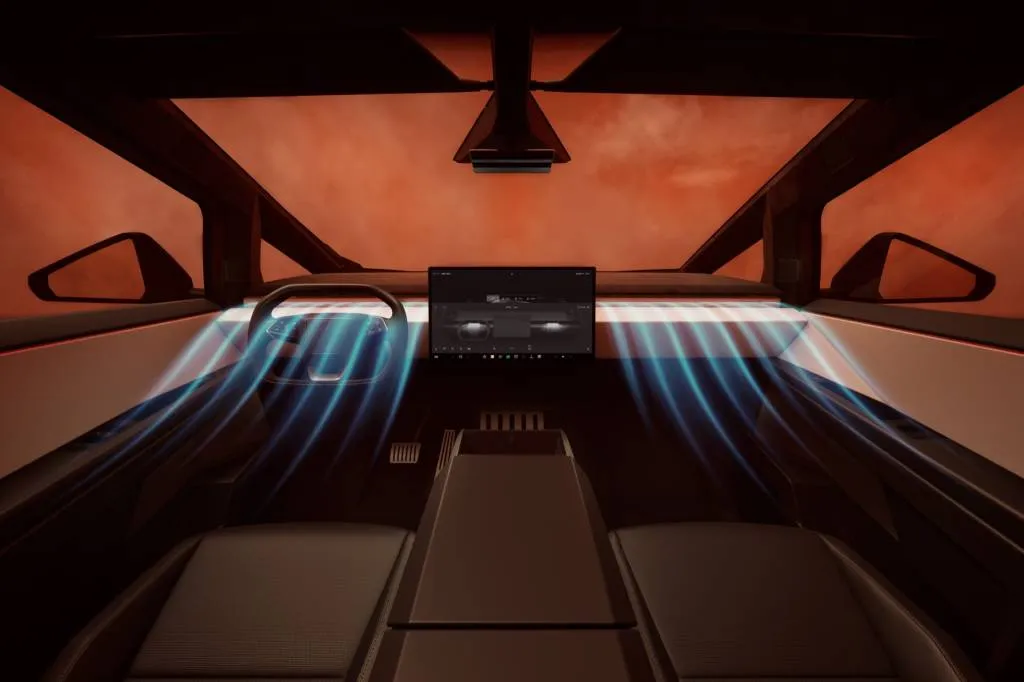
2025 Tesla Cybertruck – Courtesy of Tesla, Inc.
Tesla told the NHTSA that it is unaware of any collisions, fatalities, or injuries caused by these detaching trim pieces. The automaker said it first became aware of the problem via a field report, confirmed by service records and social media posts describing loose or separated cant rail panels.
Tesla service centers will reinstall the cant rail assembly with a different structural adhesive, reinforced with a stud welded to the stainless steel panel with a nut clamping that panel to the vehicle’s structure. This work will be performed free of charge.
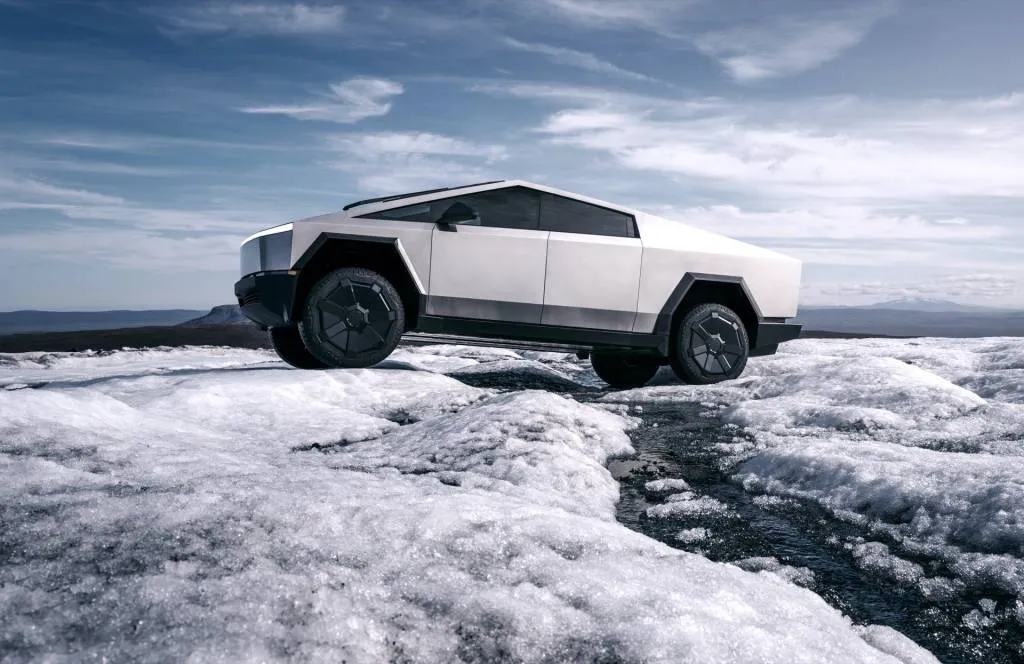
2025 Tesla Cybertruck – Courtesy of Tesla, Inc.
Owner notification letters are due to be mailed May 19. Owners can also call Tesla’s customer service department at 1-877-798-3752 for more information. Tesla’s reference number for this recall is SB-25-10-001.
The Cybertruck is proving to be a problem child, with eight recalls to date. Some of these recalls have also included other Tesla electric vehicles, but the Cybertruck has also been recalled for unique problems like trapped accelerator pedals and an inverter fault. This isn’t even the first trim-related recall; Tesla also recalled 11,383 trucks last year because the panel on the bed frame rail on the top sides of the truck could loosen and separate from the vehicle.

2027 Audi SQ9 spied for first time
 Audi finally appears to be preparing a full-size SUV to take on the likes of the BMW X7, Cadillac Escalade, and Mercedes-Benz GLS-Class. A prototype for what is believed to be the first Audi Q9 has been spotted ahead of an expected debut early next year, which would likely mean a 2027 model-year arrival for the U.S. The prototype appears to be a…

Tokyo project aims to scale up battery swapping for electric trucks
- Deployment of 5-minute battery swaps could support hundreds of commercial EVs
- Ample says it’s a straightforward retrofit, switching to its own battery packs
- Solution is less demanding on the grid than fast-charging stations
California-based startup Ample is looking to deploy its battery-swapping tech with fleets of electric delivery trucks in Tokyo.
Ample opened its first Japanese battery swapping stations in early 2024 in Kyoto, but this latest deployment looks to scale things up considerably. In a press release published Wednesday, Ample said it would build a network of stations in Tokyo, each supporting over 100 vehicles. It’s not being billed as a pilot program, so the network could have an open-ended lifespan.
Vehicles will be provided by Mitsubishi, and by the Mitsubishi Fuso Truck and Bus Corporation, a separate corporate entity owned by Daimler Trucks that focuses on commercial vehicles. The latter’s box trucks are a common sight on local delivery routes in the U.S.
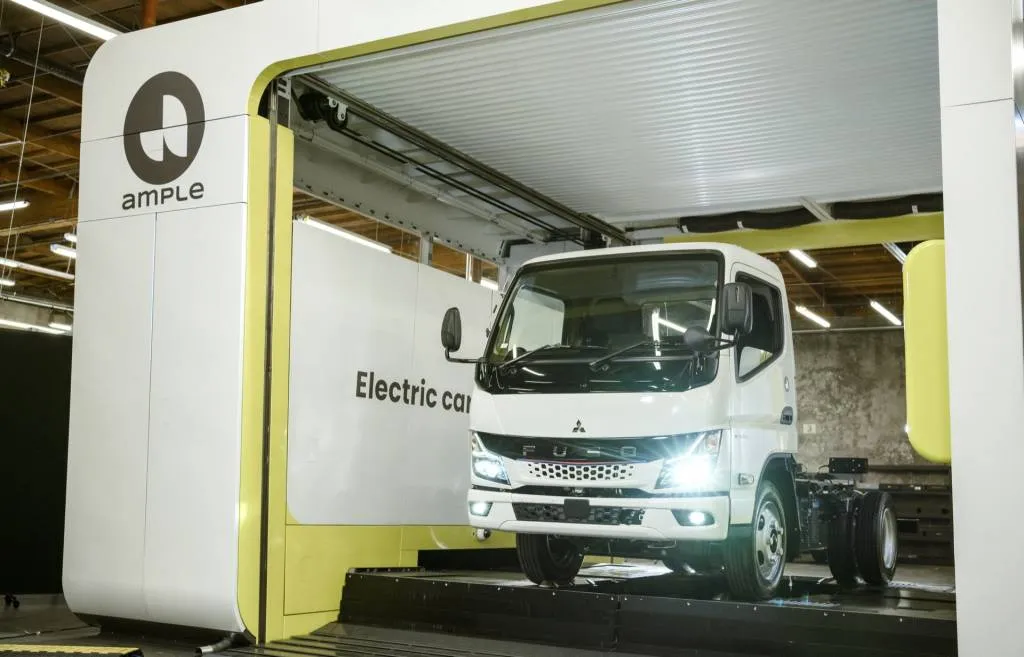
Mitsubishi Fuso eCanter EV swapping batteries
More accessible EV charging is part of how Tokyo plans to achieve a goal of cutting greenhouse gas emissions 50% by 2030, the release noted. Battery swapping manages to bypass a hurdle that fast-charging stations also share—demanding higher loads from the grid, in locations where it might not be available. The solution is drawing a lower, constant load, to be charging up spent packs.
The battery modules being used by Ample use its own NMC battery modules, the company told Green Car Reports, and it’s continuing to design its packs as drop-in replacements that do allow liquid cooling and don’t require significant changes to vehicles. Since the packs are slowly charged as part of the model, they also don’t face the high-rate fast-charging, which otherwise represent the greatest cooling challenge for batteries.
Since its emergence in 2021, Ample has worked mostly with fleets, claiming that it can save time for drivers who could potentially spend 25% of their work week at charging stations, due largely to the lack of reliable overnight charging.
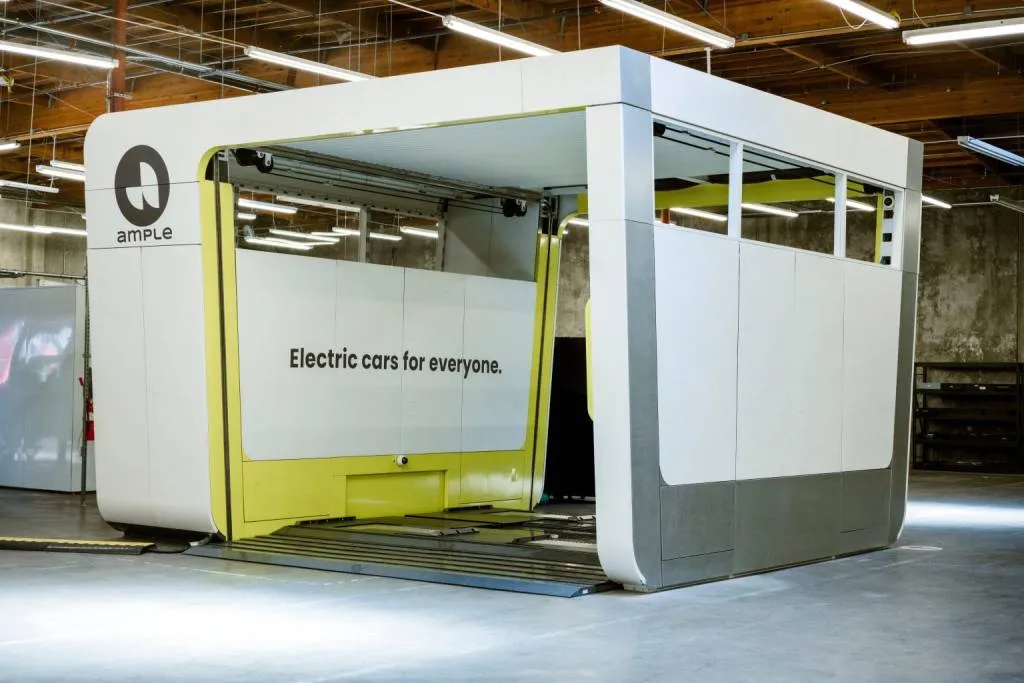
Ample 2nd generation battery swapping station
Ample’s hardware depends on common battery modules that can retrofitted to different vehicles, something that was initially demonstrated with the Nissan Leaf, followed by the announcement of the first Mitsubishi Fuso eCanter electric truck deployments in 2023. That same year, Ample unveiled a second-generation battery swapping system that cut swap times to five minutes. It hasn’t pivoted entirely away from passenger vehicles either and is currently testing a pilot fleet of 100 Fiat 500e EVs with the system.
Ample is one of the few companies with a serious vision for battery swapping outside of China, where Nio claims to have built thousands of swapping stations for its EVs along major highway corridors. The automaker is partnering with battery supplier CATL to further grow the swapping station network, while lobbying for national standards in China that would make it easier for other brands to join.

CATL and Nio aim for world’s largest EV battery swapping network
Chinese battery firm CATL and automaker Nio are preparing to launch what the two companies claim will be the world’s largest electric vehicle battery swapping network.
CATL and Nio announced a technical partnership last year that included battery swapping, but on Tuesday they confirmed plans to start coordinating efforts as they build out battery swapping stations.
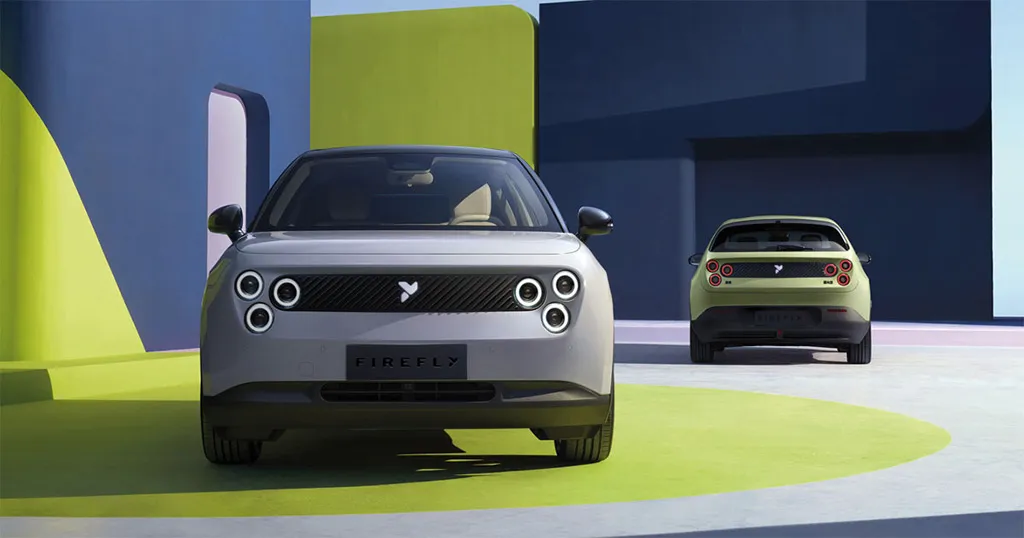
Nio launches Firefly EV brand during Nio Day 2024
The two companies will operate networks in parallel, but with more overlap as time goes on. CATL’s Chico-Swap technical standards will be used in EVs from Nio’s Firefly brand, and both companies will work toward national standards for battery swapping tech in China that would make it easier to accommodate other brands in the future, CATL and Nio said in press releases.
CATL is also investing 2.5 billion yuan (approximately $345 million at current exchange rates) in Nio Power, the automaker’s charging and battery swapping unit, as part of the ongoing partnership.
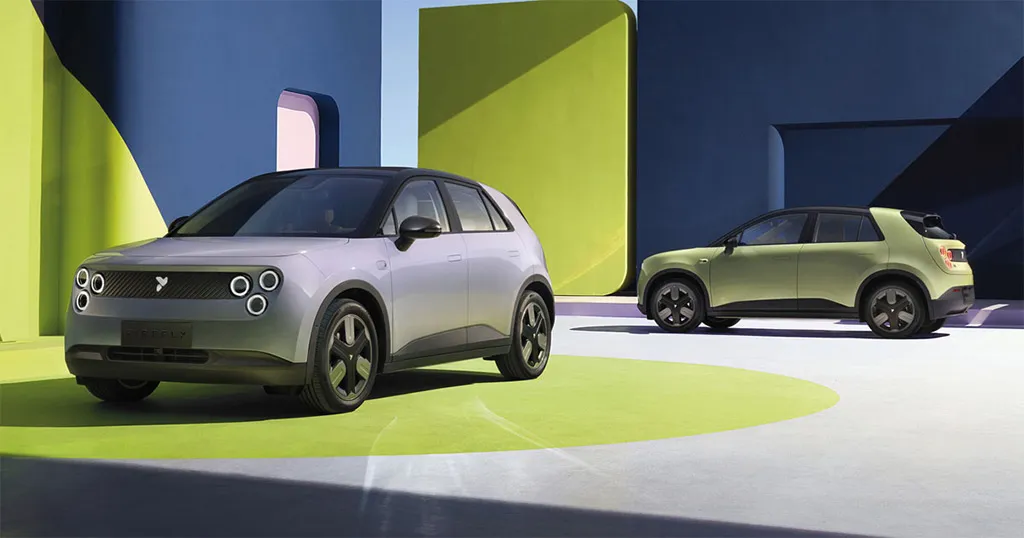
Nio launches Firefly EV brand during Nio Day 2024
Nio has stood out among Chinese automakers for years as it’s the only one that continued pushing on battery swapping even after the fast-charging network was built out. It claims to have built 3,172 swapping stations in China, including 1,000 along major highways connecting over 700 cities. Volvo and Polestar have signed up for the tech, on a limited basis, and a list of Chinese automakers have already partnered to test or use the tech in some models.
There’s nothing like it outside China, in terms of scale. A number of automakers—like Ford—have suggested they’re considering battery swapping, but none have invested big on the tech, beyond a few pilot programs. California startup Ample is also aiming to revive large-scale battery swapping in the U.S. with a system allowing different vehicles to adapt to its battery packs and swapping stations.

Mercedes-AMG plug-in hybrids recalled for loss of drive power
 Mercedes-Benz has issued a recall for certain plug-in hybrid models from its AMG performance division due to a software error that may cause a loss of drive power. The affected models include the AMG S 63 E Performance, AMG GT 63 S E Performance 4-Door Coupe, AMG GT 63 S E Performance, AMG SL 63 S E Performance, and AMG GLC 63 S E Performance…

Nissan Frontier vs. Toyota Tacoma: Compare Pickup Trucks
 Midsize pickups can do plenty of work, but they can’t match the capability of their larger, more expensive full-size brothers. When that much capability isn’t needed, midsizers provide a more maneuverable, more affordable alternative. The smaller trucks have plenty of fans, as evidenced by the popularity of the 2025 Toyota Tacoma…