
Author: EVAI

Tesla Robotaxi event rescheduled for Oct. 10
- Tesla CEO Elon Musk said the automaker Robotaxi will now debut on Oct. 10
- The new date means the reveal was pushed back two months
- Musk has provided no details about the Robotaxi
The Tesla Robotaxi reveal originally scheduled for Aug.8 has been pushed back to Oct. 10, CEO Elon Musk confirmed during the automaker’s second-quarter earnings call on Tuesday.
Musk announced the event earlier this year, but Bloomberg already reported earlier this month that the unveiling of the Robotaxi, expected to be an autonomous vehicle aimed at ride-sharing, would likely be delayed to give engineers more time to work on the prototype.
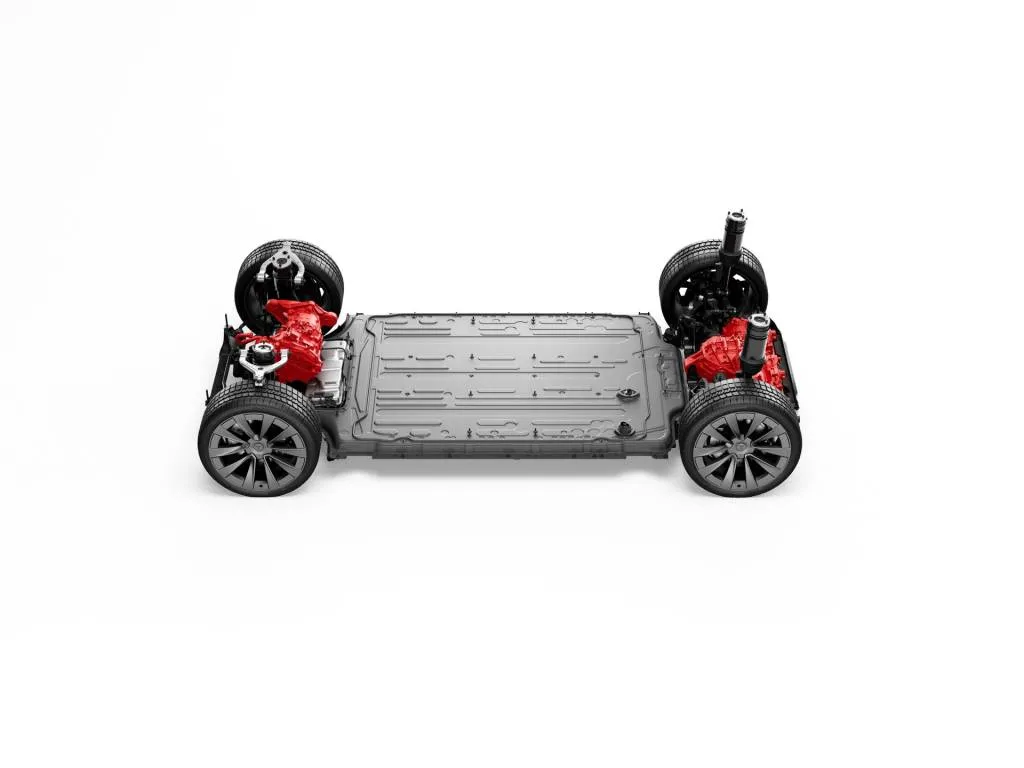
2024 Tesla Model X
Musk hasn’t provided any details on the vehicle since announcing it in April, and remained vague during the earnings call.
He wouldn’t confirm whether the Robotaxi would have a steering wheel and pedals, deletion of which could lengthen the timeline for its deployment due to a more complicate regulatory approval process, The Verge reports. General Motors’ Cruise subsidiary recently confirmed that it would mothball the Origin EV, which lacks manual controls, for its ride-sharing service, opting for a modified version of the next-generation Chevrolet Bolt EV instead.
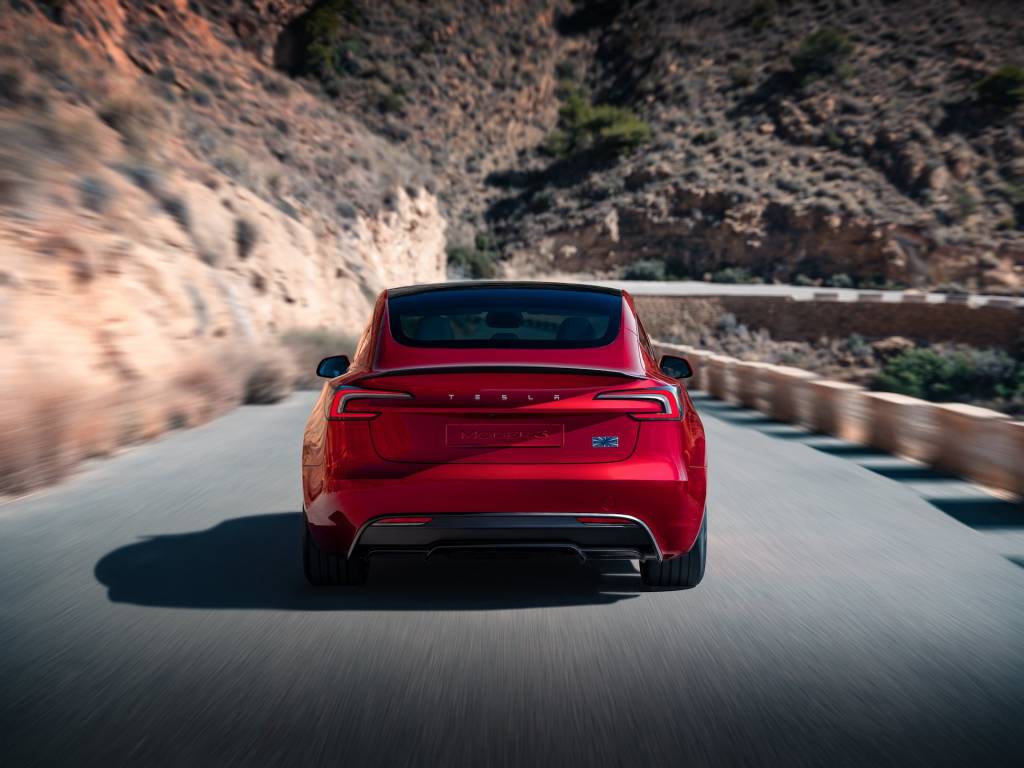
Tesla Model 3 Performance
Musk has periodically talked about this idea of revenue-generating self-driving taxis since 2019. At that time Musk suggested that Tesla would provide the interface and support to owners who would then rent out their cars as taxis, collecting a fee of 25% or 30% that still left some room for owners to generate income from their vehicles.
Building a dedicated robotaxi is a greater challenge than repurposing existing vehicles. Previous efforts by startup Arrival to develop an EV for Uber haven’t gone anywhere, and Tesla would likely need a completely different and more sophisticated hardware set, as its Full Self-Driving system continues to attract scrutiny from regulators and won’t be a system allowing the driver to hand over full responsibility anytime soon. Although, if reports prove true, the robotaxi project might improve the chances of eventually seeing Tesla’s $25,000 EV to production.

Toyota weighs 4-day workweek in sweeping overhaul of office life
The possible change in Japan is part of a sweeping rethink of office life meant to streamline workloads for a modern, more agile era of global competition and innovation.

Review: 2025 Mercedes-Benz AMG GT 63 S E Performance invests heavily in speed
 The 2025 Mercedes-Benz AMG GT 63 S E Performance puts power above all else The plug-in hybrid has 805 hp and 1,047 lb-ft, but it’s heavy Pricing hasn’t been released, but expect a bill for over $200,000 when it comes time to pay Between two farms outside of Mercedes’ proving grounds in Immendingen, Germany, I pull the 2025 Mercedes-Benz AMG…

One-off 2025 BMW M5 heads to Monterey Car Week auction
 BMW will auction off a one-off version of its redesigned 2025 M5 at next month’s 2024 Monterey Car Week to help raise funds for charity. The new M5 made its debut in June and starts U.S. deliveries in the fourth quarter, and the one-off example will be the first in the country. It’s officially known as the 2025 BMW M5 Pebble Beach Concours…

GM delays electric truck plant, punts Buick EV
- GM’s Orion Assembly Plant won’t build electric trucks until mid-2026
- Buick’s EV timeline just became TBD
- The Cruise self-driving robotaxi will no longer use the Origin purpose-built vehicle
General Motors is again delaying a planned ramp-up of electric pickup trucks, as well as the first Buick EV for the U.S., reports Bloomberg (via Autoblog).
Manufacturing of Chevrolet Silverado EV and GMC Sierra EV pickup trucks at GM’s Orion Assembly plant in Michigan has been postponed until mid-2026, CEO Mary Barra said during an earnings conference call Tuesday.
The delay is the main reason why GM won’t be able to meet a previous goal of having production capacity for one million EVs in 2025, according to the report. Barra announced last week that GM would miss that goal, blaming slow demand. But the automaker has also struggled to ramp up production capacity of new EVs using its Ultium battery tech.
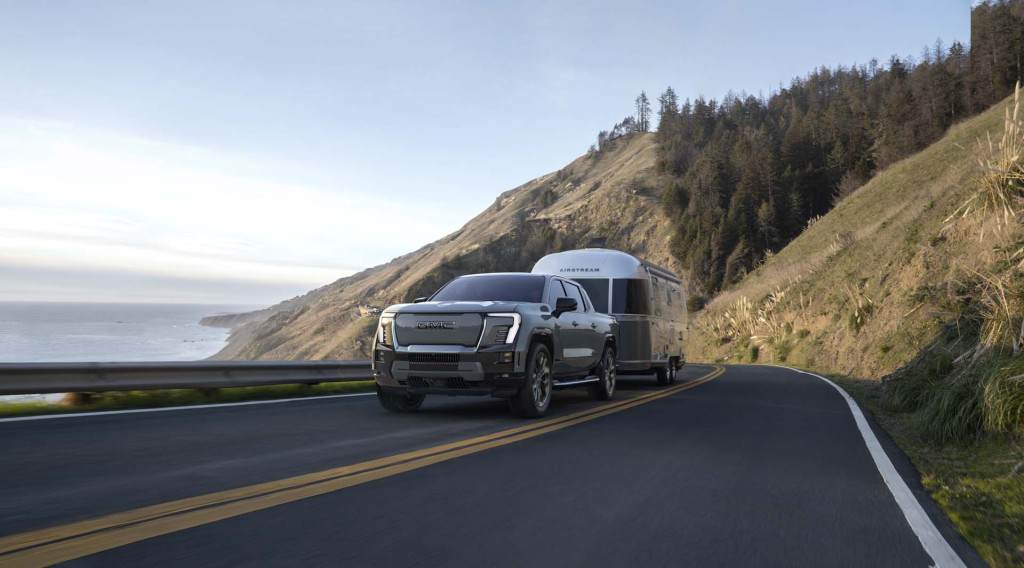
2024 GMC Sierra EV Denali Edition 1
This is the second delay for the repurposing of the Orion plant, which previously built the Chevy Bolt EV until that model was discontinued at the end of 2023. That move was meant to make room for electric trucks at the Orion plant.
This is the second time that GM has pushed back scaled-up truck production. In late 2023 it announced that this wouldn’t happen until 2025, with the Orion plant remaining idle in the meantime rather than continuing Bolt EV production. A next-generation Bolt EV is due for the 2026 model year.
Low-volume production of the Silverado EV is already underway at GM’s Factory Zero plant in Detroit. GM said in its Q2 financial results that it delivered 3,257 of the trucks in the first half of 2024. The automaker said in April that Sierra EV deliveries would start this summer, with initial production also expected to be sourced from Factory Zero.
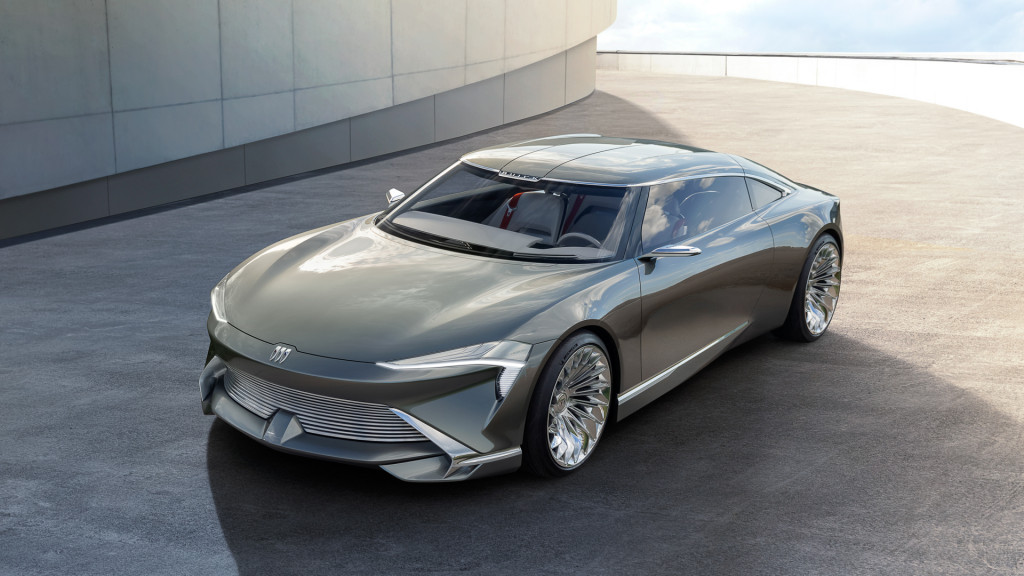
Buick Wildcat EV concept
Buick remains the only GM brand in the U.S. without an all-electric model. Its first EV for the U.S. was scheduled to be revealed later this year as the first in a series dubbed Electra, and with styling inspired by the Buick Wildcat concept shown in 2022. Buick also began offering dealer buyouts in 2022 in anticipation of an EV remake.
GM this week also confirmed that its Cruise self-driving technology subsidiary would no longer use the Origin, a purpose-built vehicle lacking a steering wheel and pedals, but utilizing the same Ultium battery tech as the automaker’s other EVs. That project had already been on hold for months, after various issues last year set back the firm’s plans and timeline. Cruise will instead use the next-generation Bolt EV for its robotaxi fleet.

Porsche says EV transition to “take years,” Audi refocuses on PHEVs
- Porsche and Audi acknowledge the electric transition will take longer than anticipated
- Audi said plug-in hybrids will be the stepping stone, especially in the U.S.
- Both Porsche and Audi still plan to go all-electric
Two Volkswagen Group brands now expect the EV transition to take longer than originally thought.
Porsche previously said it was aiming for 80% EV sales by 2030, but the automaker said Monday that this would only happen if customer demand and technological developments allowed.
“The transition to electric cars is taking longer than we thought five years ago,” Porsche said in a statement first reported by Reuters. “Our product strategy is set up such that we could deliver over 80% of our vehicles as all electric in 2030—dependent on customer demand and the development of electromobility.”
In the meantime, Porsche will keep a greater amount of combustion-engine cars in its product mix.
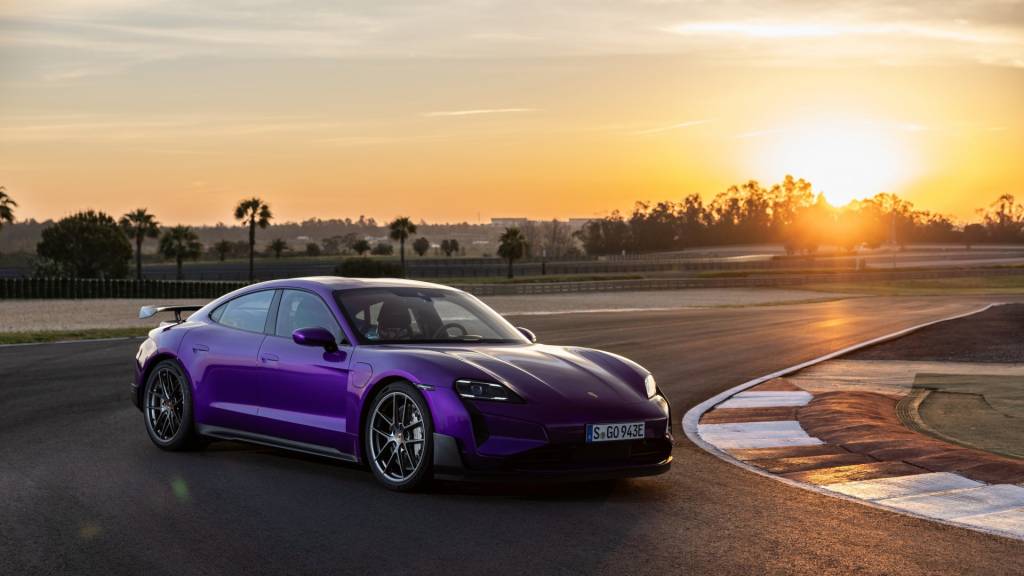
2025 Porsche Taycan Turbo GT Weissach package
“Our double strategy is more important than ever,” Porsche said, referring to its continued development of both internal combustion and electric vehicles.
Fellow VW Group brand Audi still aims to have an all-electric lineup by 2033, but CEO Gernot Döllner said in an interview with Autocar published Monday that there will be an extended “transition phase” to get to that point, adding that Audi is looking to plug-in hybrids to help smooth out that transition.
“We recognized early on that plug-in hybrids were a relevant project technology and now we see that the bridge is longer than we initially thought,” Döllner said.
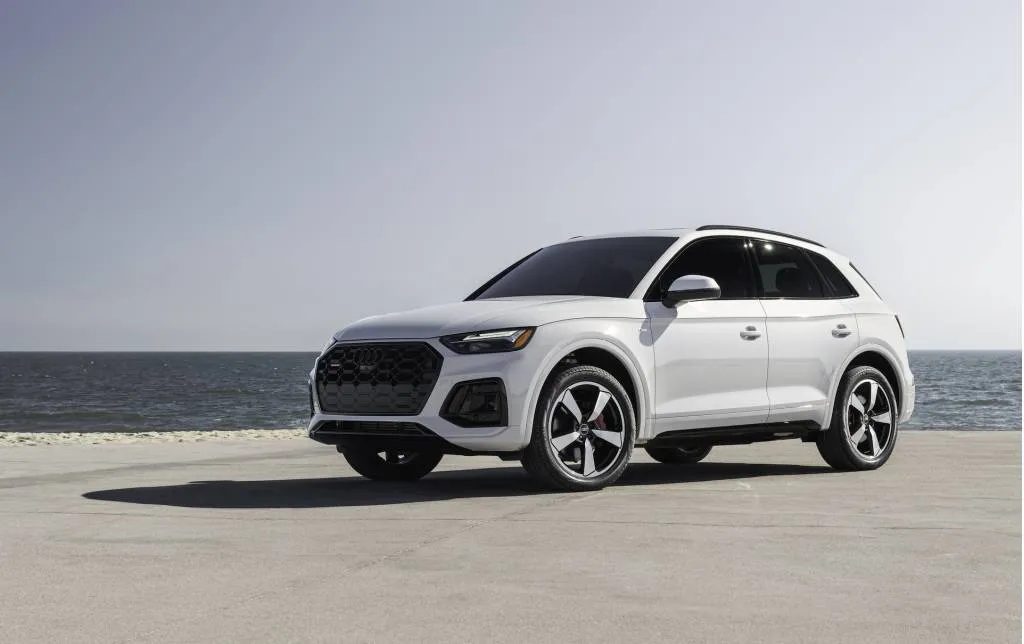
2025 Audi Q5
The 2025 Audi Q5 plug-in hybrid is the only such model in Audi’s current U.S. lineup, but the automaker is planning a new generation of plug-in hybrids with up to 62 miles of electric range, as well as a new family of combustion engines, according to Autocar. The Premium Platform Combustion (PPC), Audi’s next-generation platform for internal-combustion models that recently debuted with the new A5 sedan, can also accommodate range-extended powertrains, according to Autocar.
While this transition period could continue through the next decade, Döllner told Autocar that Audi still views EVs as the best solution in the long term.
“We believe, especially with the gradient of innovation in the battery-electric segment, that the battery-electric vehicle is superior,” he said.
The automaker is still rolling out new electric models based on the Premium Platform Electric (PPE) shared with Porsche as it moves on from earlier-generation EVs like the Q8 e-tron.

2025 Honda Civic Si gains new look, chassis updates
 The Honda Civic Si receives a nip and tuck for 2025 The updated 2025 Honda Civic Si arrives this summer and costs $31,045 Updates are minimal, power holds steady at 200 hp, but chassis tweaks increase the car’s rigidity Honda on Tuesday provided a first look at its updated 2025 Civic Si sport sedan that goes on sale later this summer. It will cost…

Rivian CEO: R3X arriving “as soon as we possibly can,” before R3
- The enthusiast-oriented Rivian R3X will launch before the mainstream R3
- No timeline has been given for when the R3X or R3 will arrive
- The Rivian R2 will go into production in 2026 and serve as the basis for the R3
The Rivian R3X electric hatchback will arrive before the base R3, Rivian CEO RJ Scaringe said in an interview with The Verge this week.
Scaringe did not provide an exact date, but said the R3 will launch “as soon as we possibly can” after the launch of the Rivian R2, which is scheduled to start production at the automaker’s Illinois plant in 2026, adding that the R3X performance variant will be the first to arrive.
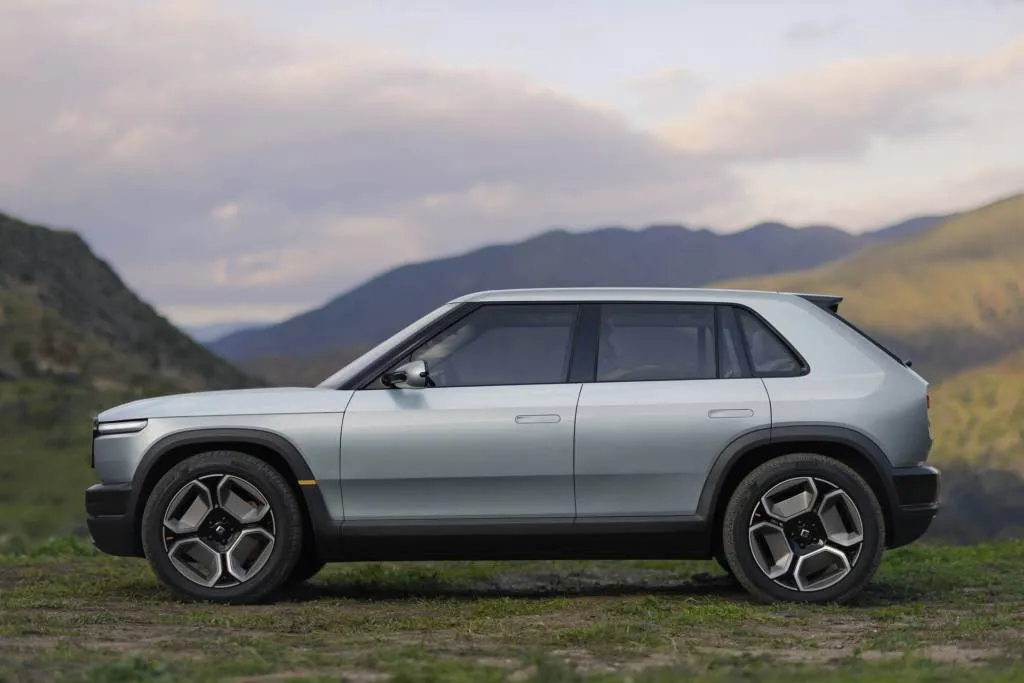
Rivian R3
“I will say this: The first R3 that we’re launching, it’s going to start with R3X,” Scaringe said.
Rivian unveiled the R3 and R3X at the R2 debut event in March. The hatchbacks will be smaller than the R2, measuring about 15 inches shorter in overall length than that SUV, which in turn is smaller than the current Rivian R1S SUV and R1T pickup truck. Rivian is also targeting a starting price below the $45,000 cost of the R2 for the base R3, although the R3X will likely be pricier.
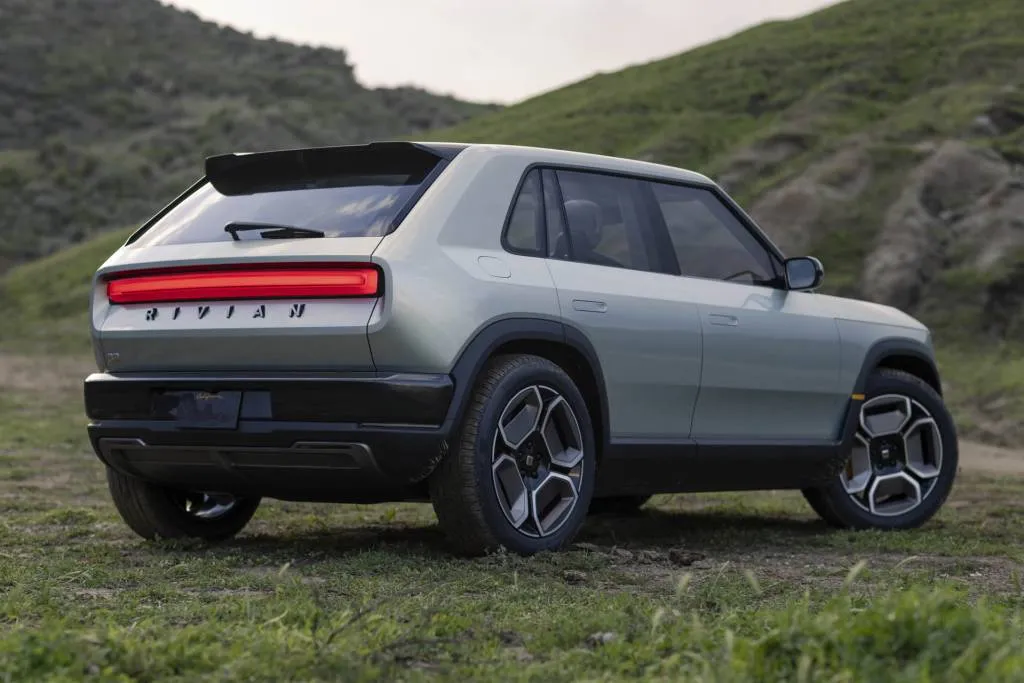
Rivian R3
The R3 lineup will share major components with the R2, including single-, dual-, and tri-motor powertrains, battery packs, and structural elements. But based on the excitement the R3 models generated at their unveiling, their more compact packaging could help revive a stagnant small-car segment in the U.S.—especially with respect to EVs.
The Volkswagen Group will invest up to $5 billion in Rivian in a deal that will give VW access to the U.S. automaker’s electrical architecture and software, while giving Rivian funding that could help get the R2 and R3 models across the line and into production.

Deployable rear step with diffuser may improve efficiency for electric trucks
- Stellantis patented a deployable diffuser that doubles as a bed step
- The diffuser would aid efficiency while also enabling easier bed access
- Active aero and bed steps aren’t new, but combining the two would be a first
Ram may be looking to turn the humble bed step into an active aerodynamic feature that could help boost range of its future electric pickup trucks.
Ram’s parent company, Stellantis, has filed a patent application for a deployable rear step that doubles as an active diffuser. The application, which was filed with the United States Patent and Trademark Office last December and published on July 4, describes the feature as a “vehicle rear step and diffuser system.”
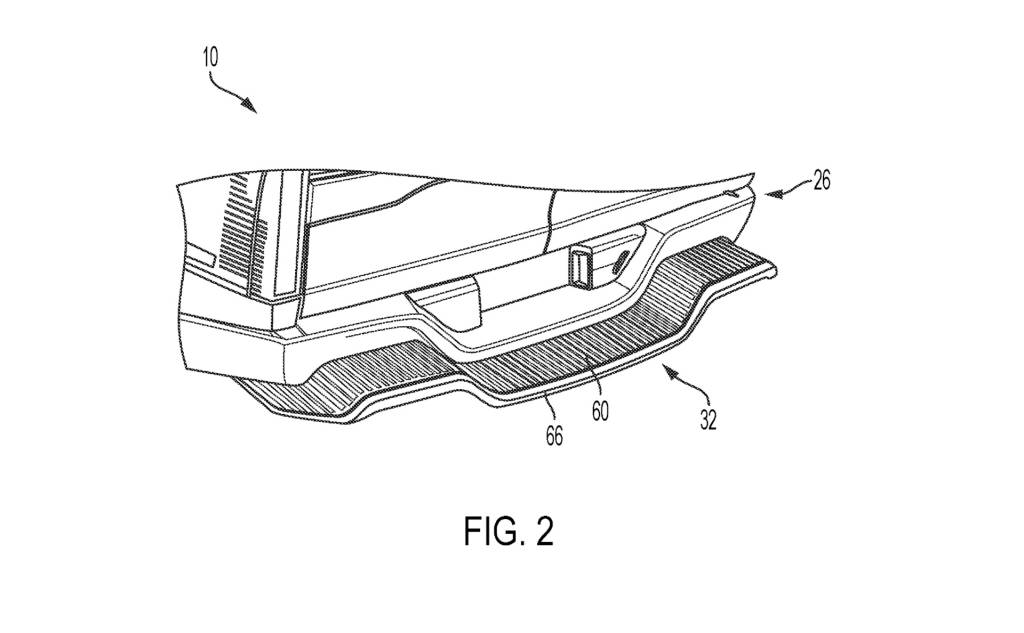
Drawing from Stellantis patent for vehicle rear step and diffuser system
The idea of an active diffuser isn’t new. Ram showed one on its 1500 Revolution BEV concept unveiled during 2023 CES. Mercedes-Benz also had one on 2022’s Vision EQXX concept. However, an active diffuser that doubles as a step hasn’t reached production just yet.
According to the patent, the bottom surface of the step would be shaped to act as a diffuser, while the top would be a flat surface that serves as a step. Unlike a conventional diffuser, it would be stowed when not needed, like at lower speeds, so vehicles wouldn’t have appendages sticking out past their rear bumpers.
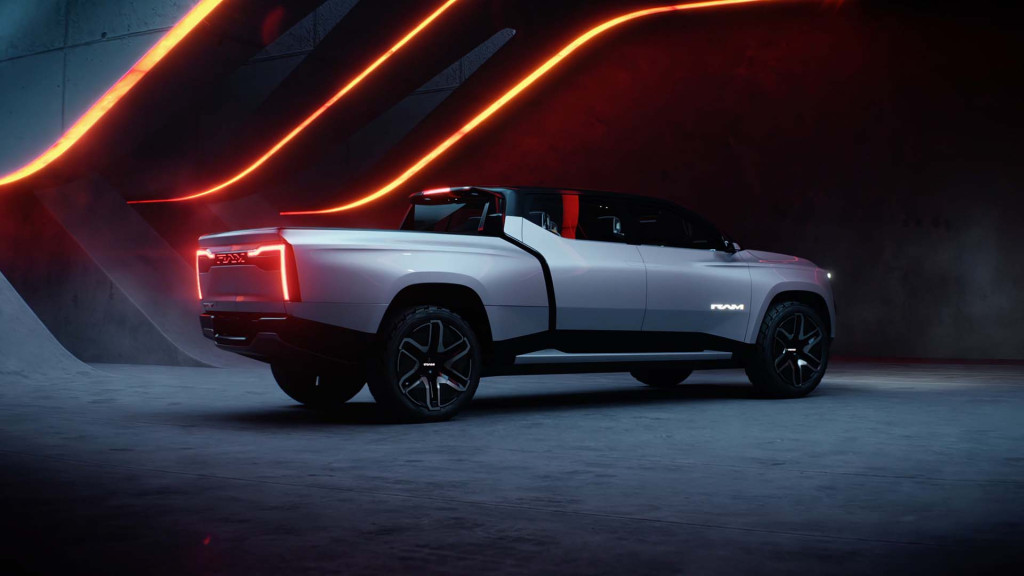
Ram 1500 Revolution BEV concept
Rear diffusers are typically used on performance vehicles as a way to generate more downforce and as a result more grip, but there’s also an efficiency gain as drag from turbulent air flow is reduced—something that could help boost an EV’s range.
The patent describes the feature as being used on vehicles with body-on-frame construction, like Ram’s pickups, including the 2025 Ram 1500 REV. The patent also includes drawings that show a pickup truck’s rear tailgate.
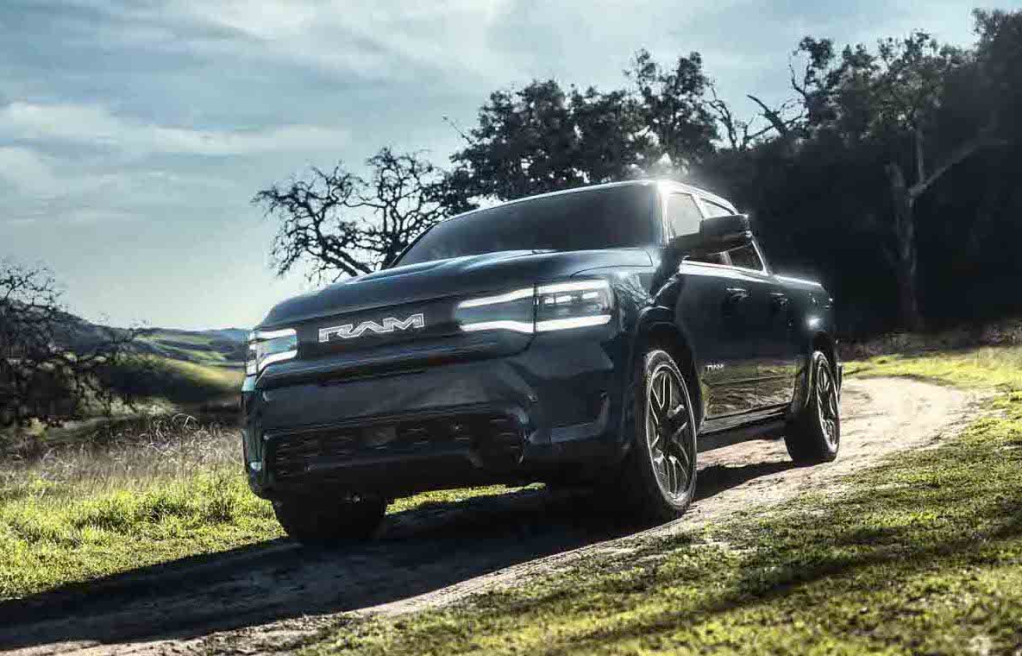
Ram 1500 REV
The design is reminiscent of the tailgate on Ram’s 1500 Revolution BEV concept. While that concept isn’t bound for production, it serves as a preview of potential design ideas for future Ram electric trucks, meaning we may see something like the active diffuser and step combination in production one day.