
Author: EVAI

Lucid gets $1.5B cash injection from Saudis
Lucid Group on Monday announced that the Saudi Arabian Public Investment Fund (PIF), the automaker’s largest shareholder, will inject up to $1.5 billion in cash.
The deal will keep Lucid sufficiently funded until the fourth quarter of 2025, reports Reuters, and comes as Lucid prepares to grow its lineup beyond the Air sedan. The PIF took a $1 billion stake in Lucid in 2018, which helped to finally get the Air into production.
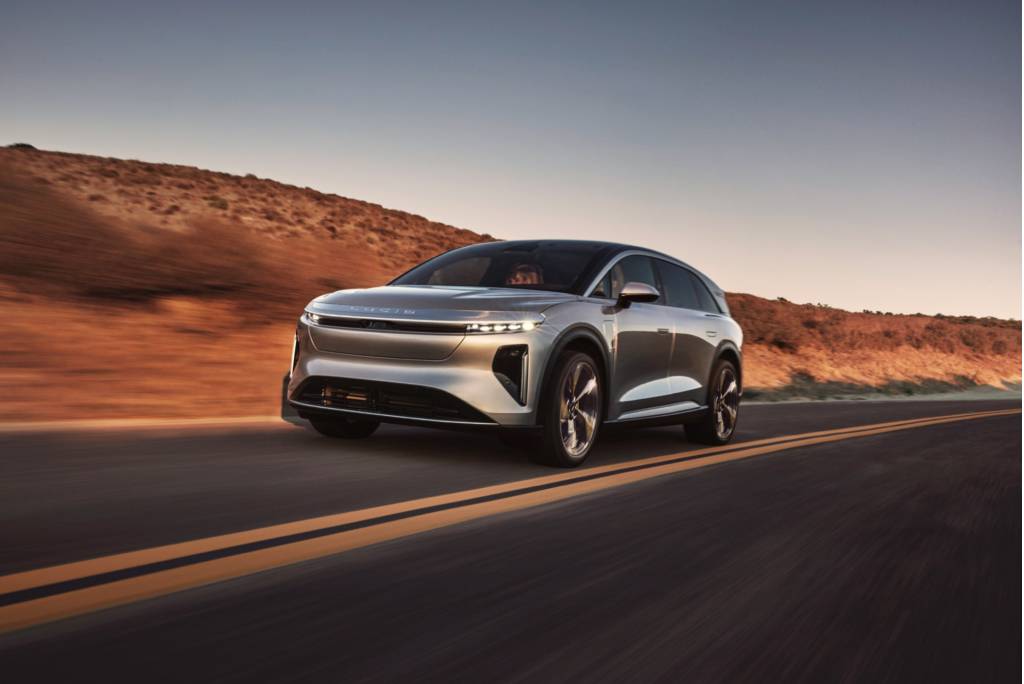
Lucid Gravity
Lucid also reported second-quarter revenue above analysts’ expectations, according to Reuters, after price cuts helped increase sales of the Air during Q2. Lucid cut prices by up to 10% earlier this year, allowing the base Air Pure to undercut the Tesla Model S.
The cash injection will likely help Lucid get its Gravity SUV into production. The automaker unveiled its second model at the 2023 Los Angeles auto show, and aims to start production later this year. After an ever-so-brief prototype test drive, we concluded that the Gravity just might defy segments, mixing the qualities of SUVs, minivans, and wagons.
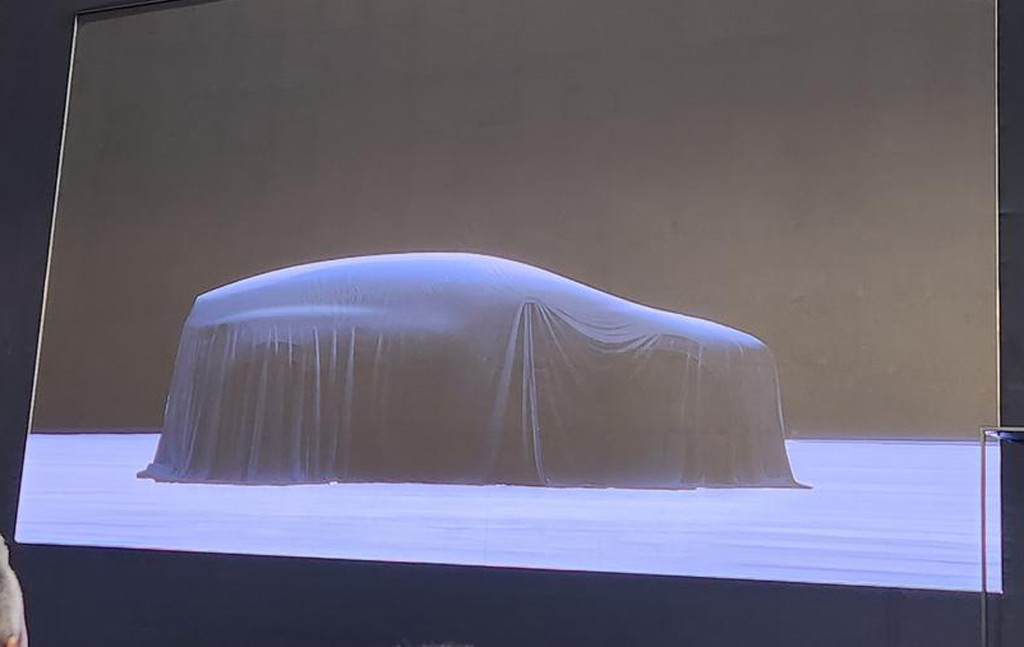
Teaser for Lucid Project Midsize – Photo credit: John Voelcker
Lucid in January also teased a somewhat smaller electric SUV, likely about the size of the Tesla Model Y, called “Project Midsize.” CEO Peter Rawlinson said at the time that engineering prototypes had already been built, while Reuters reports that Lucid is targeting a 2026 launch window for the new model.
The smaller electric SUV was announced at the opening of the second manufacturing stage at Lucid’s factory in Casa Grande, Arizona. According to Lucid, the 3 million square-foot buildout effectively quadruples the size of the factory. It will support the ramp-up of the Gravity, as well as expanded production of the Air, until the third model arrives.

2027 Mercedes-AMG GT 4-Door Coupe EV spied again
 Mercedes-Benz AMG, long known for its tire-shredding V-8 and V-12 engines, is well on its way toward offering a diverse electric portfolio. The Affalterbach tuner already offers its own versions of Mercedes’ EQE sedan, EQE SUV, and EQS hatchback, and is currently working on its first dedicated EV, a prototype for which has been spotted again. The…

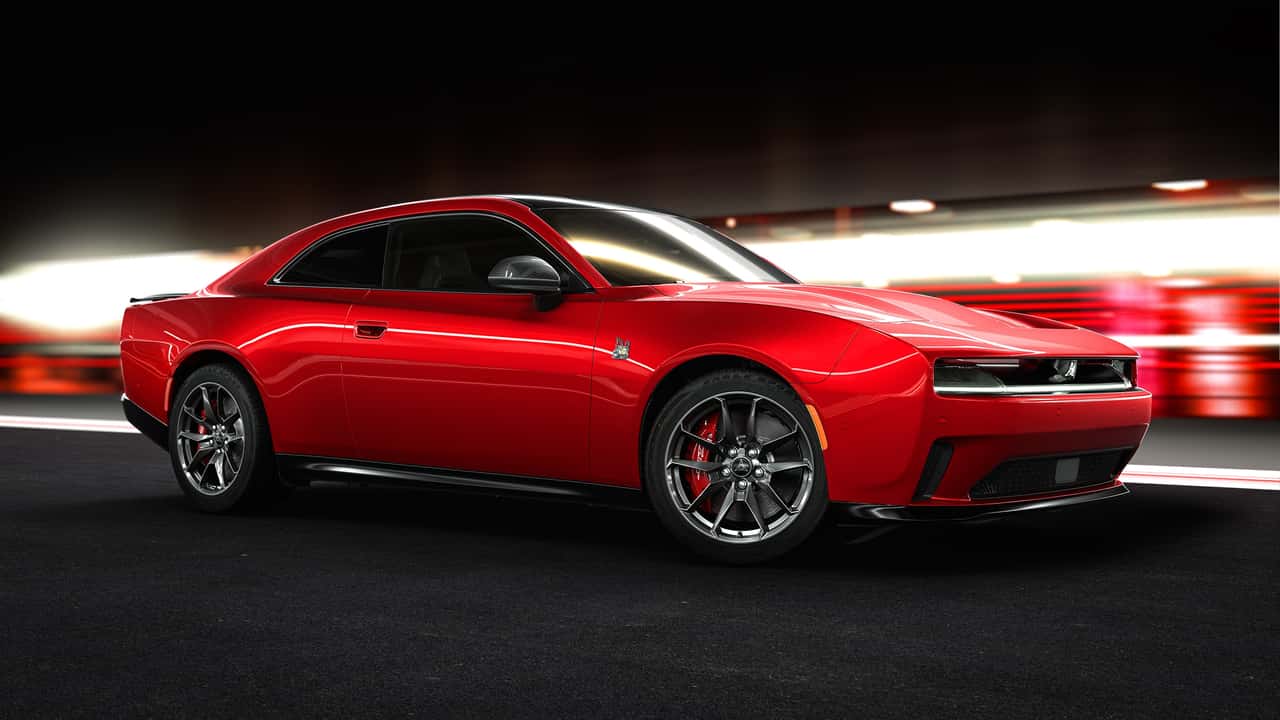
Dodge Charger Daytona EV Pricing Announced: It Ain’t Cheap (Updated)
I don’t envy the marketing team at Dodge. Getting owners of any popular model to go fully electric can be a tough proposition; cars like the Volvo EX90 and Porsche Macan seem promising, but not every loyalist is going to be fully onboard with an EV future quite yet. Arguably no automaker has a tougher task than Dodge, which will soon aim to sell some of the most hardcore, gas-crazed, V8-loving American gearheads on electric power when the Dodge Charger Daytona gets an electric option.
And Dodge may end up having to sell the Mopar faithful on paying quite a bit more than they have for these cars in the past.
Is the V8 muscle car a thing of the past?
Faced with tightening emissions and fuel economy rules, Dodge had little choice but to take the legendary Challenger and Charger electric. But that fanbase may be tough to win to the EV side after leaning into V8 power for so long.
A newly reported price leak over at Mopar Insiders—originally sourced from YouTube’s Butter Da Insider—claims that the new Charger Daytona EV models could cost some $15,000 more than their outgoing, Hemi V8-powered counterparts. And while the EVs do represent an extremely impressive performance bump over the gas cars, they could now end up ceasing to be the affordable everyperson muscle cars they are now.
The official pricing of the Charger Daytona EV sedan and coupe haven’t been announced yet. But this reported leak claims that the launch edition Daytona R/T Configuration 1 could start around $68,570. Meanwhile, upgrading to the Daytona Scat Pack could set you back $82,170.
That’s a big jump over the current V8 cars. Right now, you could get a Challenger R/T starting at around $42,000; upgrade to a Scat Pack with more power and better options for $50,680; or score a 797-horsepower SRT Hellcat Redeye Jailbreak starting at $82,895.
(As a side note, I had no idea the names of these things had become so absurd. Redeye Jailbreak! What a time to be alive.)
But as with all things EVs, there are some caveats here. First and foremost, these are almost assuredly just “launch edition” prices for the electric Charger; like the new Jeep Wagoneer S, it’s sure to debut some more loaded, collector’s item-style packages at launch before cheaper models inevitably trickle out. I fully expect prices to go up and down as Dodge finds ways to offer the new Charger at better prices, as well as more extreme ones.

23
Additionally, Dodge is sure to make the performance argument with these cars, whether the V8 superfans want to hear it or not. Designed to “surpass [the] legendary V8 performance,” the new Charger Daytona EV has 670 horsepower out of the gate and is expected to hit 60 mph in just 3.3 seconds in Scat Pack form. If so, that’s a full tick quicker than the aforementioned Hellcat Redeye Jailbreak, no doubt thanks to the traction advantage since it’s dual-motor all-wheel-drive.
The 2024 Dodge Charger Daytona.
Dodge
In all honestly—and I’m clearly biased here—the electric Charger Daytona seems pretty badass. It looks excellent in coupe and sedan form, has some interesting gimmicks like a simulated exhaust sound, and promises a very decent 317-mile range from its 100.5-kWh gross (93.4-kWh net) battery pack. The more powerful Scat Pack should do 260 miles on a full charge.
Honestly, it all sounds quite a bit more interesting and compelling than the version with the forthcoming twin-turbo inline-six; if people wanted a BMW, they’d get a BMW, right? But it’s going to be up to Dodge to sell its fans on what an EV can do. With any luck, it’ll start at the top and then work its way down to lots more everyday customers.
We reached out to Dodge for confirmation and will update if we hear back.
*Update: The official pricing has been released Those details are listed below.
Dodge just confirmed pricing for the Charger Daytona EV. The 2024 Charger Daytona R/T will start at $61,950, while the Scat Pack will cost $75,185. The Scat Pack comes with a standard “Track Package” that includes Brembo fixed-piston brakes, adaptive dampers, and upgraded seats. Option packages include the $4,995 Plus Group and a Sun and Sound Package for $2,495.
The Charger Daytona R/T will come standard with the “Direct Connection Stage 1 Upgrade Package.” This version puts out 496 horsepower and 404 pound-feet of torque The Scat Pack will get a “Stage 2” package with 670 hp and 627 lb-ft.
There may be a cheaper base version without the “Direct Connection Stage 1 Upgrade Package” offered later on.
Both trims will qualify for a $7,500 tax credit when leased, but it seems unlikely that the credit will be available if the vehicle is purchased.
Contact the author: patrick.george@insideevs.com
Share this Story

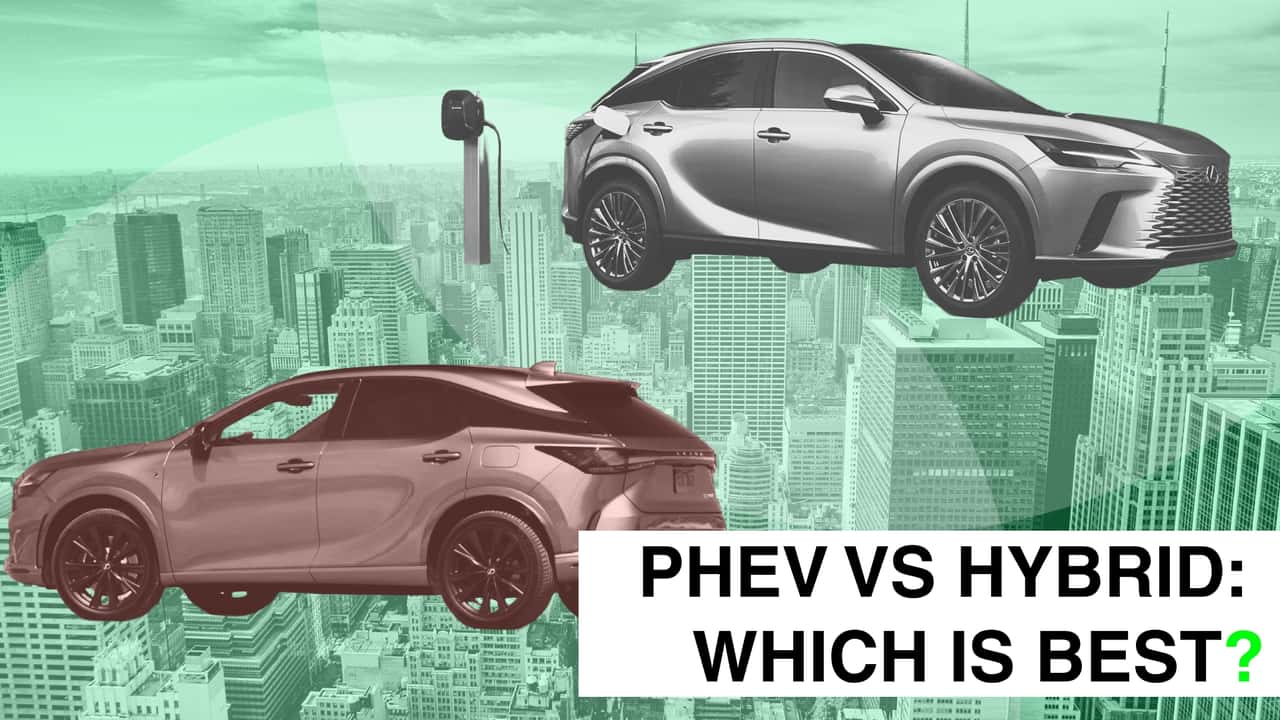
I Drove A Plug-In Hybrid And A Regular Hybrid Back-To-Back. It Got Complicated
Electric vehicle sales are a rollercoaster these days, but hybrid sales are cruising to new heights.
Many buyers aren’t ready to go fully electric. For them, hybrids offer a familiar, less drastic transition from gas cars. While hybrids still burn fossil fuels, they eliminate range anxiety, improve efficiency and free drivers from charging concerns. That means plug-in hybrids and regular hybrids are playing a big role as the world prepares to go fully electric.
However, to maximize the benefits of a PHEV, you need to plug it in. That means PHEVs face similar challenges as BEVs regarding charging and infrastructure.
Take my situation, for example. I live in a New York City apartment. While driving or even owning a car here is… less than advisable, tons of people do it. But even with a long extension cord, I can’t make EV charging work without being a nuisance to my neighbors. I can’t suspend a cable that would dangle over other people’s windows or obstruct pedestrian paths. Plus, street parking in NYC is like a game of musical chairs. So I end up parking a block or two away from my home, in a different spot each time.

22
Source: InsideEVs
So if you’re in the market for a hybrid, but can’t make home charging work, what type of hybrid should you consider: a PHEV or a HEV? What are their benefits and drawbacks when your city’s charging infrastructure is still growing? To find out, I spent back-to-back weeks with two Lexus hybrids: a PHEV and a regular hybrid version of the same car.
Full Disclosure: Lexus loaned me an RX 450h+ PHEV and the standard hybrid RX 500h F Sport Performance for a week each. They arrived at my home spanking clean, gassed up and their batteries charged. I returned them a little less clean, batteries drained, but refueled.
The Basics
I know what you’re thinking: most Americans can’t afford expensive Lexus hybrids. That’s true. The Lexus RX 450h+ PHEV and the RX 500h are the priciest models in the ultra-popular RX luxury crossover family. The RX PHEV costs $70,580 before taxes and fees, whereas the hybrid RX 500h costs $64,100. For those prices, you could buy two and a half Corolla Hybrids.
The RX has plenty in common with its more affordable Toyota cousins, which sell several times more. The RX PHEV shares a powertrain with the smaller Toyota RAV4 Prime. It’s powered by a naturally aspirated 2.5-liter four-cylinder engine and a pair of electric motors.
The dual electric motors—one on each axle—draw energy from an 18.1-kWh battery pack. The setup produces 304 horsepower and is good for 37 miles of electric-only range. With a claimed 0-60 mph time of 6.2 seconds, it’s quick enough. I never felt the need for more power. Not in New York, anyway.
14
Source: InsideEVs
On the other hand, the RX 500h is the RX you buy if you want to have fun. Its hybrid powertrain exists to make you feel less guilty about burning fossil fuel. It’s powered by a 2.4-liter four-cylinder turbo engine, supplemented by a considerably smaller 1.6 kWh battery, delivering a combined 366 hp.
The RX 500h’s EPA combined efficiency figure is 27 mpg, giving it a range of about 266 miles. The RX PHEV, however, can drive up to 540 miles on a full tank and full charge, with a whopping 83 mpge of EPA-rated efficiency. The indicated range, however, was roughly 450 miles.
Living With A PHEV
As I drove out of NYC, I felt a tidal restlessness among drivers, as if everyone was desperate to escape the concrete jungle. Blatant lane indiscipline, a cacophony of honking and drivers jumping yellow lights—all exacerbated by a scorching heat wave. But inside the Lexus RX 450h+, I felt calm. Lexus hybrids are isolation chambers.
Initially, it drove like a fully electric car: near-silent, free of tailpipe emissions and instant acceleration at the tap of the throttle. Like a BEV, when you press the start/stop button, it switches on silently in EV mode, with nothing but a “Ready” symbol on the gauge cluster to signal that you’re ready to shift to drive.
The indicated electric range was 35 miles, slightly less than the EPA estimate of 37 miles. I left it in Auto Mode for the onboard computers to manage power distribution. It ran solely on electricity for the first 42.2 miles, averaging 2.3 miles per kilowatt hour. That’s about the same as the average daily driving distance in the U.S. and identical to what Edmunds got on the RAV4 Prime, which has an EPA rated electric-only range of 42 miles.
The range, however, gets influenced by driving conditions, driving behavior, accessory usage and weather. I did not drive like a saint, but still squeezed more range than the RX PHEV’s EPA estimate because my drive had some downhill roads where the regen worked overtime. Once the battery ran low, the PHEV drove like a regular hybrid, driving on electricity at slow speeds, with the gas engine almost imperceptibly switching on while picking up speed. I love how hybrids do that, changing power sources so seamlessly like it’s nobody’s business.
The good thing is, even if you’re out of EV-only range, the battery never fully depletes. Regenerative braking and the engine recharge the battery every time you’re off the throttle. I was aware of this thanks to Toyota’s “energy monitor,” a graph on the gauge cluster that tells you what’s powering the wheels.
Over 143 miles, with the climate running on auto mode and four occupants, the RX 450h+ consumed only two gallons of gas, costing me about $7. That’s a whopping 71.5 miles per gallon, lower than the EPA estimate of 81 MPGe, but still phenomenal efficiency. In 2022 at least, the RX 450h+ was rated to put out 305 grams of CO2 per mile when it runs on gasoline, about 100 less than the average passenger vehicle, assuming you charge it frequently.
The charging experience, however, was abysmal. The 18.1 kWh battery takes 2.5 hours to fully charge. That’s only convenient if you have a home or office charger. Or if the Walmart, Costco or a restaurant you frequent has plugs. There is no “fast-charging” for most PHEVs. Moreover, the RX PHEV doesn’t show the battery percentage. All you see is a “time to full charge” bar. That’s frustrating because it’s painfully slow to charge at the top end, just like BEVs where the charging rate drops dramatically after 80%. If I knew the charging percentage, I would have saved time by ending the charging session at 80% and leaving the station open to others, instead of hogging it.
You can also charge at free-standing public charging stations in your vicinity. At an IKEA parking lot in Brooklyn with Level 2 ChargePoint dispensers, an Audi Q4 e-tron owner told me he regularly left his EV there to charge overnight. Because he lived just a block away, that was convenient for him. At another Flo charger under the Brooklyn Queens Expressway, a Toyota bZ4x owner said it made sense to leave his EV there to charge since he lived right across the street.
I had none of this at my disposal. My nearest charger is only a 10 minute drive away, but a 30 minute subway ride back home or a 40 minute walk. If I’m leaving an EV for 2.5 hours, I want to easily get home while it juices up.
It would be even better if PHEVs could fast-charge. But smaller batteries are designed to be charged more slowly to prevent overheating and other pack-related issues. PHEVs are already expensive, so upgrading their electrical systems for fast charging would only drive up costs. Unless there’s a technological breakthrough that allows PHEV batteries to safely fast-charge, charging times will likely continue to be long.
As of now only a few models like the Mitsubishi Outlander PHEV and the Mercedes-Benz GLE 450e can fast charge, although the speeds are only slightly more than Level 2 rates and nowhere close to how rapidly Teslas or 800-volt Hyundai Ioniq 5s and Kia EV6s charge.
As with an EV, you get the most when you can charge at home and in a garage; more work needs to be done to add charging everywhere so that EV and PHEV drivers can thrive no matter where they live.
Living With An HEV
By contrast, living with the RX 500h, a conventional hybrid, was hassle-free. I didn’t worry about charging at all. Its small 1.6 kWh battery recharges using engine power and regenerative braking.
The drive was as smooth as a hot knife piercing through butter. Like most modern HEVs, the dual electric motors and the battery help fill torque during acceleration; it can run on gas power, battery power or a mix of both, so there’s effectively no turbo lag. It also drove on electricity at slow speeds, albeit only for a few seconds before the engine switched back on. It coasts on EV-mode on the highway, further improving the efficiency.
But compared to the PHEV, the worry-free experience came at a cost. After covering 141.1 miles in mixed city and highway driving, the RX 500h’s calculated efficiency was 25.8 mpg, close to the EPA estimate of 27 mpg for combined highway and city driving. The PHEV was nearly three times more efficient on a much more diverse set of roads: city, highway, winding mountain roads and countryside. And the regular hybrid RX pollutes slightly more too, at 326 grams of CO2 per mile, although that’s still less than most vehicles.
With the PHEV’s battery nearly depleted, it was still more efficient than the hybrid. Despite lugging around a heavy battery, it delivered 40 mpg. I never saw more than 26 mpg on the hybrid. The main discrepancy here was the RX 500h’s 2.4-liter turbo engine, which has a drinking problem. It’s not as efficient as the 2.5-liter naturally aspirated engine on the PHEV. Plus, the RX 500h is almost as heavy as the PHEV at nearly 3,750 pounds, whereas the normally aspirated RX 350h is roughly 350 lbs lighter. The lighter, less powerful hybrid has an EPA rating of 36 mpg combined, so it’s a lot less thirsty.
You could drive these hybrids like a saint and squeeze out more miles. But the EV driving ratio of the hybrid—the distance covered on electricity—was lower and more inconsistent than the PHEV, as per the on board energy monitor. In the city, the hybrid drove 70% of the distance on EV-mode only. On the highway, the EV driving ratio dropped to 20%.
The PHEV, however, with a charged battery, had a consistent 48-50% EV driving ratio in mixed driving conditions.
Verdict
The plug-in Prius Prime was the greenest car of 2023, according to the American Council for Energy Efficient Economy (ACEEE), with life cycle emissions factored in. But if you’re not plugging them in, they can sometimes be worse than gas cars, research firm BloombergNEF says. By not plugging a PHEV, you’re carrying the dead weight of the battery, making the engine consume more fuel. If you plug it in, your daily driving can be emissions-free and the gas engine will have your back on long trips. But we have seen little data to indicate that people will plug these cars in if automakers really push wider PHEV adoption.
I found that even if you live without a home or an office charger, you can make PHEVs work, provided there’s ample supporting infrastructure in your vicinity. We’re already seeing the U.S. head in that direction. OEMs and charging companies are increasingly partnering with grocery chains, retailers, gas stations and mall giants to install more plugs, where EV owners can juice-up without having to waste time.
Granted, they’re more expensive. But you can offset the initial high cost with federal and state tax credits and offers from the OEMs on leasing and financing. Some PHEVs currently qualify for up to $7,500 or $3,750 in tax credits, depending on the vehicle and your personal tax liabilities.
I made the PHEV work because the trade-off was mind blowing. I wouldn’t mind driving it to a charging station at a Walmart once a week (something that’s already part of my routine), charging the PHEV while I shop and then enjoying 71 mpg for the rest of the week before plugging it back in the following weekend. But that’s because I don’t drive all that much. If I did, I’d definitely want a home or an office charger, or a public charging station nearby.
If you have zero charging access, an HEV would probably suit you better. They’re slightly more efficient than gas cars. But it’s 2024 and we don’t need cars to go slightly electric. A bigger battery clearly delivers better results. If you have better access to charging and can stomach the higher initial cost, a PHEV is a no-brainer for the planet, for your gas bill and for the future of driving.
Contact the author: suvrat.kothari@insideevs.com
Share this Story

Kia Carnival vs. Toyota Sienna: Compare Minivans
 Minivan or SUV? Soccer mom-mobile or soft-roader? The choice between practicality or vanity is no longer such a stark contrast. The good-looking 2025 Kia Carnival smartens up with a new hybrid option to better compete with the uber-practical 2024 Toyota Sienna, which comes standard as a hybrid. The Carnival’s SUV style, room, and value…

Rivian R1 with Large+ battery actually packs Max battery in disguise
 The Rivian Large+ battery is a Max Pack that’s software locked The Large+ isn’t an official option; Rivian’s reaching out to Large Pack buyers and offering it as an option Rivian could unlock extra battery capacity in the Large+ later for a fee Some buyers opting for an updated 2025 Rivian R1T or R1S with a Large battery are being offered a…

Rivian Large+ battery is a software-locked Max Pack
- Some Rivian R1 vehicles with the Max Pack battery will be delivered as Large+ models
- Vehicles with the Large+ battery pack feature a software-locked usable capacity
- It’s unclear if Rivian will allow Large+ owners to unlock the extra battery capacity later
Rivian is selling its revamped 2025 R1T and R1S with the largest Max Pack software-locked down to a lower usable capacity.
First spotted by RivianTrackr, the new option is called Large+ and matches the capacity and price of the true Large Pack being offered on Dual-Motor R1T and R1S models. That means 109.4 kwh of usable capacity, compared to 141.5 kwh for the unlocked Max Pack and 92.5 kwh for the Standard Pack.
Rivian is opting to produce Max Pack vehicles software-locked down to Large+ spec due to high demand and the desire to get vehicles to customers sooner.

2025 Rivian R1T
“To meet the high customer demand and accelerate delivery our second-generation Dual Large vehicles, we’re software-updating the range of certain Max pack R1 vehicles to match the starting pricing and range (up to 330 miles) of our Large pack,” Rivian spokesperson Mikhael Farah told Green Car Reports. “These Dual Large+ vehicles provide all the same performance, range, and features customers expect with a Dual Large vehicle.”
In posts on Threads, RivianTrackr also claims that the Large+ pack can be charged to 100% in daily use, citing anonymous sources within the company. That seems logical, as charging to 100% of the software-enabled capacity of the Large+ pack wouldn’t actually be using 100% of the pack’s physical capacity. But Rivian is still recommending the same charging practices, meaning 70% for daily use, 85% for “extended drives,” and 100% for road trips only.
Software limitation also leaves open the possibility of customers paying to unlock more battery capacity at a later date, but Rivian isn’t announcing anything at this time. Customers also can’t specify the Large+ option on the Rivian configurator. They’ll continue to select “Dual Large” and may be contacted by Rivian to select the Large+ option.
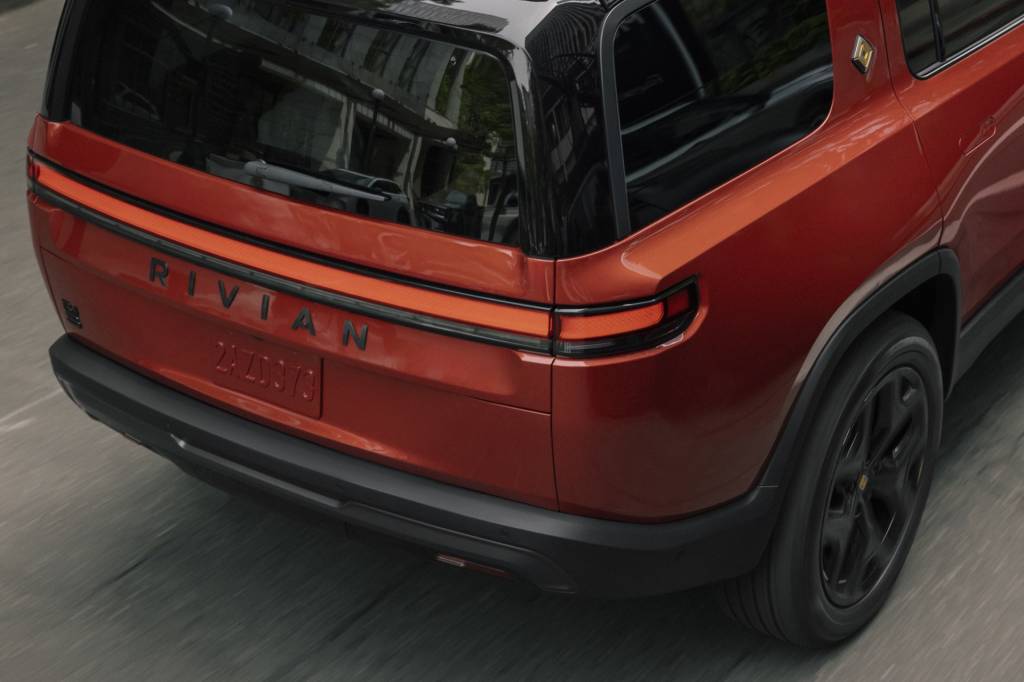
2025 Rivian R1S
Software-locked battery packs aren’t new. Tesla once limited battery capacity in certain Model S configurations to avoid having to produce multiple battery-pack sizes. BMW also limited the fuel-tank capacity on range-extended versions of its i3, although that was to comply with California regulations.
R1 models get a host of updates for 2025, fixing things existing owners wanted to see changed, adding new features to bring additional customers into the fold, and ensuring forward compatibility with the eagerly anticipated R2 lineup, due in 2026.


2023 Nissan Ariya recalled due to potential loss of drive power
Nissan has recalled 2023 Ariya electric SUVs due to a software error that could cause a loss of drive power.
The recall covers 1,188 vehicles, all of which were previously recalled for an inverter issue, according to the National Highway Traffic Safety Administration (NHTSA). The vehicles being recalled this time, which may include a mix of front-wheel-drive and all-wheel-drive models, have not had that issue addressed.
In the affected vehicles, a current sensors inside the battery junction box may detect a gap in the current ripple frequency of the motor when operating at high speeds, according to the NHTSA. This could cause the inverter’s power electronics box to cut power, sending the vehicle into a fail-safe mode without warning.
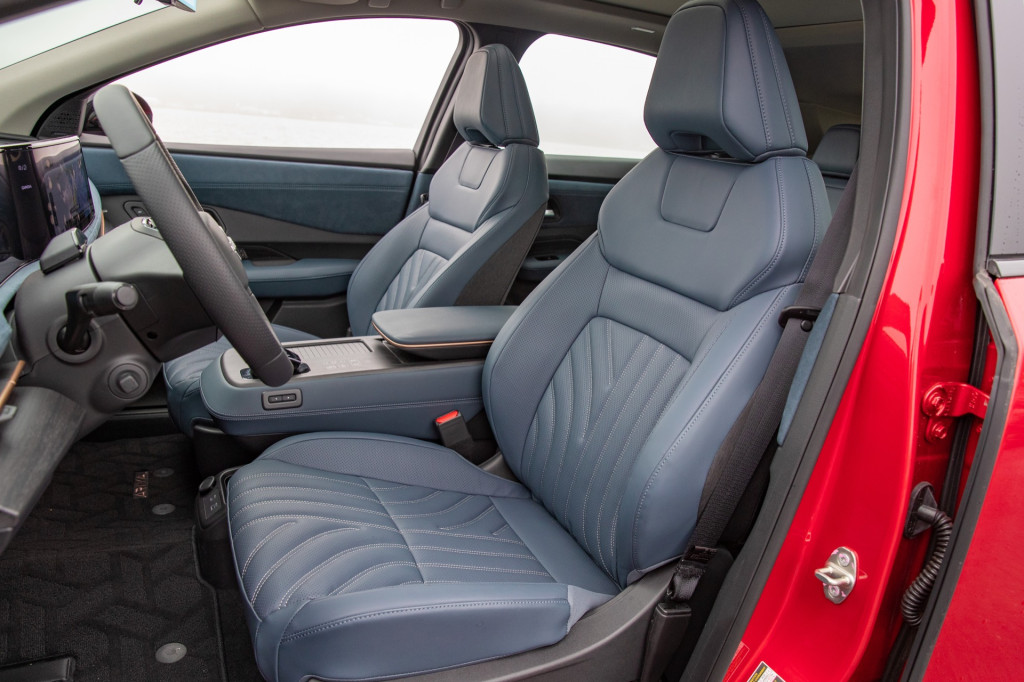
2023 Nissan Ariya e-4orce
If this fail-safe mode is triggered, the vehicle may shut off completely, although may be possible to restart it, according to the NHTSA. Drivers will see a dashboard light and “EV System Off” message on the instrument cluster.
The Ariya is compatible with over-the-air updates for the entire vehicle, but as with the previous inverter recall, this one will require a dealer visit. Dealers will verify which software version the recalled vehicle’s inverters are currently running and update if necessary, free of charge.
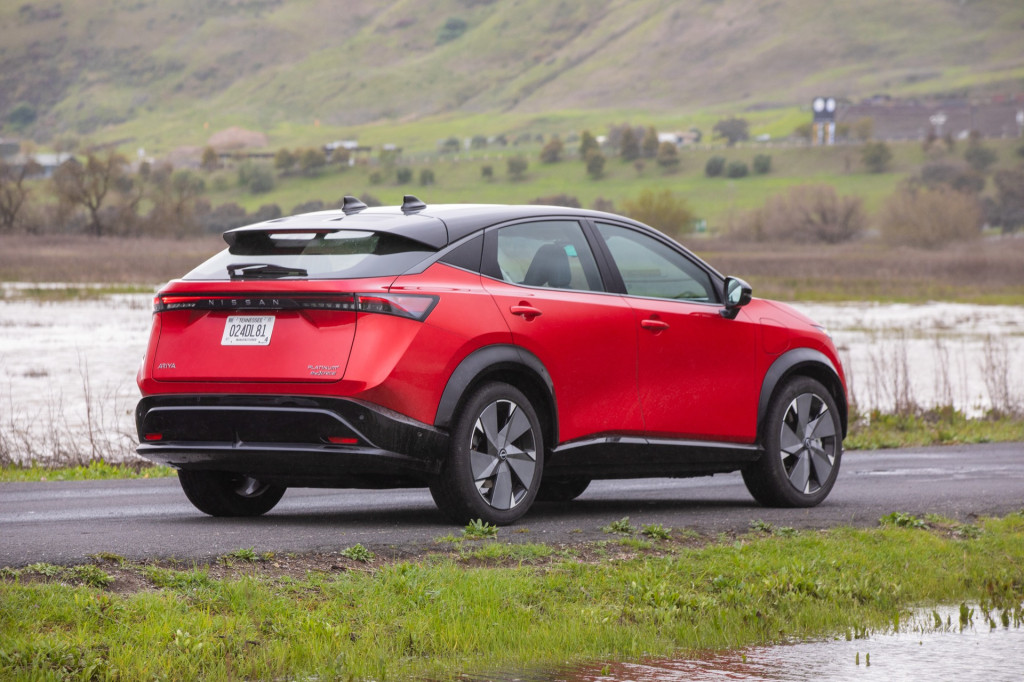
2023 Nissan Ariya e-4orce
Nissan plans to begin mailing owner notification letters Sept. 9, 2024. Owners can also contact Nissan customer service at 1-800-867-7669 for more information. Nissan’s number for this recall is R24A8.
The Ariya launched for the 2023 model year after several delays. The relatively small number of vehicles sold in that first model year have been subject to multiple recalls, including the previous inverter recall, one for steering wheels that might detach, and one for something EVs rarely have—an oil leak.

Wireless EV charging record set with Porsche Taycan prototype
- A Porsche Taycan wireless charged at a rate of 270 kw
- The Department of Energy’s Oak Ridge National Laboratory (ORNL) partnered with Volkswagen Group for the test
- No timeline was given to put a system like this in production, but testing will continue
In a recent test, the Department of Energy’s Oak Ridge National Laboratory (ORNL) wirelessly charged a Porsche Taycan at 270 kw, setting what researchers claim is a new record for wireless charging of light-duty vehicles.
Existing wireless-charging systems for light-duty vehicles charge at much lower power levels, ORNL noted in a press release. Commercially-available hardware generally reaches 11 kw with 92% efficiency, according to ORNL, and standards cover power levels of up to 20 kw. A system deployed in 2020 with a fleet of Jaguar I-Pace taxis in Oslo, Norway, was able to achieve 50 kw in 6-8 minute bursts.
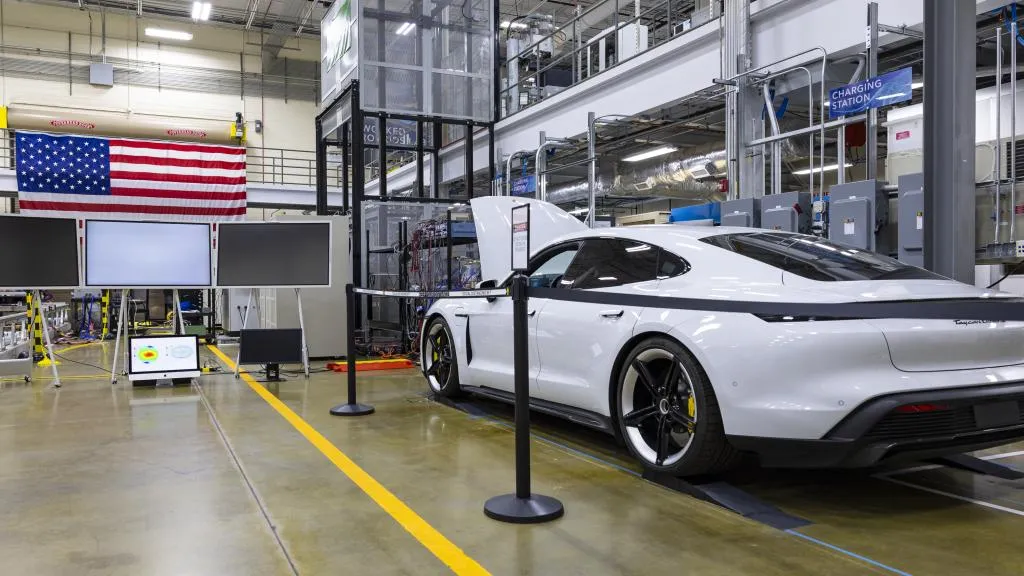
Oak Ridge National Laboratory tests 270-kw wireless EV charging system
However ORNL claims its system, which was tested in collaboration with Volkswagen Group of America as part of a research project announced in 2021, can rival the power of many conventional DC fast-charging stations, with 95% efficiency. It can also achieve a 50% increase in state of charge in 10 minutes, ORNL claims.
The system uses lightweight polyphase electromagnetic coils measuring just over 19 inches in diameter, which ORNL claims allows for the highest power density possible. The receiver coil mounted on the underside of the Taycan is in fact 8 to 10 times more power dense than existing systems, lead researcher Omer Onar said in a statement. Charging was conducted with a 4.75-inch gap between the coils on the car and the ground.
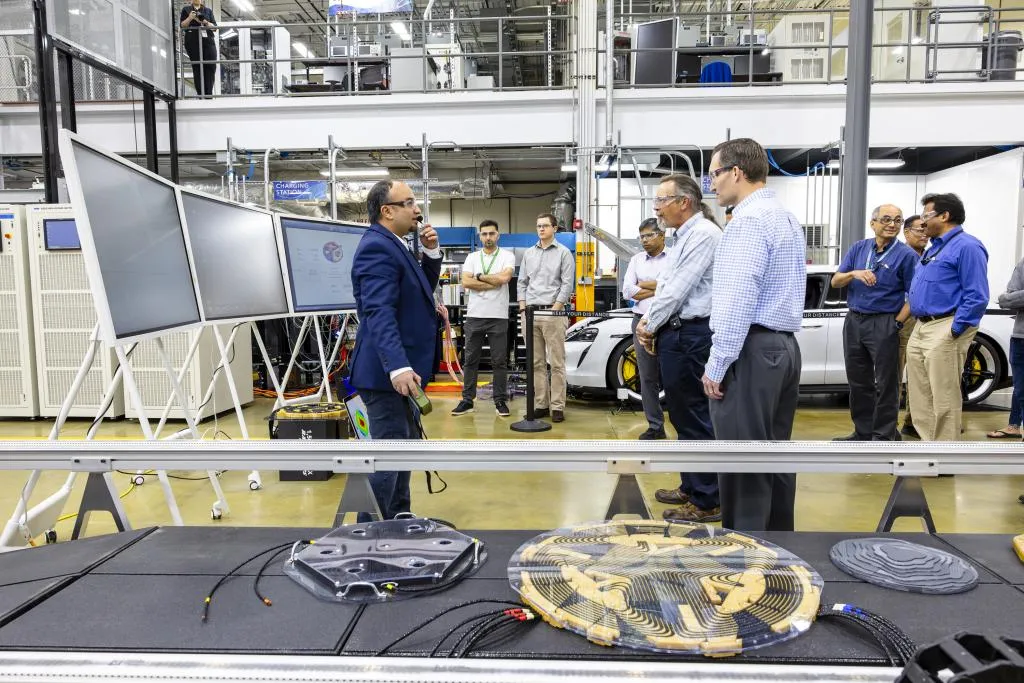
Oak Ridge National Laboratory tests 270-kw wireless EV charging system
This hardware could allow for higher-power wireless charging without bulky components that would be difficult to package in passenger cars, according to ORNL. The lab will continue to work with VW Group of America to bring the system closer to production readiness, but no firm timeline was given.
In the meantime, a handful of companies offer their own wireless charging systems. Tesla appeared to have purchased one of those companies, the German firm Wiferion, in 2023, hinting that the automaker was moving ahead with plans to offer wireless charging for its vehicles.