
Author: EVAI

Ram Professional unit looks to grow truck brand’s commercial business
Ram’s commercial team is touting a product slate with the brand’s most diverse set of powertrains ever, including the new ProMaster EV that Amazon will use for last-mile deliveries.

2024 Dodge Charger Daytona EV charges up for $61,590
- Dodge’s first EV will be the Charger Daytona R/T and Daytona Scat Pack
- 2024 Dodge Charger Daytona models arrive to dealerships later this year
- 2024 Dodge Charger Daytona R/T costs $61,590; Charger Daytona Scat Pack costs $75,185
The 2024 Dodge Charger Daytona is not like other electric vehicles. The three- and five-door hatchbacks hurtle the performance brand into its electric future by embracing all the muscle car machismo of its past. As for range and efficiency—the typical pride points of an EV launch— Dodge CEO Tim Kuniskis was characteristically blunt: “I don’t care.”
“It’s not designed to get you 500 miles of range,” Kuniskis crowed to a media gathering a week before the global debut in March. “This is designed to be the ultimate performance car until we come out with the Banshee, of course.”
At launch later in 2024 the lineup will kick off with the 2024 Dodge Charger R/T that costs $61,590 including a $1,995 destination fee. A more powerful Charger Daytona Scat Pack costs $75,185.
The Daytona Banshee will arrive last, late in 2025. The Charger Daytona BEVs go on sale later in 2024, and will be followed by the five-door variants early in 2025. At around the same time, Dodge will rock you with a Hurricane twin-turbo 3.0-liter inline-6 tuned to up to 550 hp in Charger Sixpack models. The new Charger effectively absorbs the Challenger two-door slot, even though Kuniskis says there are plans for the Challenger.
“We are gonna displace superchargers and replace them with kilowatts and Power Shots,” Kuniskis said about the Charger cadence as well as intimating future product that will include utility vehicles. “When we first started working on this platform, it was a very risky decision. The most efficient EV platform in the world is a skateboard. We made the decision at the time to do multi-energy to have multiple vehicles on that same platform.”
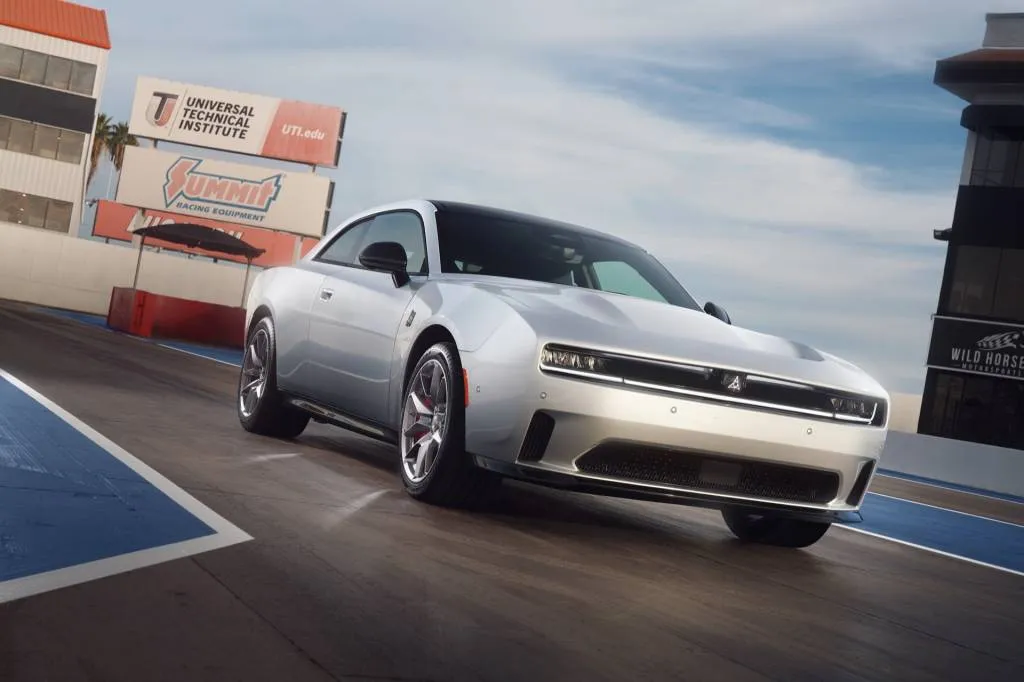
2024 Dodge Charger Daytona
2024 Dodge Charger Daytona range and performance
In spite of the performance posturing, the 2024 Charger Daytona still has an estimated 317 miles of range for the entry-level R/T model, while the Scat Pack scoots to 260 miles, courtesy of a 100.5-kwh (93.5-kwh usable) nickel-cobalt-aluminum lithium-ion battery pack.
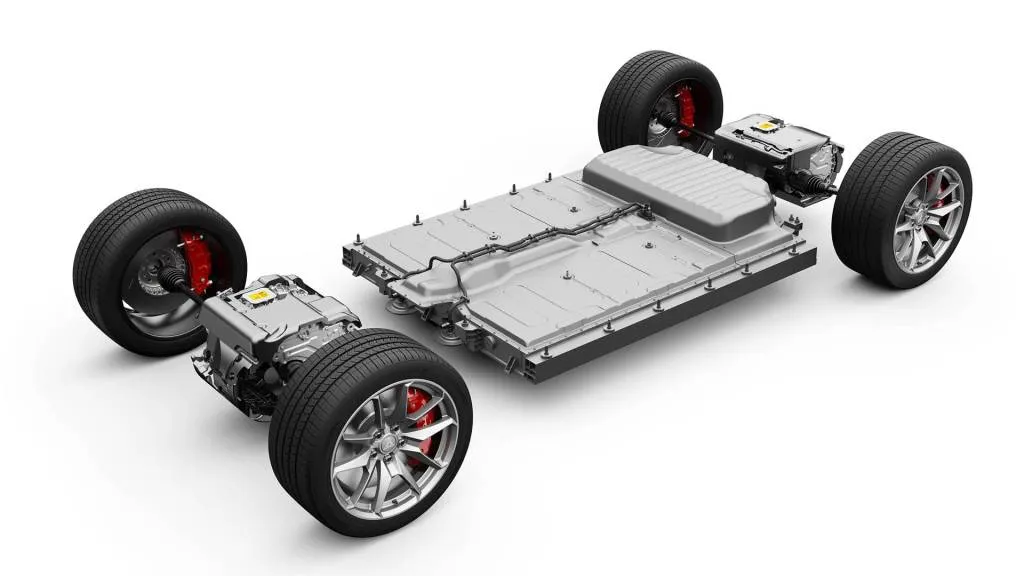
2024 Dodge Charger Daytona
Utilizing the brand’s STLA Large platform, the Daytonas have two drive units with 250-kw permanent magnet synchronous motors, one for each axle for standard all-wheel drive. For the initial launch year, both the R/T and Scat Pack will come standard with a Direct Connection upgrade kit from Dodge’s performance parts arm that provides 15-second boosts of an extra 40 hp, as long as you allow 30 seconds between each boost. Dodge brands this the Power Shot, and it’s accessible via a steering wheel button opposite the drive mode button so you don’t have to fiddle with a toggle or touchscreen when you need more power. Next year, the Power Shot kits will cost extra.
The Stage 1 Power Shot on the R/T leads to a total output of 496 hp and 404 lb-ft of torque. Dodge estimates a 0-60 mph time of 4.7 seconds, a quarter-mile of 13.1 seconds, and a top speed of 137 mph.
The Stage 2 Power Shot juices the Scat Pack to 670 hp and 627 lb-ft. It specs out to a 0-60 mph time of 3.3 seconds, a quarter-mile of 11.5 seconds, and a top speed of 134 mph.
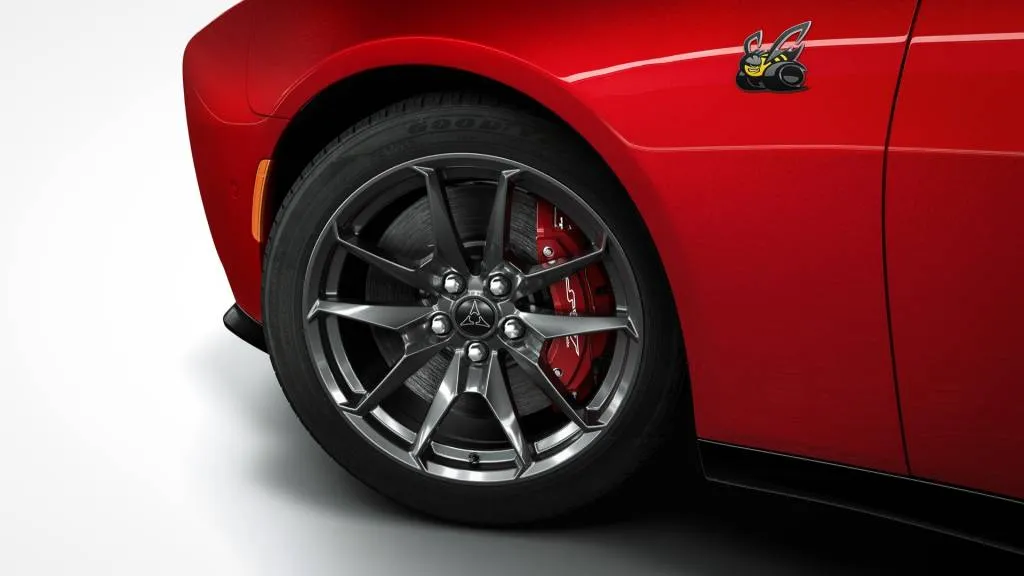
2024 Dodge Charger Daytona
Also standard for just the first year is the largest brake package ever offered on a Dodge, consisting of 6-piston Brembo front and 4-piston rear calipers clamping down on 16.0-inch rotors. One-pedal driving is not part of the plan, though paddle shifters enable three levels of regenerative braking.
The front drive unit disconnects power to the wheels and improves range and efficiency based on drive mode, while the rear unit has a mechanical limited-slip differential for better traction out of corners. Drive modes include the usual suspects, while Scat Packs get Drag, Drift, and Donut modes that cut or limit power to the front axle and neuter the traction control system.
A chambered Fratzonic exhaust that uses speakers under the body that are amplified through resonators, similar to a muffler resonator, or like a pipe organ. Inside it’s augmented by electronics and altogether makes what Dodge calls “Hellcat levels of sound.” It can be disabled via a stealth mode. It could even vibrate the car like a V-8, or it can be muted in stealth mode.
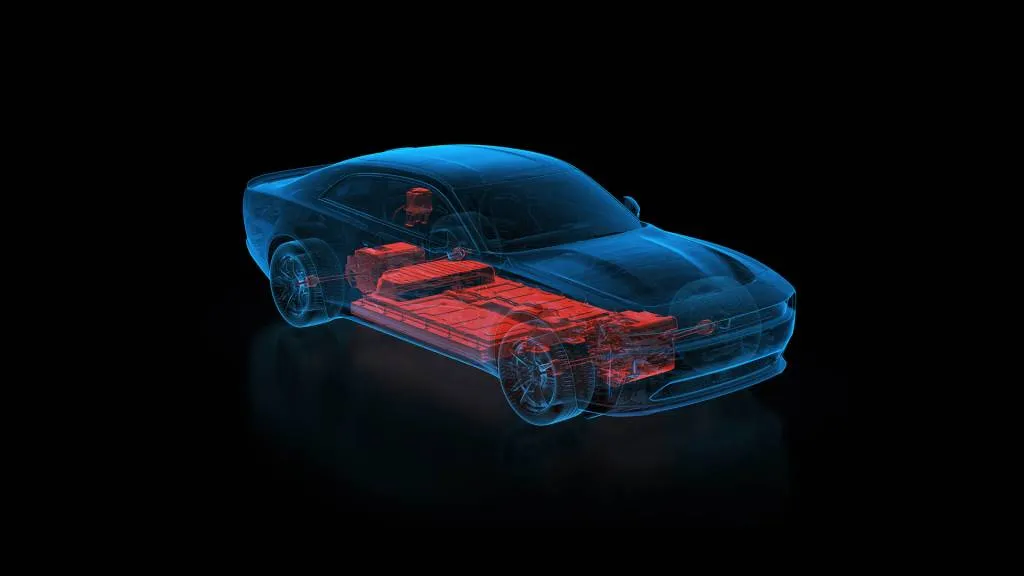
2024 Dodge Charger Daytona
The Scat Pack Track Package adds adaptive dampers to the multi-link front and rear suspension, and of course there’s a launch control function. Exclusive to the Scat Pack Track Package are staggered tires on the 20 inch wheels, with Goodyear Eagle F1 Supercar 3 305/35ZR20 up front on 11-inch wide wheels and 325s on 11.5-inch wide wheels in back.
The standard R/T wheels are 18 inches, but the EPA range estimate is based on the 20 inchers. Dodge did not provide a range estimate for 18-inch wheels.
The range and performance estimates are impressive considering one other spec: both Charger Daytonas weigh a whopping 5,838 pounds.
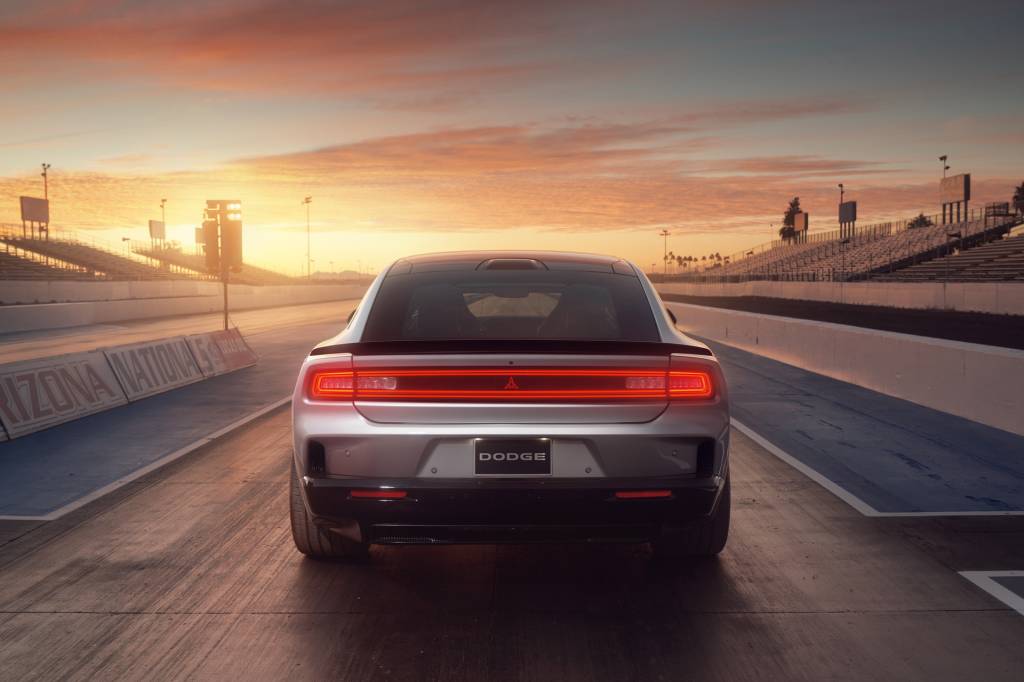
2024 Dodge Charger Daytona
Charger Daytona draws the EV muscle car
The 2024 Daytona looks nearly identical to the Dodge Charger Daytona SRT Concept unveiled in August 2022, with a nip and a tuck to appease regulators. At 206.6 inches, it’s half a foot longer than the outgoing Dodge Charger, but it’s wide enough for Dodge to call it the widest passenger car this side of a dually heavy duty truck.
The key characteristic feature of that concept and one that carries over with aerodynamic purpose is the R-Wing front blade topping the nose. Dodge didn’t tout the coefficient of drag, but the way the nose dives down reflects the almost platypus-like inspiration from the original 1968 Dodge Daytona Charger, which also had a 23-inch-tall wing at the rear. The R-Wing itself is “air neutral,” Dodge exterior designer Scott Krugger told Green Car Reports.
“By having [the nose] dive down, it’s 11 aero counts better [minus 0.011 to the coefficient of drag] than having a texture like a grille or breather that goes into an engine compartment.”
The wing helps give the Charger Daytona the brand’s trademark muscular presence. A front single light bar curls up at the edges to underscore the wing, stretching the fascia horizontally. The suggested line edges around the smooth sides into a body line that rises gracefully yet powerfully into the hatch. The 5.6-inch ground clearance and taller ride height are visually reduced with a black underbody that also rises up into the hatch beyond the rear wheels. Even though it’s an inch taller at 59.0 inches than the outgoing Charger, it still presents as wide and mean, and the sweeping C-pillars on the five-door model embodies those classic muscle car cues even more.
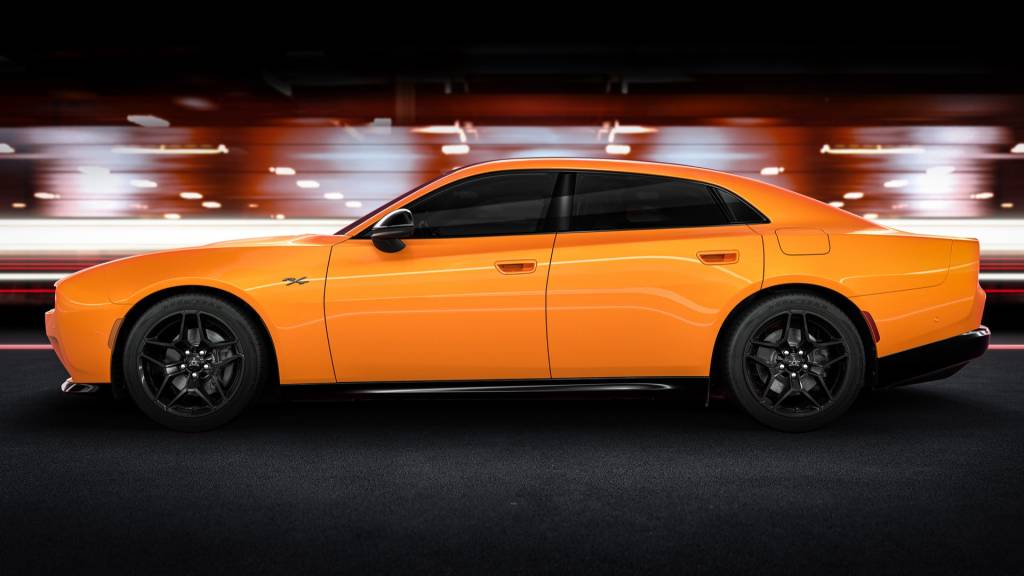
2024 Dodge Charger Daytona
Charger Daytona crosses over with a hatch
It’s a beautiful car, and it looks like no other EV on sale right now. We weren’t able to test the interior roominess of the five-door model, but the hatch opens up 133% more cargo room than in the outgoing Charger, Dodge says. There’s about 23 cubic feet of space, but even with the hidden floor it’s shallow, so if you want to fit the four track tires as Dodge promoted, you’ll have to flip down the 60:40-split rear seats that opens it up to 38.5 cubic feet of space.
That might be the best use of the rear seats for passengers above 6 feet tall, as the available fixed glass roof eats into headroom. Yet the 37.2 inches of legroom matches most compact crossovers, so four people could fit in comfort as long as the gangly folk go up front.
Also up front is a 1.5-cubic foot frunk to stow the charging cord.
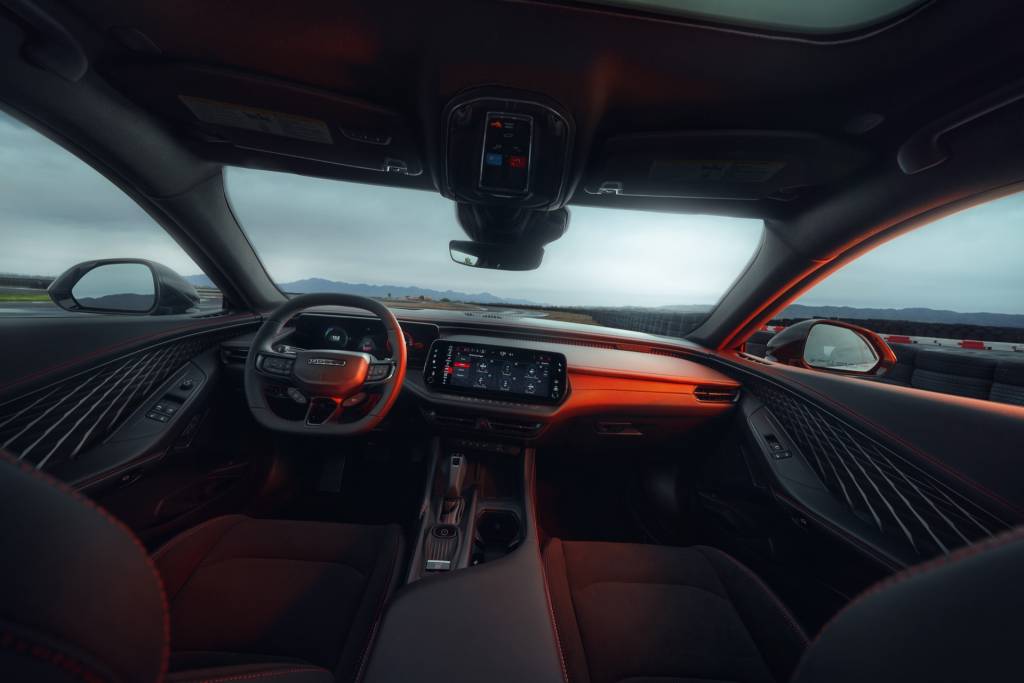
2024 Dodge Charger Daytona
The Dodge Charger Daytona charges at up to 183 kw
The 400-volt architecture supports a peak DC fast-charge rate of 183 kw, so on an available 350-kw DC charger the Daytona’s battery would charge from 20-80% in about 28 minutes. At home on a 240-volt connection, the Daytona’s 11-kw onboard charger fills the battery from 20-80% in 5.5 hours, or from 5-80% in about seven hours. Expect 10 hours for a full state of charge. Dodge will adapt the Tesla-derived NACS protocol in 2025.
Standard equipment includes a 10.3-inch digital instrument cluster (or an available 16.0-inch cluster) horizontally aligned with a 12.3-inch touchscreen with wireless Apple CarPlay and Android Auto, as well as a wireless smartphone charger. Standard driver-assist tech includes automatic emergency braking with pedestrian detection, active lane control, adaptive cruise control down to a stop, blind-spot monitors, and a driver-attention monitor.
Built in Windsor, Ontario, Canada, but with Samsung battery packs imported from Korea for the first year, the Charger Daytona won’t qualify for the federal EV tax credit on purchase, according to Sam Abuelsamid, principal analyst for Guidehouse. Sometime in 2025, the Stellantis-Samsung joint venture plant in Kokomo, Ind. are planned to be producing the packs, and should qualify for the EV credit at purchase.

Lucid CEO: Will take years for competition to catch up
- The 2025 Lucid Air Pure is the most efficient vehicle sold in the U.S.
- Lucid CEO Peter Rawlinson said competitors are years behind
- Rawlinson believes efficiency is the key to EVs
Lucid Group CEO Peter Rawlinson is confident that the automaker has built up a substantial advantage in EV efficiency.
The 2025 Lucid Air Pure achieves 146 MPGe in EPA testing and 5.0 miles per kwh based solely on its 420-mile range rating, making it the most efficient U.S.-market vehicle regardless of powertrain type, Lucid has said. In a LinkedIn post, Rawlinson added that it will take rivals years to reach this mark at their current rate of progress.
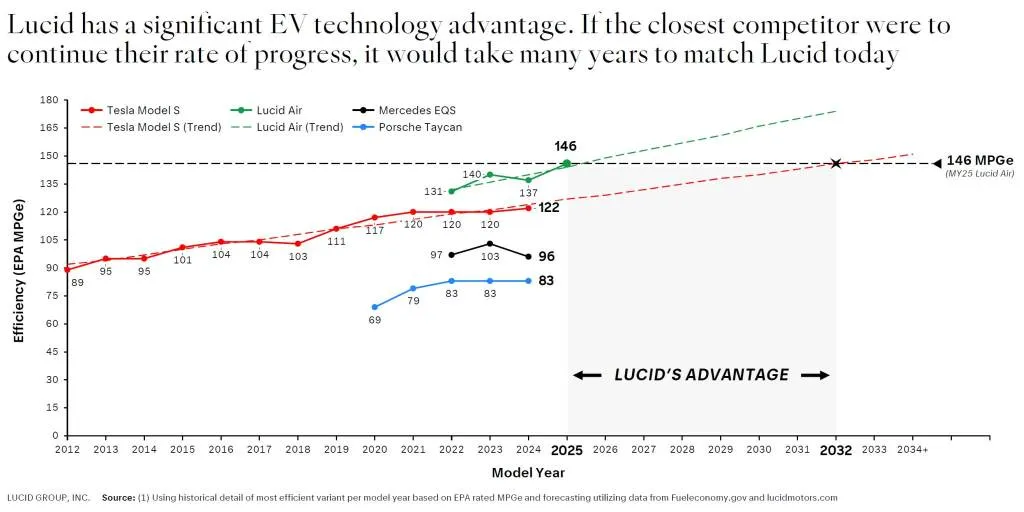
Lucid graph comparing Air efficiency with Tesla Model S, Porsche Taycan, and Mercedes-Benz EQS
Rawlinson’s post included a graph comparing the historical improvements in MPGe of the Tesla Model S, Porsche Taycan, and Mercedes-Benz EQS sedan to the Air, using data from the EPA’s fueleconomy.gov website. At its current rate of progress, Tesla could match the Air Pure’s 146 MPGe in 2032, according to Lucid, while Porsche and Mercedes are even further behind.
“Efficiency is of critical importance in making a better, lighter, more spacious, longer-range vehicle, and directly impacts the cost of manufacture,” Rawlinson said. “Therefore, efficiency is arguably the single most valid litmus test of a company’s core EV technological capability.”
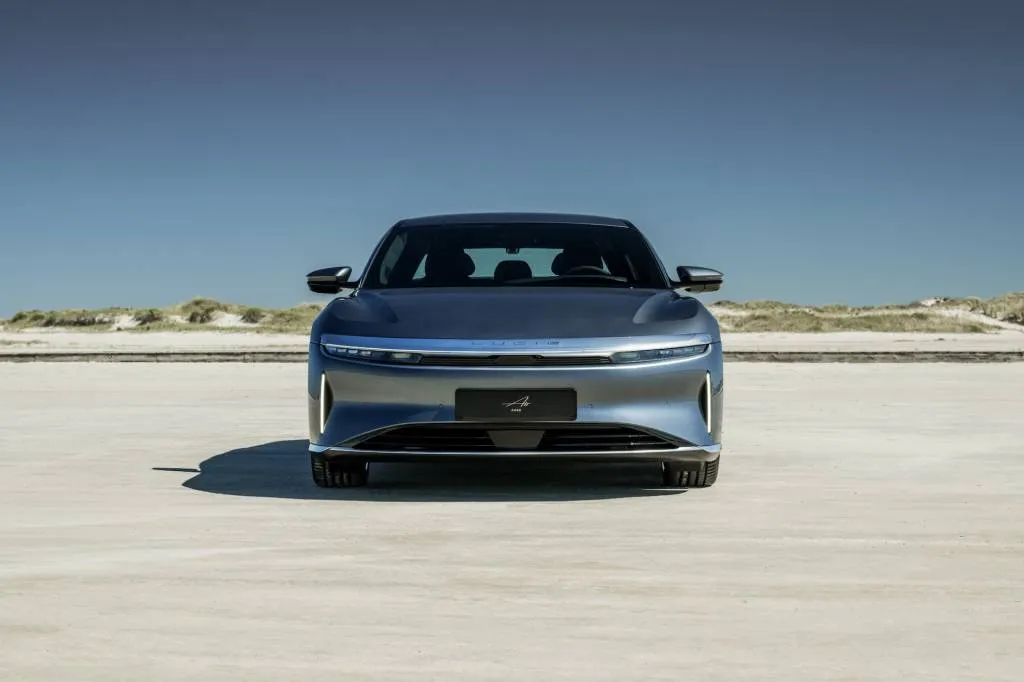
2025 Lucid Air Pure
A more efficiency EV can travel farther on a given amount of electricity, allowing for a reduction in battery-pack size that has numerous benefits including lower cost, weight reduction, and smaller demand for raw materials. It’s why efficiency, not range, is what drives Lucid engineering. The Air Pure relies on a fairly large 84.0-kwh pack to achieve its EPA range rating and its $71,400 base price isn’t considered affordable.
Lucid hopes to apply some of its efficiency-focused engineering to a less-expensive model dubbed “Project Midsize” that’s slated to debut in 2026, following the launch of the Lucid Gravity SUV later this year. Both projects will likely be funded in part by a fresh $1.5 billion cash injection from Saudi Arabia’s Public Investment Fund (PIF), which is already Lucid’s largest shareholder.
Investors back new car warranty marketplace startup Chaiz
The startup is seeking partnerships for its online marketplace for extended car warranties and vehicle service contracts

Ford Mustang Mach-E sets distance record, drives 569 miles on a charge
A U.K.-based team has set a Guinness World Record for longest distance traveled by an EV on a single charge, covering 569 miles and 3,379 feet in a Ford Mustang Mach-E.
The record attempt was staged July 27 by the team, which was sponsored by fleet management company Webfleet, and took just over 24 hours, according to Autocar. The version used was a single-motor Mach-E Premium with the larger Extended Range battery pack, with 18-inch wheels shod in EV-specific tires from Bridgestone.

Ford Mustang Mach-E sets Guinness World Record for distance driven on a single charge
The Mach-E was driven on U.K. public roads, including 21 miles at an indicated 0% battery capacity. The electric SUV averaged 6.25 miles per kwh, which far surpasses the official WLTP rating of 3.8 miles per kwh for this version of the Mach-E in the U.K. market.
While the loop was designed to “emulate real-world driving conditions,” according to Webfleet, breaking the record likely required unrealistically conservative driving. The version of the Mach-E used for the record attempt is WLTP-rated at 372 miles of range. The equivalent EPA rating is 320 miles.
[embedded content]
The previous record was set in September of last year by Chinese automaker Zeekr with a 563.971-mile journey in Hangzhou, China. Nio claimed last year that an ET7 sedan equipped with its new 150-kwh battery pack traveled 650 miles on a charge during a 14-hour trip between the Chinese cities of Shanghai and Xiamen, but this apparently wasn’t recognized by Guinness.
The Mercedes-Benz Vision EQXX concept also covered 746 miles on a charge during a 2022 trip from Germany to the U.K., but it isn’t a production car. The EQXX does however demonstrate engineering that could improve the efficiency of future Mercedes EVs, helping them to escape the weight spiral that afflicts current models.
Guest commentary: Fraud prevention across the car-buying journey
The rise and impact of fraud in the automotive industry has significant implications for both consumers and auto retailers. It is imperative to combat fraud across each step of the car-buying journey.

SunPower files bankruptcy, was to be GM’s Ultium Energy home installer
- SunPower filed bankruptcy on Monday
- SunPower was originally going to be GM’s installer for home energy storage systems
- A decade ago SunPower was the most popular choice amongst companies for solar installations
Solar company SunPower, which was once set to be the designated installer for General Motors home energy storage systems, has filed for Chapter 11 bankruptcy in the U.S.
As reported by Electrek, SunPower submitted its bankruptcy filing to a Delaware court late Monday. In the filing, SunPower reported its assets and liabilities to be between $1 billion and $10 billion, and said it would sell parts of its business to Complete Solaria for $45 million in cash.
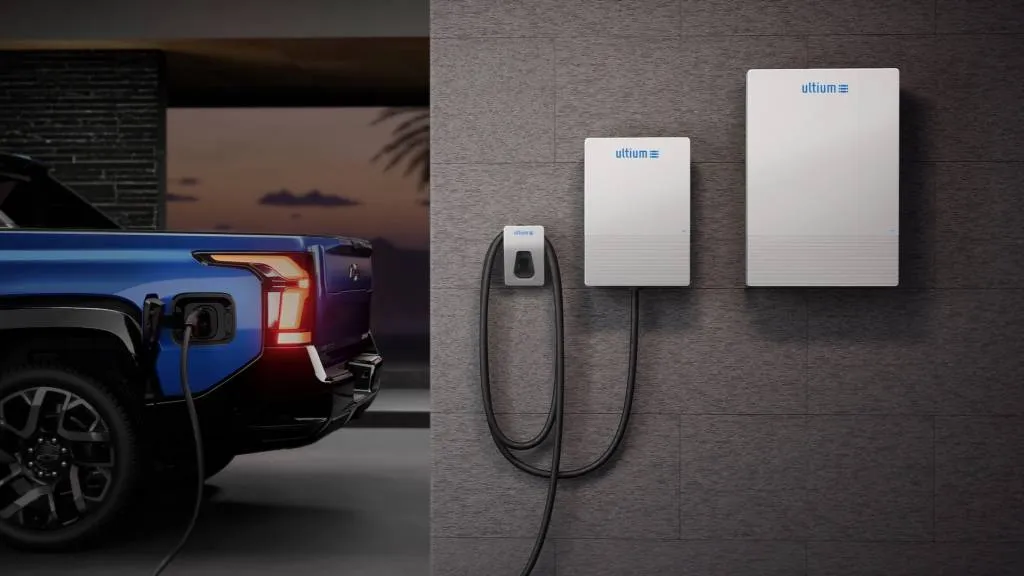
2024 Chevrolet Silverado EV with GM Ultium Home energy system
A decade ago, SunPower was the most popular choice among big corporations seeking to add solar installations. But in recent years it seems to have had trouble keeping up with the competition on cost. And Tesla’s continued struggles with solar underscore it’s not an easy market to squeeze into.
SunPower was also at the leading edge of the convergence of EV charging and solar, with a partnership with Wallbox in 2021 pretty much assuring that it would have a role in this merging of market segments. GM initially tapped SunPower as the installer for its Ultium Home systems, but a few months ago the automaker announced that it was switching to Qmerit.
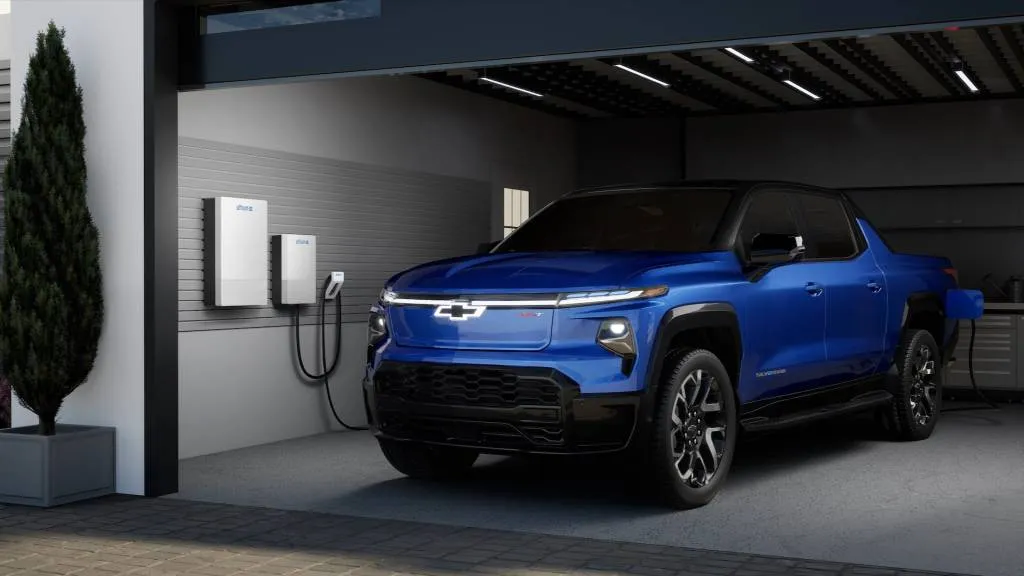
2024 Chevrolet Silverado EV with GM Ultium Home energy system
“GM and SunPower reached a mutual decision to discontinue their work together earlier this year. GM Energy remains committed to delivering its residential suite of products to customers alongside our preferred installer, Qmerit,” the automaker said in a statement.
GM said in 2023 that it would add bidirectional charging to all EVs using its Ultium component set, with vehicle-to-home (V2H) hardware supplied buy its new GM Energy business allowing these EVs to serve as backup power sources. That hardware takes the form of the Ultium Home V2H Bundle GM detailed last year.
Big utilization drop for North American auto factories on the horizon as EV production begins
Automakers will build less than two-thirds of their vehicle assembly capacity in 2030, according to GlobalData.

Porsche gives used Taycan batteries second life powering plant
- Used Taycan batteries are helping power Porsche’s Leipzig factory in Germany
- The batteries are from pre-production vehicles that were used for testing
- Porsche said the batteries provide up to 5 megawatts of energy
After they’ve degraded too much for continued use in EVs, battery packs still have plenty of usable capacity for stationary energy storage. Porsche is giving some used Taycan batteries a second life doing just that.
The automaker on Tuesday announced that it’s using an energy storage system consisting of 4,400 used Taycan battery modules to help power its factory in Leipzig, Germany. Taken from pre-production vehicles used in testing, the modules add up to 5 megawatts of capacity.
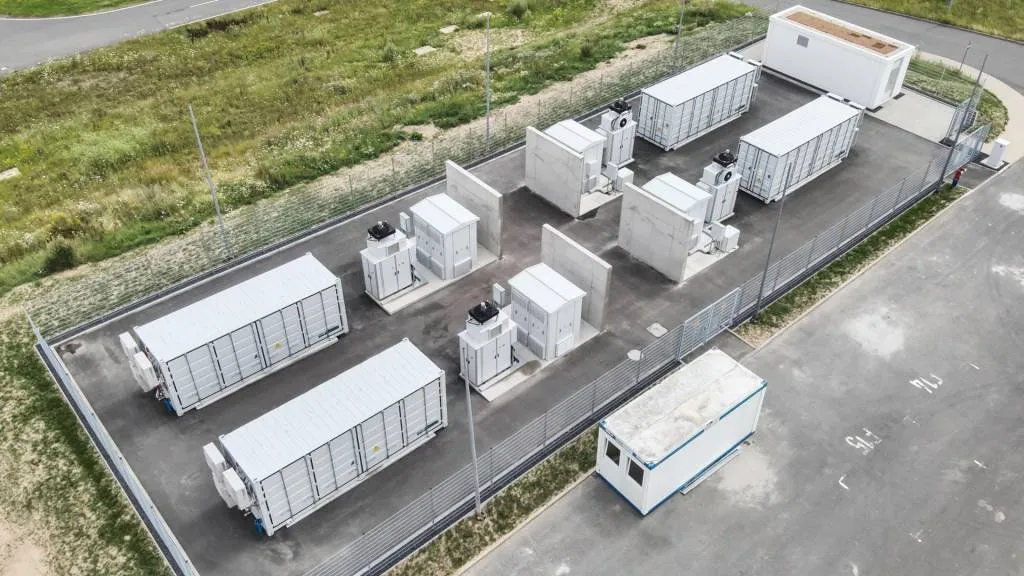
Energy storage system utilizing Porsche Taycan battery modules
“We wanted to create electricity storage capacities for the Leipzig plant in order to make the site even more economical and to increase its degree of self-sufficiency,” Jonathan Dietrich, head of the battery-storage project, said in a statement. “So it was only logical to use batteries from Taycan preseries vehicles instead of recycling them.”
Battery modules were installed into the energy-storage array without any technical changes, Porsche claims. They’re divided into four containers, each connected to an inverter and transformer. The system is designed for a useful life of more than 10 years, and individual battery modules can be replaced as necessary.
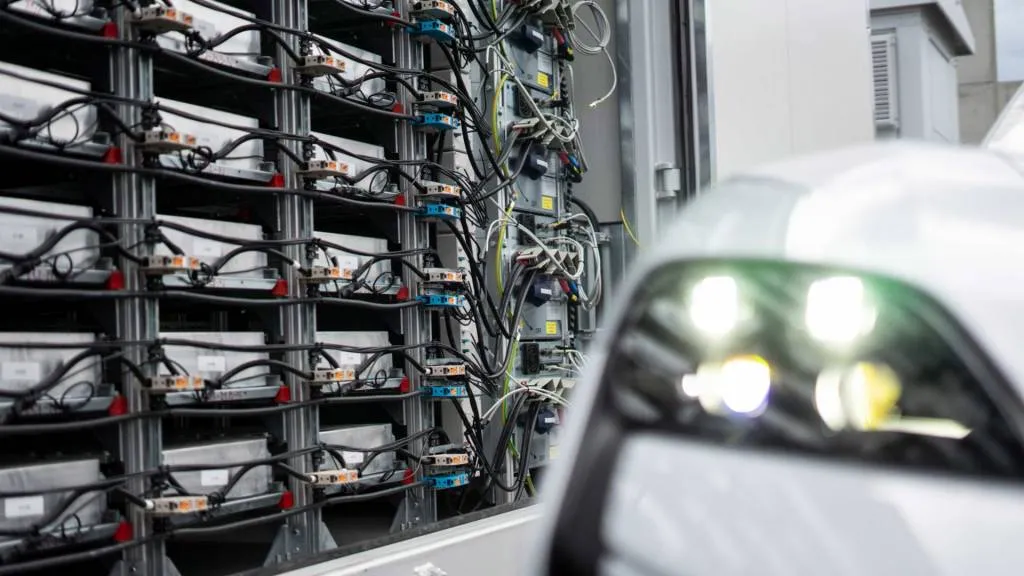
Energy storage system utilizing Porsche Taycan battery modules
The Taycan battery modules store power from an onsite solar array, which has a maximum capacity of 9.4 megawatts. Electricity can be stored for use during peak periods, helping to reduce strain on the grid by keeping electricity demand more consistent. Virtual power plants of EVs could also play a role in this, using vehicles themselves as an alternative energy source and reducing the need for burning fossil fuels.
Several other automakers have experimented with different second-life uses for EV batteries. In 2015 Nissan and General Motors demonstrated energy-storage systems using Leaf and Chevrolet Volt batteries, respectively, while Toyota turned Camry Hybrid battery packs into a power source for buildings at Yellowstone National Park. That said, there is also debate over whether reuse or recycling is the better option.