Category: Reviews

The New Tesla Model Y Gets Its Most Fearsome Competitor Ever
Suppose there’s such a thing as the iPhone of cars. If that exists at all, it’s assuredly the Tesla Model Y. Tesla’s midsize electric crossover has earned its stripes as the world’s best-selling electric vehicle (and best-selling single model of car, period) for its unassailable combination of range, power, tech features, price and practicality.
But right as an updated Model Y makes its debut, a lot of people have their reasons for wanting to move on from Tesla. That also coincides with a new crop of highly competitive EVs from other brands that just weren’t in the same class as Tesla five years ago, but are now catching up and even doing some things better.
Our friends at Edmunds highlight the state of play in a new video comparison test of highly-rated electric family crossovers: the new Model Y “Juniper,” the Honda Prologue, the Chevrolet Equinox EV and the updated Hyundai Ioniq 5. Independent of anything else, each of these is a good choice—but one emerges as being truly on par with the Tesla, which until recently was hard to pull off.

[embedded content]
In fourth place is the Honda Prologue, 2024’s surprise EV success story. It’s a General Motors EV underneath the skin until Honda starts to do its own thing. But that’s not a bad thing at all—especially as the Prologue adds some Honda vibes but keeps Apple CarPlay, unlike GM’s own cars.
And it’s extra roomy with lots of room for luggage and the biggest cupholders in the test; Honda sure knows how to sell cars to Americans. The Prologue Elite, as tested here, comes in at $59,295 and offers up to 283 miles of range.
Edmunds EV Test
Photo by: YouTube
Coming up behind it is the Chevy Equinox EV, our 2024 Breakthrough Award winner and pound-for-pound one of the best electric bargains in America. Edmunds‘ tester comes in at $34,995, and lately it’s been acing the hell out of its range tests with a stunning 356-mile result. (I’ll add that I’ve never experienced anything that good from the Equinox EV, but Edmunds’ local Southern California weather is probably helping a lot.)
Equinox EV
Photo by: YouTube
But it’s also smaller than the rest and the sole contender that’s single-motor and front-wheel-drive, so it’s no wonder it does better than its all-wheel-drive counterparts. It “almost gets to the top spot on its value proposition,” tester Brian Wong says.
Model Y vs. Ioniq 5
Photo by: YouTube
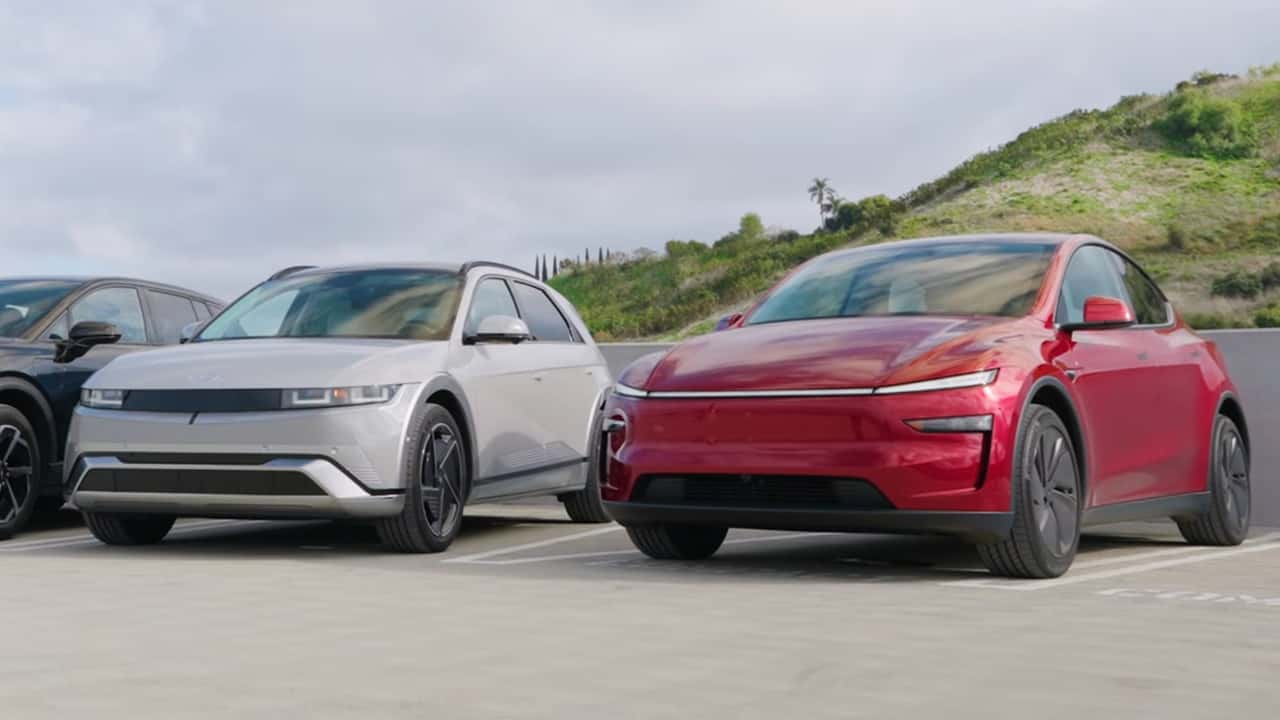
Yet what’s really telling about this test is that it ends in a dead heat. Though the Model Y was long the crossover to beat in this space—and indeed, the updated one seems to be very good—it ties with the updated Ioniq 5 here.
Edmunds‘ Model Y Launch Series (which was recently discontinued) comes in at $61,635 and offers an impressive 327 miles of range. It’s got a nicer, quieter cabin, more range, different looks and finally, better ride quality than the previous Model Y.
Wong calls it one of the most comfortable EVs you can buy today—definitely not something you’d say about the last car. And while Tesla’s tech is always good, its Full Self-Driving system “makes some questionable decisions.”
Model Y Interior
Photo by: YouTube
Wong notes that the Juniper is a “big improvement” for the Model Y, and that the previous generation “would have only gotten third place in this test. But now, it is on equal footing with the Ioniq 5.” That Wong phrased that sentence this way, and not the other way around, says a lot about how Tesla’s competition is getting better and better.
In the Ioniq 5’s case, that means a standard Tesla-style North American Charging Standard plug and native Tesla Supercharger access without an adapter. Coming in loaded at $60,285 and with a range of 282 miles, it’s simply more user-friendly than the Tesla is: buttons, knobs and physical air vents make operation a lot easier than Tesla’s all-screen approach. It also has wireless Apple CarPlay and Android Auto, a clever sliding center console, a comfortable cabin and punchy performance.
Ioniq 5 Highway
Photo by: YouTube
Is the updated Ioniq 5 now Tesla’s most fearsome competition in the U.S. market? I’d say it’s looking that way, now more than ever. Ultimately, Edmunds‘ Wong said your choice comes down to what you prefer: the Tesla’s “uncompromising minimalism” or the Ioniq 5’s “futuristic familiarity.”
But even the tie verdict makes clear that the Model Y isn’t the default top choice in the EV crossover world anymore, and that alone is a huge advancement for the entire field.
Contact the author: patrick.george@insideevs.com
Share this Story

New plug-in hybrids for 2025
 Are plug-in hybrids an on-ramp to fully electric vehicles, or undue cost and complexity? Are they something consumers asked for, or something created by bureaucrats and regulators? At least in some respects the answer includes all of the above. It’s complicated. Plug-in hybrids’ greater complexity is intended to pay off by greening the…

Review: 2025 Cadillac Escalade IQ gets smart, with batteries
 What’s in a name? The Escalade IQ is smarter, it turns out A big battery delivers 460 miles of range Cadillac delivers a big price, too: $129,990 For all its red-carpet appearances and secret-service duties over the past generation, the Cadillac Escalade has not been particularly cutting edge. It’s prospered in a prosperous world where…

Hyundai Santa Fe Hybrid: How we’d equip our Best Car To Buy 2025 winner
 Santa Fe Hybrid strikes the best value in base SEL trim with AWD for $40,975 It’s only $500 more than a similarly-equipped gas-only model But second-row captain’s chairs only come with the top Calligraphy model One strong reason the Hyundai Santa Fe Hybrid won our Best Car To Buy 2025 award was because of its value. Sure, its boxy Land…

Review: 2025 Ram Power Wagon and Rebel HD defend their mountain
 Mild design tweaks don’t change the off-road Ram trucks’ capabilities Ram Power Wagon still has no direct competitor 2025 Ram Power Wagon costs $74,235 and Rebel HD costs $70,740 The competition woke up and realized there’s room to play in the heavy-duty off-road sandbox. But Ram doesn’t want to give an inch of a segment it has defined…

Could Jeep reinvent planetary hybrid tech for 4WD adventures?
 Stellantis may be looking to adapt planetary gear hybrid systems—like the one currently used in the Chrysler Pacifica Hybrid plug-in hybrid minivan—to more rugged vehicles, a patent filing indicates. The Pacifica Hybrid uses a planetary power-split system to juggle its 3.6-liter V-6 and a pair of electric motors, which can both be used…

Hyundai Santa Fe Hybrid: Best Car To Buy 2025
 The Santa Fe gains hybrid power, 36 mpg combined It outdoes the Toyota Highlander Hybrid and Kia Sorento, and looks like a Land Rover The Hybrid model costs only $500 more than the gas-only Santa Fe A three-row crossover SUV with a hybrid powertrain may be nothing new, but packaged with a blocky Land Rover look and an interior that puts the…

Best minivans for 2025? Heed the Buzz
 New minivans can be had with gas, hybrid, plug-in hybrid, or fully electric powertrains The Toyota Sienna can only be had as a hybrid, and with all-wheel drive it gets 35 mpg combined The VW ID.Buzz is an electric van with 231 miles of range with AWD Minivans have never been better. Minivans are nowhere near as popular as they were at the end of…

Deep dive: Bugatti Tourbillon aerodynamics
 The Bugatti Tourbillon’s standout feature is an 1,800-hp plug-in hybrid powertrain built around a high-revving V-16, but Bugatti didn’t forget about the aerodynamic work needed to make use of the immense power on tap. The goal was to surpass the Bugatti Chiron in slipperiness, Paul Burnham, chief engineer for the Tourbillon, said in a video posted…

A Tesla Superfan Ditched His Car For A Rivian. Here’s What He Thought
Is there life after Tesla? All over the world, for various reasons, a lot of electric vehicle owners are asking themselves that question right now. While many competitors are catching up or even surpassing the Elon Musk-led automaker these days, most EVs on the road globally are from Tesla. Figuring out what’s next is can be a big adjustment.
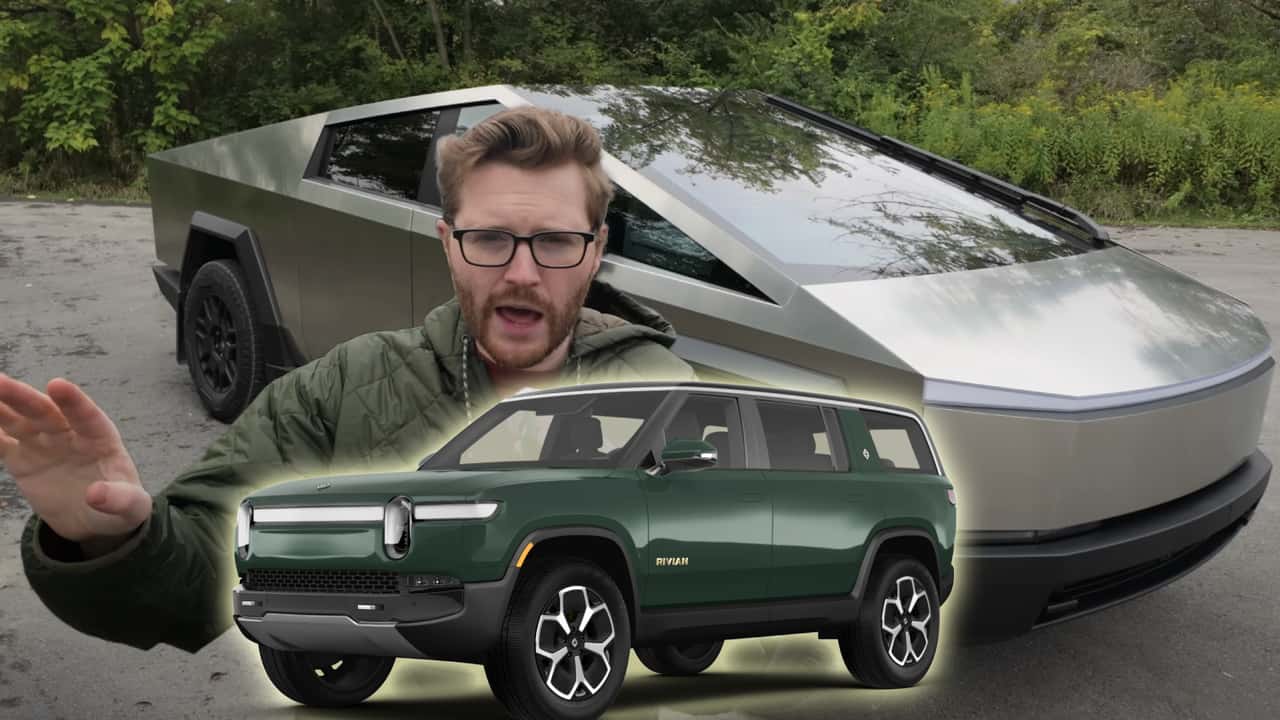
YouTuber Robert Rosenfeld is one such owner who’s asking himself that question. We have covered his videos before. He has only owned Tesla EVs since 2019, going from the Model Y to the Model X and now to a Cybertruck and building up his YouTube channel along the way. But when he got the chance to see how “the other half lives,” as he put it, he went for it, driving only a loaner 2025 Rivian R1S for a week.
Experience Rivian on the road—schedule your demo drive today.

[embedded content]
I’ll spoil the ending a bit here. Rosenfeld likes the R1S, but decides to keep the Tesla for reasons we’ll cover next. (It’s also worth noting that he has a big audience of Tesla devotees and is slinging referral codes as part of his videos, so officially making the switch may have had bigger implications for what he does.)
Yet this is still a good look at the differences between two of the most advanced EVs for sale in America right now. Rivian and Tesla are the only two brands that I believe make truly software-defined vehicles for first-rate smartphone app integration and continual over-the-air updates. And anecdotally, when I talk to Tesla owners looking to move on, Rivian’s EVs are often at the top of their list—although right now, Rivian’s choices are fewer and more expensive than Tesla’s lineup. That should change next year with the debut of the $45,000 Rivian R2.
In terms of pricing, this R1S Tri-Motor Max Pack costs about $111,000, making on par with a well-equipped Cybertruck or Model X Plaid. This Rivian configuration would get 371 miles of range, handily beating the Model X’s 314 miles and the Cybertruck’s 325 or 301 miles, depending on its configuration.
So how do these two brands really stack up? First and foremost, Rosenfeld likes the customization and options of Rivian’s R1S and R1T, including trim levels, colors and wheels. Tesla’s configurability is far more sparse. But he likes the boxy design, versatility and SUV capability of the Rivian too. “I’ve got a whole lot of room for hauling, which is nice,” he said.
Rivian YT Int
Photo by: YouTube
Rosenfeld is obviously a veteran of Tesla’s “very few buttons” approach, so he’s at home in the Rivian. (Personally, I wish both brands would add more physical controls.) He feels like it’s a premium vehicle inside and said it “checks most of the boxes,” but admits Rivian’s adventure-y vibe isn’t quite his jam. To each their own.
Rosenfeld heaps a lot of praise on the 360-degree top-down camera system and said he wishes Tesla would adopt something similar. He also really loves the driving experience and admits that even Tesla fans would like the increased degree of customization over the R1S’ driving dynamics: adjustable regenerative braking, customizable displays, different driving modes and so on. “I’d have no qualms about taking this on a road trip,” he added.
Rivian Software YT 2
Photo by: YouTube
But Rosenfeld said that software is what keeps him loyal to Tesla. He doesn’t love the Rivian’s menu setups (in part because it’s just different from what he’s used to) and he feels like the maps and HVAC controls are clunky. Frankly, I’m not a fan of the climate controls on either car and wish both of them would add some air vents. He’s also a big user of Full Self-Driving, which many Tesla owners are not, and said that not having a direct Rivian equivalent is a letdown. Right now Rivian is just now branching into hands-free highway driving assistance but has more plans for autonomy down the road.
In the end, Rosenfeld likens the experience to Apple vs. Android: one company tells you exactly what you’re going to get, and the other offers a lot more options, customizations and configuration. It can be tough to switch ecosystems, but I’d argue it’s a little easier for your car than it is for your smartphone and gadget universe.
[embedded content]
If you want a second opinion, check out this video from YouTuber Darren Byrd, a pilot who normally makes content about aviation but just posted a video about trading in his Model X for a similar R1S. He explains the upsides and downsides in a very fair way, but overall, he’s happy with his purchase. “The R1S is a more normal car that happens to be electric” than his Falcon Door-equipped SUV was, he said.
In the end, for those considering moving on from Tesla, I’d tell them to ask themselves this: what did you like most about your car? If it was range and ease of charging access, I’d recommend the new NACS-equipped Hyundai Ioniq 5. If was software, arguably Rivian is the closest Tesla competitor and likely to close any existing technology gaps soon enough. If it was performance, very few EVs are slow, but the Polestar 3 or the Porsche Taycan are always compelling options. And the entire field of options is getting better all the time.
This post may contain affiliate links. Click here to learn more.
Contact the author: patrick.george@insideevs.com
Share this Story