
Category: General

Electric Volvo ES90 sedan teased
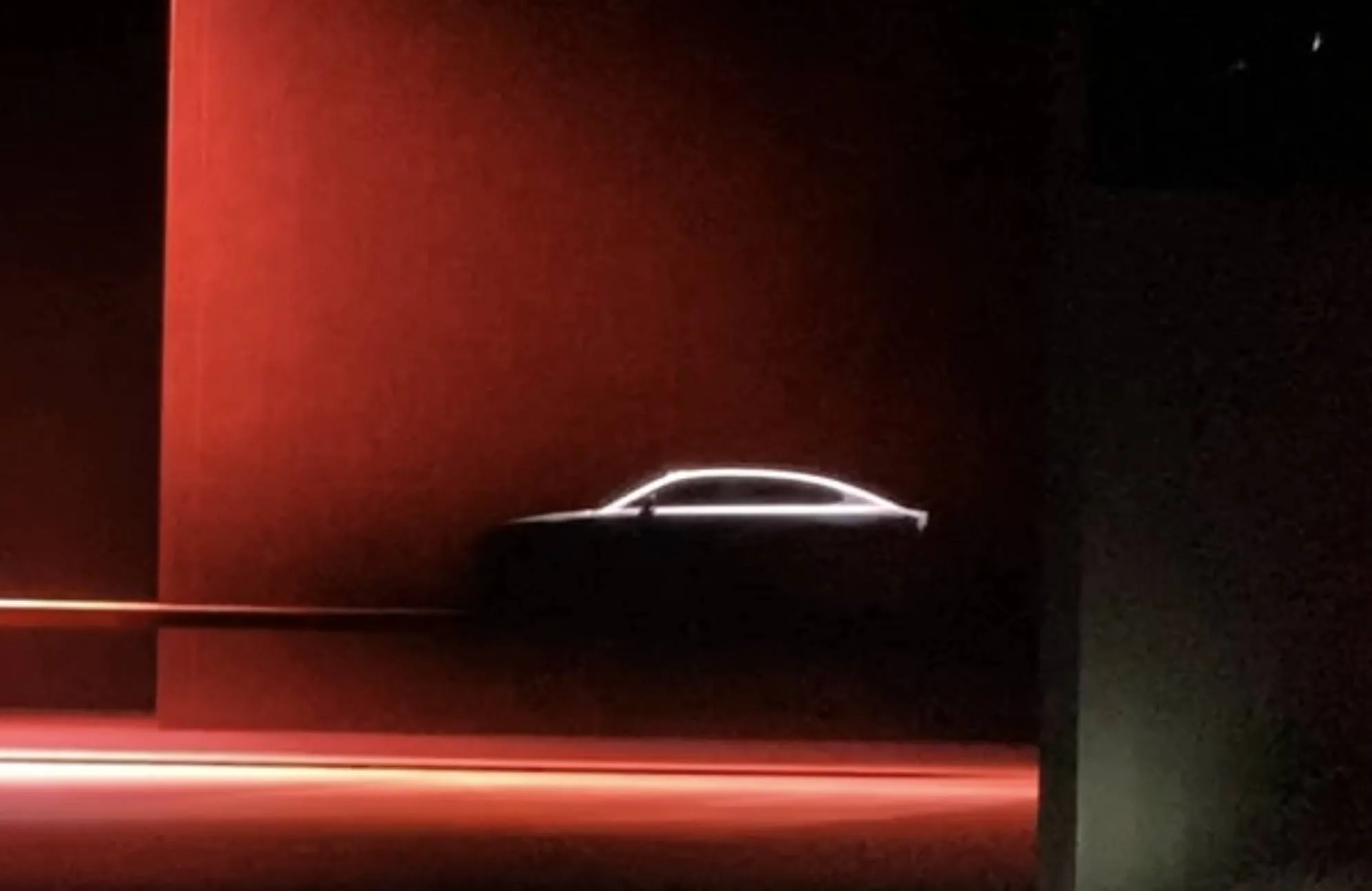
On Wednesday, in Sweden at the debut of the refreshed 2025.5 XC90 the Volvo briefly teased the upcoming ES90 midsize sedan.
The teaser displayed a midsize sedan featuring a windshield rake that’s completely different from the gas-powered S90 sedan. The body style is a sedan, though the rear glass could possibly lift up like the Polestar 2, which would be similar fashion to the Audi A6 E-Tron Sportback.
In December Volvo announced the first “verification prototype” of a new model code-named V551 had been built. The new V551 is thought to be the electric counterpart to the gas-powered S90, which would bear the name ES90 in production. The verification prototype was built at Volvo’s plant in Luqiao, China.
The ES90 would be the sedan, or liftback, counterpart to the EX90 electric SUV. Originally the ES90 was expected to be in production by May. In 2022 a Volvo executive in Australia said Volvo would launch an electric midsize sedan by the end of 2024.
The ES90 is expected to be built on Volvo’s SPA2 platform, which is the same dedicated EV platform underpinning the EX90.That would put a battery of about 111 kwh under the ES90 and a choice of single-motor rear-wheel drive or dual-motor all-wheel drive. Output could exceed 500 hp.
SPA2 supports bidirectional charging and charging rates of up to 250 kw on a DC fast charger. The EX90’s 111-kwh battery, which has a usable capacity of 107 kwh, could amount to a real-world range of about 300 miles. The ES90 might have better aerodynamics that would enable the slipperier body style to go further on a charge.
Swedish outlet Teknikens Värld reported in 2023 that the ES90 will be 196.8 inches long with a 122-inch wheelbase. That would make the ES90 6.3 inches longer than the S90 and 1.6 inches longer than the S90L that later came to the U.S. for 2018.

Review: 2024 Tesla Model 3 Highland renews formative EV for greatness
- Model 3 Highland offers a refined ride, more hushed interior, better fit/finish
- Base LFP version maintains nimble, athletic driving impressions
- Saw more than 4 mi/kwh in real-world driving, 23-min. charging 15-80%
Other automakers may have reason to breathe a sigh of relief that CEO Elon Musk has continued to stifle Tesla sales growth, as some analysts see it.
That’s because the Model 3 Highland is a great car, a home run of a product that has all the efficiency and charging ease of its predecessor but is easier to live with.
And yet, in a parallel between the car and Tesla’s top executive, it’s only the right fit if you can look past a few exasperating interface details that may truly be deal-breakers.
I enjoyed driving this base Model 3 immensely. It’s no longer one of the noisier EVs from inside. It rides and drives with more verve than the original, broadening the appeal of this formative EV, and it exemplifies the clever tuning and engineering the company has always done well.
2024 Tesla Model 3
Earlier this year, the version informally called Highland arrived and it could be misunderstood as a light mid-cycle refresh. But as I can now confirm after a 24-hour speed date with one—ehem, Turo loan—it’s much more than that.
Full disclosure: I experienced the Model 3 in Southern California, where roads are generally in fine shape, the weather is mild, and it can feel like Superchargers are nearly as ubiquitous as gas stations.
2024 Tesla Model 3
The base Tesla Model 3, dressed up a bit
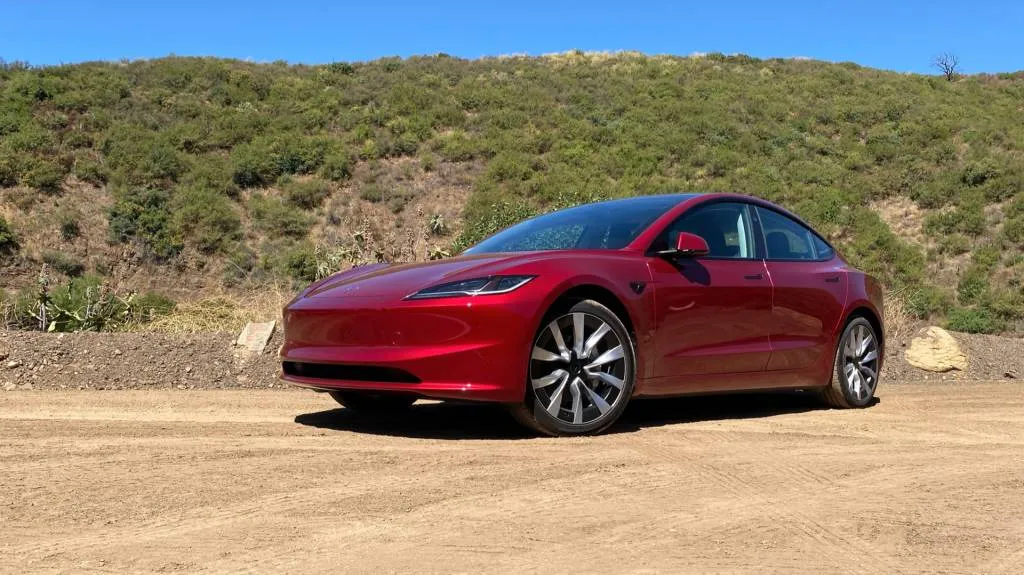
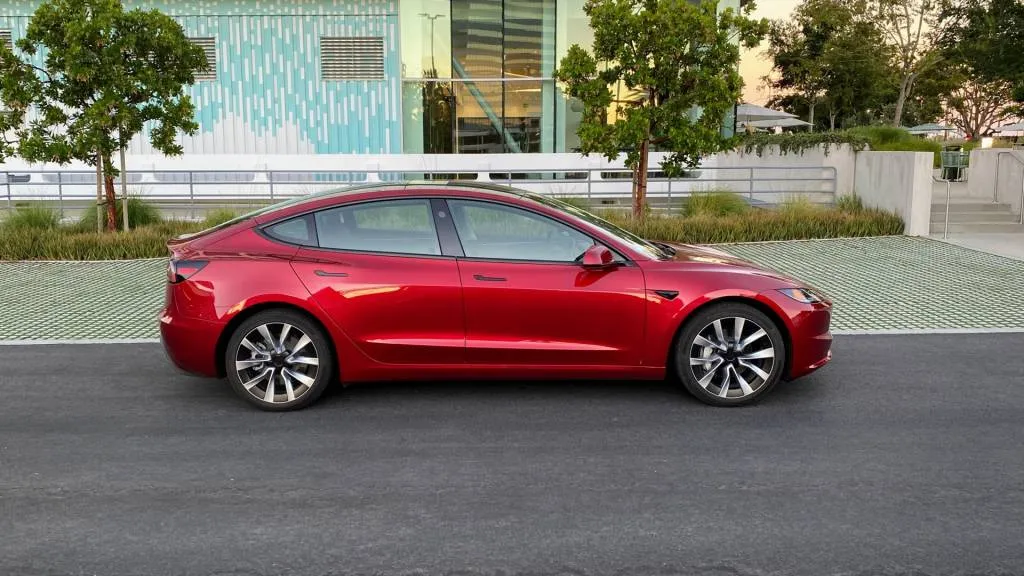
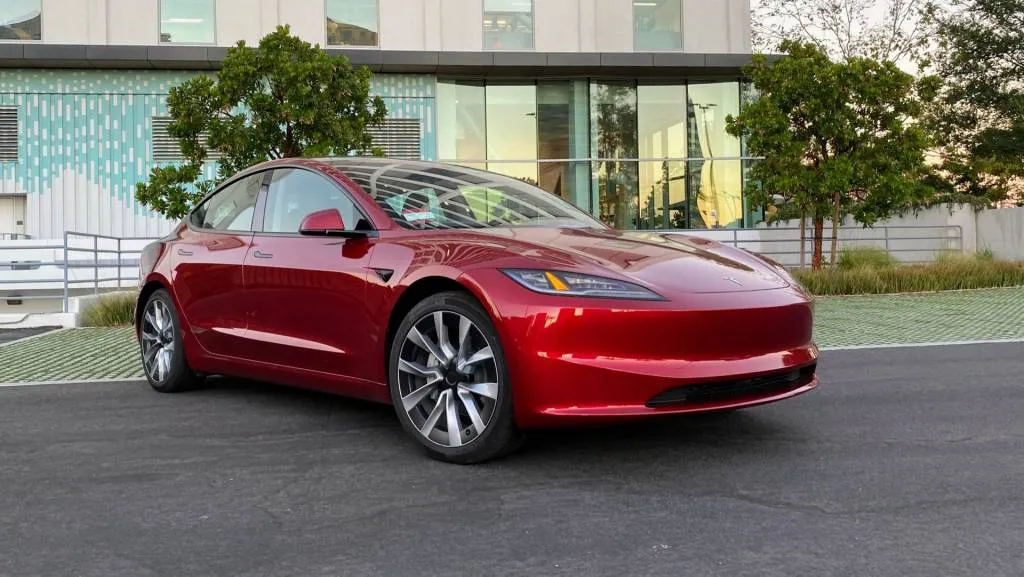
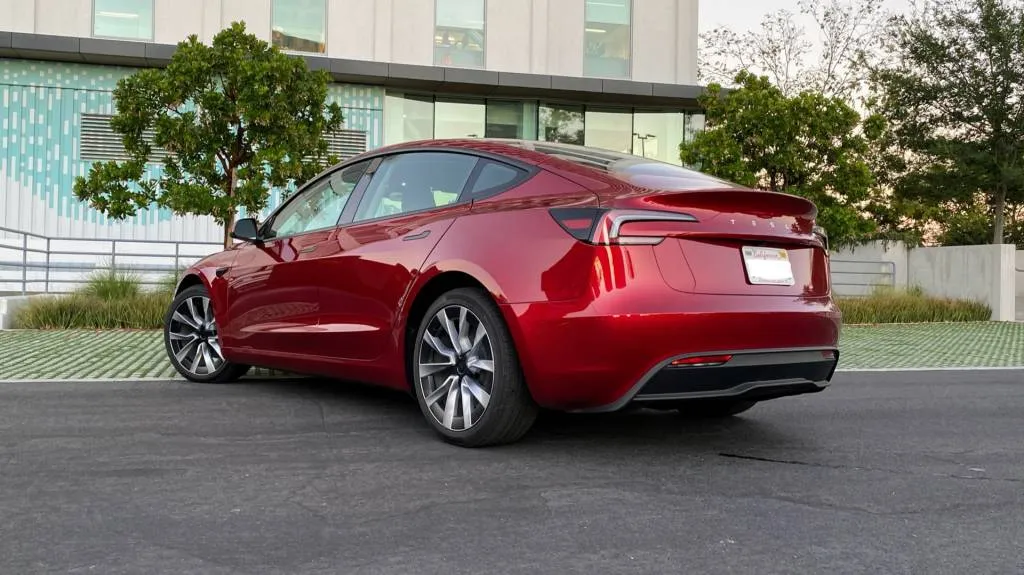
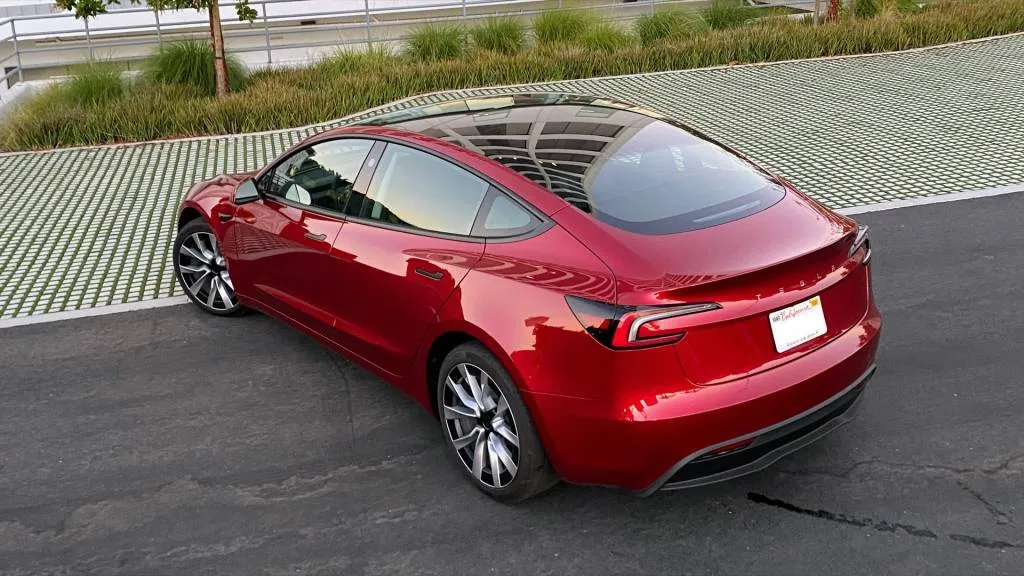
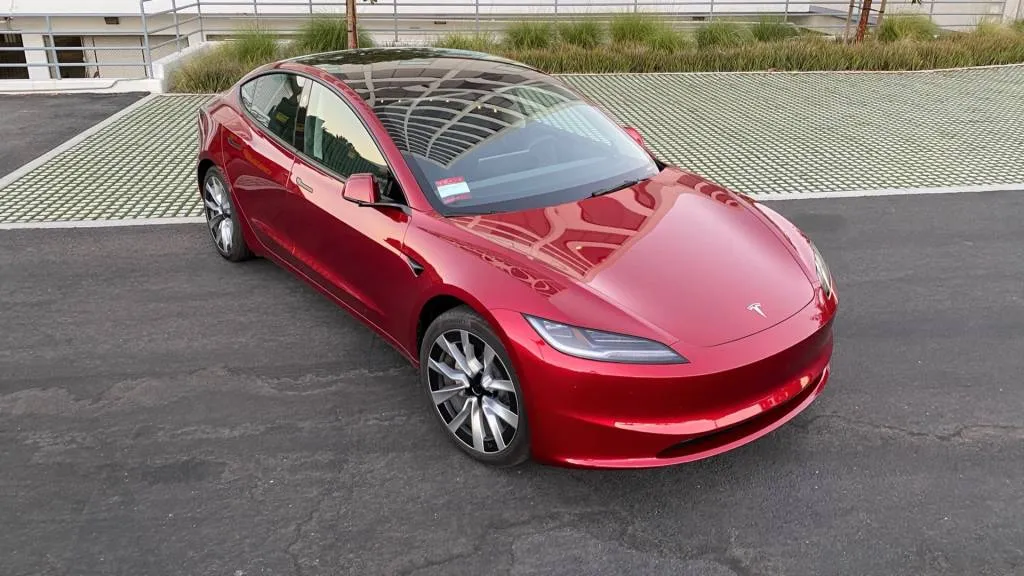
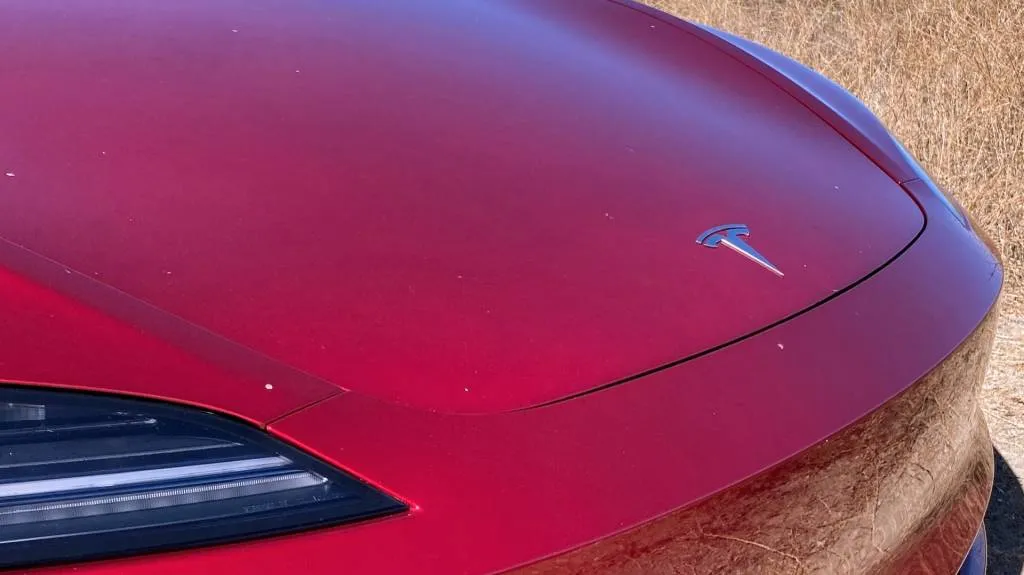
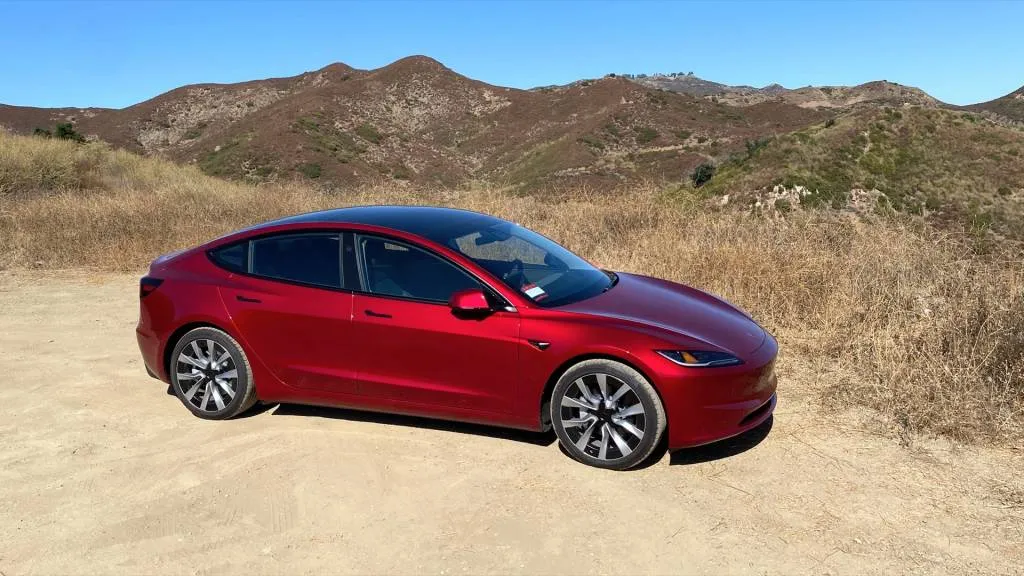
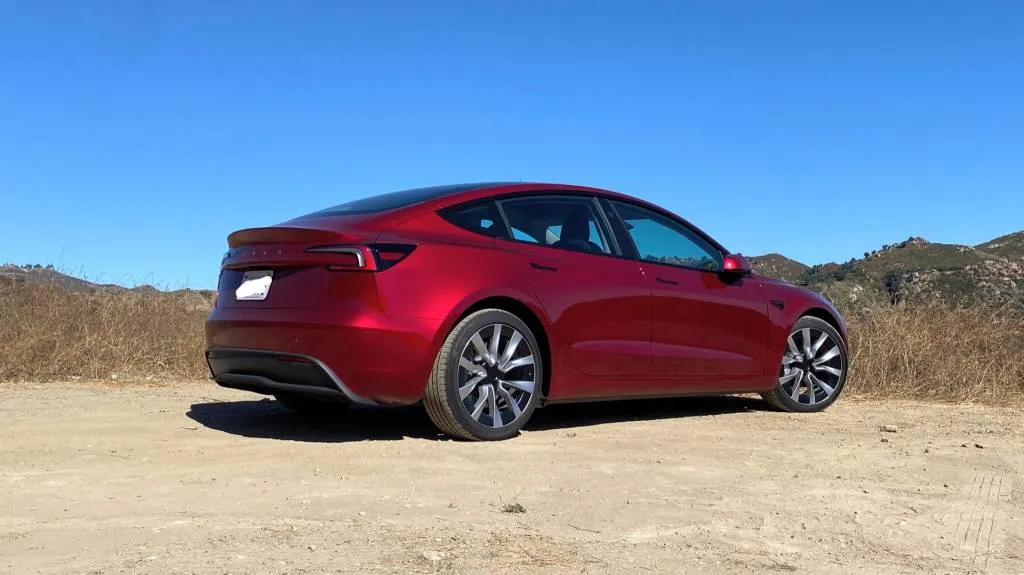
To step back first, the Highland Model 3 has the same profile we’ve become accustomed to since Tesla started Model 3 deliveries back in 2017—including the same doors and side/rear surfacing—but from the front or rear it looks like quite a different vehicle. I wasn’t sure how I felt about the rear styling compared to the original Model 3 and its cleaned-up lighting moved into the decklid, even by the end of my speed date with it. But I noted that the front end and its more decisive crease running across helps the whole roofline look sportier and more coupelike from almost any front angle.
The Tesla Model 3 I drove was the base Rear-Wheel Drive model, optioned with the showy, lustrous Ultra Red paint ($2,000) and the 19-inch Nova wheels ($1,000) fitted with Continental ProContact rubber, which drop EPA range for this model to 248 miles, from this model’s peak 272 miles with the 18-inch aero wheels. That brought the price up to $43,630, including the mandatory $1,390 destination and $250 order fees.
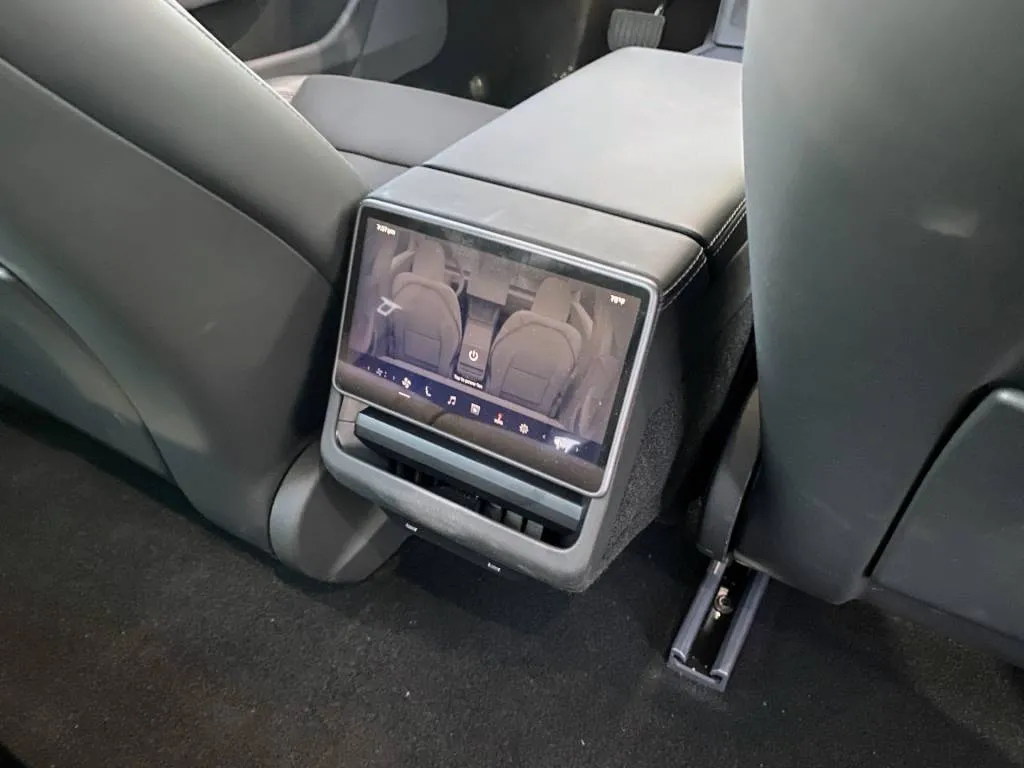
This “base” Model 3 comes with a fantastic list of standard features, by traditional car-buying sensibilities: a glass roof, a power trunklid, heated and cooled front seats, a heated steering wheel, heated rear seats, navigation, and a separate rear screen of the sort that has up until recently been solely the domain of high-end luxury cars.
2024 Tesla Model 3
2024 Tesla Model 3
2024 Tesla Model 3
Probably the most noteworthy tech feature “under the hood” in this base Model 3 is that it has a battery pack with 60.9 kwh gross, according to the Department of Energy—with 57.5 kwh of reported capacity—stocked with lithium iron phosphate (LFP) cells in a prismatic format. According to reports, Tesla may be in the process of moving some of this supply chain to the U.S., with supervision from China’s CATL, but for now they’re supplied from China.
Because of its battery pack, this model isn’t eligible for the $7,500 EV tax credit that other Model 3s qualify for with their more made-in-America pedigree. At present, the Model 3 Long Range RWD actually costs $4,000 less if you can buy and claim the credit, although the base Model 3 remains a better deal for leasing. The LFP version does have some other advantages, too—like how Tesla actively reminds you to charge it up to 100% at least once a week.
But from a value standpoint, tax credit aside, it bears keeping in mind that an otherwise identically equipped Model 3 in a less sedate color, with the base 18-inchers, would cost just $40,630.
2024 Tesla Model 3
2024 Tesla Model 3
2024 Tesla Model 3
2024 Tesla Model 3
Highland is more soothing at the seams
Giving it a once-over on the outside, everything fit together well and trim and body-panel seams were tight. I’ve seen enough Model 3s up close to know that pre-Highland, many had seams that stood out as uneven or wider than the rest—even the case with the last Model 3 I spent driver’s seat time in, a Tesla press loan in 2019.
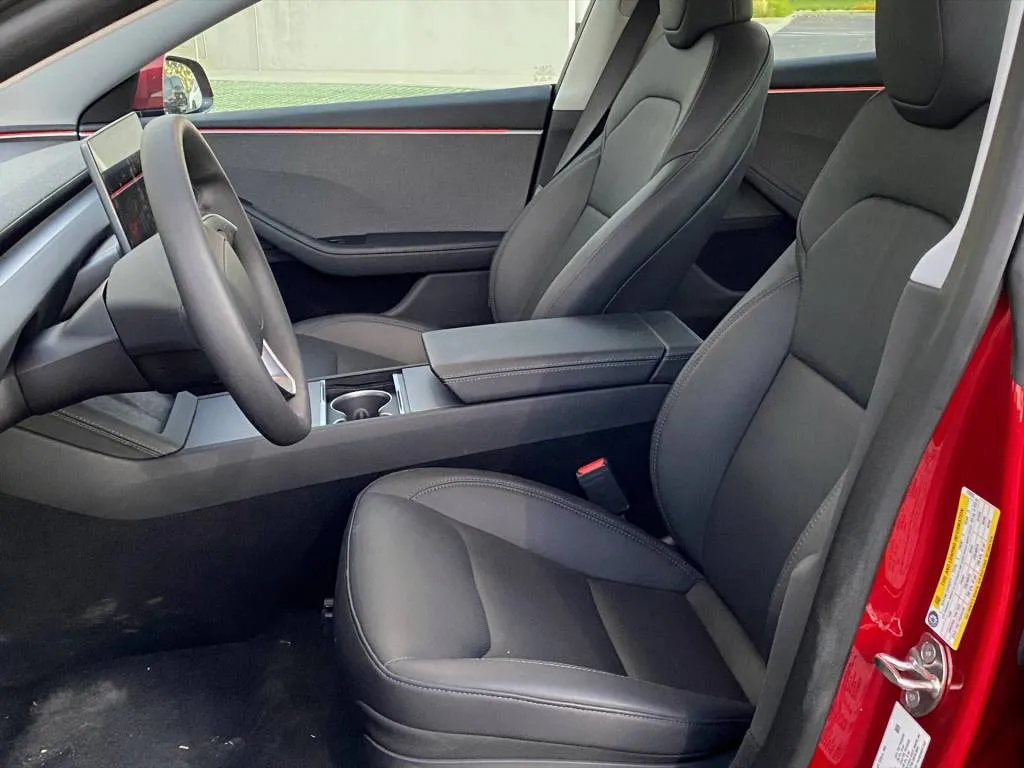
Speaking of seats, those in the Model 3 are now heated and cooled in front, and you can turn on the seat ventilation ahead of time via the app. But just in terms of physics and support, they still could use some help. They’re a little bit better than the seats in the first-generation Model 3, but they feel too flat and thinly padded. Really all they need are some better support around butts and backs, to hold you in place in corners. With the seating point nice and low, it’s all that’s getting in the way of feeling the Model 3 is a sporty sedan you sit in, not on, but the lack of hip-hugging seats leads to the latter impression.
2024 Tesla Model 3
2024 Tesla Model 3
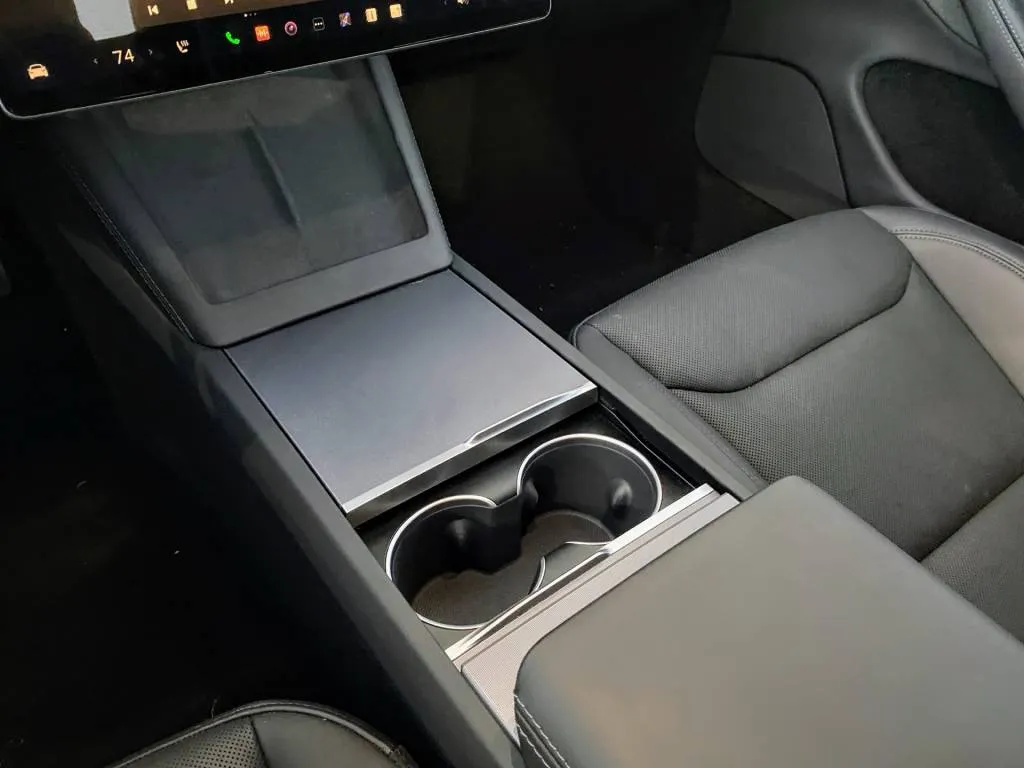
2024 Tesla Model 3
While the seats haven’t improved a lot, ride quality is night-and-day different. The outgoing version had a ride that we described as stiff and busy, and even when you were on near-perfect road surfaces there was still road noise. At first by noise and comfort alone it was like stepping into a luxury-badged cousin of the Model 3—even on the coarsely surfaced side streets of Santa Monica where I started.
The best-driving affordable EV?
Heading out to some favorite canyon roads, I soon found that the Model 3 doesn’t pull any punches in LFP form. Cost no object, the Model 3—yes, even in this base-model version—would make my shortlist of EVs in which to head out and enjoy driving on a curvy road.
This relatively low-powered Model 3, with a single permanent-magnet motor powering the rear wheels, making 257 hp and 266 lb-ft of torque, felt quicker than its official 0-60 mph times around town and on these most engaging ribbons of twisty tarmac I included in my tour. Although getting from the right lane over to the left on a free-flowing section of US 101 revealed that like other single-motor EVs its lower output becomes known at the upper end of legal speeds.
2024 Tesla Model 3
2024 Tesla Model 3
2024 Tesla Model 3
What’s more, it’s nimble and balanced. At a curb weight of less than 4,000 pounds and tuning that kept it feeling light, it felt right at home running a road that might have been a tuning benchmark for many sports cars—or for the Model 3 Performance. I found its steering to be very nicely weighted in both the Standard and Heavy modes (there’s Light too), and the Heavy one didn’t feel artificial in the way it centered as these modes often can.
The base Model 3 isn’t tuned like a performance car, but it feels a lot like base BMW 3-Series models have been tuned for several generations. Push it a little harder and it doesn’t stay razor sharp, but it leans predictably and wiggles in a way you can work with.
Tesla generally gets regen right, and the latest round of vehicles don’t leave you any options. Lift off the accelerator and the Model 3 scrubs off speed quickly, storing energy back in the battery pack, while the brake pedal is reserved for the friction brakes. This was the first Tesla I drove without a light/low regen mode—no optional creep when lifting off the brake either.
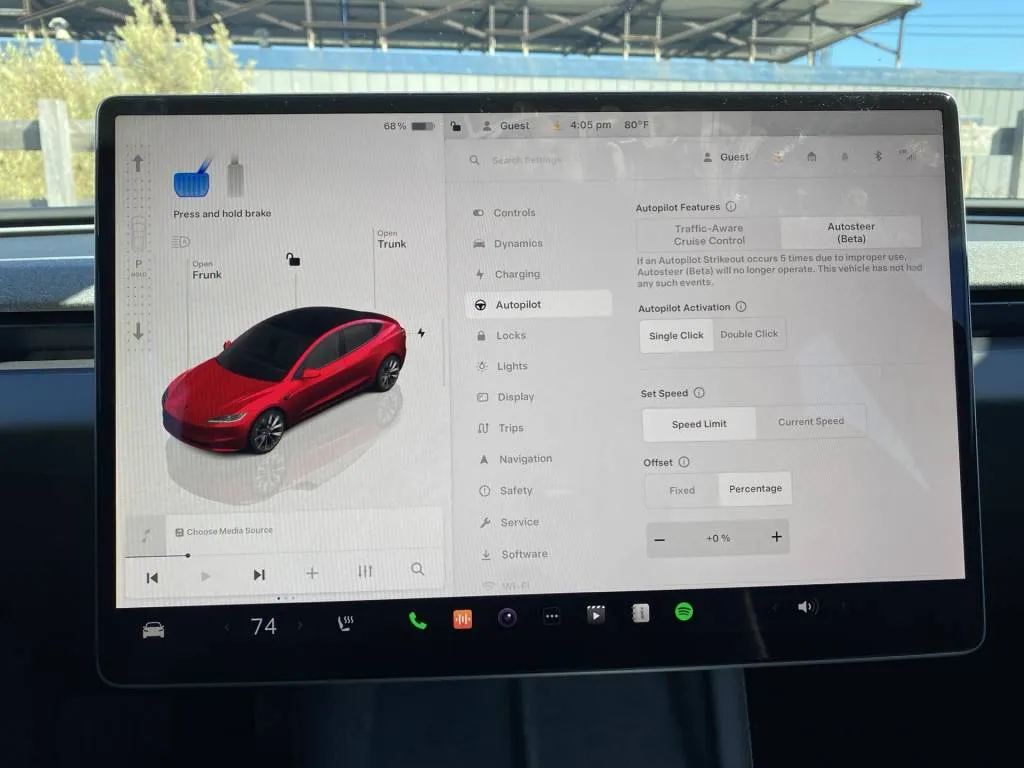
2024 Tesla Model 3
From steering to the accelerator and braking, and body motions, it all amounts to a precision in the driving experience and the inputs that many EVs simply don’t have. It feels like it represents the coordinated effort of an engineering team truly in sync on the priorities.
Indeed, a new front suspension geometry contributes to the finesse and athleticism. Gone is the loud bounding effect we noticed from the front on a curvy road in the original Model 3; instead this version soaks up sudden bumps or changes in the crown of the road in a way that doesn’t perturb things. Tesla has also in the Highland modified the rear subframe that’s always been one of the keys to the Model 3’s refinement, while updating bushings throughout and adding frequency-selective dampers.
Tech aside, Model 3 remains austere
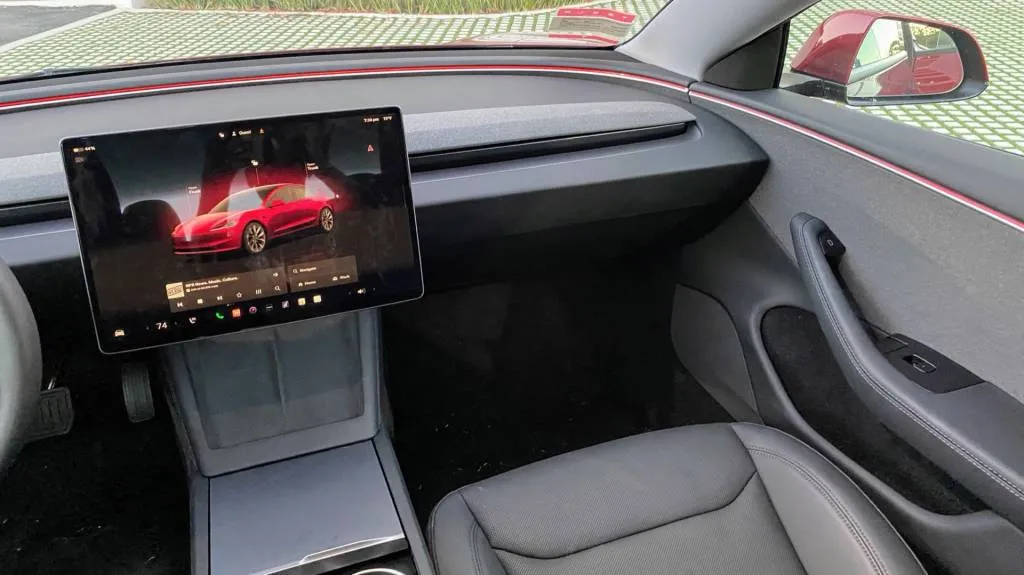
My enjoyment of that athleticism, plus the near perfect ride quality and well-hushed cabin yielded to reality eventually, when I found myself trudging along in traffic, squirming in my seat, and looking around at the textures and surfaces. They’re better for sure, and Tesla made a smart choice to go with textiles instead of the former woodgrain; I’m less certain about the multi-color ambient lighting, which is now in seemingly every new affordable car.
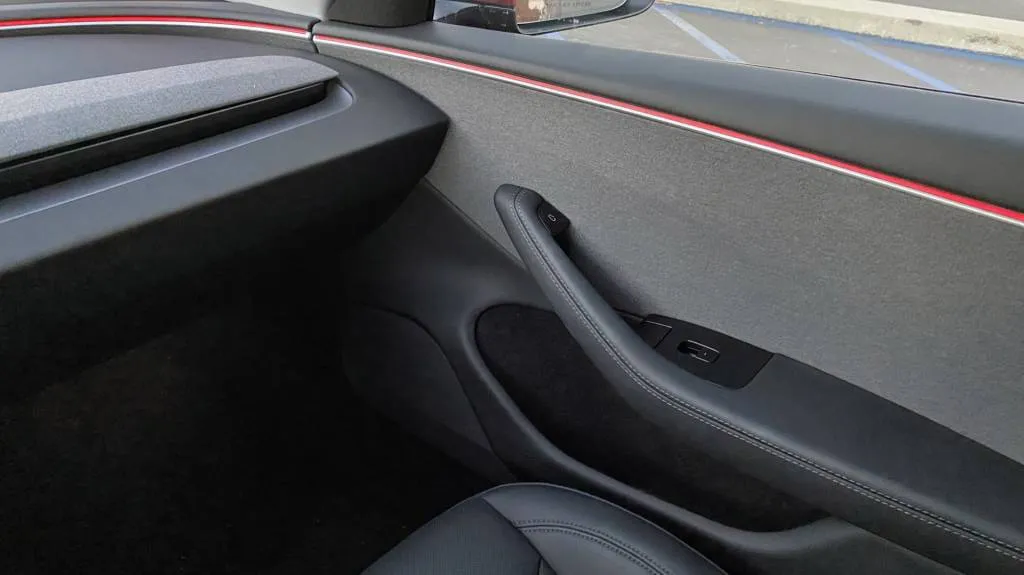
2024 Tesla Model 3
Up close, to the touch, the materials are better and the fit and finish is undeniably improved. That said, this is barely on par with other $40,000 cars and nothing more—and I could come up with plenty of $40,000 vehicles that offer more alluring seats and trims and surfaces.
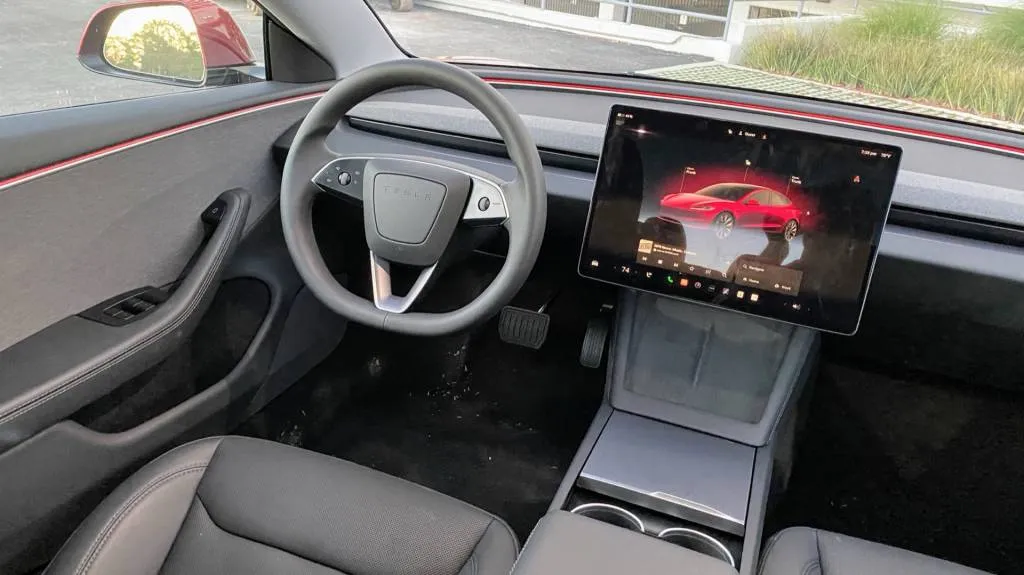
The Model 3’s centerpoint, its touchscreen, has essentially carried over, and it’s still a better interface than what you’ll find in many other EVs—if you’re OK using a corner of the single screen for gauges and making it your go-to for essentially everything. The left portion of the screen is a constant tally of speed, safety systems, and a rendering of passing vehicles (with audio controls below). But it’s always easy to find what you need quickly through the flat menu system. And a virtual tray with climate controls, navigation, and more is always locked to the bottom of the screen.
There’s no Apple CarPlay or Android Auto, and you have to be alright with that. But native navigation is excellent. Tesla includes standard data for navigation and updates for eight years, while premium data for audio and video streaming, sentry features (live camera), and more costs $99 a year or $9.99 a month.
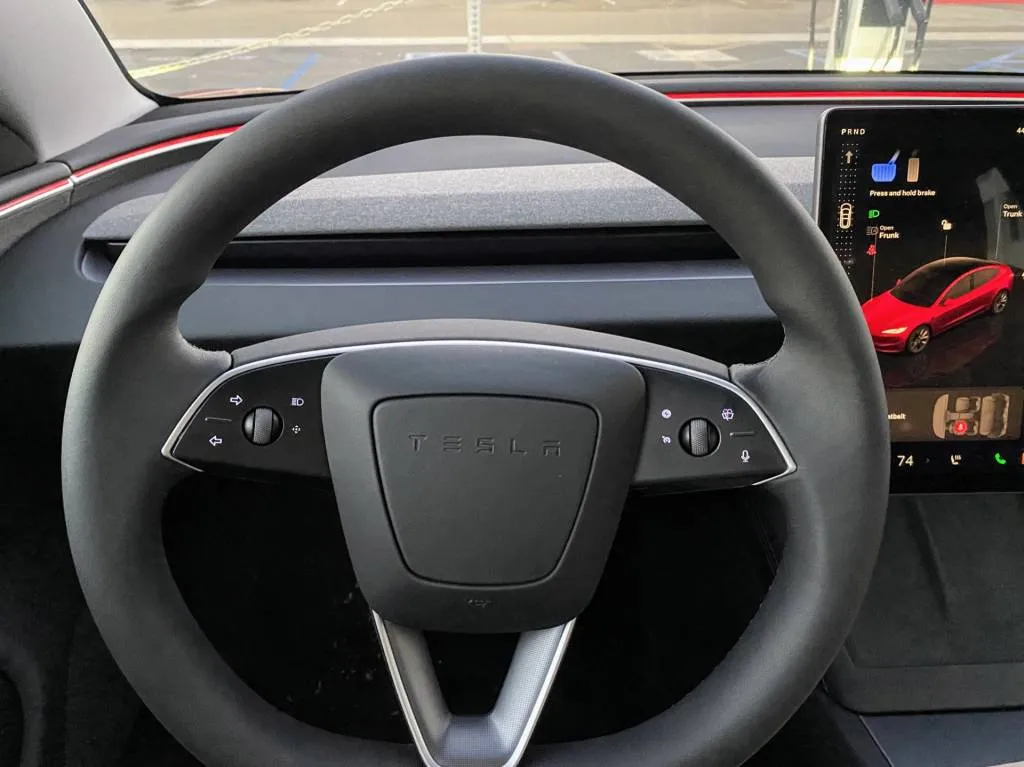
2024 Tesla Model 3
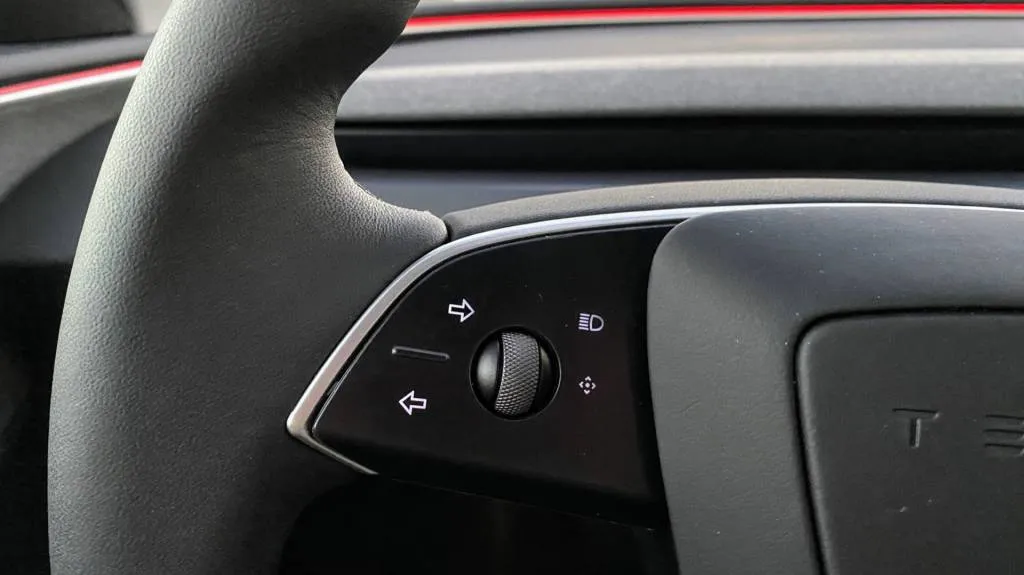
2024 Tesla Model 3
2024 Tesla Model 3
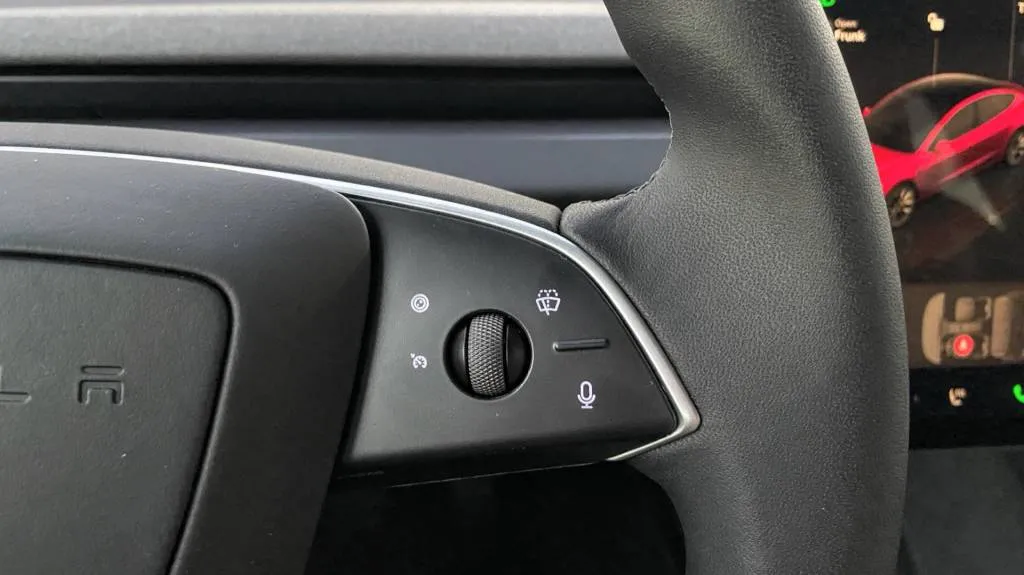
Just as with the previous Model 3, there’s no mirror or steering-wheel adjustment switchgear. You still adjust them with a somewhat clumsy combination of the screen and steering-wheel toggles. And in what feels like an unnecessary party trick, you can still pull the vents around virtually to physically aim them and provide airflow in the direction you want. Now, perhaps as part of Tesla’s push for Full Self-Driving, the Model S/X steering yoke, and seeing all these controls as unnecessary, the Highland consolidates the interface even more, purging the turn-signal stalk and shift lever completely.
Love for the car, heartburn over the interface
It’s that turn-signal function that’s the hardest to warm up to. Two steering-wheel buttons serve the purpose, with right on top and left below, and although you can mentally think it through with an imaginary turn-signal stalk as moving in those same directions, after a day using it, I was still confusing the two when flustered—for quick highway lane changes, for instance. Further, there’s no way from what I can tell of simply flashing the signal three times; you need to press to turn it on, then again to turn it off. I didn’t do any significant night driving, but I can see the same adoption curve for the high-beams—another steering-wheel button.
2024 Tesla Model 3
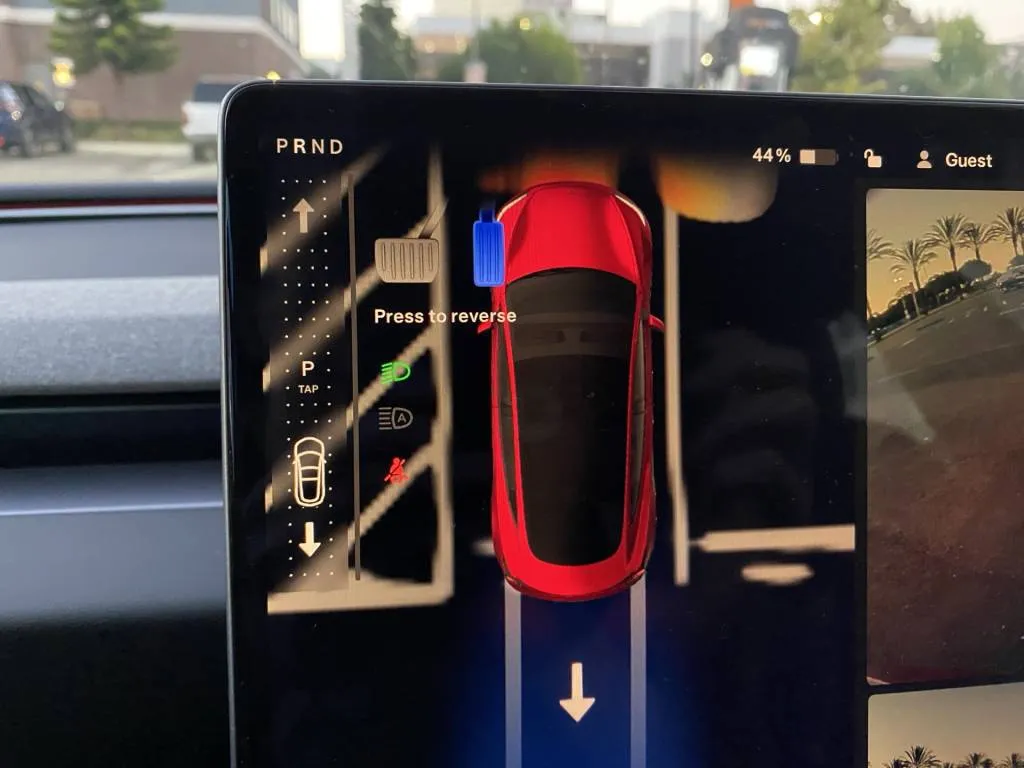
The 2024 Model 3 also loses the shift stalk, and as I found over a day this is much easier to warm up to. A visually textured area in the upper left corner of the screen acts as a shift pad. Once pressing on the brake, drag it up for Drive, drag it down for Reverse, or tap it for Park. There are backup touch-buttons up by the rearview mirror but I never needed to use them and found the screen-based shifting just fine after parking a few times. There’s a predictive shifting feature you can turn on, which will use the camera-and-sensor system, plus present behavior, to decide whether you want to shift to Drive or Reverse. I simply wasn’t in the Model 3 long enough to test this feature.
Some of the interface is markedly better though. Tesla has redone the Model 3’s entry tech, and its effectiveness in recognizing my phone as a key was flawless. While in some other vehicles I’ve faced an uneasiness over whether the car locks as I walk away, I saw the car power down at a distance and then, as I reapproached with the phone in my pocket the car would simply open whatever I went to open up, without further presses or unlocks, whether that was a passenger-side rear door or the trunk.
2024 Tesla Model 3
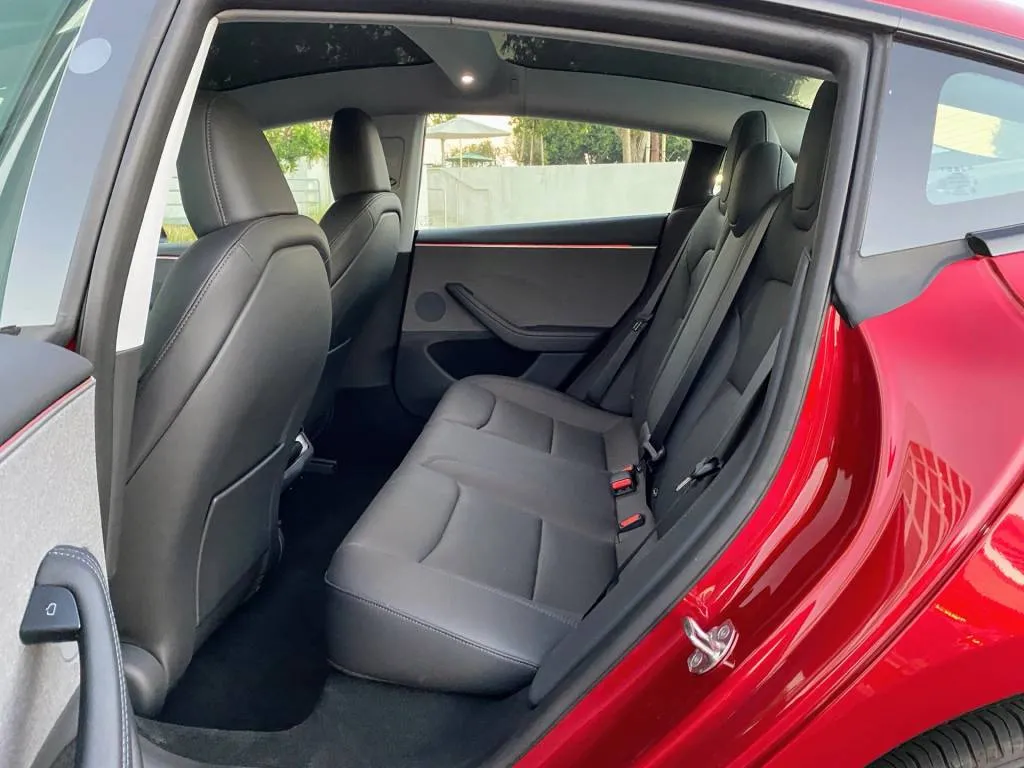
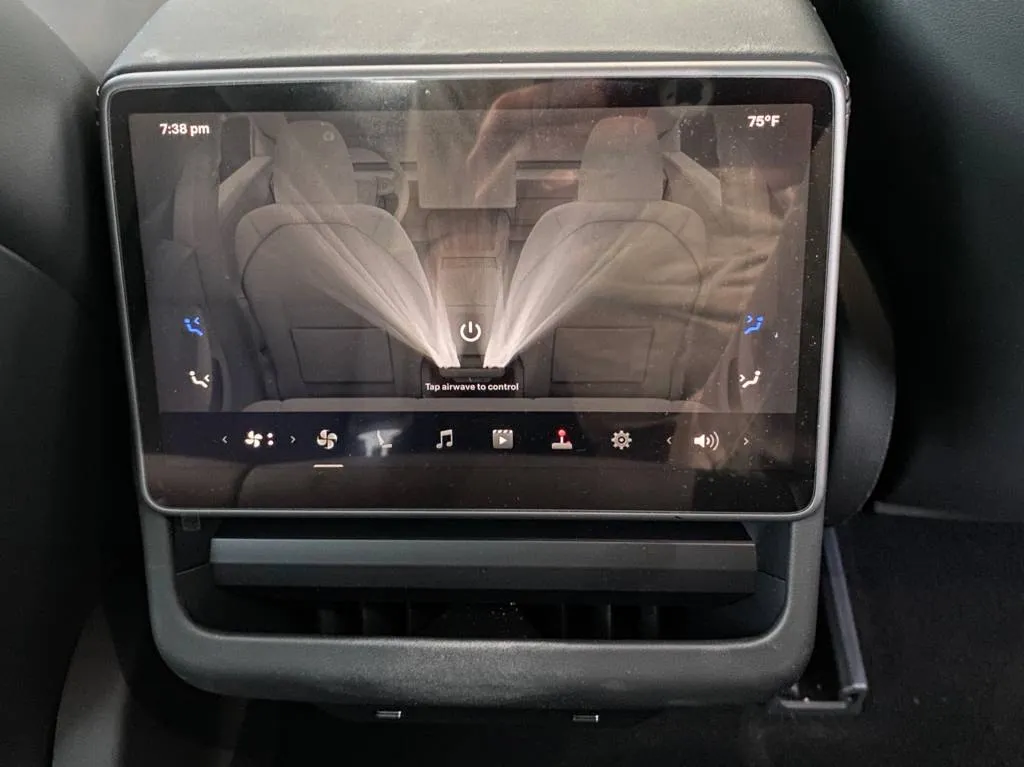
Back-seat passengers now also get their own touchscreen, and it’s no disappointment. It’s just as quick and nearly as full-featured as the one in front, with climate controls (aimable touchscreen vents there too), audio controls, gaming and viewing options, and more. Heated seats are standard for the outboard positions, and that’s how riders control them.
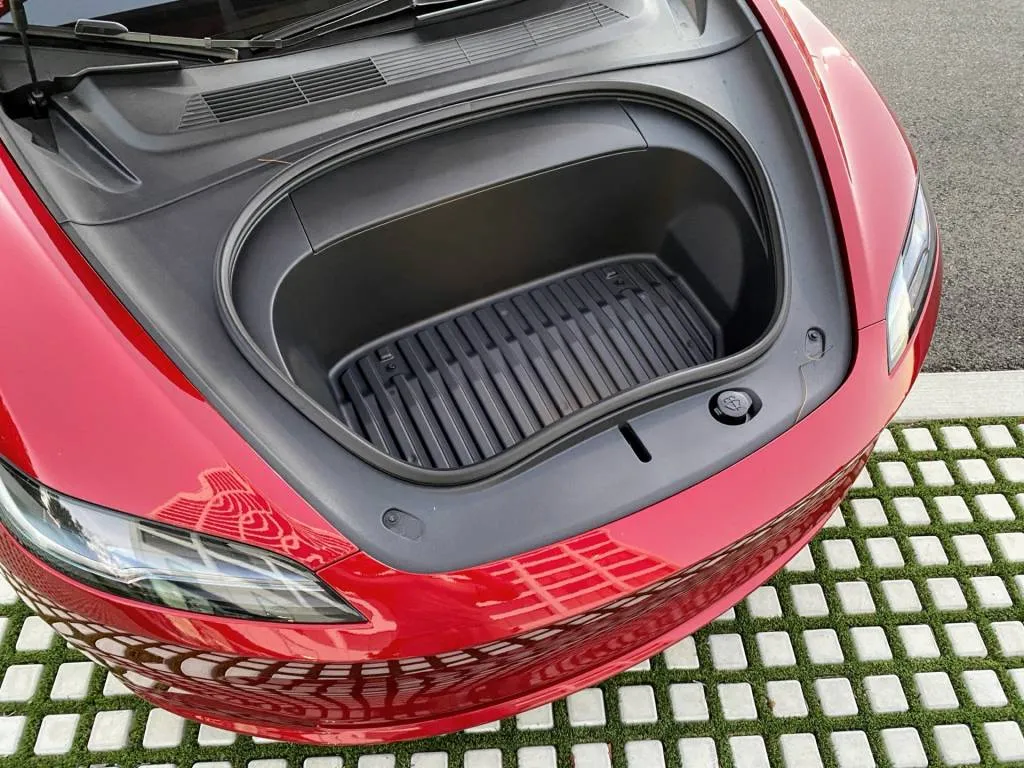
You may have people riding back there, too, as it’s a decently roomy space for two in the back seat, with headroom really the limiting factor. Storage space is really well thought out, too, with big door bins, multiple deep covered bins at the center console, and a soft-touch top to the console that’s good for the elbows of various drivers and passengers. There’s lots of trunk and frunk space (21.0 and 3.1 cubic feet, respectively), and this is one of the few frunks that’s deep enough to be useful. Put the grocery bag with the eggs up there, or stash a couple of daypacks; there’s a lot of space, but things will be snug enough to not go tumbling about.
2024 Tesla Model 3
Tesla has redone the sound system, but the nine-speaker audio system in the Highland didn’t impress. While totally fine for podcasts and most streaming music, it lacked the rich low-mid-range frequencies I’d enjoyed in previous Long Range Model 3 and Model Y experiences. Other Model 3 versions still do get a grander sound system.
All Model 3 versions come with the same suite of Autopilot cameras and sensors, but the Model 3 I tested didn’t have the Full Self-Driving package activated (currently $8,000, or by subscription). Thus, I got to see what you get at the base level, and in this form it isn’t bad, but it isn’t one of the best either. It follows a clearly defined lane and generally steers smoothly, but it easily got confused on lanes of LA’s US 101 that had weak striping plus pavement of two materials.
Tesla Model 3 Highland efficiency and charging: Home run
The Highland adds up to a very appealing EV. And it stood up to all the efficiency and charging expectations in my real-world drive.
According to the trip computer I averaged more than 4.1 miles per kwh over 158 miles that were not particularly efficiency-minded. They included boulevards, some coast cruising, demanding canyon roads, and a mix of free-flowing freeways and the traffic slog on I-405. Most of that time the temp was set to 74 degrees F, but I lowered it for a time when too much midday sun was coming directly in through the side roof (potentially an issue).
Tesla’s route planning is the benchmark, and it’s still easy to see why. The Model 3’s navigation system routed me quickly toward a Supercharger station after selecting from a few possibilities, showing me how many chargers were available as well as how many other Teslas were heading there for a charge. The Santa Monica Supercharger station was well-maintained, with bathrooms on premises and an overhead solar array providing shade.
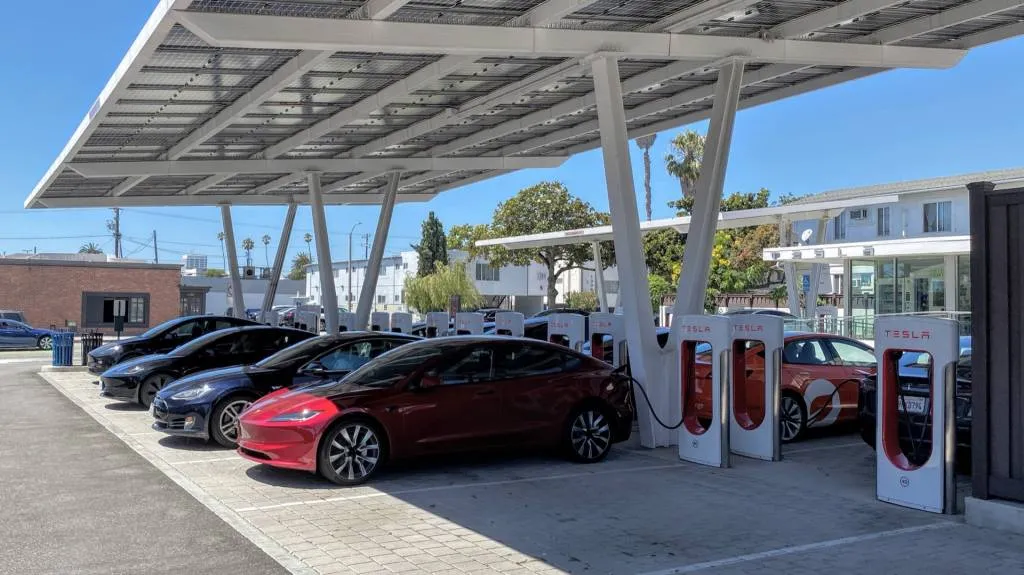
2024 Tesla Model 3at Santa Monica Supercharger station
Tesla lists a 170-kw maximum charge power for the LFP model, and I saw 168 kw briefly when I first started a charge from 15%. From there it took just 23 minutes to charge up to 80% (the limit at the busy Santa Monica station where I charged). At 80%, it indicated a range of 189 miles—figuring out to nearly 240 miles in the real world at a full charge, with those showier wheels.
Efficiency and charging are the known quantities for Tesla, and that’s why I led with everything else. The few hair-pulling interface decisions and undue drama from the top aside, Tesla’s made a very quiet, well-mannered, very pleasant-driving EV—one that I’d go out of my way to drive rather than be driven in, and one that earns its keep in ways beyond efficiency, Supercharging, and Autopilot.
2024 Tesla Model 3
Why again is Tesla making cars that are so much fun to drive if it wants us to relinquish the steering wheel and send the car off to be a robotaxi? Not really part of the now-wiped-away Master Plan, is it?

Electric Scout concepts debut Oct. 24
Scout lives.
On Tuesday, Scout Motors confirmed its electric SUV and truck concepts will debut on October 24.
Scout Motors returns from the history books thanks to Volkswagen. The brand is part of Volkswagen Group, but this latest iteration is said to be operated independently and is being treated as a start-up automaker. Scout is being billed as an electric SUV and truck brand.

Scout EV plant groundbreaking
The latest teaser reveals a roof-mounted compass. Previous teasers revealed brick-like silhouettes for both the electric truck and SUV. The rugged designs are said to be inspired by the classic International Harvester Scout SUV, which was produced from 1960 to 1980.
Both the electric SUV and truck will be built at a new factory near Columbia, South Carolina, pegged at a construction cost of $2 billion. Once at full capacity, the factory is set to produce 200,000 vehicles annually and create 4,000 jobs. Magna is assisting VW with the rapid development of the body-on-frame chassis for the Scout EVs.

Teaser for Scout Motors electric SUV and pickup truck
The SUV is said to arrive first with a target price in the $40,000 range. The larger pickup is set to arrive in short order after the SUV and cost more than its sibling.
Scout Motors CEO Scott Keogh was previously the CEO of Volkswagen America. The executive has touted the SUV as a “Rugged Utility Vehicle,” or “RUV.”
Volkswagen invested $5 billion in Rivian to get access to its zonal electrical architecture. The electrical architecture will be used across the Volkswagen Group’s various brands, though it’s unclear if the deal went through with enough time for integration into the two Scout EVs.

2019 Jaguar I-Pace recalled because high-voltage battery may overheat
JLR is again recalling early Jaguar I-Pace electric SUVs due to an issue that could cause the vehicles’ battery packs to overheat—and asking owners to park and charge their cars outside and away from structures until a remedy is implemented and for 30 days after.
The recall includes 2,760 vehicles, all from the 2019 model year—the first for Jaguar’s sole EV. These were included in previous recalls that included improved software to diagnose potential issues with the battery pack. But even after this software was installed, JLR received reports of three first involving 2019 I-Pace EVs—all in 2024.
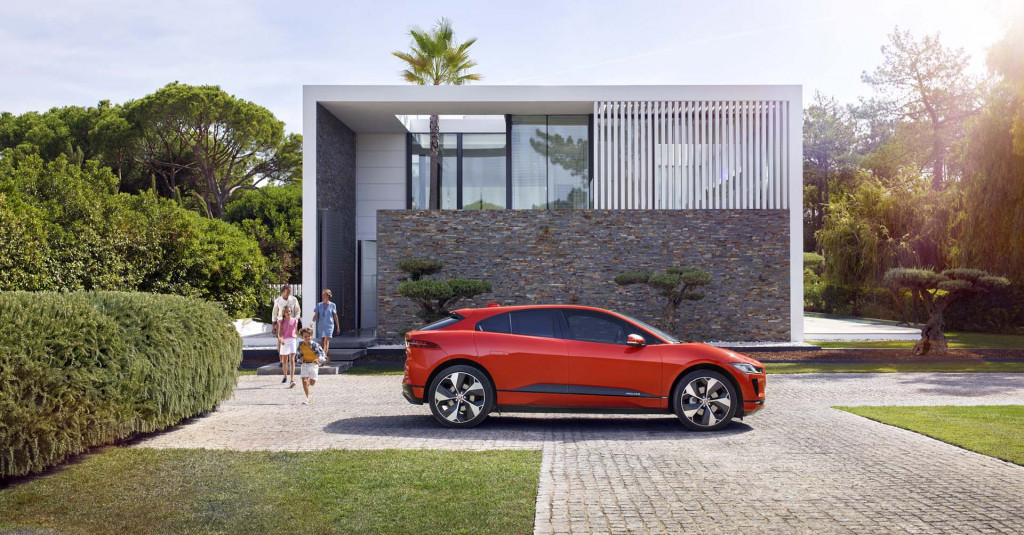
2019 Jaguar I-Pace
With battery packs still overheating after the diagnostic software was installed, JLR deemed the software inadequate and is looking for another solution. The automaker said an investigation is ongoing, noting that the software identified some battery modules as having the characteristics of a folded anode tab, which could contribute to the risk of overheating.
In the meantime, dealers will install updated battery module control software limiting capacity to 80%, free of charge. Jaguar plans to mail owner notification letters Oct. 18, 2024. Owners can call Jaguar customer service at 1-800-452-4827 and mention recall number H514 for more information.
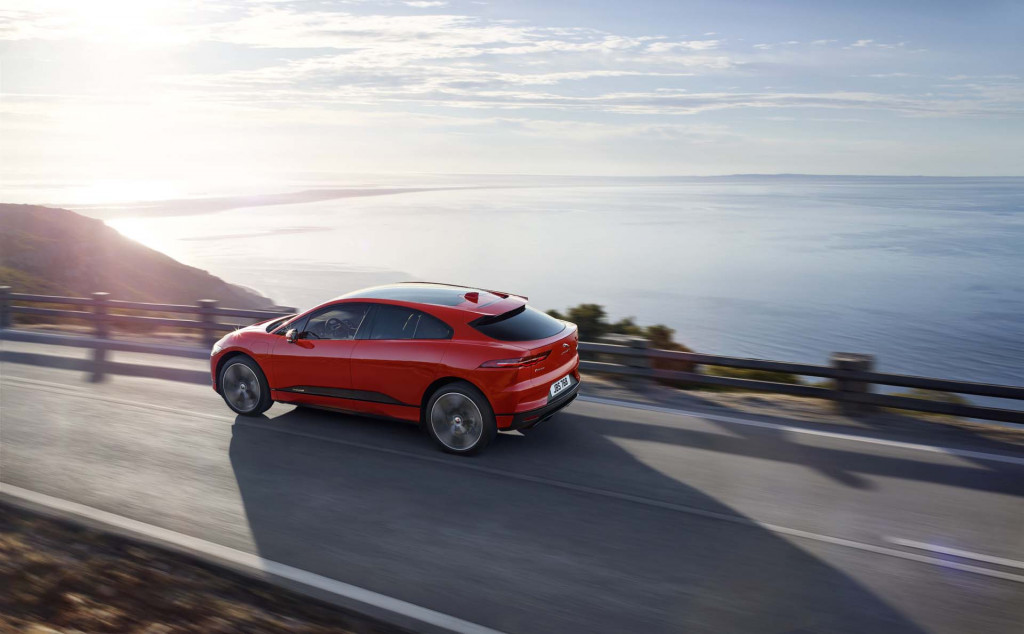
2019 Jaguar I-Pace
After a broader recall of I-Paces due to fire risk last year, Jaguar announced another small recall earlier this year of just 258 vehicles—all 2019 models. The automaker found that these vehicles had a higher propensity for short circuits within their battery cells, and eventually opted to replace entire packs.
Jaguar hasn’t redesigned the I-Pace since its launch, but an update a few years ago added faster charging and a snappier interface. A previous report that Jaguar would abandon the I-Pace has proven accurate, as the brand has dropped it and most other models ahead of an alleged rejuvenation that could include a new generation of EVs.

2025 Hyundai Ioniq 5 now U.S.-built, adds Tesla NACS port
- The 2025 Hyundai Ioniq 5 sports bigger batteries, more range, and a Tesla NACS charge port
- The 2025 Hyundai Ioniq 5 will be made in Georgia
- Hyundai didn’t say how much the 2025 Ioniq 5 will cost when it arrives
The 2025 Hyundai Ioniq 5 receives a number of notable updates, including bigger battery packs, a Tesla North American Charging Standard (NACS) port, and more rugged XRT variant. It will also be the first Hyundai EV built at the automaker’s new manufacturing complex in Georgia, dubbed the “Metaplant.”
Battery-pack sizes grow from 58.0 kwh to 63.0 kwh for Standard Range models and 77.4 kwh to 84.0 kwh for Long Range models—with expected increases in EPA range for both. The change was hinted at with the raucous 2025 Hyundai Ioniq 5 N performance model, which debuted earlier this year with the 84.0-kwh pack.
Hyundai estimates a 20-mile boost for the single-motor SE Standard Range, to 240 miles. Single-motor SE, SEL, and Limited models with the bigger pack get a smaller bump from 303 miles to 310 miles. Dual-motor versions of those models should get 250 miles to 280 miles of range, depending on the specific trim level and wheel/tire size, up from the previous 260 miles.
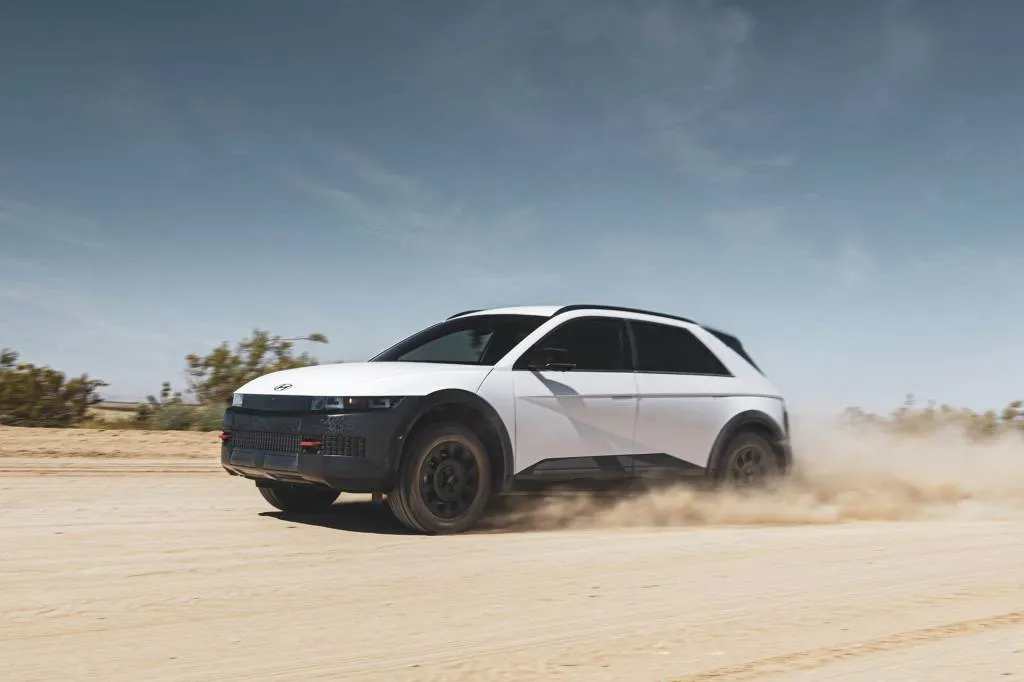
2025 Hyundai Ioniq 5
A new XRT grade also joins the lineup for 2025, marking the first time this off-road-inspired trim has been applied to a Hyundai EV. The Ioniq 5 XRT receives a 0.9-inch suspension lift, new suspension tuning, all-terrain tires on 18-inch wheels, and exterior cladding with a digital camouflage pattern. It’s only available with the dual-motor powertrain and larger battery pack, but Hyundai did not have a range estimate at press time.
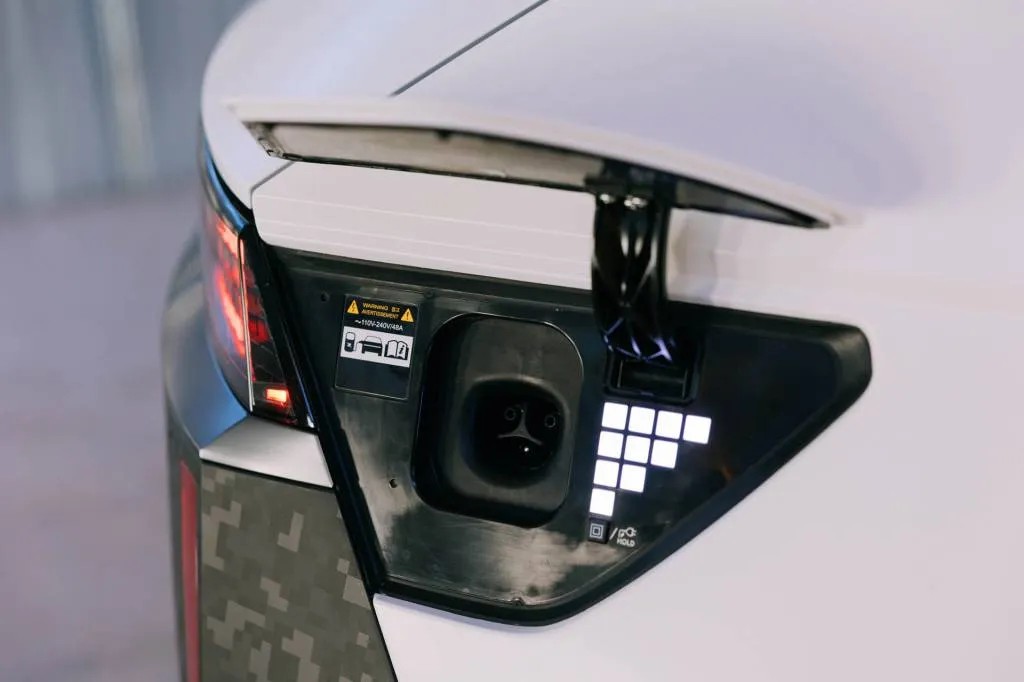
2025 Hyundai Ioniq 5
The Ioniq 5 will be the first Hyundai EV with a built-in Tesla NACS charge port, which Hyundai says will open up access to more than 17,000 Tesla Supercharger stations without requiring an adapter. Hyundai will instead sell an adapter for the Combined Charging Standard (CCS) port the Ioniq 5 previously used. All new or refreshed Hyundai EVs will come exclusively with a NACS port starting in the fourth quarter of this year.
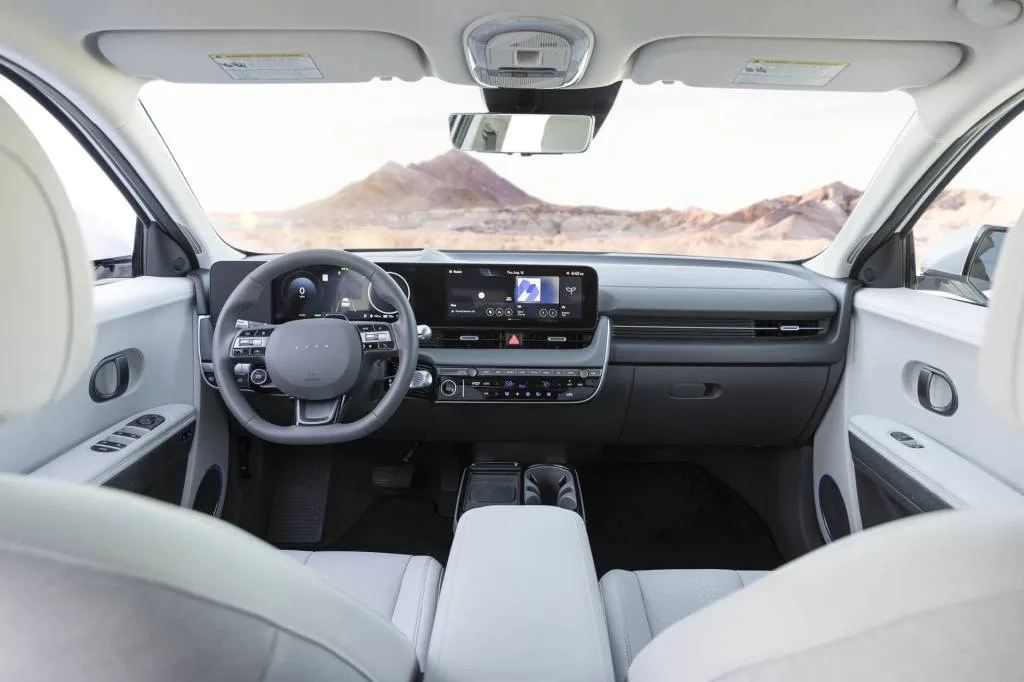
2025 Hyundai Ioniq 5
Like some other 2025 Hyundai models, the Ioniq 5 finally offers wireless Apple CarPlay and Android Auto as standard equipment on all models. A parking collision-avoidance assist feature and sensors to detect whether the driver has their hands on the steering wheel are new, while the lane-centering and remote automated parking assist features are updated.
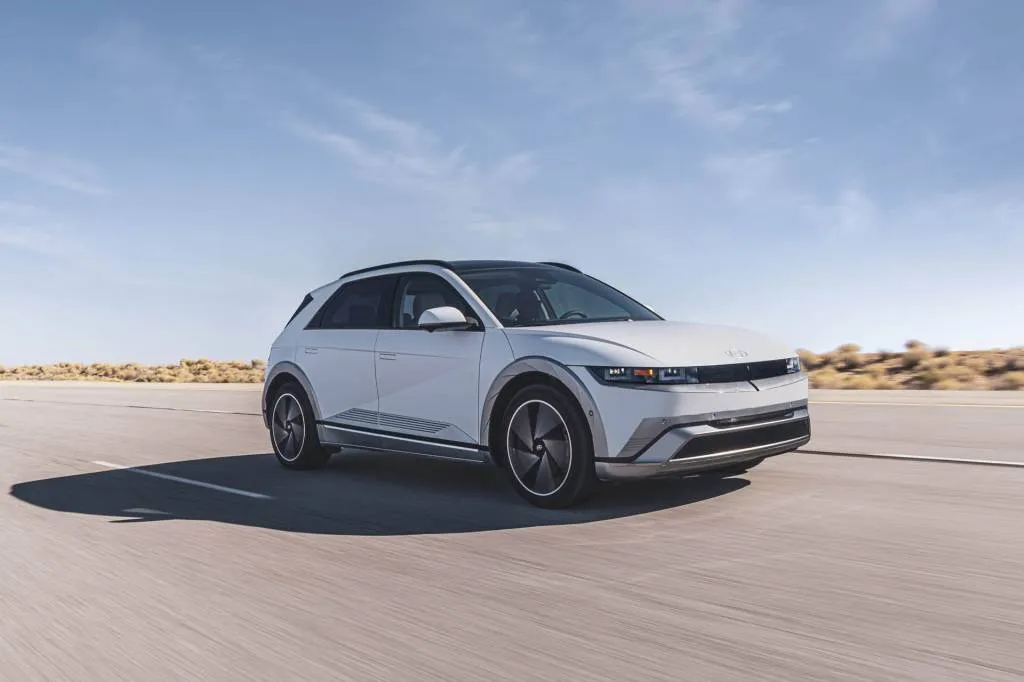
2025 Hyundai Ioniq 5
Exterior styling changes include new front and rear bumpers, a new rear spoiler, and new wheel designs Hyundai claims are more aerodynamic. Under the skin, the body shell, front and rear doors, and parts of the B-pillars have been reinforced to improve side-impact protection. Inside, the Ioniq 5 features a redesigned center console and climate controls, as well as a new steering wheel design.
As confirmed by Hyundai earlier this year, the Ioniq 5 will be the first EV built at the automaker’s new Georgia factory. This will help 2025 models qualify for a $3,750 federal tax credit, but Hyundai will continue to offer a $7,500 discount to lease customers through a loophole in the rules. Actual pricing information will be released closer to the 2025 Ioniq 5’s arrival at dealerships.

Efficiency can cut EV prices by $5k, charging costs by nearly a third
Increased EV efficiency isn’t just better for the environment. It’s also better for owners’ wallets, reports the American Council for an Energy-Efficient Economy (ACEEE).
In a new white paper, the group notes that boosting efficiency allows for smaller battery sizes, which in turn cuts costs. Most EVs average 2.5 miles per kwh, according to the paper, but the Tesla Model Y averages 3.5 miles per kwh. That’s a 40% increase which, assuming similar range, allows for a 40% reduction in battery size that’s worth up to $4,800 in cost savings, the ACEEE reasons.
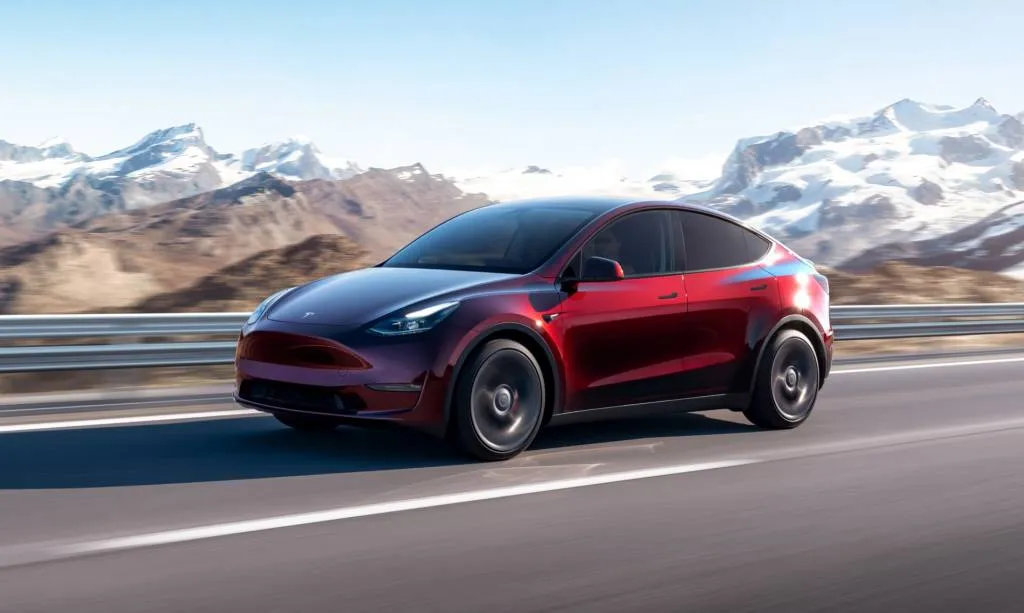
2024 Tesla Model Y. – Courtesy of Tesla, Inc.
Even less efficient EVs can save owners money compared to gasoline cars, though. At 2.5 miles per kwh, the ACEEE estimates annual charging costs at $960, compared to about $2,000 for fueling a car with gasoline. But increasing efficiency to 3.5 miles per kwh drops annual charging costs to an estimated $680 a year—a 29% savings.
Greater efficiency also means EVs gain more miles of range for a given amount of charging time, the ACEEE notes. That means drivers can spend less time charging—potentially helping to quell range anxiety—and there is less demand on the grid. This echoes the findings of a study published earlier this year by the non-profit utility organization EPRI and the National Resources Defense Council (NRDC), which found that efficiency improvements could cut grid demand from EVs by up to 20%.
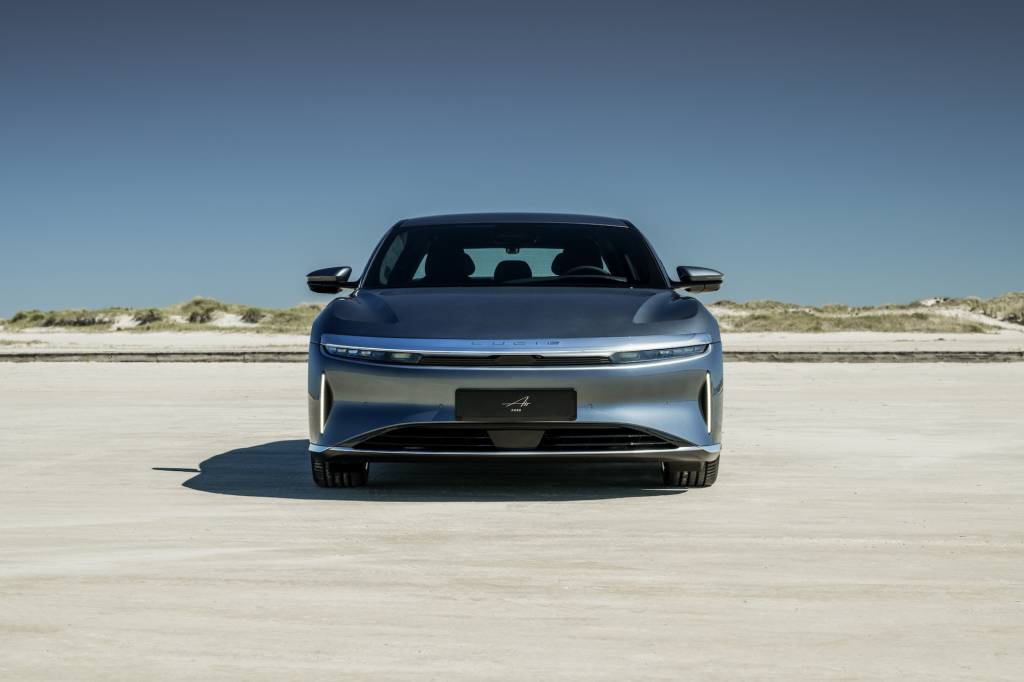
2025 Lucid Air Pure
As the ACEEE notes, different automakers have widely varying attitudes toward efficiency. Lucid has made efficiency a priority, and as a result the Lucid Air Pure luxury sedan achieves 5.0 miles per kwh, which the automaker claims is an industry benchmark. At the other end of the spectrum sits the GMC Hummer EV, which can only manage 1.4 miles per kwh, according to the ACEEE.
The white paper recommends policies to incentivize more efficient EVs, including changing EPA emissions standards to no longer focus solely on “tailpipe” emissions, a framework that currently treats all EVs the same regardless of efficiency. Purchase incentives could also be scaled based on efficiency, and registration fees could be based on vehicle weight, as is currently the case in Oklahoma and the District of Columbia, the paper suggests.

Review: 2025 Volvo EX90 EV reboots the brand but doesn’t flaunt it
Keep to quick first impressions of the 2025 Volvo EX90 and you might get the wrong idea.
In one of the many inherently Swedish aspects of this next-generation electric SUV, it doesn’t flaunt the future on the outside, but it certainly wears it well inside.
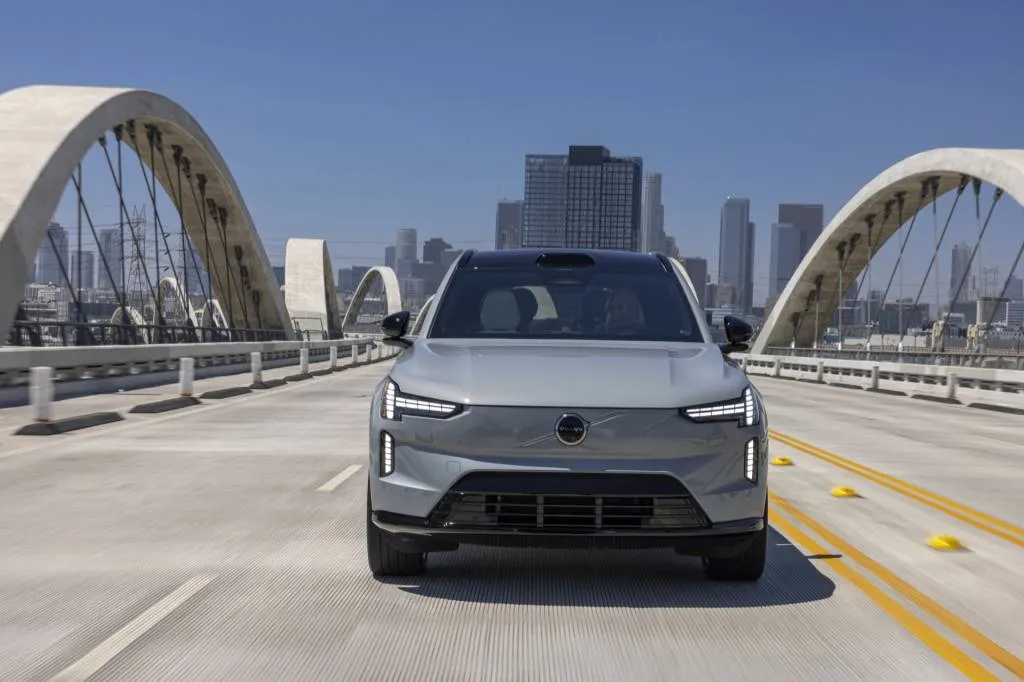
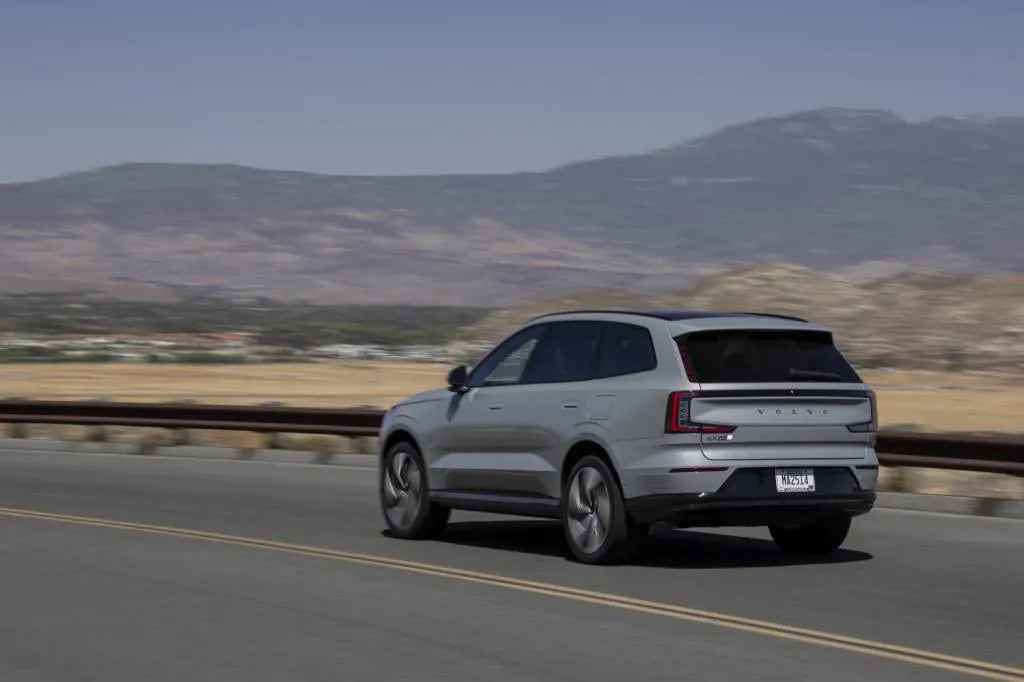
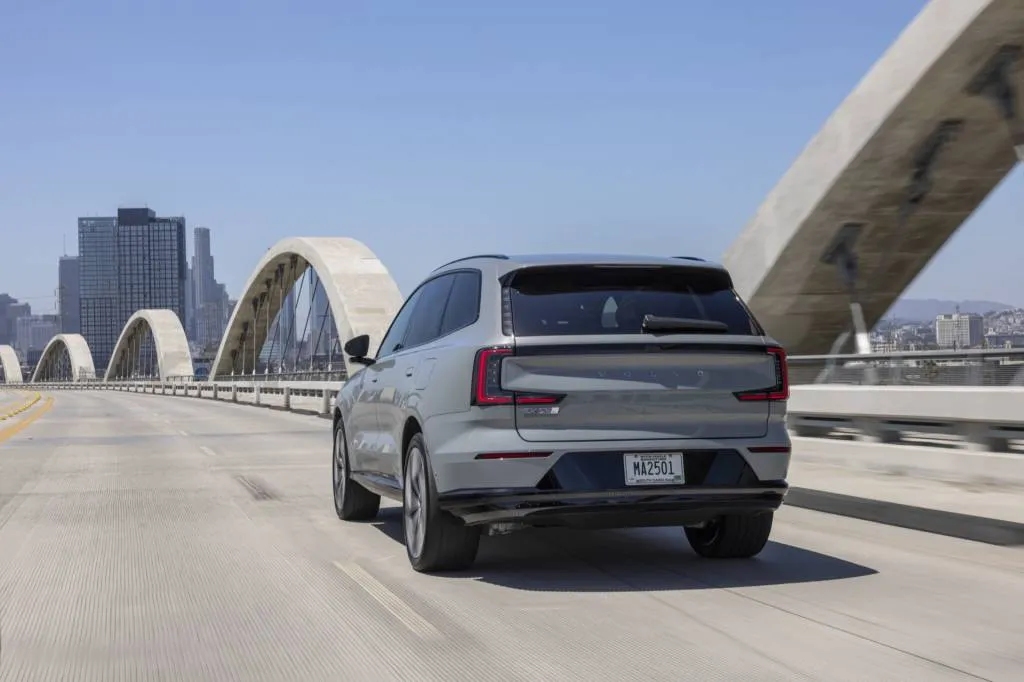
The exterior of the Volvo EX90 is what it needs to be—an evolution from the XC90. On the other hand, its cabin embraces an extreme minimalist approach, cozies up to a touchscreen for nearly everything, and syncs up with a software-defined-vehicle future.
In a recent day of up-close time with the South Carolina-made EX90, set to arrive this fall, Volvo was big on the vehicle’s software, and its platform’s origin story rooted in global technology partnerships with Google, Nvidia, Qualcomm, and Luminar. But with the perspective of several hours of driving time, I was reminded that Volvo hasn’t forgotten with the EX90 what the company does best—making people feel comfortable, safe, and pampered, without overtly flaunting it.
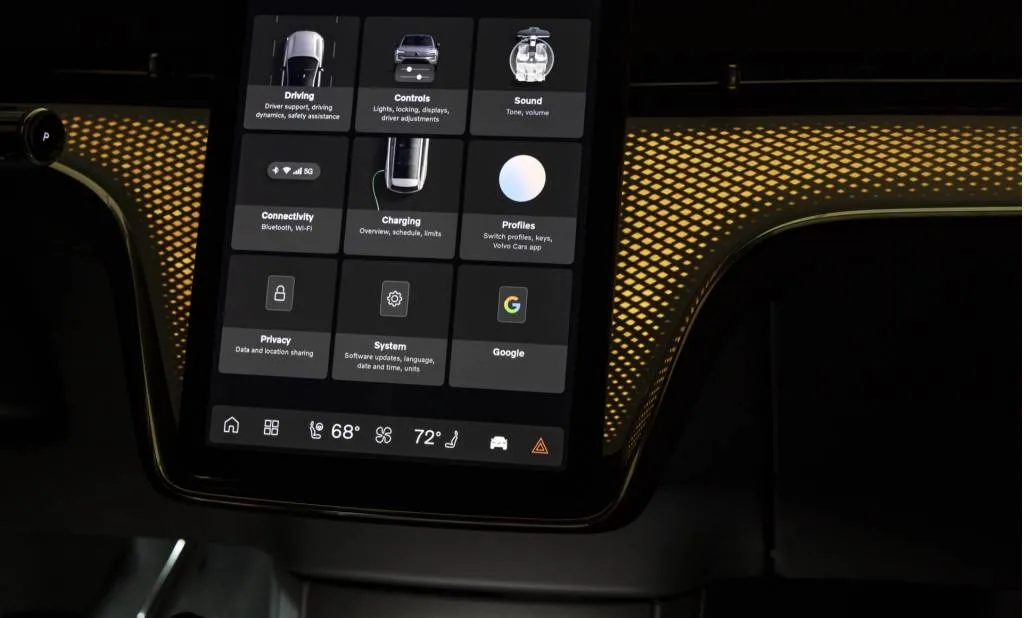
2025 Volvo EX90
Volvo EX90: Touchscreen’s the key touchpoint
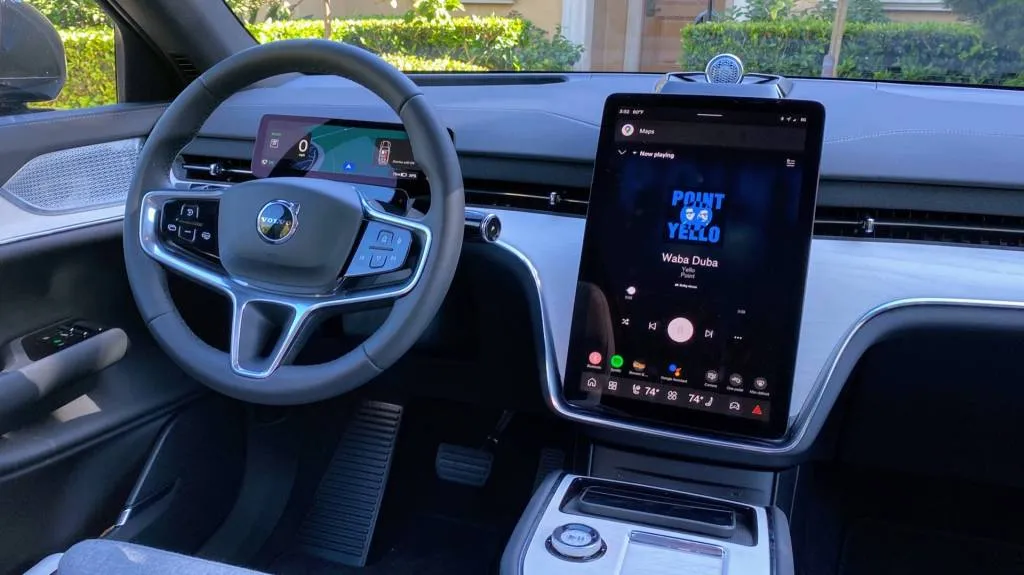
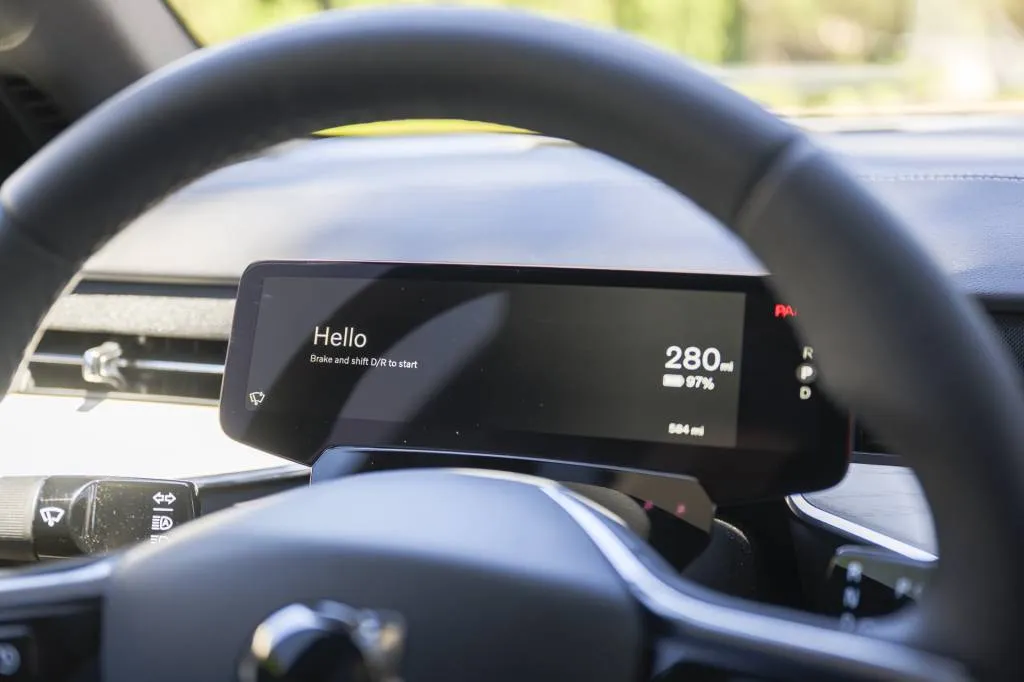
There’s no shying away from the vertically oriented 14.5-inch touchscreen when you get into the 2025 EX90, and you’ll get familiar with it quickly. While a 9.0-inch digital gauge cluster and head-up display help keep track of everything, the touchscreen is the hub for many of the controls and, like it or not, you’ll need to toggle through screen-based tabs to adjust the mirrors, steering wheel, and seats—although the seats have a center button to click through its power adjustments.
For newbies like me, it’s simply not as easy as actual adjustment switches. While we’re at it, the directional buttons on the Volvo steering wheel simply don’t offer the kind of fine precision in adjustment that Tesla’s tactile thumbwheels do.
But drivers may realistically only need to do this once, and Volvo says that its system is a step ahead. Driver profiles correspond to each known smartphone, along with Phone as Key technology, and as someone approaches the vehicle, pings from four to six ultra-wideband sensors around the vehicle determine which phone is entering at the driver’s door. If this all goes according to plan, the driver enters the vehicle with the seats, mirrors, steering wheel, presets, and other preferences all set to their liking. If by some chance the car guesses wrong, Volvo says you can select those profiles manually. This is one I truly look forward to putting to the test with a family of devices.
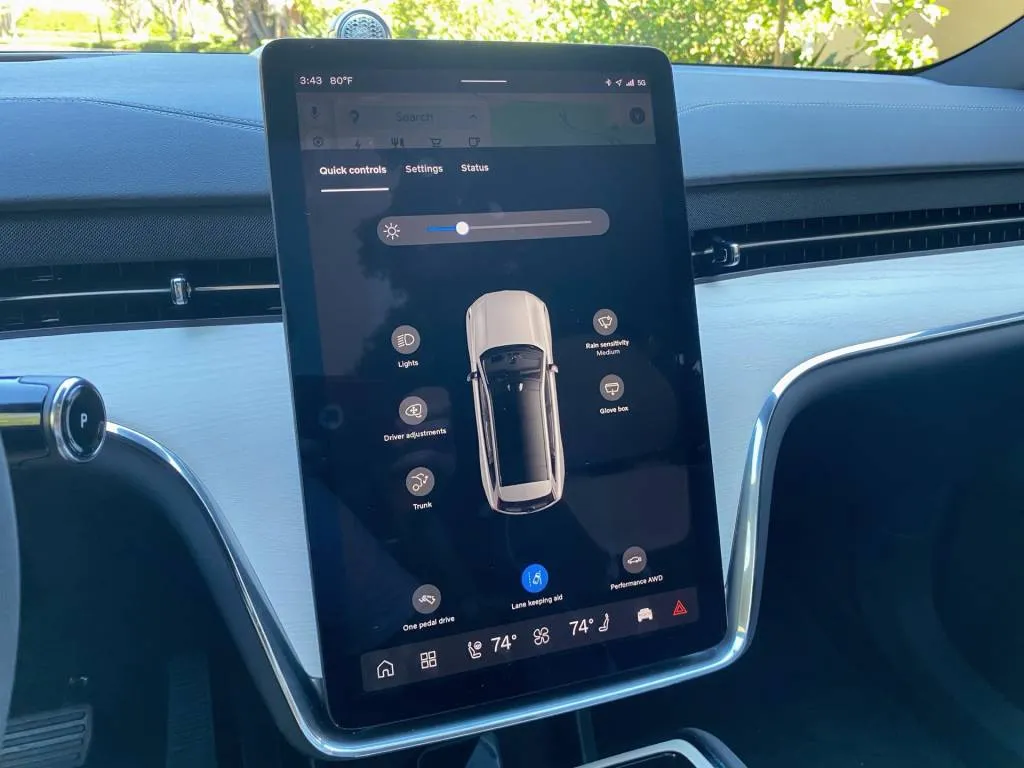
2025 Volvo EX90
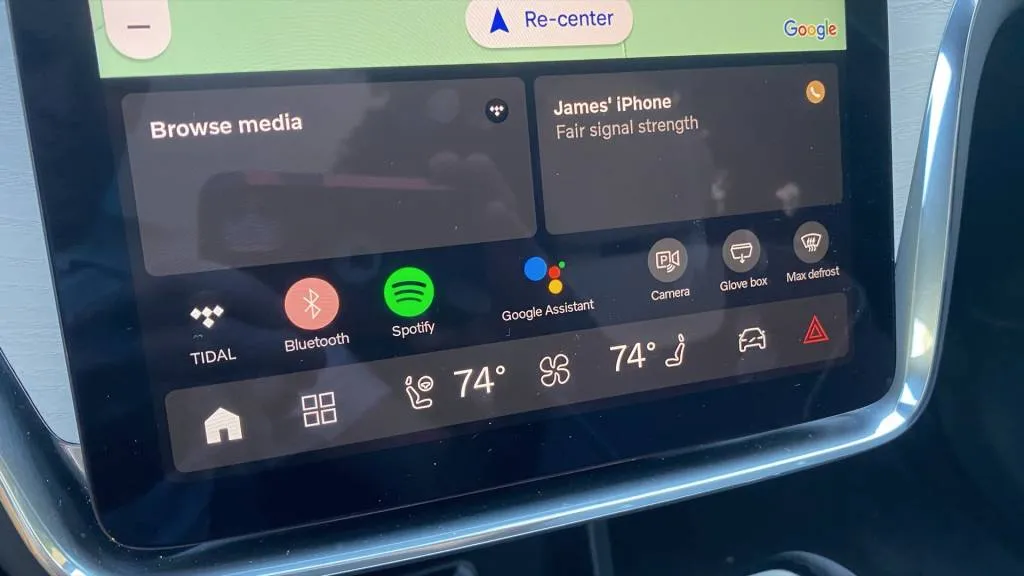
2025 Volvo EX90
2025 Volvo EX90
Volvo’s latest screen experience in the EX90 will feel familiar to virtually anyone, with a tablet-like interface that handles climate controls. At the bottom of the screen is a locked row of icons that provides quick navigation to a home screen, apps, settings, and climate control details. Above it is a row of contextual icons that will change depending on the current use, while above that widgets (for phone or audio) provide a quick look at what’s playing or available. The vast majority of the screen is used for navigation, with a clear, vertically oriented map display that’s easy to glance at quickly (but you can also add it to the instrument panel). It’s likely to evolve and a lifetime of vehicle updates are coming. Volvo says it will keep data for navigation and over-the-air updates live even if customers let their 5G data subscriptions for apps and streaming lapse.
2025 Volvo EX90
2025 Volvo EX90
2025 Volvo EX90
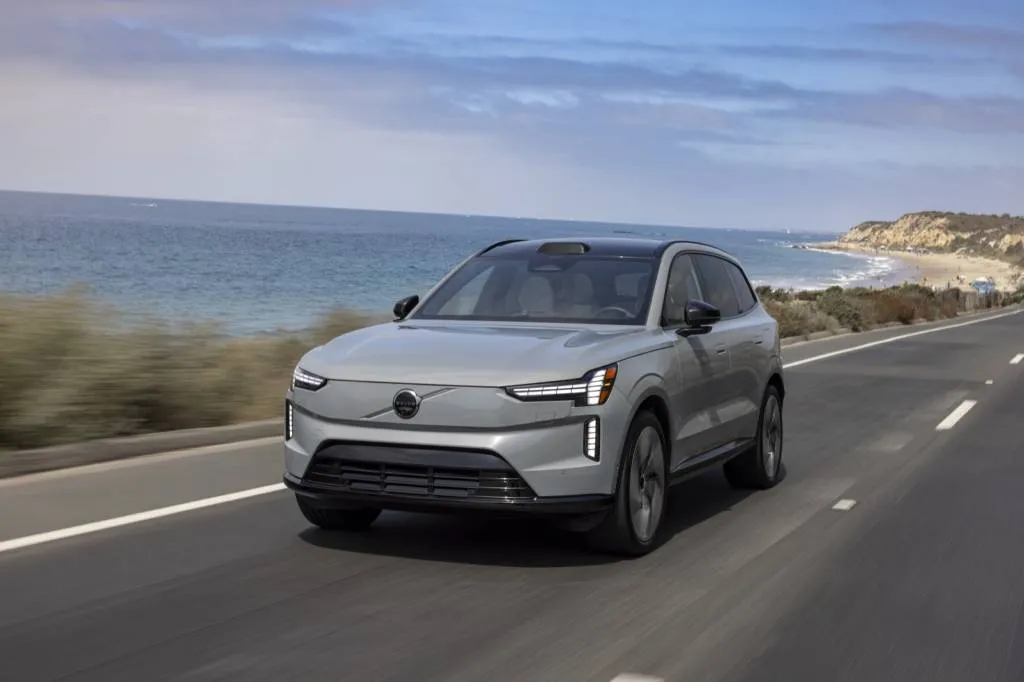
2025 Volvo EX90
Volvo EX90 is efficient, nimble, and quiet
I spent the day with two different Twin Motor Performance versions of the SUV, in the top Ultra trim, both bearing the same $93,345 sticker price. One of them offered a Sand Dune exterior (a very light tan) with a Dawn Quilted Nordico interior, the other a tailored wool blend interior and Vapour Grey exterior. Both of them wore 22-inch five spoke aero wheels.
This is the heaviest, most luxurious EX90 in the lineup, at more than 6,000 pounds by international-market specs, and this brought three pleasant surprises in the driving experience.
First, by early indications, the EX90 is very efficient for a big three-row SUV. I averaged 2.7 miles per kwh on a 146-mile loop including some stop-and-go boulevard driving in Orange County, up and down a demanding mountain road, and some high-speed cruising at a very fast clip. Then on a loop of about 40 miles that included more boulevard driving and some denser, slower-moving afternoon traffic I averaged more than 2.9 miles per kwh.
The EX90’s battery pack uses lithium-ion nickel manganese cobalt cells and adds up to a gross 111 kwh. Volvo has said that usable capacity is up to 107 kwh, so based on what we saw that amounts to a real-world range right around 300 miles, without driving particularly slowly or gently.
Volvo’s official EPA ratings for the EX90 are 310 miles with the 21-inch wheels and 300 miles for models with the 20- and 22-inch wheels.
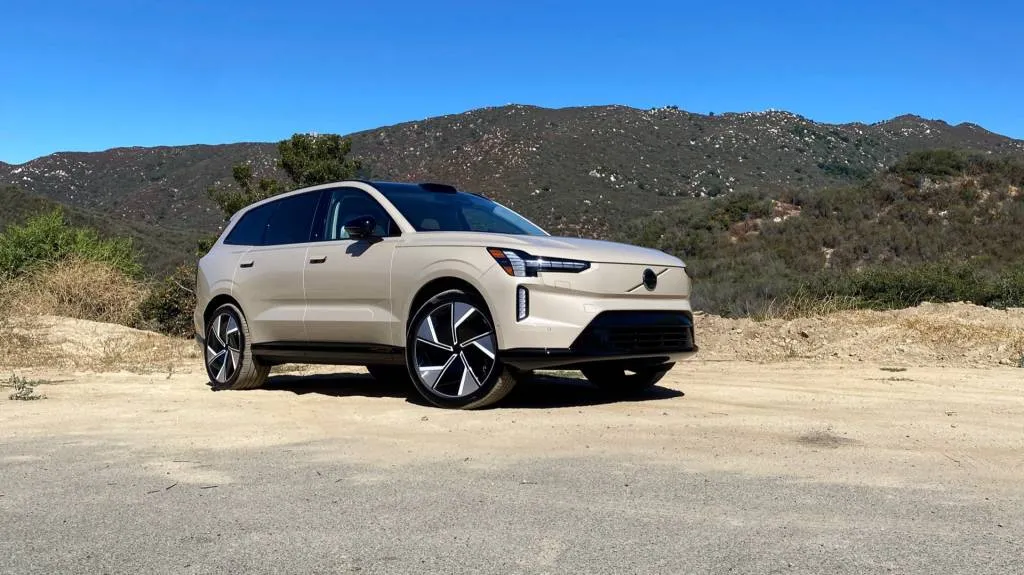
2025 Volvo EX90
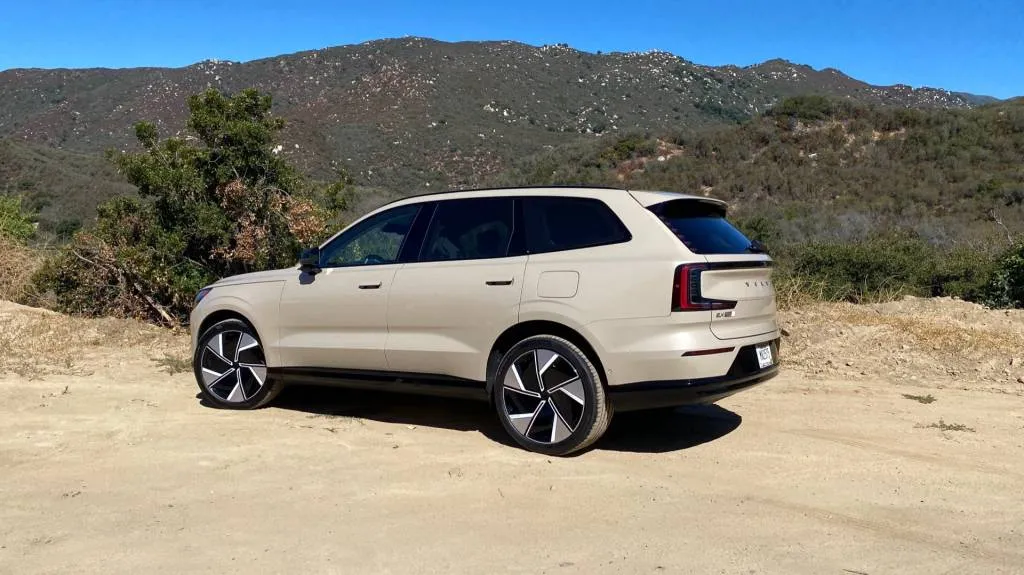
2025 Volvo EX90
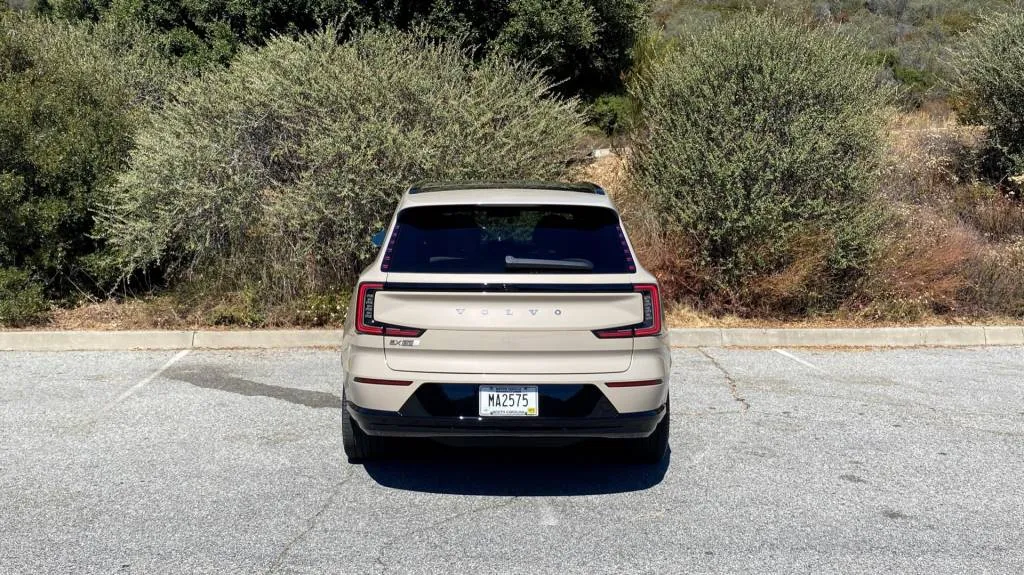
2025 Volvo EX90
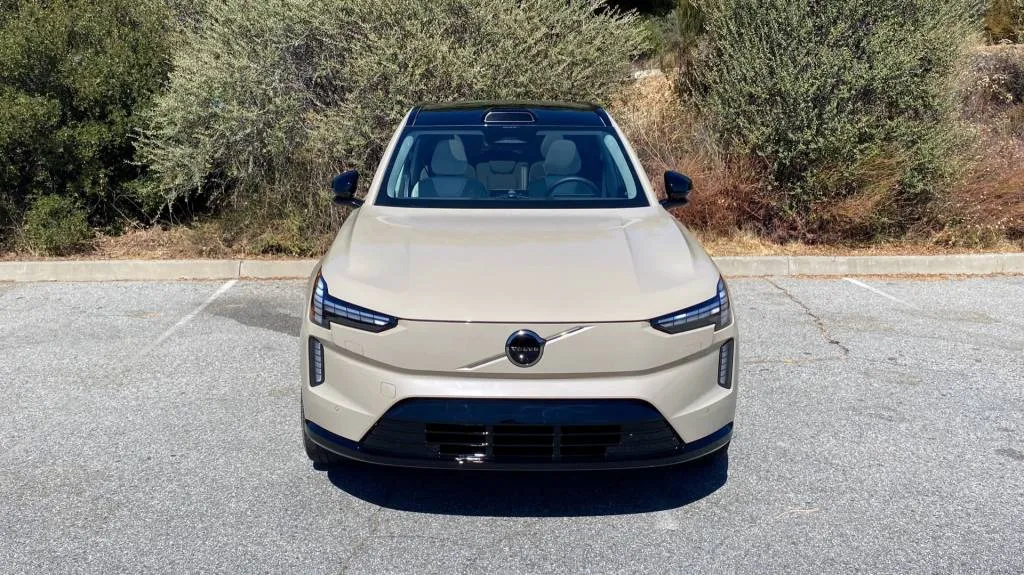
2025 Volvo EX90
The second pleasant surprise was how light and nimble the EX90 drives, considering those three rows and 6,000-plus pounds. Ultra versions—the only kind we drove at this event—include the air suspension as well as semi-active (multi-stage) dampers. Those extra suspension bits aren’t included in more affordable Plus versions, so we’ll need to report back in the future on whether they can maintain such prowess in the corners. In the Ultra, you can select from soft or firm for the steering and suspension, independently, but I settled on soft for both as with that the steering centered more neatly and the suspension still firmed up when needed in tight corners.
The third takeaway, which left me rather awestruck, was simply how quietly the EX90 rides, whether accelerating rapidly, traveling at high speed, or riding on the roughest road we found along our route in mostly smooth Orange County. Hannes Veen, Volvo’s senior manager for propulsion systems, said that the team didn’t use any kind of active noise cancellation or sound manipulation; instead Volvo simply paid a lot of attention to noise insulation and bushings, including fluid-filled mounts for the motor units.
While this is indeed Volvo’s first home-grown “software-defined vehicle,” it’s also home-grown in an engineering sense, with the vast majority of development done around the automaker’s headquarters in Gothenburg, Sweden.
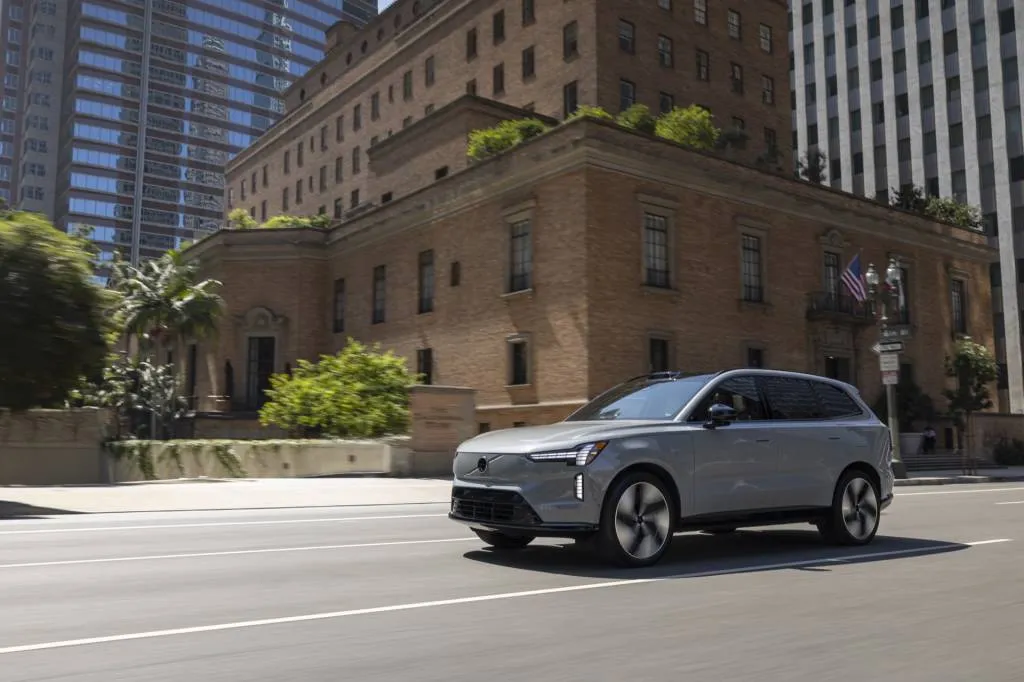
2025 Volvo EX90
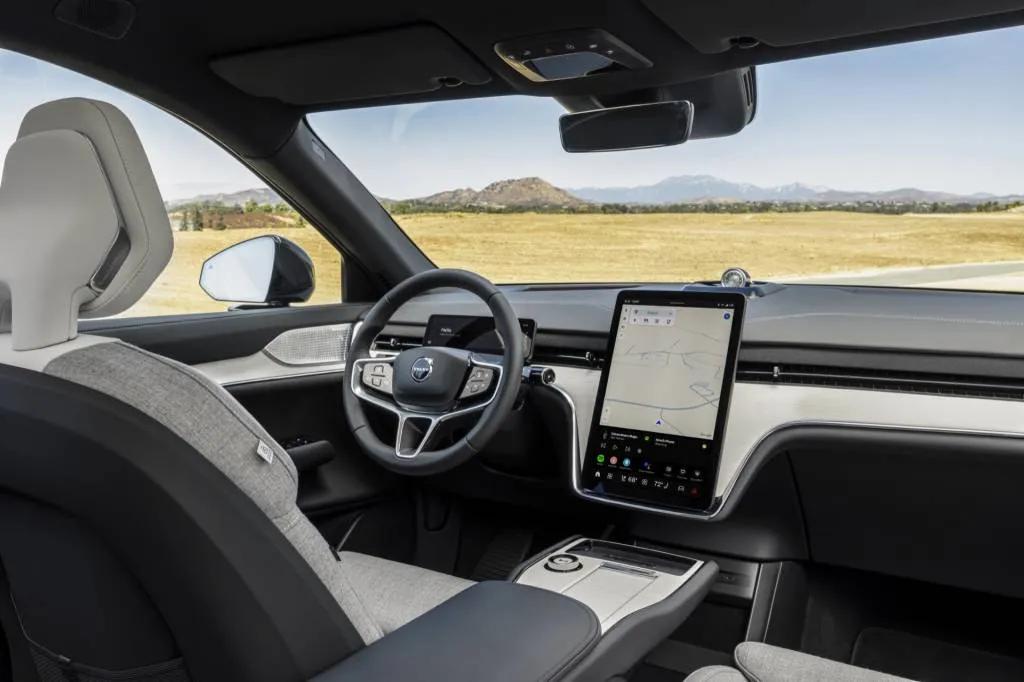
2025 Volvo EX90
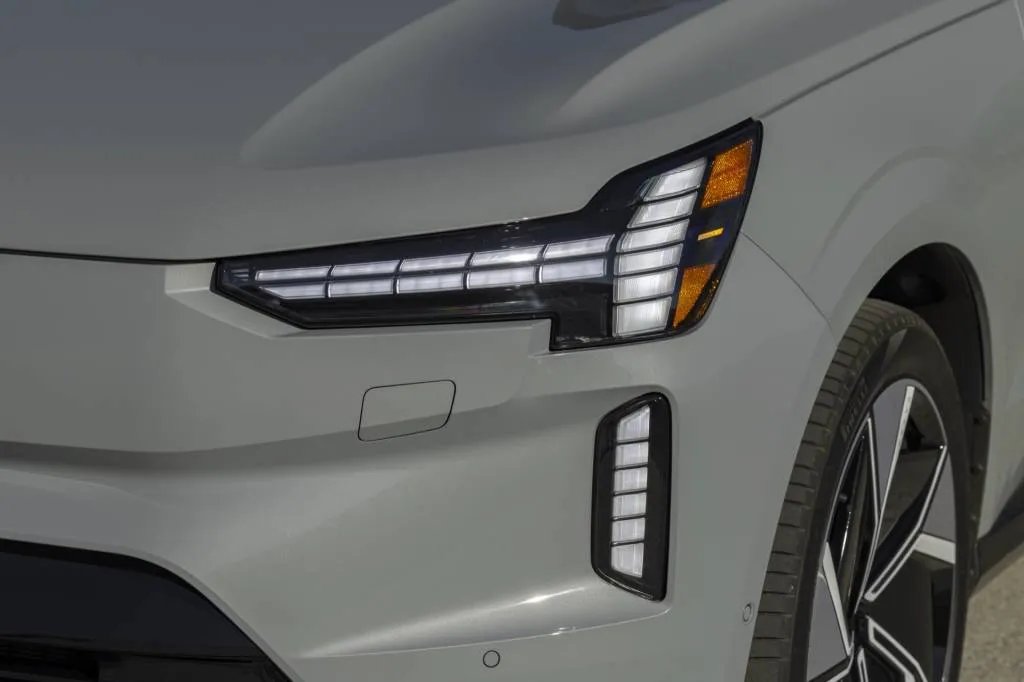
2025 Volvo EX90
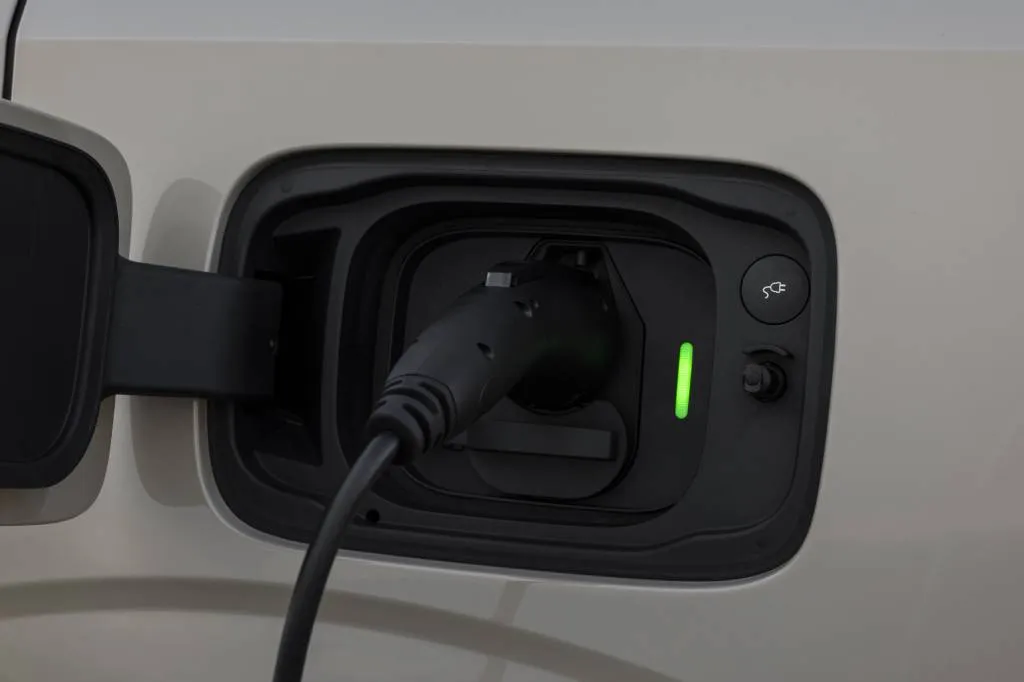
2025 Volvo EX90
EX90 has quick, satisfying performance, with one exception
In its top-trim Twin Motor Performance Ultra form, the EX90 is very quick. As is often the case in larger EVs, it felt even quicker from the front seats than its 0-60 mph time of 4.7 seconds might suggest. While motor units themselves are the same across the EX90 lineup, Twin Motor models make 402 hp and 568 lb-ft of torque combined, while Twin Motor Performance versions offer 510 hp and 571 lb-ft. The EX90 favors the front motor in steady cruising, and much of the time saves the rear motor for quick launches and traction needs. But a Performance AWD mode will access a constant (but still variable) power flow to the rear wheels at 19-81 mph, accessing more balanced dynamics. I couldn’t feel much of a difference, or detect the seamless transition as the EX90 brings its rear motor in and out via a clutch.
The accelerator and steering inputs have a felt precise, but there was one thing missing in the EX90’s otherwise finely fettled dynamics. Volvo has opted to provide just three modes for regenerative braking: off, auto, and on—and the brake-pedal feel in our test vehicles was downright spongy at a standstill, to the point where it was hard to tell when the friction pads were or weren’t making contact.
The “on” setting is a true one-pedal mode. It’s aggressive enough that you may only need to press the brake pedal for unanticipated stops. “Off” brings a coasting/gliding behavior that dials out all the regen and is like Neutral in a gasoline model. The “auto” setting applies a situational approach, relying on sensors, but I simply didn’t have enough drive time to get a sense of that. I was left wanting a middle setting for regenerative braking—one that would gradually scrub speed off more like a gasoline vehicle in Drive or one gear down.
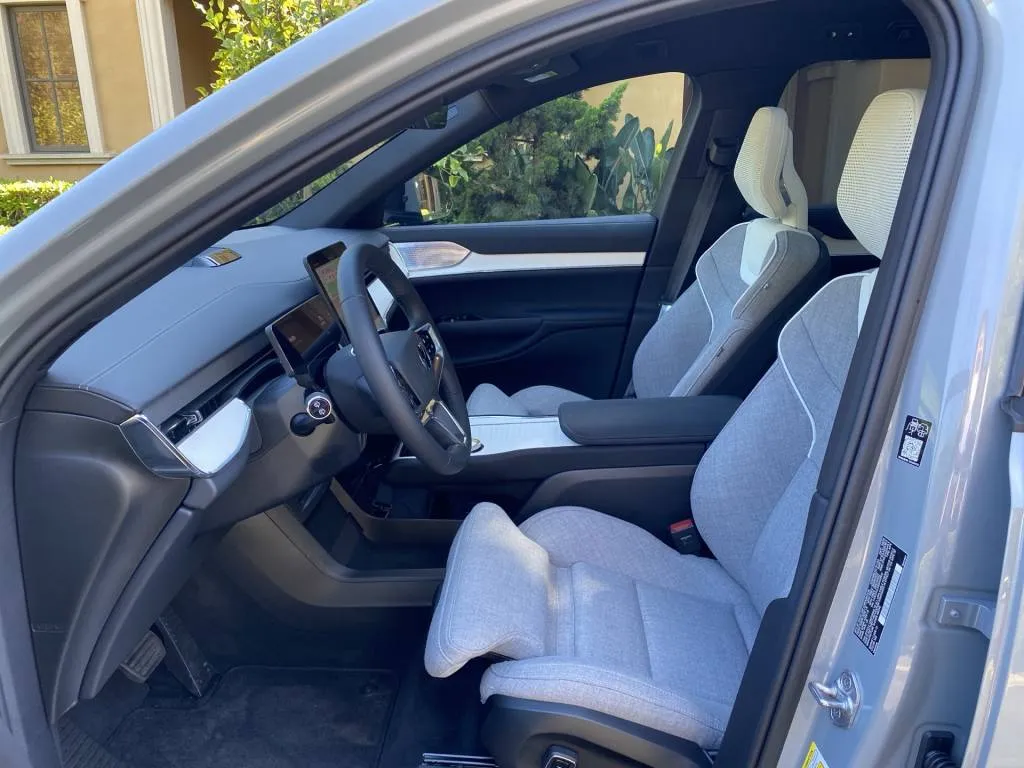
2025 Volvo EX90
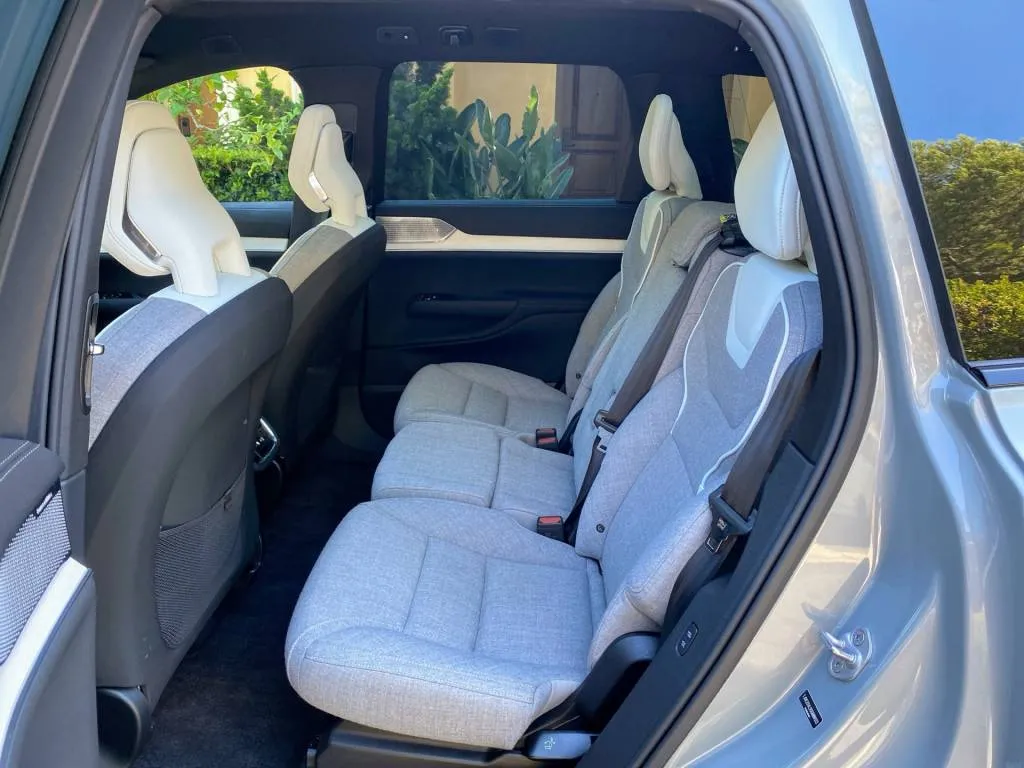
2025 Volvo EX90
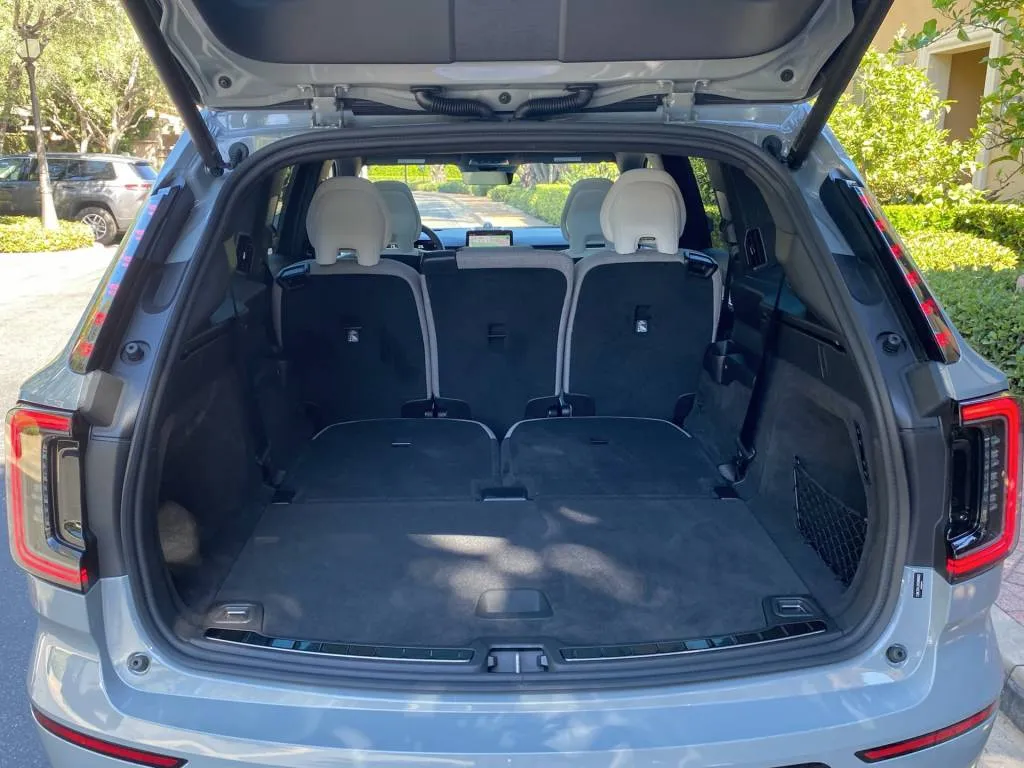
2025 Volvo EX90
2025 Volvo EX90
Volvo EX90 has luxurious seats and space
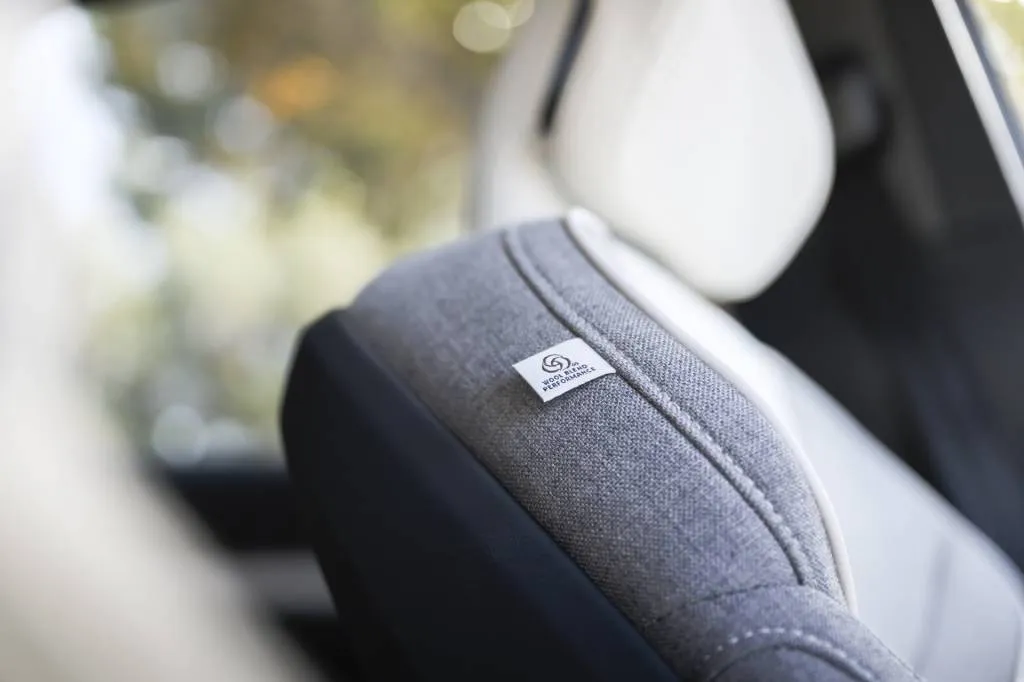
Between the two vehicles I was in, I got to sample Volvo’s two high-end upholstery choices for the EX90. While one of them had the Nordico synthetic upholstery, which mixes in plant products and looks a little easier to clean, my favorite of the two was the tailored wool blend, which mixes in recycled polyester and provides the comfortable yet breathable feel of an outdoorsy wool sweater.
It’s just an easy, comfortable space overall. A wide range of heights and sizes will find no issue fitting into the first two rows, and the second row includes a built-in booster seat for smaller kids. The third row is a pinch for taller people to get into and out of, but we found that 6-footers could fit behind two successive 6-footers in the first and second rows. Front-seat space is vast, and the passenger side has an extended footwell that impresses as a ledge for shoes (even though Volvo told me it’s there for safety).
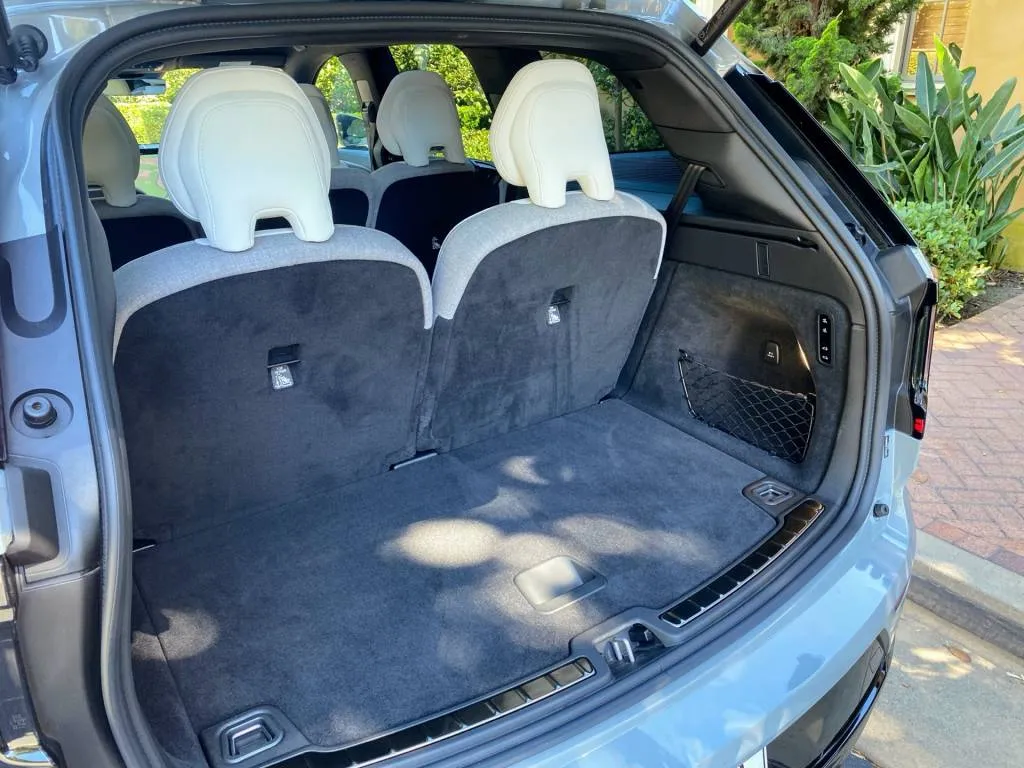
U.S. cargo space measurements aren’t available yet, but it feels decidedly larger in this area than the XC90. The power-folding third row easily taps into 50.2 inches of cargo floor from the back of the second row and potentially more than 80 inches for long items if you fold down the second row. A front trunk sits under the long hood, and while it covers a wide area it’s shallow and too divided-up by hard-plastic partitions to be all that useful.
2025 Volvo EX90
2025 Volvo EX90
2025 Volvo EX90
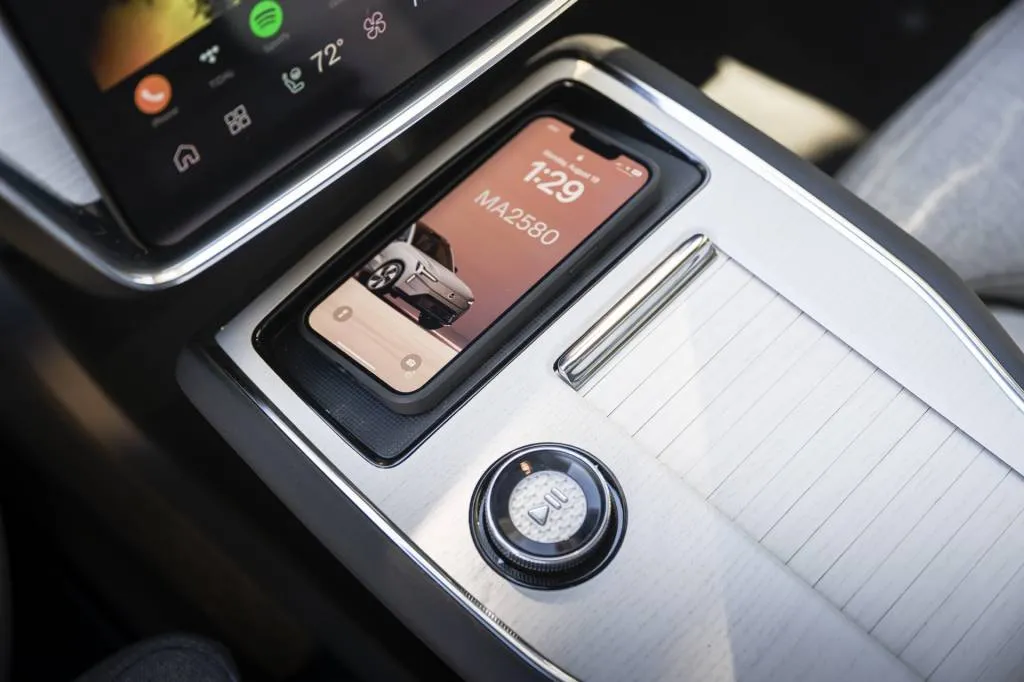
2025 Volvo EX90
Volvo EX90: Lidar, Pilot Assist, V2X to make your world better
Volvo’s safety suite incorporates a lidar sensor for the first time in the EX90, and it gives its active-safety systems a longer, more accurate look at the road ahead. Volvo says that it may help cut severe accidents by 20%.
Pilot Assist is Volvo’s appropriately named driver-assistance system intended to help with freeway driving, and it employs all of the vehicle’s safety sensors while using capacitive sensors to monitor that the driver’s hands are on the wheel. So far, it takes a conservative approach. Engaging it requires a tip down on the shift lever to where the “B” setting would be on some vehicles. Drivers can only take their hands off the wheel for 14 seconds, and while one hand can be on the wheel while cruising along, both hands need to be on the wheel before it provides an assisted lane change. That sort of defeats the purpose, I found, and it’s so cautious that it’s not a feature you’ll be using in traffic.
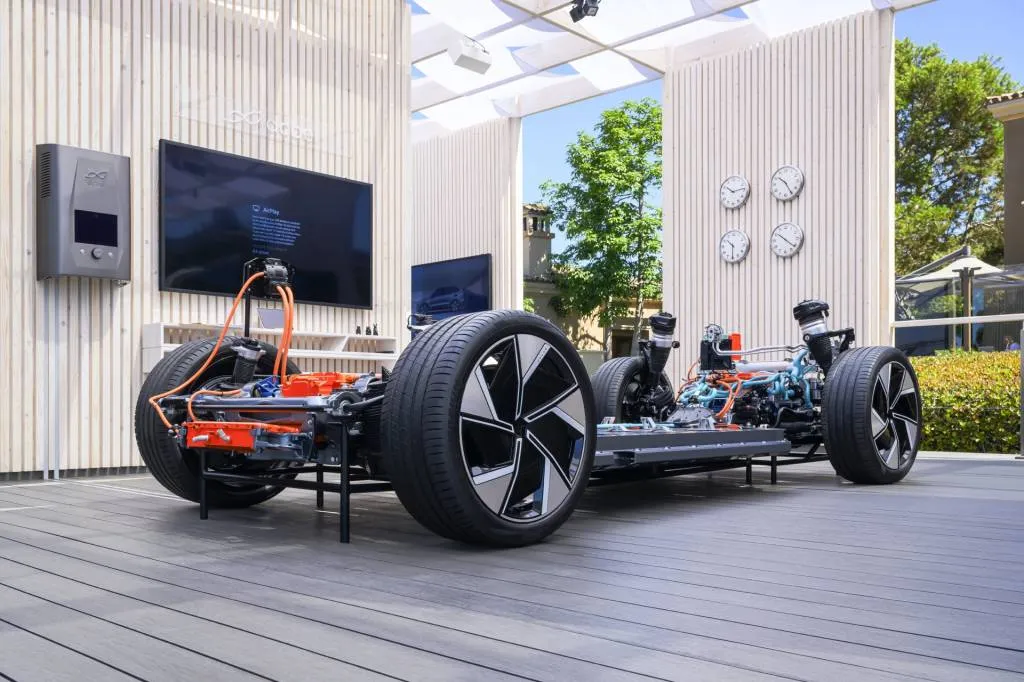
dcbel bidirectional charger for 2025 Volvo EX90
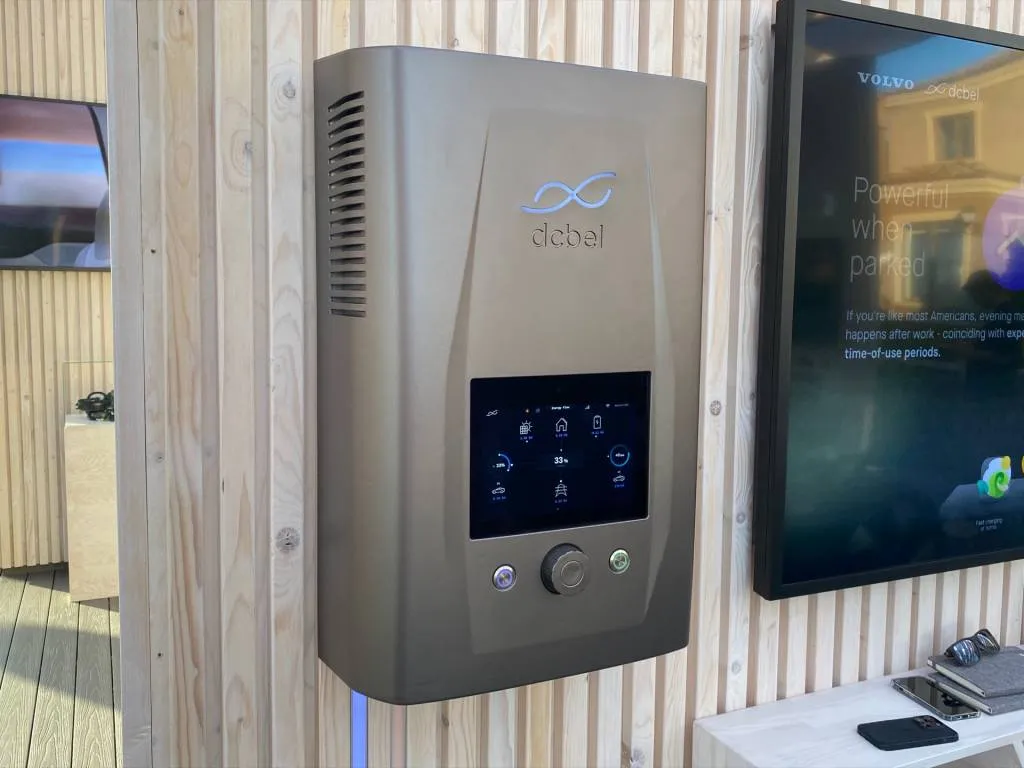
dcbel bidirectional charger for 2025 Volvo EX90
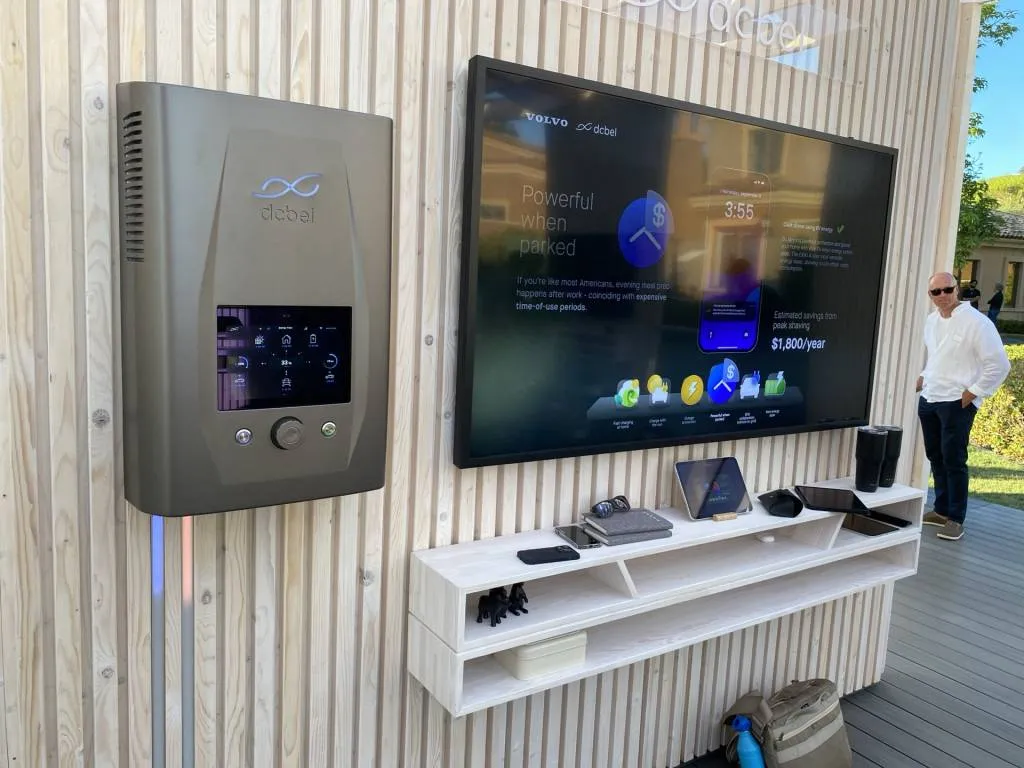
dcbel bidirectional charger for 2025 Volvo EX90
Bidirectional charging is coming in the form of a DC unit from Volvo partner dcbel that will operate at up to 25 kw depending on the situation and is capable of backing up the home, peak-shaving, or sending power back to the grid. More details are coming soon.
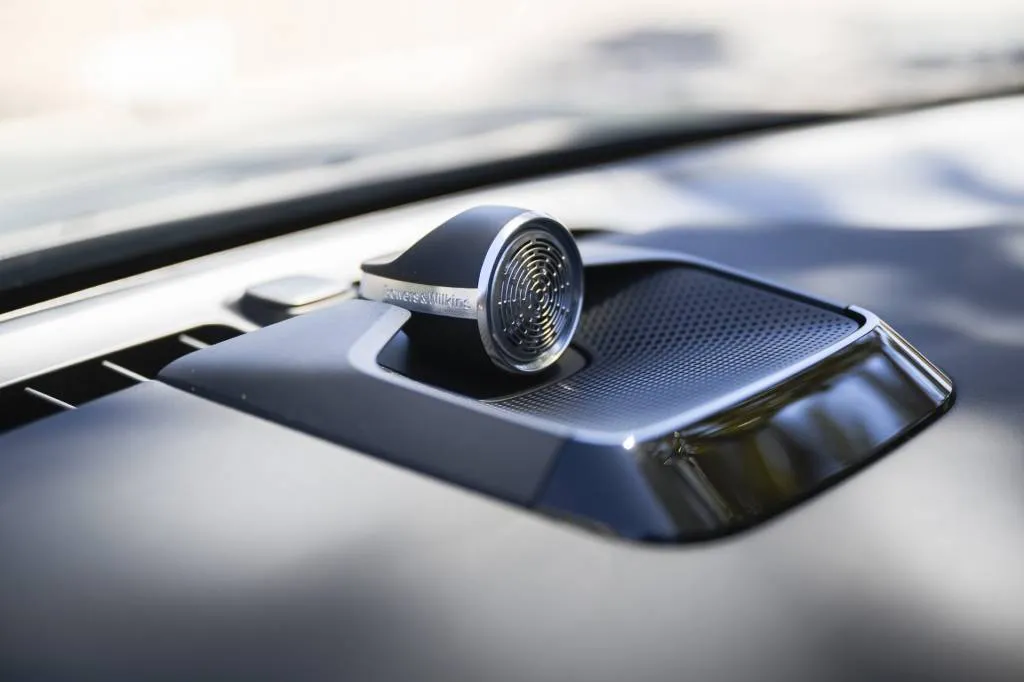
Now the hard part: The 2025 Volvo EX90, as I tested it in Ultra trim, with the optional Bowers & Wilkins audio system and 22-inch wheels, costs $94,640, including the $1,295 destination fee. The starting price for the EX90 is $81,290. That’s about $6,000 higher than the top-spec, all-wheel-drive Kia EV9 GT-Line, another three-row SUV that supports bidirectional charging. It appears that the EX90 will not qualify for the EV tax credit, at least initially.
Ultimately it feels like Volvo has kept its priorities straight. The EX90 is a completely new kind of vehicle on the inside and innovates in a long list of thoughtful ways. Those who get it won’t feel a need to shout that out.
Volvo paid for travel expenses so that we could bring you this test drive review.

Armored Lucid Air Sapphire goes bulletproof for $475K
The tri-motor Lucid Air Sapphire provides a quick means of escape from trouble, but should no escape route be available, there’s now an armored version as well.
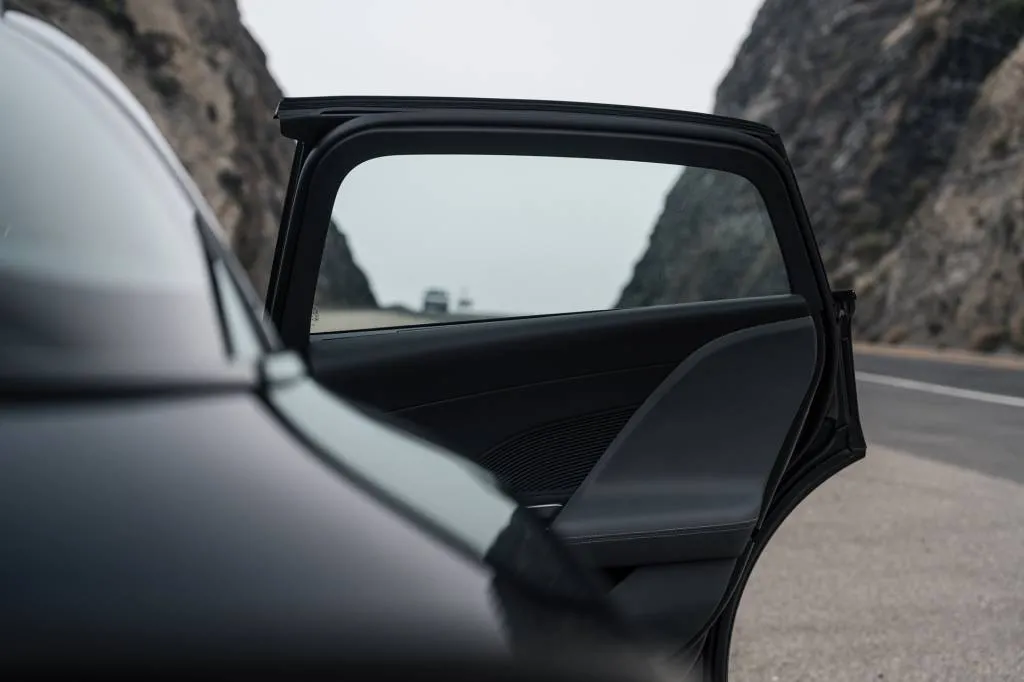
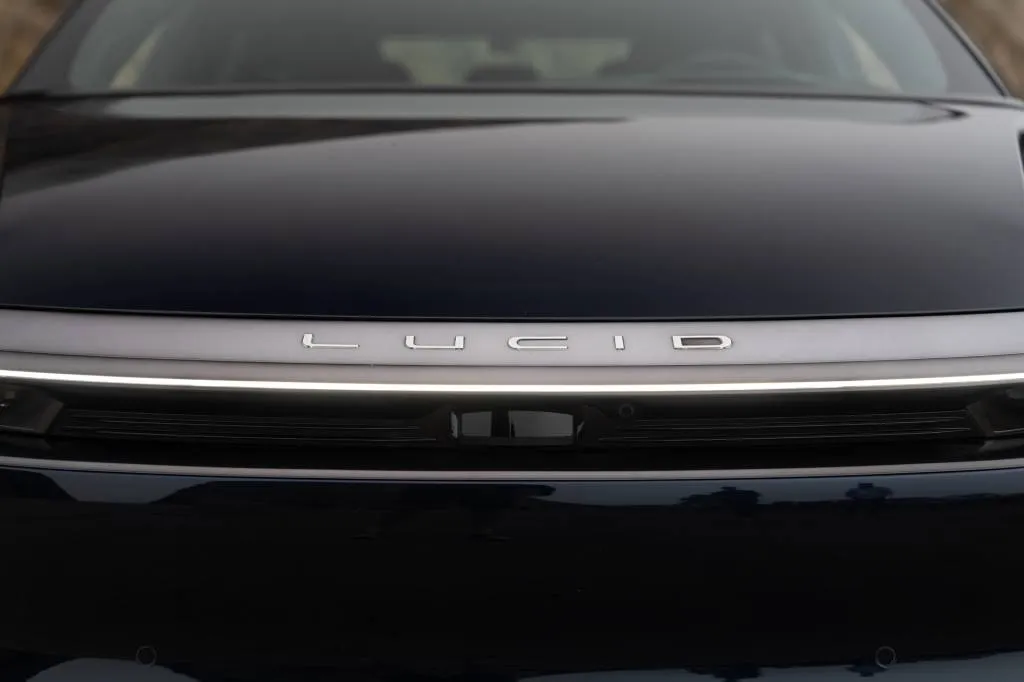
California-based U.S. Armor Group has made the electric luxury sedan bullet-resistant. The company will outfit an Air Sapphire with composite armor that it claims is 10 times stronger than ballistic steel, but five times lighter. Bullet-resistant material also replaces the factory glass, and is strong enough to stop a round from a .44 Magnum, the company claims. The armor package adds 385 pounds to the Sapphire’s curb weight.
Armored Lucid Air Sapphire by U.S. Armor Group
U.S. Armor Group can also add countermeasures like electric-shock door handles, pepper spray dispensers, concealed gun ports, and mechanisms for detecting and protecting from poison gas. Further armor upgrades are also available to stop round from high-powered rifles, as well as grenades and other explosive devices.
Cars can also be fitted with a secure communications system that also continuously monitors nearby fire department and police scanners for potential threats, and includes a one-touch call feature that directly connects to the U.S. Armor Group if any issues with the communication system arise.
Armored Lucid Air Sapphire by U.S. Armor Group
With the 1,234 hp and 1,430 lb-ft of torque, the Sapphire is the most powerful sedan in the world—electric or otherwise. Lucid quotes predictably impressive performance numbers, including 0-60 mph in 1.89 seconds and a 205-mph top speed. While it’s not as efficient as other Air models, the Sapphire also manages 427 miles of EPA range, surpassing the longest-range version of the Tesla Model S.
The armored version costs $475,000, which is a big step up from even the $249,000 price of a non-armored Lucid Air Sapphire from the factory. But the target customer likely has a deep well of stock dividends or a national gross domestic product to fund their purchases.

Kameale Terry on what we don’t know about charging reliability (Episode 266)
The CEO of ChargerHelp weighs in on the industry’s inaccurate uptime calculation and what issues actually underlie charger unreliability.