
Category: General

Ford giving EV buyers free home charger and installation
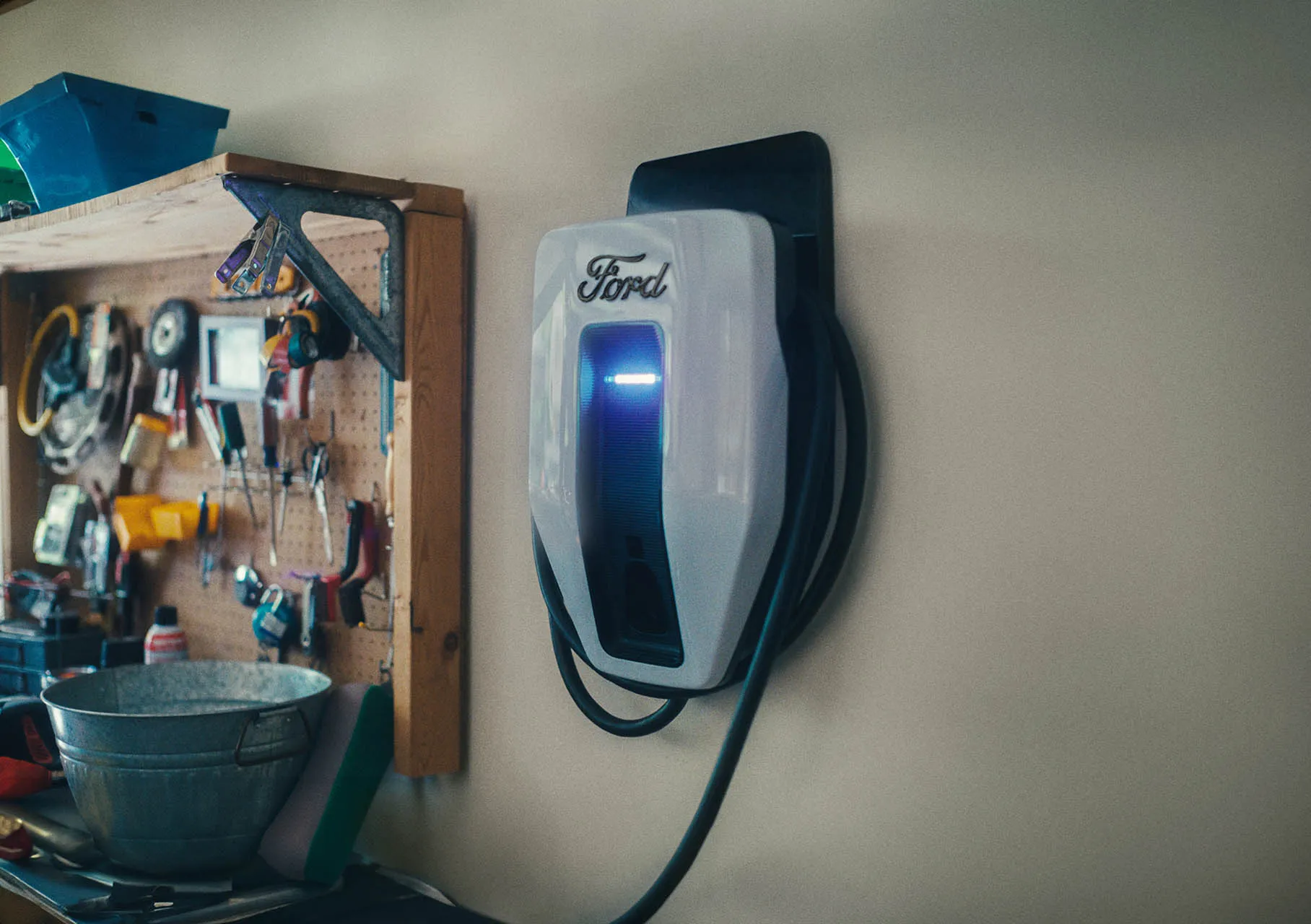
Ford’s aiming to make life easier and less confusing for EV buyers.
On Monday, Ford CEO Jim Farley posted on LinkedIn that the automaker will be providing a free home charger, along with installation, to its buyers that buy or lease a Mustang Mach-E, F-150 Lightning, or E-Transit.
Farley said the complimentary Level 2 home charger will either come with the vehicle or can be delivered when buyers are ready. Ford will arrange to have a professional install the charger for buyers at no charge.
The free charger install needs to be considered a “standard install, which Ford said means completed at a residential property with a dedicated electrical meter, circuit of up to 60 amps, and wiring that will only need to run up to 80 feet.
Recently, Farley took long road trips in EVs both across Western U.S. and Europe. The takeaway, according to Farley, is consumers are looking for “convenience, peace of mind and expert service.”
Farley said Ford’s learned home charging is important to overall electric vehicle adoption in the U.S. and nearly 90% of shoppers said they’d be more likely to buy an EV if they knew they could charge at home. Where, who, and at what cost is confusing to consumers, according to the executive. This latest incentive takes the guesswork out of the home charging situation in Farley’s view.
Ford was the first automaker to address the public charging infrastructure issue outside of Tesla, by partnering with Tesla. In 2023 Farley and Tesla CEO Elon Musk announced Tesla’s Superchargers would open to Fords. Farley also committed that Ford would adopt Tesla’s NACS charge port in future EVs.
Earlier in 2024 Ford began delivering CCS to NACS adapters free of charge to F-150 Lightning and Mustang Mach-E owners as Tesla opened its Supercharger network up to Ford EV owners.
Note – This story was updated with clarification on what Ford considers a standard installation

First 24/7 Manhattan EV fast-charging site vies for Uber drivers
Revel on Thursday opened what the company claims is New York City’s first electric vehicle fast-charging site open 24 hours a day, seven days a week.
Located at Pier 36 in the Lower East Side section of New York’s Manhattan borough, the site features 10 320-kw DC fast-chargers from Finnish company Kempower, according to a Revel press release. The site, which brings Revel’s total number of New York City fast chargers to 64, is off FDR Drive, the main highway running along the east side of Manhattan.
Revel claims the 320-kw chargers “will offer the fastest charging experience in New York City,” but a Manhattan site opened by Gravity earlier this year west of the Revel location claims to provide charging at up to 500 kw.
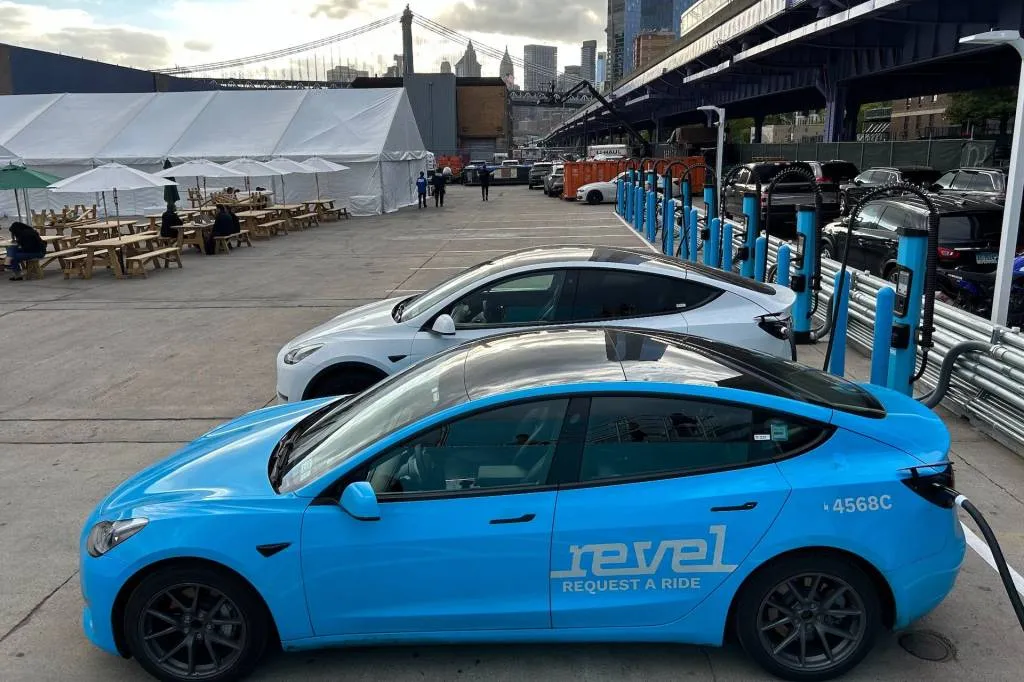
Revel DC fast-charging site at New York City’s Pier 36
While the Gravity site may see more mixed use, the Revel fast-charging site at Pier 36 will likely be used primarily used by ridesharing drivers, both from Revel’s own service and Uber. Earlier this year, Revel and Uber launched a partnership that gives Uber drivers a 25% discount at Revel chargers, while Uber guarantees a minimal rate of utilization at existing and future Revel charging sites.
Revel has had a confusing trajectory, shifting from electric mopeds under its original iteration five years ago to rideshare a couple years ago and now earlier this year just charging. The company now aims to expand its New York City charging network to 300 chargers by the end of 2025, including a 60-charger site in the borough of Queens and a 48-charger site at LaGuardia Airport, also located in Queens.
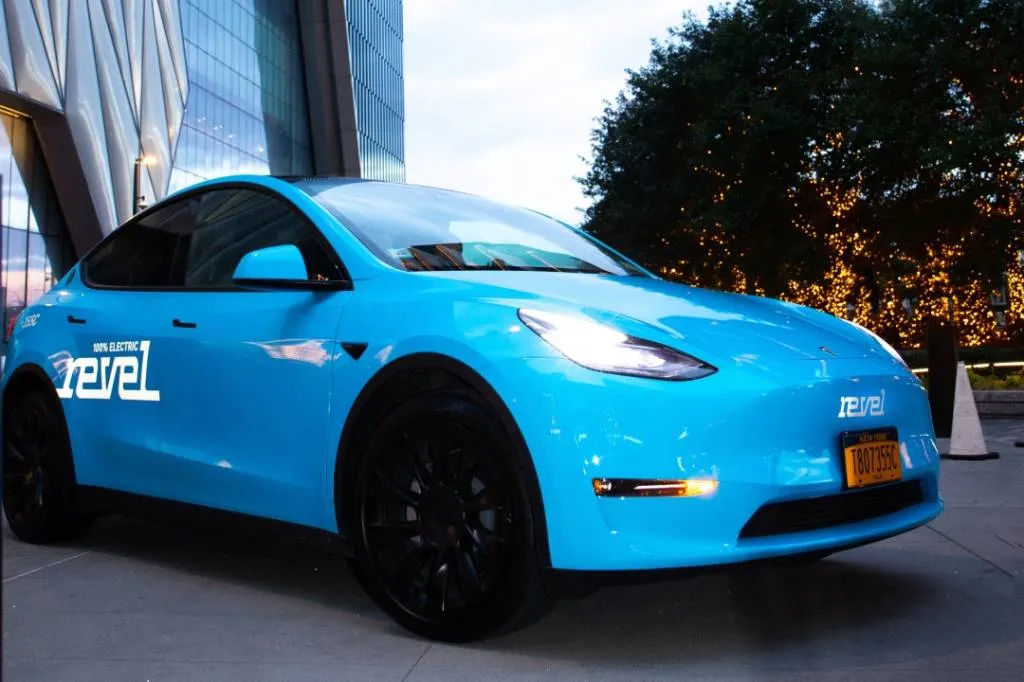
Revel rideshare service
Revel claims utilization of its charging sites has increased tenfold in the last year as a result of New York City’s Green Rides initiative, which aims to make the city’s rideshare fleet fully electric by 2030. Uber also targets all-electric rides wherever it operates by that year.
The opening of Revel’s new fast-charging site follows an announcement by New York’s largest parking operator just this past month of plans to equip 5,000 parking spots with Level 2 charging. These slower chargers will likely prove more useful for residents’ private cars rather than rideshare vehicles, though.
New York City had electric taxis in the ’90s—the 1890s, that is—but with last decade’s taxi of tomorrow push shunning EVs, it’s been a surprisingly long adoption curve for one of America’s densest cities. More public fast chargers could lay the groundwork for making the fleet of yellow cabs greener.

Bentley CEO says luxury market rejects electric cars
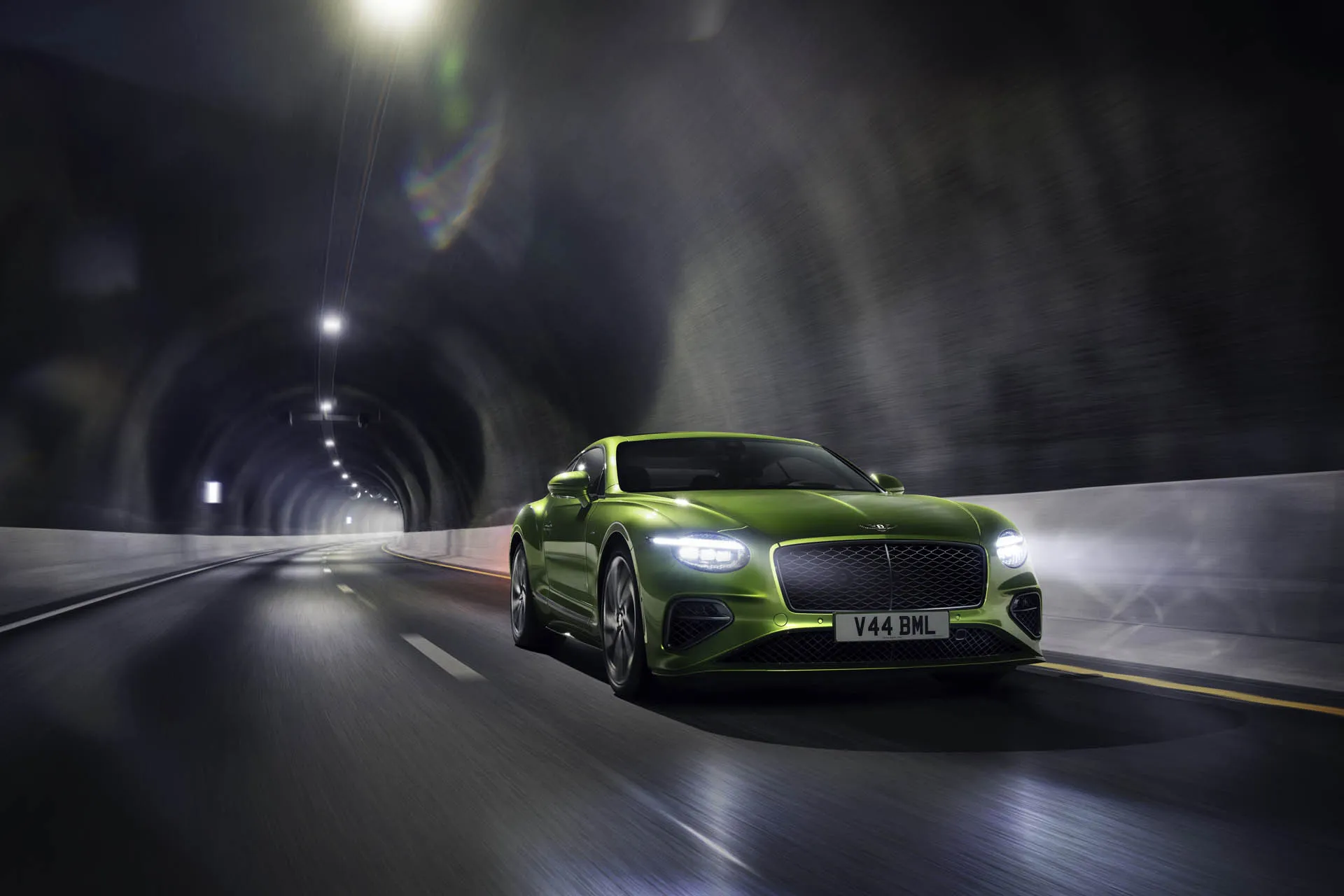
The Volkswagen Group ultra-luxury brand Bentley appears to have cooled even more on EVs.
As its CEO Frank-Steffen Walliser recently told Car and Driver “what we see in the luxury market right now (is that) people reject electric cars.” Wealthy consumers “consider luxury cars only with a combustion engine,” the executive claimed.
In 2020, Bentley laid out plans to make its entire lineup plug-in hybrids by 2026 and all-electric by 2030. The luxury automaker’s first EV was going to roll off the assembly line in 2025, according to Bentley in 2022.
After a change of plans, Bentley’s in the process of turning over its lineup and moving to plug-in hybrid V-8s replacing the former W-12 engine. The W-12 engine won’t be revived and is dead for good, according to Walliser. The automaker’s first EV is now set to debut in 2026 with a market arrival in 2027.
Walliser noted that Bentley is too small an automaker to afford simultaneous ICE and EV versions of the same car as Mercedes and BMW have been doing. Plug-in hybrids make sense and are more than a novel bridging technology in the executive’s eyes.
While the executive won’t commit to a Bentley offering only plug-in hybrids, he’s bullish on e-fuels. Walliser was an executive at Bentley’s sister company Porsche before being named CEO of the luxury automaker in July.
Bentley may continue producing non-hybrid gasoline cars, though those might be limited-production models only, according to Walliser.
Bentley’s main competitor Rolls-Royce is doubling down on EVs. The luxury rival already launched its first EV known as the Spectre, and an electric SUV and sedan are set to arrive in 2027 and 2028 respectively. Rolls-Royce committed to go all-electric by 2030 and remains steadfast with that plan.

Navigating the path toward developing software-defined vehicles (Episode 270)
False starts and missteps define the auto industry’s initial attempts to build software-defined vehicles. In this panel discussion from Automotive News Congress, experts detailed the right way to prioritize software and unlock its transformative potential.

Rivian CEO saddened EVs became political

GM and Rivian’s CEO have something in common, based on comments made in recent days: Neither thought EVs would become a political lightning rod.
On Thursday while speaking at the New York Times’ Climate Forward event Rivian founder and CEO RJ Scaringe said “I think it’s really important that we don’t make EVs a political thing, and I’m saddened that they are.”
“It doesn’t make any sense that they are,” Scaringe said.
But EVs have become political. Election 2024 has two candidates with very different stands on EVs, climate science, and democracy itself. Trump plans to gut EV policy. Harris backed the proposed Green New Deal and was a key figure behind VW’s emissions-cheating scandal.
[embedded content]
Pushing back on EVs has, in this last term of Congress, become a Republican position point beyond the top office in the nation—even though polling has pointed out Republicans’ aversion to EVs may be a generational one.
To that point, and veering away from the pull of partisanship, Scaringe offered that “the beauty of that is that whether you’re on the right or the left you care about creating a better future outcome for your kids.”
Asked specifically about the reasons behind why EVs have become such a partisan issue, Scaringe pointed to how a “massive amount of misinformation exists on electrification,” related to a lack of understanding of the battery supply chain and the scale of the challenge.
Scaringe isn’t alone in expressing a level of surprise over the pushback related to EVs and clean energy. On Sunday GM CEO Mary Barra told Kris Van Cleave during an interview “I never thought the propulsion system on a vehicle would be (a political) issue.”

Here’s how you can help Consumer Reports rate public charging
- Data from Chargeway users will be used for Consumer Reports EV charging ratings
- The Chargeway app provides advanced route planning and more
- What Chargeway provides to CR will be anonymous by user
Consumer Reports hasn’t yet evaluated electric vehicle charging on anything like the scale the organization does when looking at the reliability of EVs. But with a series of partnerships announced Thursday, the consumer advocacy giant might be able to get a more comprehensive look at the reliability of public charging.
The effort, called the EV Charging Community, engages with a series of EV advocacy groups, including Plug In America, GreenLatinos, and Generation 180, plus via a technical partnership with Chargeway, one of the apps recommended by Green Car Reports for tapping into the route-planning smarts some EVs lack.
Chargeway calls itself a software company, and it’s evolved to include a range of EV charging aspects, but it’s best known for the color-coded graphics it launched back in 2017 to help users identify EV chargers by output at a glance.
Under the new partnership, once a user reviews a charging station on the Chargeway app, the network, station location, and vehicle model charged will be sent to Consumer Reports, with the option to send advanced reporting info including power, arrival/departure state of charge percentage, and more. All this will be anonymized, as only the ratings, charging data, and feedback on a per-session basis will be shared with Consumer Reports, not the Chargeway users’ personalized data.
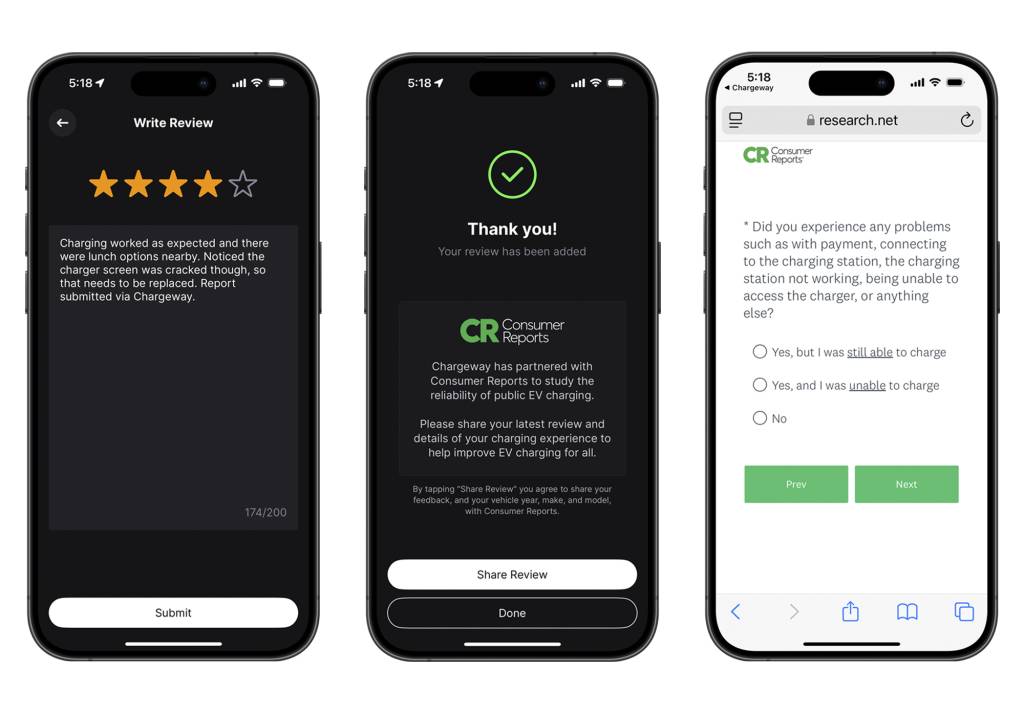
Chargeway partnership with Consumer Reports for charger reliability
According to Chargeway, data submitted through the app will then be used by Consumer Reports for “creating a rating and reporting system for public EV charging experiences to be shared with charging networks, automakers, policymakers, and the public. This will provide EV drivers a platform to improve public charging experiences and help create accountability throughout the industry.”
“Charging stations are critical services, but when they’re out of order or barely functional, it wastes consumers’ valuable time,” said Drew Toher, Consumer Reports’ sustainability campaign manager.
CR says that it’s already seen 27% of its 1,600 enrolled community members, in the early stages of this effort, have experienced a problem with public charging. As Consumer Reports pointed out, members of the public who don’t use Chargeway can also enroll to be part of the community at this link.
“Now, instead of posting complaints on social media and feeling ignored, EV drivers can use the Chargeway mobile app to provide their feedback to the leading consumer advocacy organization,” said Chargeway founder Matt Teske, in a release about the partnership, adding that Chargeway shares CR’s goal “to give drivers a voice in the public EV charging reliability conversation.”
Individual EV drivers might have good reason to feel that’s been sorely missing, as failed charging attempts and bad experiences, responded to with token direct messages, often don’t appear to trigger repairs or resolution of issues.
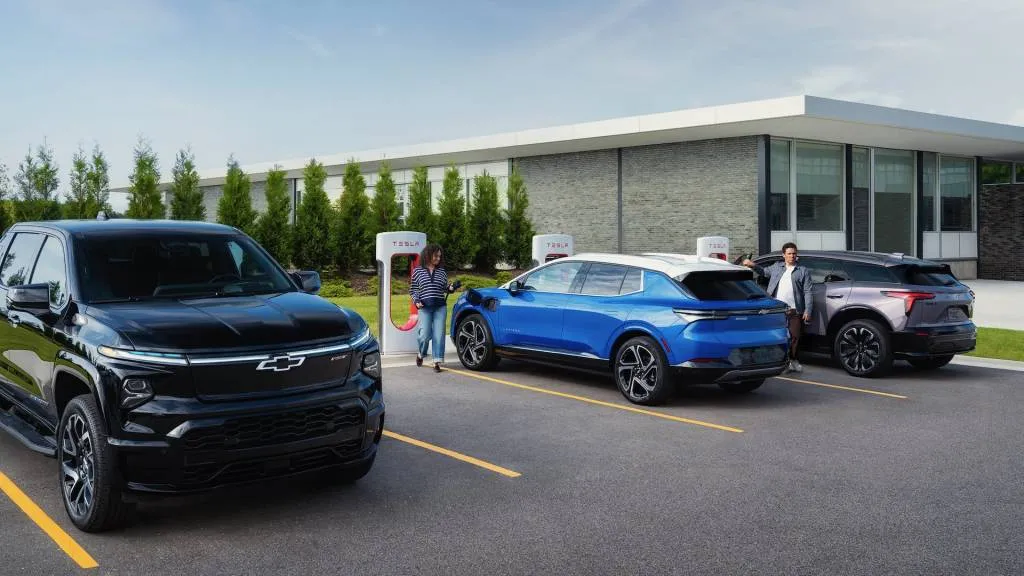
Chevrolet EVs at a Tesla Supercharger station
What’s more, hands-on equipment problems also appear to be a growing portion of issues. The ChargeX Consortium, created in 2023 by the federal government to help tackle EV charger reliability ahead of the rollout of $7.5 billion in charging infrastructure, reported last year that one of the issues was confusion over a lack of charger error code standardization across EV chargers. J.D. Power, in its most recent study of EV charging satisfaction, found it improved in interface aspects, although inoperable chargers still affected 61% of failed charging attempts.
The reporting feature has been added to updated versions of the Chargeway app available now for iOS and Android.

Hyundai and Kia seek to cut LFP battery cost, reliance on China
- Process could cut costs and reduce emissions in making LFP cells for EVs
- It lays the foundation for greater LFP manufacturing in South Korea, outside China
- Chinese suppliers also continue to innovate on a battery type they championed
Hyundai and Kia this week launched a project to develop cheaper cathode materials for lithium iron phosphate (LFP) batteries that could also reduce reliance on Chinese battery suppliers.
The project aims to develop a new production process for LFP cathode material, the two automakers said in a press release. Instead of adding lithium to “precursor materials” like phosphate and iron sulfate, as in current LFP production, a new “direct synthesis” process would combine iron powder, phosphate, and lithium without the precursor step, Hyundai and Kia explained.
Eliminating this step from the manufacturing process will cut costs and reduce emissions of hazardous substances, lowering the environmental impact of the battery-production process, the automakers claim. It’s also being developed in South Korea, by South Korean companies, laying the foundation for greater LFP battery cell manufacturing in that country.
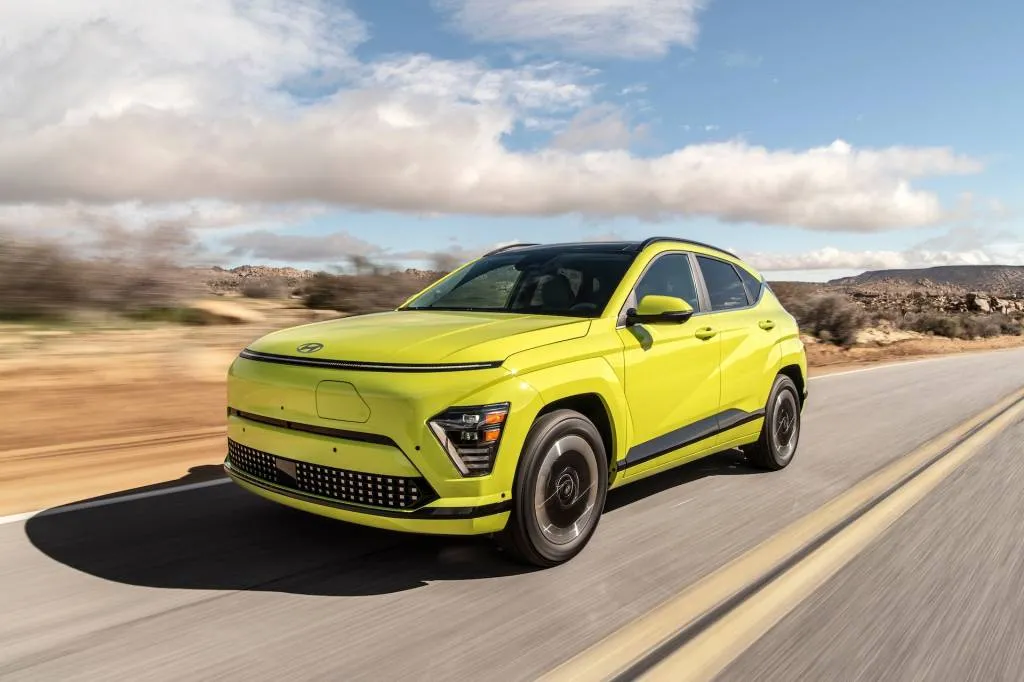
2025 Hyundai Kona Electric
This news comes nearly a year after Hyundai announced a two-year joint venture to develop LFP batteries in its home South Korea and lessen dependence on Chinese battery suppliers for them—with the aim to achieve affordable LFP cells that bypass China.
LFP battery tech originated in the U.S., but U.S. companies abandoned it for lack of a near-term payback, while it’s been refined over the past two decades by several Chinese companies. Now it’s used in the base Tesla Model 3 and Ford Mustang Mach-E, which don’t qualify for the EV tax credit because of those versions’ Chinese content.
Roughly one-fifth of the world’s batteries for EVs are LFP. They’re not as dependent on nickel and cobalt, and they’re less prone to overheating, thermal runaway, and heat-related degradation. Currently China’s BYD and CATL hold most of the world’s manufacturing capacity for LFP. Although Ford, for instance, plans to make some in Michigan, cells will be made at a Ford-owned factory with Chinese production methods.
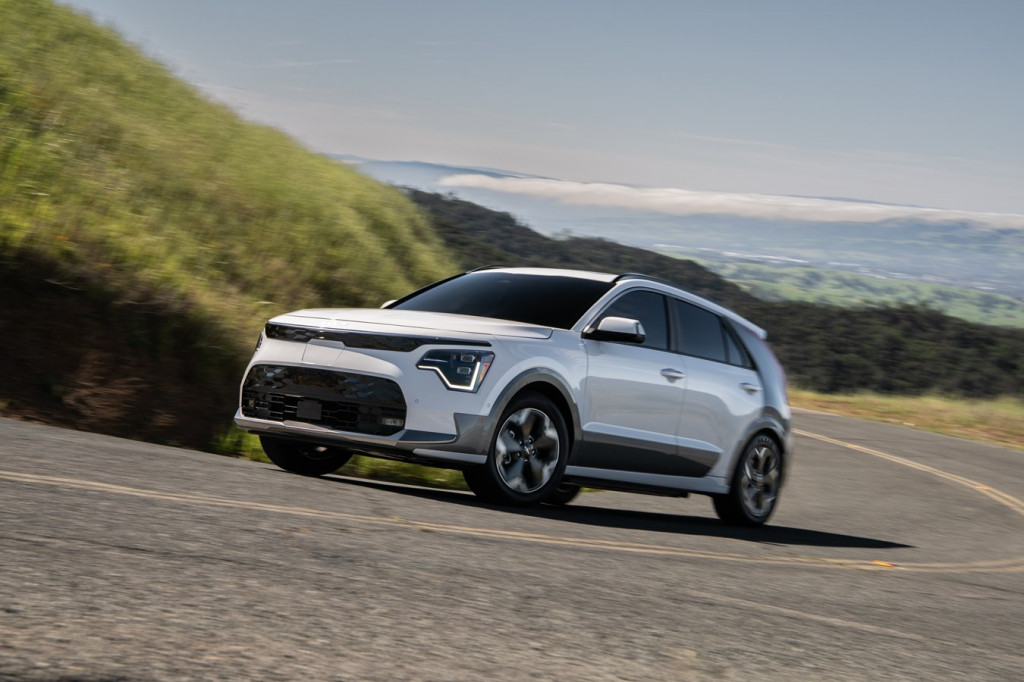
2023 Kia Niro EV
General Motors has also confirmed that the next-generation Chevrolet Bolt EV, due in 2025 as a 2026 model, will use LFP cells. They could be key in making the Bolt EV GM’s most affordable EV, as promised.
Meanwhile China continues to innovate on the LFP battery type. China’s GAC introduced LFP cells with a 20% boost in energy density last year, and CATL claims next-gen LFP cells that can add 250 miles of range in 10 minutes.

2025 Audi Q6 E-Tron costs $65,095, has up to 321 miles of range
- The 2025 Audi Q6 E-Tron arrives at dealers in the U.S. later this year
- Q6 E-Trons have up to 321 miles of range
- The Q6 E-Tron costs between $65,095 and $80,595.
Audi this week confirmed pricing and EPA electric range for the 2025 Q6 E-Tron, which is scheduled to arrive at U.S. dealerships before the end of the year.
Pricing starts at $65,095 (all prices include a $1,295 destination charge) for the Premium grade with the single-motor rear-wheel drive powertrain. Premium Plus and Prestige grades are also available at $68,895 and $71,895, respectively. A dual-motor all-wheel drive powertrain is also available for an additional $2,000.
However, you’ll need rear-wheel drive to achieve the maximum EPA-estimated range of 321 miles, which only applies to single-motor models with the Ultra Package and 18-inch wheels. All-wheel drive models max out at 307 miles of range.
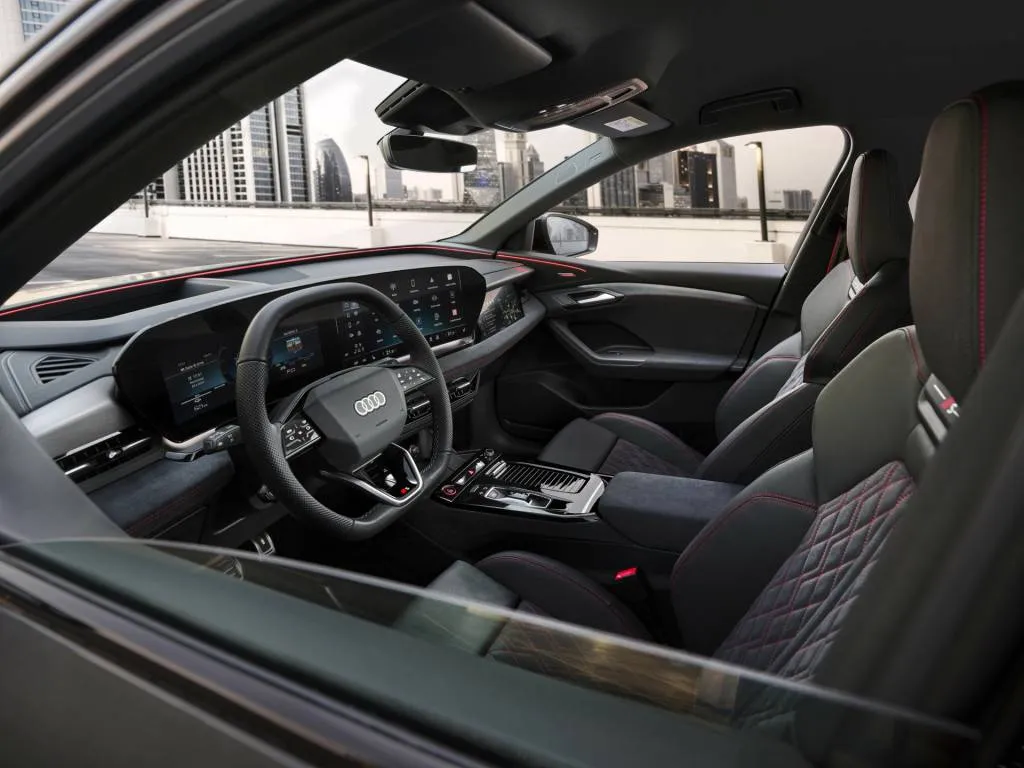
2025 Audi Q6 E-Tron
All models have a 100-kwh battery pack (94.4 kwh usable), and considering that, Audi is delivering on its promise of greater efficiency compared to previous EVs like the Q8 E-Tron.
Dual-motor models up output to 456 hp, compared to 322 hp for single-motor models. That results in estimated 0-60 mph times of 4.9 seconds for dual-motor models and 6.3 seconds for single-motor models.
The lineup also includes a sportier dual-motor SQ6 E-Tron variant, priced from $74,195 in Premium trim and $78,595 and $80,595 in Premium Plus and Prestige trim, respectively. The 509-hp SQ6 boasts a quicker 0-60 mph time of 4.1 seconds, but range drops to 275 miles.
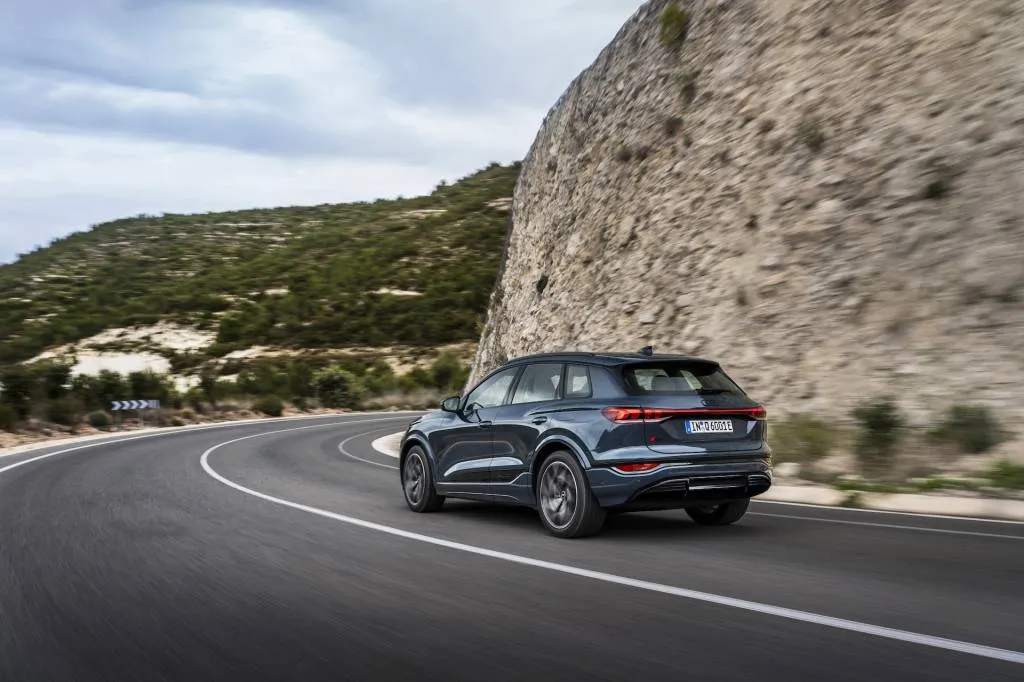
2025 Audi Q6 E-Tron
Revealed earlier this year, the Q6 E-tron is the first Audi model based on the Premium Platform Electric (PPE), which it shares with the Porsche Macan EV. The Q6 E-Tron also debuts a new interior, with a three-screen layout that will be repeated in other Audi models—both electric and gasoline.
The Q6 E-Tron won’t be the only PPE-based Audi EV for long. It’s set to be quickly followed by the Audi A6 Sportback E-Tron, which clothes the new platform in a sleeker hatchback shape (an Avant wagon will also be sold outside North America). This model is expected to reach the U.S. next spring or summer.