
Author: EVAI

Jaguar XJS-based TWR Supercat ready for production with 660-hp V-12
 TWR has been revived and its first product is a Jaguar XJS restomod called the Supercat TWR’s modified XJS is powered by a bespoke supercharged 5.6-liter V-12 Pricing for the TWR Supercat starts at $285,000 Tom Walkinshaw Racing was a British motorsports and engineering company with successes in Formula 1 and the 24 Hours of Le Mans. It went under…

Electric Mini Cooper and Aceman not coming to US for now
Mini is deferring plans to bring the redesigned electric Cooper hatchback and new Aceman urban electric vehicle to the U.S., but isn’t shutting the door on U.S. availability completely.
The news was first reported by MotoringFile, and confirmed to Green Car Reports by Mini spokesperson Andrew Cutler, who noted that Mini had previously said that a decision had yet to be made on U.S. (and Canadian) availability of both models.
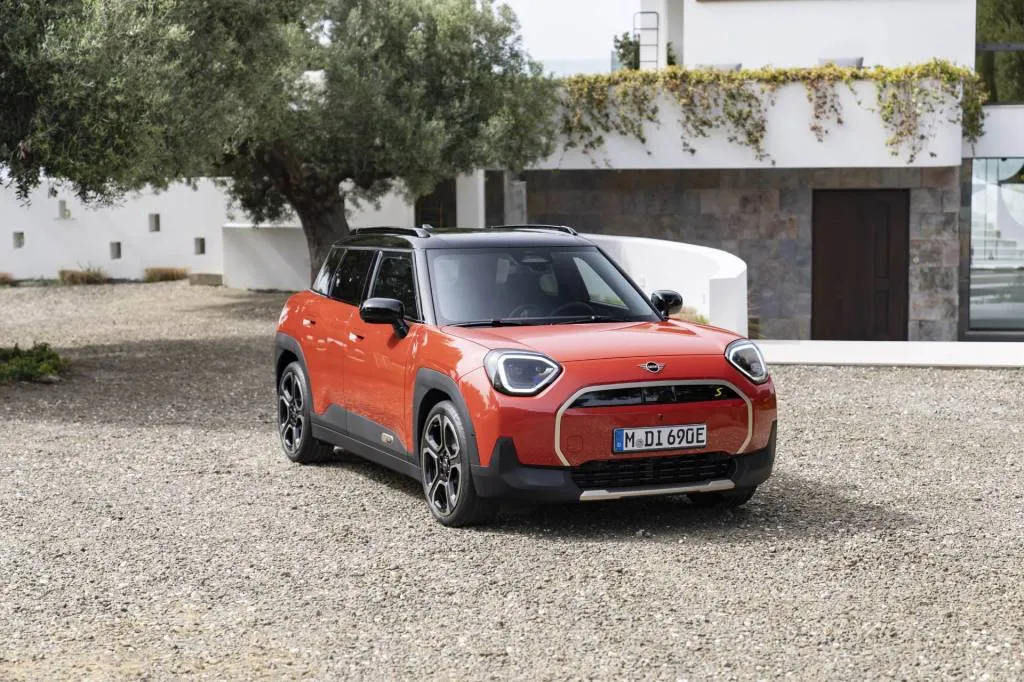
2025 Mini Aceman
“A decision has been taken to defer market availability of these models in the US (and Canada) until a later date,” Cutler said in a statement, adding that Mini is not able to confirm what that date might be.
The redesigned electric Mini Cooper hatchback was unveiled alongside a first-ever electric version of the Countryman crossover at the 2023 Munich auto show, promising more range than the 114 miles of the outgoing Mini Cooper SE, on the EPA test cycle. Mini is selling gasoline versions of the redesigned Cooper in the U.S., as well as a redesigned Countryman SE ALL4 plug-in hybrid, but hasn’t provided any updates recently on plans to bring the Countryman EV here.

2025 Mini Cooper electric hatch
Sold exclusively as an EV, and positioned between the Cooper and Countryman in size, the Aceman was unveiled earlier this year. It always seemed like a long shot for the U.S. both because of its size—smaller than the Hyundai Kona Electric and Volvo EX30—and the fact that it was developed by a joint venture of Mini and Chinese automaker Great Wall Motors, and slated to be built in China. That would rule out a federal EV tax credit due to foreign entity of concern policies.
Mini aims to go all-electric by 2030 and now has a lineup of three EVs between the Cooper, Countryman, and Aceman. But it now looks like it will take a bit longer for that electric revolution to reach the U.S.

Vinfast VF 9 3-row electric SUV deliveries slowly begin
- The first 9 examples of the Vinfast VF 9 have been delivered
- Vinfast said deliveries of the VF 9 are now underway across its distribution network
- The Vinfast VF 9 costs $69,800
Vinfast on Monday delivered the first handful of its VF 9 three-row electric SUVs to U.S. customers.
The company held a small event at its Los Angeles headquarters in which the first nine vehicles were handed over to their owners. But in addition to this small ceremonial group, deliveries are now underway to reservation holders across Vinfast’s distribution network of 36 dealerships and 15 company-owned retail stores in California, Vinfast spokesperson Jeff Holland told Green Car Reports.
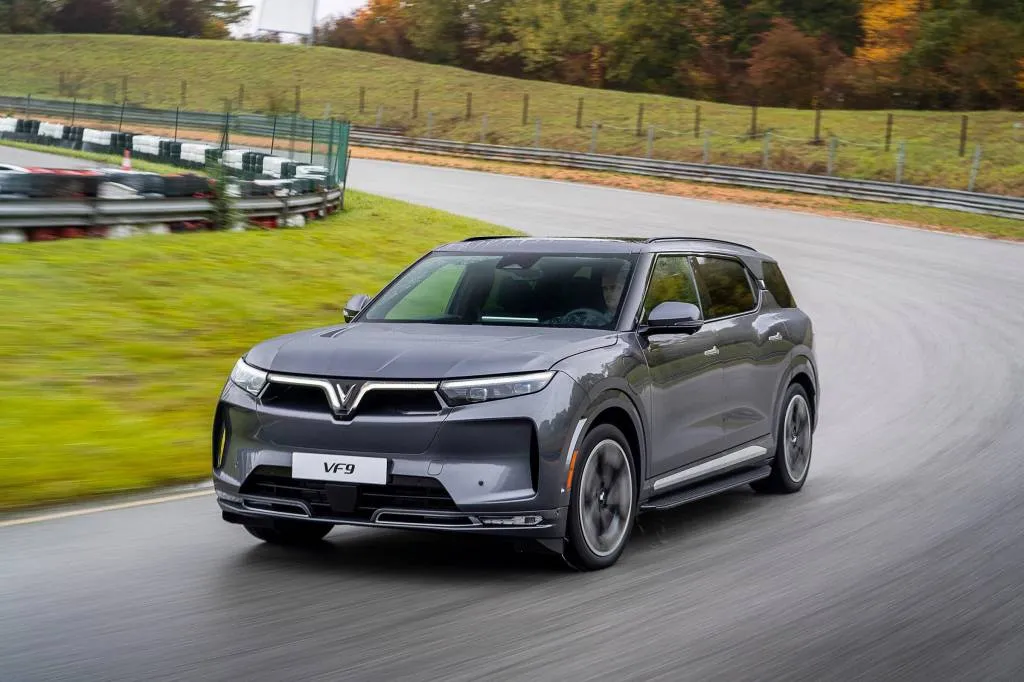
Vinfast VF 9
The VF 9 was EPA-rated and approved for U.S. sale in 2023, even before deliveries of the two-row VF 8 had picked up. Those EPA ratings—330 miles for the base Eco model and 291 miles for the Plus version—still hold, but prices have come down from what Vinfast quoted in 2023, bringing the VF 9 closer to the Kia EV9 while offering a bit more range.
After scrapping a unique model revolving around a battery subscription, Vinfast at that time raised starting prices to $83,000 for the Eco model and $91,000 for the Plus. Now the company is listing base prices of $69,800 for the Eco and $73,800 for the Plus. It’s also offering the first 100 customers a lower lease rate of $529 per month and a down payment of $2,000 on the Plus, which it claims represents a $3,500 discount. Initial deliveries are of the Plus, with the Eco following “later this year,” according to Vinfast.
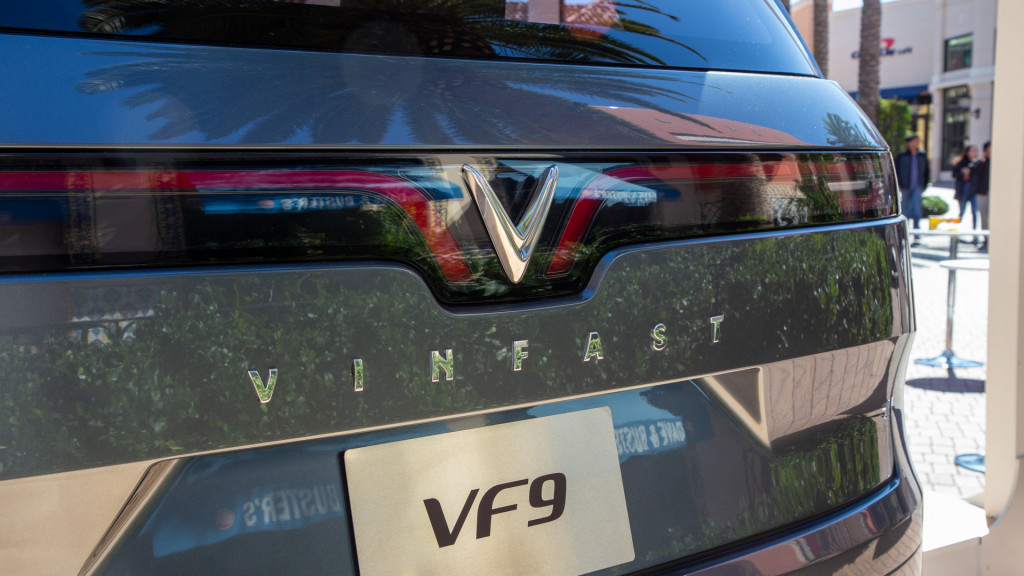
VinFast VF 9 Prototype
The VF 9 has dual motor all-wheel drive and an output of 402 hp and 457 lb-ft of torque, which will get the Eco version from 0-60 mph in a claimed 6.6 seconds (the Plus version takes 0.1 second longer). The company also claims its 123-kwh battery pack can be recharged from 10% to 70% in 35 minutes.
Vinfast has gotten off to a rocky start in the U.S. A first drive of the VF 8 last year led us to warn that it simply didn’t feel ready yet. And even after the addition of franchised dealerships in addition to its company-owned stores to more quickly move product, the company earlier this year was falling behind on sales targets. In July, Vinfast also delayed a planned North Carolina factory, saying it would open in 2028, rather than the previous target of 2025.

Bugatti’s next top speed target may be over 310 mph
 Bugatti isn’t done with attempting land speed records Bugatti boss Mate Rimac hints at hitting 500 kph, or 310.686 mph Attempt will likely have to wait until after 2026 start of Tourbillon production Bugatti has just scored the land speed record for a production open-top car with its Mistral roadster, which was clocked going 282 mph earlier this…

Stellantis details 690-mile range for STLA Frame platform
- STLA Frame platform can handle electric, range-extended electric, hybrid, and ICE powertrains
- Towing capacity maxes out at 14,000 pounds, which exceeds rivals by 4,000 pounds
- Stellantis again confirmed Ram 1500 REV electric truck will have up to 500 miles of range
On Tuesday, Stellantis filled in some further info about the STLA Frame platform that will underpin both the 500-mile Ram 1500 REV electric pickup truck and 690-mile Ram 1500 Ramcharger range-extended version.
The big news from Stellantis for its biggest global platform, first announced in 2021, is its multi-energy flexibility intended to support electric, plug-in hybrid, hybrid, hydrogen fuel cell, and even internal combustion powertrains in the future. Stellantis estimates 50% of car and light-duty truck sales in the U.S. will be electric vehicles by 2030, and the STLA Frame rollout starts with Ram and Jeep.
STLA Frame platform size
- Length: 216-234 inches
- Width: 81.2-83.6 inches
- Wheelbase: 123.7-145.3 inches
- Ground clearance: 6.6-10.3 inches (168-262 mm)
The third of four so-called multi-energy platforms detailed in Stellantis’ portfolio represents the largest and will underpin everything from the Ram trucks to light commercial vehicles and full-size SUVs such as the next iterations of the Jeep Wagoneer and Grand Wagoneer. It’s significantly longer and wider that the brand’s STLA Large platform that underpins forthcoming large sedans such as the 2024 Dodge Charger Daytona EV and midsize crossovers that could include the Jeep Grand Cherokee
The STLA Large maxes out at 201.8 inches in length, with a wheelbase of up to 121.1 inches. The STLA Large has a broader delta of ground clearance, however, from 5.5 inches to 11.3 inches.

Stellantis’ STLA Frame platform for trucks and large SUVs
STLA Frame platform towing and payload ratings
- Plug-in hybrid towing capacity of 14,000 pounds
- Payload rating of up to 2,700 pounds
- Water-fording capability of 24 inches
The Frame platform utilizes high-strength steel and reinforced frame rails intended to protect the liquid-cooled battery packs. A shield, or belly pan, underneath the frame promises to reduce drag and increase efficiency.
The series plug-in hybrid, which Stellantis calls a range-extended EV (REEV), represents the most interesting development in the electric pickup truck space. With front and electric drive modules rated at up to 250 kw in the front and less in the back, and a 92-kwh battery pack, the Ramcharger can go 145 miles on electric power alone.
In this model’s series-hybrid operation, a classic Pentastar 3.6-liter V-6 engine acts as a massive generator to convert mechanical energy into electric energy and it has no connection to the wheels and no propulsion component. The front wheels can disconnect while cruising to optimize efficiency.
Earlier in the year, Ram quoted specs of 663 hp and 615 lb-ft of torque, and a 0-60 mph time of 4.4 seconds for the Ramcharger. Stellantis on Tuesday confirmed a 14,000-pound towing capacity and a payload of up to 2,700 pounds for the STLA Frame; we’re awaiting confirmation if that applies to both the REV and the Ramcharger. That far exceeds the max 10,000-pound towing capacity for both the Ford F-150 Lightning and the Chevy Silverado EV.
Stellantis said the STLA Frame vehicles will have flexible suspension designs, including an available air suspension that will likely be offered with a multi-link rear suspension. A traditional solid axle at the rear with coil springs could also carry over to combustion versions of the STLA Frame.
Another noteworthy spec, especially for the next iteration of the Jeep Wagoneer new to this platform, was a water-fording capability of 24 inches.

Stellantis’ STLA Frame platform for trucks and large SUVs
STLA Frame range and charging estimates
- EV range of up to 500 miles, 800-volt DC fast-charging at 350 kw
- PHEV range of 690 miles, 400-volt DC fast-charging at 175 kw
- Bidirectional charging capability for home and grid applications
Battery pack sizes were listed between 159 kwh “to more than 200 kwh” in the press briefing, but Ram previously announced a 168-kwh battery pack standard on the 1500 REV, and an available 229-kwh battery pack that will provide the estimated 500-mile range.
The Ramcharger uses a 92-kwh pack. EVs on the STLA Frame can recoup 100 miles of range in 10 minutes at 350 kw, while the REEVs can gain 50 miles of range in 10 minutes at 175 kw.

Review: 2025 GMC Sierra EV Denali multitasks to the max
- Sierra EV Denali stands out with a GM-estimated 460 miles
- Midgate setup allows flexibility for items nearing 11-feet long
- Versatility from air suspension, rear-wheel steering, Super Cruise
“I’ve been on that route, and it’s not one for a full-size pickup—let alone one weighing nearly 9,000 pounds.”
That was what I noted, partly in disbelief, to my co-driver as we were shown into a 2025 GMC Sierra EV and sent off to wind up through narrow Bay Area Redwood highways and stretches of Skyline Boulevard.
Memory served well about the roads; the route included some undulating ribbons of asphalt on ridges that I’d enjoyed thoroughly in a little Volkswagen GTI years earlier. But I completely underestimated the Sierra EV.
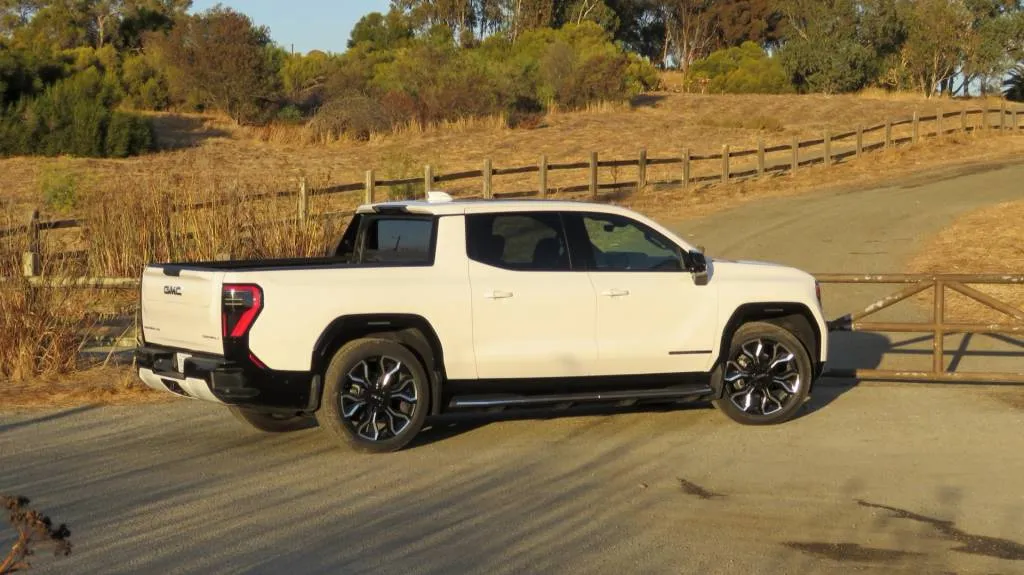
At about 233 inches long and 84 inches wide not counting mirrors, the big electric truck wasn’t so nerve-wracking for tackling narrow lanes. I could place it with precision, thanks to rear-wheel steering that pivots the rear wheels at a small angle opposite the fronts in low-speed hairpins. Instant torque delivery from the Sierra EV’s dual-motor system meant we didn’t lose momentum up the hills, while the air suspension kept us feeling even-keeled. Strong regenerative braking (Normal and High) kept our speed right as it should be on the steep downhill grades.
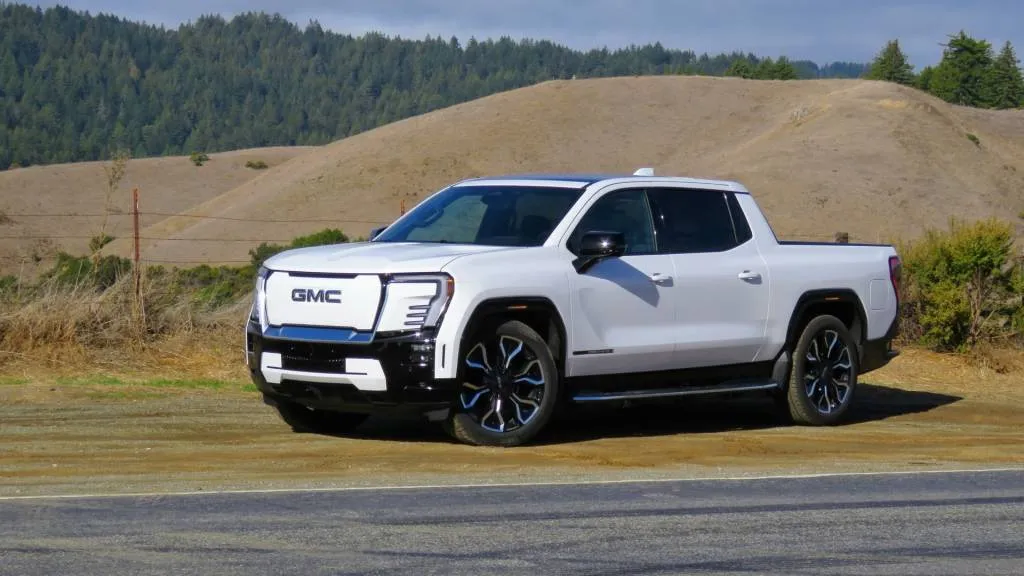
2025 GMC Sierra EV Denali
I went into the day knowing well this truck’s lofty range claim of 460 miles and how quickly it accelerates—and I didn’t need further proof that it can blast quietly to 60 mph in 4.5 seconds (or better, it seems). But GMC nudged us along the kind of route I never would have chosen, including plenty of those curves, some towing, some in-the-dirt play with the rear-wheel steering demonstrating the astonishing maneuverability and camera views, and an exercise with CrabWalk mode, which points the rear wheels in the same direction as the fronts. And it turned us loose with the challenge of fitting a whole lot of outdoor-fun gear into the Sierra EV in a hurry.
By the end of the day, I felt schooled. GMC hasn’t made a quirky design statement (that’s the Cybertruck), aimed for the outdoor lifestyle crowd (that’s the R1T), or simply made an electric version of its top-selling truck (that’s the F-150 Lightning).
The GMC Sierra EV sits next to the GMC Hummer EV in the GMC lineup, and the brand essentially separates the two by saying that if the Hummer EV pickup is the “it” truck, the Sierra EV is the “do it” truck. As a product, it’s a more impressive accomplishment for the market, and if you’re looking for the most cargo versatility for large items, and the most range for towing, hauling, and doing trucky things, this is it.
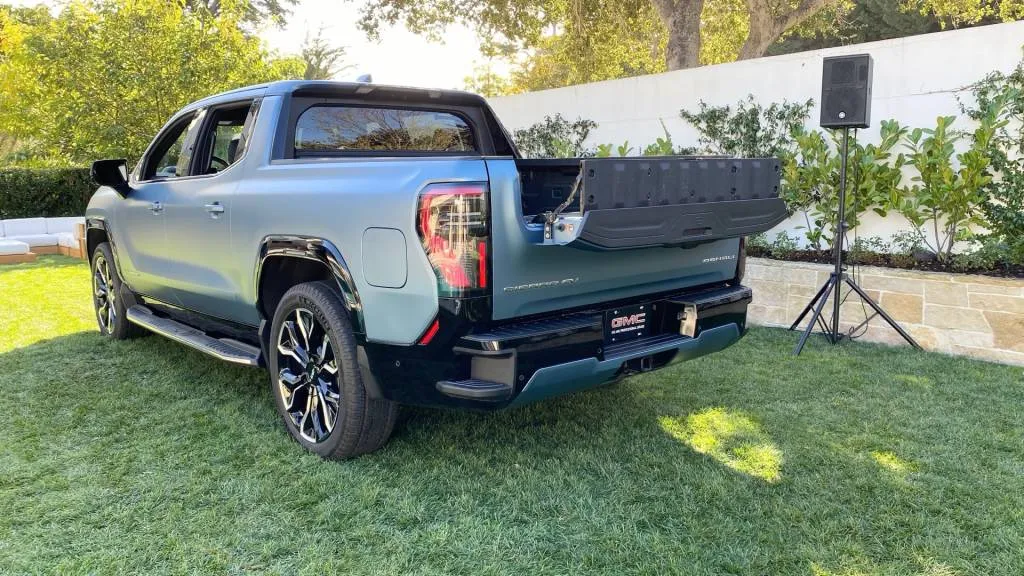
2025 GMC Sierra EV Denali
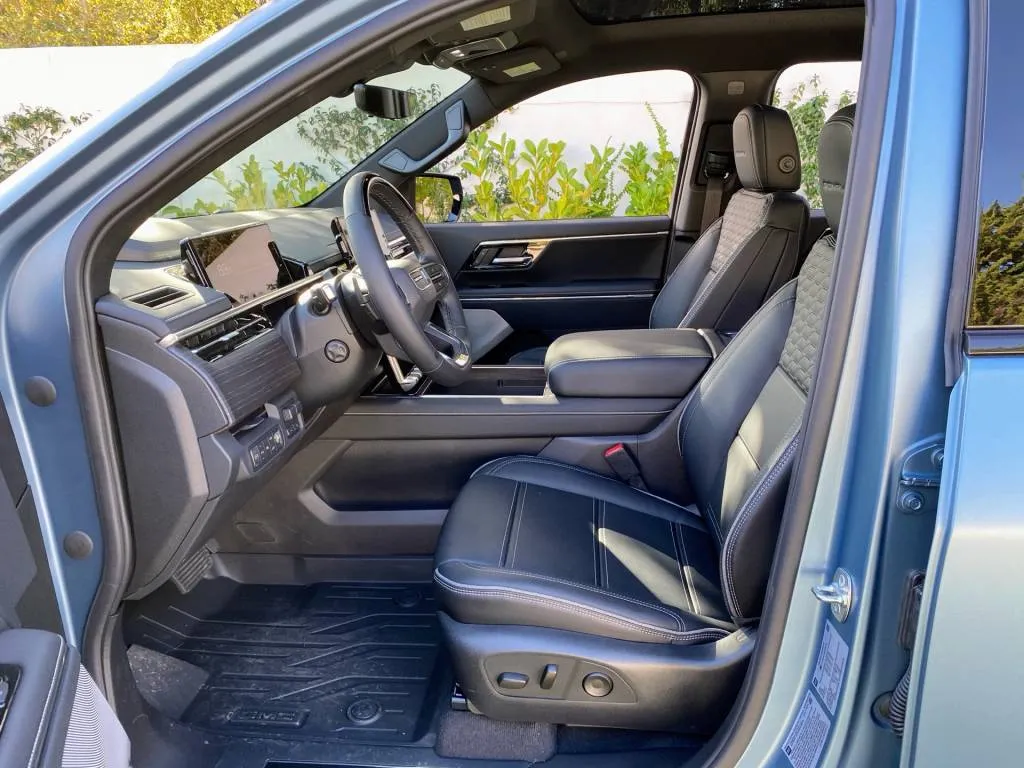
2025 GMC Sierra EV Denali
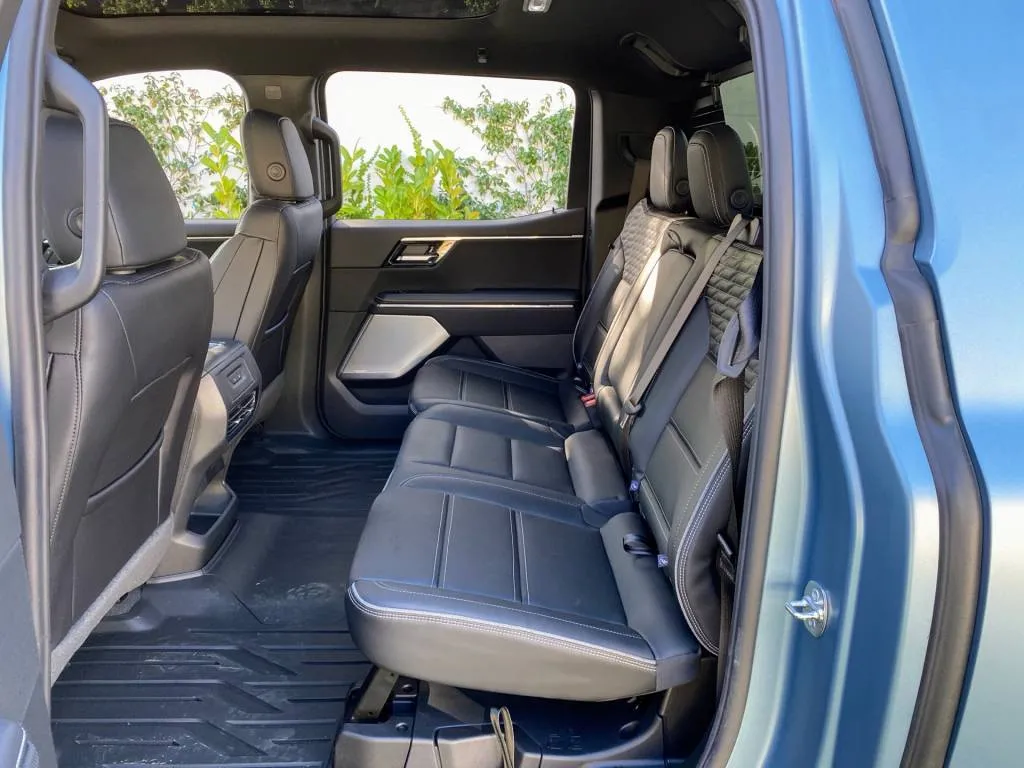
2025 GMC Sierra EV Denali
2025 GMC Sierra EV: Big range for a “do it” truck
The 2025 GMC Sierra EV has some of the market’s highest range ratings, not because it’s a standout for efficiency but because it goes big on its battery packs. Both battery packs are dual-layer, with the capability to stitch the two layers together in series to allow 800-volt DC fast-charging. The Max Range’s 205 kwh, it achieves range ratings of 460 miles, and the Extended Range’s 170 kwh affords 390 miles. The Max Range number is “GM-estimated,” because that super-sized pack throws the Sierra EV into a medium-weight category that doesn’t apply to EPA ratings.
Over nearly 90 miles of widely varied street and highway driving, we saw 1.9 miles per kwh according to the Sierra EV’s trip computer—suggesting we might still see 390 miles of range or more in this type of driving.
The huge battery opens up possibilities. The Sierra EV can tow up to 10,500 pounds with the Extended Range pack or 10,000 pounds with the Max Range pack, and while it might halve the range, that’s not so much of an issue here.
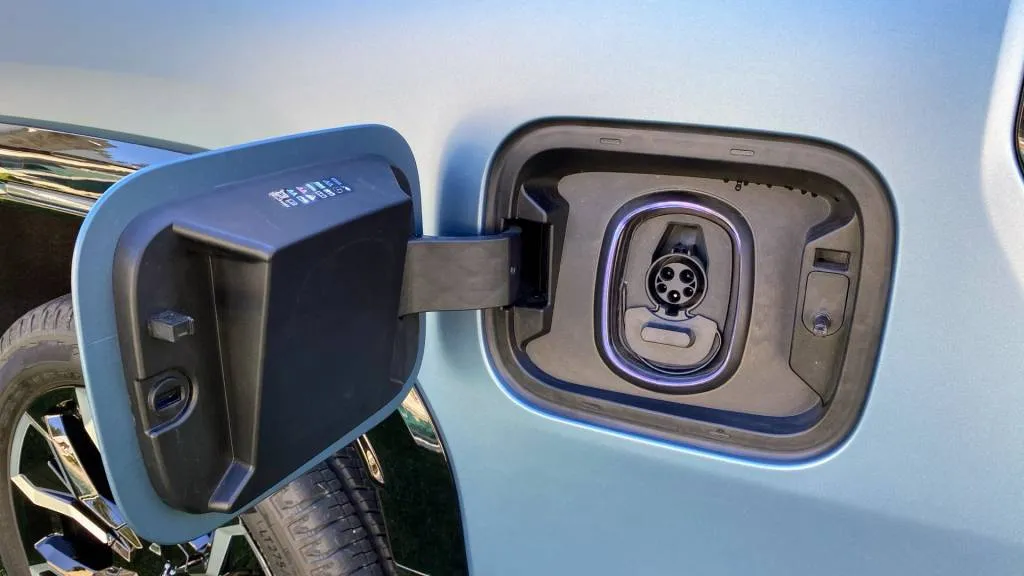
2025 GMC Sierra EV Denali
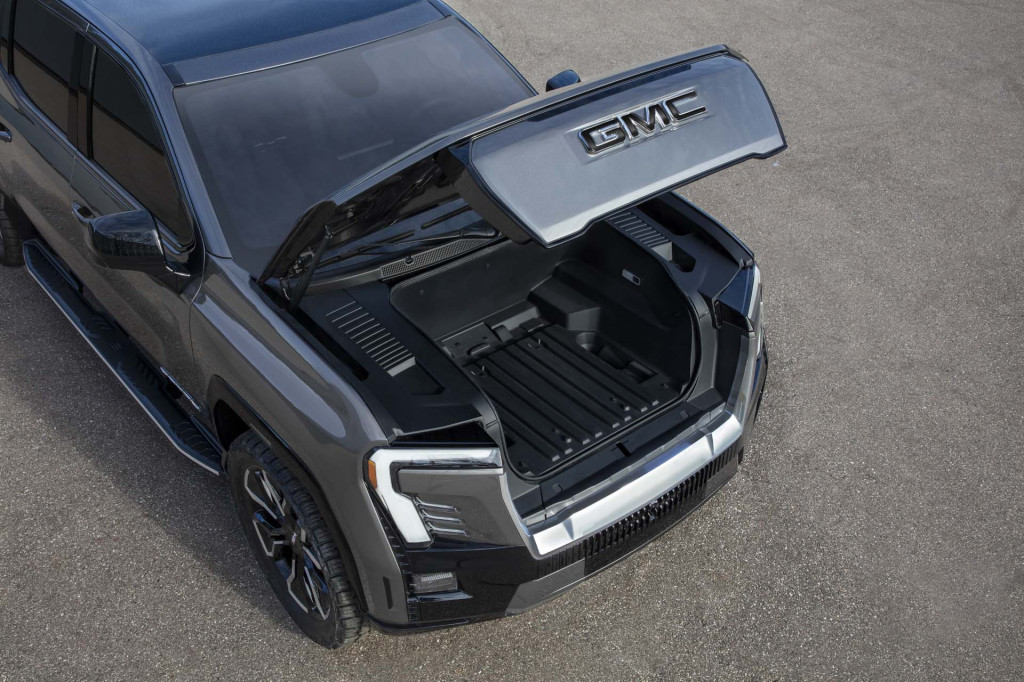
2024 GMC Sierra EV Denali Edition 1
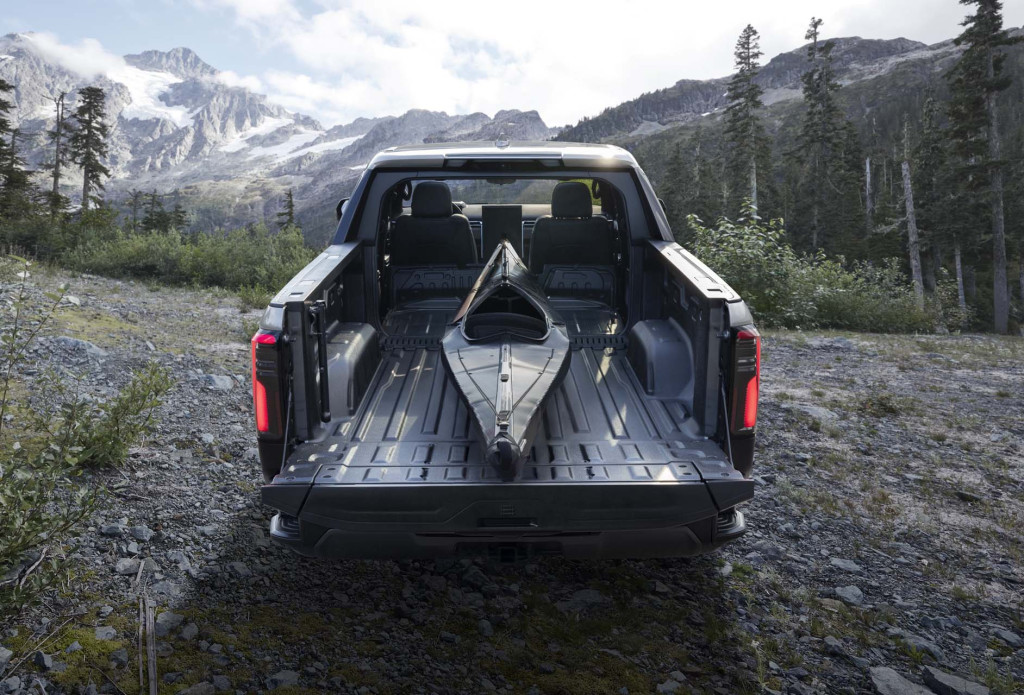
2024 GMC Sierra EV Denali Edition 1
Sierra EV can tow comfortably, find space for gear
In a short loop with a 5,500-pound trailer, the Sierra EV seemed mostly unfazed by the load, still capable of accelerating quicker than a fully loaded minivan. On a loop with two full-acceleration taps, it averaged just 1.0 miles per kwh, according to the trip computer—still indicating that 200 miles of range is possible with a horse trailer or large boat.
Max Range versions like the one I drove deliver up to 760 hp and 785 lb-ft of torque, via two permanent magnet motors that are designed and built by GM. Extended Range versions have essentially the same hardware, other than the battery pack, but make 645 hp and 785 lb-ft.
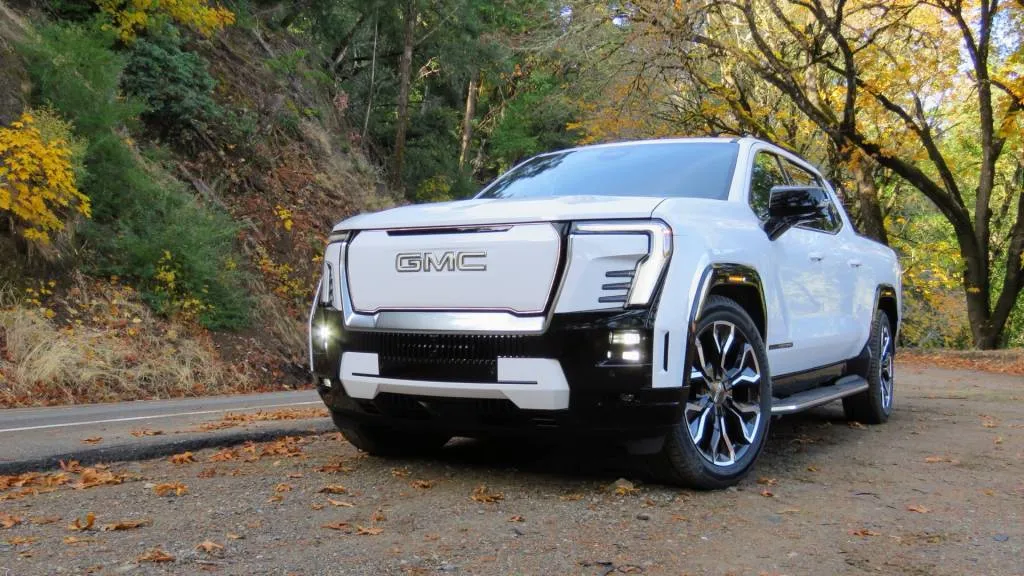
2025 GMC Sierra EV Denali
Those power numbers, and the 4.5-second acceleration time for the Max version, are only delivered when in Max Power mode. The Sierra EV also has Normal-Tour, Off-Road, Tow-Haul, and a customized mode. GM would not say what peak power is in any of those other modes.
The Sierra EV has an 11.0-cubic-foot frunk—called the eTrunk here, with a cupholder, a drain, weatherproofing, and more. But the surprise cargo-versatility star here is the Midgate. In just a few minutes you can convert the backseat area into an expansion of the cargo bed—creating a 9-foot-1-long space with the tailgate locked, or a 10-foot-10 space with the tailgate down and the flip-down tailgate load step used to backstop long items—like a kayak.
Engineers emphasized that the Midgate isn’t meant as a solution to only use once in a while, rather something you might use daily. While it’s not weatherproof, of course, it’s a great solution for bringing gear a few miles to a launch point—without having to get specialized carriers—and you can leave one of the backseat positions in place while using it.
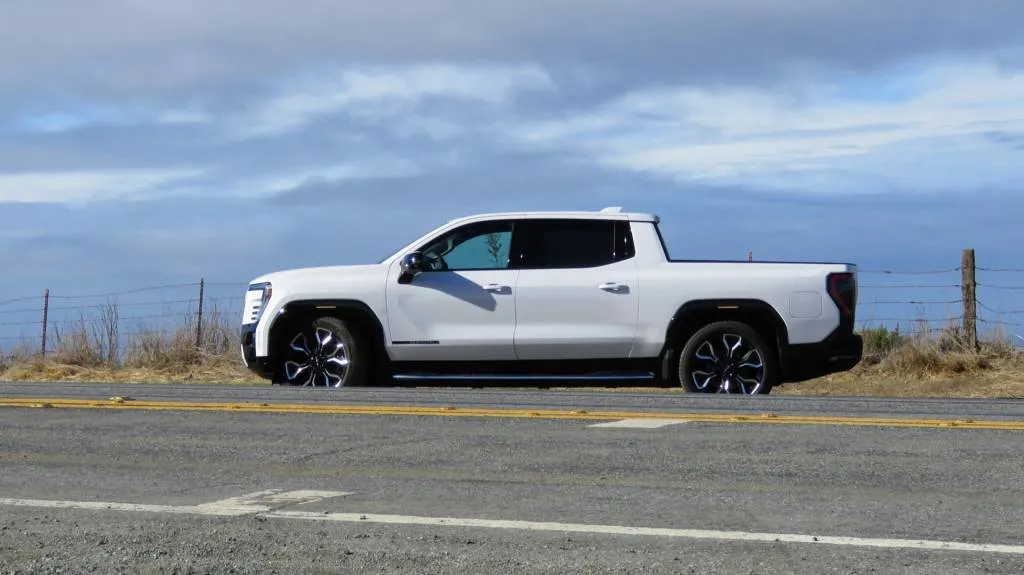
2025 GMC Sierra EV Denali
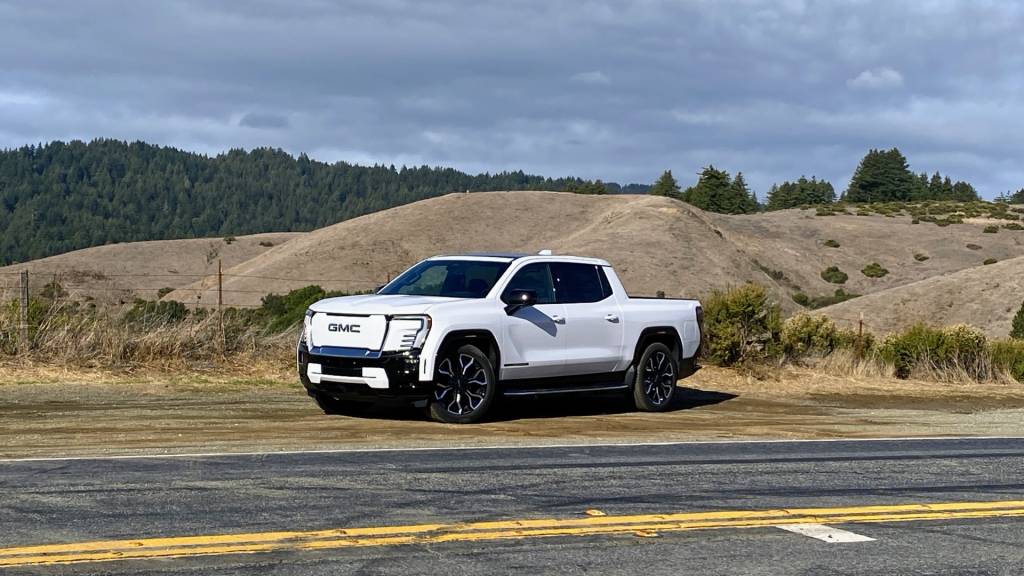
2025 GMC Sierra EV Denali
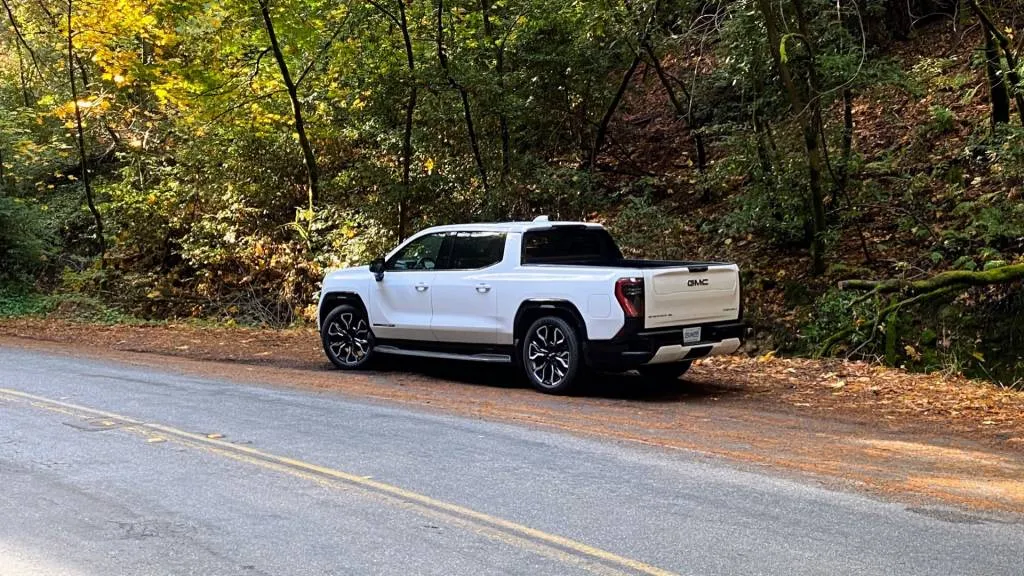
2025 GMC Sierra EV Denali
Sierra EV Denali is expensive, but very well equipped
The GMC Sierra is very closely related to the Chevrolet Silverado EV RST, but there are some key differences in how it fits into the EV market and the truck market. In 2024, the Sierra EV was only offered in its top Denali trim, with what’s essentially “the works”—the biggest battery pack, the air suspension, rear-wheel steering, and a feature set that’s one of the most luxury-focused among full-size pickups.
For 2025, there have been only some slight price changes, the addition of the Extended Range version, and 20 miles more for the Max Range version due to some efficiency improvements to the motor units themselves. My day was spent with the top Sierra EV Denali version, in Max Range form, costing at least $100,495—including the $2,095 destination fee but not any additional accessories for towing and storage.
The Sierra EV Denali includes the air suspension, rear-wheel steering, a panoramic sunroof, heated-and-cooled front seats, leather upholstery, a heated steering wheel, heated outboard seats, a head-up display, wi-fi hotspot compatibility, and seven-speaker Bose audio. There’s also wireless charging cleverly integrated into a sliding center console tray, plus plenty of USB-C ports and a 120-volt AC cabin outlets. In addition there’s the 7.2-kw AC Offboarding Power station that might eliminate the need to take that small generator out to the campsite or job site.
I didn’t get the chance to charge the Sierra EV as part of this brief test drive. Peak fast-charging rates are listed as 350 kw for the Max Range pack and 300 kw for the Extended Range pack. GM says that on a 350-kw CCS connector it will recover up to 100 miles of range in just 10 minutes, and it’s said before that either of these packs will get from 10-80% in about 40 minutes. GMC integrates a battery preconditioning feature to help achieve peak rates; it works with the native navigation trip planner or via the press of a virtual button.
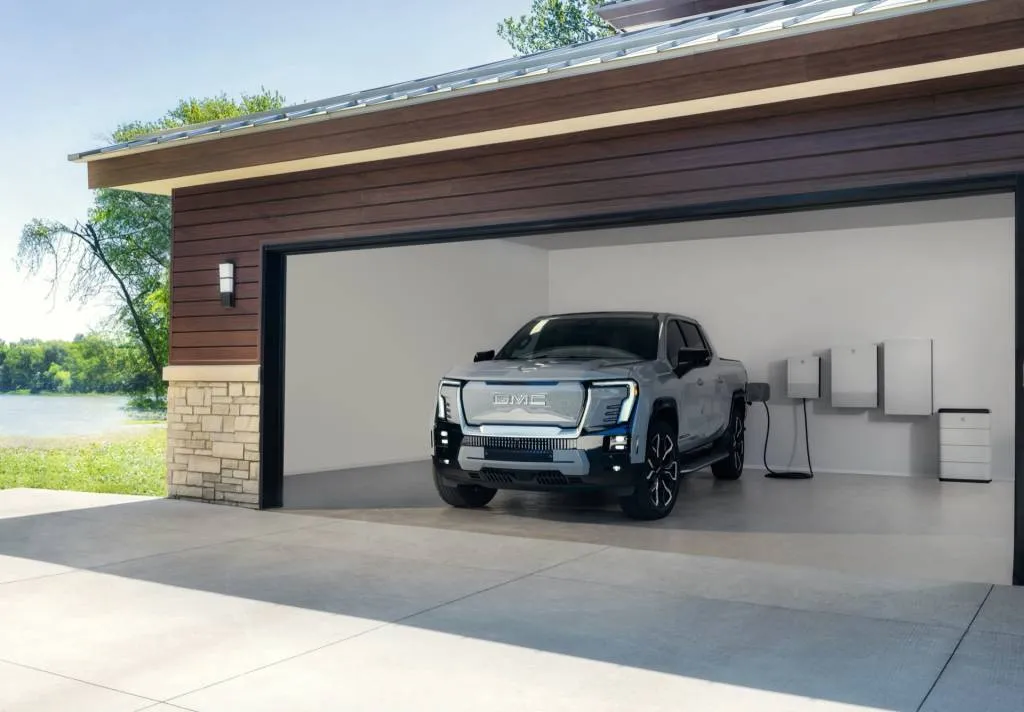
2025 GMC Sierra EV with GM Energy suite
Ready for backing up the home, not Apple CarPlay
In the give-and-take of EV living, the Sierra EV also includes the capability to output 10.2 kw AC, potentially eliminating the need to tote around a generator. And starting with the $1,699 PowerShift charger, owners can outfit their home with GM energy components that could use the Sierra EV to help backup the home—including PowerBank home energy storage.
While the GMC Sierra EV Denali shares much with the Chevrolet Silverado EV, one of the most pronounced cabin differences is that the Sierra EV gets a 16.8-inch portrait-oriented system instead of the Chevy’s landscape orientation. Just like in the Silverado EV and other new GM EVs, it’s made with Google built-in, including the capability to run Google-ecosystem apps—but there’s no Apple CarPlay or Android Auto compatibility or integration.
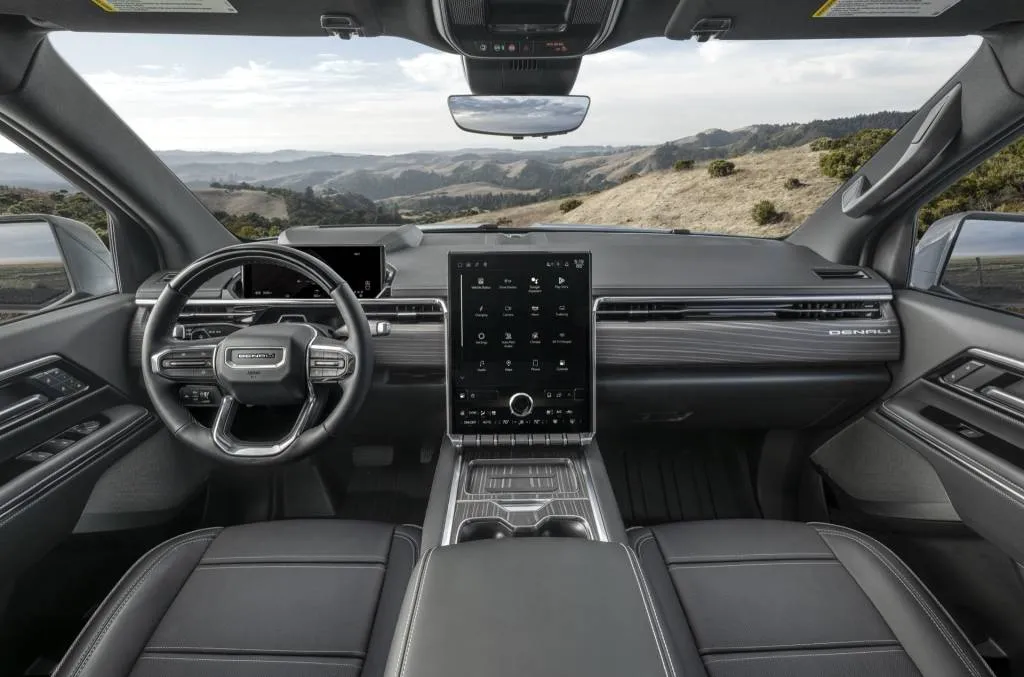
2025 GMC Sierra EV Denali
GM’s Super Cruise is also included (for three years) in the Sierra EV, allowing hands-off driving plus semi-automated lane changes on more than 750,000 miles of mapped roads and highways—with maintained driver attention. Super Cruise also now works when towing. With the 5,500-pound load, I engaged the feature briefly and found steady lane positioning and solid speed control using the regenerative braking. But it’s still not a perfect system or one to rely on all the time; when I attempted to use the system to cruise on US-101 around Palo Alto, it kept disabling itself as it couldn’t see the faint-and-inconsistent lane markings that we had no issue seeing.
GMC has managed to accommodate tall people so well in front and in back, allowing plenty of headroom and a great view outward. Seats are plush yet supportive front and rear.
The cabin is super-quiet, aided by three things: an active-noise cancellation function for the Bose audio system, additional noise padding underneath compared to GMC’s other models, and acoustic side glass. It adds up to the ambience of a luxury vehicle.
That ambience holds in this Denali version, with fine stitching details in the front perforated seats, patterned speaker grilles, laser-cut wood trim, and a tight fit and finish throughout. We’ll see if these standards hold for the less-expensive versions to come.
2025 GMC Sierra EV Denali
More GMC electric trucks on the way—but when?
GMC has said that more affordable Sierra EV AT4 and Elevation models are due in 2025, although it hasn’t confirmed whether that will be for the 2025 or 2026 model year. GM also hasn’t given an update on when it plans to ramp up production of these trucks at its Lake Orion, Michigan, plant where it ceased building the Bolt EV nearly a year ago. Until then, output will be limited.
But it’s easy, also, to envision an even more kitted-out version of the Sierra EV with magnetic ride—to quell the hold-on-tight, amusement-park-ride feeling you get in the Sierra EV when accelerating rapidly on imperfect pavement. Perhaps those are the changes that will elevate this platform for the upcoming Cadillac Escalade IQ.
GM has overcome lots of preconceptions—including my own—and shown what a great electric truck it can make. Now it needs to make more of them.

Jaguar reveals new logo and branding for ultra-luxury EVs
 Jaguar transformation starts with reveal of new logo and branding All current Jaguars to be replaced by three ultra-luxury EVs Concept previewing first EV set for 2024 Miami Art Week Jaguar is just weeks out from the reveal of a concept that will usher a new era for the brand, one fully focused on electric vehicles with prices much higher than…

Review: 2025 Cadillac CT5-V Blackwing cuts lap times with sharp new package
 The 2025 Cadillac CT5-V Blackwing gets refreshed with the rest of the CT5 lineup A new $18,000 Precision Package upgrades the CT5-V Blackwing’s handling The 2025 CT5-V Blackwing arrives by the end of the year, Precision Package cars arrive in 2025 “I’m going to make a CT5-V Blackwing drive like a CT4-V Blackwing.” That was…

US-built 2025 Kia EV9 qualifies for $3,750 EV tax credit
- U.S. production of the Kia EV9 is being cut back
- 2025 EV9s assembled in the U.S. qualify for $3,750 of the federal EV tax credit
- The 2025 Kia EV9 costs $56,225
Kia is cutting back U.S. production of the EV9 electric SUV, but 2025 models that are assembled here will qualify for a $3,750 federal EV tax credit, reports The Korea Herald.
The credit, half the maximum amount, is due to the fact that supplier SK On still manufactures batteries for the EV9 in China, which is labeled a foreign entity of concern by the U.S. government. Going forward, vehicles with battery materials sourced from any country labeled a foreign entity of concern are disqualified from the full credit amount under rules enacted as part of the Inflation Reduction Act (IRA).
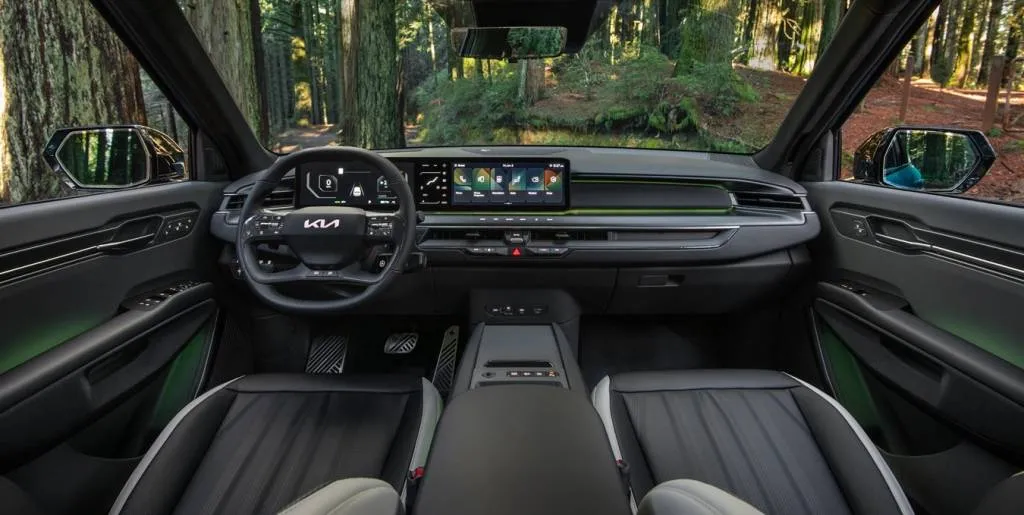
2025 Kia EV9
“The EV9 is ineligible to benefit from the full IRA benefits due to the battery issue, along with other factors, including price,” a Kia official told The Korea Herald. The IRA rules also include an $80,000 price cap for electric SUVs, but many versions of the EV9 come in underneath that. The base Light Standard Range starts at $56,225 with destination.
Kia began producing EV9s at its West Point, Georgia, plant in June, but most U.S.-market vehicles are still sourced from South Korea, according to the report. EV9s are also being built at parent Hyundai’s Metaplant, also in Georgia, but not in volume. The report said just 21 were made at that facility in the third quarter, with just one sold in the U.S.
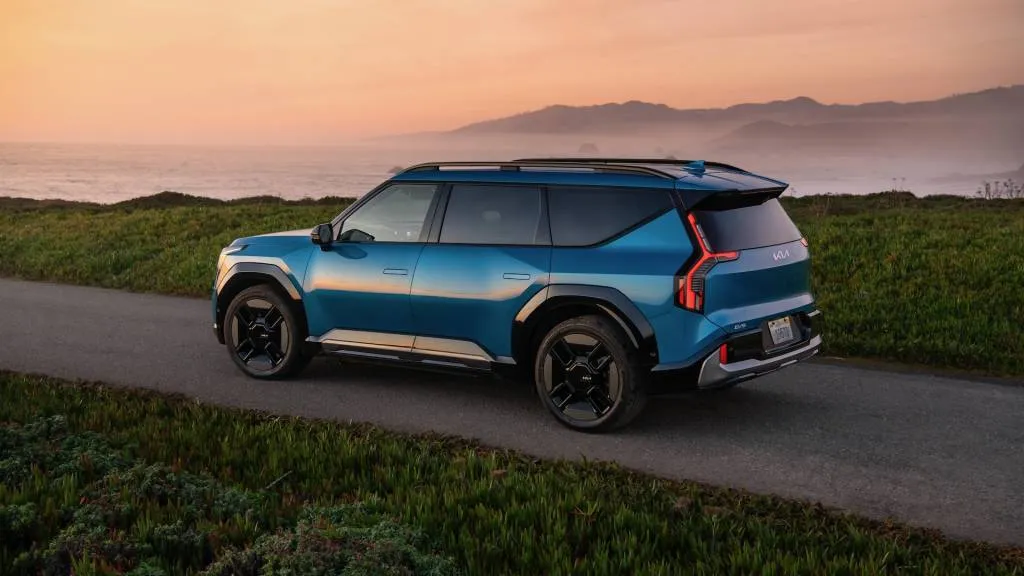
2025 Kia EV9
SK On has worked with Hyundai and Kia to meet tax-credit sourcing rules, a process that’s about to be stepped up with construction of a new battery cell plant in Georgia in close proximity to both the Hyundai and Kia plants. It’s projected to have an annual capacity of 35 gwh, sufficient for 500,000 EVs, according to the report. Hyundai is also planning a joint venture battery plant with LG Energy Solution in Georgia.
Debuting as a 2024 model, and earning Green Car Reports’ Best Car To Buy award, the EV9 has sold briskly, with nearly 18,000 sales through October. Kia now seems more concerned with satisfying that demand than specifically manufacturing vehicles in the U.S. to satisfy tax credit rules, which will likely prevent the EV9 for qualifying for the full amount for some time. The tax credit may also disappear under the incoming Trump administration, which has reportedly made nixing it a priority.

Review: 2025 Porsche 911 Carrera T evokes the past without provoking the gods
 The T’s one of the few manual-shift cars left, even at Porsche No automatic, no rear seats, no sunroof—no problem 911 T is priced from $135,995 for the coupe, $149,295 for the cabrio The Porsche 911 entered the hybrid era for the 2025 model year, but it hasn’t given up the keys to its old place in the gas-powered era. In fact…