
Author: EVAI

Project aims for EV batteries that can work past minor damage
Researchers in Norway are looking at ways to make electric vehicle battery cells more resilient.
As part of an EU-funded project involving a series of battery suppliers and researchers, the Norwegian University of Science and Technology (NTNU) said in a recent press release (via Tech Xplore) that its researchers have been looking at different ways to keep batteries working with minor damage, helping to avoid expensive replacement.
The research team has been working with silicon-anode tech, which promises more energy density and range but isn’t without its own hurdles. As researchers note, silicon anodes swell during charging and discharging, which can cause them to break down over time.

Sila Nanotechnologies Titan Silicon anode material
Researchers have looked at adding more graphite, which makes for a more stable mix, and have developed a “secret sauce” electrolyte that helps protect both the cathode and anode, according to the release.
Other experiments have focused on the addition of binders and separators to the cell. The binders help maintain the electrodes’ structure even if it becomes damaged, while the separators keep the cathode and anode physically apart to prevent short circuits.
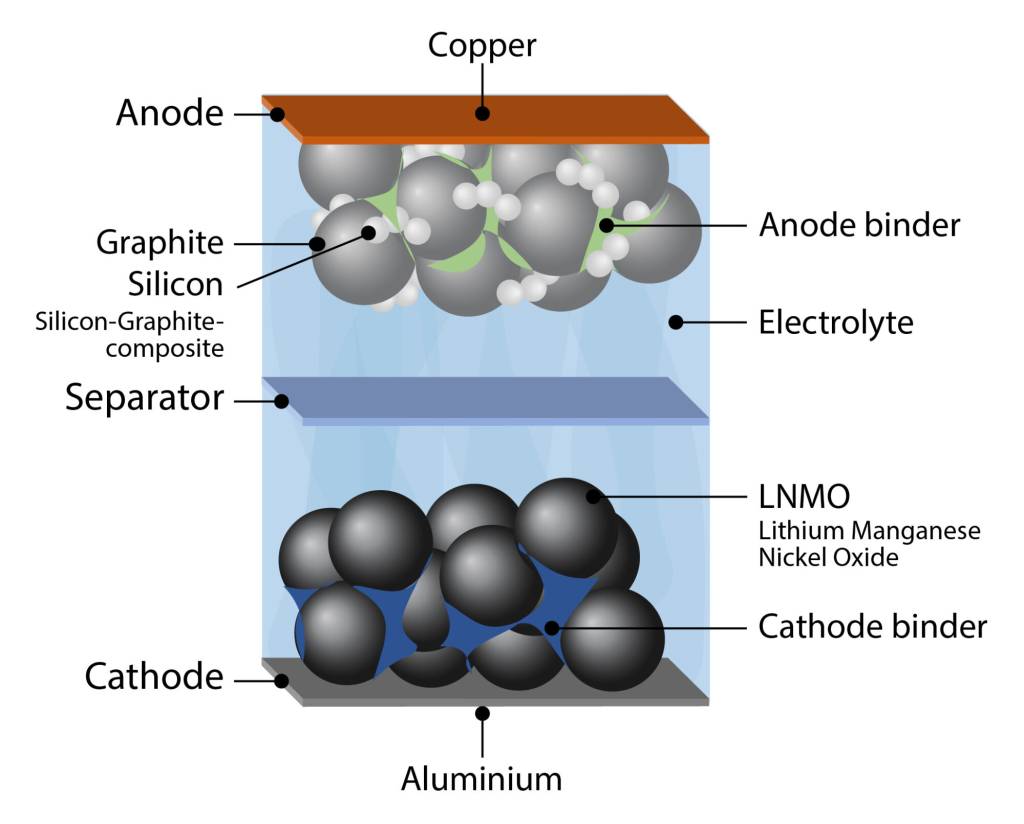
EV battery electrode binders for counteracting damage (Credit: NTNU)
In the era of cell-to-pack technology becoming common in EVs, such features may become especially important to prevent the full removal of packs for just a few bad cells. Although a few automakers are looking to innovate in that process, too. Ford, for instance, has proposed replacing battery modules while the pack itself stays put.
And it’s unclear whether a strategy such as this, using electrode binders, would serve any purpose in future solid-state cells, as the industry shifts that way.

Ford Explorer Tremor teased as Timberline’s replacement
 The Ford Explorer Timberline is getting mulched in favor of a new off-road trim with familiar nomenclature. Ford on Monday released an image of a Tremor badge—the same one that already appears on the F-150, Expedition, and Maverick—on the tailgate of an SUV. Ford didn’t explicitly say that it was an Explorer, but what’s visible in the…

Renault 5 Turbo 3E brings in-wheel motors to electric hot hatch
Renault continues to look to the past with a performance version of its affordable electric hatchback.
Just as the electric Renault 5 E-Tech is inspired by the cult-classic original that launched in 1972, the limited-edition Renault 5 Turbo 3E pays homage to an extreme performance version of that hatch. Due to start deliveries in 2027, production will be limited to 1,980 units in reference to the original 5 Turbo’s launch year.
That first Renault 5 Turbo (and a later 5 Turbo 2 variant) were powered by a turbo-4 engine mounted in the middle of the car and powering the rear wheels, instead of the front-engine, front-wheel-drive configuration of the standard 5. This all-electric revival also makes the switch from front-wheel drive to rear-wheel drive, in this case with a pair of in-wheel motors delivering a combined 533 hp, mounted in 20-inch wheels.
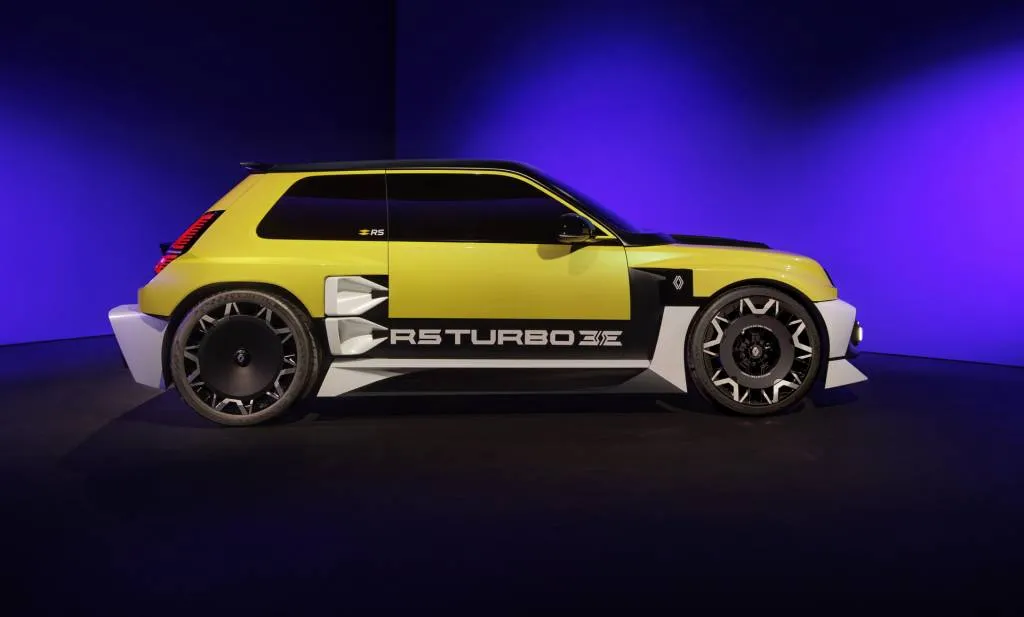
Renault 5 Turbo 3E
A 70-kwh battery pack affords what Renault estimates as approximately 250 miles of range on the European WLTP testing cycle, which generally produces higher number than the EPA cycle, or “several hot laps” of a racetrack. An 800-volt electrical architecture allows for 350-kw DC fast charging and a 15-80% charge in around 15 minutes, according to Renault.
Carbon-fiber bodywork contributes to a relatively low (for an EV) curb weight of 3,395 pounds, allowing the 5 Turbo 3E to get from 0-62 mph in under 3.5 seconds and on a top speed of 168 mph, Renault estimates.
Like the original 5 Turbo, very little of the base car’s bodywork carries over. Renault moved the windshield back, extended the wheelbase, and have the 5 Turbo 3E swollen fenders that are dead ringers for those of the original 5 Turbo. Enhancing the retro aesthetic are available liveries like the black, white, and yellow combination shown here, inspired by a racing livery from the 1982 Tour de Corse rally.
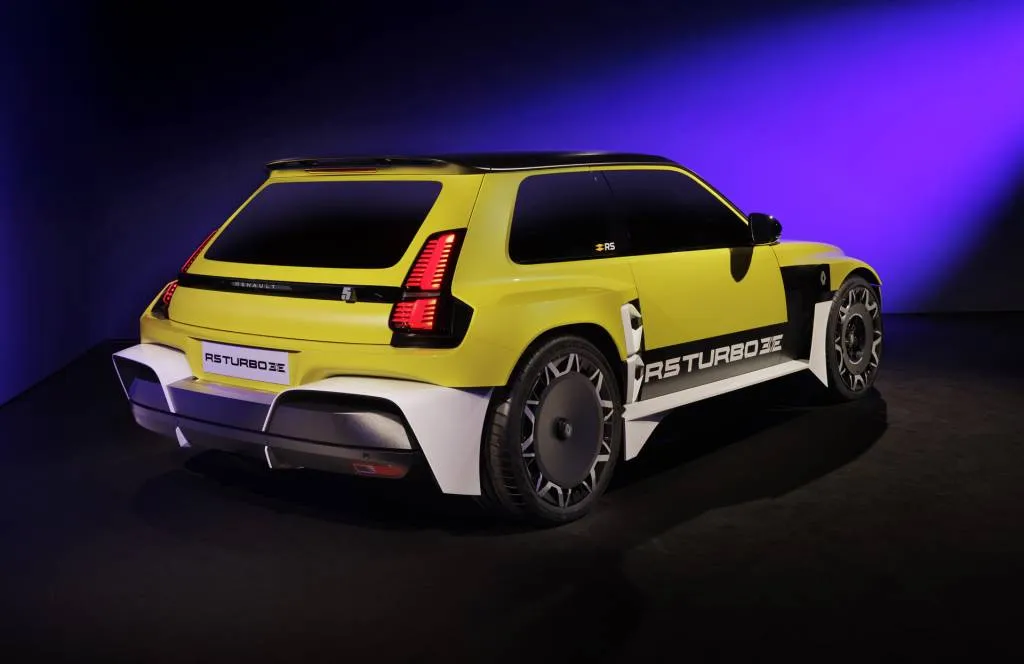
Renault 5 Turbo 3E
Inside, bucket seats and six-point harnesses mingle with a 10.1-inch digital instrument cluster and and 10.3-inch central touchscreen, with more carbon-fiber components to help drive home this car’s sporty intent.
The 5 Turbo 3E isn’t the only performance version of the modern electric Renault 5. Renault’s sibling brand Alpine recently launched the A290, a 220-hp version of the electric hatch. While prices haven’t been announced, given its extensive reworking and limited production run, expect the Turbo 3E to be much more expensive, in sharp contrast to the base 5 E-Tech’s low price. And neither version will likely come to the U.S.
Homages like the Turbo 3E are in keeping with Renault’s strategy of emphasizing retro styling as it electrifies. In January, the automaker also unveiled a one-off test car inspired by record-setting prototypes from the last century. Dubbed Filante Record 2025, it will be used in range and efficiency record attempts later this year, Renault has said.

McLaren extends Oscar Piastri contract with multi-year deal
 Australian Formula 1 driver Oscar Piastri is sticking with McLaren for the long term. McLaren announced on March 11 that it has agreed to a multi-year extension of Piastri’s current contract, which is scheduled to expire at the end of 2025. Piastri joined McLaren as a rookie in the 2023 season, and thanks to his impressive performance in that…

Cadillac CT sedans, Chevy Camaro recalled for bad transmission
 GM has recalled 90,081 Cadillac sedans and the Chevy Camaro coupe for a bad valve in the 10-speed automatic transmission that could, over time, cause the wheels to lock up, according to a NHTSA disclosure on Monday. The issue comes from a transmission control valve exclusive to the 10-speed automatic. Over time, the valves can wear excessively…

Electric BMW 3-Series arrives in 2026; undergoing cold-weather testing
The second model in BMW’s Neue Klasse electric-vehicle line is now undergoing cold-weather testing ahead of a 2026 debut.
BMW started pre-production of the first Neue Klasse model, a compact crossover, in November, and on Friday confirmed that it will debut at the 2025 Munich auto show in September. BMW also confirmed the iX3 name for this model, recycling a name first used on an electric version of the X3 that was never sold in the U.S.
Two days prior to that announcement, BMW posted a video on Instagram of an electric sedan testing in Sweden. This second Neue Klasse model is expected to wear BMW 3-Series badging, and may even be called the i3, bringing back the name of an innovative electric hatchback that was BMW’s first attempt at a volume electric car.
The original i3, which debuted in 2013 and ended production in 2022, featured an unusual (for BMW, at least) tall-and-narrow shape and unorthodox engineering, including a body structure made in part from carbon fiber-reinforced plastic. More than 250,000 were made during the i3’s nine-year production run.

Prototype for electric BMW 3-Series based on Neue Klasse platform
The i3’s departure left BMW without a small, entry-level EV, something the automaker has wanted to rectify, development boss Frank Weber said in a 2023 interview. Weber said the i3 successor wouldn’t have the “polarizing design” of the original, though. Perhaps this Neue Klasse model, sporting a more conventional sedan shape and minimalist styling previewed by a 2023 concept car, is it.
Named after the family of models credited with saving BMW in the 1960s, the Neue Klasse represents a new phase in EV engineering for the automaker. BMW has been teasing technical details for some time, confirming an 800-volt electrical architecture, a switch to cylindrical battery cells and front induction motors, and a chassis-control unit dubbed Heart of Joy.

Lynx Motors is bringing back Matech’s wild Ford GT race car for the road
 In 2010, Swiss team Matech Competition launched an FIA GT1 racing version of the Ford GT supercar (the one from the 2005 and 2006 model years, that is). Now two companies are partnering to build a road-going version called the Lynx GT1. Texas-based Lynx Motors announced Thursday in a press release that it plans to sell 28 examples of the GT1, and…

Study: Trump killing EV tax credits would decimate US industries
If the Trump Administration eliminates the federal EV tax credit, it could have a devastating effect on U.S. manufacturing, a new study warns.
Produced by the REPEAT Project, a Princeton University group that analyzes environmental policy, the study found that killing the $7,500 tax credit would reduce EV demand, as well as endanger manufacturing jobs associated with making those vehicles and the batteries that power them.
“The report is also the only analysis I’m aware of to date that draws the connection to U.S. manufacturing as well,” Jesse D. Jenkins, an assistant professor at Princeton and the study’s project leader, told Electrek in an emailed statement.
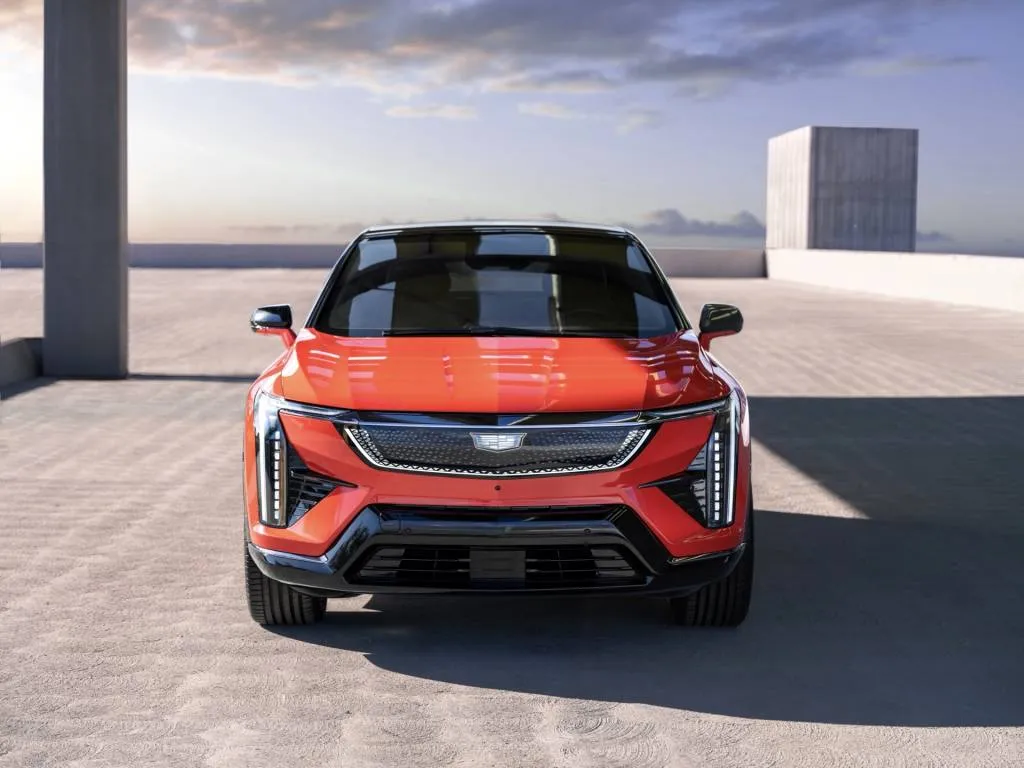
2025 Cadillac Optiq
Without the tax credit, researchers estimate that EV sales in the U.S. could decrease 30% by 2027 and nearly 40% by 2030. That might cut predicted EV market share from 18% to 13% in 2026 and from 40% to 24% in 2030, according to the study.
Such a slowdown could lead to 100% of planned expansions of U.S. EV assembly plants being canceled, and could make 29% to 72% of U.S. battery-manufacturing capacity redundant, according to the study. Factories that are idled—or never built in the first place—mean fewer jobs. And based on the distribution of current EV-related manufacturing projects, red states could be hit the hardest.
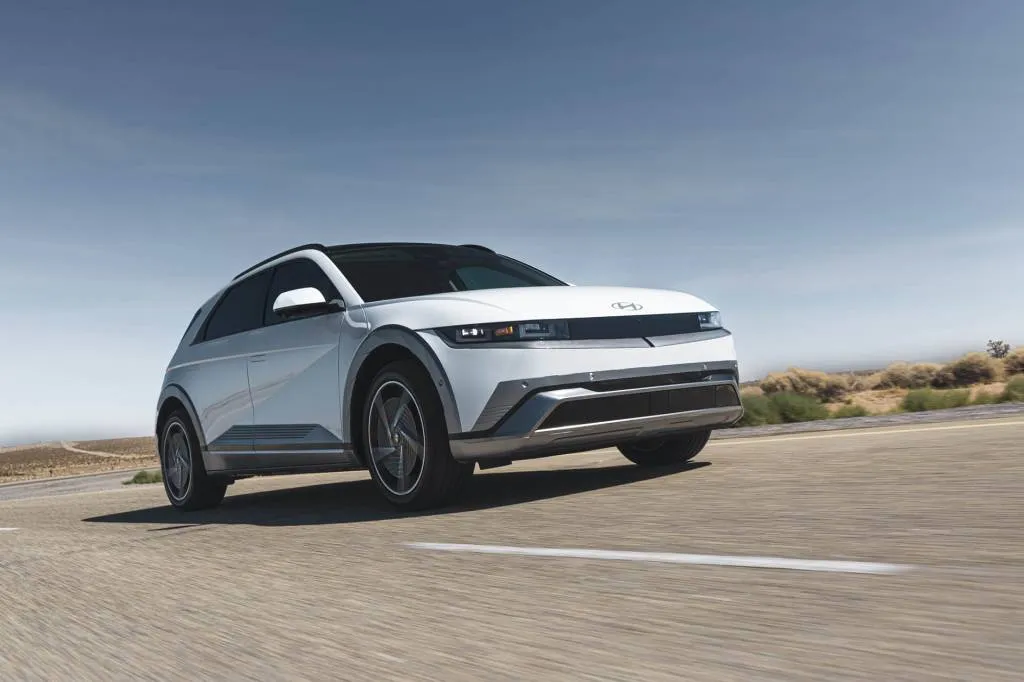
2025 Hyundai Ioniq 5
Analysts have viewed the tax credit as vital to continuing U.S. EV sales growth. It was among the trends that led S&P Global Mobility, in 2023, to predict that U.S. EV sales could more than double by 2030. But the Trump Administration is expected to target the credit, just as it’s targeted other Biden Administration policies related to charging infrastructure and emissions standards.
The potential loss of the tax credit, and other Trump policies, led J.D. Power to revise its EV market share retail forecast to be flat this year, at 9.1% of the U.S. retail market, but with resumed growth after this year to 26% of the market by 2030. Considering expected market growth among mass-market models outside EV-specific brands like Tesla, Rivian, and Lucid, that could still lead to 3% sales growth.

2025 Subaru Outback
 What kind of vehicle is the 2025 Subaru Outback? What does it compare to? The 2025 Subaru Outback is a rugged, comfortable five-seat vehicle that blurs the line between station wagon and midsize crossover. It competes with Subaru’s own Forester, as well as the Honda Passport and Hyundai Santa Fe. Is the 2025 Subaru Outback a good SUV? Yes…

2025 Hyundai Ioniq 5 N recalled because it might not stop
 The fast and fun 2025 Hyundai Ioniq 5 N is being recalled because of a problem with its brakes that has resulted in at least one crash. The recall of 1,508 vehicles aims to address a software error that could lead to “reduced braking performance,” increasing the risk of a crash, according to the NHTSA. That happens specifically when the left-foot…